- Base Value(2025): 473.8 Mn
- Estimated Value(2025): 473.8 Mn
- Forecast Value (2035): 796.5 Mn
- CAGR (2025 - 2035): 5.3%
Polyvinyl Alcohol Films Market Forecast and Outlook 2025 to 2035
The global polyvinyl alcohol films market is projected to reach USD 796.5 million by 2035, recording an absolute increase of USD 322.7 million over the forecast period. The market is valued at USD 473.8 million in 2025 and is set to rise at a CAGR of 5.3% during the assessment period.
Demand for polyvinyl alcohol films is expected to grow by approximately 1.7 times during the same period, supported by increasing global emphasis on sustainable packaging solutions and water-soluble film adoption worldwide, driving demand for biodegradable packaging materials and increasing investments in unit-dose packaging technologies with environmental benefits across detergent, agrochemical, and industrial applications globally.
Quick Stats for Polyvinyl Alcohol Films Market
- Polyvinyl Alcohol Films Market Value (2025): USD 473.8 million
- Polyvinyl Alcohol Films Market Forecast Value (2035): USD 796.5 million
- Polyvinyl Alcohol Films Market Forecast CAGR: 5.3%
- Leading Application in Polyvinyl Alcohol Films Market: Detergent Packaging (38.06%)
- Key Growth Regions in Polyvinyl Alcohol Films Market: Asia Pacific, North America, and Europe
- Top Players in Polyvinyl Alcohol Films Market: Kuraray Co., Ltd., Mitsubishi Chemical Group Corporation, Aicello Corporation, Sekisui Chemical Co., Ltd., Nippon Synthetic Chemical Industry Co., Ltd., MonoSol LLC, Chang Chun Group, Jiangmen Proudly Water-Soluble Plastic Co., Ltd., Foshan Polyva Materials Co., Ltd.
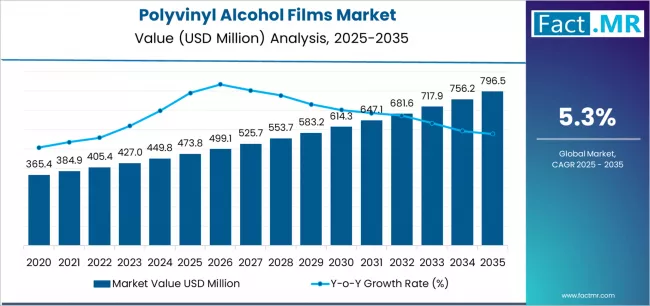
Polyvinyl Alcohol Films Market Market Value Analysis | Source: Fact.MR
Consumer goods manufacturers face mounting pressure to reduce plastic waste while maintaining product safety and convenience, with modern polyvinyl alcohol films providing documented environmental benefits including complete water solubility, biodegradability, and reduced packaging waste compared to conventional plastic films alone.
Rising awareness about environmental sustainability and expanding unit-dose product formats enabling precise dosing and contamination prevention create substantial opportunities for film manufacturers and packaging partners. However, moisture sensitivity concerns and higher production costs may pose obstacles to widespread market penetration.
The detergent packaging segment dominates market activity, driven by extensive adoption of single-dose laundry pods and dishwasher tablets requiring water-soluble film encapsulation across diverse consumer markets worldwide. Brand owners increasingly recognize the convenience benefits of polyvinyl alcohol film packaging, with typical applications providing effective product containment and controlled dissolution at accessible price points through established packaging supply chains.
The agrochemical packaging segment demonstrates robust presence, supported by growing demand for safe pesticide and herbicide handling solutions preventing direct chemical contact during agricultural applications. Consumer detergent applications emerge as the dominant end-use category, reflecting continued emphasis on household cleaning product innovation and unit-dose format popularity among residential consumers.
Regional dynamics show Asia Pacific maintaining market leadership, supported by extensive manufacturing capabilities and established polyvinyl alcohol production infrastructure. North America demonstrates steady growth trajectory driven by sustainability regulations and consumer preference for convenient cleaning products, while Europe emphasizes environmental compliance and biodegradable packaging adoption. India leads country-level growth through rapid detergent market expansion and consumer product adoption, followed by China supported by industrial manufacturing growth and unit-dose packaging development.
The competitive landscape features moderate concentration with Kuraray Co., Ltd. maintaining market leadership position, while established chemical companies including Mitsubishi Chemical Group Corporation, Aicello Corporation, and Sekisui Chemical Co., Ltd. compete through advanced film technologies and comprehensive technical support programs across diverse packaging applications.
Polyvinyl Alcohol Films Market Year-over-Year Forecast 2025 to 2035
Between 2025 and 2029, the polyvinyl alcohol films market is projected to expand from USD 473.8 million to USD 583.1 million, resulting in a value increase of USD 109.3 million, which represents 33.9% of the total forecast growth for the period. This phase of development will be shaped by rising demand for sustainable packaging solutions and unit-dose detergent formats addressing convenience imperatives, product innovation in high-barrier film formulations with enhanced moisture resistance and mechanical strength characteristics, as well as expanding integration with automated packaging equipment and high-speed filling systems. Companies are establishing competitive positions through investment in film extrusion technology partnerships, advanced polymer formulation capabilities, and strategic market expansion across consumer goods manufacturers, agrochemical companies, and industrial packaging applications.
From 2029 to 2035, the market is forecast to grow from USD 583.1 million to USD 796.5 million, adding another USD 213.4 million, which constitutes 66.1% of the overall expansion. This period is expected to be characterized by the expansion of specialized film applications, including pharmaceutical packaging and specialty chemical containment systems tailored for specific dissolution requirements, strategic collaborations between film manufacturers and consumer product companies, and an enhanced focus on circular economy principles and compostability certification standards. The growing emphasis on regulatory compliance for single-use plastics reduction and rising adoption of water-soluble packaging across industrial sectors will drive demand for comprehensive polyvinyl alcohol film solutions across diverse end-user applications.
Polyvinyl Alcohol Films Market Key Takeaways
| Metric | Value |
|---|---|
| Market Value (2025) | USD 473.8 million |
| Market Forecast Value (2035) | USD 796.5 million |
| Forecast CAGR (2025-2035) | 5.3% |
Source: Fact.MR analysis. Updated Dec 8, 2025
Why is the Polyvinyl Alcohol Films Market Growing?
The polyvinyl alcohol films market grows by enabling consumer goods manufacturers to deliver convenient unit-dose packaging solutions and environmental sustainability while addressing plastic waste reduction and product safety requirements without compromising packaging functionality.
Brand owners face mounting pressure to reduce conventional plastic usage and meet regulatory requirements while maintaining product integrity and consumer convenience, with modern polyvinyl alcohol films typically providing targeted performance characteristics including complete water solubility for dissolution in washing machines, biodegradability for environmental safety, and barrier properties for moisture-sensitive product protection compared to conventional packaging alone, making water-soluble film technology essential for comprehensive sustainable packaging strategies.
The packaging industry's need for environmentally responsible materials creates demand for polyvinyl alcohol film solutions that can provide product containment, enhance user safety, and support waste reduction without compromising packaging efficiency or consumer acceptance.
Brand owner adoption and environmental regulations supporting sustainable packaging drive utilization in consumer goods manufacturing, agrochemical production, and industrial chemical sectors, where packaging innovation directly impacts environmental footprint and user safety. The increasing consumer preference for convenient cleaning products globally, with unit-dose formats demonstrating rapid market penetration, creates expanding application opportunities for water-soluble packaging.
Rising awareness about agricultural worker safety and chemical exposure prevention enables informed adoption of soluble agrochemical packaging. Moisture sensitivity limitations and performance challenges in humid environments may restrict application scope and storage requirements among diverse end-user industries with different environmental conditions.
Segmental Analysis
The market is segmented by application, detergent type, and region. By application, the market is divided into detergent packaging, agrochemical packaging, laundry bags, embroidery, and others.
By detergent type, the market is categorized into consumer detergent and industrial detergent. Regionally, the market is divided into Asia Pacific, Europe, North America, Latin America, and Middle East & Africa.
By Application, Which Segment Accounts for the Dominant Market Share?
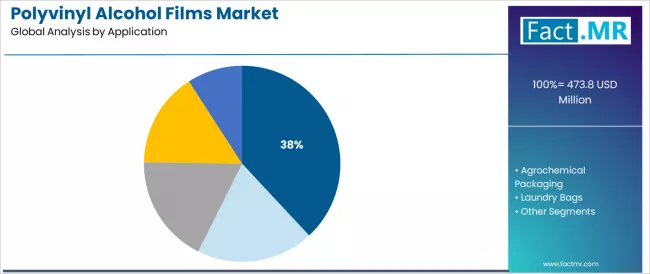
Polyvinyl Alcohol Films Market Analysis By Application | Source: Fact.MR
The detergent packaging segment represents the dominant force in the polyvinyl alcohol films market, capturing 38.06% of total market share in 2025. This established application category encompasses solutions featuring water-soluble encapsulation for laundry pods, dishwasher tablets, and concentrated detergent formulations, including advanced film specifications combining controlled dissolution rates, mechanical strength, and compatibility with liquid and powder detergent chemistries that enable superior consumer convenience and product safety across household and commercial cleaning applications worldwide.
The detergent packaging segment's market leadership stems from its transformative impact on consumer cleaning product formats, with solutions capable of providing precise dosing, preventing product waste, and enhancing user convenience while maintaining excellent dissolution characteristics and product containment across diverse water temperature conditions.
The detergent packaging segment is valued at USD 180.4 million in 2025 and is projected to grow at a CAGR of 5.9% through 2035, driven by continued innovation in laundry pod formats and expanding geographic penetration of unit-dose cleaning products. This segment benefits from established consumer acceptance, brand investment in convenient packaging formats, and retail shelf presentation advantages over traditional bulk detergent packaging.
The agrochemical packaging segment maintains substantial market share at 21.5%, valued at USD 101.8 million in 2025 with a projected CAGR of 5.3%, serving agricultural applications requiring safe pesticide and herbicide handling solutions. These films offer critical worker safety benefits by eliminating direct chemical contact during mixing and application procedures while providing precise dosing capabilities.
Within the application category, laundry bags demonstrate meaningful adoption at 14.0% market share, valued at USD 66.3 million in 2025 with a CAGR of 5.2%, driven by healthcare and hospitality sectors requiring contamination prevention during soiled linen handling. This segment benefits from infection control protocols and labor efficiency improvements in institutional laundry operations.
Key performance advantages driving the detergent packaging segment include:
- Advanced convenience characteristics with pre-measured dosing eliminating measurement requirements and preventing product overuse across consumer applications
- Established dissolution performance allowing reliable film breakdown in cold water conditions without residue formation or washing machine complications
- Enhanced safety features enabling reduced direct detergent contact and preventing accidental ingestion hazards while maintaining packaging integrity during storage
- Superior product protection providing moisture barrier properties for concentrated detergent formulations across various humidity conditions and distribution channels
By Detergent Type, Which Segment Accounts for the Largest Market Share?
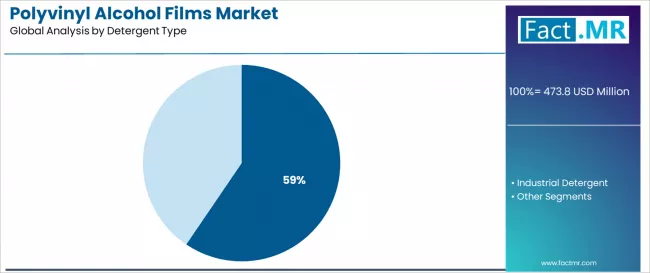
Polyvinyl Alcohol Films Market Analysis By Detergent Type | Source: Fact.MR
Consumer detergent applications dominate the polyvinyl alcohol films detergent type landscape with approximately 59.48% market share in 2025, reflecting the critical role of household cleaning products in driving water-soluble packaging adoption across residential consumer segments worldwide. The consumer detergent segment's market leadership is reinforced by strong brand marketing, retail distribution advantages, and consumer preference for convenient pre-measured cleaning products.
The consumer detergent segment is valued at USD 281.7 million in 2025 and is projected to grow at a CAGR of 6.2% through 2035, demonstrating the strongest growth rate among detergent type categories. This segment benefits from continuous product innovation, expanding geographic market penetration, and premiumization trends in household cleaning products.
Within this segment, laundry detergent pods represent the dominant application format, driven by convenient single-dose packaging and concentrated formulation benefits. Dishwasher tablets maintain significant presence through automatic dishwashing market growth and consumer adoption of convenient cleaning formats.
The industrial detergent segment represents an important category with 40.5% market share, valued at USD 192.1 million in 2025 with a projected CAGR of 5.4%. This segment serves commercial and institutional cleaning applications including hospitality, healthcare, and food service sectors requiring bulk cleaning chemical delivery through water-soluble packaging systems.
Key market dynamics supporting detergent type segmentation include:
- Consumer detergent expansion driven by household penetration growth and premiumization of cleaning product categories
- Industrial detergent adoption trends require large-format packaging solutions and automated dispensing system compatibility
- Integration of concentrated formulations enabling reduced packaging volume and improved sustainability profiles
- Growing emphasis on safety features and child-resistant packaging designs supporting regulatory compliance
By Application, What Drives Agrochemical Packaging Adoption?
Agrochemical packaging emerges as a significant application segment in the polyvinyl alcohol films market with approximately 21.5% market share in 2025, valued at USD 101.8 million in 2025 with a projected CAGR of 5.3%, reflecting the fundamental importance of worker safety and environmental protection in agricultural chemical handling. The agrochemical packaging segment demonstrates consistent demand driven by regulatory requirements for safer pesticide packaging and farmer preference for convenient, contamination-free chemical application.
The segment's market strength stems from critical safety advantages eliminating direct contact with concentrated pesticides, herbicides, and fungicides during mixing and field application operations. Water-soluble agrochemical packaging prevents empty container disposal challenges while ensuring accurate chemical dosing and reducing environmental contamination risks.
Within agrochemical applications, pesticide packaging demonstrates primary adoption, driven by extensive crop protection chemical usage and regulatory emphasis on applicator safety. Herbicide and fungicide packaging maintain meaningful presence through specialized agricultural applications requiring precise active ingredient delivery.
Key segment characteristics include:
- Worker safety enhancement accelerating adoption across commercial farming operations with emphasis on reducing chemical exposure incidents
- Environmental protection benefits addressing empty container disposal challenges and reducing packaging waste in agricultural settings
- Dosing accuracy requirements driving adoption of pre-measured packaging formats for consistent application rates
- Integration with precision agriculture practices enabling optimized chemical usage and improved crop management efficiency
By Detergent Type, What Characterizes Industrial Detergent Applications?
Industrial detergent represents an important segment in the polyvinyl alcohol films market with approximately 40.5% market share in 2025, valued at USD 192.1 million in 2025 with a projected CAGR of 5.4%, reflecting specialized packaging requirements for commercial and institutional cleaning operations requiring bulk chemical delivery and automated dispensing compatibility. The industrial detergent segment demonstrates steady demand driven by hospitality sector growth, healthcare facility expansion, and food service industry cleaning protocol requirements.
Within industrial applications, hospitality laundry systems demonstrate significant adoption through requirements for efficient linen processing and automated detergent dispensing. Healthcare facility cleaning applications maintain substantial presence driven by infection control protocols and specialized cleaning chemical requirements.
The segment benefits from operational efficiency improvements through reduced handling time, elimination of chemical spillage, and simplified inventory management. Large-format water-soluble packaging enables bulk chemical delivery while maintaining safety advantages and precise dosing capabilities.
Key application dynamics include:
- Commercial laundry operations leading adoption with emphasis on automation compatibility and labor efficiency
- Healthcare facility requirements addressing infection control and staff safety during cleaning operations
- Food service applications prioritizing food safety compliance and sanitization effectiveness
- Technology integration supporting automated dispensing systems and chemical usage tracking
What are the Drivers, Restraints, and Key Trends of the Polyvinyl Alcohol Films Market?
The market is driven by three concrete demand factors tied to sustainability and convenience. First, increasing regulatory pressure for single-use plastic reduction creates expanding demand for biodegradable packaging alternatives, with polyvinyl alcohol films representing critical solutions in comprehensive plastic waste reduction strategies, requiring widespread adoption across consumer goods sectors. Second, growing consumer preference for convenient unit-dose cleaning products drives packaging innovation, with laundry pods and dishwasher tablets demonstrating rapid market penetration and retailer support through premium positioning and shelf space allocation by 2030. Third, advancing film manufacturing technologies and formulation optimization enable enhanced performance characteristics that improve moisture resistance while maintaining dissolution properties and mechanical strength during packaging operations.
Market restraints include moisture sensitivity limitations and storage requirements that can challenge supply chain management and shelf life stability, particularly in humid climates where film degradation and premature dissolution present packaging integrity concerns. Higher production costs compared to conventional plastic films pose another significant obstacle, as polyvinyl alcohol film manufacturing depends on specialized raw materials and processing equipment, potentially affecting price competitiveness and adoption rates among cost-sensitive applications. Performance limitations in cold water dissolution and variable water hardness conditions create additional barriers for consistent product functionality, demanding extensive formulation optimization and consumer education initiatives addressing proper usage instructions.
Key trends indicate accelerated sustainability certification adoption in developed markets, particularly North America and Europe, where brands demonstrate increasing commitment to compostability validation, biodegradability testing, and circular economy principles. Technological advancement trends toward high-barrier film structures and multilayer constructions enable enhanced moisture protection systems that extend shelf life and expand application scope beyond traditional water-soluble packaging categories. However, the market thesis could face disruption if significant advances in alternative biodegradable polymer technologies or major cost reductions in bio-based plastic films substantially alter competitive dynamics and material selection criteria in sustainable packaging markets.
Analysis of the Polyvinyl Alcohol Films Market by Key Countries
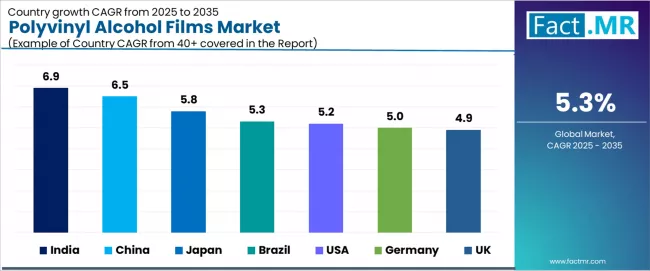
Polyvinyl Alcohol Films Market Cagr Analysis By Country | Source: Fact.MR
| Country | CAGR (2025-2035) |
|---|---|
| India | 6.9% |
| China | 6.5% |
| Japan | 5.8% |
| Brazil | 5.3% |
| USA | 5.2% |
| Germany | 5.0% |
| UK | 4.9% |
Source: Fact.MR analysis. Updated Dec 8, 2025
The global polyvinyl alcohol films market is expanding steadily, with India leading at a 6.9% CAGR through 2035, driven by rapid detergent market growth, increasing consumer product adoption, and expanding unit-dose packaging penetration. China follows at 6.5%, supported by industrial manufacturing expansion, growing unit-dose product development, and domestic polyvinyl alcohol production capabilities.
Japan records 5.8%, reflecting high-quality industrial film demand, specialty application development, and advanced packaging technology adoption. Brazil advances at 5.3%, leveraging growing industrial cleaning sectors and expanding agrochemical packaging requirements.
USA posts 5.2%, focusing on regulatory support for soluble packaging and mature market optimization, while Germany grows steadily at 5.0%, anchored by environmental compliance standards and industrial application expansion. UK demonstrates 4.9% growth, driven by sustainable packaging initiatives and recyclable film development.
How is India Leading Global Market Expansion?
India demonstrates the strongest growth potential in the polyvinyl alcohol films market with a CAGR of 6.9% through 2035. The country's leadership position stems from rapidly expanding detergent market, increasing urbanization driving consumer product adoption, and growing middle-class purchasing power supporting premium cleaning product formats.
Growth is concentrated in major metropolitan areas and tier-1 cities, including Mumbai, Delhi, Bangalore, Chennai, and Hyderabad, where consumers are increasingly adopting unit-dose laundry pods and convenient cleaning formats.
Distribution channels through modern retail chains, e-commerce platforms, and traditional distribution networks expand product accessibility across urban consumer segments. The country's developing polyvinyl alcohol film manufacturing capabilities provide momentum for domestic production expansion, including comprehensive adoption across consumer goods companies seeking sustainable packaging solutions.
Key market factors:
- Urban consumer adoption concentrated in metropolitan areas with rising disposable incomes and modern retail access
- Detergent market transformation through unit-dose format introduction and brand innovation initiatives
- Manufacturing infrastructure development featuring domestic film production capacity and converting operations
- Government sustainability initiatives supporting biodegradable packaging adoption and plastic waste reduction targets
Why is China Emerging as a High-Growth Market?
In major manufacturing centers including Shanghai, Guangzhou, Shenzhen, and Tianjin, the adoption of polyvinyl alcohol film technologies is accelerating across consumer goods production and industrial packaging applications, driven by sustainability mandates and quality improvement imperatives. The market demonstrates strong growth momentum with a CAGR of 6.5% through 2035, linked to comprehensive industrial manufacturing expansion and increasing emphasis on value-added packaging solutions.
Chinese manufacturers are implementing water-soluble packaging technologies in detergent production, agrochemical formulation, and industrial chemical distribution to enhance product differentiation while meeting environmental standards. The country's established polyvinyl alcohol production infrastructure creates ongoing opportunities for vertical integration, while increasing domestic consumption of premium cleaning products drives unit-dose packaging adoption.
Key development areas:
- Industrial manufacturing expansion leading polyvinyl alcohol film consumption with emphasis on export market supply
- Domestic consumer market development through unit-dose cleaning product introduction and brand positioning
- Technology advancement enabling high-speed film production and automated packaging system integration
- Raw material availability through established polyvinyl alcohol manufacturing providing cost advantages
What drives Market Maturity in USA?
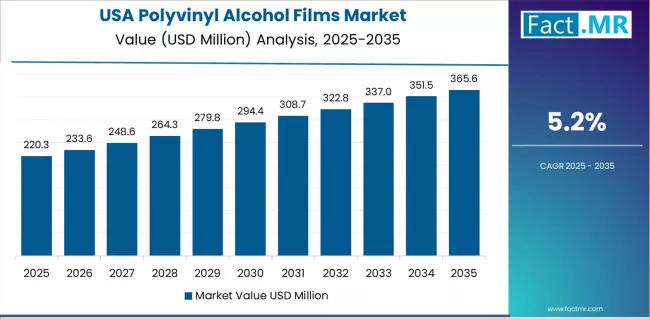
Polyvinyl Alcohol Films Market Country Value Analysis | Source: Fact.MR
USA’s market expansion is driven by established unit-dose cleaning product penetration, sustainability regulations supporting biodegradable packaging, and continuous innovation in film performance characteristics. The country demonstrates steady growth potential with a CAGR of 5.2% through 2035, supported by mature consumer acceptance of laundry pods and dishwasher tablets across household cleaning categories.
American consumer goods manufacturers face optimization opportunities related to film cost reduction, moisture resistance enhancement, and supply chain efficiency improvement. However, established market infrastructure and regulatory framework supporting water-soluble packaging create stable baseline demand for polyvinyl alcohol films, particularly among leading detergent brands where unit-dose formats represent significant product category revenue.
Market characteristics:
- Mature unit-dose penetration with established consumer acceptance and retail distribution dominance
- Brand competition driving continuous product innovation and packaging format differentiation
- Future projections indicate steady growth with emphasis on specialty applications and industrial cleaning expansion
- Growing emphasis on compostability certification and circular economy principles supporting sustainability positioning
How does Japan Demonstrate Quality Focus?
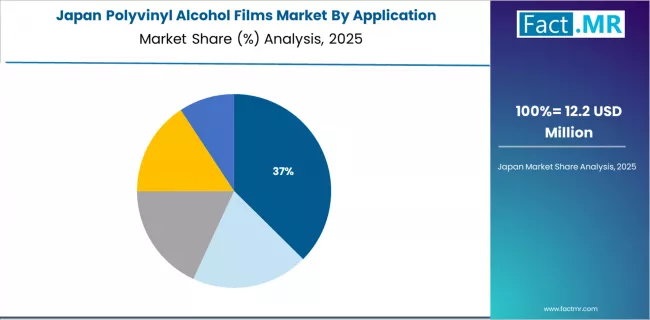
Polyvinyl Alcohol Films Market Japan Market Share Analysis By Application | Source: Fact.MR
The Japan market leads in high-quality film production based on advanced manufacturing technologies and stringent quality control standards for specialty applications. The country shows strong potential with a CAGR of 5.8% through 2035, driven by industrial film demand and specialty packaging requirements in major regions.
Japanese film manufacturers are producing premium polyvinyl alcohol films through precision extrusion processes and comprehensive quality assurance protocols for demanding applications, particularly in pharmaceutical packaging concepts and specialty chemical containment where performance requirements exceed standard detergent packaging specifications. Manufacturing infrastructure through established chemical companies and specialized film converters expands production capabilities across technical applications.
Leading market segments:
- High-quality film production in major manufacturing regions implementing advanced processing technologies
- Specialty application development achieving premium positioning through performance differentiation
- Technology innovation supporting next-generation film formulations and enhanced barrier properties
- Export market focus leveraging quality reputation and technical expertise across Asian markets
What positions Germany for Environmental Leadership?
In major industrial regions including North Rhine-Westphalia, Bavaria, and Baden-Württemberg, manufacturers are implementing polyvinyl alcohol films through comprehensive environmental compliance frameworks and industrial application development. The market shows steady growth potential with a CAGR of 5.0% through 2035, linked to stringent environmental regulations and corporate sustainability commitments driving biodegradable packaging adoption.
German companies are integrating water-soluble films in industrial detergent systems, agrochemical packaging, and specialty applications to achieve waste reduction targets while maintaining operational efficiency. The country's established chemical industry infrastructure creates ongoing opportunities for film technology innovation and application development.
Market development factors:
- Environmental compliance emphasis driving biodegradable packaging adoption across industrial sectors
- Industrial application expansion in commercial cleaning and agrochemical segments
- Technology development partnerships between film manufacturers and end-user companies
- Regulatory framework supporting circular economy principles and sustainable packaging standards
How Does UK Show Sustainable Packaging Focus?
In England, Scotland, Wales, and Northern Ireland, consumer goods companies are adopting polyvinyl alcohol films through sustainability initiatives and waste reduction commitments. The market shows steady growth potential with a CAGR of 4.9% through 2035, linked to regulatory pressure for plastic reduction and retail sector sustainability programs. The brands are implementing unit-dose packaging formats and water-soluble films to achieve environmental targets while maintaining product convenience and consumer appeal. The country's retail concentration and brand sustainability commitments create ongoing opportunities for film adoption across consumer cleaning products.
Market characteristics:
- Retail sustainability programs driving brand adoption of biodegradable packaging solutions
- Consumer awareness supporting acceptance of unit-dose formats and premium cleaning products
- Regulatory initiatives including plastic packaging taxes influencing material selection decisions
- Brand innovation emphasis supporting differentiated product positioning through sustainable packaging
What Characterizes Brazil's Market Development?
In major industrial centers including São Paulo, Rio de Janeiro, and Minas Gerais, the adoption of polyvinyl alcohol films is expanding across cleaning product manufacturing and agrochemical packaging applications, driven by industrial sector growth and agricultural modernization. The market demonstrates meaningful growth potential with a CAGR of 5.3% through 2035, linked to urbanization patterns and increasing industrial cleaning requirements.
Brazilian manufacturers are implementing water-soluble packaging technologies in commercial detergent production and agricultural chemical formulation to enhance worker safety and operational efficiency. The country's agricultural sector significance creates ongoing demand for agrochemical packaging solutions, while expanding industrial cleaning markets drive commercial detergent film adoption.
Key development areas:
- Industrial cleaning sector expansion supporting commercial detergent packaging demand
- Agrochemical packaging adoption addressing worker safety and environmental protection
- Urban market development through consumer cleaning product innovation
- Manufacturing infrastructure establishment supporting domestic film production capabilities
Europe Market Split by Country
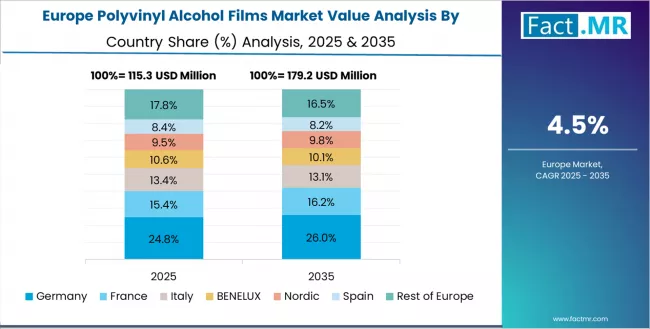
Polyvinyl Alcohol Films Market Europe Country Market Share Analysis, 2025 & 2035 | Source: Fact.MR
The polyvinyl alcohol films market in Europe is projected to grow from USD 118.4 million in 2025 to USD 198.6 million by 2035, registering a CAGR of 5.3% over the forecast period. Germany is expected to maintain its leadership position with a 28.9% market share in 2025, adjusting to 28.6% by 2035, supported by its extensive industrial manufacturing base, comprehensive environmental regulations, and established chemical industry infrastructure serving major European markets.
UK follows with a 21.7% share in 2025, projected to reach 21.4% by 2035, driven by retail sustainability initiatives and consumer goods innovation programs. France holds a 18.3% share in 2025, expected to maintain 18.6% by 2035 through ongoing development of agricultural applications and industrial cleaning sectors. Italy commands a 14.8% share, while Spain accounts for 10.6% in 2025.
The rest of Europe region is anticipated to gain momentum, expanding its collective share from 5.7% to 6.2% by 2035, attributed to increasing sustainable packaging adoption in Nordic countries and emerging market development in Eastern European countries implementing environmental standards.
Competitive Landscape of the Polyvinyl Alcohol Films Market
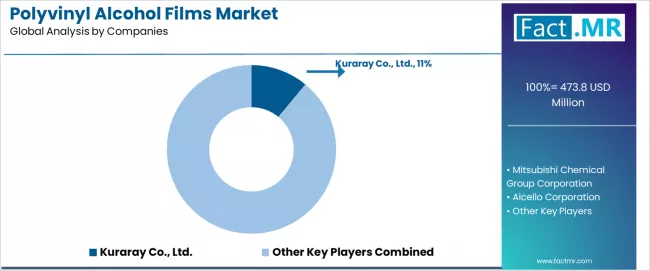
Polyvinyl Alcohol Films Market Analysis By Company | Source: Fact.MR
The polyvinyl alcohol films market features approximately 12-15 meaningful players with moderate concentration, where the top three companies control roughly 30-40% of global market share through established manufacturing capabilities, comprehensive technical expertise, and extensive customer relationships across consumer goods and industrial sectors. Competition centers on film performance optimization, application development support, and manufacturing efficiency rather than price competition alone.
Market leaders include Kuraray Co., Ltd., Mitsubishi Chemical Group Corporation, and Aicello Corporation, which maintain competitive advantages through comprehensive polyvinyl alcohol film portfolios, advanced polymer chemistry capabilities, and deep expertise in water-soluble film technology, creating high customer confidence among brand owners seeking reliable packaging solutions.
These companies leverage ongoing research and development investments and strategic partnerships with consumer goods manufacturers to defend market positions while expanding into specialty applications and emerging geographic markets.
Challengers encompass established chemical companies including Sekisui Chemical Co., Ltd., Nippon Synthetic Chemical Industry Co., Ltd., and MonoSol LLC, which compete through specialized film formulations and regional manufacturing strengths serving specific application segments through high-barrier films, cold-water soluble variants, or customized dissolution profiles.
Regional manufacturers, including Chang Chun Group, Jiangmen Proudly Water-Soluble Plastic Co., Ltd., and Foshan Polyva Materials Co., Ltd., focus on cost-competitive production and local market service, offering differentiated capabilities in rapid response, flexible order quantities, and application technical support.
Emerging technology providers and specialty converters create competitive pressure through innovative film structures and novel application development, particularly in high-growth markets including India and China, where expanding consumer goods manufacturing provides opportunities for local supply chain integration and customized film solutions.
Market dynamics favor companies that combine proven film performance with comprehensive technical support addressing the complete value chain from formulation development through high-speed packaging operations. Strategic emphasis on sustainability certification, moisture resistance enhancement, and application-specific customization enables differentiation in increasingly sophisticated water-soluble packaging markets across developed and emerging regions.
Global Polyvinyl Alcohol Films Market - Stakeholder Contribution Framework
Polyvinyl alcohol films represent a critical sustainable packaging technology that enables consumer goods manufacturers to deliver convenient unit-dose formats and environmental responsibility while addressing plastic waste reduction and product safety requirements without compromising packaging functionality, typically providing water-soluble characteristics including complete dissolution in aqueous environments, biodegradability for environmental safety, and barrier properties for product protection compared to conventional plastic films alone while ensuring improved sustainability outcomes and comprehensive packaging performance.
With the market projected to grow from USD 473.8 million in 2025 to USD 796.5 million by 2035 at a 5.3% CAGR, these solutions offer compelling advantages for detergent packaging applications, agrochemical safety, and diverse end-user industries seeking biodegradable packaging alternatives. Scaling market adoption and application expansion requires coordinated action across environmental policy, packaging standards, film manufacturers, brand owners, and sustainability framework development.
How Could Governments Spur Local Development and Adoption?
- Sustainable Packaging Policy: Include water-soluble films in national plastic reduction strategies, providing targeted support for biodegradable packaging adoption and supporting research institutions through technology development grants and validation funding.
- Regulatory Framework Development: Implement favorable classification for water-soluble packaging in extended producer responsibility schemes, provide clear standards for biodegradability certification, and establish harmonized testing protocols facilitating market access.
- Manufacturing Infrastructure Support: Create investment incentives for polyvinyl alcohol film production facilities, provide tax benefits for sustainable packaging technology adoption, and establish quality assurance infrastructure supporting domestic manufacturing development.
- Agricultural Safety Programs: Fund agrochemical packaging safety initiatives, support farmer education on water-soluble packaging benefits, and integrate safe handling protocols in agricultural extension services.
- Circular Economy Integration: Establish composting infrastructure compatible with polyvinyl alcohol materials, support research on biodegradation pathways, and create validation frameworks for environmental claims.
How Could Industry Bodies Support Market Development?
- Technical Standards & Performance: Define standardized dissolution testing protocols across temperature ranges and water hardness conditions, establish universal quality metrics for film barrier properties, and create performance databases supporting application development.
- Market Education & Best Practices: Lead messaging demonstrating polyvinyl alcohol film benefits, emphasizing environmental advantages, safety improvements, and convenience factors compared to conventional packaging approaches.
- Sustainability Guidelines: Develop standards for biodegradability validation, compostability certification, and environmental impact assessment, ensuring credible sustainability claims across production and disposal operations.
- Application Development: Run technical workshops on packaging equipment integration, film handling optimization, and storage requirement management in diverse manufacturing environments.
How Could Manufacturers and Technology Players Strengthen the Ecosystem?
- Advanced Film Development: Develop next-generation polyvinyl alcohol formulations with enhanced moisture resistance, improved mechanical strength, and optimized dissolution characteristics that expand application scope while maintaining environmental benefits.
- Technical Support Excellence: Provide comprehensive packaging equipment compatibility testing, storage condition guidance, and troubleshooting assistance that help brand owners successfully implement water-soluble packaging.
- Application Innovation: Offer customized film development services, specialized coating technologies, and performance optimization capabilities that address specific customer requirements and enable new application development.
- Sustainability Validation: Build comprehensive testing capabilities, biodegradability certification programs, and environmental documentation systems that ensure credible sustainability positioning.
How Could Brand Owners and End Users Navigate the Market?
- Strategic Packaging Integration: Incorporate validated polyvinyl alcohol films into product development programs, with particular focus on unit-dose formats, agricultural chemicals, and industrial applications requiring safety enhancement.
- Supply Chain Optimization: Establish robust moisture control protocols, appropriate storage conditions, and quality verification procedures that ensure consistent film performance throughout distribution.
- Consumer Education: Implement comprehensive communication strategies addressing proper product usage, environmental benefits, and safety advantages through optimized packaging information and marketing programs.
- Performance Monitoring: Develop systematic quality tracking, consumer feedback collection, and continuous improvement processes that ensure sustained packaging performance and customer satisfaction.
How Could Investors and Financial Enablers Unlock Value?
- Manufacturing Capacity Financing: Provide growth capital for established film manufacturers expanding production facilities in high-growth regions including India and China, supporting capacity additions that address increasing market demand.
- Technology Innovation Investment: Back companies developing breakthrough film formulations, advanced barrier technologies, and novel application systems that enhance water-soluble packaging performance and market adoption.
- Application Development Funding: Finance partnerships between film manufacturers and brand owners establishing new application categories and market segments beyond traditional detergent packaging.
- Sustainability Infrastructure Support: Support composting facility development, biodegradation research programs, and circular economy initiatives that enhance polyvinyl alcohol film environmental credentials and market acceptance.
Key Players in the Polyvinyl Alcohol Films Market
- Kuraray Co., Ltd.
- Mitsubishi Chemical Group Corporation
- Aicello Corporation
- Sekisui Chemical Co., Ltd.
- Nippon Synthetic Chemical Industry Co., Ltd.
- MonoSol LLC
- Chang Chun Group
- Jiangmen Proudly Water-Soluble Plastic Co., Ltd.
- Foshan Polyva Materials Co., Ltd.
Segmentation
Scope of the Report
| Items | Values |
|---|---|
| Quantitative Units | USD 473.8 Million |
| Application | Detergent Packaging, Agrochemical Packaging, Laundry Bags, Embroidery, Others |
| Detergent Type | Consumer Detergent, Industrial Detergent |
| Regions Covered | Asia Pacific, Europe, North America, Latin America, Middle East & Africa |
| Country Covered | India, China, Japan, Brazil, USA, Germany, UK, and 40+ countries |
| Key Companies Profiled | Kuraray Co., Ltd., Mitsubishi Chemical Group Corporation, Aicello Corporation, Sekisui Chemical Co., Ltd., Nippon Synthetic Chemical Industry Co., Ltd., MonoSol LLC, Chang Chun Group, Jiangmen Proudly Water-Soluble Plastic Co., Ltd., Foshan Polyva Materials Co., Ltd. |
| Additional Attributes | Dollar sales by application and detergent type categories, regional adoption trends across Asia Pacific, Europe, and North America, competitive landscape with film manufacturers and specialty chemical companies, film specification requirements and dissolution performance standards, integration with packaging equipment and high-speed filling systems, innovations in moisture barrier technologies and multilayer film structures, and development of specialized applications with biodegradability certification and environmental compliance capabilities. |
Source: Fact.MR analysis. Updated Dec 8, 2025
Polyvinyl Alcohol Films Market by Segments
-
Application :
- Detergent Packaging
- Agrochemical Packaging
- Laundry Bags
- Embroidery
- Others
-
Detergent Type :
- Consumer Detergent
- Industrial Detergent
-
Region :
- Asia Pacific
- China
- Japan
- South Korea
- India
- Australia
- Thailand
- Rest of Asia Pacific
- Europe
- Germany
- UK
- France
- Italy
- Spain
- Denmark
- Sweden
- Norway
- Rest of Europe
- North America
- USA
- Canada
- Mexico
- Latin America
- Brazil
- Argentina
- Rest of Latin America
- Middle East & Africa
- South Africa
- Saudi Arabia
- UAE
- Kuwait
- Rest of Middle East & Africa
- Asia Pacific
Frequently Asked Questions
How big is the polyvinyl alcohol films market in 2025?
What will be the size of polyvinyl alcohol films market in 2035?
How much will be the polyvinyl alcohol films market growth between 2025 and 2035?
What are the key product types in the polyvinyl alcohol films market?
Which detergent type segment to contribute significant share in the polyvinyl alcohol films market in 2025?
Who worked on this report


Preview the report firsthand - request a free sample
Free SampleGet the brochure for pricing and purchase details
Download PDF