- Base Value(2025): 4.4 Bn
- Estimated Value(2026): 4.7 Bn
- Forecast Value (2036): 8.7 Bn
- CAGR (2026 - 2036): 6.4%
What is the polyvinyl butyral market forecast to be worth by 2036?
- The Polyvinyl Butyral Market is expected to grow from USD 4.7 billion in 2026 to USD 8.7 billion by 2036, at a 6.4% CAGR.
- Driven by expanding automotive laminated glass production for safety compliance and acoustic comfort, growing architectural safety glass demand for building facades and interior glazing, and rising solar photovoltaic module encapsulation using PVB film .
- PVB serves as a moisture barrier and optical coupling agent, with PVB film accounting for 48.3% share and automotive applications contributing 44.1% share as OEMs and glass laminators prioritize safety, acoustic performance, and UV protection.
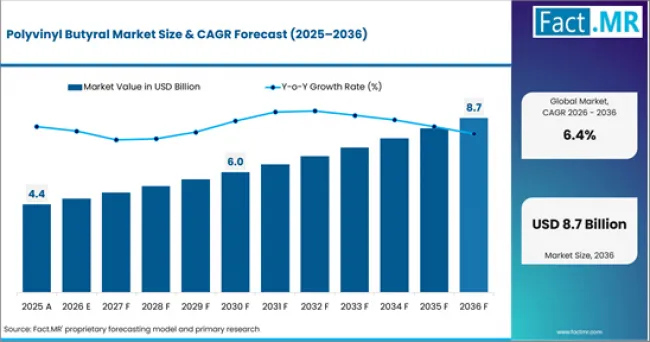
Polyvinyl Butyral Market Value Analysis | Source: Fact.MR
Summary of Polyvinyl Butyral Market
- Market Snapshot
- In 2025, the global Polyvinyl Butyral Market was valued at approximately USD 4.4 billion.
- The market is estimated to reach USD 4.7 billion in 2026 and is projected to attain USD 8.7 billion by 2036.
- The market is likely to expand at a CAGR of 6.4% during the forecast period.
- The market is anticipated to create an absolute dollar opportunity of USD 4.0 billion between 2026 and 2036.
- Polyvinyl butyral film accounts for 48.3% of the product segment share in 2026.
- China (7.8%) and India (7.4%) are the key growth markets during the forecast period.
- Demand and Growth Drivers
- Automotive windshield laminated safety glass production uses PVB interlayer film as the primary adhesive and energy-absorbing layer, with every vehicle produced requiring one windshield containing approximately 0.76mm PVB interlayer film.
- Architectural laminated safety glass demand for building facades, balustrades, overhead glazing, and hurricane-resistant windows is growing as building safety codes expand laminated glass specification requirements.
- Solar PV module encapsulation uses PVB film as an alternative to EVA (ethylene vinyl acetate) in thin-film and building-integrated photovoltaic applications where optical clarity and moisture resistance are critical performance parameters.
- Acoustic PVB interlayer development provides enhanced sound insulation in automotive and architectural glass, with acoustic PVB commanding pricing premiums of 30 to 50% above standard interlayer film.
- Head-up display (HUD) windshield applications require wedge-profile PVB interlayers with precise thickness gradients that project instrument data onto the windshield without double imaging, creating a high-value automotive PVB sub-category.
- Geography and Competitive Outlook
- China at 7.8% reflects strong market fundamentals and expanding demand.
- India at 7.4% reflects strong market fundamentals and expanding demand.
- South Korea at 6.9% reflects strong market fundamentals and expanding demand.
- Key players include Kuraray Co. Ltd., Eastman Chemical Company, Sekisui Chemical Co. Ltd., Chang Chun Group, Hubergroup, Kingboard Chemical Holdings.
- Analyst Opinion
- Shambhu Nath Jha, Principal Consultant at Fact.MR, says 'The polyvinyl butyral market is structurally linked to automotive and architectural glass production, with windshield manufacturing consuming the largest share of global PVB output. Kuraray and Eastman Chemical control approximately 70% of global PVB production capacity, creating a concentrated supply structure with stable pricing dynamics. Growth is driven by vehicle production expansion, building safety code tightening, and solar PV module production scaling. China represents the fastest growth because it houses the world's largest automotive production, construction, and solar PV manufacturing bases. Acoustic and HUD-grade PVB represent the fastest-growing sub-categories by value, commanding significant pricing premiums above standard interlayer film.'
What is accelerating polyvinyl butyral adoption, and what is holding it back?
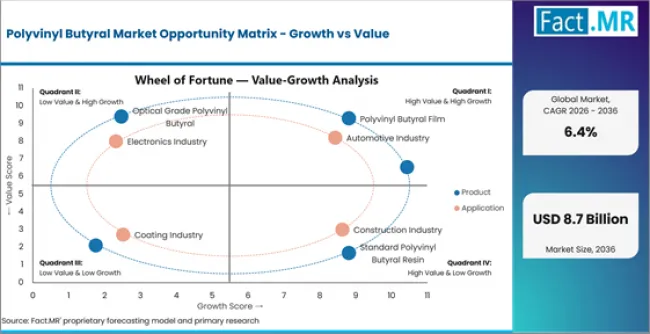
Polyvinyl Butyral Market Opportunity Matrix Growth Vs Value | Source: Fact.MR
Key Factors Driving Growth
- Structural trends in industrial consumption are fueling primary demand expansion, and this is leading to continued demand for procurement.
- Product capability and application scope expansion across end-use segments through technology advancement
- Regulatory frameworks that drive compliance-based demand and mandate quality specifications.
Key Market Constraints
- Supply concentration or feedstock cost volatility creates the procurement risk for downstream consumers.
- Manufacturers competing in multiple jurisdictions face increased operating cost due to regulatory compliance complexity.
- In commodity segments, competitive pressure from alternative materials or processes limits pricing power.
Key Opportunity Areas
- Price premiums for specialty and high-performance grades are margin-differentiating.
- Industrial expansion in emerging markets means there’s big untapped demand as manufacturing capacity builds.
- Product differentiation is driven by clean-label and sustainability requirements.
How does the polyvinyl butyral market break down by segment?
- Polyvinyl butyral film holds 48.3% of the product segment in 2026.
The polyvinyl butyral market has been segmented based on product type, application, end use, technology, formulation, distribution channel and region.
Which Product Segment Dominates the Polyvinyl Butyral Market?
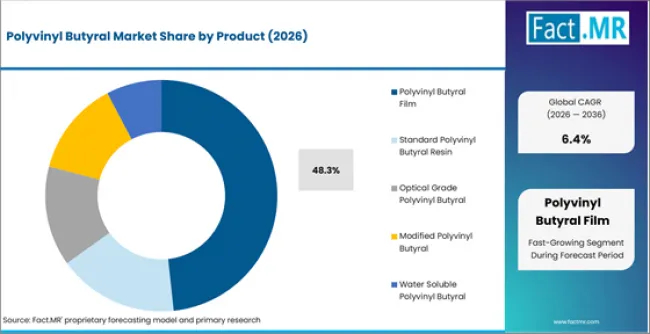
Polyvinyl Butyral Market Analysis By Product | Source: Fact.MR
Polyvinyl Butyral Film Product Segment to Cover 48.3% in 2026. Leadership is based on established patterns of industrial consumption, wide compatibility with applications and compliance with the main requirements of the end-use.
Complementary product categories meet certain requirements. The major segment is expected to continue to dominate through 2036.
Which Application Segment Dominates the Polyvinyl Butyral Market?
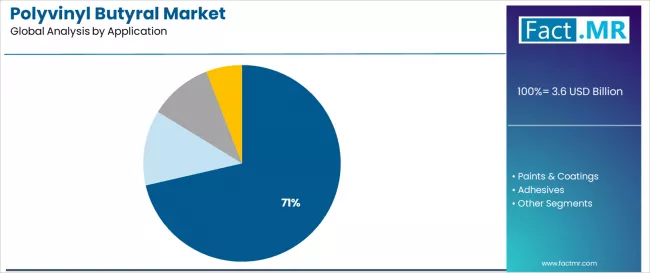
Polyvinyl Butyral Market Analysis By Application | Source: Fact.MR
The leading application is based on structural consumption of primary industrial end-use categories supported by trends in production volume and regulatory specifications.
Secondary applications are driving rising demand from an expanding portfolio of use cases. The leading application still has the main demand position.
What single trend will determine the polyvinyl butyral market’s pace?
The development of head-up display (HUD) windshield PVB interlayers with precision wedge-profile thickness gradients is the highest-value product development in the market. The standard windshield PVB is uniform and 0.76mm thick. For PVB compatible with HUDs, the interlayer has to be precisely controlled in its gradient of thickness to compensate for the curvature of the windshield and project the data of the instruments without double imaging. Each HUD windshield interlayer must be custom engineered to fit the particular windshield geometry of the vehicle model.
Commercially, HUD-grade PVB interlayers cost 3x to 5x the price per square meter of normal windshield PVB, and this is reflective of the precision required in manufacturing and the engineering that has to be done for each vehicle. As automotive HUD adoption extends from luxury vehicles into mid-range segments, the addressable market for premium wedge-profile PVB grows. Kuraray and Eastman are competing for HUD PVB specifications using proprietary manufacturing processes that provide the thickness control required for distortion-free projection over complex windshield geometries.
Which countries are scaling polyvinyl butyral demand fastest?
- China at 7.8% reflects expanding demand driven by regional fundamentals.
- India at 7.4% reflects expanding demand driven by regional fundamentals.
- South Korea at 6.9% reflects expanding demand driven by regional fundamentals.
- Germany at 6.5% reflects expanding demand driven by regional fundamentals.
.webp "Top Country Growth Comparison Polyvinyl Butyral Market Cagr (2026 2036)")
Top Country Growth Comparison Polyvinyl Butyral Market Cagr (2026 2036) | Source: Fact.MR
| Country | CAGR (%) |
|---|---|
| China | 7.8% |
| India | 7.4% |
| South Korea | 6.9% |
| Germany | 6.5% |
| USA | 6.1% |
Source: Fact.MR analysis. Updated Jun 13, 2026
Source: Fact.MR analysis, based on proprietary forecasting model and primary research.
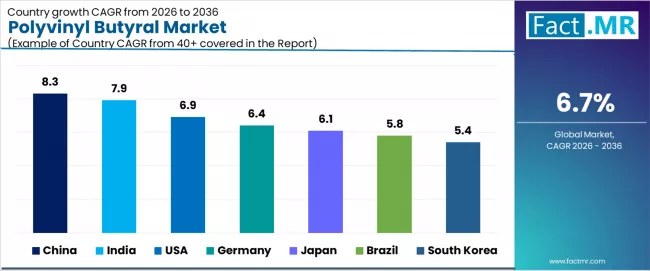
Polyvinyl Butyral Market Cagr Analysis By Country | Source: Fact.MR
Polyvinyl Butyral Market Growth Assessment in China
The China polyvinyl butyral market is projected to grow at a CAGR of 7.8% through 2036, reflecting demand factors shaping demand across primary application categories. Regional regulatory frameworks and end-use consumption patterns dictate product specification and procurement requirements.
- In China, structural industrial growth and application diversification are propelling the growth of primary demand channels.
- The relative balance of local production capacity and imported supply of specialty grade drives regional competition dynamics.
Polyvinyl Butyral Market Demand Trends in India
Demand Shaping across Primary Application Categories of India Polyvinyl Butyral Market The India polyvinyl butyral market is likely to register a CAGR of 7.4% through 2036. Product specification and procurement requirements are determined by regional regulatory frameworks and end-use consumption patterns.
- Structural industrial growth and application diversification are widening the primary demand channels in India.
- The competitive situation in regions is the balance of domestic production capacity and imported specialty grade supply.
Polyvinyl Butyral Market Analysis in South Korea
Drivers such as infrastructure factors driving demand across key application segments are expected to drive a 6.9% CAGR for South Korea polyvinyl butyral market through 2036. Product specifications and procurement requirements are influenced by regional regulatory frameworks and end-use consumption patterns.
- South Korea’s primary demand channels are expanding driven by structural growth in industry and diversification of applications.
- Regional competitive dynamics are a function of the balance between domestic production capacity and imported specialty grade supply.
Polyvinyl Butyral Market Analysis in Germany
Germany Polyvinyl Butyral Market to register a CAGR of 6.5% through 2036 on account of regulation factors affecting demand across major application segments. "Product specification and procurement are driven by regional regulatory frameworks and end-use consumption patterns.
- In Germany, broadening primary demand channels through structural industrial growth and diversification of applications.
- Regional competitive dynamics are a reflection of the balance between domestic production capacity and imported specialty grade supply.
Polyvinyl Butyral Market Outlook in USA
The polyvinyl butyral market in the USA is projected to grow at a CAGR of 6.1% through 2036, reflecting maturity factors influencing demand in the major application segments. Product specification and procurement requirements are influenced by regional regulatory frameworks and end-use consumption patterns.
- The main demand comes from structural industrial expansion and a wider range of applications in the USA.
- Local production capacity vs. imported specialty grade supply balance reflects regional competitive dynamics.
Who leads the polyvinyl butyral market landscape?
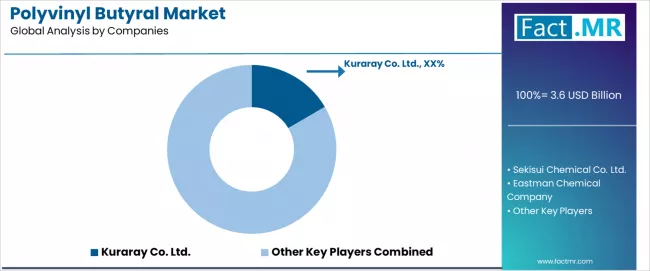
Polyvinyl Butyral Market Analysis By Company | Source: Fact.MR
Polyvinyl Butyral Market Analysis By Company
- Kuraray Co. Ltd., Eastman Chemical Company, Sekisui Chemical Co. Ltd. hold leading positions through established production scale and market presence.
- Chang Chun Group, Hubergroup, Kingboard Chemical Holdings compete across specific grades, regional markets, and application niches.
- Production capability, application development expertise, and customer technical service create primary competitive differentiators.
The competitive landscape features Kuraray Co. Ltd. and Eastman Chemical Company leading through scale and expertise, while regional competitors serve specialized requirements.
Competition is intensifying as technology advancement and market expansion create new product requirements.
Key Companies in the Polyvinyl Butyral Market
Kuraray Co. Ltd., Eastman Chemical Company, Sekisui Chemical Co. Ltd., Chang Chun Group, Hubergroup are among the leading players.
Kingboard Chemical Holdings, Tiantai Kanglai Industrial, Jiangxi Rongxin New Materials, Zhejiang Decent Plastic, SWM International compete across specific segments.
Recent Industry Developments
- Kuraray, Product Development, Trosifol™ SkyViera™ PVB Interlayer (2025)
- In 2025, Kuraray advanced its Trosifol™ PVB interlayer portfolio through selection of its SkyViera™ ambient light interlayer for panoramic sunroofs in Mahindra's BE 6 and XEV 9e electric vehicles, supporting adoption of advanced glazing technologies in premium automotive applications.
- Eastman Chemical, Capacity Expansion, Saflex™ PVB Production (2024–2025)
- In 2025, Eastman Chemical expanded extrusion capabilities at its Ghent, Belgium facility to strengthen Saflex™ PVB interlayer supply for premium automotive and architectural laminated glass applications across European and global markets.
- Sekisui Chemical, Capacity Expansion, S-LEC™ Thailand Facility (2024)
- In 2024, Sekisui Chemical announced an approximately ¥8 billion investment to expand S-LEC™ PVB production capacity at its Rayong, Thailand facility, targeting HUD-compatible glazing and EV-related automotive applications across Asia.
Which companies are the key players?
- Kuraray Co. Ltd.
- Eastman Chemical Company
- Sekisui Chemical Co. Ltd.
- Chang Chun Group
- Tiantai Kanglai Industrial
- Jiangxi Rongxin New Materials
- Zhejiang Decent Plastic
Sources and Research References
- Kuraray Co., Ltd. (2025). Trosifol™ SkyViera™ ambient light control interlayer selected for Mahindra BE 6 and XEV 9e electric vehicles. Kuraray Co., Ltd
- Eastman Chemical Company. (2025). Eastman expands Saflex™ polyvinyl butyral interlayer production capacity at Ghent facility in Belgium. Eastman Chemical Company.
- Sekisui Chemical Co., Ltd. (2024, November 14). Sekisui Chemical to expand interlayer film production capacity in Thailand with approximately ¥8 billion investment. Sekisui Chemical Co., Ltd.
- This bibliography is provided for reader reference and is not exhaustive. The full report contains the complete reference list and detailed citations.
Key Questions This Report Addresses
- What is the current and future size of the Polyvinyl Butyral Market?
- How fast is the Polyvinyl Butyral Market expected to grow between 2026 and 2036?
- Which product type is likely to lead the market by 2026?
- Which application segment is expected to account for the highest demand?
- What factors are driving demand globally?
- How is technology evolution reshaping competitive dynamics?
- Why are China and India the fastest-growing markets?
- Which countries are projected to show the fastest growth through 2036?
- Who are the key companies active in the Polyvinyl Butyral Market?
- How does Fact.MR estimate and validate the market forecast?
What does the polyvinyl butyral market cover?
The polyvinyl butyral market covers the core products, materials, and formulations within the defined scope across global and regional markets.
Polyvinyl Butyral Market Inclusions
- The scope covers global and regional market size and forecasts for 2026 to 2036 across product type, application, end use, technology, formulation, distribution channel, and region.
- It includes regional demand analysis based on primary demand drivers, regulatory frameworks, and end-use consumption patterns.
- The report covers pricing analysis across major product grades and delivery configurations.
Polyvinyl Butyral Market Exclusions
- The scope excludes adjacent categories and general-purpose materials not specifically designed for the defined market application.
- It excludes consulting and financial services not directly linked to market-specific procurement.
Polyvinyl Butyral Market Research Methodology
- The methodology combines secondary research, primary interviews, and forecast modelling.
- It draws on 100+ secondary sources and benchmarks 40+ company portfolios.
- Market sizing covers 25+ countries through a demand-side model with top-down validation.
- Primary validation includes 20+ interviews across manufacturers, providers, end users, and partners.
- Final estimates go through cross-validation, procurement-cycle analysis, and sensitivity testing.
Segmentation
What is the report’s scope and coverage?
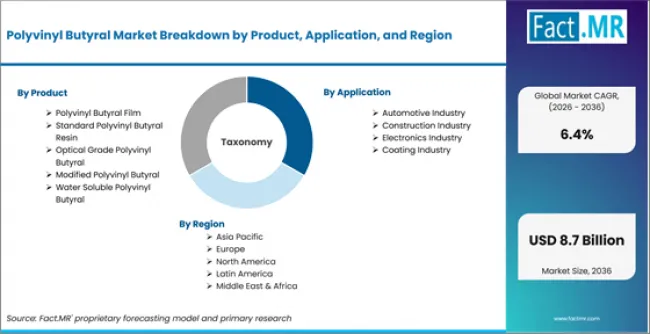
Polyvinyl Butyral Market Breakdown By Product, Application, And Region | Source: Fact.MR
| Parameter | Details |
|---|---|
| Quantitative Units | USD 4.7 billion to USD 8.7 billion, at a CAGR of 6.4% |
| Market Definition | The Polyvinyl Butyral Market covers the primary products and materials within the defined scope. |
| Regions Covered | North America, Latin America, Europe, East Asia, South Asia and Pacific, Middle East and Africa |
| Countries Covered | China, India, South Korea, Germany, USA, 25 plus countries |
| Key Companies | Kuraray Co. Ltd., Eastman Chemical Company, Sekisui Chemical Co. Ltd., Chang Chun Group, Hubergroup, Kingboard Chemical Holdings, Tiantai Kanglai Industrial, Jiangxi Rongxin New Materials, Zhejiang Decent Plastic, SWM International |
| Forecast Period | 2026 to 2036 |
| Approach | Hybrid demand-side and top-down methodology with primary interviews and cross-validation |
Source: Fact.MR analysis. Updated Jun 13, 2026
How is the market segmented?
-
Polyvinyl Butyral Market Segmented by Product:
- Polyvinyl Butyral Film
- Automotive Laminating Film
- Windshield Applications
- Vehicle Safety Systems
- Architectural Laminating Film
- Building Glass Applications
- Construction Safety Products
- Automotive Laminating Film
- Standard Polyvinyl Butyral Resin
- General Purpose Polyvinyl Butyral
- Coating Applications
- Industrial Resin Systems
- High Adhesion Polyvinyl Butyral
- Metal Primer Applications
- Protective Coating Products
- General Purpose Polyvinyl Butyral
- Optical Grade Polyvinyl Butyral
- High Clarity Polyvinyl Butyral
- Display Applications
- Optical Film Systems
- UV Resistant Polyvinyl Butyral
- Solar Panel Applications
- Photovoltaic Encapsulation Products
- High Clarity Polyvinyl Butyral
- Modified Polyvinyl Butyral
- Plasticized Polyvinyl Butyral
- Flexible Film Applications
- Industrial Lamination Systems
- Functional Additive Modified Polyvinyl Butyral
- Specialty Coating Applications
- Advanced Material Products
- Plasticized Polyvinyl Butyral
- Water Soluble Polyvinyl Butyral
- Alcohol Soluble Polyvinyl Butyral
- Printing Ink Applications
- Packaging Systems
- Dispersible Polyvinyl Butyral
- Adhesive Applications
- Industrial Processing Products
- Alcohol Soluble Polyvinyl Butyral
- Polyvinyl Butyral Film
-
Polyvinyl Butyral Market Segmented by Application:
- Automotive Industry
- Laminated Windshield Applications
- Passenger Vehicle Systems
- Commercial Vehicle Products
- Acoustic Glass Applications
- Noise Reduction Systems
- Premium Automotive Products
- Laminated Windshield Applications
- Construction Industry
- Architectural Glass Applications
- Safety Glazing Systems
- Commercial Building Products
- Hurricane Resistant Glass Applications
- Protective Infrastructure Systems
- High Performance Construction Products
- Architectural Glass Applications
- Electronics Industry
- Display Panel Applications
- Consumer Electronics Systems
- Optical Film Products
- Photovoltaic Module Applications
- Solar Energy Systems
- Renewable Energy Products
- Display Panel Applications
- Coating Industry
- Metal Coating Applications
- Corrosion Protection Systems
- Industrial Coating Products
- Wood Coating Applications
- Furniture Protection Systems
- Decorative Coating Products
- Metal Coating Applications
- Automotive Industry
-
Polyvinyl Butyral Market Segmented by Functionality:
- Adhesion Performance
- High Bonding Polyvinyl Butyral
- Glass Lamination Applications
- Safety Film Systems
- Metal Surface Adhesion Systems
- Industrial Coating Applications
- Protective Layer Products
- High Bonding Polyvinyl Butyral
- Impact Resistance
- Shatter Resistance Systems
- Automotive Safety Applications
- Laminated Glass Products
- Energy Absorption Polyvinyl Butyral
- Protective Glazing Applications
- Security Glass Systems
- Shatter Resistance Systems
- Optical Performance
- High Transparency Systems
- Display Applications
- Optical Film Products
- Low Haze Polyvinyl Butyral
- Solar Panel Applications
- Photovoltaic Systems
- High Transparency Systems
- Acoustic Insulation
- Sound Dampening Film Systems
- Automotive Applications
- Noise Control Products
- Acoustic Laminating Systems
- Architectural Applications
- Building Comfort Systems
- Sound Dampening Film Systems
- Adhesion Performance
-
Polyvinyl Butyral Market Segmented by Processing Technology:
- Lamination Technology
- Autoclave Lamination Systems
- Automotive Glass Applications
- Safety Windshield Products
- Vacuum Lamination Systems
- Architectural Applications
- Protective Glazing Systems
- Autoclave Lamination Systems
- Extrusion Processing
- Film Extrusion Systems
- Laminating Applications
- Industrial Film Products
- Sheet Extrusion Technology
- Construction Applications
- Safety Glass Systems
- Film Extrusion Systems
- Casting Technology
- Solution Casting Systems
- Optical Film Applications
- High Clarity Products
- Multi Layer Casting Systems
- Advanced Lamination Applications
- Specialty Material Systems
- Solution Casting Systems
- Compounding Technology
- Additive Blending Systems
- Functional Material Applications
- Industrial Resin Products
- Plasticizer Integration Systems
- Flexible Film Applications
- Customized Material Systems
- Additive Blending Systems
- Lamination Technology
-
Polyvinyl Butyral Market Segmented by Form:
- Film Form
- Clear Laminating Films
- Automotive Applications
- Safety Glass Products
- Colored Film Systems
- Decorative Applications
- Architectural Design Products
- Clear Laminating Films
- Powder Form
- Fine Resin Powder
- Coating Applications
- Industrial Processing Systems
- Granulated Resin Systems
- Compounding Applications
- Manufacturing Products
- Fine Resin Powder
- Sheet Form
- Flexible Polyvinyl Butyral Sheets
- Protective Applications
- Industrial Lamination Systems
- Rigid Sheet Systems
- Construction Applications
- Safety Barrier Products
- Flexible Polyvinyl Butyral Sheets
- Solution Form
- Solvent Based Solutions
- Printing Ink Applications
- Packaging Products
- Water Based Dispersions
- Adhesive Applications
- Industrial Coating Systems
- Solvent Based Solutions
- Film Form
-
Polyvinyl Butyral Market by Region:
- North America
- USA
- Canada
- Mexico
- Latin America
- Brazil
- Chile
- Rest of Latin America
- Western Europe
- Germany
- UK
- Italy
- Spain
- France
- Nordic
- BENELUX
- Rest of Western Europe
- Eastern Europe
- Russia
- Poland
- Hungary
- Balkan & Baltic
- Rest of Eastern Europe
- East Asia
- China
- Japan
- South Korea
- South Asia and Pacific
- India
- ASEAN
- Australia & New Zealand
- Rest of South Asia and Pacific
- Middle East & Africa
- Kingdom of Saudi Arabia
- Other GCC Countries
- Turkiye
- South Africa
- Other African Union
- Rest of Middle East & Africa
- North America
Frequently Asked Questions
How big is the polyvinyl butyral market in 2026?
What will be the size of polyvinyl butyral market in 2036?
How much will be the polyvinyl butyral market growth between 2026 and 2036?
What are the key products in the polyvinyl butyral market?
Which application segment is expected to contribute significant share in the polyvinyl butyral market in 2026?
Who worked on this report


Preview the report firsthand - request a free sample
Free SampleGet the brochure for pricing and purchase details
Download PDF