Pool and Spa Water Treatment Chemicals Market (2026 - 2036)
Pool and Spa Water Treatment Chemicals Market Size and Share Forecast Outlook 2026 to 2036
Core Findings
Pool and Spa Water Treatment Chemicals Market Forecast and Outlook 2026 to 2036
The pool and spa water treatment chemicals market is expected to increase from USD 6.3 billion in 2026 to USD 9.4 billion by 2036, at a 4.1% CAGR, reflecting ongoing transformation in how water quality is managed.
Pool and Spa Water Treatment Chemicals Market Key Takeaways
- Pool and Spa Water Treatment Chemicals Market Value (2026): USD 6.3 billion
- Pool and Spa Water Treatment Chemicals Market Forecast Value (2036): USD 9.4 billion
- Pool and Spa Water Treatment Chemicals Market Forecast CAGR 2026 to 2036: 4.1%
- Leading Chemical Type by Demand Share: Sanitizers (Chlorine/Bromine) (46.0%)
- Key Market Participants: Archroma, Lonza, Olin, Westlake, Nouryon, Kemira, BioLab, Ecolab, HydroTools, Haviland Enterprises
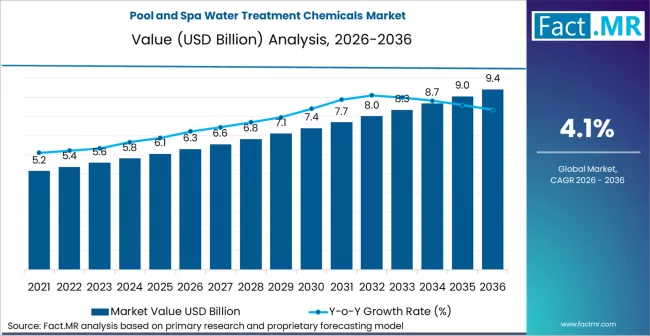
There is a growing trend of combining traditional chemical sales with connected hardware and automated solutions, as service and maintenance models shift toward digital, performance oriented solutions that reduce manual dosing needs.Steve Berens, CEO of Clear Comfort, stated that “water treated with AOP is better water... it makes water care simpler and much, much more sustainable,” highlighting how advanced oxidation and smart treatment technologies are reshaping expectations for water quality and user experience.
Competitive strategies highlight the industry's ongoing transformation. Established chemical players are divesting legacy portfolios to reposition around consumer brands, while pool equipment incumbents invest in sensor enabled dosing and connected water management systems. North America's robust residential pool construction and Europe's rising demand for sustainable chemicals are driving regional expansion. The shift from consumable-based revenue models to integrated smart water platforms is set to drive continued demand for innovative, user-friendly chemical and digital solutions through 2036.
Pool and Spa Water Treatment Chemicals Market
| Metric | Value |
|---|---|
| Estimated Value in (2026E) | USD 6.3 billion |
| Forecast Value in (2036F) | USD 9.4 billion |
| Forecast CAGR (2026 to 2036) | 4.1% |
Category
| Category | Segments |
|---|---|
| Chemical Type | Sanitizers (Chlorine / Bromine); Shock Oxidizers & Specialty; Algaecides & Clarifiers; pH Control (Acids / Alkalinity) |
| Pool Type | Residential Pools; Commercial / Public Pools; Spas & Hot Tubs |
| Delivery Form | Tablets / Granules; Liquids; Cartridges / Pods; Other Forms |
| Sales Channel | Specialty Pool Retail; Mass Retail & E-commerce; Service / Contractor Supply; Other Channels |
| Region | North America; Europe; Asia Pacific; Latin America; Middle East & Africa |
Segmental Analysis
What Is the Impact of Chemical Type on the Pool and Spa Water Treatment Chemicals Market?
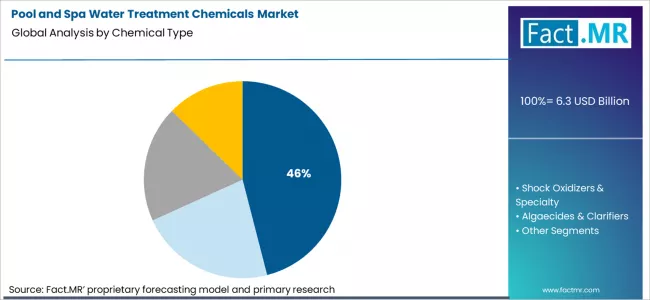
In the pool and spa water treatment chemicals market, chemical type plays a pivotal role in maintaining water quality, ensuring safety, and managing operational costs. Sanitizers (Chlorine / Bromine) lead the market with a 46.0% share, driven by their broad application in disinfecting pool and spa water. Chlorine and bromine remain the primary choice for water sanitization due to their proven effectiveness in eliminating harmful pathogens, bacteria, and viruses. Their long-standing dominance is reinforced by their affordability, ease of use, and established regulatory acceptance, making them the go-to solution for both residential and commercial pool operators seeking reliable and cost-efficient water treatment.
How Does Pool Type Influence Demand in the Pool and Spa Water Treatment Chemicals Market?
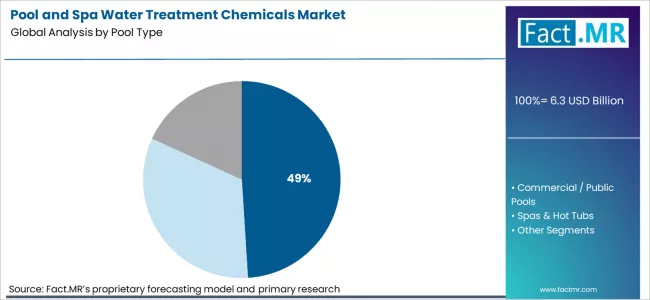
The pool type is a significant factor shaping the demand for water treatment chemicals, as different pool types require tailored chemical solutions. Residential pools represent the largest share with 49.0%, driven by the growing number of private pool installations and the increased focus on maintaining high-quality, safe water. Residential pool owners seek cost-effective and easy-to-apply chemical treatments that can be managed with minimal technical knowledge. The rise in backyard pool installations, especially in warmer regions and during the summer months, continues to propel demand for water treatment chemicals designed specifically for home use.
What are the Drivers, Restraints, and Key Trends in the Pool and Spa Water Treatment Chemicals Market?
| Country | Driver | Restraint | Trend |
|---|---|---|---|
| USA | Strong residential and commercial pool construction driving chemical demand. | Rising cost of specialty water treatment chemicals. | Growing use of saltwater and mineralbased treatment systems. |
| UK | Increased investments in leisure and wellness facilities with indoor pools. | Seasonal usage patterns limiting consistent chemical sales. | Shift toward ecofriendly and lowchlorine water treatment solutions. |
| Germany | High public health standards requiring effective water sanitation. | Strict regulatory compliance increasing operational costs. | Adoption of automated dosing and monitoring systems for pools. |
| China | Expansion of urban recreational and hospitality sectors with pools and spas. | Water quality variation across regions limiting uniform adoption. | Rapid growth in advanced, lowmaintenance treatment chemistries. |
| India | Rising middleclass recreation spending and new residential pool installations. | Limited awareness of advanced water treatment chemicals among smaller operators. | Increasing preference for packaged treatment kits and safer sanitizers. |
Analysis of the Pool and Spa Water Treatment Chemicals Market by Key Country
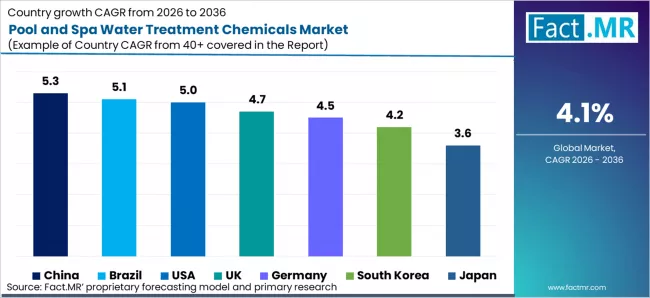
| Country | CAGR (%) |
|---|---|
| China | 5.3% |
| Brazil | 5.1% |
| USA | 5.0% |
| UK | 4.7% |
| Germany | 4.5% |
| South Korea | 4.2% |
| Japan | 3.6% |
The report covers an in-depth analysis of 40+ countries; top-performing countries are highlighted below.
What drives growth in China for pool and spa water treatment chemicals?
The pool and spa water treatment chemicals market in China is projected to grow at 5.3% CAGR, supported by rising middle-class incomes, rapid urban development, and expanding hospitality and leisure infrastructure. The government’s promotion of healthy lifestyles and construction of community recreational centers have led to increased public pool installations, which in turn boost demand for sanitizing and balancing chemicals. Domestic manufacturers are innovating with products that combine disinfectant efficacy with reduced by-product formation to meet local water quality standards.
“In China’s fast-growing urban centers, demand for safe and easy-to-manage pool water treatment chemicals continues to rise,” explains Zhang Wei, Product Development Manager at a Chinese specialty chemicals firm.
What fuels the rise in Brazil?
Brazil’s market is expected to grow at 5.1% CAGR as the combination of a tropical climate and a strong culture of outdoor living drives widespread pool usage in both residential and commercial settings. High ambient temperatures increase the importance of effective sanitization and pH control to prevent algae growth and microbial hazards. Brazilian pool operators prioritize treatment chemicals that reduce maintenance costs while delivering dependable sanitation.
“In Brazil, effective pool water chemistry management is essential year-round, and treatment chemicals that improve clarity and reduce maintenance intervals are in high demand,” notes Carlos Silva, Operations Manager at a Brazilian pool services company.
How is the USA market evolving in the pool and spa water treatment chemicals market?
Demand for pool and spa water treatment chemicals in the USA is forecast to grow at 5.0%, reflecting a stable demand environment underpinned by high residential pool ownership and ongoing investment in commercial aquatic facilities. According to the Association of Pool & Spa Professionals (APSP), more than 10 million residential pools in the United States rely on consistent chemical treatment to maintain sanitation, clarity, and balanced water chemistry, underpinning steady chemical consumption. Growth is driven by refinements in treatment formulations aimed at reducing chloramine formation, lowering maintenance frequency, and improving safety for swimmers.
“Effective pool and spa water treatment chemicals are central to preventing microbial contamination and minimizing irritation for swimmers,” says Dr. Emily Carter, Technical Director at a major U.S. water treatment chemicals provider.
Commercial pools, wellness centers, and hotel spas further contribute to demand as facility operators balance regulatory compliance with guest satisfaction, encouraging advanced disinfectant and balancing products that simplify maintenance while ensuring water quality.
Why is the UK market critical for water treatment chemicals in pools and spas?
The UK market is expanding at 4.7%, anchored in both residential and public aquatic facilities where regulatory oversight of water quality is rigorous. The UK’s Health and Safety Executive (HSE) and local council guidelines emphasize effective disinfection and chemical balance to prevent waterborne illness and ensure safe bathing conditions. Operators of leisure centers and municipal pools increasingly specify advanced treatment formulations that deliver robust pathogen control while supporting bather comfort and compliance with stringent standards.
“Pool water quality is central to public confidence in facility safety, and treatment chemicals must consistently meet performance and safety benchmarks,” says Lucy Harrington, Head of Aquatic Operations at a UK leisure management group.
What is driving expansion in Germany?
Germany is projected to grow at 4.5% CAGR, supported by a mature leisure industry and strict regulatory frameworks governing water quality in public and commercial pools. The Federal Environment Agency and local health authorities emphasize rigorous disinfection and water balance protocols to prevent recreational water illnesses and minimize chemical exposure risks to bathers. As a result, operators adopt advanced sanitization products and stabilizers that deliver reliable performance while reducing by-product formation.
“Operators in Germany rely on high performance water treatment chemicals that meet stringent water quality and safety standards,” says Dr. Petra Müller, Environmental Compliance Lead at a German aquatic facility operator.
High expectations for swimmer comfort and environmental responsibility sustain adoption of premium formulations.
How is South Korea shaping demand for pool and spa treatment chemicals?
The pool and spa water treatment chemicals market in South Korea is growing at 4.2% CAGR, buoyed by increasing presence of wellness and leisure facilities in urban centers where pool usage is integrated with lifestyle and fitness trends. Municipal pools, hotel wellness areas, and residential complexes require water treatment solutions that maintain sanitation without high maintenance burdens. The Korean Ministry of Environment’s performance and quality guidelines for recreational water quality encourage facility operators to adopt products that deliver consistent disinfection while minimizing harmful disinfection by-products.
“In South Korea, facility operators focus on safety, ease of maintenance, and swimmer comfort when selecting water treatment chemistries,” explains Min-Jae Lee, Lead Technical Specialist at a South Korean water treatment supplier.
Export demand for Korean pool chemicals that meet international standards also influences product formulation trends.
What fuels the gradual rise in Japan?
Japan’s pool and spa water treatment chemicals market is forecast to grow at 3.6% CAGR, reflecting careful uptake driven by precise water quality control and high expectations for cleanliness in both public and private facilities. The Japanese Ministry of Health, Labor and Welfare enforces detailed water quality standards for bathing facilities, driving uptake of treatment chemicals that deliver dependable sanitization while aligning with stringent safety norms. Operators emphasize products that produce minimal irritants and support easy monitoring of water chemistry.
“In Japan, the emphasis on detailed water quality management means that operators prefer solutions that deliver predictable results and are easy to integrate into routine testing protocols,” says Hiroshi Tanaka, Senior Technical Consultant at a Japanese aquatic services firm.
Conservative capital expenditure and meticulous operational protocols moderate rapid category expansion, but sustained demand in hospitality and leisure sectors supports steady growth.
What Strategic Moves Are Defining Competitive Landscape?
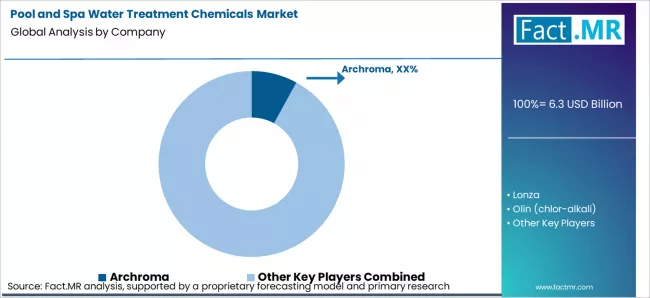
The pool and spa water treatment chemicals market is evolving towards 'water-positive' systems, even as companies continue to protect their established chlorine products. According to Fact.MR, manufacturers are increasingly shifting from bulk chemical sales to offering automated, sensor-based water health solutions. The industry's focus is shifting from simply maintaining sanitation to minimizing freshwater use and chemical runoff, marking the next phase of value creation for both residential and commercial users. Christophe Beck, CEO of Ecolab, points out that the traditional model of linear water usage is coming to an end.
"Wastewater is an engineering flaw. There should be no wastewater. We should be reusing and recycling the water within the process. If you do it step by step with the right technology, you can use almost no water."-Christophe Beck, CEO of Ecolab
Olin and Westlake are strengthening their supply chains by capitalizing on vertical integration in chlor-alkali production, while BioLab is expanding its high-efficiency TCCA production at its cutting-edge facility. Ecolab and Nouryon are turning to AI-powered analytics and bio-based stabilizers to lower the environmental footprint of conventional sanitizers. This shift helps these companies stay competitive as the market quickly moves from manual testing to a zero-waste, fully automated water care system.
Key Players in the Pool and Spa Water Treatment Chemicals Market
- Archroma
- Lonza
- Olin (chlor-alkali)
- Westlake
- Nouryon
- Kemira
- BioLab (KIK)
- Ecolab
- HydroTools
- Haviland Enterprises
Scope of the Report
| Items | Values |
|---|---|
| Quantitative Units | USD billion |
| Chemical Type | Sanitizers (Chlorine / Bromine); Shock Oxidizers & Specialty; Algaecides & Clarifiers; pH Control (Acids / Alkalinity) |
| Pool Type | Residential Pools; Commercial / Public Pools; Spas & Hot Tubs |
| Delivery Form | Tablets / Granules; Liquids; Cartridges / Pods; Other Forms |
| Sales Channel | Specialty Pool Retail; Mass Retail & E-commerce; Service / Contractor Supply; Other Channels |
| Regions Covered | Asia Pacific, Europe, North America, Latin America, Middle East & Africa |
| Countries Covered | China, Brazil, USA, UK, Germany, South Korea, Japan, and 40+ countries |
| Key Companies Profiled | Archroma; Lonza; Olin (chlor-alkali); Westlake; Nouryon; Kemira; BioLab (KIK); Ecolab; HydroTools; Haviland Enterprises |
| Additional Attributes | Dollar sales by chemical type, pool type, delivery form, and sales channel; increased adoption of eco-friendly and non-toxic sanitizers and shock oxidizers driving growth; expansion of commercial pool installations and rise in spa & wellness industry boosting demand for water treatment chemicals; shift toward convenient cartridge and pod formats for ease of use; service & contractor supply expected to dominate sales in commercial pools and spas. |
Pool and Spa Water Treatment Chemicals Market Key Segment
-
Chemical Type :
- Sanitizers (Chlorine / Bromine)
- Shock Oxidizers & Specialty
- Algaecides & Clarifiers
- pH Control (Acids / Alkalinity)
-
Pool Type :
- Residential Pools
- Commercial / Public Pools
- Spas & Hot Tubs
-
Delivery Form :
- Tablets / Granules
- Liquids
- Cartridges / Pods
- Other Forms
-
Sales Channel :
- Specialty Pool Retail
- Mass Retail & E-commerce
- Service / Contractor Supply
- Other Channels
-
Region :
- North America
- USA
- Canada
- Mexico
- Europe
- Germany
- UK
- France
- Italy
- Spain
- Nordic Countries
- BENELUX
- Rest of Europe
- Asia Pacific
- China
- Japan
- South Korea
- India
- Australia
- Rest of Asia Pacific
- Latin America
- Brazil
- Argentina
- Rest of Latin America
- Middle East and Africa
- Kingdom of Saudi Arabia
- United Arab Emirates
- South Africa
- Rest of Middle East and Africa
- Other Regions
- Oceania
- Central Asia
- Other Markets
- North America
Bibliographies
- World Health Organization. (2023). Guidelines for safe recreational water environments: Swimming pools and similar environments. World Health Organization.
- U.S. Environmental Protection Agency. (2023). Disinfection by-products in recreational water systems and control strategies. U.S. Environmental Protection Agency.
- Health and Safety Executive. (2024). Managing health and safety in swimming pools (HSG179): Chemical treatment and water quality control. Health and Safety Executive.
- International Organization for Standardization. (2023). ISO 5667-5: Water quality-Sampling-Guidance on sampling of drinking water and pool water. ISO.
- Ecolab. (2024). Pool and spa water treatment programs: Sanitizers, oxidizers, and automated dosing systems. Ecolab technical documentation.
Table of Content
- Executive Summary
- Global Market Outlook
- Demand to side Trends
- Supply to side Trends
- Technology Roadmap Analysis
- Analysis and Recommendations
- Market Overview
- Market Coverage / Taxonomy
- Market Definition / Scope / Limitations
- Research Methodology
- Chapter Orientation
- Analytical Lens and Working Hypotheses
- Market Structure, Signals, and Trend Drivers
- Benchmarking and Cross-market Comparability
- Market Sizing, Forecasting, and Opportunity Mapping
- Research Design and Evidence Framework
- Desk Research Programme (Secondary Evidence)
- Company Annual and Sustainability Reports
- Peer-reviewed Journals and Academic Literature
- Corporate Websites, Product Literature, and Technical Notes
- Earnings Decks and Investor Briefings
- Statutory Filings and Regulatory Disclosures
- Technical White Papers and Standards Notes
- Trade Journals, Industry Magazines, and Analyst Briefs
- Conference Proceedings, Webinars, and Seminar Materials
- Government Statistics Portals and Public Data Releases
- Press Releases and Reputable Media Coverage
- Specialist Newsletters and Curated Briefings
- Sector Databases and Reference Repositories
- FMR Internal Proprietary Databases and Historical Market Datasets
- Subscription Datasets and Paid Sources
- Social Channels, Communities, and Digital Listening Inputs
- Additional Desk Sources
- Expert Input and Fieldwork (Primary Evidence)
- Primary Modes
- Qualitative Interviews and Expert Elicitation
- Quantitative Surveys and Structured Data Capture
- Blended Approach
- Why Primary Evidence is Used
- Field Techniques
- Interviews
- Surveys
- Focus Groups
- Observational and In-context Research
- Social and Community Interactions
- Stakeholder Universe Engaged
- C-suite Leaders
- Board Members
- Presidents and Vice Presidents
- R&D and Innovation Heads
- Technical Specialists
- Domain Subject-matter Experts
- Scientists
- Physicians and Other Healthcare Professionals
- Governance, Ethics, and Data Stewardship
- Research Ethics
- Data Integrity and Handling
- Primary Modes
- Tooling, Models, and Reference Databases
- Desk Research Programme (Secondary Evidence)
- Data Engineering and Model Build
- Data Acquisition and Ingestion
- Cleaning, Normalisation, and Verification
- Synthesis, Triangulation, and Analysis
- Quality Assurance and Audit Trail
- Market Background
- Market Dynamics
- Drivers
- Restraints
- Opportunity
- Trends
- Scenario Forecast
- Demand in Optimistic Scenario
- Demand in Likely Scenario
- Demand in Conservative Scenario
- Opportunity Map Analysis
- Product Life Cycle Analysis
- Supply Chain Analysis
- Investment Feasibility Matrix
- Value Chain Analysis
- PESTLE and Porter’s Analysis
- Regulatory Landscape
- Regional Parent Market Outlook
- Production and Consumption Statistics
- Import and Export Statistics
- Market Dynamics
- Global Market Analysis 2021 to 2025 and Forecast, 2026 to 2036
- Historical Market Size Value (USD Million) Analysis, 2021 to 2025
- Current and Future Market Size Value (USD Million) Projections, 2026 to 2036
- Y to o to Y Growth Trend Analysis
- Absolute $ Opportunity Analysis
- Global Market Pricing Analysis 2021 to 2025 and Forecast 2026 to 2036
- Global Market Analysis 2021 to 2025 and Forecast 2026 to 2036, By Chemical Type
- Introduction / Key Findings
- Historical Market Size Value (USD Million) Analysis By Chemical Type, 2021 to 2025
- Current and Future Market Size Value (USD Million) Analysis and Forecast By Chemical Type, 2026 to 2036
- Sanitizers (Chlorine / Bromine)
- Shock Oxidizers & Specialty
- Algaecides & Clarifiers
- pH Control (Acids / Alkalinity)
- Sanitizers (Chlorine / Bromine)
- Y to o to Y Growth Trend Analysis By Chemical Type, 2021 to 2025
- Absolute $ Opportunity Analysis By Chemical Type, 2026 to 2036
- Global Market Analysis 2021 to 2025 and Forecast 2026 to 2036, By Pool Type
- Introduction / Key Findings
- Historical Market Size Value (USD Million) Analysis By Pool Type, 2021 to 2025
- Current and Future Market Size Value (USD Million) Analysis and Forecast By Pool Type, 2026 to 2036
- Residential Pools
- Commercial / Public Pools
- Spas & Hot Tubs
- Residential Pools
- Y to o to Y Growth Trend Analysis By Pool Type, 2021 to 2025
- Absolute $ Opportunity Analysis By Pool Type, 2026 to 2036
- Global Market Analysis 2021 to 2025 and Forecast 2026 to 2036, By Delivery Form
- Introduction / Key Findings
- Historical Market Size Value (USD Million) Analysis By Delivery Form, 2021 to 2025
- Current and Future Market Size Value (USD Million) Analysis and Forecast By Delivery Form, 2026 to 2036
- Tablets / Granules
- Liquids
- Cartridges / Pods
- Other Forms
- Tablets / Granules
- Y to o to Y Growth Trend Analysis By Delivery Form, 2021 to 2025
- Absolute $ Opportunity Analysis By Delivery Form, 2026 to 2036
- Global Market Analysis 2021 to 2025 and Forecast 2026 to 2036, By Sales Channel
- Introduction / Key Findings
- Historical Market Size Value (USD Million) Analysis By Sales Channel, 2021 to 2025
- Current and Future Market Size Value (USD Million) Analysis and Forecast By Sales Channel, 2026 to 2036
- Specialty Pool Retail
- Mass Retail & E-commerce
- Service / Contractor Supply
- Other Channels
- Specialty Pool Retail
- Y to o to Y Growth Trend Analysis By Sales Channel, 2021 to 2025
- Absolute $ Opportunity Analysis By Sales Channel, 2026 to 2036
- Global Market Analysis 2021 to 2025 and Forecast 2026 to 2036, By Region
- Introduction
- Historical Market Size Value (USD Million) Analysis By Region, 2021 to 2025
- Current Market Size Value (USD Million) Analysis and Forecast By Region, 2026 to 2036
- North America
- Latin America
- Western Europe
- Eastern Europe
- East Asia
- South Asia and Pacific
- Middle East & Africa
- Market Attractiveness Analysis By Region
- North America Market Analysis 2021 to 2025 and Forecast 2026 to 2036, By Country
- Historical Market Size Value (USD Million) Trend Analysis By Market Taxonomy, 2021 to 2025
- Market Size Value (USD Million) Forecast By Market Taxonomy, 2026 to 2036
- By Country
- USA
- Canada
- Mexico
- By Chemical Type
- By Pool Type
- By Delivery Form
- By Sales Channel
- By Country
- Market Attractiveness Analysis
- By Country
- By Chemical Type
- By Pool Type
- By Delivery Form
- By Sales Channel
- Key Takeaways
- Latin America Market Analysis 2021 to 2025 and Forecast 2026 to 2036, By Country
- Historical Market Size Value (USD Million) Trend Analysis By Market Taxonomy, 2021 to 2025
- Market Size Value (USD Million) Forecast By Market Taxonomy, 2026 to 2036
- By Country
- Brazil
- Chile
- Rest of Latin America
- By Chemical Type
- By Pool Type
- By Delivery Form
- By Sales Channel
- By Country
- Market Attractiveness Analysis
- By Country
- By Chemical Type
- By Pool Type
- By Delivery Form
- By Sales Channel
- Key Takeaways
- Western Europe Market Analysis 2021 to 2025 and Forecast 2026 to 2036, By Country
- Historical Market Size Value (USD Million) Trend Analysis By Market Taxonomy, 2021 to 2025
- Market Size Value (USD Million) Forecast By Market Taxonomy, 2026 to 2036
- By Country
- Germany
- UK
- Italy
- Spain
- France
- Nordic
- BENELUX
- Rest of Western Europe
- By Chemical Type
- By Pool Type
- By Delivery Form
- By Sales Channel
- By Country
- Market Attractiveness Analysis
- By Country
- By Chemical Type
- By Pool Type
- By Delivery Form
- By Sales Channel
- Key Takeaways
- Eastern Europe Market Analysis 2021 to 2025 and Forecast 2026 to 2036, By Country
- Historical Market Size Value (USD Million) Trend Analysis By Market Taxonomy, 2021 to 2025
- Market Size Value (USD Million) Forecast By Market Taxonomy, 2026 to 2036
- By Country
- Russia
- Poland
- Hungary
- Balkan & Baltic
- Rest of Eastern Europe
- By Chemical Type
- By Pool Type
- By Delivery Form
- By Sales Channel
- By Country
- Market Attractiveness Analysis
- By Country
- By Chemical Type
- By Pool Type
- By Delivery Form
- By Sales Channel
- Key Takeaways
- East Asia Market Analysis 2021 to 2025 and Forecast 2026 to 2036, By Country
- Historical Market Size Value (USD Million) Trend Analysis By Market Taxonomy, 2021 to 2025
- Market Size Value (USD Million) Forecast By Market Taxonomy, 2026 to 2036
- By Country
- China
- Japan
- South Korea
- By Chemical Type
- By Pool Type
- By Delivery Form
- By Sales Channel
- By Country
- Market Attractiveness Analysis
- By Country
- By Chemical Type
- By Pool Type
- By Delivery Form
- By Sales Channel
- Key Takeaways
- South Asia and Pacific Market Analysis 2021 to 2025 and Forecast 2026 to 2036, By Country
- Historical Market Size Value (USD Million) Trend Analysis By Market Taxonomy, 2021 to 2025
- Market Size Value (USD Million) Forecast By Market Taxonomy, 2026 to 2036
- By Country
- India
- ASEAN
- Australia & New Zealand
- Rest of South Asia and Pacific
- By Chemical Type
- By Pool Type
- By Delivery Form
- By Sales Channel
- By Country
- Market Attractiveness Analysis
- By Country
- By Chemical Type
- By Pool Type
- By Delivery Form
- By Sales Channel
- Key Takeaways
- Middle East & Africa Market Analysis 2021 to 2025 and Forecast 2026 to 2036, By Country
- Historical Market Size Value (USD Million) Trend Analysis By Market Taxonomy, 2021 to 2025
- Market Size Value (USD Million) Forecast By Market Taxonomy, 2026 to 2036
- By Country
- Kingdom of Saudi Arabia
- Other GCC Countries
- Turkiye
- South Africa
- Other African Union
- Rest of Middle East & Africa
- By Chemical Type
- By Pool Type
- By Delivery Form
- By Sales Channel
- By Country
- Market Attractiveness Analysis
- By Country
- By Chemical Type
- By Pool Type
- By Delivery Form
- By Sales Channel
- Key Takeaways
- Key Countries Market Analysis
- USA
- Pricing Analysis
- Market Share Analysis, 2025
- By Chemical Type
- By Pool Type
- By Delivery Form
- By Sales Channel
- Canada
- Pricing Analysis
- Market Share Analysis, 2025
- By Chemical Type
- By Pool Type
- By Delivery Form
- By Sales Channel
- Mexico
- Pricing Analysis
- Market Share Analysis, 2025
- By Chemical Type
- By Pool Type
- By Delivery Form
- By Sales Channel
- Brazil
- Pricing Analysis
- Market Share Analysis, 2025
- By Chemical Type
- By Pool Type
- By Delivery Form
- By Sales Channel
- Chile
- Pricing Analysis
- Market Share Analysis, 2025
- By Chemical Type
- By Pool Type
- By Delivery Form
- By Sales Channel
- Germany
- Pricing Analysis
- Market Share Analysis, 2025
- By Chemical Type
- By Pool Type
- By Delivery Form
- By Sales Channel
- UK
- Pricing Analysis
- Market Share Analysis, 2025
- By Chemical Type
- By Pool Type
- By Delivery Form
- By Sales Channel
- Italy
- Pricing Analysis
- Market Share Analysis, 2025
- By Chemical Type
- By Pool Type
- By Delivery Form
- By Sales Channel
- Spain
- Pricing Analysis
- Market Share Analysis, 2025
- By Chemical Type
- By Pool Type
- By Delivery Form
- By Sales Channel
- France
- Pricing Analysis
- Market Share Analysis, 2025
- By Chemical Type
- By Pool Type
- By Delivery Form
- By Sales Channel
- India
- Pricing Analysis
- Market Share Analysis, 2025
- By Chemical Type
- By Pool Type
- By Delivery Form
- By Sales Channel
- ASEAN
- Pricing Analysis
- Market Share Analysis, 2025
- By Chemical Type
- By Pool Type
- By Delivery Form
- By Sales Channel
- Australia & New Zealand
- Pricing Analysis
- Market Share Analysis, 2025
- By Chemical Type
- By Pool Type
- By Delivery Form
- By Sales Channel
- China
- Pricing Analysis
- Market Share Analysis, 2025
- By Chemical Type
- By Pool Type
- By Delivery Form
- By Sales Channel
- Japan
- Pricing Analysis
- Market Share Analysis, 2025
- By Chemical Type
- By Pool Type
- By Delivery Form
- By Sales Channel
- South Korea
- Pricing Analysis
- Market Share Analysis, 2025
- By Chemical Type
- By Pool Type
- By Delivery Form
- By Sales Channel
- Russia
- Pricing Analysis
- Market Share Analysis, 2025
- By Chemical Type
- By Pool Type
- By Delivery Form
- By Sales Channel
- Poland
- Pricing Analysis
- Market Share Analysis, 2025
- By Chemical Type
- By Pool Type
- By Delivery Form
- By Sales Channel
- Hungary
- Pricing Analysis
- Market Share Analysis, 2025
- By Chemical Type
- By Pool Type
- By Delivery Form
- By Sales Channel
- Kingdom of Saudi Arabia
- Pricing Analysis
- Market Share Analysis, 2025
- By Chemical Type
- By Pool Type
- By Delivery Form
- By Sales Channel
- Turkiye
- Pricing Analysis
- Market Share Analysis, 2025
- By Chemical Type
- By Pool Type
- By Delivery Form
- By Sales Channel
- South Africa
- Pricing Analysis
- Market Share Analysis, 2025
- By Chemical Type
- By Pool Type
- By Delivery Form
- By Sales Channel
- USA
- Market Structure Analysis
- Competition Dashboard
- Competition Benchmarking
- Market Share Analysis of Top Players
- By Regional
- By Chemical Type
- By Pool Type
- By Delivery Form
- By Sales Channel
- Competition Analysis
- Competition Deep Dive
- Archroma
- Overview
- Product Portfolio
- Profitability by Market Segments (Product/Age /Sales Channel/Region)
- Sales Footprint
- Strategy Overview
- Marketing Strategy
- Product Strategy
- Channel Strategy
- Lonza
- Olin (chlor-alkali)
- Westlake
- Nouryon
- Kemira
- BioLab (KIK)
- Ecolab
- HydroTools
- Haviland Enterprises
- Archroma
- Competition Deep Dive
- Assumptions & Acronyms Used
List Of Table
- Table 1: Global Market Value (USD Million) Forecast by Region, 2021 to 2036
- Table 2: Global Market Value (USD Million) Forecast by Chemical Type, 2021 to 2036
- Table 3: Global Market Value (USD Million) Forecast by Pool Type, 2021 to 2036
- Table 4: Global Market Value (USD Million) Forecast by Delivery Form, 2021 to 2036
- Table 5: Global Market Value (USD Million) Forecast by Sales Channel, 2021 to 2036
- Table 6: North America Market Value (USD Million) Forecast by Country, 2021 to 2036
- Table 7: North America Market Value (USD Million) Forecast by Chemical Type, 2021 to 2036
- Table 8: North America Market Value (USD Million) Forecast by Pool Type, 2021 to 2036
- Table 9: North America Market Value (USD Million) Forecast by Delivery Form, 2021 to 2036
- Table 10: North America Market Value (USD Million) Forecast by Sales Channel, 2021 to 2036
- Table 11: Latin America Market Value (USD Million) Forecast by Country, 2021 to 2036
- Table 12: Latin America Market Value (USD Million) Forecast by Chemical Type, 2021 to 2036
- Table 13: Latin America Market Value (USD Million) Forecast by Pool Type, 2021 to 2036
- Table 14: Latin America Market Value (USD Million) Forecast by Delivery Form, 2021 to 2036
- Table 15: Latin America Market Value (USD Million) Forecast by Sales Channel, 2021 to 2036
- Table 16: Western Europe Market Value (USD Million) Forecast by Country, 2021 to 2036
- Table 17: Western Europe Market Value (USD Million) Forecast by Chemical Type, 2021 to 2036
- Table 18: Western Europe Market Value (USD Million) Forecast by Pool Type, 2021 to 2036
- Table 19: Western Europe Market Value (USD Million) Forecast by Delivery Form, 2021 to 2036
- Table 20: Western Europe Market Value (USD Million) Forecast by Sales Channel, 2021 to 2036
- Table 21: Eastern Europe Market Value (USD Million) Forecast by Country, 2021 to 2036
- Table 22: Eastern Europe Market Value (USD Million) Forecast by Chemical Type, 2021 to 2036
- Table 23: Eastern Europe Market Value (USD Million) Forecast by Pool Type, 2021 to 2036
- Table 24: Eastern Europe Market Value (USD Million) Forecast by Delivery Form, 2021 to 2036
- Table 25: Eastern Europe Market Value (USD Million) Forecast by Sales Channel, 2021 to 2036
- Table 26: East Asia Market Value (USD Million) Forecast by Country, 2021 to 2036
- Table 27: East Asia Market Value (USD Million) Forecast by Chemical Type, 2021 to 2036
- Table 28: East Asia Market Value (USD Million) Forecast by Pool Type, 2021 to 2036
- Table 29: East Asia Market Value (USD Million) Forecast by Delivery Form, 2021 to 2036
- Table 30: East Asia Market Value (USD Million) Forecast by Sales Channel, 2021 to 2036
- Table 31: South Asia and Pacific Market Value (USD Million) Forecast by Country, 2021 to 2036
- Table 32: South Asia and Pacific Market Value (USD Million) Forecast by Chemical Type, 2021 to 2036
- Table 33: South Asia and Pacific Market Value (USD Million) Forecast by Pool Type, 2021 to 2036
- Table 34: South Asia and Pacific Market Value (USD Million) Forecast by Delivery Form, 2021 to 2036
- Table 35: South Asia and Pacific Market Value (USD Million) Forecast by Sales Channel, 2021 to 2036
- Table 36: Middle East & Africa Market Value (USD Million) Forecast by Country, 2021 to 2036
- Table 37: Middle East & Africa Market Value (USD Million) Forecast by Chemical Type, 2021 to 2036
- Table 38: Middle East & Africa Market Value (USD Million) Forecast by Pool Type, 2021 to 2036
- Table 39: Middle East & Africa Market Value (USD Million) Forecast by Delivery Form, 2021 to 2036
- Table 40: Middle East & Africa Market Value (USD Million) Forecast by Sales Channel, 2021 to 2036
List Of Figures
- Figure 1: Global Market Pricing Analysis
- Figure 2: Global Market Value (USD Million) Forecast 2021 to 2036
- Figure 3: Global Market Value Share and BPS Analysis by Chemical Type, 2026 and 2036
- Figure 4: Global Market Y to o to Y Growth Comparison by Chemical Type, 2026 to 2036
- Figure 5: Global Market Attractiveness Analysis by Chemical Type
- Figure 6: Global Market Value Share and BPS Analysis by Pool Type, 2026 and 2036
- Figure 7: Global Market Y to o to Y Growth Comparison by Pool Type, 2026 to 2036
- Figure 8: Global Market Attractiveness Analysis by Pool Type
- Figure 9: Global Market Value Share and BPS Analysis by Delivery Form, 2026 and 2036
- Figure 10: Global Market Y to o to Y Growth Comparison by Delivery Form, 2026 to 2036
- Figure 11: Global Market Attractiveness Analysis by Delivery Form
- Figure 12: Global Market Value Share and BPS Analysis by Sales Channel, 2026 and 2036
- Figure 13: Global Market Y to o to Y Growth Comparison by Sales Channel, 2026 to 2036
- Figure 14: Global Market Attractiveness Analysis by Sales Channel
- Figure 15: Global Market Value (USD Million) Share and BPS Analysis by Region, 2026 and 2036
- Figure 16: Global Market Y to o to Y Growth Comparison by Region, 2026 to 2036
- Figure 17: Global Market Attractiveness Analysis by Region
- Figure 18: North America Market Incremental Dollar Opportunity, 2026 to 2036
- Figure 19: Latin America Market Incremental Dollar Opportunity, 2026 to 2036
- Figure 20: Western Europe Market Incremental Dollar Opportunity, 2026 to 2036
- Figure 21: Eastern Europe Market Incremental Dollar Opportunity, 2026 to 2036
- Figure 22: East Asia Market Incremental Dollar Opportunity, 2026 to 2036
- Figure 23: South Asia and Pacific Market Incremental Dollar Opportunity, 2026 to 2036
- Figure 24: Middle East & Africa Market Incremental Dollar Opportunity, 2026 to 2036
- Figure 25: North America Market Value Share and BPS Analysis by Country, 2026 and 2036
- Figure 26: North America Market Value Share and BPS Analysis by Chemical Type, 2026 and 2036
- Figure 27: North America Market Y to o to Y Growth Comparison by Chemical Type, 2026 to 2036
- Figure 28: North America Market Attractiveness Analysis by Chemical Type
- Figure 29: North America Market Value Share and BPS Analysis by Pool Type, 2026 and 2036
- Figure 30: North America Market Y to o to Y Growth Comparison by Pool Type, 2026 to 2036
- Figure 31: North America Market Attractiveness Analysis by Pool Type
- Figure 32: North America Market Value Share and BPS Analysis by Delivery Form, 2026 and 2036
- Figure 33: North America Market Y to o to Y Growth Comparison by Delivery Form, 2026 to 2036
- Figure 34: North America Market Attractiveness Analysis by Delivery Form
- Figure 35: North America Market Value Share and BPS Analysis by Sales Channel, 2026 and 2036
- Figure 36: North America Market Y to o to Y Growth Comparison by Sales Channel, 2026 to 2036
- Figure 37: North America Market Attractiveness Analysis by Sales Channel
- Figure 38: Latin America Market Value Share and BPS Analysis by Country, 2026 and 2036
- Figure 39: Latin America Market Value Share and BPS Analysis by Chemical Type, 2026 and 2036
- Figure 40: Latin America Market Y to o to Y Growth Comparison by Chemical Type, 2026 to 2036
- Figure 41: Latin America Market Attractiveness Analysis by Chemical Type
- Figure 42: Latin America Market Value Share and BPS Analysis by Pool Type, 2026 and 2036
- Figure 43: Latin America Market Y to o to Y Growth Comparison by Pool Type, 2026 to 2036
- Figure 44: Latin America Market Attractiveness Analysis by Pool Type
- Figure 45: Latin America Market Value Share and BPS Analysis by Delivery Form, 2026 and 2036
- Figure 46: Latin America Market Y to o to Y Growth Comparison by Delivery Form, 2026 to 2036
- Figure 47: Latin America Market Attractiveness Analysis by Delivery Form
- Figure 48: Latin America Market Value Share and BPS Analysis by Sales Channel, 2026 and 2036
- Figure 49: Latin America Market Y to o to Y Growth Comparison by Sales Channel, 2026 to 2036
- Figure 50: Latin America Market Attractiveness Analysis by Sales Channel
- Figure 51: Western Europe Market Value Share and BPS Analysis by Country, 2026 and 2036
- Figure 52: Western Europe Market Value Share and BPS Analysis by Chemical Type, 2026 and 2036
- Figure 53: Western Europe Market Y to o to Y Growth Comparison by Chemical Type, 2026 to 2036
- Figure 54: Western Europe Market Attractiveness Analysis by Chemical Type
- Figure 55: Western Europe Market Value Share and BPS Analysis by Pool Type, 2026 and 2036
- Figure 56: Western Europe Market Y to o to Y Growth Comparison by Pool Type, 2026 to 2036
- Figure 57: Western Europe Market Attractiveness Analysis by Pool Type
- Figure 58: Western Europe Market Value Share and BPS Analysis by Delivery Form, 2026 and 2036
- Figure 59: Western Europe Market Y to o to Y Growth Comparison by Delivery Form, 2026 to 2036
- Figure 60: Western Europe Market Attractiveness Analysis by Delivery Form
- Figure 61: Western Europe Market Value Share and BPS Analysis by Sales Channel, 2026 and 2036
- Figure 62: Western Europe Market Y to o to Y Growth Comparison by Sales Channel, 2026 to 2036
- Figure 63: Western Europe Market Attractiveness Analysis by Sales Channel
- Figure 64: Eastern Europe Market Value Share and BPS Analysis by Country, 2026 and 2036
- Figure 65: Eastern Europe Market Value Share and BPS Analysis by Chemical Type, 2026 and 2036
- Figure 66: Eastern Europe Market Y to o to Y Growth Comparison by Chemical Type, 2026 to 2036
- Figure 67: Eastern Europe Market Attractiveness Analysis by Chemical Type
- Figure 68: Eastern Europe Market Value Share and BPS Analysis by Pool Type, 2026 and 2036
- Figure 69: Eastern Europe Market Y to o to Y Growth Comparison by Pool Type, 2026 to 2036
- Figure 70: Eastern Europe Market Attractiveness Analysis by Pool Type
- Figure 71: Eastern Europe Market Value Share and BPS Analysis by Delivery Form, 2026 and 2036
- Figure 72: Eastern Europe Market Y to o to Y Growth Comparison by Delivery Form, 2026 to 2036
- Figure 73: Eastern Europe Market Attractiveness Analysis by Delivery Form
- Figure 74: Eastern Europe Market Value Share and BPS Analysis by Sales Channel, 2026 and 2036
- Figure 75: Eastern Europe Market Y to o to Y Growth Comparison by Sales Channel, 2026 to 2036
- Figure 76: Eastern Europe Market Attractiveness Analysis by Sales Channel
- Figure 77: East Asia Market Value Share and BPS Analysis by Country, 2026 and 2036
- Figure 78: East Asia Market Value Share and BPS Analysis by Chemical Type, 2026 and 2036
- Figure 79: East Asia Market Y to o to Y Growth Comparison by Chemical Type, 2026 to 2036
- Figure 80: East Asia Market Attractiveness Analysis by Chemical Type
- Figure 81: East Asia Market Value Share and BPS Analysis by Pool Type, 2026 and 2036
- Figure 82: East Asia Market Y to o to Y Growth Comparison by Pool Type, 2026 to 2036
- Figure 83: East Asia Market Attractiveness Analysis by Pool Type
- Figure 84: East Asia Market Value Share and BPS Analysis by Delivery Form, 2026 and 2036
- Figure 85: East Asia Market Y to o to Y Growth Comparison by Delivery Form, 2026 to 2036
- Figure 86: East Asia Market Attractiveness Analysis by Delivery Form
- Figure 87: East Asia Market Value Share and BPS Analysis by Sales Channel, 2026 and 2036
- Figure 88: East Asia Market Y to o to Y Growth Comparison by Sales Channel, 2026 to 2036
- Figure 89: East Asia Market Attractiveness Analysis by Sales Channel
- Figure 90: South Asia and Pacific Market Value Share and BPS Analysis by Country, 2026 and 2036
- Figure 91: South Asia and Pacific Market Value Share and BPS Analysis by Chemical Type, 2026 and 2036
- Figure 92: South Asia and Pacific Market Y to o to Y Growth Comparison by Chemical Type, 2026 to 2036
- Figure 93: South Asia and Pacific Market Attractiveness Analysis by Chemical Type
- Figure 94: South Asia and Pacific Market Value Share and BPS Analysis by Pool Type, 2026 and 2036
- Figure 95: South Asia and Pacific Market Y to o to Y Growth Comparison by Pool Type, 2026 to 2036
- Figure 96: South Asia and Pacific Market Attractiveness Analysis by Pool Type
- Figure 97: South Asia and Pacific Market Value Share and BPS Analysis by Delivery Form, 2026 and 2036
- Figure 98: South Asia and Pacific Market Y to o to Y Growth Comparison by Delivery Form, 2026 to 2036
- Figure 99: South Asia and Pacific Market Attractiveness Analysis by Delivery Form
- Figure 100: South Asia and Pacific Market Value Share and BPS Analysis by Sales Channel, 2026 and 2036
- Figure 101: South Asia and Pacific Market Y to o to Y Growth Comparison by Sales Channel, 2026 to 2036
- Figure 102: South Asia and Pacific Market Attractiveness Analysis by Sales Channel
- Figure 103: Middle East & Africa Market Value Share and BPS Analysis by Country, 2026 and 2036
- Figure 104: Middle East & Africa Market Value Share and BPS Analysis by Chemical Type, 2026 and 2036
- Figure 105: Middle East & Africa Market Y to o to Y Growth Comparison by Chemical Type, 2026 to 2036
- Figure 106: Middle East & Africa Market Attractiveness Analysis by Chemical Type
- Figure 107: Middle East & Africa Market Value Share and BPS Analysis by Pool Type, 2026 and 2036
- Figure 108: Middle East & Africa Market Y to o to Y Growth Comparison by Pool Type, 2026 to 2036
- Figure 109: Middle East & Africa Market Attractiveness Analysis by Pool Type
- Figure 110: Middle East & Africa Market Value Share and BPS Analysis by Delivery Form, 2026 and 2036
- Figure 111: Middle East & Africa Market Y to o to Y Growth Comparison by Delivery Form, 2026 to 2036
- Figure 112: Middle East & Africa Market Attractiveness Analysis by Delivery Form
- Figure 113: Middle East & Africa Market Value Share and BPS Analysis by Sales Channel, 2026 and 2036
- Figure 114: Middle East & Africa Market Y to o to Y Growth Comparison by Sales Channel, 2026 to 2036
- Figure 115: Middle East & Africa Market Attractiveness Analysis by Sales Channel
- Figure 116: Global Market - Tier Structure Analysis
- Figure 117: Global Market - Company Share Analysis
- FAQs -
How big is the pool and spa water treatment chemicals market in 2026?
The global pool and spa water treatment chemicals market is estimated to be valued at USD 6.3 billion in 2026.
What will be the size of pool and spa water treatment chemicals market in 2036?
The market size for the pool and spa water treatment chemicals market is projected to reach USD 9.4 billion by 2036.
How much will be the pool and spa water treatment chemicals market growth between 2026 and 2036?
The pool and spa water treatment chemicals market is expected to grow at a 4.1% CAGR between 2026 and 2036.
What are the key product types in the pool and spa water treatment chemicals market?
The key product types in pool and spa water treatment chemicals market are sanitizers (chlorine / bromine), shock oxidizers & specialty, algaecides & clarifiers and ph control (acids / alkalinity).
Which pool type segment to contribute significant share in the pool and spa water treatment chemicals market in 2026?
In terms of pool type, residential pools segment to command 49.0% share in the pool and spa water treatment chemicals market in 2026.