- Market Value (2025): USD 120.5 Mn
- Estimated Value (2026): USD 130.0 Mn
- Forecast Value (2036): USD 278.1 Mn
- CAGR (2026-2036): 7.9%
Bioactive Vitamin Complexes Market Forecast and Outlook 2026 to 2036
According to the Fact.MR analysis, the bioactive vitamin complexes market surpassed a value of USD 120.5 million in 2025 and is projected to grow from USD 130.0 million in 2026 to USD 278.1 million by 2036. Demand for bioactive vitamin complexes is likely to grow at a CAGR of 7.9% over the forecast period.
Demand for bioactive vitamin complexes is rising as supplement and medical nutrition brands move from basic synthetic vitamins to forms the body can use directly, such as methylated folate and B12, pyridoxal-5-phosphate, menaquinone-7 and tocotrienols, often combined in complexes with documented absorption. Suppliers of bioactive vitamin complexes are offering branded, clinically studied actives and ready blends in stabilized formats. For example, in October 2026, Balchem reported third-quarter net sales of USD 290.7 million, up 8.6%, and highlighted new science supporting its K2VITAL vitamin K2 and Optifolin+ folate ingredients. Similar ingredient science is projected to drive sales of bioactive vitamin complexes.
Key Takeaways from the Bioactive Vitamin Complexes Market
- Bioactive Vitamin Complexes Market Value (2025): USD 120.5 million
- Bioactive Vitamin Complexes Market Value (2026): USD 130.0 million
- Bioactive Vitamin Complexes Market Forecast Value (2036): USD 278.1 million
- Bioactive Vitamin Complexes Market Forecast CAGR (2026-2036): 7.9%
- Leading Product Type: B-complex bioactive (23.8%)
- Key Market Participants: DSM-Firmenich, BASF, Balchem, Gnosis by Lesaffre, Glanbia Nutritionals, Lonza
- Key Growth Regions: France, United States, United Kingdom, Japan, Germany
In March 2026, the French supplements association Synadiet reported that France's supplement market exceeded EUR 3 billion for the first time in 2025, growing 2.6%, led by online sales and specialist channels. Demand for bioactive vitamin complexes is growing as consumers trade up to premium formulas that state the active form on the label. Suppliers of bioactive vitamin complexes are supplying pharmacy and practitioner brands with differentiated actives. Similar premiumization is projected to drive sales of bioactive vitamin complexes across Europe, the United States and Japan.
Bioactive Vitamin Complexes Market
| Metric | Value |
|---|---|
| Estimated Value in (2026) | USD 130.0 million |
| Forecast Value in (2036) | USD 278.1 million |
| Forecast CAGR (2026 to 2036) | 7.9% |
Source: Fact.MR analysis. Updated Nov 23, 2026
Source: Fact.MR analysis. Updated 18 Nov 2026
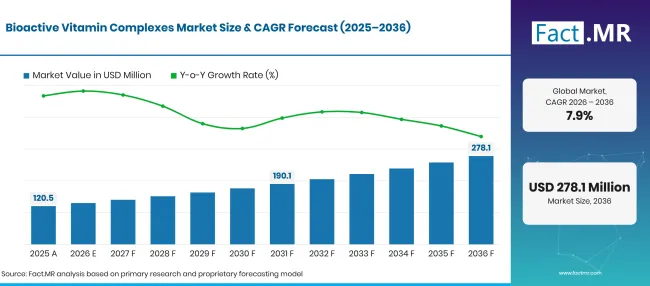
Bioactive Vitamin Complexes Forecast Global | Source: Fact.MR
Category
| Category | Segments |
|---|---|
| Product Type | B-complex bioactive, Vitamin K2 complex, Vitamin D3 complex, Vitamin E tocotrienol, Multivitamin bioactive blend |
| Delivery Form | Powder, Liquid, Tablet and capsule, Medical device and system, Specialty controlled-release |
| Clinical Use | Preventive care, Long-term management, Acute care, Nutrition support, Specialty and rare condition |
| Purchasing Channel | Home and community, Specialty clinic, Pharmacy, Medical nutrition OEM, Hospital |
| Region | France; United States; United Kingdom; Japan; Germany |
Source: Fact.MR analysis. Updated Nov 23, 2026
Source: Fact.MR analysis.
Segmental Analysis
Why do B-complex bioactives lead product demand in the Bioactive Vitamin Complexes Market?
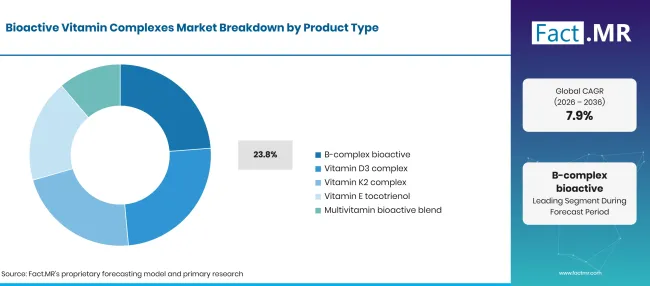
Bioactive Vitamin Complexes Breakdown Product Type | Source: Fact.MR
Demand for B-complex bioactives account for 23.8% of the bioactive vitamin complexes market in 2026, about USD 30.9 million, because the difference between standard and active B vitamins is easy to explain: a share of people convert folic acid and cyanocobalamin poorly, so methylfolate and methylcobalamin are promoted for energy, pregnancy and healthy homocysteine levels. Eight vitamins in one complex add value. The key players of bioactive vitamin complexes are offering coenzyme-form blends. Similar consumer understanding is projected to keep B-complex bioactives the leading product type.
How is the powder form leading demand in the Bioactive Vitamin Complexes Market?
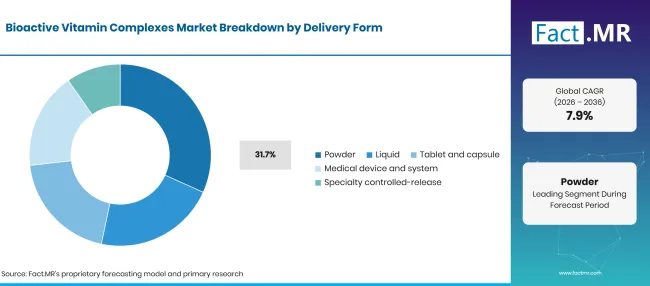
Bioactive Vitamin Complexes Breakdown Delivery Form | Source: Fact.MR
Sales of powder segment to represent 31.7% of bioactive vitamin complexes revenue in 2026, about USD 41.2 million, because active vitamins are sold to manufacturers as standardized powders and triturates that can be dosed in micrograms into capsules, tablets, sachets and drink mixes. Powder forms are also the most stable. As per the data published by the National Institute of Biotechnology Information, in 2025, the bioactive vitamin complexes are providing dilutions on neutral carriers. Similar handling needs are projected to keep powder the leading delivery form.
Why does preventive care lead clinical demand in the Bioactive Vitamin Complexes Market?
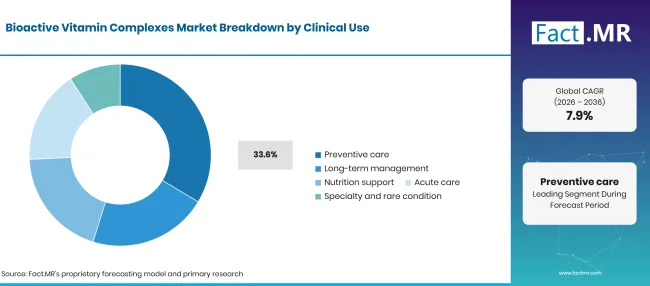
Bioactive Vitamin Complexes Breakdown Clinical Use | Source: Fact.MR
Demand for Preventive care segment to hold 33.6% of bioactive vitamin complexes revenue in 2026, about USD 43.7 million, as most buyers are healthy adults taking daily vitamins to support energy, immunity, bone and heart health, including women planning pregnancy and older adults. Daily use over years creates steady volume. Manufacturers of bioactive vitamin complexes are supporting claims with studies. Similar wellness habits are projected to keep preventive care the leading clinical use, in line with the immune health supplements market.
How is the home and community channel leading demand in the Bioactive Vitamin Complexes Market?
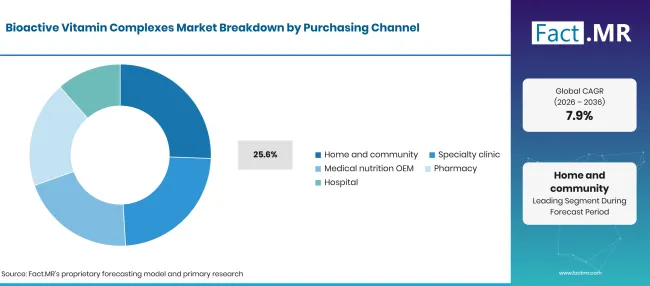
Bioactive Vitamin Complexes Breakdown Purchasing Channel | Source: Fact.MR
Home and community sales account for 25.6% of bioactive vitamin complexes revenue in 2026, about USD 33.3 million, as consumers increasingly purchase nutritional products through online platforms, subscriptions and health stores for personal use. According to INSEE, 72.9% of people aged 15 and above in France made an online purchase during the 12 months preceding its 2025 survey, while 63.6% purchased online within the previous three months. Eurostat's 2025 data also show that 80% of French residents aged 16–74 purchased goods or services online. These figures demonstrate the broad reach of digital retail, providing an established route for supplement brands to reach household consumers and introduce specialized vitamin formulations.
Bioactive Vitamin Complexes Market-Drivers, Restraints & Trends
Drivers:
Demand for bioactive vitamin complexes is rising as specialty nutrient suppliers report solid growth. For example, dsm-firmenich reported in November 2026 that its Health, Nutrition & Care unit grew 5% organically in the third quarter, with volume up 4%, and raised its full-year outlook. Suppliers of bioactive vitamin complexes are gaining as formulators replace commodity vitamins. Similar supplier momentum is projected to drive sales of bioactive vitamin complexes.
Restraints:
Demand for bioactive vitamin complexes is constrained by higher ingredient cost, instability of some active forms and pending dose limits. For example, industry advisers said in June 2026 that harmonized EU maximum levels for vitamins and minerals in supplements were on the way and would likely be low. Similar limits are projected to cap high-dose products. Suppliers of bioactive vitamin complexes must reformulate for European markets.
Opportunity: Vitamin K2 and D3 Combinations
Demand for menaquinone-7 with vitamin D3 is rising for bone and heart health positioning. Suppliers are offering stabilized K2 that survives mineral-rich formulas. World Osteoporosis Day on 20 October 2026 focused on lifelong bone health. Similar awareness is projected to drive sales, as covered in the bioactive vitamin K2 formulations market.
Trend: Fermentation-Derived Vitamins
In August 2026, an industry analysis found that Japan's market for foods with function claims grew 4% even as fewer new products were launched. Demand for natural-origin, fermentation-derived vitamins is rising among clean-label brands. Similar positioning is projected to support sales of bioactive vitamin complexes. Suppliers of bioactive vitamin complexes are serving brands across the nutraceutical supplements market.
Bioactive Vitamin Complexes Market by Analysis by Key Country
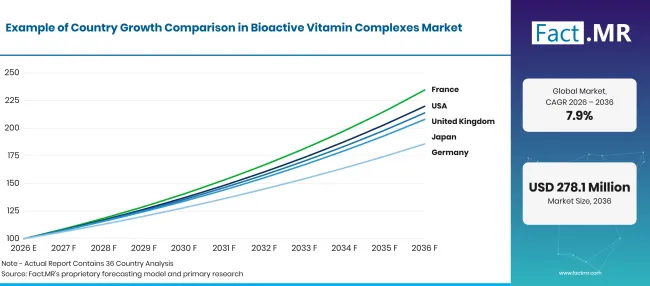
Bioactive Vitamin Complexes Growth Index | Source: Fact.MR
| Country | CAGR (2026-2036) |
|---|---|
| France | 8.9% |
| United States | 8.2% |
| United Kingdom | 7.9% |
| Japan | 7.6% |
| Germany | 6.4% |
Source: Fact.MR analysis. Updated Nov 23, 2026
Source: Fact.MR analysis.
What is driving bioactive vitamin complexes demand in France?
In November 2026, Le Monde reported that the French supplement market had tripled over fifteen years, and a Synadiet survey found that most recent users take supplements regularly.
Demand for bioactive vitamin complexes in France is projected to grow at an 8.9% CAGR, the fastest among the five key countries, as pharmacies and online brands promote premium vitamin formulas. Suppliers of bioactive vitamin complexes, including Gnosis by Lesaffre, are serving French laboratories. Similar market expansion is projected to drive sales in France.
How are specialty ingredients supporting bioactive vitamin complexes sales in the United States?
Sales of bioactive vitamin complexes in the United States are projected to increase at an 8.2% CAGR as supplement brands differentiate products through active nutrient forms, formulation quality and targeted health positioning.
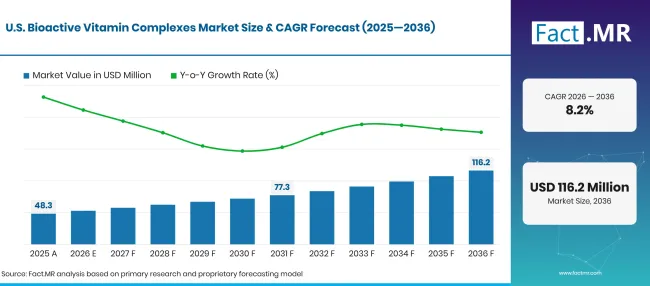
Bioactive Vitamin Complexes Forecast Usa | Source: Fact.MR
Balchem reported third-quarter 2026 Human Nutrition and Health sales of USD 188.2 million, up 8.1% year over year, with growth across nutrients and food ingredients. Glanbia’s Health and Nutrition revenue rose 14.0% in the first nine months of 2026, supported by volume growth and demand in vitamins, minerals and supplements. These results indicate continued activity across the nutrition ingredient supply chain, despite cautious consumer spending in North America.
What is shaping bioactive vitamin complexes demand in the United Kingdom?
Demand for bioactive vitamin complexes in the United Kingdom is estimated to grow at a 7.9% CAGR as consumers and healthcare professionals focus on targeted micronutrient intake.
The Food Standards Agency updated its consumer guidance on food supplements on June 25, 2026, reiterating that vitamin D supplements are recommended during autumn and winter. A June 2026 study led by Newcastle University found persistently low vitamin D levels among higher-risk groups, including older adults and people from minoritised ethnic backgrounds. These developments keep vitamin D status and supplementation in public discussion, creating opportunities for formulations using selected vitamin forms and combinations.
How is aging shaping bioactive vitamin complexes sales in Japan?
Sales of bioactive vitamin complexes in Japan are anticipated to record a 7.6% CAGR as population ageing increases attention to nutrition for healthy ageing.
Japan’s Ministry of Internal Affairs and Communications estimated that 36.24 million people were aged 65 or older in September 2026, representing 29.6% of the population. Separately, an August 2026 industry analysis reported that Japan’s Foods with Function Claims market expanded 4% in FY2025, despite fewer new product notifications. This demographic profile and demand for function-oriented foods support opportunities for age-specific nutrition products in supplements and wellness.
Why is growth slower for bioactive vitamin complexes in Germany?
Demand for bioactive vitamin complexes in Germany is projected to hold a 6.4% CAGR as supplement manufacturers operate within a cautious safety-assessment environment.
Germany’s Federal Institute for Risk Assessment recommends maximum levels for vitamins and minerals in supplements to limit excessive intake. However, these recommendations are guidance rather than legally binding limits, and no binding maximum levels currently apply across the EU. This distinction creates a need for careful formulation, dosage justification and compliance review. Suppliers such as BASF can compete through documented ingredient quality and technical support, while monitoring future EU-level harmonisation proposals and scientific risk assessments.
Competitive Landscape for Bioactive Vitamin Complexes Market
Competition in the bioactive vitamin complexes market is led by vitamin and specialty nutrient producers. DSM-Firmenich and BASF compete with broad vitamin portfolios and premix capability, Balchem competes with vitamin K2, folate and choline brands, Gnosis by Lesaffre competes with fermentation-derived K2 and active folate, Glanbia Nutritionals competes with custom premixes, and Lonza competes through capsule and delivery technologies. Buyers select bioactive vitamin complexes on clinical evidence, stability, purity, regulatory status and price.
From 2025 onward, competition shifted toward branded, studied actives. Balchem reported new science on its vitamin ingredients in October 2026, dsm-firmenich raised its outlook, and the French supplement market passed EUR 3 billion. Suppliers with stable active forms and human studies are best placed to grow.
Recent Developments
- In November 2026, dsm-firmenich raised its full-year growth outlook following 5% organic growth in its Health, Nutrition & Care business during the third quarter.
- In October 2026, Balchem reported third-quarter net sales of USD 290.7 million, reflecting continued demand across its human nutrition, health and specialty ingredient businesses.
- In June 2026, the UK Food Standards Agency published consumer guidance on food supplements, highlighting responsible use, product safety and important considerations when choosing supplements.
- In March 2026, Synadiet reported that French dietary supplement sales exceeded EUR 3 billion in 2025, reflecting continued consumer interest in nutritional and preventive health products.
Key Players in Bioactive Vitamin Complexes Market
Key companies operating in the market include DSM-Firmenich, BASF, Balchem, Gnosis by Lesaffre, Glanbia Nutritionals, and Lonza.
- DSM-Firmenich
- BASF
- Balchem
- Gnosis by Lesaffre
- Glanbia Nutritionals
- Lonza
Bibliography
- Balchem Corporation. (2026, October 23). Balchem reports third quarter 2026 financial results.
- dsm-firmenich. (2026, November 4). dsm-firmenich reports Q3 2026 trading update.
- Eurostat. (2026). E-commerce statistics for individuals. European Commission.
- Food Standards Agency. (2026, June 25). Food supplements: Guidance for consumers. GOV.UK.
- German Federal Institute for Risk Assessment. (n.d.). Health assessment of food supplements.
- Institut national de la statistique et des études économiques. (2025, December 2). Achat sur Internet selon l’âge: Données annuelles de 2009 à 2025.
- International Osteoporosis Foundation. (2026, October 20). World Osteoporosis Day 2026.
- Japan Times. (2026, September 21). Japan’s elderly population grows to its largest share yet.
- Synadiet. (n.d.). La consommation des compléments alimentaires en France.
Segmentation
Scope of Report
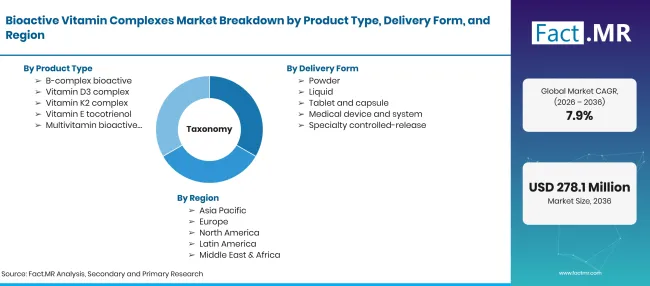
Bioactive Vitamin Complexes Taxonomy | Source: Fact.MR
| Items | Values |
|---|---|
| Quantitative Units (2026) | USD 130.0 Million |
| Product Type | B-complex bioactive, Vitamin K2 complex, Vitamin D3 complex, Vitamin E tocotrienol, Multivitamin bioactive blend |
| Delivery Form | Powder, Liquid, Tablet and capsule, Medical device and system, Specialty controlled-release |
| Clinical Use | Preventive care, Long-term management, Acute care, Nutrition support, Specialty and rare condition |
| Purchasing Channel | Home and community, Specialty clinic, Pharmacy, Medical nutrition OEM, Hospital |
| Regions Covered | North America, Latin America, Europe, East Asia, South Asia and Pacific, Middle East & Africa |
| Countries Covered | France, United States, United Kingdom, Japan, Germany, and other countries |
| Key Companies Profiled | DSM-Firmenich, BASF, Balchem, Gnosis by Lesaffre, Glanbia Nutritionals, Lonza |
| Additional Attributes | Dollar revenue in the Bioactive Vitamin Complexes Market is segmented by product type (B-complex bioactive, vitamin K2 complex, vitamin D3 complex, vitamin E tocotrienol, multivitamin bioactive blend), delivery form, clinical use, purchasing channel and region. |
Source: Fact.MR analysis. Updated Nov 23, 2026
Source: Fact.MR analysis.
Bioactive Vitamin Complexes Market by Segments
-
Product Type
- B-complex bioactive
- Vitamin K2 complex
- Vitamin D3 complex
- Vitamin E tocotrienol
- Multivitamin bioactive blend
-
Delivery Form
- Powder
- Liquid
- Tablet and capsule
- Medical device and system
- Specialty controlled-release
-
Clinical Use
- Preventive care
- Long-term management
- Acute care
- Nutrition support
- Specialty and rare condition
-
Purchasing Channel
- Home and community
- Specialty clinic
- Pharmacy
- Medical nutrition OEM
- Hospital
-
Region:
- North America
- United States
- Canada
- Mexico
- Europe
- Germany
- United Kingdom
- France
- Italy
- Spain
- Rest of Europe
- Asia Pacific
- China
- India
- Japan
- South Korea
- Australia
- Rest of Asia Pacific
- Latin America
- Brazil
- Mexico
- Argentina
- Rest of Latin America
- Middle East & Africa
- GCC Countries
- South Africa
- Rest of Middle East & Africa
- North America
Frequently Asked Questions
How big is the global Bioactive Vitamin Complexes Market in 2026?
What will be the size of the Bioactive Vitamin Complexes Market by 2036?
How fast will the Bioactive Vitamin Complexes Market grow during the forecast period?
Which product type segment holds the largest share of the Bioactive Vitamin Complexes Market?
Who worked on this report


Preview the report firsthand - request a free sample
Free SampleGet the brochure for pricing and purchase details
Download PDF