- Market Value (2025): USD 36.7 Mn
- Estimated Value (2026): USD 40.0 Mn
- Forecast Value (2036): USD 93.8 Mn
- CAGR (2026-2036): 8.9%
Microencapsulated Nutrient Carriers Market Forecast and Outlook 2026 to 2036
According to the Fact.MR analysis, the microencapsulated nutrient carriers market crossed a valuation of USD 36.7 million in 2025 and is projected to grow from USD 40.0 million in 2026 to USD 93.8 million by 2036. Demand for microencapsulated nutrient carriers is likely to grow at a CAGR of 8.9% over the forecast period.
Demand for microencapsulated nutrient carriers is rising as makers of medical nutrition, infant formula and supplements need to protect sensitive vitamins, minerals, omega-3 oils and bioactives from oxygen, moisture, heat and each other, mask unpleasant tastes and improve absorption. The key players manufacturing microencapsulated nutrient carriers are offering cyclodextrin inclusion complexes, lipid and protein microcapsules, polysaccharide matrices and hybrid carriers made by spray drying, fluid-bed coating and coacervation. For example, in November 2026, dsm-firmenich reported 5% organic growth in its Health, Nutrition & Care unit for the third quarter and raised its full-year growth outlook. Similar ingredient demand is projected to drive sales of microencapsulated nutrient carriers.
Key Takeaways from the Microencapsulated Nutrient Carriers Market
- Microencapsulated Nutrient Carriers Market Value (2025): USD 36.7 million
- Microencapsulated Nutrient Carriers Market Value (2026): USD 40.0 million
- Microencapsulated Nutrient Carriers Market Forecast Value (2036): USD 93.8 million
- Microencapsulated Nutrient Carriers Market Forecast CAGR (2026-2036): 8.9%
- Leading Product Type: Cyclodextrin inclusion (29.7%)
- Key Market Participants: DSM-Firmenich, BASF, Balchem, Glatt, IFF, Kerry Group
- Key Growth Regions: United Kingdom, France, Netherlands, United States, Switzerland
In October 2026, Balchem reported third-quarter Human Nutrition and Health sales of USD 188 million, up 8.1%, with segment earnings up 11.8%. Demand for microencapsulated nutrient carriers is growing as specialty nutrient suppliers gain from formulations that need encapsulated forms. Manufacturing companies of microencapsulated nutrient carriers are publishing bioavailability and stability data. Similar supplier growth is projected to support sales of microencapsulated nutrient carriers across Europe and the United States.
Microencapsulated Nutrient Carriers Market
| Metric | Value |
|---|---|
| Estimated Value in (2026) | USD 40.0 million |
| Forecast Value in (2036) | USD 93.8 million |
| Forecast CAGR (2026 to 2036) | 8.9% |
Source: Fact.MR analysis. Updated Nov 23, 2026
Source: Fact.MR analysis.
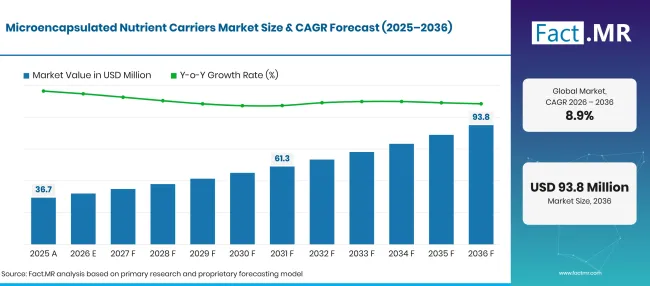
Microencapsulated Nutrient Carriers Forecast Global | Source: Fact.MR
Category
| Category | Segments |
|---|---|
| Product Type | Cyclodextrin inclusion, Hybrid nutrient microcarrier, Polysaccharide carrier, Lipid microcapsule, Protein-based microcapsule |
| Delivery Form | Powder, Specialty controlled-release, Tablet and capsule, Medical device and system, Liquid |
| Clinical Use | Nutrition support, Specialty and rare condition, Preventive care, Long-term management, Acute care |
| Purchasing Channel | Specialty clinic, Medical nutrition OEM, Hospital, Home and community, Pharmacy |
| Region | United Kingdom; France; Netherlands; United States; Switzerland |
Source: Fact.MR analysis. Updated Nov 23, 2026
Source: Fact.MR analysis.
Segmental Analysis
Why do cyclodextrin inclusion carriers lead product demand in the Microencapsulated Nutrient Carriers Market?
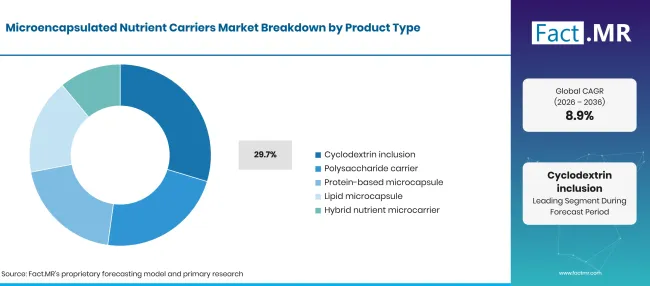
Microencapsulated Nutrient Carriers Breakdown Product Type | Source: Fact.MR
Demand for cyclodextrin inclusion carriers account for 29.7% of the microencapsulated nutrient carriers market in 2026, about USD 11.9 million, because these ring-shaped starch derivatives trap a single nutrient molecule inside a cavity, which makes fat-soluble vitamins, coenzyme Q10 and plant actives disperse in water and shields them from oxidation. Complexes form by simple mixing and drying. Suppliers of microencapsulated nutrient carriers are documenting improved absorption. Similar solubility gains are projected to keep cyclodextrin inclusion the leading product type. Fat-soluble vitamins A, D, E and K are among the nutrients investigated for cyclodextrin complexation. A 2025 review in International Journal of Molecular Sciences documents the use of these complexes to improve solubility and stability, supporting their relevance in nutrient formulation. Their ability to address solubility challenges makes cyclodextrins particularly useful for incorporating lipid-soluble nutrients into aqueous beverage and supplement formulations.
How is the powder form leading demand in the Microencapsulated Nutrient Carriers Market?
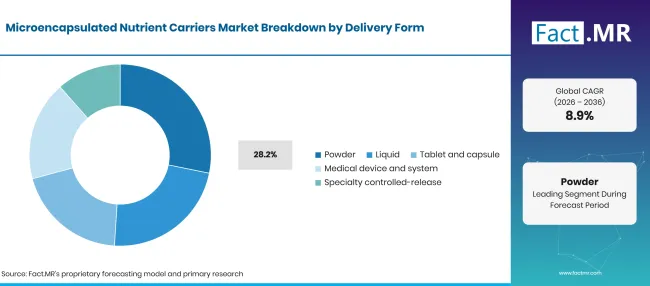
Microencapsulated Nutrient Carriers Breakdown Delivery Form | Source: Fact.MR
Sales of powder to represent 28.2% of microencapsulated nutrient carriers revenue in 2026, about USD 11.3 million, because spray-dried and coated carriers are supplied as free-flowing powders that blend into dry mixes, premixes, sachets and tablet granulations and stay stable in storage. Most clinical nutrition products are assembled from powders. Manufactueres of microencapsulated nutrient carriers are controlling particle size for uniform blending. Similar manufacturing practice is projected to keep powder the leading delivery form. A November 2025 review in Trends in Food Science & Technology explains that spray drying produces transportable powders, while subsequent fluidized-bed agglomeration can improve particle handling and solubility. These processing advantages allow manufacturers to incorporate sensitive nutrients into multiple product formats while managing particle characteristics and ingredient stability.
Why does nutrition support lead clinical demand in the Microencapsulated Nutrient Carriers Market?
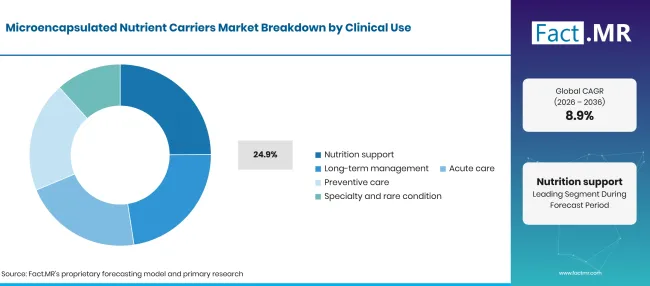
Microencapsulated Nutrient Carriers Breakdown Clinical Use | Source: Fact.MR
Nutrition support segment hold 24.9% of microencapsulated nutrient carriers revenue in 2026, about USD 10.0 million, as oral nutritional supplements and tube feeds must carry a full set of vitamins, trace elements and fatty acids through heat treatment and long shelf life without off-flavors. Encapsulated iron and omega-3 are standard solutions. Suppliers of microencapsulated nutrient carriers are serving medical nutrition formulators, in line with the clinical nutrition market. Formulation demands are projected to keep nutrition support the leading clinical use. Research on microencapsulation highlights its role in protecting functional ingredients and maintaining their properties during processing and storage. This is particularly relevant for fortified nutrition products that must maintain nutrient content and acceptable sensory characteristics throughout their intended shelf life.
How are specialty clinics leading channel demand in the Microencapsulated Nutrient Carriers Market?
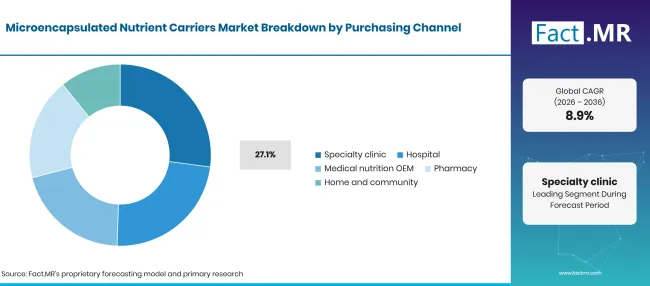
Microencapsulated Nutrient Carriers Breakdown Purchasing Channel | Source: Fact.MR
Adoption by specialty clinics to represent 27.1% of microencapsulated nutrient carriers revenue in 2026, about USD 10.8 million, because metabolic, bariatric, gastroenterology and pediatric clinics recommend specialized supplements that rely on encapsulated nutrients for tolerance and absorption, and practitioner-channel brands pay for premium carriers. Patients there need reliable dosing. The manufacturing companies of microencapsulated nutrient carriers are supplying practitioner brands. Clinical channels are projected to keep specialty clinics the leading purchasing channel. Microencapsulation can help formulators improve the stability, dispersibility and handling of selected vitamins and minerals used in specialized supplements. These clinical requirements create opportunities for premium nutrient formulations, particularly products designed around defined patient needs rather than general-purpose nutritional supplementation.
Microencapsulated Nutrient Carriers Market-Drivers, Restraints & Trends
Drivers:
Demand for microencapsulated nutrient carriers is rising as supplement use grows. For example, the French supplements association Synadiet reported in March 2026 that the French market exceeded EUR 3 billion for the first time in 2025, up 2.6%, with online sales up 5%. Manufactueres of microencapsulated nutrient carriers are benefiting from demand for better-tasting, more stable products. Similar market growth is projected to drive sales of microencapsulated nutrient carriers.
Restraints:
Demand for microencapsulated nutrient carriers is constrained by added cost, limits on payload and pending regulation. For example, industry advisers warned in June 2026 that harmonized EU maximum levels for vitamins and minerals in supplements were coming and would likely be set quite low. Similar rules are projected to force reformulation and delay some launches. Suppliers of microencapsulated nutrient carriers must also meet clean-label expectations for coating materials.
Opportunity: Clean-Label Coating Materials
Demand for carriers made from plant proteins, starches and natural lipids is rising as brands avoid synthetic polymers. The key players are developing pea protein and modified-starch-free shells. Roquette reported growth in protein and fibre sales in September 2026. Similar materials are projected to drive sales of microencapsulated nutrient carriers, using inputs from the plant protein ingredients market.
Trend: Targeted and Delayed Release
In October 2026, Balchem highlighted new science supporting its encapsulated and specialty nutrients. Demand for carriers that release nutrients in the intestine instead of the stomach is rising. Similar functionality is projected to drive sales of microencapsulated nutrient carriers. Suppliers of microencapsulated nutrient carriers are supplying brands in the nutraceutical supplements market.
Microencapsulated Nutrient Carriers Market by Analysis by Key Country
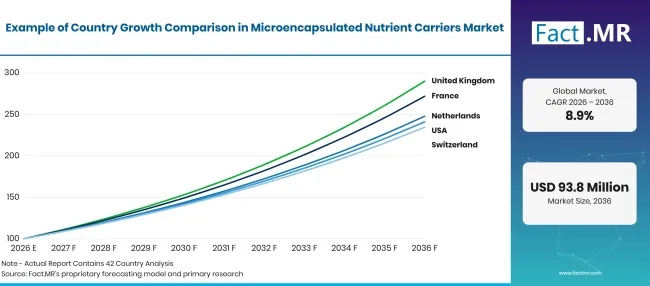
Microencapsulated Nutrient Carriers Growth Index | Source: Fact.MR
| Country | CAGR (2026-2036) |
|---|---|
| United Kingdom | 11.2% |
| France | 10.5% |
| Netherlands | 9.5% |
| United States | 9.2% |
| Switzerland | 8.9% |
Source: Fact.MR analysis. Updated Nov 23, 2026
Source: Fact.MR analysis.
What is driving microencapsulated nutrient carriers demand in the United Kingdom?
In June 2026, the UK Food Standards Agency published new guidance for consumers on food supplements, and NHS integrated care boards updated guidance on oral nutritional supplements during the year.
Demand for microencapsulated nutrient carriers in the United Kingdom is projected to grow at an 11.2% CAGR, the fastest among the five key countries, as UK supplement brands and contract manufacturers upgrade formulations from a small base. Manufacturing companies of microencapsulated nutrient carriers are serving UK formulators. Similar activity is projected to drive sales in the United Kingdom.
How is supplement growth supporting microencapsulated nutrient carriers sales in France?
Sales of microencapsulated nutrient carriers in France are estimated to increase at a 10.5% CAGR as demand for dietary supplements expands and product formulations become more specialized.
Le Monde reported in November 2026 that French supplement sales had tripled between 2010 and 2025, exceeding EUR 3 billion. Synadiet also reported that 61% of French consumers used supplements in 2026, while 78% of users consumed them several times a year. In addition, 29% of supplement sales in 2025 came from products launched during the preceding three years. This rapid product renewal encourages formulators to improve nutrient stability, taste and dispersibility. Microencapsulation can help protect sensitive vitamins, minerals and botanical ingredients in increasingly differentiated supplement formats for pharmacy and online retail products.
What is shaping microencapsulated nutrient carriers demand in the Netherlands?
Demand for microencapsulated nutrient carriers in the Netherlands is anticipated to record a 9.5% CAGR as infant, performance and medical nutrition manufacturers expand ingredient capabilities.
dsm-firmenich reported 5% like-for-like sales growth in its Health, Nutrition & Care business in the third quarter of 2026, supported by continued momentum in Early Life Nutrition and strong demand for human milk oligosaccharides. FrieslandCampina announced an investment programme exceeding EUR 90 million in May 2026 to upgrade Dutch production sites and expand high-value whey protein capacity for performance, early-life and medical nutrition applications. These developments strengthen the country's nutrition ingredient manufacturing base. They also create opportunities for carriers that protect sensitive nutrients and support consistent incorporation into specialized powdered formulations for nutrition producers.
How is cautious spending shaping microencapsulated nutrient carriers sales in the United States?
Sales of microencapsulated nutrient carriers in the United States are estimated to grow at a 9.2% CAGR as specialty nutrition demand advances despite cautious consumer spending.
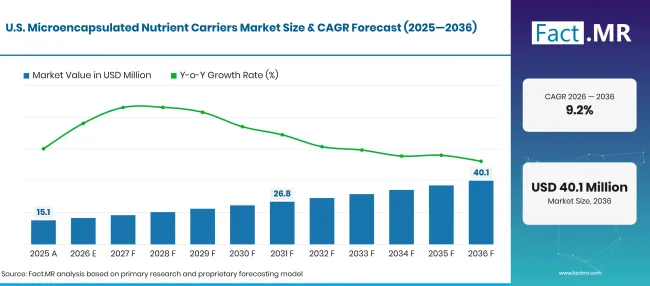
Microencapsulated Nutrient Carriers Forecast Usa | Source: Fact.MR
In its November 2026 trading update, dsm-firmenich said cautious North American consumer behavior continued to affect dietary supplements and i-Health, indicating pressure on discretionary purchases. However, Balchem reported that third-quarter 2026 sales in its Human Nutrition & Health segment increased 8.1% year over year to USD 188.2 million, driven by higher sales in nutrients and food ingredients and solutions. This divergence points to selective demand rather than a broad-based slowdown. Ingredient suppliers can benefit from manufacturers prioritizing differentiated formulations, nutrient stability and functional performance while managing product costs and retail price sensitivity and differentiation.
Why is growth slower for microencapsulated nutrient carriers in Switzerland?
Demand for microencapsulated nutrient carriers in Switzerland is projected to represent at an 8.9% CAGR, the slowest among the five countries, as a smaller domestic market and established ingredient infrastructure moderate expansion.
dsm-firmenich maintains a global headquarters in Kaiseraugst, where its Swiss operations include research, formulation, application, analytics and manufacturing capabilities. The company reported 5% like-for-like growth in Health, Nutrition & Care during the third quarter of 2026, reflecting continued momentum in its nutrition businesses. Nestlé, another major Swiss-based nutrition group, recorded 3.7% organic growth across the group during the first nine months of 2026, although nutrition category sales declined 0.7%. These mixed indicators suggest steady demand, with growth opportunities concentrated in specialized, higher-value nutrition applications and innovation-led niches there.
Competitive Landscape for Microencapsulated Nutrient Carriers Market
Competition in the microencapsulated nutrient carriers market is led by nutrition ingredient companies and process technology firms. DSM-Firmenich and BASF compete with encapsulated vitamins and lipids, Balchem competes with lipid-encapsulated and chelated nutrients, Glatt competes with fluid-bed coating technology and contract processing, and IFF and Kerry Group compete with flavor and nutrient delivery systems. Buyers select microencapsulated nutrient carriers on stability, payload, taste masking, release profile, label acceptance and cost.
From 2025 onward, competition shifted toward clean-label shells and proven absorption. dsm-firmenich raised its outlook in November 2026, Balchem's human nutrition earnings rose 11.8%, and the French supplement market passed EUR 3 billion. Suppliers that pair natural coating materials with bioavailability data are best placed to grow.
Recent Developments
- In November 2026, dsm-firmenich reported 5% organic growth in Health, Nutrition & Care and raised its outlook.
- In October 2026, Balchem reported an 8.1% rise in Human Nutrition and Health sales.
- In June 2026, the UK Food Standards Agency published consumer guidance on food supplements.
- In March 2026, Synadiet reported that the French supplement market passed EUR 3 billion.
Key Players in Microencapsulated Nutrient Carriers Market
Key companies operating in the market include DSM-Firmenich, BASF, Balchem, Glatt, IFF, and Kerry Group.
- DSM-Firmenich
- BASF
- Balchem
- Glatt
- IFF
- Kerry Group
Bibliography
- Balchem Corporation. (2026, October 23). Balchem reports third quarter 2026 financial results.
- Chaffin, Z. (2026, November 4). L’incroyable essor des compléments alimentaires, porté par l’anxiété des Français. Le Monde.
- dsm-firmenich. (2026, November 4). dsm-firmenich reports Q3 2026 trading update.
- Food Standards Agency. (2026, June 25). Food supplements guidance. GOV.UK.
- Pidalà, J., Lombardelli, C., Benucci, I., & Esti, M. (2025). Synergistic use of spray drying and fluidized bed in the microencapsulation of food ingredients. Trends in Food Science & Technology.
- Roquette. (2026, September 24). Strategic transformation supports Roquette’s H1 2026 performance.
- Synadiet. (2026). La consommation des compléments alimentaires en France.
- Zielińska-Pisklak, M., Michalik, K. A., & Szeleszczuk, Ł. (2025). Complexes of fat-soluble vitamins with cyclodextrins. International Journal of Molecular Sciences, 26(13), 6110.
Segmentation
Scope of Report
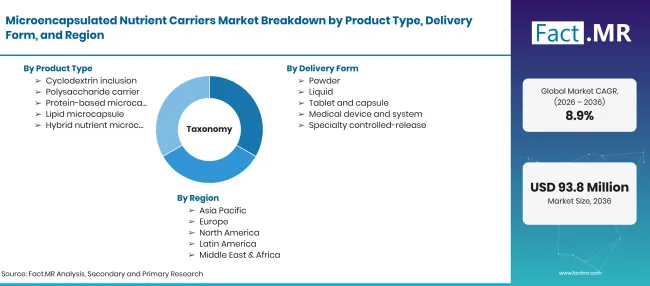
Microencapsulated Nutrient Carriers Taxonomy | Source: Fact.MR
| Items | Values |
|---|---|
| Quantitative Units (2026) | USD 40.0 Million |
| Product Type | Cyclodextrin inclusion, Hybrid nutrient microcarrier, Polysaccharide carrier, Lipid microcapsule, Protein-based microcapsule |
| Delivery Form | Powder, Specialty controlled-release, Tablet and capsule, Medical device and system, Liquid |
| Clinical Use | Nutrition support, Specialty and rare condition, Preventive care, Long-term management, Acute care |
| Purchasing Channel | Specialty clinic, Medical nutrition OEM, Hospital, Home and community, Pharmacy |
| Regions Covered | North America, Latin America, Europe, East Asia, South Asia and Pacific, Middle East & Africa |
| Countries Covered | United Kingdom, France, Netherlands, United States, Switzerland, and other countries |
| Key Companies Profiled | DSM-Firmenich, BASF, Balchem, Glatt, IFF, Kerry Group |
| Additional Attributes | Dollar revenue in the Microencapsulated Nutrient Carriers Market is segmented by product type (cyclodextrin inclusion, hybrid microcarrier, polysaccharide carrier, lipid microcapsule, protein-based microcapsule), delivery form, clinical use, purchasing channel and region. |
Source: Fact.MR analysis. Updated Nov 23, 2026
Source: Fact.MR analysis.
Microencapsulated Nutrient Carriers Market by Segments
-
Product Type
- Cyclodextrin inclusion
- Hybrid nutrient microcarrier
- Polysaccharide carrier
- Lipid microcapsule
- Protein-based microcapsule
-
Delivery Form
- Powder
- Specialty controlled-release
- Tablet and capsule
- Medical device and system
- Liquid
-
Clinical Use
- Nutrition support
- Specialty and rare condition
- Preventive care
- Long-term management
- Acute care
-
Purchasing Channel
- Specialty clinic
- Medical nutrition OEM
- Hospital
- Home and community
- Pharmacy
-
Region:
- North America
- United States
- Canada
- Mexico
- Europe
- Germany
- United Kingdom
- France
- Italy
- Spain
- Rest of Europe
- Asia Pacific
- China
- India
- Japan
- South Korea
- Australia
- Rest of Asia Pacific
- Latin America
- Brazil
- Mexico
- Argentina
- Rest of Latin America
- Middle East & Africa
- GCC Countries
- South Africa
- Rest of Middle East & Africa
- North America
Frequently Asked Questions
How big is the global Microencapsulated Nutrient Carriers Market in 2026?
What will be the size of the Microencapsulated Nutrient Carriers Market by 2036?
How fast will the Microencapsulated Nutrient Carriers Market grow during the forecast period?
Which product type segment holds the largest share of the Microencapsulated Nutrient Carriers Market?
Who worked on this report


Preview the report firsthand - request a free sample
Free SampleGet the brochure for pricing and purchase details
Download PDF