- Market Value (2025): USD 344.7 Mn
- Estimated Value (2026): USD 384.5 Mn
- Forecast Value (2036): USD 1147.1 Mn
- CAGR (2026-2036): 11.6%
Women’s Health Smart Rings Market Forecast and Outlook 2026 to 2036
The global women’s health smart rings market was valued at USD 344.7 million in 2025 and reached USD 384.5 million in 2026. The market is forecast to reach USD 1147.1 million by 2036,expanding at a CAGR of 11.6% during the assessment period.
Women are using smart rings to track temperature, heart rate and sleep patterns, gaining a better understanding of menstrual cycles, fertility, pregnancy and menopause. Manufacturers are adding cycle tracking, perimenopause insights and health reports that make these devices more useful for everyday monitoring. For example, Oura reported USD 1.2 billion in revenue for the nine months ended June 30, 2026, up 74% year on year, while membership revenue increased 121%. This wider interest in personal health tracking is creating more opportunities for women’s health smart rings.
Key Takeaways from the Women’s Health Smart Rings Market
- Sales of women’s health smart rings stood at USD 344.7 million in 2025
- Women’s Health Smart Rings Market Value (2026): USD 384.5 million
- Women’s Health Smart Rings Market Forecast Value (2036): USD 1147.1 million
- Women’s Health Smart Rings Market Forecast CAGR (2026-2036): 11.6%
- Leading Women's Health Feature: Cycle / ovulation inference (22.7%)
- Key Market Participants: Oura, Samsung Electronics, Ultrahuman, RingConn, Movano Health (Evie), Circular
- Key Growth Regions: South Korea, China, United States, Japan, Germany
In May 2026, Oura introduced the Oura Ring 5, describing it as the world's smallest smart ring, around 40% smaller than its previous model, with prices starting at USD 399 plus a monthly membership. Compact designs are making smart rings more comfortable for everyday use across different hand sizes. Manufacturers are also focusing on longer battery life and more detailed hormonal health features. These improvements are helping women’s health smart rings gain attention across North America, East Asia and Europe.
Women’s Health Smart Rings Market
| Metric | Value |
|---|---|
| Estimated Value in (2025) | USD 344.7 million |
| Estimated Value in (2026) | USD 384.5 million |
| Forecast Value in (2036) | USD 1147.1 million |
| Forecast CAGR (2026 to 2036) | 11.6% |
Source: Fact.MR analysis. Updated Nov 23, 2026
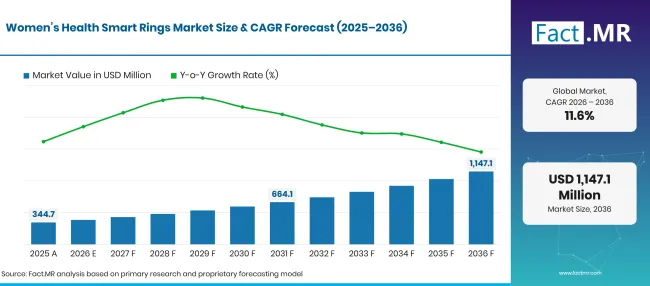
Womens Health Smart Rings Market Forecast Global | Source: Fact.MR
Category
| Category | Segments |
|---|---|
| Women's Health Feature | Cycle / ovulation inference, Basal temperature tracking, Pregnancy wellness, Menopause monitoring, General recovery metrics |
| Data Processing | Clinician-linked dashboard, Smartphone companion, Cloud AI, On-device algorithm, Hybrid edge-cloud |
| Sales Channel | Brand direct online, Retail electronics, Pharmacy / wellness retail, Clinical / professional, B2B / institutional |
| Region | South Korea; China; United States; Japan; Germany |
Source: Fact.MR analysis. Updated Nov 23, 2026
Segmental Analysis
Why does cycle and ovulation inference lead feature demand in the Women’s Health Smart Rings Market?
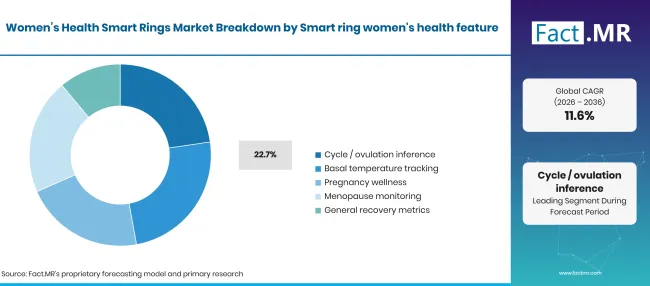
Womens Health Smart Rings Market Breakdown Smart Ring Womens Health Feature | Source: Fact.MR
Cycle and ovulation inference leads the feature segment with 22.7% of market revenue in 2026, valued at USD 87.3 million. Women are using overnight skin temperature and heart rate variations to understand menstrual patterns and identify fertile windows without maintaining daily records. The feature also appeals to users tracking irregular cycles and hormonal changes around perimenopause. Other features, including sleep monitoring and stress tracking, are gaining attention as women look for a broader view of their health. Clear communication about the limitations of cycle-based fertility estimates remains important.
How are clinician-linked dashboards leading data demand in the Women’s Health Smart Rings Market?
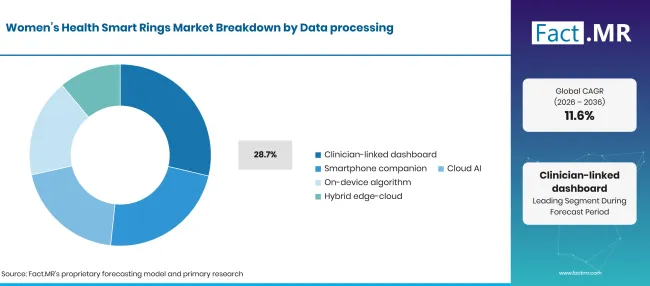
Womens Health Smart Rings Market Breakdown Data Processing | Source: Fact.MR
Clinician-linked dashboards lead the data segment with 28.7% of revenue in 2026, reaching USD 110.4 million. Women increasingly want to discuss recurring changes in sleep, temperature and menstrual patterns with gynecologists and menopause specialists rather than rely entirely on app-generated insights. Shareable summaries make these conversations easier, while privacy controls and data compatibility are becoming important selection factors. In 2026, the American Medical Association examined consumer wearable data use in clinical practice, highlighting the need for clearer workflows and consistent data interpretation.
Why do brand direct online channels lead sales in the Women’s Health Smart Rings Market?
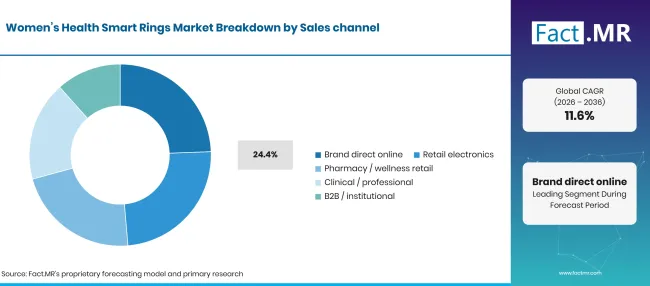
Womens Health Smart Rings Market Breakdown Sales Channel | Source: Fact.MR
Buying directly from brand websites gives women access to sizing kits, product comparisons, subscription plans and personalised support before choosing a ring. This channel leads with 24.4% of revenue in 2026, valued at USD 93.8 million. Retail partnerships and third-party marketplaces are also gaining ground as consumers prefer trying ring sizes before purchasing. Oura's September 2026 SEC filing reported USD 723.8 million in direct-to-consumer revenue for the nine months ended June 30, compared with USD 420.5 million a year earlier. Its membership revenue also increased 121%, strengthening the appeal of subscription-led online sales.
Women’s Health Smart Rings Market-Drivers, Restraints & Trends
Drivers: Menopause Awareness Expands Interest in Women's Health Monitoring:
Women are paying closer attention to menopause because symptoms such as disrupted sleep, temperature fluctuations and fatigue can affect their working lives and daily routines. This is creating room for smart rings that track physiological changes over time and help users recognise recurring patterns. In November 2026, KPMG highlighted HWR Berlin research linking menopause-related workplace constraints in Germany to nearly 40 million lost working days annually. Greater workplace awareness is opening opportunities for women's health smart rings with dedicated perimenopause and menopause insights.
Restraints: Limited Clinical Validation and Regulatory Recognition:
Many women's health smart rings still face a credibility gap because their readings cannot replace medical tests or professional diagnosis. In July 2026, Oura clarified that its ring is not a medical device and is not intended to diagnose or treat medical conditions. Differences in sensor accuracy, inconsistent cycle predictions, privacy concerns and recurring subscription charges can also discourage buyers.
Trend: Regulatory Recognition of Smart Ring Health Monitoring:
Smart rings are moving beyond general wellness tracking as regulators begin clearing specific health-screening applications. In November 2026, Samsung announced FDA-cleared sleep apnea risk detection on Galaxy Ring, alongside approval from South Korea's MFDS. This progress creates an opportunity for the wider women's health smart rings market to invest in clinical validation, reliable hormonal tracking and evidence-backed health insights. Greater regulatory acceptance could also encourage healthcare partnerships and wider adoption of ring-based monitoring.
Trend: Menopause and Work:
In October 2026, Medscape reported research from Japan linking psychological symptoms in peri- and postmenopausal women to intentions to leave their jobs. Similar evidence is projected to drive sales of women’s health smart rings among working women aged 40 to 60.
Women’s Health Smart Rings Market by Analysis by Key Country
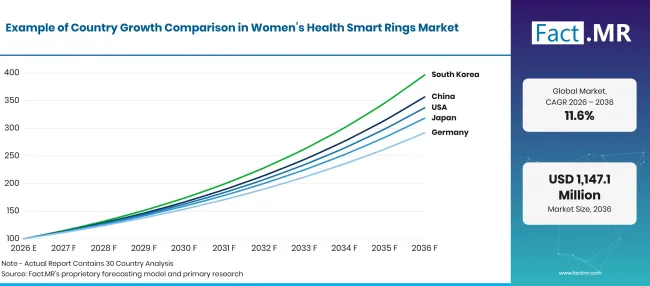
Womens Health Smart Rings Market Growth Index | Source: Fact.MR
| Country | CAGR (2026-2036) |
|---|---|
| South Korea | 14.8% |
| China | 13.6% |
| United States | 12.9% |
| Japan | 12.3% |
| Germany | 11.3% |
Source: Fact.MR analysis. Updated Nov 23, 2026
What is driving women’s health smart rings demand in South Korea?
South Korea's strong digital health ecosystem and consumer interest in connected wellness devices are creating favourable conditions for women's health smart rings.
The regulatory environment is also evolving. In January 2026, the Ministry of Food and Drug Safety introduced a framework covering digital health-support devices that measure and analyse indicators such as heart rate, oxygen saturation and body composition. This is encouraging greater attention to wearable health monitoring. Rising interest in menstrual tracking, sleep analysis and personalised health data is adding to sales opportunities.
How are domestic brands supporting women’s health smart rings sales in China?
China's expanding digital healthcare ecosystem is bringing wearable monitoring closer to everyday health management.
In November 2025, the National Health Commission issued guidance on integrating artificial intelligence into healthcare, including health management and preventive services.This creates a supportive environment for connected wellness technologies. Women's increasing interest in menstrual health, fertility awareness and convenient health tracking is also creating room for smart rings. Wider smartphone adoption, local wearable manufacturing and AI-based health applications are adding momentum to regional sales.
What is shaping women’s health smart rings demand in the United States?
American consumers are showing greater interest in wearable health data that can be used beyond basic fitness tracking.
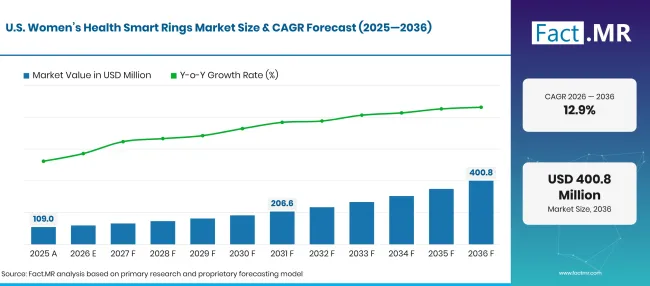
Womens Health Smart Rings Market Forecast Usa | Source: Fact.MR
A 2026 study published in JAMA Network Open found that wearable device use among US adults increased from 30.2% in 2020 to 41.1% in 2024. The findings point to wider acceptance of continuous health monitoring. For women's health smart rings, interest in fertility awareness, menstrual patterns and menopause tracking is creating additional sales opportunities. Strong digital health research and direct-to-consumer retail channels further support adoption.
Why is menopause shaping women’s health smart rings demand in Japan?
Workplace wellness and greater recognition of women's health needs are giving Japan's femtech industry fresh momentum.
In May 2026, Japan's Ministry of Economy, Trade and Industry released guidance for businesses and local governments on introducing femtech solutions, following 79 demonstration projects conducted between FY2021 and FY2025. The initiative covers menstrual health, fertility, pregnancy and menopause. This wider institutional interest is creating opportunities for smart rings that track temperature, sleep and cycle changes. Corporate wellness programmes and Japan's ageing female population are additional sales drivers.
How is the cost of menopause shaping women’s health smart rings demand in Germany?
Germany's focus on menopause awareness and better access to women's healthcare is creating opportunities for wearable monitoring solutions.
In October 2026, the Federal Ministry of Health concluded its year-long menopause dialogue and outlined measures to strengthen medical education and research in this area. Greater recognition of symptoms such as sleep disruption and temperature fluctuations is encouraging interest in continuous health tracking. Women's health smart rings can help users record these changes over time. Workplace wellness initiatives, privacy-conscious digital health services and interest in personalized healthcare are also supporting regional sales.
Competitive Landscape for Women’s Health Smart Rings Market
The women’s health smart rings market brings together specialist ring manufacturers and established electronics companies, each competing through different strengths. Oura draws attention through its membership base and menstrual and perimenopause insights, while Samsung builds on its Galaxy ecosystem and regulated health-monitoring features. Ultrahuman and RingConn appeal to buyers seeking longer battery life and subscription-free options. Movano Health focuses on women's health through Evie and EvieMED, while Circular combines ring-based tracking with app insights. Buyers place considerable importance on sensor accuracy, comfort, data privacy and ongoing costs.
Competition is also moving beyond basic wellness tracking. During 2025 and 2026, manufacturers placed greater emphasis on clinical validation, production capacity and broader health applications. Oura's September 2026 IPO filing highlighted its expanding subscription business, while Samsung's health-screening clearances strengthened the role of regulated monitoring. Going forward, companies that combine reliable hormonal-health insights, comfortable designs and accessible pricing can build stronger positions in this market.
Recent Developments
- On November 10, 2026, Oura announced it had signed a definitive agreement to acquire Counsel Health, bringing AI-powered healthcare services and physician-led care into its connected health platform. The transaction has not yet closed and remains subject to customary closing conditions.
- On November 3, 2026, Samsung Electronics introduced an upgraded sleep apnea detection feature for Galaxy Ring following regulatory approvals from the US FDA and South Korea's MFDS.
- On February 27, 2026, Ultrahuman launched its Ring PRO smart ring with up to 15 days of battery life, improved health tracking and its new Jade AI health intelligence technology.
- On May 29, 2026, RingConn officially launched its Gen 3 Smart Ring globally, introducing vascular health insights and continuous health monitoring features.
- On February 18, 2025, Movano Health launched EvieAI, a virtual wellness assistant designed to provide personalized health insights and wellness guidance to Evie Ring users.
- On September 3, 2026, Circular unveiled its Ring 3 series, comprising Pro and Slim models with contactless payment capabilities, vibration alerts and advanced health monitoring features.
Key Players in Women’s Health Smart Rings Market
Key companies operating in the market include Oura, Samsung Electronics, Ultrahuman, RingConn, Movano Health (Evie), and Circular.
- Oura
- Samsung Electronics
- Ultrahuman
- RingConn
- Movano Health (Evie)
- Circular
Bibliography
- American Medical Association. (2026, July 8). Wearable data adoption stalled by system barriers.
- Federal Ministry of Health. (2026, October 13). Dialogprozess Wechseljahre: Frauengesundheit im Fokus, Forschung und Versorgung stärken.
- Ministry of Economy, Trade and Industry. (2026, May 27). Guidance for companies and local governments on the introduction of femtech to address women's health issues released.
- Ministry of Food and Drug Safety. (2026, January 23). Partial amendment to the regulation on classification and designation of grades of digital medical products.
- National Health Commission of the People's Republic of China. (2025, November 4). Implementation opinions on promoting and regulating the application and development of artificial intelligence in healthcare.
- Oura. (2026, July 14). Oura and medical conditions. Oura Member Care.
- Oura Team. (2026a, May 28). Introducing Oura Ring 5: The world's smallest smart ring. The Pulse.
- Oura Team. (2026b, May 1). Introducing two new hormonal health features: Birth control support and menopause insights. The Pulse.
- Oura Inc. (2026, September 21). Amendment No. 1 to Form S-1 registration statement. U.S. Securities and Exchange Commission.
- Pedroso, A. F., Dhingra, L. S., Aminorroaya, A., & Khera, R. (2026). Wearable devices and data sharing in the US. JAMA Network Open, 9(6), e2617733.
- Samsung Electronics. (2026, November 3). Upgraded sleep apnea feature now available on Galaxy Ring following regulatory approvals from US FDA and Korea MFDS. Samsung Global Newsroom.
- Oura. (2026, November 10). Oura to acquire Counsel Health, advancing vision for more connected, personalized healthcare. Business Wire.
- U.S. Food and Drug Administration. (2024, November 29). 510(k) premarket notification: Evie Med Ring (K241090).
Segmentation
Scope of Report
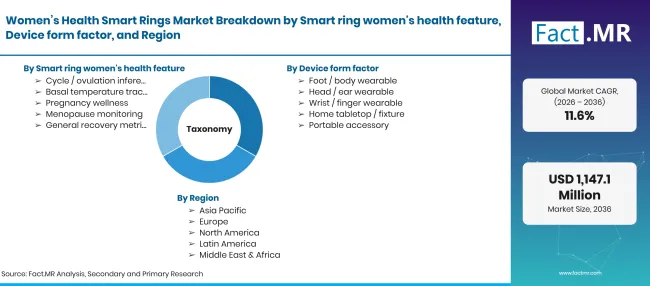
Womens Health Smart Rings Market Taxonomy | Source: Fact.MR
| Items | Values |
|---|---|
| Quantitative Units (2026) | USD 384.5 Million |
| Women's Health Feature | Cycle / ovulation inference, Basal temperature tracking, Pregnancy wellness, Menopause monitoring, General recovery metrics |
| Data Processing | Clinician-linked dashboard, Smartphone companion, Cloud AI, On-device algorithm, Hybrid edge-cloud |
| Sales Channel | Brand direct online, Retail electronics, Pharmacy / wellness retail, Clinical / professional, B2B / institutional |
| Regions Covered | North America, Latin America, Europe, East Asia, South Asia and Pacific, Middle East & Africa |
| Countries Covered | South Korea, China, United States, Japan, Germany, and other countries |
| Key Companies Profiled | Oura, Samsung Electronics, Ultrahuman, RingConn, Movano Health (Evie), Circular |
| Additional Attributes | Dollar revenue in the Women’s Health Smart Rings Market is segmented by women's health feature (cycle / ovulation inference, basal temperature tracking, pregnancy wellness, menopause monitoring, general recovery metrics), data processing, sales channel and region. |
Source: Fact.MR analysis. Updated Nov 23, 2026
Women’s Health Smart Rings Market by Segments
-
Women's Health Feature
- Cycle / ovulation inference
- Basal temperature tracking
- Pregnancy wellness
- Menopause monitoring
- General recovery metrics
-
Data Processing
- Clinician-linked dashboard
- Smartphone companion
- Cloud AI
- On-device algorithm
- Hybrid edge-cloud
-
Sales Channel
- Brand direct online
- Retail electronics
- Pharmacy / wellness retail
- Clinical / professional
- B2B / institutional
-
Region
- North America
- United States
- Canada
- Mexico
- Europe
- Germany
- United Kingdom
- France
- Italy
- Spain
- Rest of Europe
- Asia Pacific
- China
- India
- Japan
- South Korea
- Australia
- Rest of Asia Pacific
- Latin America
- Brazil
- Mexico
- Argentina
- Rest of Latin America
- Middle East & Africa
- GCC Countries
- South Africa
- Rest of Middle East & Africa
- North America
Frequently Asked Questions
How big is the global Women’s Health Smart Rings Market in 2026?
What will be the size of the Women’s Health Smart Rings Market by 2036?
How fast will the Women’s Health Smart Rings Market grow during the forecast period?
Which women's health feature segment holds the largest share of the Women’s Health Smart Rings Market?
Who worked on this report


Preview the report firsthand - request a free sample
Free SampleGet the brochure for pricing and purchase details
Download PDF