- Market Value (2025): USD 165.4 Mn
- Estimated Value (2026): USD 181.6 Mn
- Forecast Value (2036): USD 463.4 Mn
- CAGR (2026-2036): 9.8%
Vagus Nerve Wearables Market Forecast and Outlook 2026 to 2036
The global vagus nerve wearables market was valued at USD 165.4 million in 2025 and reached USD 181.6 million in 2026. At a CAGR of 9.8%, the market will reach USD 463.4 million by 2036.
Interest in vagus nerve wearables is extending beyond headache management, with users exploring non-invasive stimulation for stress, sleep, mood and recovery. Manufacturers are responding with neck-worn and ear-clip devices, many linked to apps that help users manage sessions and monitor responses. In November 2026, electroCore reported record third-quarter sales of USD 9.7 million, up around 12% year on year, while its gammaCore device had reached nearly 17,700 U.S. Department of Veterans Affairs patients. Wider institutional use could open further sales opportunities.
Key Takeaways from the Vagus Nerve Wearables Market
- Sales of vagus nerve wearables stood at USD 165.4 million in 2025
- Vagus Nerve Wearables Market Value (2026): USD 181.6 million
- Vagus Nerve Wearables Market Forecast Value (2036): USD 463.4 million
- Vagus Nerve Wearables Market Forecast CAGR (2026-2036): 9.8%
- Leading Stimulation Approach: Combined neurofeedback (26.4%)
- Key Market Participants: electroCore, Nurosym, Truvaga, Pulsetto, Neuvana, tVNS Technologies
- Key Growth Countries: South Korea, China, United States, Japan, Germany
In January 2026, Acacia Clinics and the Vagus Nerve Society announced a planned study of electroCore’s non-invasive vagus nerve stimulator as an adjunctive treatment for PTSD-related symptoms. In April 2026, electroCore reported that the first eight patients had been enrolled, with the study expected to enroll up to 40 adults. The research reflects wider clinical interest in using vagus nerve stimulation beyond migraine and cluster headache management. Studies involving anxiety, sleep and other mental health conditions are adding new areas of investigation for these devices. Further clinical progress could open up sales opportunities across North America, Europe and Asia.
Vagus Nerve Wearables Market
| Metric | Value |
|---|---|
| Estimated Value in (2025) | USD 165.4 million |
| Estimated Value in (2026) | USD 181.6 million |
| Forecast Value in (2036) | USD 463.4 million |
| Forecast CAGR (2026 to 2036) | 9.8% |
Source: Fact.MR analysis. Updated Nov 23, 2026
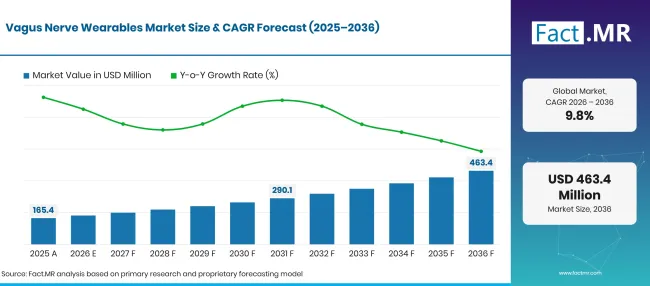
Vagus Nerve Wearables Market Forecast Global | Source: Fact.MR
Category
| Category | Segments |
|---|---|
| Stimulation Approach | Combined neurofeedback, Cervical transcutaneous, Acoustic / respiratory adjunct, Auricular tVNS, Other non-invasive stimulation |
| Data Processing | Cloud AI, Smartphone companion, On-device algorithm, Clinician-linked dashboard, Hybrid edge-cloud |
| Sales Channel | B2B / institutional, Retail electronics, Pharmacy / wellness retail, Clinical / professional, Brand direct online |
| Country | South Korea; China; United States; Japan; Germany |
Source: Fact.MR analysis. Updated Nov 23, 2026
Segmental Analysis
Why does combined neurofeedback lead stimulation approach demand in the Vagus Nerve Wearables Market?
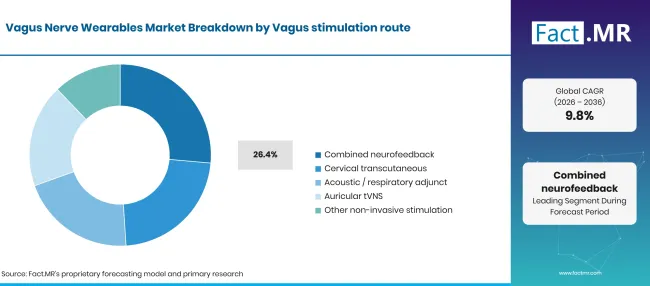
Vagus Nerve Wearables Market Breakdown Vagus Stimulation Route | Source: Fact.MR
Users can see more than the immediate sensation of stimulation when devices combine nerve stimulation with heart rate variability (HRV) or breathing feedback. Neurofeedback is a feature layered onto stimulation rather than a route of stimulation in itself, since the devices still deliver stimulation through sites such as the ear or neck. This explains why combined neurofeedback leads the stimulation approach segment with 26.4% of the market in 2026, valued at USD 47.9 million. Stimulation-only devices also attract users who prefer simpler sessions without continuous tracking. A University of the Basque Country study, registered on ClinicalTrials.gov in March 2026, is examining auricular vagus nerve stimulation alongside HRV-guided breathing for stress regulation.
How is cloud AI processing leading data demand in the Vagus Nerve Wearables Market?
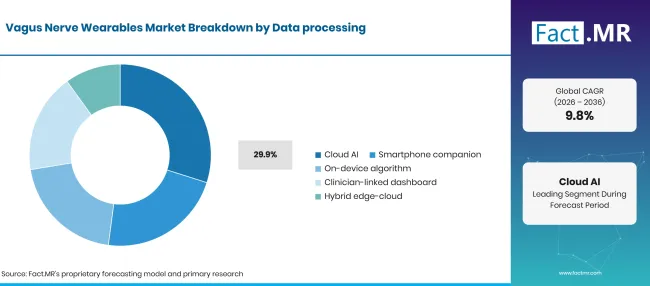
Vagus Nerve Wearables Market Breakdown Data Processing | Source: Fact.MR
Cloud AI processing leads the data segment with 29.9% of market revenue in 2026, valued at USD 54.3 million. Processing data across multiple sessions helps companies refine stimulation schedules and offer personalized recommendations. Edge processing is also gaining attention among users and clinicians who prefer faster responses and less reliance on internet connectivity. In August 2025, the FDA issued final guidance on AI-enabled medical device software, outlining how manufacturers can manage planned software changes while maintaining safety and effectiveness.
Why do B2B and institutional channels lead sales in the Vagus Nerve Wearables Market?
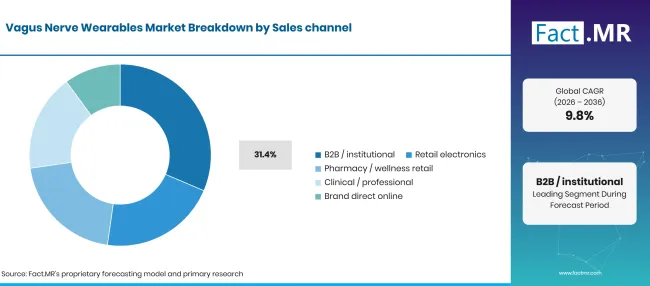
Vagus Nerve Wearables Market Breakdown Sales Channel | Source: Fact.MR
Institutional purchasing is giving vagus nerve wearable manufacturers access to larger patient groups through healthcare networks, government programmes and clinical partnerships. B2B channels lead with 31.4% of market revenue in 2026, valued at USD 57.0 million. Direct consumer sales are also gaining ground as at-home wellness devices reach individuals outside clinical settings. In May 2026, electroCore reported 26% year-on-year growth in first-quarter prescription gammaCore revenue through the Veterans Affairs channel, with 200 VA facilities purchasing the device.
Vagus Nerve Wearables Market-Drivers, Restraints & Trends
Drivers: Wider Access Through Prescription Healthcare Channels:
Prescription access is giving vagus nerve wearables a stronger commercial foothold because patients can obtain clinically positioned devices through established healthcare programmes rather than relying entirely on personal wellness spending. This is also encouraging manufacturers to invest in clinical evidence and institutional partnerships. In August 2026, electroCore reported second-quarter revenue of USD 9.5 million, up 28% year on year, with growth coming partly from prescription gammaCore sales through the Veterans Affairs system. Wider healthcare adoption could create further opportunities for non-invasive neuromodulation.
Restraints: Limited Clinical Validation of Consumer Wellness Devices:
The gap between marketed wellness claims and independent clinical evidence creates hesitation among consumers and healthcare professionals. Many devices promote stress relief, better sleep and relaxation without sufficient device-specific clinical validation. A 2026 review published in Comprehensive Physiology noted that Truvaga draws on gammaCore research but lacks independent clinical trials of its own. Differences in stimulation methods and parameters add further uncertainty, making buyers cautious about spending on these devices.
Trend: Increasing Competition in Consumer Wellness Devices:
Consumer-focused brands are competing through simpler purchasing options, app-based guidance and subscription-free usage, making vagus nerve stimulation more accessible outside clinical settings. However, marketing costs and price competition are putting pressure on commercial performance. In November 2026, electroCore reported that it had shifted attention away from lower-return consumer channel sales amid a more competitive and costly advertising environment. This creates an opportunity for manufacturers to differentiate through credible clinical evidence, transparent pricing and flexible purchasing models.
Trend: Neuromodulation Moving Beyond Headache Management:
Research into non-invasive vagus nerve stimulation is moving into cardiovascular, neurological, inflammatory and mental health applications, opening opportunities beyond traditional headache treatment. A February 2026 review published in Surgical Neurology International examined 346 eligible clinical trials, of which 86% involved non-invasive stimulation. This wider research base creates opportunities for wearable manufacturers to pursue new clinical applications, develop indication-specific devices and build partnerships with healthcare providers as further evidence becomes available.
Vagus Nerve Wearables Market Analysis by Key Country
| Country | CAGR (2026-2036) |
|---|---|
| South Korea | 13.4% |
| China | 12.3% |
| United States | 12.2% |
| Japan | 10.7% |
| Germany | 8.8% |
Source: Fact.MR analysis. Updated Nov 23, 2026
What is driving vagus nerve wearables demand in South Korea?
South Korea is emerging as a promising market for vagus nerve wearables as interest in digital healthcare, sleep management and non-invasive neurological treatments expands.
The country's advanced medical technology ecosystem and active clinical research environment are creating opportunities for wearable neuromodulation devices. Research into stress regulation, autonomic function and sleep quality is also widening the potential user base beyond patients receiving conventional neurological treatment. Hospitals, specialist clinics and wellness providers could drive sales as these devices gain greater clinical acceptance. Consumer interest in non-drug approaches to relaxation and sleep management adds another avenue for market expansion.
How are sleep problems supporting vagus nerve wearables sales in China?
China's expanding clinical research base and large healthcare system are creating room for wider use of vagus nerve wearables.
Interest in non-invasive treatment options for insomnia, neurological conditions and autonomic dysfunction is bringing these devices into more hospital-led investigations. A study registered with the Chinese Clinical Trial Registry in June 2026 is examining transcutaneous auricular vagus nerve stimulation for sleep quality in patients with insomnia. Another Chinese trial, registered in October 2025, is evaluating the technology in narcolepsy patients across four clinical centres. These investigations could open new sales opportunities through hospitals, neurology departments and specialist sleep clinics.
What is shaping vagus nerve wearables demand in the United States?
The United States has a commercial advantage in prescription-based vagus nerve wearables because government healthcare programmes offer manufacturers access to established patient networks.
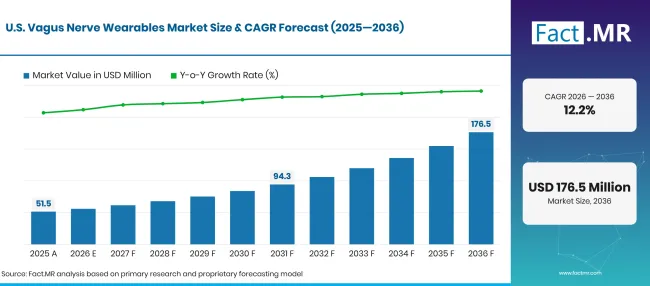
Vagus Nerve Wearables Market Forecast Usa | Source: Fact.MR
Veterans Affairs purchasing, clinical adoption and direct-to-consumer wellness sales are contributing to market expansion. In August 2026, electroCore reported second-quarter revenue of USD 9.5 million, up 28% year on year. Prescription gammaCore sales through the Veterans Affairs system continued to drive growth, while the company also recorded higher Truvaga sales. Wider acceptance of non-invasive neuromodulation and institutional purchasing could sustain sales across clinical and consumer channels.
How is neurological rehabilitation research shaping vagus nerve wearables demand in Japan?
Japan's interest in neurological rehabilitation and non-invasive brain stimulation is creating additional avenues for vagus nerve wearable adoption.
'Research institutions are exploring how stimulation of the auricular branch of the vagus nerve may influence autonomic activity, visual processing and physical coordination. In March 2026, Japan's National Institute of Public Health clinical trial registry recorded an interventional study targeting visual perception and visuomotor performance in 100 healthy participants. The investigation adds a new research direction beyond conventional headache treatment. Specialist rehabilitation centres, hospitals and medical research partnerships could help expand the domestic market.
How is drug-resistant epilepsy research supporting vagus nerve wearables demand in Germany?
Germany's established clinical research network is bringing vagus nerve stimulation into investigations involving patients who have limited treatment options.
Drug-resistant epilepsy is one such area, where non-invasive stimulation is being examined as an additional therapy rather than a replacement for existing medication. The German Clinical Trials Register recorded the TRAVAST study in March 2026, with recruitment planned across approximately 15 clinical sites and 164 adult participants. The trial compares transcutaneous vagus nerve stimulation alongside individual medication with sham stimulation. Progress in such hospital-based research could strengthen clinical confidence and create opportunities for wearable device adoption in neurology centres.
Competitive Landscape for Vagus Nerve Wearables Market
Competition in the vagus nerve wearables market is divided between prescription neuromodulation and consumer wellness brands. electroCore competes through prescription gammaCore and its consumer Truvaga device, Nurosym and tVNS Technologies through ear-based transcutaneous stimulation with clinical studies, and Pulsetto and Neuvana through consumer neck and ear devices for stress and sleep. Buyers select devices on clinical evidence, comfort, price, app quality and whether a subscription is required.
From 2025 onward, competition shifted toward institutional channels and evidence. electroCore grew through the Veterans Affairs system and reported record third-quarter sales in November 2026, a planned PTSD study announced in January 2026 began enrolling patients in April 2026, and consumer brands competed on price and subscription terms. Suppliers that pair devices with clinical data and institutional contracts are best placed to grow.
Recent Developments
- On May 2, 2025, electroCore completed its acquisition of NeuroMetrix, adding the Quell fibromyalgia treatment platform to its portfolio of non-invasive bioelectronic health technologies.
- On January 7, 2026, Pulsetto partnered with Spike Technologies to integrate wearable health data from Apple Health, Oura, Garmin, WHOOP and Fitbit into its stress management platform.
- In January 2026, electroCore launched its Truvaga wellness device in the United Kingdom, marking the brand's first international market expansion.
- On January 21, 2026, electroCore announced that Acacia Clinics and the Vagus Nerve Society planned a study of gammaCore Sapphire as an adjunctive treatment for PTSD-related symptoms.
- On April 7, 2026, electroCore announced the enrollment of the first eight patients in the PTSD study, which is expected to enroll up to 40 adults.
- On September 17, 2026, Pulsetto launched FIT X, a next-generation vagus nerve stimulation wearable with redesigned bilateral electrodes and improved integration with its Stress Resilience Score platform.
- On October 12, 2026, Parasym announced the wider UK distribution of its Nurosym wearable vagus nerve stimulation device, expanding access to its non-invasive neuromodulation technology.
Key Players in Vagus Nerve Wearables Market
Key companies operating in the market include electroCore, Nurosym, Truvaga, Pulsetto, Neuvana, and tVNS Technologies.
- electroCore
- Nurosym
- Truvaga
- Pulsetto
- Neuvana
- tVNS Technologies
Bibliography
- Bu, Y., Liang, A., Hoffman, B. U., Schiehser, D. M., Case, O., Simmons, A., Klaming, R., Gottfried-Blackmore, A., Mittal, R. K., Puleo, C., Lim, H., & Lerman, I. (2026). A review of vagus nerve stimulation for disease: Comprehensive theory and evidence for mechanisms of action. Comprehensive Physiology, 16(2), e70109.
- ClinicalTrials.gov. (2026). LasaiON: Multimodal self-regulation program combining transcutaneous auricular vagus nerve stimulation and heart-rate variability biofeedback (NCT07498881). U.S. National Library of Medicine.
- Chinese Clinical Trial Registry. (2026). Effects of transcutaneous auricular vagus nerve stimulation on sleep quality in patients with insomnia disorder (ChiCTR2600125912).
- electroCore, Inc. (2026a, January 21). Acacia Clinics and Vagus Nerve Society conduct study using electroCore's gammaCore Sapphire for adjunctive treatment of symptoms associated with post-traumatic stress disorder (PTSD).
- electroCore, Inc. (2026b, April 7). electroCore announces first patient enrollment in investigator-led study of gammaCore nVNS for PTSD.
- electroCore, Inc. (2026c, August 6). electroCore announces second quarter 2026 financial results.
- electroCore, Inc. (2026d, November 4). electroCore announces third quarter 2026 financial results.
- German Clinical Trials Register. (2026). Transcutaneous vagus nerve stimulation as add-on therapy versus pharmacotherapy alone (DRKS00039592).
- Hong, S. W., Im, J., Koh, C. S., Roh, S., Jung, H. H., & Chang, J. W. (2026). Exploratory pilot randomized crossover study of transcutaneous vagus nerve stimulation on sleep quality and mood in healthy adults. Journal of Korean Medical Science, 41(44), e279.
- Japan Registry of Clinical Trials. (2026). Elucidating the effects of transcutaneous stimulation of the auricular vagus nerve on visual perception and visuomotor performance (jRCT1050250266). National Institute of Public Health.
- U.S. Food and Drug Administration. (2025). Marketing submission recommendations for a predetermined change control plan for artificial intelligence-enabled device software functions: Guidance for industry and Food and Drug Administration staff.
- Vagus Nerve Stimulation: An update of currently registered clinical trials on ClinicalTrials.gov. (2026). Surgical Neurology International.
Segmentation
Scope of Report
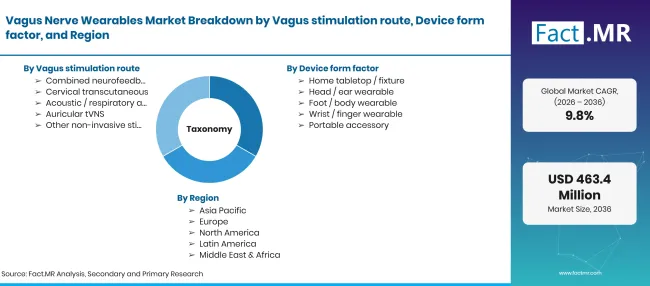
Vagus Nerve Wearables Market Taxonomy | Source: Fact.MR
| Items | Values |
|---|---|
| Quantitative Units (2026) | USD 181.6 Million |
| Stimulation Approach | Combined neurofeedback, Cervical transcutaneous, Acoustic / respiratory adjunct, Auricular tVNS, Other non-invasive stimulation |
| Data Processing | Cloud AI, Smartphone companion, On-device algorithm, Clinician-linked dashboard, Hybrid edge-cloud |
| Sales Channel | B2B / institutional, Retail electronics, Pharmacy / wellness retail, Clinical / professional, Brand direct online |
| Regions Covered | North America, Latin America, Europe, Asia Pacific, Middle East & Africa |
| Countries Covered | South Korea, China, United States, Japan, Germany, and other countries |
| Key Companies Profiled | electroCore, Nurosym, Truvaga, Pulsetto, Neuvana, tVNS Technologies |
| Additional Attributes | Dollar revenue in the Vagus Nerve Wearables Market is segmented by stimulation approach (combined neurofeedback, cervical transcutaneous, acoustic / respiratory adjunct, auricular tVNS, other non-invasive stimulation), data processing, sales channel and region. |
Source: Fact.MR analysis. Updated Nov 23, 2026
Source: Fact.MR analysis. Updated 17 Nov 2026
Vagus Nerve Wearables Market by Segments
-
Stimulation Approach
- Combined neurofeedback
- Cervical transcutaneous
- Acoustic / respiratory adjunct
- Auricular tVNS
- Other non-invasive stimulation
-
Data Processing
- Cloud AI
- Smartphone companion
- On-device algorithm
- Clinician-linked dashboard
- Hybrid edge-cloud
-
Sales Channel
- B2B / institutional
- Retail electronics
- Pharmacy / wellness retail
- Clinical / professional
- Brand direct online
-
Region
- North America
- United States
- Canada
- Mexico
- Europe
- Germany
- United Kingdom
- France
- Italy
- Spain
- Rest of Europe
- Asia Pacific
- China
- India
- Japan
- South Korea
- Australia
- Rest of Asia Pacific
- Latin America
- Brazil
- Argentina
- Rest of Latin America
- Middle East & Africa
- GCC Countries
- South Africa
- Rest of Middle East & Africa
- North America
Frequently Asked Questions
How big is the global Vagus Nerve Wearables Market in 2026?
What will be the size of the Vagus Nerve Wearables Market by 2036?
How fast will the Vagus Nerve Wearables Market grow during the forecast period?
Which stimulation approach segment holds the largest share of the Vagus Nerve Wearables Market?
Who worked on this report


Preview the report firsthand - request a free sample
Free SampleGet the brochure for pricing and purchase details
Download PDF