- Market Value (2025): USD 276.5 Mn
- Estimated Value (2026): USD 300.0 Mn
- Forecast Value (2036): USD 678.3 Mn
- CAGR (2026-2036): 8.5%
Portable Respiratory Management Units Market Forecast and Outlook 2026 to 2036
The portable respiratory management units market was valued at approximately USD 276.5 million in 2025 and USD 300.0 million in 2026. It is projected to reach USD 678.3 million by 2036, registering an 8.5% CAGR during the 2026–2036 assessment period.
The use of respiratory care equipment outside hospitals is gaining attention as patients seek greater flexibility in managing long-term breathing conditions. Portable oxygen concentrators, compact nebulizers and non-invasive ventilation devices allow patients to continue treatment at home or while travelling, without depending entirely on hospital-based care. In 2025, the WHO continued to identify COPD as a major global health concern, highlighting the need for accessible and consistent respiratory care. This shift toward home-based treatment and greater patient mobility is creating new opportunities for portable respiratory management units through 2036.
Key Takeaways from the Portable Respiratory Management Units Market
- Sales of portable respiratory management units stood at USD 276.5 million in 2025
- Portable Respiratory Management Units Market Value (2026): USD 300.0 million
- Portable Respiratory Management Units Market Forecast Value (2036): USD 678.3 million
- Portable Respiratory Management Units Market Forecast CAGR (2026-2036): 8.5%
- Leading Respiratory support modality: Airway clearance (22.7%)
- Key Market Participants: Philips, ResMed, Vyaire Medical; Breas Medical; Fisher & Paykel Healthcare; Inogen
- Key Growth Regions: China, United States, United Kingdom; Germany; Japan
Philips’ withdrawal from the US sleep and respiratory device market created room for competing manufacturers to strengthen their position. During 2025, ResMed, Fisher & Paykel Healthcare and Breas continued to compete in respiratory care through their device portfolios and connected care offerings. Changes in supplier availability and product preferences are shaping competition in the portable respiratory management units market across international markets.
Portable Respiratory Management Units Market
| Metric | Value |
|---|---|
| Estimated Value in (2025) | USD 276.5 million |
| Estimated Value in (2026) | USD 300.0 million |
| Forecast Value in (2036) | USD 678.3 million |
| Forecast CAGR (2026 to 2036) | 8.5% |
Source: Fact.MR analysis. Updated Nov 20, 2026
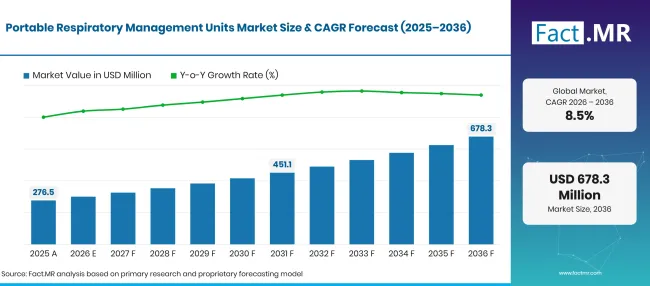
Portable Respiratory Management Units Forecast Global | Source: Fact.MR
Category
| Category | Segments |
|---|---|
| Respiratory support modality | Nebulizer, Portable oxygen concentrator, CPAP / NIV; Airway clearance; Multi-function |
| Care setting | Hospital, Specialist clinic, Primary care; Home care; Emergency / mobile |
| Connectivity | Standalone, Bluetooth / app, Wi-Fi / cloud; Clinical network; Integrated telehealth |
| Patient group | Pediatric, Working-age adult, Older adult; Chronic severe; Mixed / other |
| Region | China; United States; United Kingdom; Germany; Japan |
Source: Fact.MR analysis. Updated Nov 20, 2026
Segmental Analysis
Why does Airway clearance lead modality demand in the Portable Respiratory Management Units Market?
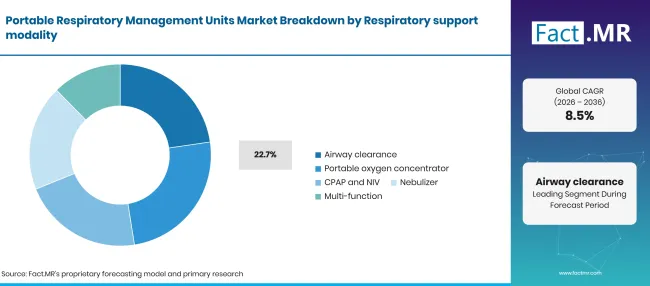
Portable Respiratory Management Units Breakdown Respiratory Support Modality | Source: Fact.MR
Airway clearance devices generate about USD 68.1 million, or 22.7% of 2026 revenue. Oscillating and cough-assist units support home-based mucus clearance for patients with COPD, bronchiectasis, cystic fibrosis and neuromuscular disease. CPAP/NIV and multi-function devices follow closely, and suppliers are introducing portable airway clearance units. The UK Cystic Fibrosis Registry 2024 Annual Data Report (October 2025) recorded 11,381 registered people with CF who had an annual review in 2024. The report monitors the primary airway clearance technique used by patients.
Why does Hospital lead care-setting demand in the Portable Respiratory Management Units Market?
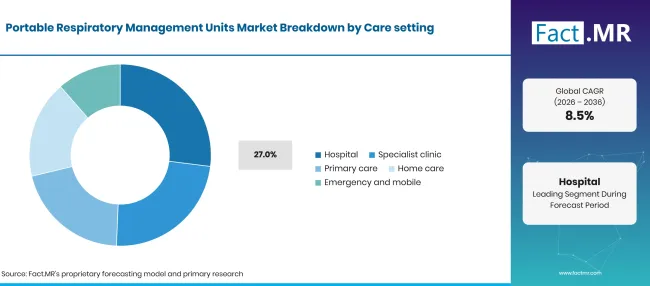
Portable Respiratory Management Units Breakdown Care Setting | Source: Fact.MR
Hospital settings contribute about USD 81.0 million, or 27.0% of 2026 revenue. Hospitals initiate therapy, train patients, and deploy portable units on wards and during patient transport. Primary care follows closely, and suppliers serve hospitals through discharge programs. The CMS Hospital Readmissions Reduction Program continues to include 30-day COPD readmissions as a measured condition, with FY 2026 payment adjustments effective 1 October 2025. The GOLD 2026 report, published on 10 November 2025, also updated guidance on exacerbation management; including admission and discharge criteria.
Why does Bluetooth / app lead connectivity demand in the Portable Respiratory Management Units Market?
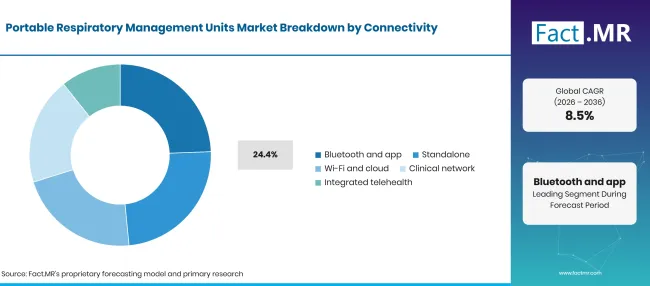
Portable Respiratory Management Units Breakdown Connectivity 1 | Source: Fact.MR
Bluetooth / app connectivity accounts for about USD 73.2 million, or 24.4% of 2026 revenue. Patients use apps to track therapy and share data with clinicians. Clinical network connectivity follows, and suppliers are adding app support. The CY 2026 Medicare Physician Fee Schedule final rule (CMS-1832-F), effective 1 January 2026, introduced remote patient monitoring code CPT 99445 for 2–15 days of data in a 30-day period. It also introduced remote therapeutic monitoring code CPT 98984 for respiratory system monitoring over the same period. The GOLD 2026 report added a new chapter on artificial intelligence and emerging technologies in COPD.
Why does the Mixed / other group lead patient demand in the Portable Respiratory Management Units Market?
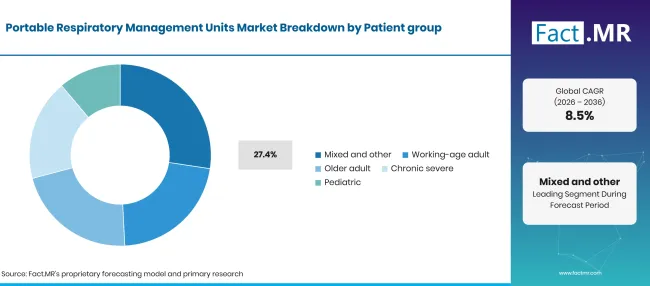
Portable Respiratory Management Units Breakdown Patient Group 1 | Source: Fact.MR
The Mixed / other group represents about USD 82.2 million, or 27.4% of 2026 revenue. It covers patients with sleep apnea, post-COVID and post-surgical needs across all ages. Working-age adults follow, and suppliers serve broad populations. The GOLD 2026 report revised its chapter on COPD and multimorbidity and updated its screening and case-finding chapter with two new figures (2.8 and 2.9). It also updated RSV and influenza vaccination recommendations for people with COPD.
Portable Respiratory Management Units Market-Drivers, Restraints & Trends
Drivers
The move of respiratory care from hospitals to homes is the main force behind demand. Health systems need to free up beds, so patients with chronic lung conditions are discharged earlier and managed at home with portable units. Connected devices make this practical, because clinicians can follow therapy data remotely and step in when readings change, without calling the patient in. Reimbursement now supports the model as well: from 1 January 2026, Medicare pays for remote monitoring covering as few as 2 to 15 days of data in a month.
Restraints
\Adoption is held back by several practical problems. Reimbursement is uneven, so many patients still pay out of pocket for devices and consumables. Recalls damage trust among clinicians and patients, and they take a long time to repair. Battery life limits true portability, since users on long trips or during power cuts can't rely on the unit. Connected devices add data-privacy and cybersecurity worries for providers. Complicated setup and cleaning also lead some older patients to use their devices less or abandon them. Suppliers must improve batteries and keep quality consistent.
Trend Connected Home Respiratory Care
Clinicians increasingly want proof that therapy is actually being used, so devices that report usage remotely are becoming the default expectation for home patients. Looking ahead, streamed data could flag worsening symptoms early, which may reduce avoidable admissions and create recurring service revenue. Medicare’s fee schedule, effective 1 January 2026, added respiratory monitoring code CPT 98984 for 2–15 days of data in a 30-day period.
Trend
Lightweight Oxygen Concentrators: Patients are turning away from bulky equipment that keeps them housebound, and demand has shifted toward lighter portable concentrators suited to travel and daily errands. The next opening lies in ageing populations who want to stay active while on long-term oxygen therapy. In 2026, FDA continued clearing portable oxygen generators under product code CAW, with decisions on 23 April and 17 June.
Portable Respiratory Management Units Market by Analysis by Key Country
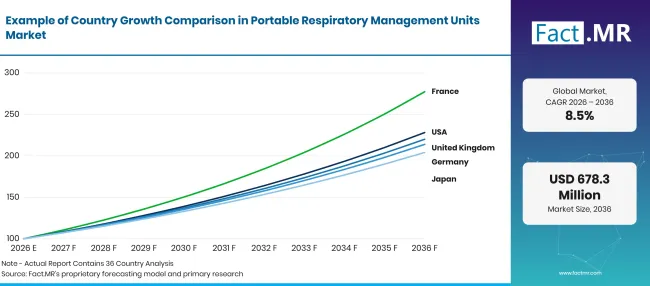
Portable Respiratory Management Units Growth Index | Source: Fact.MR
| Country | CAGR (2026-2036) |
|---|---|
| China | 10.1% |
| United States | 8.6% |
| United Kingdom | 8.1% |
| Germany | 7.9% |
| Japan | 7.4% |
Source: Fact.MR analysis. Updated Nov 20, 2026
Why is China the fastest-growing market for portable respiratory management units?
China's expanding primary healthcare network is creating a wider market for respiratory support equipment. In November 2025, China CDC Weekly reported that COPD had been added to the National Basic Public Health Services programme for the first time, bringing chronic respiratory care into routine primary healthcare.
This policy shift is important for portable oxygen concentrators, nebulizers and home ventilation equipment. Wider screening, long-term patient follow-up and improved access to respiratory treatment are set to encourage sales across urban and rural healthcare settings.
What is shaping portable respiratory unit sales in the United States?
Home respiratory treatment has a strong foothold in the United States, where Medicare coverage rules recognize portable oxygen systems for eligible mobile patients. In May 2026, a real-world study presented data on more than 350 million linked patient records and examined portable oxygen concentrator use among adults with COPD, emphysema and chronic bronchitis.
Greater preference for mobility during oxygen therapy, Medicare-supported equipment access and remote respiratory monitoring are driving purchases of portable units.
What is shaping portable respiratory unit demand in the United Kingdom?
A shift towards community-based respiratory treatment is opening new opportunities across the UK. In March 2026, the Department of Health and Social Care announced a £10 million partnership with NHS England to improve care for asthma and COPD patients closer to home. The initiative aims to reduce hospital dependence and expand personalized treatment.
This approach is creating opportunities for portable oxygen equipment, nebulizers and connected monitoring devices, particularly as healthcare teams seek to manage more respiratory patients through home-based services.
What is shaping portable respiratory unit demand in Germany?
Germany has a substantial base of patients receiving mechanical ventilation outside hospitals. A 2025 European Respiratory Society study identified 14,280 people receiving outpatient intensive care in Germany, with COPD accounting for 18% of cases.
In March 2025, the German Clinical Trials Register also recorded the launch of the T-CABS study at Charité to examine telemedical support for home ventilation and oxygen therapy. Demand is being shaped by an aging patient population, home ventilation services and interest in reducing repeated specialist visits.
Why is portable respiratory unit growth slower in Japan?
Japan's aging population is sustaining the need for respiratory equipment that patients can use without frequent hospital visits. A 2026 study published in the Journal of the Japan Medical Association found that annual long-term oxygen therapy claims increased from 1.53 million in FY2017 to 1.92 million in FY2023, while positive airway pressure claims reached 7.43 million.
These findings highlight the scale of home respiratory treatment in the country. Sales are being encouraged by long-term oxygen therapy, sleep apnea management and wider use of home-based ventilation systems.
Competitive Landscape for Portable Respiratory Management Units Market
Competition in the portable respiratory management units market varies across product categories, with companies targeting different patient care needs. ResMed and Fisher & Paykel Healthcare have strong positions in sleep therapy and breathing support, while Inogen focuses on portable oxygen concentrators and Breas Medical on ventilation systems. Philips and Vyaire Medical also participate across respiratory care equipment. Product selection often comes down to battery performance, ease of use, clinical reliability and maintenance access.Philips' US sales restrictions following the 2024 consent decree altered supplier dynamics. By 2025, competing manufacturers were placing greater attention on portable product ranges and connected respiratory care.
Recent Developments
- On May 1, 2025, ResMed acquired VirtuOx; a US-based diagnostic testing company; to expand its home-based sleep; respiratory and cardiac testing services.
- On June 6, 2025, Breas Medical integrated its EveryWare cloud solution with Encore Healthcare's Nexus platform; allowing healthcare professionals to access respiratory patient data through a connected system.
- Fisher & Paykel Healthcare introduced the F&P Nova Nasal interface in the United States in January 2026. Its relevance to portable respiratory management lies in patient-interface design and the usability of respiratory support equipment.
- On February 24, 2026, Inogen announced a strategic collaboration with Yuwell Medical to expand its respiratory product portfolio through joint research and development and strengthen its presence in China.
- On April 22, 2026, Drive Medical launched the DeVilbiss 555 Compact Oxygen Concentrator; a new 5-litre device designed to reduce equipment size; energy consumption and maintenance costs.
Key Players in Portable Respiratory Management Units Market
Key companies profiled include Philips; ResMed; Breas Medical; Fisher & Paykel Healthcare; Inogen; ZOLL Medical; Drive DeVilbiss Healthcare; and React Health.
- Philips
- ResMed
- Breas Medical
- Fisher & Paykel Healthcare
- Inogen
- ZOLL Medical
- Drive DeVilbiss Healthcare
- React Health
Bibliography
- Centers for Disease Control and Prevention. (2025, November 20). Investing in primary care to reduce the burden of chronic obstructive pulmonary disease. China CDC Weekly.
- Centers for Medicare & Medicaid Services. (2025, October 31). Calendar year (CY) 2026 Medicare Physician Fee Schedule final rule (CMS-1832-F).
- Centers for Medicare & Medicaid Services. (n.d.). Transitional care management services.
- Centers for Medicare & Medicaid Services. (2025). FY 2026 Hospital Inpatient Prospective Payment System (IPPS) and Long-Term Care Hospital Prospective Payment System (LTCH PPS) final rule: CMS-1833-F
- Charité – Universitätsmedizin Berlin. (2025). Telemedical centre for out-of-hospital ventilation and oxygen therapy (T-CABS). German Clinical Trials Register
- Cystic Fibrosis Foundation. (n.d.). Patient registry.
- Department of Health and Social Care. (2026, March 17). Asthma and COPD patients to receive better care closer to home. GOV.UK.
- Ministry of Health, Labour and Welfare. (n.d.). About Japan's population.
- Ministry of Internal Affairs and Communications. (2024, September 15). Statistical topics No. 142: Older people in Japan as seen through statistics.
- U.S. Food and Drug Administration. (n.d.). Product classification: Device generator, oxygen, portable (Product Code CAW).
- U.S. Food and Drug Administration. (2026, April 23). 510(k) premarket notification: OxyGo portable oxygen concentrator (K252407).
- U.S. Food and Drug Administration. (2026, June 17). 510(k) premarket notification: Portable oxygen concentrator (K252399).
- World Health Organization. (2025). Chronic respiratory diseases. WHO Regional Office for Europe.
- World Health Organization. (2026, June 10). Chronic obstructive pulmonary disease (COPD).
Segmentation
Scope of Report
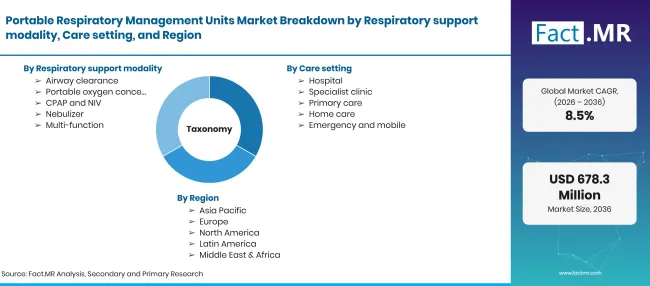
Portable Respiratory Management Units Taxonomy | Source: Fact.MR
| Items | Values |
|---|---|
| Quantitative Units (2026) | USD 300.0 Million |
| Respiratory support modality | Nebulizer, Portable oxygen concentrator, CPAP / NIV; Airway clearance; Multi-function |
| Care setting | Hospital, Specialist clinic, Primary care; Home care; Emergency / mobile |
| Connectivity | Standalone, Bluetooth / app, Wi-Fi / cloud; Clinical network; Integrated telehealth |
| Patient group | Pediatric, Working-age adult, Older adult; Chronic severe; Mixed / other |
| Regions Covered | North America, Latin America, Europe; East Asia; South Asia and Pacific; Middle East & Africa |
| Countries Covered | China, United States, United Kingdom; Germany; Japan; and other countries |
| Key Companies Profiled | Philips, ResMed, Vyaire Medical; Breas Medical; Fisher & Paykel Healthcare; Inogen |
| Additional Attributes | Dollar revenue in the Portable Respiratory Management Units Market is segmented by respiratory support modality (nebulizer, portable oxygen concentrator, CPAP / NIV; airway clearance; multi-function); care setting (hospital; specialist clinic; primary care; home care; emergency / mobile); connectivity (standalone; bluetooth / app; wi-fi / cloud; clinical network; integrated telehealth); patient group (pediatric; working-age adult; older adult; chronic severe; mixed / other) and region. |
Source: Fact.MR analysis. Updated Nov 20, 2026
Portable Respiratory Management Units Market by Segments
-
Respiratory support modality
- Nebulizer
- Portable oxygen concentrator
- CPAP / NIV
- Airway clearance
- Multi-function
-
Care setting
- Hospital
- Specialist clinic
- Primary care
- Home care
- Emergency / mobile
-
Connectivity
- Standalone
- Bluetooth / app
- Wi-Fi / cloud
- Clinical network
- Integrated telehealth
-
Patient group
- Pediatric
- Working-age adult
- Older adult
- Chronic severe
- Mixed / other
-
Region:
- North America
- United States
- Canada
- Mexico
- Europe
- Germany
- United Kingdom
- France
- Italy
- Spain
- Rest of Europe
- Asia Pacific
- China
- India
- Japan
- South Korea
- Australia
- Rest of Asia Pacific
- Latin America
- Brazil
- Mexico
- Argentina
- Rest of Latin America
- Middle East & Africa
- GCC Countries
- South Africa
- Rest of Middle East & Africa
- North America
Frequently Asked Questions
How big is the global Portable Respiratory Management Units Market in 2026?
What will be the size of the Portable Respiratory Management Units Market by 2036?
How fast will the Portable Respiratory Management Units Market grow during the forecast period?
Which respiratory support modality segment holds the largest share of the Portable Respiratory Management Units Market?
Who worked on this report


Preview the report firsthand - request a free sample
Free SampleGet the brochure for pricing and purchase details
Download PDF