Precision Band-Placed Liquid Nutrient Concentrate Market
Precision Band-Placed Liquid Nutrient Concentrate Market Size and Share Forecast Outlook 2026 to 2036
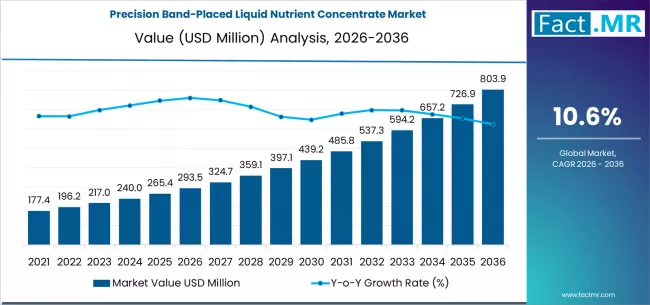
Precision band-placed liquid nutrient concentrate market is projected to grow from USD 293.5 million in 2026 to USD 803.9 million by 2036, at a CAGR of 10.6%. Greenhouse Vegetables will dominate with a 46.8% market share, while clear liquid will lead the viscosity segment with a 42.2% share.
Precision Band-Placed Liquid Nutrient Concentrate Market Forecast and Outlook 2026 to 2036
The precision band-placed liquid nutrient concentrate market will total USD 293.55 million in 2026, rising to USD 803.95 million by 2036 at a CAGR of 10.6%. This growth underscores a strategic shift in high-value agriculture towards hyper-efficient nutrient delivery, moving beyond broad-acre broadcasting to targeted subsurface placement.
This method places concentrated liquid fertilizers in a precise band near the plant root zone, simultaneously maximizing nutrient availability, minimizing soil contact and fixation, and dramatically reducing the total volume of product required per hectare. Greenhouse vegetable production is the primary crop segment, commanding a 47% share, as the controlled environment and high economic value of crops justify the investment in precise application equipment and premium formulations.
Key Takeaways from the Precision Band-Placed Liquid Nutrient Concentrate Market
- Market Value for 2026: USD 293.55 Million
- Market Value for 2036: USD 803.95 Million
- Forecast CAGR (2026-2036): 10.6%
- Leading Crop Share (2026): Greenhouse Vegetables (47%)
- Leading Viscosity Share (2026): Clear Liquid (42%)
- Leading Sales Channel Share (2026): Ag-Retailers (53%)
- Key Players in the Market: Nutrien, Yara International, ICL Group, Haifa Group, Mosaic, EuroChem
Clear liquid concentrates represent the dominant viscosity type, holding a 42% share due to their superior flow characteristics and compatibility with sophisticated banding and drip injection systems. Ag-retailers maintain their central role in the supply chain, facilitating 53% of sales through their critical functions of agronomic guidance, custom blending, and equipment service.
Market expansion is driven by the relentless pursuit of input efficiency and yield optimization in intensive cropping systems. Band placement minimizes nutrient competition from weeds and soil microbes, enhancing the uptake efficiency of key elements like phosphorus and micronutrients. This technology directly addresses the challenges of rising fertilizer costs and environmental regulations by ensuring more nutrient reaches the crop, thereby reducing the overall environmental footprint per unit of production. It represents a core tool for growers aiming to achieve higher margins through precision rather than volume.
Metric
| Metric | Value |
|---|---|
| Market Value (2026) | USD 293.55 Million |
| Market Forecast Value (2036) | USD 803.95 Million |
| Forecast CAGR (2026 to 2036) | 10.6% |
Category
| Category | Segments |
|---|---|
| Crop | Greenhouse Vegetables, Orchards, Open Field Vegetables, Cannabis/Hemp |
| Viscosity | Clear Liquid, Suspension, Emulsion, Soluble Gel |
| Sales Channel | Ag-Retailers, Direct-to-Farmer, Online Marketplaces, Cooperatives |
| Region | North America, Latin America, Western Europe, Eastern Europe, East Asia, South Asia & Pacific, MEA |
Segmental Analysis
By Crop, Where is the Economic Justification Strongest?
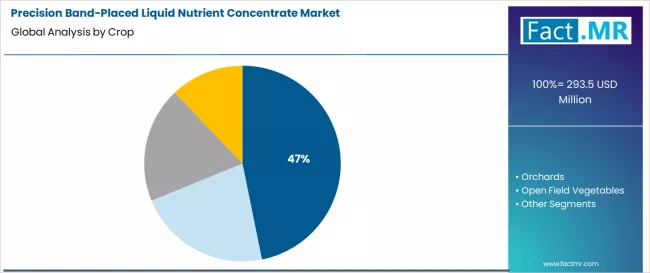
Greenhouse vegetables lead with a 47% share. The high revenue per square meter in protected agriculture makes the capital and operational cost of precision banding equipment viable. Crops like tomatoes, cucumbers, and peppers have exacting nutritional demands throughout their growth cycle.
Placing concentrated nutrients directly in the root band allows for real-time adjustment of nutrient ratios, directly impacting fruit quality, consistency, and yield, providing a rapid return on investment for commercial greenhouse operators.
By Viscosity, Which Formulation Enables Optimal Application?
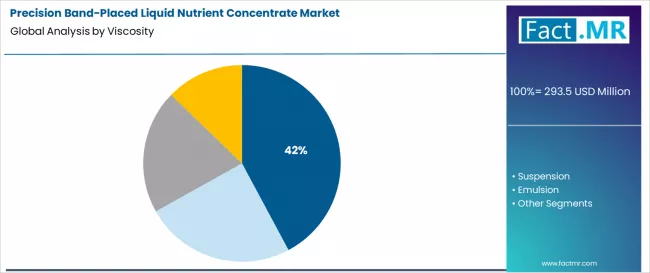
Clear liquid concentrates are the foremost type, with a 42% share. Their low viscosity and high solubility ensure they can be accurately metered, injected into irrigation lines or applied via specialized banding knives without clogging or sedimentation.
This physical stability is crucial for maintaining the accuracy of placement and concentration. Clear liquids also allow for easy tank mixing of multiple nutrients and additives, offering growers maximum formulation flexibility.
By Sales Channel, Who Provides the Necessary Technical Ecosystem?
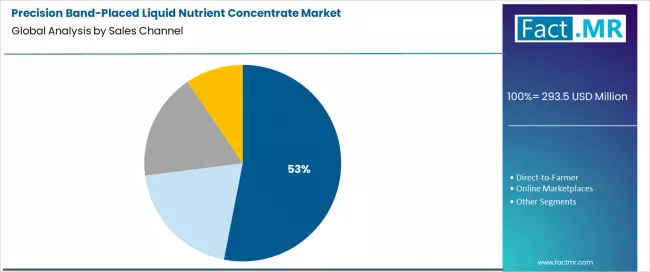
Ag-Retailers are the pivotal channel, accounting for 53% of sales. Successful band-placed application requires more than just the chemical; it demands compatible equipment, precise calibration, and deep agronomic knowledge.
Retailers serve as the integrator, offering custom formulation of concentrates, renting or servicing banding applicators, and providing field-specific recommendations on placement depth and timing. This hands-on technical support is indispensable for farmer adoption and correct implementation.
What are the Drivers, Restraints, and Key Trends of the Market?
The primary driver is the proven agronomic advantage of nutrient placement in improving phosphorus and micronutrient use efficiency, which are often immobilized in the bulk soil. Rising costs for high-purity nutrient salts and increasing water scarcity make efficiency paramount.
The expansion of high-value, controlled-environment agriculture and specialty crops like cannabis, where nutrient precision directly influences product quality and compliance, creates natural early-adopter markets. A significant restraint is the high capital requirement for specialized application equipment, such as precision banding kits for planters or injection systems for drip irrigation, which can be prohibitive for smaller growers.
The need for a high level of management skill to correctly calibrate and operate this equipment presents a knowledge barrier. Additionally, formulating stable, highly concentrated clear liquids or suspensions that do not crystallize or separate is chemically complex, potentially limiting product options and increasing cost.
Key trends include the development of crop- and stage-specific concentrate formulations tailored for banding, which may include biostimulants or biologicals. There is a strong movement toward integration with planting equipment, where smart planters equipped with sensors and hydraulic pumps place a concentrated nutrient band simultaneously with the seed. The market is also seeing growth in water-soluble gel formulations that act as a moisture-retentive nutrient reservoir in the band, particularly beneficial in arid regions or coarse-textured soils.
Analysis of the Precision Band-Placed Liquid Nutrient Concentrate Market by Key Countries
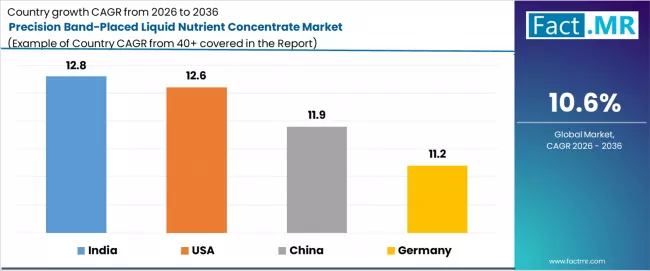
| Country | CAGR (2026 to 2036) |
|---|---|
| India | 12.8% |
| USA | 12.6% |
| China | 11.9% |
| Germany | 11.2% |
Why does India Show the Highest Growth Potential?
India's leading CAGR of 12.8% is propelled by the rapid modernization of its protected agriculture sector and government subsidies promoting micro-irrigation and precision farming techniques.
The need to achieve higher yields from limited land and water resources is driving adoption in high-value open-field vegetable and fruit production. The growing network of advanced agri-service providers is making the technology more accessible to progressive farmers.
How is Large-Scale Speciality Crop Production encouraging Precision Band-Placed Liquid Nutrient Concentrates Sales in USA?
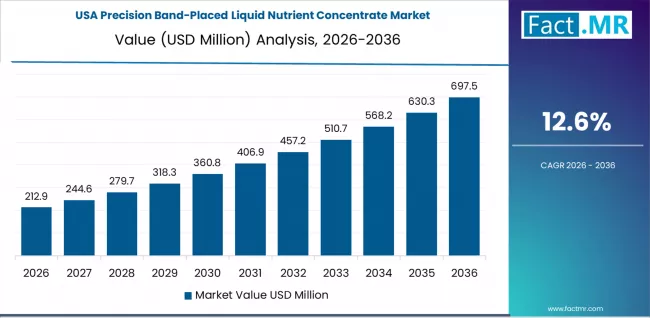
The USA's 12.6% growth is fueled by large-scale specialty crop production, a strong focus on input use efficiency, and widespread adoption of precision planting technology. The robust market for cannabis/hemp cultivation, which is highly dependent on precise nutrient management, represents a significant and growing segment. Major row-crop producers are also beginning to adopt banding for starter fertilizers, expanding the market's scope.
How is China's Protected Agriculture Sector Influencing Demand?
China's 11.9% CAGR is linked to its world-leading scale of greenhouse vegetable production and national policy emphasizing agricultural modernization. The drive for food security and quality, coupled with labor shortages, is accelerating the automation of fertigation and nutrient delivery. Band-placed concentrates are a key component in upgrading these high-tech greenhouse operations to achieve superior yield and resource efficiency.
What makes Germany a European Center for Precision Application?
Germany's 11.2% growth reflects its leadership in high-precision agricultural engineering and its strong horticulture sector. German farmers and growers are early adopters of technologies that optimize input use and comply with strict EU nutrient management regulations.
The focus on quality production for high-end markets, such as open-field asparagus and orchard fruits, makes the yield and quality benefits of band-placed concentrates particularly attractive.
Competitive Landscape of the Precision Band-Placed Liquid Nutrient Concentrate Market
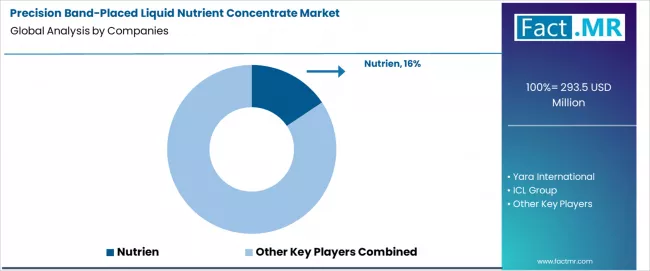
Global specialty fertilizer companies with strong capabilities in liquid formulation chemistry and agronomic research dominate the competitive landscape. Competition centers on developing superior, stable concentrate formulations, building a portfolio of crop-specific solutions, and establishing partnerships with agricultural equipment manufacturers to ensure product compatibility.
Providing extensive agronomic data from field trials that demonstrate clear yield and ROI advantages from band placement is a critical success factor for securing customer loyalty and premium pricing.
Key Players in the Precision Band-Placed Liquid Nutrient Concentrate Market
- Nutrien
- Yara International
- ICL Group
- Haifa Group
- Mosaic
- EuroChem
Scope of Report
| Items | Values |
|---|---|
| Quantitative Units | USD Million |
| Crop | Greenhouse Vegetables, Orchards, Open Field Vegetables, Cannabis/Hemp |
| Viscosity | Clear Liquid, Suspension, Emulsion, Soluble Gel |
| Sales Channel | Ag-Retailers, Direct-to-Farmer, Online Marketplaces, Cooperatives |
| Key Countries | USA, China, India, Germany |
| Key Companies | Nutrien, Yara International, ICL Group, Haifa Group, Mosaic, EuroChem |
| Additional Analysis | Agronomic principles of nutrient banding and root interception; formulation science of high-concentration stable liquids; comparative analysis of application equipment (knives, coulters, injectors); economic analysis of capital investment vs. nutrient savings and yield lift; regulatory considerations for concentrated nutrient handling and storage. |
Market by Segments
Crop :
- Greenhouse Vegetables
- Orchards
- Open Field Vegetables
- Cannabis/Hemp
Viscosity :
- Clear Liquid
- Suspension
- Emulsion
- Soluble Gel
Sales Channel :
- Ag-Retailers
- Direct-to-Farmer
- Online Marketplaces
- Cooperatives
Region :
- North America
- USA
- Canada
- Latin America
- Brazil
- Mexico
- Argentina
- Rest of Latin America
- Western Europe
- Germany
- UK
- France
- Spain
- Italy
- BENELUX
- Rest of Western Europe
- Eastern Europe
- Russia
- Poland
- Czech Republic
- Rest of Eastern Europe
- East Asia
- China
- Japan
- South Korea
- Rest of East Asia
- South Asia & Pacific
- India
- ASEAN
- Australia
- Rest of South Asia & Pacific
- MEA
- Saudi Arabia
- UAE
- Turkiye
- Rest of MEA
Table of Content
- Executive Summary
- Global Market Outlook
- Demand to side Trends
- Supply to side Trends
- Technology Roadmap Analysis
- Analysis and Recommendations
- Market Overview
- Market Coverage / Taxonomy
- Market Definition / Scope / Limitations
- Market Background
- Market Dynamics
- Drivers
- Restraints
- Opportunity
- Trends
- Scenario Forecast
- Demand in Optimistic Scenario
- Demand in Likely Scenario
- Demand in Conservative Scenario
- Opportunity Map Analysis
- Product Life Cycle Analysis
- Supply Chain Analysis
- Investment Feasibility Matrix
- Value Chain Analysis
- PESTLE and Porter’s Analysis
- Regulatory Landscape
- Regional Parent Market Outlook
- Production and Consumption Statistics
- Import and Export Statistics
- Market Dynamics
- Global Market Analysis 2021 to 2025 and Forecast, 2026 to 2036
- Historical Market Size Value (USD Million) Analysis, 2021 to 2025
- Current and Future Market Size Value (USD Million) Projections, 2026 to 2036
- Y to o to Y Growth Trend Analysis
- Absolute $ Opportunity Analysis
- Global Market Pricing Analysis 2021 to 2025 and Forecast 2026 to 2036
- Global Market Analysis 2021 to 2025 and Forecast 2026 to 2036, By Crop
- Introduction / Key Findings
- Historical Market Size Value (USD Million) Analysis By Crop, 2021 to 2025
- Current and Future Market Size Value (USD Million) Analysis and Forecast By Crop, 2026 to 2036
- Greenhouse Vegetables
- Orchards
- Open Field Vegetables
- Cannabis/Hemp
- Greenhouse Vegetables
- Y to o to Y Growth Trend Analysis By Crop, 2021 to 2025
- Absolute $ Opportunity Analysis By Crop, 2026 to 2036
- Global Market Analysis 2021 to 2025 and Forecast 2026 to 2036, By Viscosity
- Introduction / Key Findings
- Historical Market Size Value (USD Million) Analysis By Viscosity, 2021 to 2025
- Current and Future Market Size Value (USD Million) Analysis and Forecast By Viscosity, 2026 to 2036
- Clear Liquid
- Suspension
- Emulsion
- Soluble Gel
- Clear Liquid
- Y to o to Y Growth Trend Analysis By Viscosity, 2021 to 2025
- Absolute $ Opportunity Analysis By Viscosity, 2026 to 2036
- Global Market Analysis 2021 to 2025 and Forecast 2026 to 2036, By Sales Channel
- Introduction / Key Findings
- Historical Market Size Value (USD Million) Analysis By Sales Channel, 2021 to 2025
- Current and Future Market Size Value (USD Million) Analysis and Forecast By Sales Channel, 2026 to 2036
- Ag-Retailers
- Direct-to-Farmer
- Online Marketplaces
- Cooperatives
- Ag-Retailers
- Y to o to Y Growth Trend Analysis By Sales Channel, 2021 to 2025
- Absolute $ Opportunity Analysis By Sales Channel, 2026 to 2036
- Global Market Analysis 2021 to 2025 and Forecast 2026 to 2036, By Region
- Introduction
- Historical Market Size Value (USD Million) Analysis By Region, 2021 to 2025
- Current Market Size Value (USD Million) Analysis and Forecast By Region, 2026 to 2036
- North America
- Latin America
- Western Europe
- Eastern Europe
- East Asia
- South Asia and Pacific
- Middle East & Africa
- Market Attractiveness Analysis By Region
- North America Market Analysis 2021 to 2025 and Forecast 2026 to 2036, By Country
- Historical Market Size Value (USD Million) Trend Analysis By Market Taxonomy, 2021 to 2025
- Market Size Value (USD Million) Forecast By Market Taxonomy, 2026 to 2036
- By Country
- USA
- Canada
- Mexico
- By Crop
- By Viscosity
- By Sales Channel
- By Country
- Market Attractiveness Analysis
- By Country
- By Crop
- By Viscosity
- By Sales Channel
- Key Takeaways
- Latin America Market Analysis 2021 to 2025 and Forecast 2026 to 2036, By Country
- Historical Market Size Value (USD Million) Trend Analysis By Market Taxonomy, 2021 to 2025
- Market Size Value (USD Million) Forecast By Market Taxonomy, 2026 to 2036
- By Country
- Brazil
- Chile
- Rest of Latin America
- By Crop
- By Viscosity
- By Sales Channel
- By Country
- Market Attractiveness Analysis
- By Country
- By Crop
- By Viscosity
- By Sales Channel
- Key Takeaways
- Western Europe Market Analysis 2021 to 2025 and Forecast 2026 to 2036, By Country
- Historical Market Size Value (USD Million) Trend Analysis By Market Taxonomy, 2021 to 2025
- Market Size Value (USD Million) Forecast By Market Taxonomy, 2026 to 2036
- By Country
- Germany
- UK
- Italy
- Spain
- France
- Nordic
- BENELUX
- Rest of Western Europe
- By Crop
- By Viscosity
- By Sales Channel
- By Country
- Market Attractiveness Analysis
- By Country
- By Crop
- By Viscosity
- By Sales Channel
- Key Takeaways
- Eastern Europe Market Analysis 2021 to 2025 and Forecast 2026 to 2036, By Country
- Historical Market Size Value (USD Million) Trend Analysis By Market Taxonomy, 2021 to 2025
- Market Size Value (USD Million) Forecast By Market Taxonomy, 2026 to 2036
- By Country
- Russia
- Poland
- Hungary
- Balkan & Baltic
- Rest of Eastern Europe
- By Crop
- By Viscosity
- By Sales Channel
- By Country
- Market Attractiveness Analysis
- By Country
- By Crop
- By Viscosity
- By Sales Channel
- Key Takeaways
- East Asia Market Analysis 2021 to 2025 and Forecast 2026 to 2036, By Country
- Historical Market Size Value (USD Million) Trend Analysis By Market Taxonomy, 2021 to 2025
- Market Size Value (USD Million) Forecast By Market Taxonomy, 2026 to 2036
- By Country
- China
- Japan
- South Korea
- By Crop
- By Viscosity
- By Sales Channel
- By Country
- Market Attractiveness Analysis
- By Country
- By Crop
- By Viscosity
- By Sales Channel
- Key Takeaways
- South Asia and Pacific Market Analysis 2021 to 2025 and Forecast 2026 to 2036, By Country
- Historical Market Size Value (USD Million) Trend Analysis By Market Taxonomy, 2021 to 2025
- Market Size Value (USD Million) Forecast By Market Taxonomy, 2026 to 2036
- By Country
- India
- ASEAN
- Australia & New Zealand
- Rest of South Asia and Pacific
- By Crop
- By Viscosity
- By Sales Channel
- By Country
- Market Attractiveness Analysis
- By Country
- By Crop
- By Viscosity
- By Sales Channel
- Key Takeaways
- Middle East & Africa Market Analysis 2021 to 2025 and Forecast 2026 to 2036, By Country
- Historical Market Size Value (USD Million) Trend Analysis By Market Taxonomy, 2021 to 2025
- Market Size Value (USD Million) Forecast By Market Taxonomy, 2026 to 2036
- By Country
- Kingdom of Saudi Arabia
- Other GCC Countries
- Turkiye
- South Africa
- Other African Union
- Rest of Middle East & Africa
- By Crop
- By Viscosity
- By Sales Channel
- By Country
- Market Attractiveness Analysis
- By Country
- By Crop
- By Viscosity
- By Sales Channel
- Key Takeaways
- Key Countries Market Analysis
- USA
- Pricing Analysis
- Market Share Analysis, 2025
- By Crop
- By Viscosity
- By Sales Channel
- Canada
- Pricing Analysis
- Market Share Analysis, 2025
- By Crop
- By Viscosity
- By Sales Channel
- Mexico
- Pricing Analysis
- Market Share Analysis, 2025
- By Crop
- By Viscosity
- By Sales Channel
- Brazil
- Pricing Analysis
- Market Share Analysis, 2025
- By Crop
- By Viscosity
- By Sales Channel
- Chile
- Pricing Analysis
- Market Share Analysis, 2025
- By Crop
- By Viscosity
- By Sales Channel
- Germany
- Pricing Analysis
- Market Share Analysis, 2025
- By Crop
- By Viscosity
- By Sales Channel
- UK
- Pricing Analysis
- Market Share Analysis, 2025
- By Crop
- By Viscosity
- By Sales Channel
- Italy
- Pricing Analysis
- Market Share Analysis, 2025
- By Crop
- By Viscosity
- By Sales Channel
- Spain
- Pricing Analysis
- Market Share Analysis, 2025
- By Crop
- By Viscosity
- By Sales Channel
- France
- Pricing Analysis
- Market Share Analysis, 2025
- By Crop
- By Viscosity
- By Sales Channel
- India
- Pricing Analysis
- Market Share Analysis, 2025
- By Crop
- By Viscosity
- By Sales Channel
- ASEAN
- Pricing Analysis
- Market Share Analysis, 2025
- By Crop
- By Viscosity
- By Sales Channel
- Australia & New Zealand
- Pricing Analysis
- Market Share Analysis, 2025
- By Crop
- By Viscosity
- By Sales Channel
- China
- Pricing Analysis
- Market Share Analysis, 2025
- By Crop
- By Viscosity
- By Sales Channel
- Japan
- Pricing Analysis
- Market Share Analysis, 2025
- By Crop
- By Viscosity
- By Sales Channel
- South Korea
- Pricing Analysis
- Market Share Analysis, 2025
- By Crop
- By Viscosity
- By Sales Channel
- Russia
- Pricing Analysis
- Market Share Analysis, 2025
- By Crop
- By Viscosity
- By Sales Channel
- Poland
- Pricing Analysis
- Market Share Analysis, 2025
- By Crop
- By Viscosity
- By Sales Channel
- Hungary
- Pricing Analysis
- Market Share Analysis, 2025
- By Crop
- By Viscosity
- By Sales Channel
- Kingdom of Saudi Arabia
- Pricing Analysis
- Market Share Analysis, 2025
- By Crop
- By Viscosity
- By Sales Channel
- Turkiye
- Pricing Analysis
- Market Share Analysis, 2025
- By Crop
- By Viscosity
- By Sales Channel
- South Africa
- Pricing Analysis
- Market Share Analysis, 2025
- By Crop
- By Viscosity
- By Sales Channel
- USA
- Market Structure Analysis
- Competition Dashboard
- Competition Benchmarking
- Market Share Analysis of Top Players
- By Regional
- By Crop
- By Viscosity
- By Sales Channel
- Competition Analysis
- Competition Deep Dive
- Nutrien
- Overview
- Product Portfolio
- Profitability by Market Segments (Product/Age /Sales Channel/Region)
- Sales Footprint
- Strategy Overview
- Marketing Strategy
- Product Strategy
- Channel Strategy
- Yara International
- ICL Group
- Haifa Group
- Mosaic
- EuroChem
- Nutrien
- Competition Deep Dive
- Assumptions & Acronyms Used
- Research Methodology
List Of Table
- Table 1: Global Market Value (USD Million) Forecast by Region, 2021 to 2036
- Table 2: Global Market Value (USD Million) Forecast by Crop, 2021 to 2036
- Table 3: Global Market Value (USD Million) Forecast by Viscosity, 2021 to 2036
- Table 4: Global Market Value (USD Million) Forecast by Sales Channel, 2021 to 2036
- Table 5: North America Market Value (USD Million) Forecast by Country, 2021 to 2036
- Table 6: North America Market Value (USD Million) Forecast by Crop, 2021 to 2036
- Table 7: North America Market Value (USD Million) Forecast by Viscosity, 2021 to 2036
- Table 8: North America Market Value (USD Million) Forecast by Sales Channel, 2021 to 2036
- Table 9: Latin America Market Value (USD Million) Forecast by Country, 2021 to 2036
- Table 10: Latin America Market Value (USD Million) Forecast by Crop, 2021 to 2036
- Table 11: Latin America Market Value (USD Million) Forecast by Viscosity, 2021 to 2036
- Table 12: Latin America Market Value (USD Million) Forecast by Sales Channel, 2021 to 2036
- Table 13: Western Europe Market Value (USD Million) Forecast by Country, 2021 to 2036
- Table 14: Western Europe Market Value (USD Million) Forecast by Crop, 2021 to 2036
- Table 15: Western Europe Market Value (USD Million) Forecast by Viscosity, 2021 to 2036
- Table 16: Western Europe Market Value (USD Million) Forecast by Sales Channel, 2021 to 2036
- Table 17: Eastern Europe Market Value (USD Million) Forecast by Country, 2021 to 2036
- Table 18: Eastern Europe Market Value (USD Million) Forecast by Crop, 2021 to 2036
- Table 19: Eastern Europe Market Value (USD Million) Forecast by Viscosity, 2021 to 2036
- Table 20: Eastern Europe Market Value (USD Million) Forecast by Sales Channel, 2021 to 2036
- Table 21: East Asia Market Value (USD Million) Forecast by Country, 2021 to 2036
- Table 22: East Asia Market Value (USD Million) Forecast by Crop, 2021 to 2036
- Table 23: East Asia Market Value (USD Million) Forecast by Viscosity, 2021 to 2036
- Table 24: East Asia Market Value (USD Million) Forecast by Sales Channel, 2021 to 2036
- Table 25: South Asia and Pacific Market Value (USD Million) Forecast by Country, 2021 to 2036
- Table 26: South Asia and Pacific Market Value (USD Million) Forecast by Crop, 2021 to 2036
- Table 27: South Asia and Pacific Market Value (USD Million) Forecast by Viscosity, 2021 to 2036
- Table 28: South Asia and Pacific Market Value (USD Million) Forecast by Sales Channel, 2021 to 2036
- Table 29: Middle East & Africa Market Value (USD Million) Forecast by Country, 2021 to 2036
- Table 30: Middle East & Africa Market Value (USD Million) Forecast by Crop, 2021 to 2036
- Table 31: Middle East & Africa Market Value (USD Million) Forecast by Viscosity, 2021 to 2036
- Table 32: Middle East & Africa Market Value (USD Million) Forecast by Sales Channel, 2021 to 2036
List Of Figures
- Figure 1: Global Market Pricing Analysis
- Figure 2: Global Market Value (USD Million) Forecast 2021-2036
- Figure 3: Global Market Value Share and BPS Analysis by Crop, 2026 and 2036
- Figure 4: Global Market Y to o to Y Growth Comparison by Crop, 2026-2036
- Figure 5: Global Market Attractiveness Analysis by Crop
- Figure 6: Global Market Value Share and BPS Analysis by Viscosity, 2026 and 2036
- Figure 7: Global Market Y to o to Y Growth Comparison by Viscosity, 2026-2036
- Figure 8: Global Market Attractiveness Analysis by Viscosity
- Figure 9: Global Market Value Share and BPS Analysis by Sales Channel, 2026 and 2036
- Figure 10: Global Market Y to o to Y Growth Comparison by Sales Channel, 2026-2036
- Figure 11: Global Market Attractiveness Analysis by Sales Channel
- Figure 12: Global Market Value (USD Million) Share and BPS Analysis by Region, 2026 and 2036
- Figure 13: Global Market Y to o to Y Growth Comparison by Region, 2026-2036
- Figure 14: Global Market Attractiveness Analysis by Region
- Figure 15: North America Market Incremental Dollar Opportunity, 2026-2036
- Figure 16: Latin America Market Incremental Dollar Opportunity, 2026-2036
- Figure 17: Western Europe Market Incremental Dollar Opportunity, 2026-2036
- Figure 18: Eastern Europe Market Incremental Dollar Opportunity, 2026-2036
- Figure 19: East Asia Market Incremental Dollar Opportunity, 2026-2036
- Figure 20: South Asia and Pacific Market Incremental Dollar Opportunity, 2026-2036
- Figure 21: Middle East & Africa Market Incremental Dollar Opportunity, 2026-2036
- Figure 22: North America Market Value Share and BPS Analysis by Country, 2026 and 2036
- Figure 23: North America Market Value Share and BPS Analysis by Crop, 2026 and 2036
- Figure 24: North America Market Y to o to Y Growth Comparison by Crop, 2026-2036
- Figure 25: North America Market Attractiveness Analysis by Crop
- Figure 26: North America Market Value Share and BPS Analysis by Viscosity, 2026 and 2036
- Figure 27: North America Market Y to o to Y Growth Comparison by Viscosity, 2026-2036
- Figure 28: North America Market Attractiveness Analysis by Viscosity
- Figure 29: North America Market Value Share and BPS Analysis by Sales Channel, 2026 and 2036
- Figure 30: North America Market Y to o to Y Growth Comparison by Sales Channel, 2026-2036
- Figure 31: North America Market Attractiveness Analysis by Sales Channel
- Figure 32: Latin America Market Value Share and BPS Analysis by Country, 2026 and 2036
- Figure 33: Latin America Market Value Share and BPS Analysis by Crop, 2026 and 2036
- Figure 34: Latin America Market Y to o to Y Growth Comparison by Crop, 2026-2036
- Figure 35: Latin America Market Attractiveness Analysis by Crop
- Figure 36: Latin America Market Value Share and BPS Analysis by Viscosity, 2026 and 2036
- Figure 37: Latin America Market Y to o to Y Growth Comparison by Viscosity, 2026-2036
- Figure 38: Latin America Market Attractiveness Analysis by Viscosity
- Figure 39: Latin America Market Value Share and BPS Analysis by Sales Channel, 2026 and 2036
- Figure 40: Latin America Market Y to o to Y Growth Comparison by Sales Channel, 2026-2036
- Figure 41: Latin America Market Attractiveness Analysis by Sales Channel
- Figure 42: Western Europe Market Value Share and BPS Analysis by Country, 2026 and 2036
- Figure 43: Western Europe Market Value Share and BPS Analysis by Crop, 2026 and 2036
- Figure 44: Western Europe Market Y to o to Y Growth Comparison by Crop, 2026-2036
- Figure 45: Western Europe Market Attractiveness Analysis by Crop
- Figure 46: Western Europe Market Value Share and BPS Analysis by Viscosity, 2026 and 2036
- Figure 47: Western Europe Market Y to o to Y Growth Comparison by Viscosity, 2026-2036
- Figure 48: Western Europe Market Attractiveness Analysis by Viscosity
- Figure 49: Western Europe Market Value Share and BPS Analysis by Sales Channel, 2026 and 2036
- Figure 50: Western Europe Market Y to o to Y Growth Comparison by Sales Channel, 2026-2036
- Figure 51: Western Europe Market Attractiveness Analysis by Sales Channel
- Figure 52: Eastern Europe Market Value Share and BPS Analysis by Country, 2026 and 2036
- Figure 53: Eastern Europe Market Value Share and BPS Analysis by Crop, 2026 and 2036
- Figure 54: Eastern Europe Market Y to o to Y Growth Comparison by Crop, 2026-2036
- Figure 55: Eastern Europe Market Attractiveness Analysis by Crop
- Figure 56: Eastern Europe Market Value Share and BPS Analysis by Viscosity, 2026 and 2036
- Figure 57: Eastern Europe Market Y to o to Y Growth Comparison by Viscosity, 2026-2036
- Figure 58: Eastern Europe Market Attractiveness Analysis by Viscosity
- Figure 59: Eastern Europe Market Value Share and BPS Analysis by Sales Channel, 2026 and 2036
- Figure 60: Eastern Europe Market Y to o to Y Growth Comparison by Sales Channel, 2026-2036
- Figure 61: Eastern Europe Market Attractiveness Analysis by Sales Channel
- Figure 62: East Asia Market Value Share and BPS Analysis by Country, 2026 and 2036
- Figure 63: East Asia Market Value Share and BPS Analysis by Crop, 2026 and 2036
- Figure 64: East Asia Market Y to o to Y Growth Comparison by Crop, 2026-2036
- Figure 65: East Asia Market Attractiveness Analysis by Crop
- Figure 66: East Asia Market Value Share and BPS Analysis by Viscosity, 2026 and 2036
- Figure 67: East Asia Market Y to o to Y Growth Comparison by Viscosity, 2026-2036
- Figure 68: East Asia Market Attractiveness Analysis by Viscosity
- Figure 69: East Asia Market Value Share and BPS Analysis by Sales Channel, 2026 and 2036
- Figure 70: East Asia Market Y to o to Y Growth Comparison by Sales Channel, 2026-2036
- Figure 71: East Asia Market Attractiveness Analysis by Sales Channel
- Figure 72: South Asia and Pacific Market Value Share and BPS Analysis by Country, 2026 and 2036
- Figure 73: South Asia and Pacific Market Value Share and BPS Analysis by Crop, 2026 and 2036
- Figure 74: South Asia and Pacific Market Y to o to Y Growth Comparison by Crop, 2026-2036
- Figure 75: South Asia and Pacific Market Attractiveness Analysis by Crop
- Figure 76: South Asia and Pacific Market Value Share and BPS Analysis by Viscosity, 2026 and 2036
- Figure 77: South Asia and Pacific Market Y to o to Y Growth Comparison by Viscosity, 2026-2036
- Figure 78: South Asia and Pacific Market Attractiveness Analysis by Viscosity
- Figure 79: South Asia and Pacific Market Value Share and BPS Analysis by Sales Channel, 2026 and 2036
- Figure 80: South Asia and Pacific Market Y to o to Y Growth Comparison by Sales Channel, 2026-2036
- Figure 81: South Asia and Pacific Market Attractiveness Analysis by Sales Channel
- Figure 82: Middle East & Africa Market Value Share and BPS Analysis by Country, 2026 and 2036
- Figure 83: Middle East & Africa Market Value Share and BPS Analysis by Crop, 2026 and 2036
- Figure 84: Middle East & Africa Market Y to o to Y Growth Comparison by Crop, 2026-2036
- Figure 85: Middle East & Africa Market Attractiveness Analysis by Crop
- Figure 86: Middle East & Africa Market Value Share and BPS Analysis by Viscosity, 2026 and 2036
- Figure 87: Middle East & Africa Market Y to o to Y Growth Comparison by Viscosity, 2026-2036
- Figure 88: Middle East & Africa Market Attractiveness Analysis by Viscosity
- Figure 89: Middle East & Africa Market Value Share and BPS Analysis by Sales Channel, 2026 and 2036
- Figure 90: Middle East & Africa Market Y to o to Y Growth Comparison by Sales Channel, 2026-2036
- Figure 91: Middle East & Africa Market Attractiveness Analysis by Sales Channel
- Figure 92: Global Market - Tier Structure Analysis
- Figure 93: Global Market - Company Share Analysis
- FAQs -
How big is the precision band-placed liquid nutrient concentrate market in 2026?
The global precision band-placed liquid nutrient concentrate market is estimated to be valued at USD 293.5 million in 2026.
What will be the size of precision band-placed liquid nutrient concentrate market in 2036?
The market size for the precision band-placed liquid nutrient concentrate market is projected to reach USD 803.9 million by 2036.
How much will be the precision band-placed liquid nutrient concentrate market growth between 2026 and 2036?
The precision band-placed liquid nutrient concentrate market is expected to grow at a 10.6% CAGR between 2026 and 2036.
What are the key product types in the precision band-placed liquid nutrient concentrate market?
The key product types in precision band-placed liquid nutrient concentrate market are greenhouse vegetables, orchards, open field vegetables and cannabis/hemp.
Which viscosity segment to contribute significant share in the precision band-placed liquid nutrient concentrate market in 2026?
In terms of viscosity, clear liquid segment to command 42.2% share in the precision band-placed liquid nutrient concentrate market in 2026.