- Market Value (2025): USD 1.0 Bn
- Estimated Value (2026): USD 1.2 Bn
- Forecast Value (2036): USD 5.2 Bn
- CAGR (2026-2036): 16.2%
What is the Protein-Derived Postbiotics Market forecast to be worth by 2036?
USD 1.2 billion in 2026 to USD 5.2 billion by 2036 at a 16.2% CAGR.
- The Protein-Derived Postbiotics Market reached USD 1.0 billion in 2025.
- Demand is projected to increase from USD 1.2 billion in 2026 to USD 5.2 billion by 2036.
- The market is forecast to record 16.2% CAGR from 2026 to 2036 as nutrition brands use inactive microbial fractions to support digestive and immune positioning.
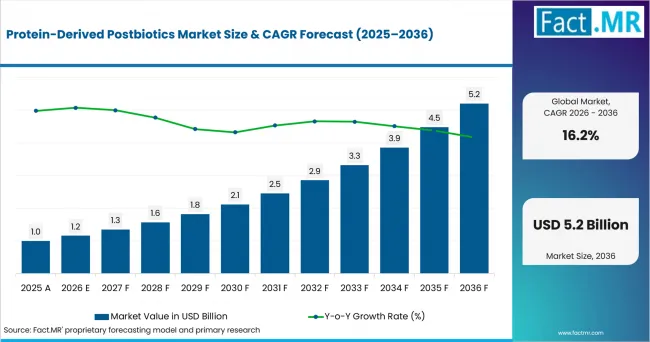
Protein Derived Postbiotics Market Value Analysis | Source: Fact.MR
What are the defining numbers behind Protein-Derived Postbiotics Market growth?
An absolute opportunity of USD 4.05 billion is expected between 2026 and 2036.
- Demand Drivers in the Market
- Supplement brands need shelf-stable postbiotic materials that keep label claims consistent across capsules, sachets and powder blends.
- Functional food formulators are expected to use peptide-rich fractions where live-culture survival is difficult during heating or storage.
- CDC NCHS reported in May 2026 that 60.2% of U.S. adults aged 20 and older used any dietary supplement in the past 30 days during August 2021-August 2023. This provides a broad indicator of U.S. supplement use rather than a direct measure of adoption of postbiotic formats.
- Clinical nutrition teams are anticipated to test protein-hydrolysate metabolite preparations retaining inanimate microbial components where digestive comfort and tolerability guide formula selection.
- Pet nutrition developers are likely to evaluate inactive fermentation materials where extrusion and drying favor ingredients that retain function after processing.
- Key Segments Analyzed
- By Postbiotic Fraction: Bioactive peptide-containing inanimate microbial preparations are expected to hold 32.00% share in 2026 because peptide identity gives formulators a clearer route to digestive-health positioning.
- By Protein Substrate: Dairy proteins are projected to account for 31.00% share in 2026 due to established fermentation know-how and broad use in specialized nutrition.
- By Health Positioning: Gut barrier and digestive health is anticipated to capture 34.00% share in 2026 as brands connect postbiotic fractions with daily digestive support.
- By Application: Dietary supplements are estimated to represent 38.00% share in 2026 owing to familiar dosage forms and clearer serving-size communication.
- Analyst Opinion at Fact.MR
- Shambhu Nath Jha, Principal Consultant at Fact.MR, states, "The commercial test for protein-derived postbiotics centers on documentation depth ahead of broad microbiome language. Brands are expected to ask for peptide identity, strain lineage and processing tolerance before committing to new launches. Suppliers that connect fermentation control with finished-format stability should gain access to higher-value supplement and food programs."
- Strategic Implications
- Ingredient manufacturers should document peptide profiles and heat-treatment steps so formulators can compare inactive postbiotic fractions across supplier portfolios.
- Supplement brands should align dose, serving size and health-positioning language before moving protein-derived postbiotics into daily-use formats.
- Food formulators should test taste, solubility and heat stability early because protein substrates can influence texture in bars and beverages.
- Regional teams should map digestive-health wording against local supplement rules before scaling the same postbiotic story across countries.
The USA is projected to post 18.3% CAGR through supplement-channel depth and food-format scale. Germany is expected to record 17.3% CAGR owing to supplement familiarity and plant-protein formulation activity. The UK is forecast to advance at 17.0% CAGR through food manufacturing capacity and active nutrition use. Japan is anticipated to reach 16.2% CAGR as functional-food systems favor documented ingredient files. France is estimated to register 14.6% CAGR due to dairy substrate availability and cautious health-positioning practices.
How does the Protein-Derived Postbiotics Market break down by segment?
Bioactive peptide-containing inanimate microbial preparations lead Postbiotic Fraction at 32.00%; Dietary supplements lead Application at 38.00%.
Which Postbiotic Fraction dominates?
Bioactive peptide-containing inanimate microbial preparations are expected to hold 32.0% share in 2026.
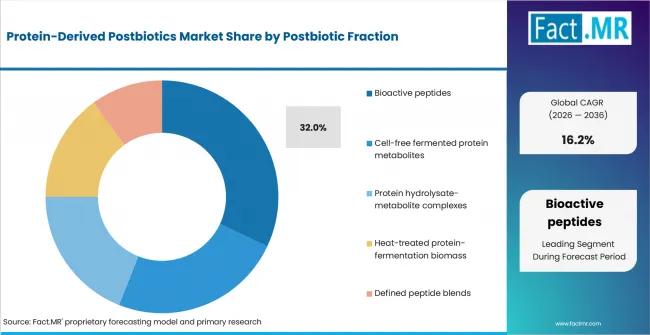
Protein Derived Postbiotics Market Analysis By Postbiotic Fraction | Source: Fact.MR
Bioactive peptide-containing inanimate microbial preparations lead the fraction mix because they give formulators a more defined functional story than broad fermented biomass. Their use is expected to rise in digestive health and healthy aging products where brands want inactive ingredients with measurable protein-derived components. Fermented protein-metabolite preparations retaining inanimate microbial components serve formulations that need a cleaner matrix. Protein hydrolysate-metabolite preparations retaining inanimate microbial components fit specialized nutrition where absorption and tolerability guide development.
What leads the Protein Substrate segment?
Dairy proteins are projected to account for 31.0% share in 2026.
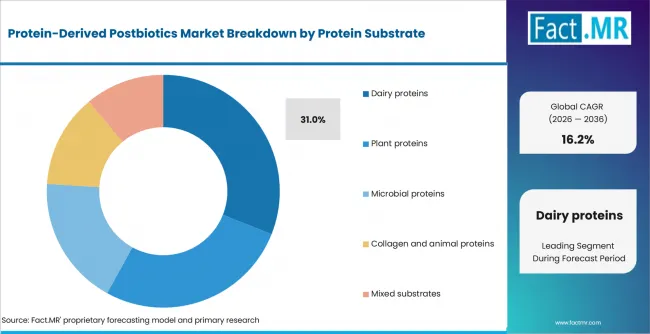
Protein Derived Postbiotics Market Analysis By Protein Substrate | Source: Fact.MR
Dairy proteins lead substrate use because they are familiar to enzyme users, culture suppliers and nutrition formulators. They are expected to remain preferred in gut barrier and clinical nutrition concepts where whey and casein heritage supports product development. Plant proteins are gaining use in vegan-friendly formulations. Destatis reported in May 2026 that Germany produced 124,900 tonnes of vegetarian or vegan meat-substitute products in 2025.
How does Health Positioning shape demand?
Gut barrier and digestive health is anticipated to lead with 34.0% share in 2026.
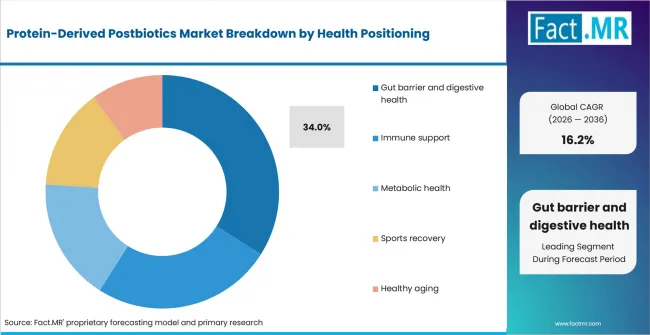
Protein Derived Postbiotics Market Analysis By Health Positioning | Source: Fact.MR
Gut barrier and digestive health leads because it is the clearest fit for postbiotic language and consumer understanding. Immune support follows where brands link inactive biotic fractions to everyday resilience and seasonal wellness. Metabolic health remains more evidence-sensitive because benefit wording needs stronger trial support. Sports recovery uses peptide-rich positioning where protein metabolism and comfort after training are part of the product story.
What supports Dietary Supplements within Application?
Dietary supplements are estimated to represent 38.0% share in 2026.
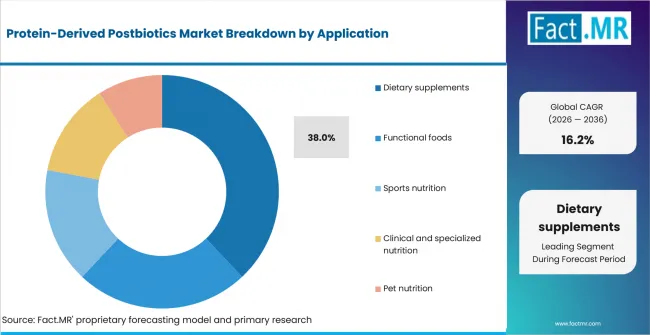
Protein Derived Postbiotics Market Analysis By Application | Source: Fact.MR
Dietary supplements lead application use because capsules, tablets and sachets can carry defined serving sizes. These formats are expected to suit postbiotic fractions that need precise dose communication and shelf-life records. Functional foods follow where taste and processing stability are solved at pilot scale. Sports nutrition brands are likely to test protein-derived postbiotics in powders and bars where digestive comfort complements amino-acid positioning.
What is accelerating Protein-Derived Postbiotics Market adoption, and what is holding it back?
Shelf-stable digestive-health positioning drives it; claim and substrate documentation restrains it.
| DRIVER | (~) % IMPACT ON CAGR | GEOGRAPHIC RELEVANCE | IMPACT TIMELINE |
|---|---|---|---|
| Shelf-stable inactive biotic formats | +2.1% | North America, Western Europe | Short term (<= 2 years) |
| Digestive-health and gut barrier positioning | +1.7% | Global | Medium term (2-4 years) |
| Protein-rich functional food expansion | +1.2% | Europe, East Asia | Medium term (2-4 years) |
| Specialized nutrition and sports recovery use | +0.9% | USA, Japan, UK | Long term (>= 4 years) |
Source: Fact.MR analysis. Updated Sep 3, 2026
- Shelf-stable inactive biotic formats: Heat-treated or inanimate materials are expected to help brands manage shelf life in capsules, powders and food applications. The mechanism is valuable where live-culture count retention creates formulation stress.
- Digestive-health and gut barrier positioning: Postbiotic fractions are anticipated to gain use where brands want gut-health language tied to defined fermentation outputs. Peptide identity and strain documentation give review teams a stronger basis for claims.
- Protein-rich functional food expansion: Protein substrates are projected to support postbiotic concepts in bars, drink mixes and spoonable foods. Developers can combine protein nutrition with digestive positioning when taste and texture remain acceptable.
- Specialized nutrition and sports recovery use: Nutrition brands are expected to evaluate protein-derived postbiotics where digestive comfort supports adherence. Sports formulas can pair peptide-rich fractions with recovery language and familiar serving rituals.
| OPPORTUNITY | (~) % IMPACT ON CAGR | GEOGRAPHIC RELEVANCE | IMPACT TIMELINE |
|---|---|---|---|
| Defined inanimate microbial preparations containing characterized peptide fractions for premium supplements | +1.3% | USA, Europe | Short term (<= 2 years) |
| Functional foods using inanimate microbial preparations with fermented protein fractions | +1.0% | Europe, East Asia | Medium term (2-4 years) |
| Pet nutrition with process-stable biotic ingredients | +0.7% | North America, Western Europe | Long term (>= 4 years) |
Source: Fact.MR analysis. Updated Sep 3, 2026
- Defined inanimate microbial preparations containing characterized peptide fractions for premium supplements: Ingredient firms can build higher-value lines around named peptide profiles and controlled fermentation steps. Capsules and sachets give early launch formats for clear dose communication.
- Functional foods using inanimate microbial preparations with fermented protein fractions: Food developers are expected to use postbiotic materials where live cultures face process limits. Drink powders and chilled foods provide practical routes when sensory testing supports repeat purchase.
- Pet nutrition with process-stable biotic ingredients: Kibble and treat producers can use inanimate fermentation fractions that tolerate drying steps. Companion animal digestive-health positioning gives a further route for protein-derived postbiotic claims.
| RESTRAINT | (~) % IMPACT ON CAGR | GEOGRAPHIC RELEVANCE | IMPACT TIMELINE |
|---|---|---|---|
| Health-claim review and label discipline | -0.8% | USA, Europe, Japan | Short term (<= 2 years) |
| Substrate allergen and sensory limits | -0.5% | Global | Medium term (2-4 years) |
| Cost of validated fermentation control | -0.4% | Global | Long term (>= 4 years) |
Source: Fact.MR analysis. Updated Sep 3, 2026
- Health-claim review and label discipline: Brands need careful wording when postbiotic ingredients are positioned around gut barrier or immune support. Claim files must connect ingredient identity, dosage and benefit language before broader launches.
- Substrate allergen and sensory limits: Dairy-derived materials carry allergen-label considerations and plant substrates can affect taste. Formulators are expected to run more pilot trials before using protein-derived postbiotics in mainstream foods.
- Cost of validated fermentation control: Controlled fermentation, heat treatment and peptide testing add cost before commercialization. Smaller brands may choose standard probiotics or simpler prebiotic ingredients until documentation costs decline.
Which countries are scaling the Protein-Derived Postbiotics Market through 2036?
- The country comparison spans 3.73 percentage points and forms a concentrated growth band across the forecast period.
- The USA remains 0.98 percentage point above Germany through supplement-format depth and food-channel scale.
- Germany remains 0.34 percentage point above the UK as supplement familiarity and plant-protein processing support formulation work.
- The UK remains 0.79 percentage point above Japan through food manufacturing capacity and active nutrition use.
- Japan remains 1.62 percentage points above France as functional-food discipline supports metabolic health positioning.
- France closes the displayed range through dairy substrate availability and established food manufacturing depth.
Comparable CAGRs create different entry conditions due to supplement habits, functional-food rules, substrate availability and brand evidence standards. Full report coverage includes North America, Latin America, Western Europe, Eastern Europe, East Asia, South Asia & Pacific, Middle East & Africa.
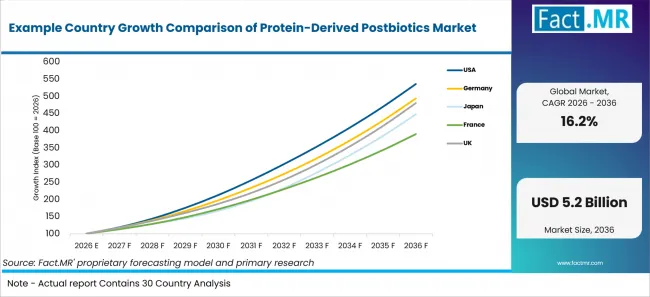
Example Country Growth Comparison Of Protein Derived Postbiotics Market | Source: Fact.MR
| Country | CAGR (2026-2036) |
|---|---|
| United States | 18.3% |
| Germany | 17.3% |
| United Kingdom | 17.0% |
| Japan | 16.2% |
| France | 14.6% |
Source: Fact.MR analysis. Updated Sep 3, 2026
What supports USA adoption?
18.3% CAGR, supported by supplement use and food-channel scale.
U.S. supplement brands evaluate dose clarity and shelf life before approving new postbiotic inputs. The USA is projected to post 18.3% CAGR through 2036. USDA Economic Research Service reported in June 2026 that inflation-adjusted U.S. food spending by consumers, businesses and government entities reached USD 2.51 trillion in 2025.
How is Germany scaling demand?
17.3% CAGR, shaped by supplement familiarity and protein formulation depth.
German formulators are expected to prioritize documentation around strain origin and protein substrate identity. Germany is forecast to record 17.3% CAGR through 2036. The German Federal Institute for Risk Assessment stated in its English-language July 2025 publication that more than two thirds of respondents had consumed a food supplement within the previous 12 months.
What supports the United Kingdom’s growth?
17.0% CAGR, backed by food manufacturing scale and active nutrition use.
UK brands are anticipated to scale protein-derived postbiotics through supplement powders and functional food formats. The UK is expected to advance at 17.0% CAGR through 2036. The Office for National Statistics reported in July 2026 that manufacture of food represented 22.9% of total UK manufacturers' product sales in 2025.
How is Japan developing demand?
16.2% CAGR, driven by functional-food rules and metabolic-health demand.
Japan's product teams are likely to value postbiotic ingredients that fit functional claim files and stable food formats. Japan is anticipated to reach 16.2% CAGR through 2036. The Ministry of Health, Labour and Welfare reported in December 2025 that approximately 11 million people in Japan were estimated to be strongly suspected of having diabetes.
What is supporting France’s adoption?
14.6% CAGR, supported by dairy substrate supply and food-sector depth.
French dairy and specialized nutrition firms are expected to test peptide-rich postbiotics where digestive-health positioning fits established product lines. France is estimated to register 14.6% CAGR through 2036. The French Ministry of Agriculture states that the French agrifood industry comprises more than 19,000 enterprises.
Who leads the Protein-Derived Postbiotics Market?
Novonesis is profiled as an adjacent participant through broader biosolutions, fermentation and health-nutrition capabilities.
ADM added Asahi Group Foods’ Lactobacillus gasseri CP2305 to its health and wellness portfolio through a February 2025 exclusive marketing and distribution agreement. ADM describes CP2305 as a lactic acid-based postbiotic backed by eight human clinical trials for stress, mood and sleep support.
Lallemand Health Solutions and Kirin Holdings announced a May 2025 distribution agreement for IMMUSE®, a heat-inactivated Lactococcus lactis strain Plasma postbiotic. Lallemand states that IMMUSE® is supported by 15 clinical studies, establishing direct postbiotic participation without a specific protein-derived postbiotic classification.
Kerry participates in postbiotics through Plenibiotic™, its current rice-derived postbiotic based on strain 327, following its exclusive licensing agreement with Kameda Seika for the rice-derived Lactobacillus K-1 technology. Kerry also provides broader food, beverage and supplement formulation capabilities.
IFF and dsm-firmenich provide particularly relevant examples of protein-associated postbiotic preparations. IFF markets CalceoBiotic, a postbiotic system standardized for calcium and protein, while dsm-firmenich markets Humiome Post LB, an inactivated microbial preparation with fermented culture-medium components including peptides and amino acids.
Which companies are the key providers?
Key companies include Novonesis, Lallemand Health Solutions, IFF, Kerry Group, dsm-firmenich, and ADM.
- Novonesis
- Lallemand Health Solutions
- IFF
- Kerry Group
- dsm-firmenich
- ADM
Bibliography
- Stierman, B., Couch, C. A., Gahche, J. J., & Mishra, S. (2026, May). Dietary supplement use: United States, August 2021–August 2023 (NCHS Data Brief No. 561). National Center for Health Statistics.
- Zeballos, E., & Sinclair, W. (2026, June 11). Total U.S. food spending reached $2.51 trillion in 2025. Economic Research Service, U.S. Department of Agriculture.
- Statistisches Bundesamt (Destatis). (2026, May 18). Nach jahrelangem Anstieg: Fleischersatz-Produktion sinkt 2025 um 1,2 % gegenüber dem Vorjahr [After years of increase: Meat substitute production decreased by 1.2% in 2025].
- German Federal Institute for Risk Assessment. (2025, July 18). Between hype and misconception: Common misunderstandings about food supplements.
- Office for National Statistics. (2026, July 24). UK manufacturers' sales by product: 2025.
- ADM. (2025, February 25). ADM and Asahi Group sign exclusive distribution agreement for innovative postbiotic designed to support stress, mood and sleep.
- Lallemand Health Solutions. (2025, May 15). Lallemand Health Solutions and Kirin Holdings announce distribution agreement for scientifically proven postbiotic IMMUSE®.
- dsm-firmenich. (2026, February 20). Sustainability, innovation, and partnerships. In Integrated Annual Report 2025.
This Report Answers
- The report explains where protein-derived postbiotics are used across fraction type and protein substrate. It also covers health positioning and application, together with regional demand conditions.
- Segment analysis identifies the leading subsegments and the formulation reasons brands prioritize them.
- Country analysis examines the listed markets and the supplement, food manufacturing and functional-health mechanisms supporting demand.
- Competitive analysis reviews profiled participants across fermentation, postbiotic ingredients, health-science portfolios and food formulation support, distinguishing direct and adjacent relevance where evidence differs.
- Application analysis assesses how shelf stability, protein identity and dosage communication influence purchase decisions.
What does the Protein-Derived Postbiotics Market cover?
The Protein-Derived Postbiotics Market covers postbiotic preparations containing inanimate microorganisms and/or their components in which proteinaceous cell components, peptides or other protein-associated fractions contribute to the commercial value proposition. The scope requires the inanimate microbial preparation to remain part of the finished postbiotic ingredient used in supplements, functional foods or specialized nutrition.
The assessment covers dairy, plant, microbial and collagen-based substrates across digestive health, immune support, metabolic health, sports recovery and healthy aging. Demand is assessed across application routes and regional conditions that influence claim review, sensory fit and launch feasibility.
What is included in the scope?
The scope includes inanimate microbial postbiotic preparations used in supplement capsules, drink powders and foods where protein-associated fractions contribute to the health-positioning story.
Adjacent coverage considers dietary supplement formats and nutraceutical products when postbiotic ingredients are used as active nutrition inputs. The scope also connects to probiotics products and health and wellness foods where buyers compare live cultures with stable inactive biotic systems.
What is excluded from the scope?
The scope excludes live probiotic cultures sold mainly for colony-forming-unit claims. It excludes commodity protein powders where fermentation or postbiotic functionality is outside the purchase decision.
The scope also excludes finished medical treatments, prescription nutrition products and broad gut-health products where protein-derived inactive biotic fractions are outside the formula identity.
How Was the Analysis Built?
The analysis draws on 120+ sources, 35+ company portfolios, 25+ countries, and more than 20 industry interviews.
- Primary Research: Primary research includes discussions with manufacturers, service providers, technology developers, distributors, end users, and subject-matter experts. These conversations examine purchasing priorities, product adoption, operational challenges, approval requirements, competitive positioning, and the factors that influence wider market acceptance.
- Desk Research: Desk research covers government statistics, regulatory publications, company filings, trade data, technical studies, industry associations, standards, public policy, and other authoritative sources. Every source used in the analysis is documented in the bibliography.
- Market Sizing and Forecasting: Market estimates combine historical performance, demand indicators, pricing and volume trends, segment shares, company participation, country-level growth, adoption patterns, investment activity, and barriers to market expansion.
- Data Validation and Update Cycle: Findings are validated by comparing primary interviews with public data, company activity, regulatory changes, trade patterns, and industry developments. Regular updates review new product launches, capacity changes, partnerships, approvals, and shifts in commercial adoption.
Segmentation
What is the report’s scope and coverage?
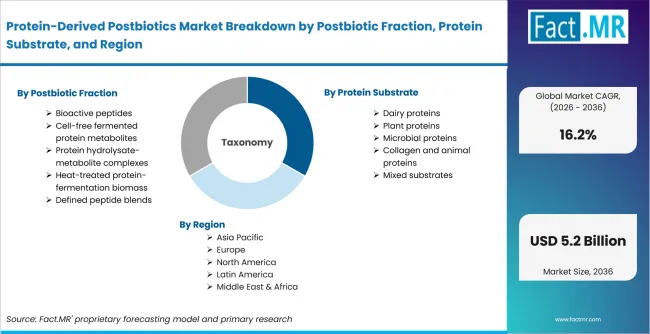
Protein Derived Postbiotics Market Breakdown By Postbiotic Fraction, Protein Substrate, And Region | Source: Fact.MR
| Attribute | Details |
|---|---|
| Quantitative Units | USD billion |
| Market Definition | Protein-associated postbiotic preparations containing inanimate microorganisms and/or their components together with proteinaceous cell components, peptides or protein-derived material generated during fermentation and processing. Substantially purified proteins, peptides, metabolites and cell-free filtrates are outside the postbiotic definition when presented on their own. |
| Postbiotic Fraction | Bioactive peptides; Cell-free fermented protein metabolites; Protein hydrolysate-metabolite complexes; Heat-treated protein-fermentation biomass; Defined peptide blends |
| Protein Substrate | Dairy proteins; Plant proteins; Microbial proteins; Collagen and animal proteins; Mixed substrates |
| Health Positioning | Gut barrier and digestive health; Immune support; Metabolic health; Sports recovery; Healthy aging |
| Application | Dietary supplements; Functional foods; Sports nutrition; Clinical and specialized nutrition; Pet nutrition |
| Regions Covered | North America; Latin America; Western Europe; Eastern Europe; East Asia; South Asia & Pacific; Middle East & Africa |
| Countries Covered | United States; Germany; United Kingdom; Japan; France |
| Key Companies Profiled | Novonesis; Lallemand Health Solutions; IFF; Kerry Group; dsm-firmenich; ADM |
| Forecast Period | 2026 to 2036 |
| Approach | Hybrid top-down and bottom-up approach using supplement adoption, functional food channels, substrate availability, country growth, application fit and provider portfolio review. |
Source: Fact.MR analysis. Updated Sep 3, 2026
How is the market segmented?
-
By Postbiotic Fraction
- Bioactive peptides
- Cell-free fermented protein metabolites
- Protein hydrolysate-metabolite complexes
- Heat-treated protein-fermentation biomass
- Defined peptide blends
-
By Protein Substrate
- Dairy proteins
- Plant proteins
- Microbial proteins
- Collagen and animal proteins
- Mixed substrates
-
By Health Positioning
- Gut barrier and digestive health
- Immune support
- Metabolic health
- Sports recovery
- Healthy aging
-
By Application
- Dietary supplements
- Functional foods
- Sports nutrition
- Clinical and specialized nutrition
- Pet nutrition
-
By Region
- North America
- Latin America
- Western Europe
- Eastern Europe
- East Asia
- South Asia & Pacific
- Middle East & Africa
Frequently Asked Questions
How big is the protein-derived postbiotics market in 2026?
What is the CAGR of the protein-derived postbiotics market from 2026 to 2036?
Which postbiotic fraction leads the protein-derived postbiotics market?
Which protein substrate leads the protein-derived postbiotics market?
Who are the leading companies in the protein-derived postbiotics market?
Who worked on this report


Preview the report firsthand - request a free sample
Free SampleGet the brochure for pricing and purchase details
Download PDF