- Market Value (2025): USD 1.0 Bn
- Estimated Value (2026): USD 1.1 Bn
- Forecast Value (2036): USD 2.6 Bn
- CAGR (2026-2036): 9.1%
What is the PVC Bio-Based Plasticizers Market forecast to be worth by 2036?
USD 1.1 billion in 2026 to USD 2.6 billion by 2036, at 9.1% CAGR.
- The PVC bio-based plasticizers market reached USD 1.0 billion in 2025.
- Demand is projected to increase from USD 1.1 billion in 2026 to USD 2.6 billion by 2036.
- The market is expected to expand at 9.1% CAGR from 2026 to 2036.
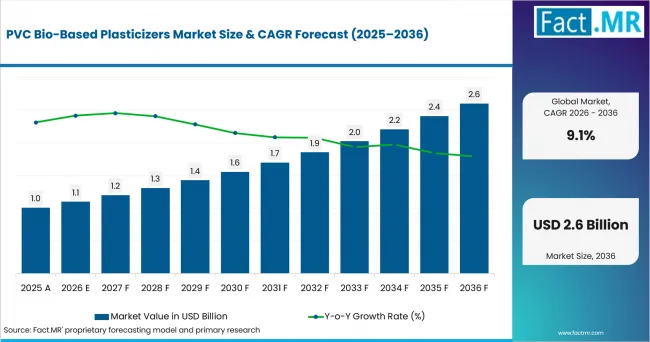
Pvc Bio Based Plasticizers Market Value Analysis | Source: Fact.MR
What are the defining numbers behind PVC Bio-Based Plasticizers Market growth?
- Market Defination
- USD 1.5 billion in absolute opportunity is expected between 2026 and 2036.
- The Epoxidized soybean/vegetable oil category accounts for 36.0% of Type in the PVC bio-based plasticizers market in 2026, equivalent to USD 388.8 million.
- The Wire & cable category accounts for 28.0% of Application in the PVC bio-based plasticizers market in 2026.
- The Construction category accounts for 34.0% of End-Use Industry in the PVC bio-based plasticizers market in 2026.
- Demand Drivers in the Market
- EU REACH restrictions on the ortho-phthalates DEHP, DBP, BBP and DIBP in consumer articles are steering PVC processors toward verified non-phthalate alternatives, including some bio-based plasticizers.
- US Consumer Product Safety Commission rules limiting phthalates in children's products are encouraging North American converters to adopt certified citrate and epoxidized-oil plasticizers in toys, childcare and consumer goods.
- Wire and cable manufacturers are adopting bio-based plasticizers to meet evolving fire, smoke and insulation performance while addressing customer transparency requests for renewable-sourced insulation compounds.
- Medical-device makers are favoring bio-based plasticizer systems that hold food-contact and medical-device clearances, particularly for tubing, blood bags and infusion applications where phthalate migration is scrutinised.
- Building and construction demand for flooring, wall coverings and PVC films is underpinned by renewable-sourced plasticizers that help green-building certification schemes score material content.
- Key Segments Analyzed
- By Type: The Epoxidized soybean/vegetable oil category is projected to account for 36.0% of the PVC bio-based plasticizers market in 2026. Epoxidized vegetable oils combine plasticization with secondary stabilization in many flexible-PVC formulations.
- By Application: The Wire & cable category is projected to account for 28.0% of the PVC bio-based plasticizers market in 2026. Wire and cable compounds require flexibility together with thermal and electrical performance.
- By End-Use Industry: The Construction category is projected to account for 34.0% of the PVC bio-based plasticizers market in 2026. Construction uses flexible PVC in cable, flooring, wall covering and coated-product applications.
- Analyst Opinion at Fact.MR
- Fact.MR opines, "PVC processors do not replace a plasticizer on feedstock origin alone. The alternative has to deliver the required softness, volatility and extraction resistance through the product's service life. Epoxidized vegetable oils have a practical position because they can combine plasticization with secondary stabilization, while medical and wire applications require tighter qualification." - Shambhu Nath Jha, Sr. Consultant at Fact.MR.
- Strategic Implications
- Plasticizer suppliers offering epoxidized soybean oil combined with co-stabilizer functionality can serve converters seeking a single drop-in replacement that preserves both plasticizing and heat-stability performance.
- The tightening of phthalate restrictions across REACH and US consumer-safety rules is opening a favorable demand window for citrates and bio-succinates with broad food-contact and medical clearances.
- Wire and cable converters replacing phthalate systems create pull for bio-based plasticizers that hold insulation resistance, low-temperature flexibility and smoke performance in compound specifications.
- Medical-device applications under the EU Medical Device Regulation reward plasticizer systems with documented biocompatibility and migration data, supporting premium citrates and castor-oil derivatives in healthcare.
- Green-building certification interest in renewable material content positions bio-based plasticizers favorably in flooring and wall-covering specifications across commercial construction.
How does the PVC Bio-Based Plasticizers Market break down by segment?
Why does the Epoxidized soybean/vegetable oil category lead Type?
In 2026, the Epoxidized soybean/vegetable oil category is projected to account for 36.0% of Type within the PVC bio-based plasticizers market.
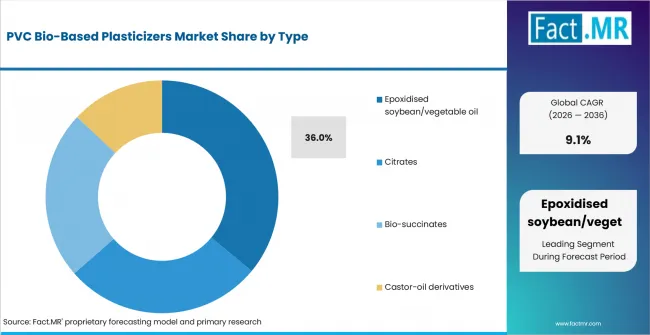
Pvc Bio Based Plasticizers Market Analysis By Type | Source: Fact.MR
Epoxidized soybean and other vegetable oils can soften PVC while contributing secondary heat stabilization through the oxirane functionality. Their established processing history gives formulators a practical renewable option in several flexible-PVC applications.
Performance still depends on compatibility, volatility and migration resistance at the required loading. Citrates, bio-succinates and castor-oil derivatives gain preference where extraction behavior or application-specific documentation sets a different threshold.
Why does the Wire & cable category lead Application?
Within Application, the Wire & cable category is projected to hold a 28.0% share in the PVC bio-based plasticizers market in 2026.
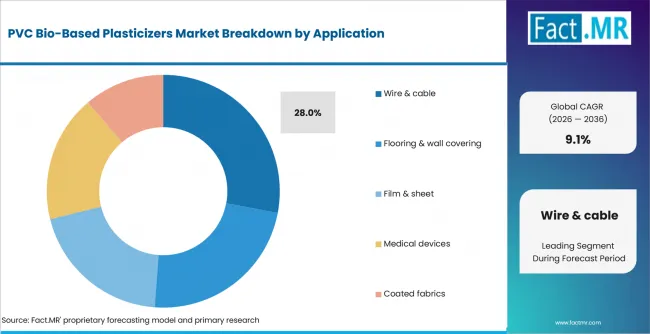
Pvc Bio Based Plasticizers Market Analysis By Application | Source: Fact.MR
Wire and cable compounds require flexibility through installation and service while preserving thermal and electrical properties. Plasticizer choice also affects processing, low-temperature behavior and resistance to migration into adjacent materials.
These requirements create repeat demand across building, appliance and industrial cable. Medical devices have an equally rigorous qualification process, but the application base is narrower than general wire and cable production.
Why does the Construction category lead End-Use Industry?
The Construction category is expected to represent 34.0% of End-Use Industry within the PVC bio-based plasticizers market in 2026.
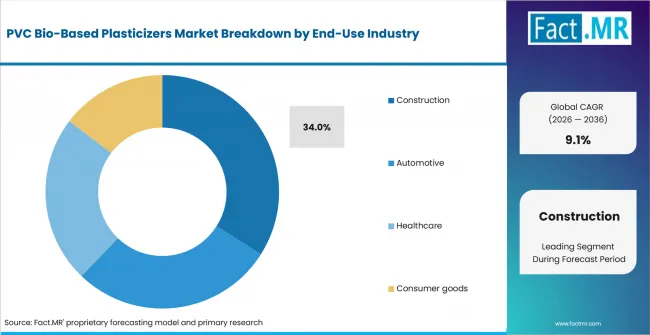
Pvc Bio Based Plasticizers Market Analysis By End Use Industry | Source: Fact.MR
Construction consumes flexible PVC in cable, flooring, wall coverings and coated products, creating a broad outlet for plasticizer formulations. Product life and indoor-use requirements make permanence and emissions performance important selection factors.
Specification decisions are influenced by regulation, green-building criteria and converter economics. Automotive, healthcare and consumer applications add differentiated demand, while construction provides a broad range of established PVC uses without relying on a single product type.
What is accelerating PVC Bio-Based Plasticizers Market adoption, and what is holding it back?
Adoption is being driven by phthalate restrictions and application demand for renewable plasticizer systems, while price premiums, limited certified supply and formulation revalidation can slow conversion.
Drivers Impact Analysis
| Driver | (~) % Impact on CAGR | Geographic Relevance | Impact Timeline |
|---|---|---|---|
| EU REACH and US consumer-safety restrictions phasing out ortho-phthalates | +1.1% | Europe, North America | Near term |
| Medical-device and food-contact clearance for citrate and bio-succinate chemistries | +0.9% | Global | Mid term |
| Wire and cable converter conversion to renewable plasticizer systems | +0.7% | Asia-Pacific, Europe | Mid term |
| Green-building certification interest in renewable material content | +0.5% | Europe, North America | Long term |
Source: Fact.MR analysis. Updated Aug 20, 2026
Opportunity Impact Analysis
| Opportunity | (~) % Impact on CAGR | Geographic Relevance | Impact Timeline |
|---|---|---|---|
| Citrate and bio-succinate grades with broad food-contact and medical migration data | +0.8% | Global | Mid term |
| Castor-oil derivatives for high-durability flooring and coated fabrics | +0.6% | Asia-Pacific, Europe | Long term |
| Bio-based plasticizer systems bundled with co-stabilizer functionality | +0.5% | Global | Mid term |
Source: Fact.MR analysis. Updated Aug 20, 2026
Restraints Impact Analysis
| Restraint | (~) % Impact on CAGR | Geographic Relevance | Impact Timeline |
|---|---|---|---|
| Price premium and limited supply of certified bio-based chemistries versus conventional plasticizers | -0.6% | Asia-Pacific, Latin America | Near term |
| Higher migration or extraction behavior of some bio plasticizers in demanding cable and automotive grades | -0.4% | Global | Mid term |
| Legacy-equipment and formulation re-validation costs when converting flexible-PVC lines | -0.3% | Global | Long term |
Source: Fact.MR analysis. Updated Aug 20, 2026
Which countries are scaling the PVC Bio-Based Plasticizers Market through 2036?
- South Korea: South Korea combines an integrated petrochemical and PVC conversion base with the adoption of renewable plasticizer systems, and its cable and flooring producers use certified bio-based grades.
- Germany: Germany has an established PVC-processing base with automotive, wire and cable, and construction applications, where REACH-driven phthalate removal and green-building preferences support bio-based plasticizer uptake.
- United States: The United States combines a flexible-PVC market with CPSC phthalate restrictions, encouraging certified citrates and epoxidized oils in children's products, wire and cable, and consumer applications.
- France: EU restrictions on named phthalates in toys and childcare articles, together with PVC film and coated-fabric processing, support interest in renewable plasticizer systems.
- Netherlands: The Netherlands has an active circular and bio-based chemicals sector whose converters and formulators use bio-based plasticizer grades across cable and construction.
- Italy: Italy has a significant wire and cable and footwear-processing sector that is converting flexible-PVC lines toward bio-based plasticizer systems while managing the re-validation costs of formulation change.
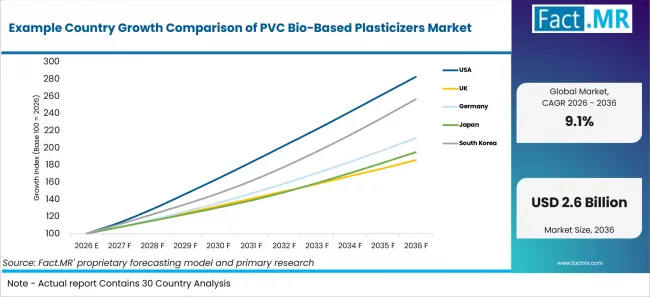
Example Country Growth Comparison Of Pvc Bio Based Plasticizers Market | Source: Fact.MR
| Country | CAGR (2026-2036) |
|---|---|
| South Korea | 10.9% |
| Germany | 9.0% |
| United States | 10.3% |
| France | 9.6% |
| Netherlands | 10.2% |
| Italy | 8.5% |
Source: Fact.MR analysis. Updated Aug 20, 2026
What is driving South Korea's growth through 2036?
The market in South Korea is projected to expand at a 10.9% CAGR from 2026 to 2036.
South Korea hosts an integrated polymer and PVC conversion ecosystem whose cable, flooring and film producers have adopted renewable plasticizer systems. Domestic bio-based feedstocks and export demand for certified non-phthalate PVC compounds support continued market activity.
What is driving Germany's growth through 2036?
From 2026 to 2036, demand in Germany is forecast to grow at a 9.0% CAGR.
Germany is an established European PVC processor, with an automotive, wire and cable, flooring and construction base. REACH-driven phthalate substitution and green-building material preferences support steady bio-based plasticizer demand across the German supply chain.
What is driving growth in the United States through 2036?
The United States is expected to record a 10.3% CAGR between 2026 and 2036.
The United States combines a flexible-PVC market with CPSC restrictions on phthalates in children's products. Converters serving toys, childcare, wire and cable and consumer goods are adopting certified citrate and epoxidized-oil plasticizers that document compliance and renewable content.
What is driving France's growth through 2036?
Demand in France is forecast to rise at a 9.6% CAGR from 2026 to 2036.
France is subject to EU restrictions on named phthalates in toys and childcare articles. Its PVC film, coated-fabric and cable-processing base supports interest in bio-based plasticizer systems that meet regulatory and migration requirements.
What is driving growth in the Netherlands through 2036?
A 10.2% CAGR is projected for the Netherlands from 2026 to 2036.
The Netherlands has an established bio-based and circular-chemicals sector, with converters and formulators adopting renewable plasticizer grades. Dutch demand is concentrated in cable, construction and premium film applications that value documented renewable content.
What is driving Italy's growth through 2036?
Between 2026 and 2036, Italy is projected to post an 8.5% CAGR.
Italy hosts important wire and cable and footwear-processing industries that are converting flexible-PVC lines to bio-based plasticizer systems. The transition is measured, reflecting the re-validation and cost considerations of moving away from long-established conventional formulations.
Who leads the PVC Bio-Based Plasticizers Market?
The supplier group includes global chemical producers, oleochemical specialists and compound-formulation companies. BASF and Evonik Industries participate through plasticizer and additive portfolios, while Emery Oleochemicals, Roquette and Cargill bring renewable-feedstock capabilities.
Avient serves the market through compounded material and additive systems that can reduce the formulation work required by converters. The competitive emphasis differs by application: wire and cable buyers prioritize electrical and heat-aging performance, while medical and consumer uses place greater weight on extraction, migration and documentation.
Suppliers compete on renewable-content evidence, consistent color and odor, PVC compatibility and long-term performance. Technical support during formulation changes is important because a shift in plasticizer chemistry can alter fusion behavior, stabilizer demand and final mechanical properties.
Which companies are the key providers?
Key Companies includes BASF; Evonik Industries; Emery Oleochemicals; Roquette; Cargill; Avient
- BASF
- Evonik Industries
- Emery Oleochemicals
- Roquette
- Cargill
- Avient
Bibliography
- European Chemicals Agency. Information on phthalates and restrictions under REACH.
- European Parliament and Council. Regulation (EC) No 1907/2006 concerning REACH.
- U.S. Consumer Product Safety Commission. Phthalate restrictions for children's toys and child-care articles.
- European Union. Regulation (EU) 2017/745 on medical devices.
- U.S. Food and Drug Administration. Food-contact substance and materials guidance relevant to plasticized PVC.
- International Organization for Standardization. Test methods relevant to flexible PVC and plasticizer performance.
- BASF. Non-phthalate and renewable plasticizer documentation.
- Evonik Industries. Specialty plasticizer technical documentation.
- Emery Oleochemicals. Epoxidized vegetable-oil plasticizer documentation.
- Roquette. Bio-sourced plasticizer product information.
- Cargill. Vegetable-oil-derived plasticizer technical information.
- Avient. Flexible-PVC formulation and additive-system documentation.
This Report Answers
- The report evaluates bio-based PVC plasticizers by chemistry type, application and end-use industry.
- It explains the role of epoxidized oils, citrates, bio-succinates and castor-oil derivatives in flexible-PVC formulation.
- Country analysis considers phthalate substitution, manufacturing capacity and downstream demand from construction, automotive and healthcare.
- The supplier review compares renewable feedstock, application documentation and formulation support.
- The scope excludes fossil-derived non-phthalate plasticizers and bio-based additives that do not perform a plasticizing function.
What does the PVC Bio-Based Plasticizers Market cover?
Bio-based plasticizers made wholly or predominantly from renewable sources, including epoxidized soybean or vegetable oils, citrates, bio-succinates and castor-oil derivatives used to plasticize PVC.
Applications across wire and cable, flooring and wall covering, film and sheet, medical devices and coated fabrics in construction, automotive, healthcare and consumer-goods end-use industries.
What is included in the scope?
Epoxidized soybean and vegetable oils, citrates, bio-succinates and castor-oil derivatives in PVC compounding, together with renewable plasticizer systems provided for flexible-PVC conversion.
Bio-based plasticizers used in wire and cable insulation, flooring and wall covering, films and sheets, medical tubing and coated fabrics across the tracked end-use industries.
What is excluded from the scope?
Petroleum-based ortho-phthalates and non-renewable plasticizers, and PVC resin and other compounding ingredients that are not plasticizer additives.
Finished PVC consumer products, plasticizer application equipment, and aftermarket reformulation or re-validation services sold separately from additive supply.
How Was the Analysis Built?
The market boundary includes renewable-origin additives whose primary commercial purpose is to plasticize flexible PVC.
- Primary Research: Interviews cover PVC compounders, cable formulators and converters that qualify plasticizer performance, permanence and compliance.
- Secondary Research: Chemical restrictions, medical-device rules, food-contact material guidance and official supplier technical literature are reviewed.
- Market Sizing and Forecasting: Demand is built from plasticizer type, PVC application, end-use consumption and realized pricing in the covered countries.
- Validation and Updates: Product origin and function are checked independently so stabilizers, processing aids and conventional petrochemical plasticizers are not counted.
Segmentation
What is the report's scope and coverage?
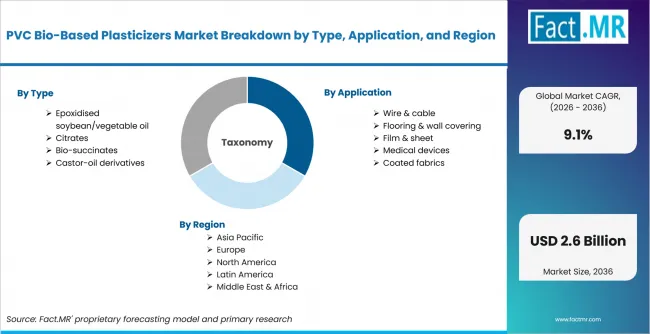
Pvc Bio Based Plasticizers Market Breakdown By Type, Application, And Region | Source: Fact.MR
| Attribute | Details |
|---|---|
| Quantitative Units | USD Million |
| Market Definition | Renewable, non-phthalate plasticizers such as epoxidized vegetable oils, citrates, bio-succinates and castor-oil derivatives used in flexible PVC. |
| Segments Covered | Type; Application; End-Use Industry |
| Regions Covered | North America; Latin America; Europe; East Asia; South Asia and Oceania; Middle East and Africa |
| Countries Covered | South Korea; Germany; United States; France; Netherlands; Italy |
| Key Companies Profiled | BASF; Evonik Industries; Emery Oleochemicals; Roquette; Cargill; Avient |
| Forecast Period | 2026 to 2036 |
| Base Year | 2025 |
| Market Value, 2026 | USD 1,080 million |
| Market Value, 2036 | USD 2,580 million |
| CAGR, 2026-2036 | 9.1% |
| Absolute Opportunity | USD 1,500 million |
| Approach | Demand is built from plasticizer type, PVC application, end-use consumption and realized pricing in the covered countries. |
Source: Fact.MR analysis. Updated Aug 20, 2026
How is the market segmented?
-
By Type:
- Epoxidized soybean/vegetable oil
- Citrates
- Bio-succinates
- Castor-oil derivatives
-
By Application:
- Wire & cable
- Flooring & wall covering
- Film & sheet
- Medical devices
- Coated fabrics
-
By End-Use Industry:
- Construction
- Automotive
- Healthcare
- Consumer goods
-
By Region:
- North America
- Latin America
- Europe
- East Asia
- South Asia and Oceania
- Middle East and Africa
Frequently Asked Questions
What is the PVC Bio-Based Plasticizers Market value in 2026?
At what CAGR is the market projected to grow?
What is the projected market value by 2036?
Which Type category has the leading share?
Which Application category has the leading share?
Which End-Use Industry category has the leading share?
What CAGR is projected for South Korea?
What is the primary demand driver?
What is the main restraint?
Which companies are active in the market?
Who worked on this report


Preview the report firsthand - request a free sample
Free SampleGet the brochure for pricing and purchase details
Download PDF