- Market Value (2025): USD 3.13 Bn
- Estimated Value (2026): USD 3.34 Bn
- Forecast Value (2036): USD 6.35 Bn
- CAGR (2026-2036): 6.6%
What is the Radar Antennas Market forecast to be worth by 2036?
USD 3.3 billion in 2026 to USD 6.4 billion by 2036 at a 6.6% CAGR.
- The radar antennas market was valued at USD 3.13 billion in 2025.
- According to Fact.MR analysis, sales are projected to rise from USD 3.34 billion in 2026 to USD 6.35 billion by 2036.
- A 6.6% CAGR between 2026 and 2036 reflects antenna replacement and the growing use of electronic scanning in defense and surveillance.
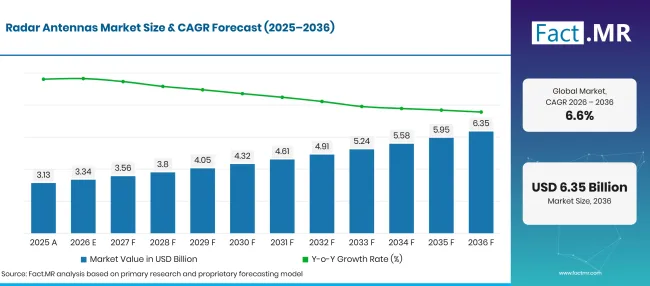
Radar Antennas Market Forecast Global | Source: Fact.MR
| Year | Basis | Market Value (USD billion) |
|---|---|---|
| 2025 | Actual | 3.13 |
| 2026 | Estimate | 3.34 |
| 2036 | Forecast | 6.34 |
| CAGR 2026 to 2036 | Forecast period | 6.6% |
Source: Fact.MR analysis. Updated Oct 27, 2026
What are the defining numbers behind Radar Antennas Market growth?
USD 3.1 billion in additional annual market value by 2036, with defense systems and electronically steered antennas shaping purchasing decisions.
- Demand Drivers in the Market
- Defense system integrators favor electronically steered antennas where operators need to follow several targets and change scan direction without rotating the full assembly.
- Naval designers select antenna layouts around available deck space and interference from nearby equipment.
- Weather services and airport operators need antenna coverage matched to rainfall sensing or runway surveillance.
- Key Segments Analyzed
- By Type: Electronically Steered Antennas account for 38.5% share in 2026 as defense integrators prioritize beam control.
- By Application: Military and Defense represents 42.3% share in 2026 owing to airborne and ground surveillance needs.
- By Frequency Band: L Band holds 43.9% share in 2026 for radar systems requiring wide-area coverage.
- By End-User: Defense leads with 42.3% of 2026 sales as operators renew detection equipment.
- Analyst Opinion at Fact.MR
- Shambhu Nath Jha, Principal Consultant at Fact.MR, states, “Radar antennas require lengthy qualification because they must operate with the transmitter, receiver and mission software as one system. Buyers compare coverage and tracking performance with installation limits and long-term maintenance access. Actual requirements differ between aircraft, ships and ground sites.”
- Strategic Implications
- Antenna manufacturers should demonstrate beam coverage and thermal performance under the actual mounting conditions used by aircraft and ships.
- Radar integrators benefit from testing complete antenna and processing chains before field installation, limiting expensive changes late in a program.
- Airport operators should distinguish full antenna replacement from electronics refresh when planning spending over several budget years.
- Component producers can compete through reliable transmit and receive modules that remain serviceable across long equipment lifetimes.
The United States records an 8.0% CAGR as radar infrastructure and defense platforms undergo renewal. Germany follows at 6.9% with domestic sensor capability and European air-defense programs. The United Kingdom is forecast at 6.1% as fighter-radar work continues. Japan posts 5.8% on naval and air-defense modernization, while Brazil records 5.2% through weather surveillance and defense applications.
How does the Radar Antennas Market break down by segment?
Electronically Steered Antennas lead Type at 38.5%; Military and Defense leads Application at 42.3%; L Band leads Frequency Band at 43.9%; Defense leads End-User at 42.3%.
Which antenna Type leads purchasing?
Electronically Steered Antennas represents 38.5% of 2026 market value.
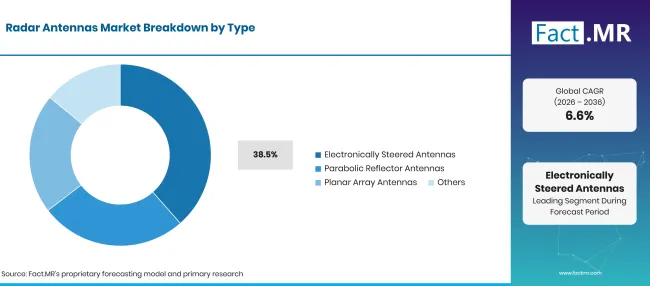
Radar Antennas Market Breakdown Type | Source: Fact.MR
| Which antenna Type leads purchasing | Share (2026) |
|---|---|
| Electronically Steered Antennas (Leading segment) | 38.5% |
| Other segments combined | 61.5% |
| Total | 100.0% |
Source: Fact.MR analysis. Updated Oct 27, 2026
electronically steered arrays alter the direction of a radar beam electronically, which allows tracking routines to respond quickly to changing targets. The design creates value for fighter aircraft and air-defense installations where operators need frequent updates without waiting for a mechanical rotation. Parabolic reflector antennas remain useful for fixed-point links and surveillance systems with familiar service arrangements. September 2025 saw RTX announce its APG-82(V)X active electronically scanned array radar, using gallium nitride technology [2].
What shapes the Application mix?
Military and Defense represents 42.3% of 2026 market value.
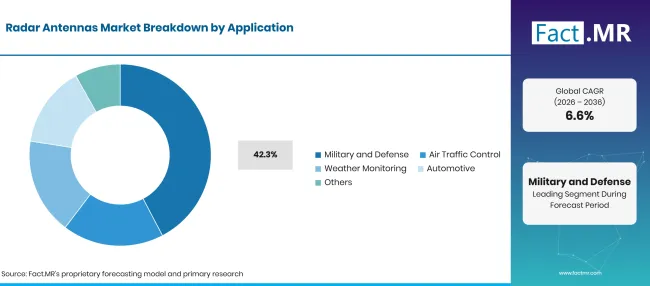
Radar Antennas Market Breakdown Application | Source: Fact.MR
| What shapes the Application mix | Share (2026) |
|---|---|
| Military and Defense (Leading segment) | 42.3% |
| Other segments combined | 57.7% |
| Total | 100.0% |
Source: Fact.MR analysis. Updated Oct 27, 2026
Military and defense programs rely on radar antennas to provide target information to mission systems and surveillance crews. Aircraft installations emphasize weight and aerodynamic fit, while surface-based arrays must remain stable in demanding weather. Civil air traffic control takes a different approach: operators value dependable coverage, redundancy and equipment that technicians can maintain. Weather monitoring systems need scanning patterns suited to precipitation and storm analysis. In August 2026, the FAA unveiled a replacement surface movement radar at Newark Liberty International Airport [3].
Which Frequency Band accounts for the principal share?
L Band represents 43.9% of 2026 market value.
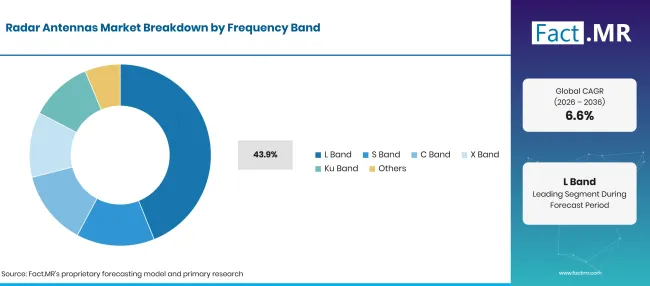
Radar Antennas Market Breakdown Frequency Band | Source: Fact.MR
| Which Frequency Band accounts for the principal share | Share (2026) |
|---|---|
| L Band (Leading segment) | 43.9% |
| Other segments combined | 56.1% |
| Total | 100.0% |
Source: Fact.MR analysis. Updated Oct 27, 2026
L Band antennas suit radar designs focused on wide-area surveillance and identification functions, although the final choice depends on range and resolution requirements. S Band is widely associated with airport and weather surveillance where dependable performance in precipitation matters. C Band and X Band systems support applications that require different antenna sizes and tracking detail. The FAA describes an airport radar whose primary surveillance operates in S Band while its secondary beacon function uses L Band [4].
How does End-User influence product design?
Defense represents 42.3% of 2026 market value.
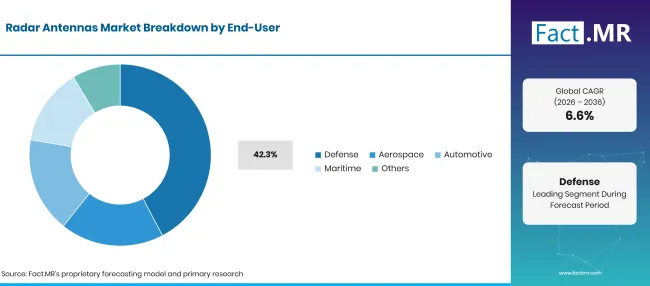
Radar Antennas Market Breakdown End User | Source: Fact.MR
| How does End-User influence product design | Share (2026) |
|---|---|
| Defense (Leading segment) | 42.3% |
| Other segments combined | 57.7% |
| Total | 100.0% |
Source: Fact.MR analysis. Updated Oct 27, 2026
Defense organizations typically buy antennas as part of integrated radar equipment, making acceptance testing and long-term maintenance central to the buying process. Aerospace operators must fit sensing equipment into available space, while maritime users focus on coverage and service life.
What is accelerating Radar Antennas Market adoption, and what is holding it back?
Defense surveillance renewal supports antenna sales; lengthy qualification and installation costs constrain the pace of replacement.
Drivers Impact Analysis
| DRIVER | (~) % IMPACT ON CAGR | GEOGRAPHIC RELEVANCE | IMPACT TIMELINE |
|---|---|---|---|
| Electronic beam control | +1.0% | North America, Europe, East Asia | Medium term (2–4 years) |
| Replacement of aging radar infrastructure | +0.8% | United States, Europe | Short term (<= 2 years) |
| Shipboard radar programs | +0.7% | East Asia, Europe | Long term (>= 4 years) |
| Airfield surveillance renewal | +0.5% | North America, Latin America | Medium term (2–4 years) |
| Weather and civil protection monitoring | +0.4% | Global | Medium term (2–4 years) |
Source: Fact.MR analysis. Updated Oct 27, 2026
Opportunity Impact Analysis
| OPPORTUNITY | (~) % IMPACT ON CAGR | GEOGRAPHIC RELEVANCE | IMPACT TIMELINE |
|---|---|---|---|
| Modular array upgrades | +0.8% | North America, Europe | Medium term (2–4 years) |
| Integrated naval panels | +0.6% | Japan, Europe | Long term (>= 4 years) |
| Radar and wind-farm coexistence | +0.5% | United Kingdom | Medium term (2–4 years) |
| Weather sensor deployment | +0.4% | Brazil, Asia | Short term (<= 2 years) |
Source: Fact.MR analysis. Updated Oct 27, 2026
Restraints Impact Analysis
| RESTRAINT | (~) % IMPACT ON CAGR | GEOGRAPHIC RELEVANCE | IMPACT TIMELINE |
|---|---|---|---|
| Long system qualification | -0.8% | Global | Medium term (2–4 years) |
| Specialized cooling and electronics | -0.6% | Defense markets | Short term (<= 2 years) |
| Installation access and outage limits | -0.5% | Civil aviation, maritime | Medium term (2–4 years) |
| Budget timing and service-life extensions | -0.4% | Global | Long term (>= 4 years) |
Source: Fact.MR analysis. Updated Oct 27, 2026
Which countries are scaling the Radar Antennas Market through 2036?
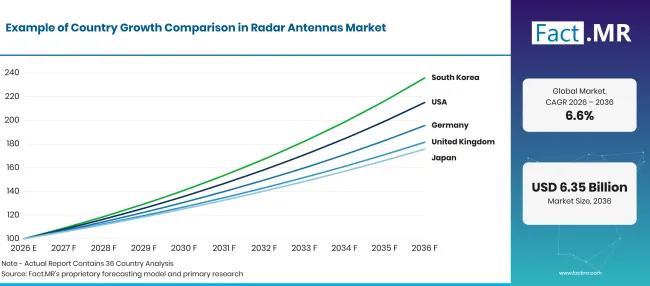
Radar Antennas Market Growth Index | Source: Fact.MR
| Country | CAGR (2026 to 2036) |
|---|---|
| United States | 8.0% |
| Germany | 6.9% |
| United Kingdom | 6.1% |
| Japan | 5.8% |
| Brazil | 5.2% |
Source: Fact.MR analysis. Updated Oct 27, 2026
What supports United States adoption?
8.0% CAGR, tied to airfield radar renewal and military system upgrades.
U.S. radar antenna spending reflects two different purchasing paths. Civil aviation is updating surveillance infrastructure while defense users continue to assess electronically steered equipment for aircraft and missile detection. The FAA’s January 2026 radar contracts cover replacement of up to 612 radars by June 2028 [1]. Aviation operators also need ongoing maintenance for equipment that remains installed.
How is Germany shaping radar antenna sales?
6.9% CAGR, associated with air-defense sensor production and European system integration.
Germany combines radar engineering with production work for European air-defense applications. Domestic specialists supply antennas and radar assemblies that must connect reliably with wider detection and missile-defense equipment. HENSOLDT announced an order worth more than EUR 340 million for TRML-4D and SPEXER radar systems in July 2025 [7]. The company’s production activity places German manufacturing within a wider European supply network.
What is supporting United Kingdom purchases?
6.1% CAGR, shaped by Typhoon radar upgrades and air-defense monitoring.
The United Kingdom has a visible radar production base serving military aviation. In January 2026, the Ministry of Defence announced a GBP 453 million contract to manufacture radar systems for RAF Typhoons [8]. In a separate March 2026 announcement, the government linked radar upgrades with the planned release of up to 10 GW of offshore wind capacity [5].
How does Japan develop its antenna market?
5.8% CAGR, linked to naval surveillance and fixed air-defense radar renewal.
Japan’s radar antenna market has a strong naval and territorial-surveillance focus. Japan’s Ministry of Defense allocated JPY 79.7 billion in its FY2026 budget for expenses related to the Aegis System Equipped Vessel program, including preparations for testing [9]. Lockheed Martin Corporation delivered the first SPY-7 antenna for a Japanese vessel in January 2025. Naval programs require coordination between antenna manufacturers and shipbuilders well before final installation.
What determines growth in Brazil?
5.2% CAGR, related to meteorological monitoring and national airspace surveillance.
Brazil has a practical requirement for radar coverage across extensive land areas and coastal routes. Mato Grosso’s civil-defense agency reported in May 2026 that the Doppler weather radar installed at Chapada dos Guimarães covers up to 400 kilometers [6].
Who leads the Radar Antennas Market?
The competitive field includes radar system manufacturers and defense electronics specialists whose offerings differ by platform.
RTX and Lockheed Martin Corporation have documented work on active-array radar and naval surveillance antennas. Northrop Grumman Corporation and L3Harris serve defense sensor requirements, while Thales and Leonardo S.p.A. provide radar technology for military and civilian missions.
Which companies are the main providers?
Key companies include RTX Corporation; Lockheed Martin Corporation; Northrop Grumman Corporation; Thales; BAE Systems plc; Leonardo S.p.A.; Saab AB; Honeywell Aerospace Inc.; and L3Harris Technologies, Inc.
- RTX Corporation
- Lockheed Martin Corporation
- Northrop Grumman Corporation
- Thales
- BAE Systems plc
- Leonardo S.p.A.
- Saab AB
- Honeywell Aerospace Inc.
- L3Harris Technologies, Inc.
What is the report’s scope and coverage?
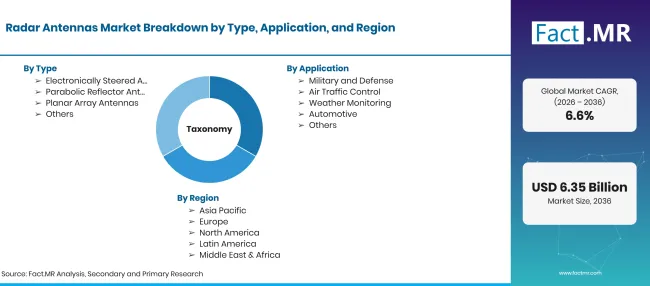
Radar Antennas Market Taxonomy | Source: Fact.MR
| Attribute | Details |
|---|---|
| Quantitative Units | USD billion; 2026 to 2036; 6.6% CAGR |
| Market Definition | Radar antennas used in military and civil radar equipment, including rotating and electronically scanned designs. |
| Type | Electronically Steered Antennas; Parabolic Reflector Antennas; Planar Array Antennas; Others |
| Application | Military and Defense; Air Traffic Control; Weather Monitoring; Automotive; Others |
| Frequency Band | L Band; S Band; C Band; X Band; Ku Band; Others |
| End-User | Defense; Aerospace; Automotive; Maritime; Others |
| Countries Covered | United States; Germany; United Kingdom; Japan; Brazil |
| Companies Profiled | RTX Corporation; Lockheed Martin Corporation; Northrop Grumman Corporation; Thales; BAE Systems plc; Leonardo S.p.A.; Saab AB; Honeywell Aerospace Inc.; and L3Harris Technologies, Inc. |
| Forecast Period | 2026 to 2036 |
| Approach | Review of radar platforms, antenna installations, customer applications and official program evidence. |
Source: Fact.MR analysis. Updated Oct 27, 2026
Bibliography
- [1] Federal Aviation Administration. (2026, January 5). Trump's Transportation Secretary Duffy & FAA Administrator Bedford announce radar contracts as part of brand-new air traffic control system. FAA source
- [2] RTX. (2025, September 23). RTX unveils new APG-82(V)X radar enhanced with gallium nitride. RTX source
- [3] Federal Aviation Administration. (2026, August 11). Trump’s Transportation Secretary Sean P. Duffy unveils brand-new radar as latest improvement to Newark Liberty International Airport (EWR). FAA source
- [4] Federal Aviation Administration. (2025, September 22). Airport Surveillance Radar (ASR-11). FAA source
- [5] Department for Energy Security and Net Zero. (2026, March 20). New radar systems to unlock offshore wind. GOV.UK. GOV.UK source
- [6] Defesa Civil de Mato Grosso. (2026, May 16). Defesa Civil de MT reforça monitoramento climático com capacitação em novo radar meteorológico. Mato Grosso Civil Defense source
- [7] HENSOLDT. (2025, July 24). HENSOLDT strengthens Ukraine's air defence. HENSOLDT source
- [8] Ministry of Defence. (2026, January 22). Half a billion investment to upgrade RAF Typhoons and secure 1,500 British jobs. GOV.UK. UK Ministry of Defence source
- [9] Ministry of Defense, Japan. (2025, December 26). Progress and budget in fundamental reinforcement of defense capabilities: Overview of FY2026 budget. Japan Ministry of Defense PDF
This Report Answers
- The 2025 historical estimate and the 2026 and 2036 valuations for radar antennas.
- The role of electronic beam steering in surveillance platform design and replacement plans.
- The application, frequency and end-user segments represented in the forecast.
- How antenna installation conditions affect purchasing in the United States, Germany, the United Kingdom, Japan and Brazil.
- Which supplier capabilities affect acceptance testing and long-term maintenance.
What does the Radar Antennas Market cover?
The market covers antenna assemblies used by radar systems to transmit or receive signals. It includes rotating reflector equipment and fixed electronic arrays built for defined surveillance missions.
What is included in the scope?
Included products range from parabolic reflectors to electronically steered panels intended for military and civil radar installations.
Antennas used in air traffic surveillance and storm monitoring fall within the application boundary when sold as radar equipment. The same definition applies to airborne, ground-based and maritime sensing systems.
What is excluded from the scope?
General communication antennas and satellite communication terminals are outside the radar antenna category.
Standalone software subscriptions and radar processors are excluded unless sold as an inseparable part of the antenna assembly. Full aircraft and ships are separate markets and are not counted as radar antenna revenue.
How Was the Analysis Built?
The analysis draws on 120+ sources, 35+ company portfolios, 25+ countries, and more than 20 industry interviews.
- Primary Research: Primary research includes discussions with manufacturers, service providers, technology developers, distributors, end users, and subject-matter experts. These conversations examine purchasing priorities, product adoption, operational challenges, approval requirements, competitive positioning, and the factors that influence wider market acceptance.
- Desk Research: Desk research covers government statistics, regulatory publications, company filings, trade data, technical studies, industry associations, standards, public policy, and other authoritative sources. Every source used in the analysis is documented in the bibliography.
- Market Sizing and Forecasting: Market estimates combine historical performance, demand indicators, pricing and volume trends, segment shares, company participation, country-level growth, adoption patterns, investment activity, and barriers to market expansion.
- Data Validation and Update Cycle: Findings are validated by comparing primary interviews with public data, company activity, regulatory changes, trade patterns, and industry developments. Regular updates review new product launches, capacity changes, partnerships, approvals, and shifts in commercial adoption.
Segmentation
How is the market segmented?
-
By Type
- Electronically Steered Antennas
- Parabolic Reflector Antennas
- Planar Array Antennas
- Others
-
By Application
- Military and Defense
- Air Traffic Control
- Weather Monitoring
- Automotive
- Others
-
By Frequency Band
- L Band
- S Band
- C Band
- X Band
- Ku Band
- Others
-
By End-User
- Defense
- Aerospace
- Automotive
- Maritime
- Others
-
By Region
- North America
- Latin America
- Western Europe
- Eastern Europe
- East Asia
- South Asia & Pacific
- Middle East & Africa
Frequently Asked Questions
How big is the radar antennas market in 2026?
What CAGR applies through 2036?
Which antenna type leads the market?
Which application has the largest stated share?
Who are the main companies in the radar antennas market?
Who worked on this report


Preview the report firsthand - request a free sample
Free SampleGet the brochure for pricing and purchase details
Download PDF