- Market Value (2025): USD 4.09 Bn
- Estimated Value (2026): USD 4.83 Bn
- Forecast Value (2036): USD 25.8 Bn
- CAGR (2026-2036): 18.2%
What is the 5G Antennas Market forecast to be worth by 2036?
USD 4.83 Billion in 2026 to USD 25.8 Billion by 2036, at an 18.2% CAGR.
- As per Fact.MR analysis, the 5G antennas market reached USD 4.09 Billion in 2025.
- Demand will increase from USD 4.83 Billion in 2026 to USD 25.8 Billion in 2036.
- The market is forecast to record an 18.2% CAGR during 2026 to 2036 driven by accelerating global 5G Standalone (SA) core network rollouts, rapid commercialization of 5G Fixed Wireless Access (FWA) broadband, proliferating industrial private campus networks, and surging demand for connected vehicle cellular vehicle-to-everything (C-V2X) antennas.
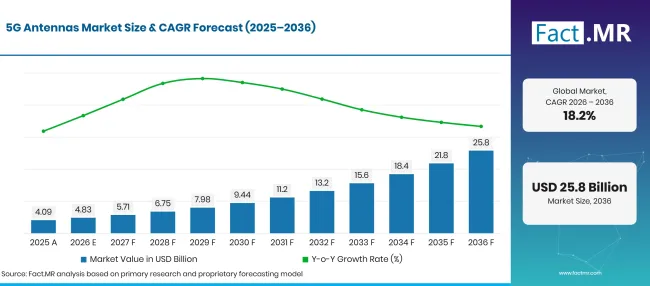
5G Antennas Market Forecast Global | Source: Fact.MR
| Year | Basis | Market Value (USD Billion) |
|---|---|---|
| 2025 | Actual | 4.1 |
| 2026 | Estimate | 4.8 |
| 2036 | Forecast | 25.8 |
| CAGR 2026 to 2036 | Forecast period | 18.2% |
Source: Fact.MR analysis. Updated Oct 23, 2026
What are the defining numbers behind 5G Antennas Market growth?
USD 21.0 Billion absolute chance between 2026 and 2036, with Sub-6 GHz technology, outdoor deployments, and telecommunication carriers generating the dominant expansion volume.
- Demand Drivers in the Market
- The FCC’s July 2026 Upper C-band order makes 160 MHz at 3.98–4.14 GHz available for terrestrial flexible use and establishes a 20 MHz guard band at 4.14–4.16 GHz [1]. Extending the 3.7 GHz Service across this additional mid-band spectrum creates a longer-term requirement for wideband, multi-element antennas that can add capacity while coexisting with adjacent radio-altimeter and satellite operations.
- In October 2025, the FCC proposed making between 100 MHz and 180 MHz of the 3.98–4.2 GHz Upper C-band available for terrestrial flexible use, building on the existing 3.7–3.98 GHz service rules [2]. The proceeding reinforced the strategic importance of contiguous mid-band capacity and the need for antenna systems that can support expanded tuning ranges, filtering, and coexistence requirements.
- NIST reports that 4G LTE commonly uses two to four antenna elements, whereas massive MIMO can employ hundreds or more elements to form narrow, steerable beams that improve signal-to-noise ratio, data rates, and user capacity [3]. The resulting measurement and calibration complexity increases demand for integrated active antenna arrays and over-the-air test systems.
- ITU estimated that 5G networks covered 55% of the world’s population in 2025, including 84% in high-income countries but only 4% in low-income countries [4]. The 80-percentage-point income-group gap highlights a substantial remaining deployment opportunity for macro, small-cell, and fixed-wireless antenna infrastructure.
- Key Segments Analyzed
- By Type: Omnidirectional holds 35.2% share in 2026, preferred across small cells, indoor enterprise distributed antenna systems, and vehicular telematics for its balanced 360-degree horizontal radiation coverage.
- By Application: Telecommunications accounts for 42.5% share in 2026, driven by massive macro base station densification and standalone 5G core upgrades executed by Tier-1 telecom service providers.
- By Technology: Sub-6 GHz holds 68.4% share in 2026, dominating commercial carrier allocations due to its optimal balance between wide geographic coverage, robust building penetration, and high data capacity.
- By Deployment Location: Outdoor accounts for 64.2% share in 2026, supported by nationwide macro tower installations, urban street-furniture small cell attachments, and rooftop colocation deployments.
- Analyst Opinion at Fact.MR
- Shambhu Nath Jha, Lead Consultant at Fact.MR, states, “The 5G antenna market is entering a hyper-growth cycle fueled by the convergence of massive MIMO active architectures, Open RAN modularity, and high-frequency millimeter-wave beamforming. Network operators are no longer treating antennas as passive radiating elements; they are deploying intelligent, software-defined active antenna units that integrate digital transceivers, beamforming algorithms, and RF filtering directly onto the antenna backplane. Antenna manufacturers who master advanced low-loss dielectric substrate chemistry, automated robotic surface-mount assembly, and compact GaN integration will secure Tier-1 contracts as telecom carriers build out multi-gigabit Standalone 5G networks.”
- Strategic Implications
- NIST’s 2025 research on 5G reference-signal sensing found that adding a second monostatic base station improved spatial-resolution area by at least 40%; using positioning reference signals with bandwidths up to 100 MHz produced sub-1-meter localization resolution with five base stations [5]. The results illustrate how denser, coordinated antenna sites can extend 5G infrastructure beyond communications into integrated sensing applications.
- Telecom infrastructure providers are accelerating support for Open Radio Access Network (Open RAN) standards, designing antenna heads with standardized eCPRI digital interfaces. Decoupling antenna hardware from proprietary baseband software allows mobile operators to mix and match commercial antenna arrays with cloud-based baseband processors, reducing total network deployment costs.
- Automotive antenna manufacturers are developing multi-function conformal shark-fin and glass-integrated antenna modules capable of housing 5G C-V2X, GNSS high-precision positioning, Wi-Fi 6E, and satellite communication elements within aerodynamic housings. Sourcing directors negotiate long-term agreements for specialized temperature-resistant polycarbonate radome polymers to ensure automotive qualification across extreme environmental operating temperatures.
- Tower infrastructure operators are collaborating with municipal utilities to deploy camouflaged 5G small cell antennas integrated directly into smart street lighting poles and bus shelters. Deploying aesthetically unobtrusive omnidirectional small cells enables telecom carriers to bypass complex urban zoning hurdles while achieving dense millimeter-wave microcell coverage in historic downtown districts.
The United States is projected to record an industry-leading 18.7% CAGR, driven by massive C-band macro deployments, aggressive Fixed Wireless Access (FWA) competition, and extensive private 5G enterprise funding. The United Kingdom follows closely at an 18.2% CAGR, supported by Project Gigabit fiber-to-the-tower backhaul investments and dense urban small cell rollouts. Japan advances at a 17.9% CAGR, anchored by pioneer commercial Open RAN deployments, nationwide Local 5G private licensing, and bullet-train trackside 5G corridors. Brazil records a 15.0% CAGR, propelled by rapid 3.5 GHz standalone network expansion across capital cities and agricultural IoT modernization. Germany expands at a 13.4% CAGR, driven by world-leading industrial 5G campus networks allocated across automotive, chemical, and engineering manufacturing plants.
How does the 5G Antennas Market break down by segment?
Sub-6 GHz 68.4%; Outdoor 64.2%; Telecommunications 42.5%; Omnidirectional 35.2% in 2026.
Which Technology captures the largest market share?
Sub-6 GHz holds 68.4% share in 2026.
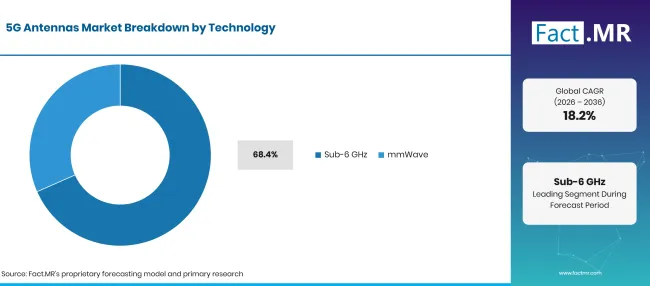
5G Antennas Market Breakdown Technology | Source: Fact.MR
| Technology | Share (2026) |
|---|---|
| Sub-6 GHz (Leading segment) | 68.4% |
| Other segments combined (mmWave) | 31.6%* |
| Total | 100.0% |
Source: Fact.MR analysis. Updated Oct 23, 2026
Sub-6 GHz technology commands more than two-thirds of total 5G antenna market value, serving as the foundational bedrock for global mobile broadband deployments. Telecom operators favor mid-band frequencies between 2.5 GHz and 4.2 GHz because they offer the optimal physical compromise between broad radio propagation range and multi-hundred-megabit transmission capacity. Sourcing directors allocate massive budgets toward 32T32R and 64T64R massive MIMO antenna panels that deploy dynamic beamforming across wide geographic suburban and rural cell footprints. In parallel, millimeter-wave (mmWave) antennas represent the highest-speed technology frontier, capturing 31.6% share as carriers deploy ultra-dense microcells in sports stadiums, convention centers, airport terminals, and dense metropolitan transit hubs. Network planners deploy dense small cell networks to augment capacity in high-traffic urban hot spots. Carrier engineers install advanced massive MIMO arrays to multiply cell capacity without requiring additional spectrum licenses. Telecom providers also bundle these antenna systems with fixed wireless access solutions to provide high-speed home broadband competing directly with fiber connections.
Where are most antennas deployed?
Outdoor accounts for 64.2% share in 2026.
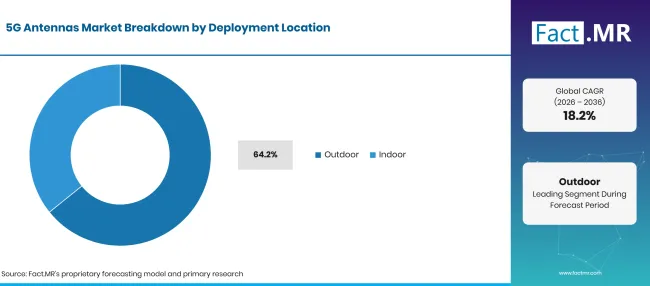
5G Antennas Market Breakdown Deployment Location | Source: Fact.MR
| Deployment Location | Share (2026) |
|---|---|
| Outdoor (Leading segment) | 64.2% |
| Other segments combined (Indoor) | 35.8%* |
| Total | 100.0% |
Source: Fact.MR analysis. Updated Oct 23, 2026
Outdoor deployment locations generate nearly two-thirds of total industry revenue, reflecting substantial civil engineering and hardware investments in macro cellular tower sites, high-voltage utility transmission towers, building rooftops, and roadside pole infrastructure. Outdoor antennas must withstand harsh environmental conditions, including gale-force wind loading, solar ultraviolet degradation, heavy rain ingress, and extreme temperature cycling from -40°C to +65°C, requiring ruggedized fiberglass radomes and IP67-rated weatherproofing seals. Concurrently, indoor deployments account for 35.8% share, expanding rapidly as corporate headquarters, hospitals, automated manufacturing plants, and underground metro transit networks install distributed antenna systems (DAS) and indoor 5G micro-radios to overcome building exterior wall signal penetration loss. Telecom equipment vendors supply next-generation 5G base stations paired with optimized outdoor antenna arrays. Network architects integrate advanced antenna systems to automate tilt and azimuth adjustments remotely through digital controllers. Infrastructure developers also roll out complete 5G New Radio infrastructure across municipal transit corridors.
What leads the Application segment?
Telecommunications accounts for 42.5% share in 2026.
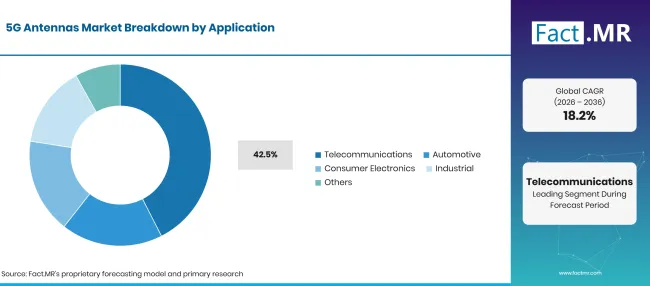
5G Antennas Market Breakdown Application | Source: Fact.MR
| Application | Share (2026) |
|---|---|
| Telecommunications (Leading segment) | 42.5% |
| Other segments combined | 57.5%* |
| Total | 100.0% |
Source: Fact.MR analysis. Updated Oct 23, 2026
Telecommunications network operators represent the preeminent application segment, contributing 42.5% of total antenna procurement spending. Tier-1 cellular carriers are in the midst of multi-year capital expenditure cycles transitioning non-standalone (NSA) networks toward standalone (SA) architectures, which require completely new massive MIMO antenna arrays capable of network slicing and edge compute integration. The automotive sector represents the fastest-growing secondary application, integrating conformal 5G antennas into vehicle body panels to enable automated driving and vehicle-to-cloud telemetry. Industrial manufacturing enterprises, commercial airports, and energy utility grids comprise the remaining consumption base, investing in private 5G antenna networks to operate autonomous mobile robots and smart grid sensors. Material engineers evaluate low-loss dielectric materials to minimize high-frequency signal attenuation inside antenna housings. Sourcing managers procure certified telecom mounting hardware to secure heavy active antenna units to cellular masts. RF test engineers utilize high-frequency signal generators to validate beam-steering accuracy during factory calibration. Tower operators also deploy RF over fiber solutions to connect remote antenna heads with centralized baseband hotel units.
What is accelerating 5G Antennas Market adoption, and what is holding it back?
Global standalone 5G rollouts, soaring demand for Fixed Wireless Access broadband, and private industrial enterprise networks accelerate market expansion. Significant capital costs for massive MIMO infrastructure, zoning approval delays for outdoor urban cell sites, and millimeter-wave line-of-sight signal attenuation restrict frictionless deployment.
Drivers Impact Analysis
| DRIVER | (~) % IMPACT ON CAGR | GEOGRAPHIC RELEVANCE | IMPACT TIMELINE |
|---|---|---|---|
| Mobile network operator transition from 5G NSA to Standalone (SA) 5G core networks | +2.0% | Global | Short term (<= 2 years) |
| Rapid commercial adoption of 5G Fixed Wireless Access (FWA) as a fiber substitute | +1.8% | North America, Europe | Short term (<= 2 years) |
| Proliferation of private 5G campus networks across smart manufacturing and logistics | +1.5% | Europe, East Asia | Medium term (2–4 years) |
| Integration of 5G C-V2X telematics and multi-element conformal antennas in connected vehicles | +1.3% | East Asia, North America | Medium term (2–4 years) |
| Adoption of massive MIMO beamforming to overcome C-band and mmWave propagation loss | +1.1% | Global | Long term (>= 4 years) |
Source: Fact.MR analysis. Updated Oct 23, 2026
Opportunity Impact Analysis
| OPPORTUNITY | (~) % IMPACT ON CAGR | GEOGRAPHIC RELEVANCE | IMPACT TIMELINE |
|---|---|---|---|
| Open RAN architecture standardizing digital antenna interfaces and lowering operator capex | +1.7% | North America, Europe, Japan | Short term (<= 2 years) |
| Reconfigurable Intelligent Surfaces (RIS) utilizing metamaterials to redirect 5G beams | +1.4% | East Asia, USA | Medium term (2–4 years) |
| Transparent conformal antennas integrated directly into smart building glass windows | +1.2% | Western Europe, East Asia | Medium term (2–4 years) |
| Direct-to-cellular satellite-terrestrial convergence requiring hybrid phased array antennas | +1.0% | North America, Global | Long term (>= 4 years) |
Source: Fact.MR analysis. Updated Oct 23, 2026
Restraints Impact Analysis
| RESTRAINT | (~) % IMPACT ON CAGR | GEOGRAPHIC RELEVANCE | IMPACT TIMELINE |
|---|---|---|---|
| High power consumption and severe thermal dissipation challenges in 64T64R active antennas | -1.5% | Global | Short term (<= 2 years) |
| Stringent municipal zoning restrictions and public permitting delays for new cell towers | -1.2% | Europe, North America | Short term (<= 2 years) |
| Heavy physical weight and wind-load restrictions requiring expensive tower structural reinforcement | -0.9% | Global | Medium term (2–4 years) |
| Millimeter-wave signal blockage caused by foliage, heavy rainfall, and low-emissivity glass | -0.7% | North America, East Asia | Long term (>= 4 years) |
Source: Fact.MR analysis. Updated Oct 23, 2026
Which countries are scaling the 5G Antennas Market through 2036?
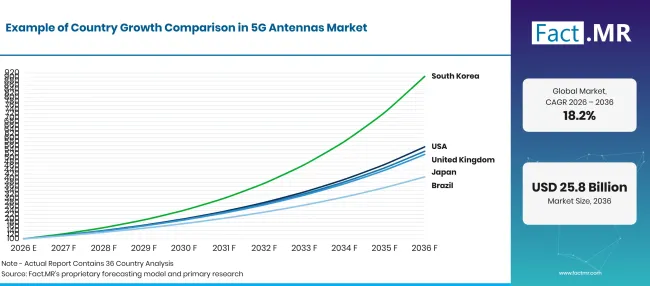
5G Antennas Market Growth Index | Source: Fact.MR
| Country | CAGR (2026–2036) |
|---|---|
| Germany | 13.4% |
| Brazil | 15.0% |
| USA | 18.7% |
| UK | 18.2% |
| Japan | 17.9% |
Source: Fact.MR analysis. Updated Oct 23, 2026
What sustains engineering leadership in Germany?
13.4% CAGR, rooted in Germany’s pioneer industrial 5G private campus licensing, world-class automotive manufacturing, and heavy Industry 4.0 infrastructure investment.
Germany’s Federal Network Agency reported 484 applications and 484 frequency assignments for local 5G networks in the 3.7–3.8 GHz band as of November 2025 [6]. The scale of completed assignments confirms sustained enterprise demand for site-specific indoor and outdoor antenna arrays across manufacturing, logistics, research, and other industrial settings.
What opportunities are unfolding across Brazil?
15.0% CAGR, backed by aggressive standalone 5G rollouts in major state capitals, agricultural IoT smart-farming adoption, and federal 3.5 GHz spectrum licensing.
Brazil’s 2021 5G auction obligations require coverage of all 5,570 municipal seats by 2029 and a further 1,700 non-seat localities by 2030 [7]. The timetable creates a measurable multi-year antenna deployment pipeline across large cities and smaller municipalities. Beyond metropolitan centers, agricultural enterprises can use directional antennas and private mobile infrastructure to connect machinery, drones, and field sensors across extensive rural sites.
Why is the United States leading overall market valuation?
18.7% CAGR, propelled by massive C-band macro deployments, aggressive Fixed Wireless Access (FWA) competition, and extensive private 5G enterprise funding.
The United States represents a major commercial market for 5G antennas as nationwide operators expand mid-band coverage and fixed wireless access. NTIA’s July 2025 BEAD guidance retained distinct eligibility categories for unserved and underserved locations and provided updated implementation answers for state and territorial broadband programs [8]. Although BEAD is technology-neutral rather than a dedicated 5G antenna program, deployment in hard-to-serve areas strengthens the broader backhaul and infrastructure environment available to wireless networks.
How is the United Kingdom modernizing 5G cellular infrastructure?
18.2% CAGR, supported by Project Gigabit fiber-to-the-tower backhaul investments, dense urban small cell rollouts, and shared rural network agreements.
Ofcom’s Connected Nations 2025 reporting shows that 5G Standalone coverage outside UK premises reached 83% at its High Confidence level and 74% at its Very High Confidence level, measured as coverage from at least one mobile network operator [9]. This verified coverage expansion supports continued deployment of active antenna sites, while dense urban areas increasingly use compact small cells and neutral-host infrastructure to add capacity.
Why does Japan maintain aggressive technological innovation?
17.9% CAGR, anchored by pioneer commercial Open RAN deployments, nationwide Local 5G private licensing, and bullet-train trackside 5G corridors.
Japan’s Ministry of Internal Affairs and Communications reported 302,118 outdoor 5G base stations and nationwide 5G population coverage of 98.4% at the end of fiscal 2024, with base stations installed in all 1,741 municipalities [10]. The installed base and near-universal coverage support continued demand for capacity upgrades, sub-6 GHz densification, and specialized antennas for rail, industrial, and local-network applications.
Who leads the 5G Antennas Market?
Huawei Technologies Co., Ltd. commands the largest global market share, manufacturing an extensive portfolio of massive MIMO active antenna units, blade antennas, and integrated ultra-wideband base station solutions deployed extensively across Asia, Europe, the Middle East, and Latin America. Telefonaktiebolaget LM Ericsson stands as a premier global telecommunications titan, pioneering ultra-lightweight massive MIMO antennas and silicon-integrated active radio units engineered for high energy efficiency and Open RAN compatibility. Nokia Corporation delivers formidable technological strength through its AirScale antenna portfolio, specializing in compact modular antenna systems, multi-band active antennas, and advanced digital beamforming architectures.
Samsung Electronics Co., Ltd. and ZTE Corporation maintain commanding market shares across major telecommunications infrastructure projects, with Samsung leading advanced millimeter-wave microcell antenna deployments and ZTE supplying massive MIMO arrays to carriers worldwide. CommScope Holding Company, Inc. and Amphenol Corporation represent premier North American antenna specialists, manufacturing high-performance macro antennas, distributed antenna systems, and precision RF connectors. Rosenberger, Tongyu Communication Inc., and Comba Telecom Systems Holdings Ltd. provide elite RF design and high-volume manufacturing capabilities, delivering customized multi-band base station antennas, small cell omnidirectional units, and high-precision testing hardware to telecom operators globally.
Which companies are the key providers?
Key companies include Huawei; Ericsson; Nokia; Samsung Electronics; ZTE; CommScope Holding Company, Inc.; Amphenol Corporation; Rosenberger; Tongyu Communication Inc.; and Comba Telecom Systems Holdings Ltd.
- Huawei
- Ericsson
- Nokia
- Samsung Electronics
- ZTE
- CommScope Holding Company, Inc.
- Amphenol Corporation
- Rosenberger
- Tongyu Communication Inc.
- Comba Telecom Systems Holdings Ltd.
Bibliography
- [1] Federal Communications Commission. (2026, July 24). FCC adopts plan for C-band auction in July 2027.
- [2] Federal Communications Commission. (2025, October 30). Upper C-band (3.98–4.2 GHz): Notice of proposed rulemaking fact sheet.
- [3] National Institute of Standards and Technology. (2026, July 6). Massive MIMO.
- [4] International Telecommunication Union. (2025). Mobile network coverage.
- [5] Ropitault, T., Blandino, S., Griffith, D., Nguyen, T., Sahoo, A., & Golmie, N. (2025). Characterization of monostatic base stations sensing resolution using 5G reference signals. In 2025 IEEE International Conference on Communications Workshops. National Institute of Standards and Technology.
- [6] Bundesnetzagentur. (2025, November). Overview of assignment holders for local frequency uses in the 3,700–3,800 MHz band.
- [7] Agência Nacional de Telecomunicações. (2025, September 12). 5G auction coverage commitments.
- [8] National Telecommunications and Information Administration. (2025, July 18). BEAD: Frequently asked questions and answers (Version 12).
- [9] Office of Communications. (2025, November 19). Connected Nations 2025: England report.
- [10] Ministry of Internal Affairs and Communications. (2026, March). 5G infrastructure development status based on the new targets: End of fiscal 2024.
This Report Answers
- How does the global 5G antennas market expand from USD 4.8 Billion in 2026 to USD 25.8 Billion by 2036?
- What technological innovations in 64T64R massive MIMO active antenna units are driving network capacity expansion?
- Why does Sub-6 GHz technology command 68.4% of total market value in 2026?
- How are telecommunications operators utilizing Fixed Wireless Access (FWA) to capture residential broadband subscribers?
- What factors support the United States achieving an industry-leading 18.7% CAGR through 2036?
- How are German industrial 5G campus licenses transforming automated smart factory connectivity?
- What role do low-loss dielectric substrates and GaN power amplifiers play in reducing antenna thermal dissipation?
What does the 5G Antennas Market cover?
Antennas designed to transmit and receive signals across 5G networks form the core of this market. These include omnidirectional antennas, directional arrays and small-cell antennas used in telecommunications, vehicles and connected industrial systems.
Sales are tracked across Sub-6 GHz and millimeter-wave technologies. Outdoor network installations and indoor connectivity systems are covered across commercial and industrial applications.
What is included in the scope?
5G antenna elements, massive MIMO active antenna units and beamforming antenna arrays are counted. Small-cell antennas, indoor distributed antenna systems and outdoor base station antennas are included.
Vehicle-mounted 5G antennas, private industrial network antennas and integrated antenna modules designed for 5G New Radio connections are covered. Products supporting both Sub-6 GHz and mmWave operations are also included.
What is excluded from the scope?
Antennas designed exclusively for 2G, 3G and 4G networks fall outside the revenue boundary. Standalone Wi-Fi, Bluetooth, GPS and satellite antennas without 5G functionality are excluded.
Core network servers, fiber-optic cables and separate network management software are not counted. Smartphones, connected vehicles and complete industrial machines are excluded as finished products, apart from qualifying 5G antenna components.
How Was the Analysis Built?
The analysis draws on 120+ sources, 35+ company portfolios, 25+ countries, and more than 20 industry interviews.
- Primary Research: Primary research includes discussions with manufacturers, service providers, technology developers, distributors, end users, and subject-matter experts. These conversations examine purchasing priorities, product adoption, operational challenges, approval requirements, competitive positioning, and the factors that influence wider market acceptance.
- Desk Research: Desk research covers government statistics, regulatory publications, company filings, trade data, technical studies, industry associations, standards, public policy, and other authoritative sources. Every source used in the analysis is documented in the bibliography.
- Market Sizing and Forecasting: Market estimates combine historical performance, demand indicators, pricing and volume trends, segment shares, company participation, country-level growth, adoption patterns, investment activity, and barriers to market expansion.
- Data Validation and Update Cycle: Findings are validated by comparing primary interviews with public data, company activity, regulatory changes, trade patterns, and industry developments. Regular updates review new product launches, capacity changes, partnerships, approvals, and shifts in commercial adoption.
Segmentation
What is the report’s scope and coverage?
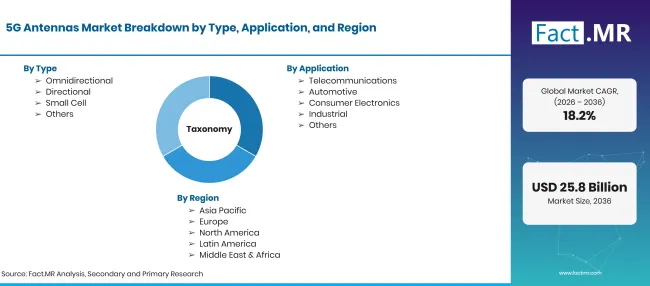
5G Antennas Market Taxonomy | Source: Fact.MR
| Attribute | Details |
|---|---|
| Quantitative Units | USD Billion |
| Market Definition | Commercial shipments of radiating antenna elements, massive MIMO active antenna units (AAUs), small cell antennas, and vehicular telematics antennas for 5G New Radio (NR) networks. |
| Type | Omnidirectional; Directional; Small Cell; Others |
| Application | Telecommunications; Automotive; Consumer Electronics; Industrial; Others |
| Technology | Sub-6 GHz; mmWave |
| Deployment Location | Outdoor; Indoor |
| Regions Covered | North America; Latin America; Western Europe; Eastern Europe; East Asia; South Asia & Pacific; Middle East & Africa |
| Countries Covered | Germany; Brazil; USA; UK; Japan |
| Companies Profiled | Huawei; Ericsson; Nokia; Samsung Electronics; ZTE; CommScope Holding Company, Inc.; Amphenol Corporation; Rosenberger; Tongyu Communication Inc.; Comba Telecom Systems Holdings Ltd. |
| Forecast Period | 2026 to 2036 |
| Approach | Primary interviews with cellular network RF planning engineers, base station procurement directors, and antenna radome material specialists combined with spectrum auction database verifications. |
Source: Fact.MR analysis. Updated Oct 23, 2026
How is the market segmented?
-
By Type
- Omnidirectional
- Directional
- Small Cell
- Others
-
By Application
- Telecommunications
- Automotive
- Consumer Electronics
- Industrial
- Others
-
By Technology
- Sub-6 GHz
- mmWave
- By Deployment Location
- Outdoor
- Indoor
-
By Region
- North America
- Latin America
- Western Europe
- Eastern Europe
- East Asia
- South Asia & Pacific
- Middle East & Africa
Frequently Asked Questions
What is the projected value of the 5G Antennas Market by 2036?
Which technology commands the largest share of the 5G antenna market?
What deployment location accounts for the majority of antenna revenues?
Which country is projected to record the highest growth rate during the forecast period?
Who are the dominant equipment providers in the global market?
Who worked on this report


Preview the report firsthand - request a free sample
Free SampleGet the brochure for pricing and purchase details
Download PDF