- Base Value(2025): 1.2 Bn
- Estimated Value(2026): 1.3 Bn
- Forecast Value (2036): 2.3 Bn
- CAGR (2026 - 2036): 6.4%
Radiation-Free Scoliosis Monitoring Devices Market Forecast and Outlook By FACT.MR
In 2025, the radiation-free scoliosis monitoring devices market was valued at USD 1.2 billion. Based on Fact.MR analysis, demand for radiation-free scoliosis monitoring devices is estimated to grow to USD 1.3 billion in 2026 and USD 2.3 billion by 2036. FACT.MR projects a CAGR of 6.4% during the forecast period.
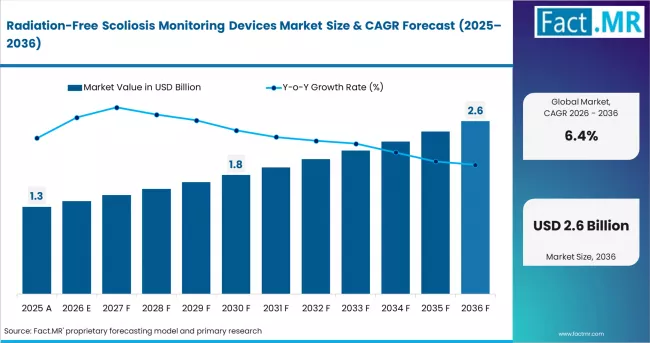
Radiation Free Scoliosis Monitoring Devices Market Value Analysis | Source: Fact.MR
Summary Of Radiation-Free Scoliosis Monitoring Devices Market
- Market Definition
- Market covers radiation-free scoliosis monitoring systems including surface topography, ultrasound, and AI posture analysis platforms for orthopedic and pediatric use globally.
- Demand Drivers
- Pediatric radiation safety mandates in the United Kingdom and United States are accelerating adoption.
- China hospital digitization is driving AI and topography system demand.
- India school screening programmes are increasing demand for portable devices.
- Key Segments Analyzed
- By Technology: Surface topography leads 50% in 2026 due to strong clinical validation.
- By Product Type: Standalone systems lead 45% in 2026 for accuracy and workflow fit.
- By Application: Pediatric monitoring leads 58% in 2026 due to radiation sensitivity.
- By Geography: India leads with 10.8% CAGR driven by screening expansion.
- Analyst Opinion at FACT.MR
- Shambhu Nath Jha states that surface topography and AI systems are replacing X-ray-based monitoring. Pediatric safety mandates are the key driver. Hospitals prefer platforms with EHR integration and longitudinal tracking. Clinical validation is the main competitive factor.
- Strategic Implications
- Invest in FDA and CE approvals for AI-based systems to access hospital procurement in the United States and Germany.
- Build reimbursement support aligned with NHS England and India screening guidelines.
- Partner with school health programmes in India and China for large-scale adoption.
- Methodology
- Market sizing uses manufacturer revenue and unit data validated with recent procurement and screening records.
- Includes FDA data, NHS policy updates, and China digitization statistics.
- Forecasts consider safety regulations, AI adoption, and expert insights.
| Metric | Value |
|---|---|
| Estimated Value in 2026 | USD 1.3 billion |
| Forecast Value in 2036 | USD 2.3 billion |
| Forecast CAGR (2026 to 2036) | 6.4% |
Source: Fact.MR analysis. Updated Apr 21, 2026
Between 2026 and 2036, the market is projected to create USD 1.0 billion in absolute opportunity. Growth is driven by rising pediatric radiation safety awareness and increasing scoliosis screening mandates. Hospital digital health integration is expanding device adoption. Growth is moderated by high device costs and limited reimbursement pathways in emerging markets. Integration of AI posture analysis into clinical workflows remains uneven.
Procurement is shifting toward clinically validated, documentation-ready radiation-free monitoring systems. Hospital administrators and orthopedic procurement teams are consolidating vendors around platforms offering software integration and longitudinal data tracking. Key players such as EOS Imaging and Stryker Corporation are competing on interoperability and clinical outcome data. Reimbursement eligibility tied to clinical protocols is reshaping product positioning across markets.
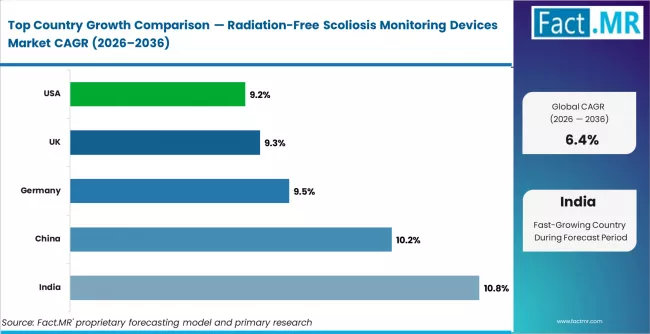
India leads with a CAGR of 10.8% through 2036. Growth is supported by expanding school scoliosis screening programmes and cost-effective digital monitoring solutions. China follows at 10.2%, driven by large patient pools and hospital digitization mandates. The United Kingdom records 9.3%, supported by NHS-led pediatric radiation reduction policies. Germany records 9.5%, driven by strong orthopedic infrastructure and early adoption of imaging alternatives. The United States records 9.2%, supported by advanced non-radiation monitoring adoption and digital health system integration.
Segmental Analysis
Radiation-Free Scoliosis Monitoring Devices Market Analysis by Technology
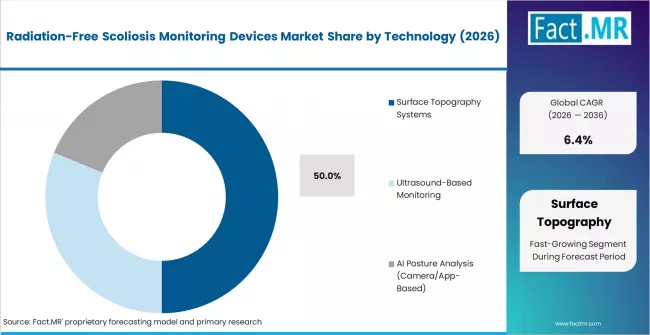
Radiation Free Scoliosis Monitoring Devices Market Analysis By Technology | Source: Fact.MR
Based on FACT.MR, surface topography holds 50% share in 2026. It is the most clinically validated non-radiation method. It is widely used in orthopedic centers and supported by clinical guidelines.
- EOS Imaging Clinical Integration: Expanded portfolio in 2024. Built partnerships with U.S. and European centers. Supported topography-based workflows. [4]
- Orthoscan Ultrasound Development: Introduced improved tools in 2025. Targets outpatient clinics needing portable alternatives. [5]
- AI Posture Analysis Adoption: Momentum Health Inc. expanded deployments in 2024. Used in school screening across North America and South Asia. Lower cost than topography systems. [6]
Radiation-Free Scoliosis Monitoring Devices Market Analysis by Product Type
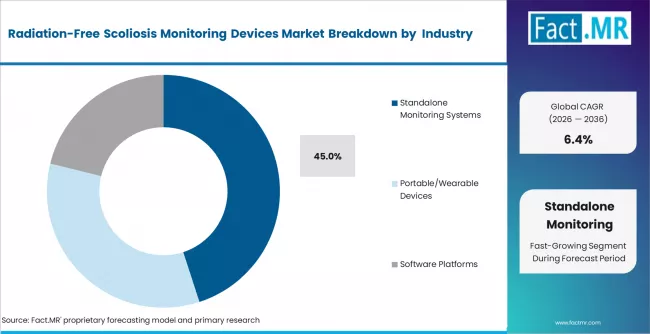
Radiation Free Scoliosis Monitoring Devices Market Analysis By Product Type | Source: Fact.MR
Based on FACT.MR, standalone systems hold 45% share in 2026. They provide high accuracy and repeatability. Hospitals prefer them for clinical assessment.
- Stryker Corporation Expansion: Expanded orthopedic monitoring portfolio in 2024. Integrated with hospital workflows. [7]
- Zimmer Biomet Development: Advanced portable monitoring in 2025. Targets ambulatory and clinic settings. [8]
- Medtronic Software Growth: Reported rising demand in 2024. AI-based scoliosis tracking is gaining adoption among pediatric specialists. [9]
Drivers, Restraints, and Opportunities
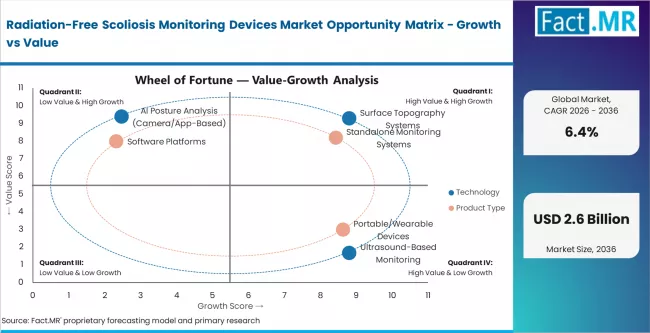
Radiation Free Scoliosis Monitoring Devices Market Opportunity Matrix Growth Vs Value | Source: Fact.MR
FACT.MR analysts observe that the market is in an early scaling phase. It is transitioning from niche use to mainstream orthopedic procurement. Demand is driven by pediatric radiation safety, school screening mandates, and digital health integration. Clinical validation of radiation-free technologies is enabling hospital adoption.
The market is segmented between high-precision standalone systems and portable AI tools. Surface topography systems dominate hospital procurement. AI posture tools are expanding in outpatient and screening settings. Portable and wearable formats face reimbursement gaps. Certified systems carry 30–50% price premiums. Growth is driven by higher selling prices rather than volume.
- Pediatric Radiation Safety Regulatory Driver: The American College of Radiology and Scoliosis Research Society updated guidelines in 2024. Reduced reliance on X-ray is recommended. This is accelerating surface topography adoption in the United States and NHS England hospitals. [1]
- Hospital Digital Health Integration: China healthcare digitization under the 14th Five-Year Plan is ongoing through 2025. AI-assisted diagnostics are being deployed across 1,000+ hospitals. Radiation-free tools are integrated into orthopedic workflows. This is boosting system and software sales. [2]
- India School Screening Programme Expansion: India expanded RBSK screening in 2024. Spinal assessment is included in 400,000+ sessions. This drives demand for portable radiation-free devices. [3]
Regional Analysis
The radiation-free scoliosis monitoring devices market is assessed across North America, Europe, Asia Pacific, Latin America, and Middle East and Africa, covering 40+ countries with distinct demand profiles shaped by pediatric radiation regulation maturity, national screening programme infrastructure, hospital digital health investment cycles, and reimbursement framework development. The full report offers market attractiveness analysis by region and country.
.webp "Top Country Growth Comparison Radiation Free Scoliosis Monitoring Devices Market Cagr (2026 2036)")
Top Country Growth Comparison Radiation Free Scoliosis Monitoring Devices Market Cagr (2026 2036) | Source: Fact.MR
| Country | CAGR (2026 to 2036) |
|---|---|
| India | 10.8% |
| China | 10.2% |
| United Kingdom | 9.3% |
| Germany | 9.5% |
| United States | 9.2% |
Source: Fact.MR analysis. Updated Apr 21, 2026
Source: Fact.MR (FACT.MR) analysis, based on proprietary forecasting model and primary research
Radiation Free Scoliosis Monitoring Devices Market Cagr Analysis By Country | Source: Fact.MR
Asia Pacific Radiation-Free Scoliosis Monitoring Devices Market Analysis
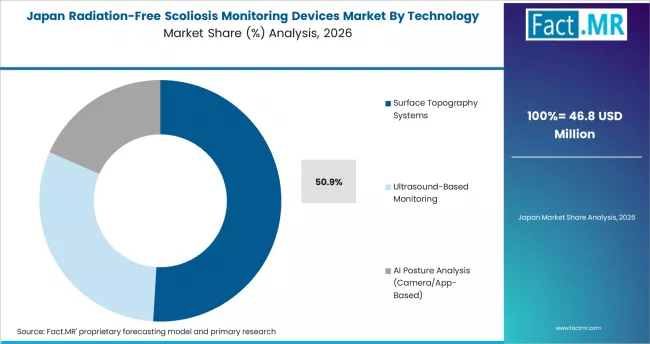
Radiation Free Scoliosis Monitoring Devices Market Japan Market Share Analysis By Technology | Source: Fact.MR
Asia Pacific is the fastest-growing region. India and China drive screening volume expansion. Japan leads in technology quality and clinical adoption depth. EOS Imaging and Medtronic are strengthening regional supply through hospital partnerships and regulatory expansion.
- India: Diagnostic and screening expansion supports 10.8% CAGR through 2036. It is the fastest-growing market. RBSK expansion in 2024 enabled large-scale screening. Government guidelines in 2025 endorsed radiation-free tools. Procurement is driven by public tenders. Private hospitals are expanding orthopedic screening in tier-2 cities. PLI scheme supports local manufacturing. Growth is policy-driven and volume-led.
- China: Hospital digitization supports 10.2% CAGR through 2036. National Health Commission updated guidelines in 2024. AI-assisted diagnostics are mandated. Stryker Corporation and EOS Imaging expanded distribution. Provincial procurement favors integrated systems. Growth is driven by digital health mandates and infrastructure scale.
- Japan: Premium diagnostics adoption supports 8.8% CAGR through 2036. Reimbursement-backed care drives adoption. Olympus Corporation supports advanced monitoring integration. Growth is driven by early clinical adoption and high-spec systems.
Fact.MR's analysis covers India, China, Japan, South Korea, ASEAN, and ANZ. It includes screening trends, regulatory updates, and adoption patterns.
Europe Radiation-Free Scoliosis Monitoring Devices Market Analysis
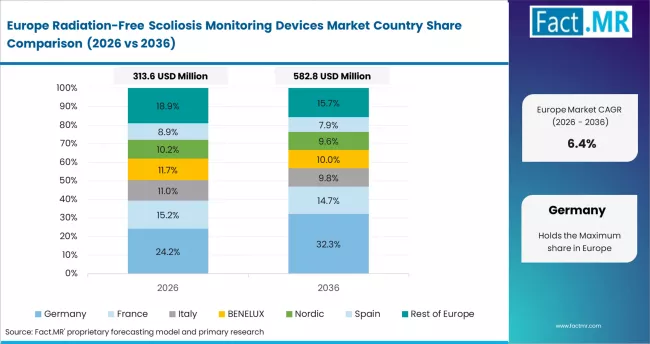
Radiation Free Scoliosis Monitoring Devices Market Europe Country Market Share Analysis, 2026 & 2036 | Source: Fact.MR
Europe is a clinical validation and regulatory benchmark region. NHS England policies and CE marking standards guide procurement. EOS Imaging and Orthoscan lead hospital adoption.
- Germany: Clinical and reimbursement support drives 9.5% CAGR through 2036. Statutory insurance updates in 2024 enabled non-radiation monitoring coverage. Clinical guidelines in 2025 recommended radiation-free follow-up. Procurement is hospital-driven with preference for validated systems. Growth is driven by compliance and quality standards.
- United Kingdom: NHS-led adoption supports 9.3% CAGR through 2036. Radiation reduction policies were prioritised in 2024. NICE initiated evaluation in 2025. Centralised NHS procurement enables rapid adoption. Growth is driven by national frameworks and safety mandates.
Fact.MR covers Germany, France, the UK, Italy, Spain, and Rest of Europe. It includes reimbursement benchmarks, clinical guidelines, and adoption trends.
North America Radiation-Free Scoliosis Monitoring Devices Market Analysis
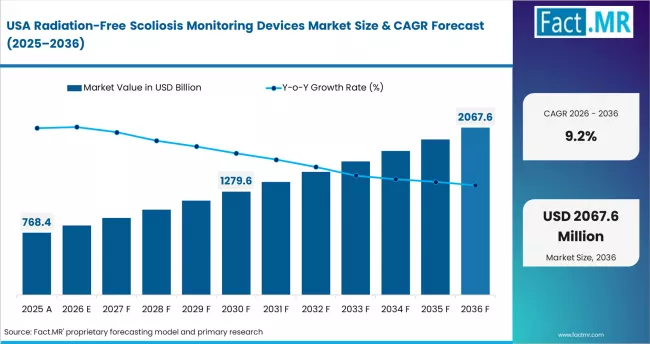
Radiation Free Scoliosis Monitoring Devices Market Country Value Analysis | Source: Fact.MR
North America is a clinically driven and digitally integrated market. Adoption is supported by pediatric care programmes and value-based care models. Stryker Corporation and Medtronic lead through hospital networks.
- United States: AI-enabled adoption supports 9.2% CAGR through 2036. FDA cleared new platforms in 2024. Pediatric screening guidelines expanded in 2024. This increased referral volume. Value-based care supports long-term monitoring adoption. Growth is driven by regulatory progress and clinical demand.
Fact.MR covers the United States, Canada, and Mexico. It includes FDA trends, reimbursement updates, and procurement insights.
Competitive Aligners for Market Players
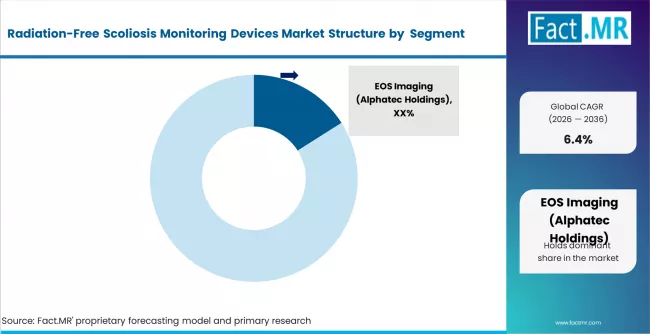
Radiation Free Scoliosis Monitoring Devices Market Analysis By Company | Source: Fact.MR
The radiation-free scoliosis monitoring devices market is evolving into a two-track competitive landscape. On one side are large, established orthopedic companies such as Stryker Corporation, Medtronic, and Zimmer Biomet. These players benefit from long-standing relationships with hospitals and integrated digital surgery ecosystems, allowing them to introduce radiation-free monitoring solutions as part of broader orthopedic care platforms. On the other side are specialist companies like EOS Imaging and Orthoscan, which focus on clinical precision and dedicated scoliosis monitoring expertise.
Competition is no longer defined only by device accuracy. Hospitals are increasingly prioritizing systems that can demonstrate strong clinical outcomes, integrate with electronic health records, and support reimbursement pathways. EOS Imaging, now part of Alphatec’s portfolio, holds a notable advantage due to its established presence in low-dose and radiation-free spinal imaging. Its strong clinical evidence base and compatibility with existing spine care workflows make adoption easier for hospitals. Meanwhile, Stryker and Medtronic leverage their existing orthopedic networks to bundle monitoring technologies into wider digital spine programs, reducing the need for standalone capital investment. Procurement behavior is also changing. Hospitals and pediatric spine centers are moving away from one-time device purchases toward long-term platform partnerships.
Vendors offering continuous software updates, service support, and data-driven insights are gaining preference. Multi-year contracts and software-as-a-service models are becoming more common. This shift benefits companies with integrated platforms and proven clinical validation, while limiting opportunities for smaller suppliers that offer standalone devices without strong outcome data or system integration capabilities.
Key Players
- EOS Imaging (Alphatec Holdings)
- Orthoscan
- Stryker Corporation
- Zimmer Biomet Holdings Inc.
- Medtronic plc
- Momentum Health Inc.
- 3D Systems Corporation
Scope of Report
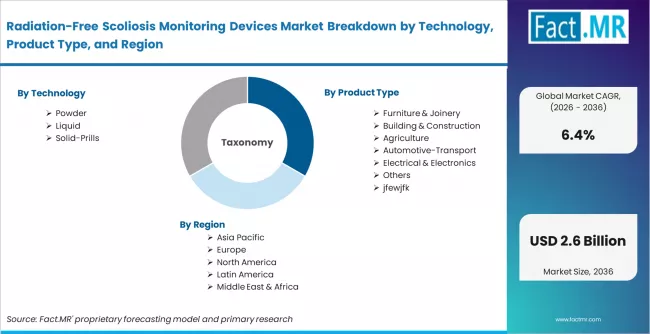
Radiation Free Scoliosis Monitoring Devices Market Breakdown By Technology, Product Type, And Region | Source: Fact.MR
| Attribute | Details |
|---|---|
| Quantitative Units | USD 1.3 billion (2026) to USD 2.3 billion (2036), at a CAGR of 6.4% |
| Market Definition | Non-ionizing clinical and portable systems for radiation-free spinal curvature monitoring including surface topography, ultrasound, and AI posture analysis platforms, supplied with clinical validation documentation for orthopedic, pediatric, and adult scoliosis care globally. |
| Technology Segmentation | Surface Topography Systems, Ultrasound-Based Monitoring, AI Posture Analysis |
| Product Type Segmentation | Standalone Monitoring Systems, Portable/Wearable Devices, Software Platforms |
| Application Segmentation | Pediatric Scoliosis Monitoring, Adolescent Scoliosis, Adult Scoliosis |
| Application Coverage | Pediatric radiation-safe spinal screening in hospital orthopedic departments, adolescent idiopathic scoliosis follow-up monitoring, adult degenerative scoliosis longitudinal tracking, and school-based population-level scoliosis screening programmes. |
| Regions Covered | North America, Europe, Asia Pacific, Latin America, Middle East and Africa |
| Countries Covered | USA, Canada, Mexico, Germany, UK, France, Italy, Spain, Nordic, BENELUX, China, Japan, South Korea, India, ASEAN, Australia and New Zealand, Brazil, Saudi Arabia, GCC, Turkey, South Africa, Rest of MEA |
| Key Companies Profiled | EOS Imaging (Alphatec), Orthoscan, Stryker Corporation, Zimmer Biomet, Medtronic, Momentum Health Inc., 3D Systems |
| Forecast Period | 2026 to 2036 |
| Approach | Hybrid top-down and bottom-up model using orthopedic device manufacturer revenues, unit volume estimates by technology and application, average selling prices by product type and clinical setting, hospital procurement benchmarks, and primary interviews with orthopedic device buyers and pediatric spine specialists. |
Source: Fact.MR analysis. Updated Apr 21, 2026
Radiation-Free Scoliosis Monitoring Devices Market by Segments
-
By Technology:
- Surface Topography Systems
- Ultrasound-Based Monitoring
- AI Posture Analysis (Camera/App-Based)
-
By Product Type:
- Standalone Monitoring Systems
- Portable/Wearable Devices
- Software Platforms
-
By Application:
- Pediatric Scoliosis Monitoring
- Adolescent Scoliosis
- Adult Scoliosis
-
By Region:
- North America
- United States
- Canada
- Mexico
- Latin America
- Brazil
- Mexico
- Argentina
- Rest of Latin America
- Western Europe
- Germany
- United Kingdom
- France
- Italy
- Spain
- Nordic Countries
- BENELUX
- Rest of Western Europe
- Eastern Europe
- Russia
- Poland
- Rest of Eastern Europe
- East Asia
- China
- Japan
- South Korea
- South Asia and Pacific
- India
- ASEAN
- Australia and New Zealand
- Rest of South Asia and Pacific
- Middle East and Africa
- Kingdom of Saudi Arabia
- Other GCC Countries
- Turkey
- South Africa
- Rest of Middle East and Africa
- North America
Bibliography
- [1] Scoliosis Research Society and American College of Radiology. (2024). Updated Clinical Guidelines for Pediatric Scoliosis Monitoring: Recommendations for Reducing Ionizing Radiation Exposure in Spinal Curvature Assessment Programmes for Patients Under 18 Years. srs.org
- [2] National Health Commission of the People's Republic of China. (2024). 14th Five-Year Plan Healthcare Digitization Implementation Report: AI-Assisted Diagnostic Integration Requirements for Grade-A Hospital Orthopedic Departments Including Spinal Assessment System Procurement Standards. nhc.gov.cn
- [3] Ministry of Health and Family Welfare, Government of India. (2024). Rashtriya Bal Swasthya Karyakram Annual Programme Report 2024: Musculoskeletal Screening Expansion Including Spinal Curvature Assessment Protocol Integration Across District Early Intervention Centres. mohfw.gov.in
- [4] Alphatec Holdings Inc. (2024). Annual Report 2024: EOS Imaging Portfolio Integration and Radiation-Free Spinal Assessment Platform Commercial Expansion Including U.S. Hospital Distribution Agreement Updates for Orthopedic and Pediatric Spine Programmes. atecspine.com/investor-relations
- [5] Orthoscan Inc. (2025). Product Update Announcement: Enhanced Ultrasound-Based Scoliosis Assessment System for Outpatient Orthopedic Clinics Seeking Portable Non-Ionizing Spinal Curvature Monitoring Alternatives to Standard Standing Radiograph Protocols. orthoscan.com/news
- [6] Momentum Health Inc. (2024). Market Report: AI Camera-Based Posture Analysis Platform Deployment in School Scoliosis Screening Programmes Across North America and South Asia Including Cost-Per-Screening Benchmarks and Programme Outcome Data. momentumhealthinc.com
- [7] Stryker Corporation. (2024). Annual Report 2024: Orthopedic Digital Monitoring Portfolio Expansion Including Spinal Assessment Integration Within Mako Robotic Surgery Digital Ecosystem Across U.S. and European Hospital Networks. stryker.com/investor-relations
- [8] Zimmer Biomet Holdings Inc. (2025). Product Launch: Portable Radiation-Free Spinal Monitoring System for Ambulatory Surgical Centres and Community Orthopedic Clinics With EHR Integration and Compact Non-Ionizing Spinal Curvature Assessment Capability. zimmerbiomet.com/news
- [9] Medtronic plc. (2024). Annual Report 2024: Spine Care Digital Platform Update Including AI-Assisted Scoliosis Progression Tracking and Non-Radiation Longitudinal Monitoring Integration for U.S. Paediatric and Adolescent Spine Specialist Networks. medtronic.com/investor-relations
This Report Addresses
- Strategic insights on radiation-free scoliosis monitoring device demand across pediatric hospital procurement, adolescent screening programme adoption, and adult degenerative scoliosis longitudinal monitoring.
- Market forecast from USD 1.3 billion in 2026 to USD 2.3 billion by 2036, at 6.4% CAGR.
- Opportunity mapping across India school scoliosis screening expansion, China hospital digitization mandates, NHS England pediatric radiation reduction policy adoption, and U.S. AI-assisted diagnostics 510(k) clearance pipeline.
- Segment analysis by technology, product type, and application. Covers surface topography, ultrasound, and AI posture analysis systems across standalone, portable, and software platform formats for pediatric, adolescent, and adult scoliosis monitoring.
- Regional outlook covering Asia Pacific school screening-led growth, Europe reimbursement and regulatory-driven procurement, and North America value-based care digital spine programme adoption.
- Competitive landscape of EOS Imaging, Orthoscan, Stryker Corporation, Zimmer Biomet, Medtronic, Momentum Health Inc., and 3D Systems covering clinical validation, EHR integration, and reimbursement eligibility positioning.
- Regulatory analysis covering FDA 510(k) clearance pipeline for AI posture analysis tools, NHS England Getting It Right First Time scoliosis protocols, NICE technology appraisal processes, and India RBSK school musculoskeletal screening guidelines.
- Report delivery in PDF, Excel, and presentation formats supported by validated manufacturer data, hospital procurement benchmarks, and industry expert inputs.
Market Definition
The radiation-free scoliosis monitoring devices market covers non-ionizing diagnostic and monitoring systems used to assess spinal curvature in pediatric, adolescent, and adult patients.
Radiation-Free Scoliosis Monitoring Devices Market Inclusions
Covers global and regional forecasts from 2026 to 2036 by technology, product type, and application. Includes surface topography, ultrasound-based, and AI posture analysis systems across standalone, portable, and software formats for pediatric, adolescent, and adult scoliosis monitoring.
Radiation-Free Scoliosis Monitoring Devices Market Exclusions
Excludes X-ray, CT, and MRI-based imaging systems. Excludes orthopedic bracing and implant products with secondary monitoring functions. Physiotherapy software and general posture apps without clinical validation are also excluded.
Radiation-Free Scoliosis Monitoring Devices Market Research Methodology
- Primary Research
- Interviews with orthopedic device manufacturers, pediatric specialists, hospital procurement teams, and screening programme administrators across United States, Germany, United Kingdom, China, and India.
- Desk Research
- Uses data from EOS Imaging, Stryker Corporation, and Medtronic reports. Includes NHS England policy updates, FDA 510(k) records, and 2024–2025 procurement data.
- Market-Sizing and Forecasting
- Uses a hybrid model combining manufacturer revenues, unit volumes, and pricing benchmarks by product and application.
- Data Validation and Update Cycle
- Validated using manufacturer data, hospital procurement records, and screening programme benchmarks. Supported by expert interviews.
Frequently Asked Questions
How large is the global radiation-free scoliosis monitoring devices market in 2025?
What will the market size be in 2026?
What is the projected market size by 2036?
What is the expected CAGR from 2026 to 2036?
Which technology segment is poised to lead the market?
Which application segment holds the largest share?
Which country shows the fastest growth in the market?
What are radiation-free scoliosis monitoring devices used for?
What drives demand in this market?
Who are the key players in the market?
Who worked on this report


Preview the report firsthand - request a free sample
Free SampleGet the brochure for pricing and purchase details
Download PDF