Drop-Test-Compliant Packaging for Computer Products Market (2026 - 2036)
Drop-Test-Compliant Packaging for Computer Products Market Size and Share Forecast Outlook 2026 to 2036
Core Findings
Drop-Test-Compliant Packaging for Computer Products Market Forecast and Outlook 2026 to 2036
The global drop-test-compliant packaging for computer products market is projected to grow from USD 591.6 million in 2026 to USD 1142.2 million by 2036, reflecting a compound annual growth rate of 6.8%.
Key Takeaways from Drop-Test-Compliant Packaging for Computer Products Market
- Drop-Test-Compliant Packaging for Computer Products Market Value 2026: USD 591.6 million
- Drop-Test-Compliant Packaging for Computer Products Market Forecast Value 2036: USD 1142.2 million
- Drop-Test-Compliant Packaging for Computer Products Market Forecast CAGR: 6.8%
- Leading Protection Technology in Drop-Test-Compliant Packaging for Computer Products Market: Engineered foam systems 30.6%
- Leading Product Class in Drop-Test-Compliant Packaging for Computer Products Market: Laptops or tablets 34.7%
- Key Growth Regions in Drop-Test-Compliant Packaging for Computer Products Market: India, Vietnam, Indonesia, China, Mexico, U.S., Germany, Japan
- Key Players in Drop-Test-Compliant Packaging for Computer Products Market: Sealed Air, NEFAB, Smurfit Kappa, WestRock, International Paper, Mondi, Amcor, Sonoco, Huhtamaki, Stora Enso
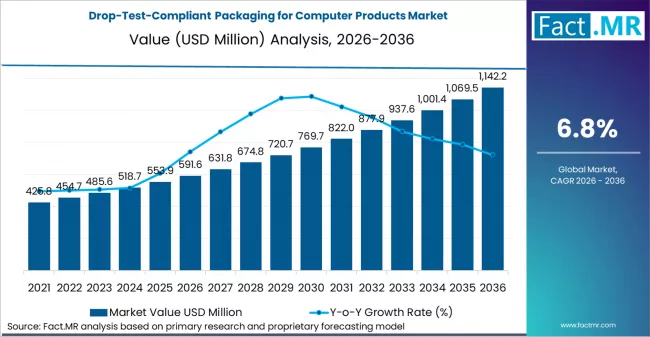
Growth is driven by the need to protect high-value computer products such as laptops, tablets, monitors, printers, servers, and gaming consoles during transportation and handling. Engineered foam systems dominate protection technology due to their ability to absorb shocks and distribute impact energy, while molded pulp shock absorbers, honeycomb and paper structures, inflatable air columns, and suspension packaging provide specialized protection for specific product classes.
Laptops and tablets represent the largest product class, reflecting their high shipping volumes and sensitivity to impact. Certification needs, such as ISTA testing, retail-ready drop testing, and export/transit testing, guide the adoption of compliant packaging solutions. Asia-Pacific, particularly India, Vietnam, and Indonesia, is the fastest-growing region due to increasing production and consumption of computer products, while North America and Europe maintain steady adoption through organized retail and enterprise channels. Suppliers focus on providing packaging that ensures product safety, reduces damage claims, and simplifies logistics while maintaining efficient packing and handling.
Drop-Test-Compliant Packaging for Computer Products Market
| Metric | Value |
|---|---|
| Estimated Value in (2026E) | USD 591.6 million |
| Forecast Value in (2036F) | USD 1,142.2 million |
| Forecast CAGR (2026 to 2036) | 6.8% |
Category
| Category | Segments |
|---|---|
| Protection Technology | Engineered Foam Systems; Molded Pulp Shock Absorbers; Honeycomb and Paper Structures; Inflatable Air Columns; Suspension Packaging; Other |
| Product Class | Laptops or Tablets; Monitors or Displays; Networking or Servers; Printers or Imaging Equipment; Gaming Consoles; Other |
| Certification Need | ISTA or Parcel; Retail Ready and Drop Tested; Export or Transit Tested; Other |
| Application Environment | E-commerce Shipments; Retail Distribution; Export Logistics; Warehouse Handling; Other |
| Region | North America; Europe; Asia Pacific; Latin America; Middle East & Africa |
Segmental Analysis
By Protection Technology, Which Segment Holds the Dominant Share in the Drop-Test-Compliant Packaging for Computer Products Market?
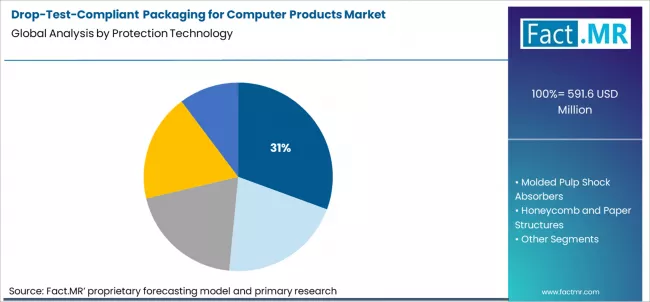
In terms of protection technology, engineered foam systems account for a 30.6% share in the Drop-Test-Compliant Packaging for Computer Products Market. These systems are designed to manage controlled energy absorption during vertical and edge drops encountered in parcel handling. Computer manufacturers rely on engineered foams to maintain product clearance inside cartons while limiting peak impact forces during standardized drop sequences.
- Foam density and geometry are tuned to product weight and center of gravity.
- Repeatable drop performance supports qualification across multiple shipment profiles.
By Product Class, Which Segment Registers the Highest Share in the Drop-Test-Compliant Packaging for Computer Products Market?
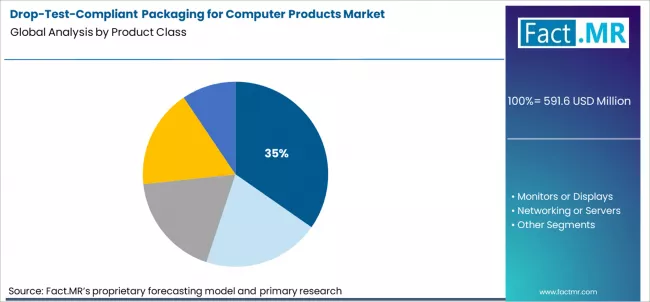
By product class, laptops and tablets represent a 34.7% share. These devices combine high unit value with thin form factors, increasing sensitivity to corner and edge impacts. Packaging designs prioritize suspension spacing and impact attenuation to protect screens, hinges, and internal components during drops.
- Compact device profiles require precise insert fit to prevent internal contact.
- High shipment volumes sustain steady demand for validated drop-protection solutions.
By Certification Need, Which Segment Holds the Dominant Share in the Drop-Test-Compliant Packaging for Computer Products Market?
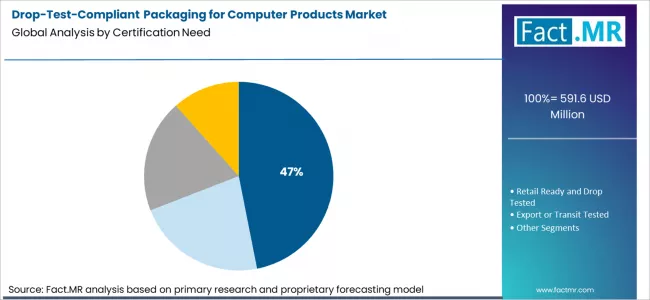
By certification need, ISTA or parcel testing accounts for a 46.9% share. Compliance with parcel-focused test protocols is required for products shipped through courier and e-commerce networks. Packaging systems are engineered to pass defined drop heights and orientations without compromising product integrity.
- Test compliance influences material selection and cushioning layout.
- Qualification cycles are closely tied to product launch and logistics approval timelines.
What are the Drivers, Restraints, and Key Trends of the Drop-Test-Compliant Packaging for Computer Products Market?
- Drivers: Frequent shipping of high value and fragile computer products such as laptops, monitors, servers, and gaming consoles is pushing manufacturers to adopt packaging solutions that can consistently pass ISTA and parcel drop tests, reducing damage claims and protecting brand reputation across global distribution networks.
- Restraint: Designing packaging that meets strict drop test standards while controlling material usage, box size, and overall cost remains challenging, particularly as products become thinner, lighter, and more sensitive to edge and corner impacts.
- Trend 1: Engineered foam systems and molded pulp shock absorbers are increasingly selected for laptops and tablets as brands look for predictable energy absorption performance across repeated drop test cycles without excessive packaging bulk.
- Trend 2: Paper based honeycomb structures, inflatable air columns, and suspension packaging are gaining traction for larger products such as monitors and servers, offering certified drop protection while improving pack out efficiency and supporting evolving material reduction goals.
Analysis of the Drop-Test-Compliant Packaging for Computer Products Market by Key Country
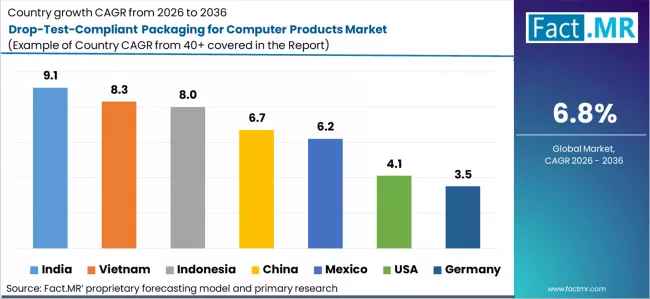
| Country | CAGR |
|---|---|
| India | 9.1% |
| Vietnam | 8.3% |
| Indonesia | 8.0% |
| China | 6.7% |
| Mexico | 6.2% |
| U.S. | 4.1% |
| Germany | 3.5% |
| Japan | 3.0% |
The report covers an in depth analysis of 8 countries; higher growth markets are highlighted below.
What Is Driving Demand for Drop-Test-Compliant Packaging for Computer Products in India?
India shows the fastest growth at 9.1%, driven by rising shipment volumes of laptops, tablets, and peripherals through e-commerce and organized retail. Packaging must meet parcel and transit drop test requirements to limit in transit damage. Engineered foam and molded pulp solutions are increasingly adopted to manage repeated handling stress.
- Growth in e-commerce shipments is raising demand for drop-tested packaging formats.
- Focus on damage reduction supports adoption of certified protective solutions.
How Is Vietnam Emerging as a High-Growth Market for Drop-Test-Compliant Packaging?
Vietnam is projected to grow at 8.3%, supported by export oriented manufacturing of laptops and consumer computing devices. Packaging designs prioritize compliance with international drop test standards. Engineered foam systems are commonly used to protect products during long distance air and parcel transport.
- Export driven device shipments sustain demand for certified packaging.
- Engineered foam solutions support consistent drop test performance.
What Factors Are Supporting Market Expansion in Indonesia?
Indonesia is expected to expand at 8.0%, driven by growing distribution of monitors and computing hardware across domestic and regional markets. Molded pulp shock absorbers are widely used to balance protection and material efficiency. Retail ready packaging often requires validation through drop testing.
- Growth in display and hardware shipments increases need for shock protection.
- Retail ready requirements support certified packaging adoption.
How Is China Influencing Demand for Drop-Test-Compliant Packaging?
China is forecast to grow at 6.7%, reflecting large scale export of networking equipment and computing hardware. Honeycomb and paper based protective structures are widely used to meet transit testing standards. Packaging must support export certification and handling across complex logistics networks.
- Export oriented hardware production sustains demand for tested packaging.
- Paper based protective structures support compliance at scale.
What Role Does Mexico Play in This Market?
Mexico is projected to grow at 6.2%, supported by cross border shipment of printers and imaging products. Inflatable air column packaging is used to manage impact protection during long haul transport. Certification needs align with transit and distribution testing requirements.
- Cross border shipments drive demand for impact tested packaging.
- Air column solutions support consistent drop test performance.
What Defines Market Conditions in the U.S.?
The U.S. market is expected to expand at 4.1%, shaped by mature distribution systems and strict damage reduction benchmarks. Suspension packaging and foam systems are used for gaming consoles and premium hardware. Growth remains steady due to stable shipment volumes.
- Damage reduction goals sustain demand for compliant packaging.
- Mature logistics networks moderate growth pace.
How Is the Market Positioned in Germany?
Germany is forecast to grow at 3.5%, influenced by emphasis on transport testing and packaging validation. Drop-test-compliant solutions support shipment of precision computing equipment. Paper based protective formats are increasingly used alongside engineered systems.
- Focus on testing compliance supports certified packaging demand.
- Stable hardware shipments limit rapid expansion.
What Factors Shape Market Development in Japan?
Japan is expected to register a CAGR of 3.0%, reflecting high expectations for packaging precision and product protection. Drop-tested packaging is used selectively for high value computing products. Adoption remains measured due to optimized domestic logistics systems.
- Emphasis on packaging accuracy supports selective adoption.
- Mature distribution practices constrain growth rates.
Competitive Landscape of the Drop-Test-Compliant Packaging for Computer Products Market
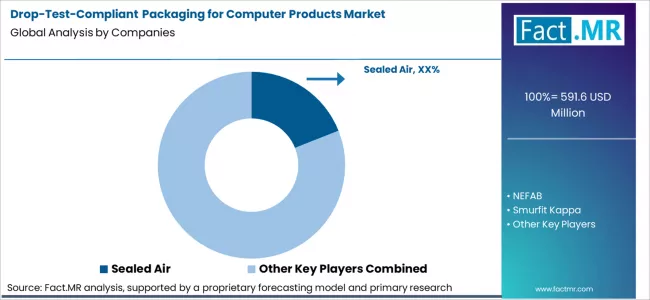
The drop-test-compliant packaging for computer products market is driven by the need to protect high-value, fragile devices from damage during increasingly demanding logistics cycles. Products such as laptops, tablets, monitors, servers, printers, and gaming consoles must survive repeated drops, edge impacts, and compression forces encountered in parcel and export shipments. Competition centers on the ability to consistently meet ISTA and parcel carrier drop-test standards while controlling packaging weight, material use, and overall system cost.
Suppliers differentiate through engineered foam systems, molded pulp shock absorbers, honeycomb paper structures, inflatable air columns, and suspension-style packaging designs. Engineered foam remains critical for heavier and vibration-sensitive products, while molded pulp and paper-based structures gain adoption for their balance of shock absorption and structural rigidity. Packaging engineers focus on precise energy management, product immobilization, and repeatable performance across standardized test protocols rather than one-off protective designs.
Market players include Sealed Air, NEFAB, Smurfit Kappa, WestRock, International Paper, Mondi, Amcor, Sonoco, Huhtamaki, and Stora Enso. Sealed Air and NEFAB lead in test-certified engineered systems, while paper-based specialists support scalable, drop-compliant designs for global electronics distribution.
Key Players in the Drop-Test-Compliant Packaging for Computer Products Market
- Sealed Air
- NEFAB
- Smurfit Kappa
- WestRock
- International Paper
- Mondi
- Amcor
- Sonoco
- Huhtamaki
- Stora Enso
Scope of the Report
| Items | Values |
|---|---|
| Quantitative Units 2026 | USD 591.6 Million |
| Protection Technology | Engineered foam systems, Molded pulp shock absorbers, Honeycomb and paper structures, Inflatable air columns, Suspension packaging |
| Product Class | Laptops or tablets, Monitors or displays, Networking equipment or servers, Printers or imaging devices, Gaming consoles |
| Certification Need | ISTA or parcel drop compliance, Retail-ready and drop-tested packaging, Export or transit-tested packaging |
| Regions Covered | North America, Europe, Asia Pacific, Latin America, Middle East & Africa |
| Countries Covered | India, Vietnam, Indonesia, China, Mexico, U.S., Germany, Japan |
| Key Companies Profiled | Sealed Air, NEFAB, Smurfit Kappa, WestRock, International Paper, Mondi, Amcor, Sonoco, Huhtamaki, Stora Enso |
| Additional Attributes | Dollar revenue by drop-test-compliant protection technology, product class, certification requirement, and region; regional demand trends; compliance with parcel and courier handling standards; damage reduction for high-value computer products; balance between protection performance and packaging weight; alignment with global logistics testing protocols |
Drop-Test-Compliant Packaging for Computer Products Market Segments
-
Protection Technology:
- Engineered Foam Systems
- Molded Pulp Shock Absorbers
- Honeycomb and Paper Structures
- Inflatable Air Columns
- Suspension Packaging
-
Product Class:
- Laptops or Tablets
- Monitors or Displays
- Networking or Servers
- Printers or Imaging
- Gaming Consoles
-
Certification Need:
- ISTA or Parcel
- Retail Ready and Drop Tested
- Export or Transit Tested
- Other
-
Region:
- North America
- U.S.
- Canada
- Mexico
- Europe
- Germany
- Italy
- UK
- France
- Spain
- Netherlands
- Switzerland
- Rest of Europe
- Asia Pacific
- Japan
- Australia
- South Korea
- China
- India
- Rest of Asia Pacific
- Latin America
- Brazil
- Argentina
- Rest of Latin America
- Middle East and Africa
- United Arab Emirates
- South Africa
- Rest of Middle East and Africa
- North America
Bibliography
- International Safe Transit Association. (2024). Packaged-products testing procedures for parcel, courier, and e-commerce distribution systems. International Safe Transit Association.
- Organisation for Economic Co-operation and Development. (2023). Damage prevention, logistics testing, and protective packaging requirements in global electronics supply chains. OECD Publishing.
- U.S. Environmental Protection Agency. (2024). Protective packaging materials performance for electronic products under transport and drop-test conditions. U.S. Environmental Protection Agency.
- World Packaging Organisation. (2023). Drop-test-compliant packaging systems for high-value electronics and computer hardware. World Packaging Organisation.
- International Electrotechnical Commission. (2024). Packaging and transport testing considerations for electronic equipment and assemblies (IEC Technical Report). IEC.
Table of Content
- Executive Summary
- Global Market Outlook
- Demand to side Trends
- Supply to side Trends
- Technology Roadmap Analysis
- Analysis and Recommendations
- Market Overview
- Market Coverage / Taxonomy
- Market Definition / Scope / Limitations
- Market Background
- Market Dynamics
- Drivers
- Restraints
- Opportunity
- Trends
- Scenario Forecast
- Demand in Optimistic Scenario
- Demand in Likely Scenario
- Demand in Conservative Scenario
- Opportunity Map Analysis
- Product Life Cycle Analysis
- Supply Chain Analysis
- Investment Feasibility Matrix
- Value Chain Analysis
- PESTLE and Porter’s Analysis
- Regulatory Landscape
- Regional Parent Market Outlook
- Production and Consumption Statistics
- Import and Export Statistics
- Market Dynamics
- Global Market Analysis 2021 to 2025 and Forecast, 2026 to 2036
- Historical Market Size Value (USD Million) Analysis, 2021 to 2025
- Current and Future Market Size Value (USD Million) Projections, 2026 to 2036
- Y to o to Y Growth Trend Analysis
- Absolute $ Opportunity Analysis
- Global Market Pricing Analysis 2021 to 2025 and Forecast 2026 to 2036
- Global Market Analysis 2021 to 2025 and Forecast 2026 to 2036, By Protection Technology
- Introduction / Key Findings
- Historical Market Size Value (USD Million) Analysis By Protection Technology, 2021 to 2025
- Current and Future Market Size Value (USD Million) Analysis and Forecast By Protection Technology, 2026 to 2036
- Engineered Foam Systems
- Molded Pulp Shock Absorbers
- Honeycomb and Paper Structures
- Inflatable Air Columns
- Suspension Packaging
- Engineered Foam Systems
- Y to o to Y Growth Trend Analysis By Protection Technology, 2021 to 2025
- Absolute $ Opportunity Analysis By Protection Technology, 2026 to 2036
- Global Market Analysis 2021 to 2025 and Forecast 2026 to 2036, By Product Class
- Introduction / Key Findings
- Historical Market Size Value (USD Million) Analysis By Product Class, 2021 to 2025
- Current and Future Market Size Value (USD Million) Analysis and Forecast By Product Class, 2026 to 2036
- Laptops or Tablets
- Monitors or Displays
- Networking or Servers
- Printers or Imaging
- Gaming Consoles
- Laptops or Tablets
- Y to o to Y Growth Trend Analysis By Product Class, 2021 to 2025
- Absolute $ Opportunity Analysis By Product Class, 2026 to 2036
- Global Market Analysis 2021 to 2025 and Forecast 2026 to 2036, By Certification Need
- Introduction / Key Findings
- Historical Market Size Value (USD Million) Analysis By Certification Need, 2021 to 2025
- Current and Future Market Size Value (USD Million) Analysis and Forecast By Certification Need, 2026 to 2036
- ISTA or Parcel
- Retail Ready and Drop Tested
- Export or Transit Tested
- Other
- ISTA or Parcel
- Y to o to Y Growth Trend Analysis By Certification Need, 2021 to 2025
- Absolute $ Opportunity Analysis By Certification Need, 2026 to 2036
- Global Market Analysis 2021 to 2025 and Forecast 2026 to 2036, By Region
- Introduction
- Historical Market Size Value (USD Million) Analysis By Region, 2021 to 2025
- Current Market Size Value (USD Million) Analysis and Forecast By Region, 2026 to 2036
- North America
- Latin America
- Western Europe
- Eastern Europe
- East Asia
- South Asia and Pacific
- Middle East & Africa
- Market Attractiveness Analysis By Region
- North America Market Analysis 2021 to 2025 and Forecast 2026 to 2036, By Country
- Historical Market Size Value (USD Million) Trend Analysis By Market Taxonomy, 2021 to 2025
- Market Size Value (USD Million) Forecast By Market Taxonomy, 2026 to 2036
- By Country
- USA
- Canada
- Mexico
- By Protection Technology
- By Product Class
- By Certification Need
- By Country
- Market Attractiveness Analysis
- By Country
- By Protection Technology
- By Product Class
- By Certification Need
- Key Takeaways
- Latin America Market Analysis 2021 to 2025 and Forecast 2026 to 2036, By Country
- Historical Market Size Value (USD Million) Trend Analysis By Market Taxonomy, 2021 to 2025
- Market Size Value (USD Million) Forecast By Market Taxonomy, 2026 to 2036
- By Country
- Brazil
- Chile
- Rest of Latin America
- By Protection Technology
- By Product Class
- By Certification Need
- By Country
- Market Attractiveness Analysis
- By Country
- By Protection Technology
- By Product Class
- By Certification Need
- Key Takeaways
- Western Europe Market Analysis 2021 to 2025 and Forecast 2026 to 2036, By Country
- Historical Market Size Value (USD Million) Trend Analysis By Market Taxonomy, 2021 to 2025
- Market Size Value (USD Million) Forecast By Market Taxonomy, 2026 to 2036
- By Country
- Germany
- UK
- Italy
- Spain
- France
- Nordic
- BENELUX
- Rest of Western Europe
- By Protection Technology
- By Product Class
- By Certification Need
- By Country
- Market Attractiveness Analysis
- By Country
- By Protection Technology
- By Product Class
- By Certification Need
- Key Takeaways
- Eastern Europe Market Analysis 2021 to 2025 and Forecast 2026 to 2036, By Country
- Historical Market Size Value (USD Million) Trend Analysis By Market Taxonomy, 2021 to 2025
- Market Size Value (USD Million) Forecast By Market Taxonomy, 2026 to 2036
- By Country
- Russia
- Poland
- Hungary
- Balkan & Baltic
- Rest of Eastern Europe
- By Protection Technology
- By Product Class
- By Certification Need
- By Country
- Market Attractiveness Analysis
- By Country
- By Protection Technology
- By Product Class
- By Certification Need
- Key Takeaways
- East Asia Market Analysis 2021 to 2025 and Forecast 2026 to 2036, By Country
- Historical Market Size Value (USD Million) Trend Analysis By Market Taxonomy, 2021 to 2025
- Market Size Value (USD Million) Forecast By Market Taxonomy, 2026 to 2036
- By Country
- China
- Japan
- South Korea
- By Protection Technology
- By Product Class
- By Certification Need
- By Country
- Market Attractiveness Analysis
- By Country
- By Protection Technology
- By Product Class
- By Certification Need
- Key Takeaways
- South Asia and Pacific Market Analysis 2021 to 2025 and Forecast 2026 to 2036, By Country
- Historical Market Size Value (USD Million) Trend Analysis By Market Taxonomy, 2021 to 2025
- Market Size Value (USD Million) Forecast By Market Taxonomy, 2026 to 2036
- By Country
- India
- ASEAN
- Australia & New Zealand
- Rest of South Asia and Pacific
- By Protection Technology
- By Product Class
- By Certification Need
- By Country
- Market Attractiveness Analysis
- By Country
- By Protection Technology
- By Product Class
- By Certification Need
- Key Takeaways
- Middle East & Africa Market Analysis 2021 to 2025 and Forecast 2026 to 2036, By Country
- Historical Market Size Value (USD Million) Trend Analysis By Market Taxonomy, 2021 to 2025
- Market Size Value (USD Million) Forecast By Market Taxonomy, 2026 to 2036
- By Country
- Kingdom of Saudi Arabia
- Other GCC Countries
- Turkiye
- South Africa
- Other African Union
- Rest of Middle East & Africa
- By Protection Technology
- By Product Class
- By Certification Need
- By Country
- Market Attractiveness Analysis
- By Country
- By Protection Technology
- By Product Class
- By Certification Need
- Key Takeaways
- Key Countries Market Analysis
- USA
- Pricing Analysis
- Market Share Analysis, 2025
- By Protection Technology
- By Product Class
- By Certification Need
- Canada
- Pricing Analysis
- Market Share Analysis, 2025
- By Protection Technology
- By Product Class
- By Certification Need
- Mexico
- Pricing Analysis
- Market Share Analysis, 2025
- By Protection Technology
- By Product Class
- By Certification Need
- Brazil
- Pricing Analysis
- Market Share Analysis, 2025
- By Protection Technology
- By Product Class
- By Certification Need
- Chile
- Pricing Analysis
- Market Share Analysis, 2025
- By Protection Technology
- By Product Class
- By Certification Need
- Germany
- Pricing Analysis
- Market Share Analysis, 2025
- By Protection Technology
- By Product Class
- By Certification Need
- UK
- Pricing Analysis
- Market Share Analysis, 2025
- By Protection Technology
- By Product Class
- By Certification Need
- Italy
- Pricing Analysis
- Market Share Analysis, 2025
- By Protection Technology
- By Product Class
- By Certification Need
- Spain
- Pricing Analysis
- Market Share Analysis, 2025
- By Protection Technology
- By Product Class
- By Certification Need
- France
- Pricing Analysis
- Market Share Analysis, 2025
- By Protection Technology
- By Product Class
- By Certification Need
- India
- Pricing Analysis
- Market Share Analysis, 2025
- By Protection Technology
- By Product Class
- By Certification Need
- ASEAN
- Pricing Analysis
- Market Share Analysis, 2025
- By Protection Technology
- By Product Class
- By Certification Need
- Australia & New Zealand
- Pricing Analysis
- Market Share Analysis, 2025
- By Protection Technology
- By Product Class
- By Certification Need
- China
- Pricing Analysis
- Market Share Analysis, 2025
- By Protection Technology
- By Product Class
- By Certification Need
- Japan
- Pricing Analysis
- Market Share Analysis, 2025
- By Protection Technology
- By Product Class
- By Certification Need
- South Korea
- Pricing Analysis
- Market Share Analysis, 2025
- By Protection Technology
- By Product Class
- By Certification Need
- Russia
- Pricing Analysis
- Market Share Analysis, 2025
- By Protection Technology
- By Product Class
- By Certification Need
- Poland
- Pricing Analysis
- Market Share Analysis, 2025
- By Protection Technology
- By Product Class
- By Certification Need
- Hungary
- Pricing Analysis
- Market Share Analysis, 2025
- By Protection Technology
- By Product Class
- By Certification Need
- Kingdom of Saudi Arabia
- Pricing Analysis
- Market Share Analysis, 2025
- By Protection Technology
- By Product Class
- By Certification Need
- Turkiye
- Pricing Analysis
- Market Share Analysis, 2025
- By Protection Technology
- By Product Class
- By Certification Need
- South Africa
- Pricing Analysis
- Market Share Analysis, 2025
- By Protection Technology
- By Product Class
- By Certification Need
- USA
- Market Structure Analysis
- Competition Dashboard
- Competition Benchmarking
- Market Share Analysis of Top Players
- By Regional
- By Protection Technology
- By Product Class
- By Certification Need
- Competition Analysis
- Competition Deep Dive
- Sealed Air
- Overview
- Product Portfolio
- Profitability by Market Segments (Product/Age /Sales Channel/Region)
- Sales Footprint
- Strategy Overview
- Marketing Strategy
- Product Strategy
- Channel Strategy
- NEFAB
- Smurfit Kappa
- WestRock
- International Paper
- Mondi
- Amcor
- Sonoco
- Huhtamaki
- Stora Enso
- Sealed Air
- Competition Deep Dive
- Assumptions & Acronyms Used
- Research Methodology
List Of Table
- Table 1: Global Market Value (USD Million) Forecast by Region, 2021 to 2036
- Table 2: Global Market Value (USD Million) Forecast by Protection Technology, 2021 to 2036
- Table 3: Global Market Value (USD Million) Forecast by Product Class, 2021 to 2036
- Table 4: Global Market Value (USD Million) Forecast by Certification Need, 2021 to 2036
- Table 5: North America Market Value (USD Million) Forecast by Country, 2021 to 2036
- Table 6: North America Market Value (USD Million) Forecast by Protection Technology, 2021 to 2036
- Table 7: North America Market Value (USD Million) Forecast by Product Class, 2021 to 2036
- Table 8: North America Market Value (USD Million) Forecast by Certification Need, 2021 to 2036
- Table 9: Latin America Market Value (USD Million) Forecast by Country, 2021 to 2036
- Table 10: Latin America Market Value (USD Million) Forecast by Protection Technology, 2021 to 2036
- Table 11: Latin America Market Value (USD Million) Forecast by Product Class, 2021 to 2036
- Table 12: Latin America Market Value (USD Million) Forecast by Certification Need, 2021 to 2036
- Table 13: Western Europe Market Value (USD Million) Forecast by Country, 2021 to 2036
- Table 14: Western Europe Market Value (USD Million) Forecast by Protection Technology, 2021 to 2036
- Table 15: Western Europe Market Value (USD Million) Forecast by Product Class, 2021 to 2036
- Table 16: Western Europe Market Value (USD Million) Forecast by Certification Need, 2021 to 2036
- Table 17: Eastern Europe Market Value (USD Million) Forecast by Country, 2021 to 2036
- Table 18: Eastern Europe Market Value (USD Million) Forecast by Protection Technology, 2021 to 2036
- Table 19: Eastern Europe Market Value (USD Million) Forecast by Product Class, 2021 to 2036
- Table 20: Eastern Europe Market Value (USD Million) Forecast by Certification Need, 2021 to 2036
- Table 21: East Asia Market Value (USD Million) Forecast by Country, 2021 to 2036
- Table 22: East Asia Market Value (USD Million) Forecast by Protection Technology, 2021 to 2036
- Table 23: East Asia Market Value (USD Million) Forecast by Product Class, 2021 to 2036
- Table 24: East Asia Market Value (USD Million) Forecast by Certification Need, 2021 to 2036
- Table 25: South Asia and Pacific Market Value (USD Million) Forecast by Country, 2021 to 2036
- Table 26: South Asia and Pacific Market Value (USD Million) Forecast by Protection Technology, 2021 to 2036
- Table 27: South Asia and Pacific Market Value (USD Million) Forecast by Product Class, 2021 to 2036
- Table 28: South Asia and Pacific Market Value (USD Million) Forecast by Certification Need, 2021 to 2036
- Table 29: Middle East & Africa Market Value (USD Million) Forecast by Country, 2021 to 2036
- Table 30: Middle East & Africa Market Value (USD Million) Forecast by Protection Technology, 2021 to 2036
- Table 31: Middle East & Africa Market Value (USD Million) Forecast by Product Class, 2021 to 2036
- Table 32: Middle East & Africa Market Value (USD Million) Forecast by Certification Need, 2021 to 2036
List Of Figures
- Figure 1: Global Market Pricing Analysis
- Figure 2: Global Market Value (USD Million) Forecast 2021 to 2036
- Figure 3: Global Market Value Share and BPS Analysis by Protection Technology, 2026 and 2036
- Figure 4: Global Market Y to o to Y Growth Comparison by Protection Technology, 2026 to 2036
- Figure 5: Global Market Attractiveness Analysis by Protection Technology
- Figure 6: Global Market Value Share and BPS Analysis by Product Class, 2026 and 2036
- Figure 7: Global Market Y to o to Y Growth Comparison by Product Class, 2026 to 2036
- Figure 8: Global Market Attractiveness Analysis by Product Class
- Figure 9: Global Market Value Share and BPS Analysis by Certification Need, 2026 and 2036
- Figure 10: Global Market Y to o to Y Growth Comparison by Certification Need, 2026 to 2036
- Figure 11: Global Market Attractiveness Analysis by Certification Need
- Figure 12: Global Market Value (USD Million) Share and BPS Analysis by Region, 2026 and 2036
- Figure 13: Global Market Y to o to Y Growth Comparison by Region, 2026 to 2036
- Figure 14: Global Market Attractiveness Analysis by Region
- Figure 15: North America Market Incremental Dollar Opportunity, 2026 to 2036
- Figure 16: Latin America Market Incremental Dollar Opportunity, 2026 to 2036
- Figure 17: Western Europe Market Incremental Dollar Opportunity, 2026 to 2036
- Figure 18: Eastern Europe Market Incremental Dollar Opportunity, 2026 to 2036
- Figure 19: East Asia Market Incremental Dollar Opportunity, 2026 to 2036
- Figure 20: South Asia and Pacific Market Incremental Dollar Opportunity, 2026 to 2036
- Figure 21: Middle East & Africa Market Incremental Dollar Opportunity, 2026 to 2036
- Figure 22: North America Market Value Share and BPS Analysis by Country, 2026 and 2036
- Figure 23: North America Market Value Share and BPS Analysis by Protection Technology, 2026 and 2036
- Figure 24: North America Market Y to o to Y Growth Comparison by Protection Technology, 2026 to 2036
- Figure 25: North America Market Attractiveness Analysis by Protection Technology
- Figure 26: North America Market Value Share and BPS Analysis by Product Class, 2026 and 2036
- Figure 27: North America Market Y to o to Y Growth Comparison by Product Class, 2026 to 2036
- Figure 28: North America Market Attractiveness Analysis by Product Class
- Figure 29: North America Market Value Share and BPS Analysis by Certification Need, 2026 and 2036
- Figure 30: North America Market Y to o to Y Growth Comparison by Certification Need, 2026 to 2036
- Figure 31: North America Market Attractiveness Analysis by Certification Need
- Figure 32: Latin America Market Value Share and BPS Analysis by Country, 2026 and 2036
- Figure 33: Latin America Market Value Share and BPS Analysis by Protection Technology, 2026 and 2036
- Figure 34: Latin America Market Y to o to Y Growth Comparison by Protection Technology, 2026 to 2036
- Figure 35: Latin America Market Attractiveness Analysis by Protection Technology
- Figure 36: Latin America Market Value Share and BPS Analysis by Product Class, 2026 and 2036
- Figure 37: Latin America Market Y to o to Y Growth Comparison by Product Class, 2026 to 2036
- Figure 38: Latin America Market Attractiveness Analysis by Product Class
- Figure 39: Latin America Market Value Share and BPS Analysis by Certification Need, 2026 and 2036
- Figure 40: Latin America Market Y to o to Y Growth Comparison by Certification Need, 2026 to 2036
- Figure 41: Latin America Market Attractiveness Analysis by Certification Need
- Figure 42: Western Europe Market Value Share and BPS Analysis by Country, 2026 and 2036
- Figure 43: Western Europe Market Value Share and BPS Analysis by Protection Technology, 2026 and 2036
- Figure 44: Western Europe Market Y to o to Y Growth Comparison by Protection Technology, 2026 to 2036
- Figure 45: Western Europe Market Attractiveness Analysis by Protection Technology
- Figure 46: Western Europe Market Value Share and BPS Analysis by Product Class, 2026 and 2036
- Figure 47: Western Europe Market Y to o to Y Growth Comparison by Product Class, 2026 to 2036
- Figure 48: Western Europe Market Attractiveness Analysis by Product Class
- Figure 49: Western Europe Market Value Share and BPS Analysis by Certification Need, 2026 and 2036
- Figure 50: Western Europe Market Y to o to Y Growth Comparison by Certification Need, 2026 to 2036
- Figure 51: Western Europe Market Attractiveness Analysis by Certification Need
- Figure 52: Eastern Europe Market Value Share and BPS Analysis by Country, 2026 and 2036
- Figure 53: Eastern Europe Market Value Share and BPS Analysis by Protection Technology, 2026 and 2036
- Figure 54: Eastern Europe Market Y to o to Y Growth Comparison by Protection Technology, 2026 to 2036
- Figure 55: Eastern Europe Market Attractiveness Analysis by Protection Technology
- Figure 56: Eastern Europe Market Value Share and BPS Analysis by Product Class, 2026 and 2036
- Figure 57: Eastern Europe Market Y to o to Y Growth Comparison by Product Class, 2026 to 2036
- Figure 58: Eastern Europe Market Attractiveness Analysis by Product Class
- Figure 59: Eastern Europe Market Value Share and BPS Analysis by Certification Need, 2026 and 2036
- Figure 60: Eastern Europe Market Y to o to Y Growth Comparison by Certification Need, 2026 to 2036
- Figure 61: Eastern Europe Market Attractiveness Analysis by Certification Need
- Figure 62: East Asia Market Value Share and BPS Analysis by Country, 2026 and 2036
- Figure 63: East Asia Market Value Share and BPS Analysis by Protection Technology, 2026 and 2036
- Figure 64: East Asia Market Y to o to Y Growth Comparison by Protection Technology, 2026 to 2036
- Figure 65: East Asia Market Attractiveness Analysis by Protection Technology
- Figure 66: East Asia Market Value Share and BPS Analysis by Product Class, 2026 and 2036
- Figure 67: East Asia Market Y to o to Y Growth Comparison by Product Class, 2026 to 2036
- Figure 68: East Asia Market Attractiveness Analysis by Product Class
- Figure 69: East Asia Market Value Share and BPS Analysis by Certification Need, 2026 and 2036
- Figure 70: East Asia Market Y to o to Y Growth Comparison by Certification Need, 2026 to 2036
- Figure 71: East Asia Market Attractiveness Analysis by Certification Need
- Figure 72: South Asia and Pacific Market Value Share and BPS Analysis by Country, 2026 and 2036
- Figure 73: South Asia and Pacific Market Value Share and BPS Analysis by Protection Technology, 2026 and 2036
- Figure 74: South Asia and Pacific Market Y to o to Y Growth Comparison by Protection Technology, 2026 to 2036
- Figure 75: South Asia and Pacific Market Attractiveness Analysis by Protection Technology
- Figure 76: South Asia and Pacific Market Value Share and BPS Analysis by Product Class, 2026 and 2036
- Figure 77: South Asia and Pacific Market Y to o to Y Growth Comparison by Product Class, 2026 to 2036
- Figure 78: South Asia and Pacific Market Attractiveness Analysis by Product Class
- Figure 79: South Asia and Pacific Market Value Share and BPS Analysis by Certification Need, 2026 and 2036
- Figure 80: South Asia and Pacific Market Y to o to Y Growth Comparison by Certification Need, 2026 to 2036
- Figure 81: South Asia and Pacific Market Attractiveness Analysis by Certification Need
- Figure 82: Middle East & Africa Market Value Share and BPS Analysis by Country, 2026 and 2036
- Figure 83: Middle East & Africa Market Value Share and BPS Analysis by Protection Technology, 2026 and 2036
- Figure 84: Middle East & Africa Market Y to o to Y Growth Comparison by Protection Technology, 2026 to 2036
- Figure 85: Middle East & Africa Market Attractiveness Analysis by Protection Technology
- Figure 86: Middle East & Africa Market Value Share and BPS Analysis by Product Class, 2026 and 2036
- Figure 87: Middle East & Africa Market Y to o to Y Growth Comparison by Product Class, 2026 to 2036
- Figure 88: Middle East & Africa Market Attractiveness Analysis by Product Class
- Figure 89: Middle East & Africa Market Value Share and BPS Analysis by Certification Need, 2026 and 2036
- Figure 90: Middle East & Africa Market Y to o to Y Growth Comparison by Certification Need, 2026 to 2036
- Figure 91: Middle East & Africa Market Attractiveness Analysis by Certification Need
- Figure 92: Global Market - Tier Structure Analysis
- Figure 93: Global Market - Company Share Analysis
- FAQs -
How big is the drop-test-compliant packaging for computer products market in 2026?
The global drop-test-compliant packaging for computer products market is estimated to be valued at USD 591.6 million in 2026.
What will be the size of drop-test-compliant packaging for computer products market in 2036?
The market size for the drop-test-compliant packaging for computer products market is projected to reach USD 1,142.2 million by 2036.
How much will be the drop-test-compliant packaging for computer products market growth between 2026 and 2036?
The drop-test-compliant packaging for computer products market is expected to grow at a 6.8% CAGR between 2026 and 2036.
What are the key product types in the drop-test-compliant packaging for computer products market?
The key product types in drop-test-compliant packaging for computer products market are engineered foam systems, molded pulp shock absorbers, honeycomb and paper structures, inflatable air columns and suspension packaging.
Which product class segment to contribute significant share in the drop-test-compliant packaging for computer products market in 2026?
In terms of product class, laptops or tablets segment to command 34.7% share in the drop-test-compliant packaging for computer products market in 2026.