- Base Value(2025): 4.7 Bn
- Estimated Value(2026): 5.6 Bn
- Forecast Value (2036): 35.7 Bn
- CAGR (2026 - 2036): 20.4%
Drones Rescue Service Market Forecast and Outlook By Fact.MR
- In 2025, the drones rescue service market was valued at USD 4.7 billion.
- Based on Fact.MR analysis, demand for drones rescue services is estimated to grow to USD 5.6 billion in 2026 and USD 35.7 billion by 2036.
- Fact.MR projects a CAGR of 20.4% during the forecast period.
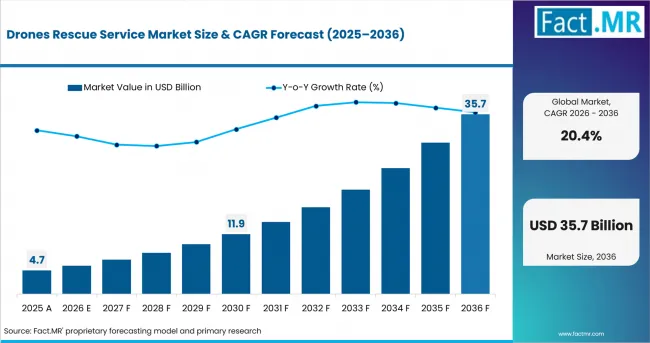
Drones Rescue Service Market Value Analysis | Source: Fact.MR
| Metric | Value |
|---|---|
| Estimated Value in 2026 | USD 5.6 billion |
| Forecast Value in 2036 | USD 35.7 billion |
| Forecast CAGR (2026 to 2036) | 20.4% |
Source: Fact.MR analysis. Updated Jun 2, 2026
Summary of the Drones Rescue Service Market
- Demand Drivers
- Disaster Response Modernization: Emergency agencies are increasing drone deployment across disaster assessment and rapid response operations. Faster situational awareness supports technology adoption.
- Public Safety Investment Growth: Government organizations are increasing spending on aerial emergency response capability. Expanded safety budgets support rescue drone deployment.
- Thermal Detection Expansion: Rescue teams are increasing thermal imaging usage across search operations and night response missions. Improved victim detection supports service demand.
- Key Segments Analyzed
- By Drone Type: Multirotor accounts for 60.0% share in 2026 due to superior maneuverability across rescue environments.
- By End Use: Emergency Response accounts for 40.0% share in 2026 supported by wider deployment across disaster management operations.
- By Application: Search and Rescue accounts for 38.0% share in 2026 attributable to increasing emergency location activity.
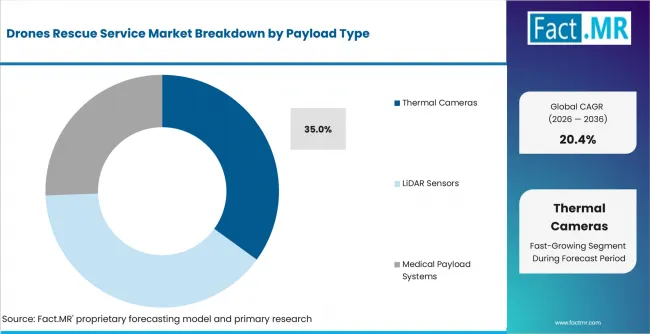
- By Payload Type: Thermal Cameras account for 35.0% share in 2026 due to stronger night detection capability.
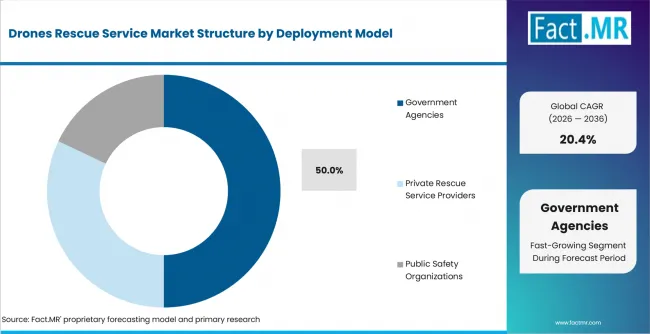
- By Deployment Model: Government Agencies account for 50.0% share in 2026 supported by higher public safety investment.
- By Geography: The United States is projected to record the highest CAGR at 23.5% through 2036 supported by advanced public safety drone deployment programs.
- Analyst Opinion at Fact.MR
- Shambhu Nath Jha, Principal Consultant at Fact.MR, opines, ‘Emergency response organizations are increasing investment in integrated drone networks that combine aerial imaging, thermal detection, and real time communication capability. Faster response execution and improved operational visibility are shaping purchase priorities across rescue operations.’
- Strategic Implications
- Drone manufacturers should increase thermal imaging integration across emergency response platforms. Improved detection capability supports deployment growth.
- Rescue technology providers should strengthen partnerships with public safety agencies. Long term contracts improve deployment visibility.
- Service operators should expand training programs across developing emergency management markets. Operational readiness supports technology adoption.
The market is projected to create nearly USD 30.1 billion in additional revenue between 2026 and 2036. Growth is supported by rising disaster response requirements and wider deployment of aerial emergency assessment systems. Adoption is constrained by aviation compliance requirements and operational limitations across restricted airspace environments.
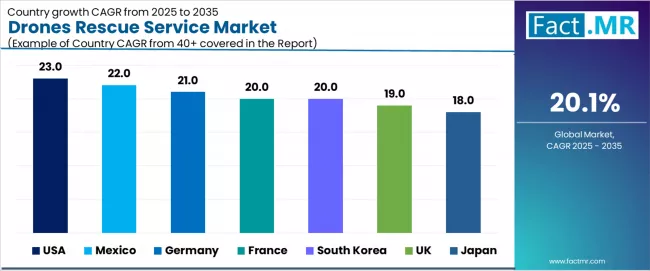
The United States is projected to expand at 23.5% CAGR through 2036 supported by public safety drone deployment programs. Mexico is forecast to grow at 22.8% CAGR due to increasing disaster response modernization. Germany is estimated to witness 21.4% CAGR supported by emergency management digitization initiatives. South Korea is likely to register 21.0% CAGR driven by smart city safety infrastructure investment. France is anticipated to expand at 20.9% CAGR due to public sector emergency response technology adoption. Japan is projected to record 19.8% CAGR supported by disaster preparedness programs and aerial monitoring investment.
Segmental Analysis
Drones Rescue Service Market Analysis by Drone Type
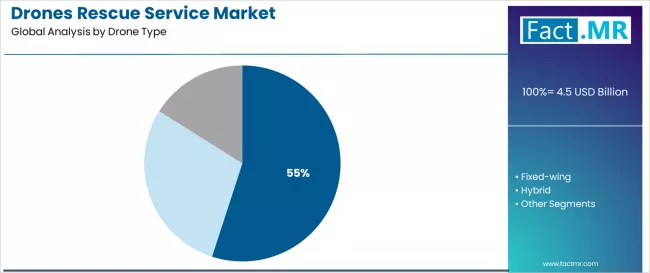
Drones Rescue Service Market Analysis By Drone Type | Source: Fact.MR
- Multirotor drones is estimated to hold 60.0% share in 2026. The segment accounts for leading share due to superior maneuverability and stronger suitability for search and rescue operations across complex environments. Draganfly signed a UAV solutions partnership with Squamish Search and Rescue to deploy drones for wilderness rescue, inland water rescue, and emergency response missions. [1] The collaboration focuses on improving lifesaving operations through advanced UAV-based search and rescue technologies.
- Emergency Response Expansion: Public safety agencies are increasing multirotor drone deployment across disaster response and search operations. Faster aerial access supports rescue efficiency.
- Flight Technology Development: Drone manufacturers are increasing autonomous navigation capability across rescue platforms. Improved operational control supports emergency mission performance.
- Rescue Mission Growth: Emergency management organizations are increasing aerial response activity across flood and wildfire incidents. Higher deployment frequency supports segment demand.
Drones Rescue Service Market Analysis by End Use
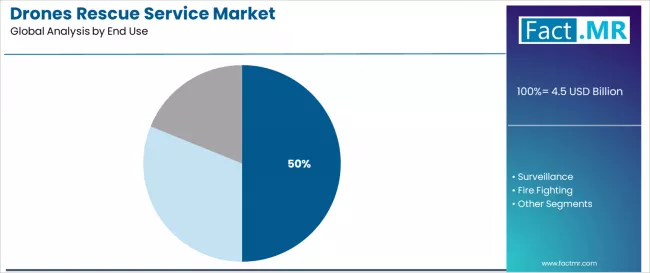
Drones Rescue Service Market Analysis By End Use | Source: Fact.MR
- Emergency response is estimated to account for 40.0% share in 2026. The segment reflects higher deployment across disaster management and medical emergency operations. Rapid situational awareness improves resource allocation during critical incidents. DJI launched DJI Dock 3 in February 2025, a “Drone in a Box” enterprise platform supporting 24/7 remote emergency response, search and rescue, and public safety drone operations. [2] The system integrates Matrice 4D and 4TD drones for autonomous rescue deployment.
- Disaster Management Demand: Emergency agencies are increasing drone deployment across earthquake and flood response operations. Faster damage assessment supports adoption.
- Medical Response Expansion: Public safety organizations are increasing aerial support across emergency healthcare delivery missions. Response time reduction supports demand.
- Crisis Monitoring Growth: Rescue authorities are increasing drone usage across large scale incident management operations. Operational visibility improves coordination efficiency.
Drones Rescue Service Market Analysis by Application
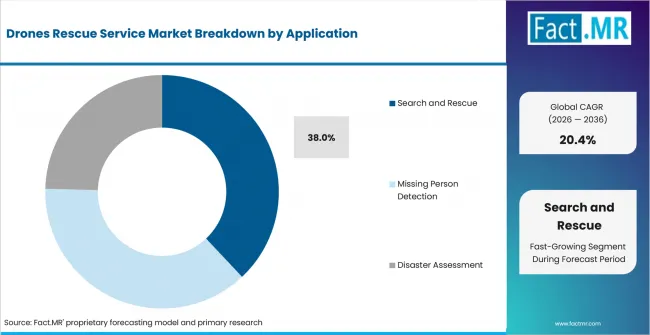
Drones Rescue Service Market Analysis By Application | Source: Fact.MR
- Search and rescue is projected to register 38.0% share in 2026. The segment accounts for higher share due to increasing drone deployment across rapid response and emergency location operations. Thermal imaging capability improves search effectiveness across challenging terrain. Parsons Corporation introduced the BlueFly search-and-rescue sensor platform in 2025 to help emergency responders locate victims faster using Bluetooth low-energy detection and drone-based situational awareness systems. [3]
- Missing Person Detection: Rescue organizations are increasing aerial search deployment across wilderness and remote area operations. Faster location capability supports demand.
- Disaster Assessment Activity: Emergency response teams are increasing drone usage across post disaster evaluation missions. Real time imagery improves operational planning.
- Night Operation Expansion: Search agencies are increasing thermal camera deployment across low visibility rescue environments. Enhanced detection capability supports mission success.
Drones Rescue Service Market Analysis by Payload Type
Drones Rescue Service Market Analysis By Payload Type | Source: Fact.MR
- Thermal cameras are estimated to account for 35.0% share in 2026. The segment reflects stronger demand for victim detection and night operation support across rescue missions. Thermal imaging improves response capability across difficult environmental conditions.
- Thermal Imaging Adoption: Rescue service providers are increasing thermal sensor integration across emergency response platforms. Improved target identification supports deployment growth.
- Detection Capability Enhancement: Public safety agencies are increasing investment in advanced imaging payloads. Operational effectiveness supports technology demand.
- Wildfire Response Demand: Emergency teams are increasing thermal imaging usage across fire monitoring and rescue operations. Hazard assessment capability strengthens adoption.
Drones Rescue Service Market Analysis by Deployment Model
Drones Rescue Service Market Analysis By Deployment Model | Source: Fact.MR
- Government agencies are estimated to capture 50.0% share in 2026. The segment accounts for leading share due to higher investment across disaster response and public safety operations. National emergency preparedness programs support deployment activity. ZenaTech announced that its ZenaDrone subsidiary started testing the IQ Square drone for public safety, emergency response, and search-and-rescue operations in 2025. [4] The drone supports aerial surveillance, thermal imaging, and rapid situational awareness to improve rescue efficiency and first responder operations.
- Public Safety Investment: Government organizations are increasing spending on aerial emergency response infrastructure. Budget allocation supports market expansion.
- Disaster Preparedness Programs: Emergency management authorities are increasing rescue drone sourcing across regional response networks. Preparedness initiatives support demand.
- Humanitarian Coordination Growth: Public agencies are increasing drone deployment across disaster relief and humanitarian support missions. Operational efficiency improves adoption.
Drivers, Restraints, and Opportunities
Drones Rescue Service Market Opportunity Matrix Growth Vs Value | Source: Fact.MR
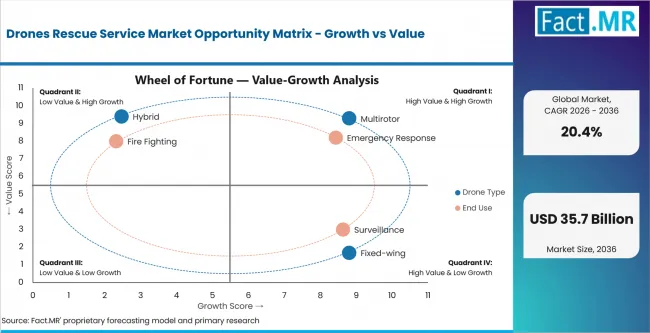
- Drone rescue service market is expanding through rising emergency response requirements and public safety modernization initiatives. Demand is concentrated in disaster management operations and search missions requiring rapid situational awareness. Wrap Technologies launched its next-generation Drone First Responder-X (DFR-X) system in 2025 to enhance emergency response and rescue operations through drone-based rapid deployment and situational awareness. [5] The platform integrates advanced aerial monitoring and non-lethal response capabilities to support first responders during public safety and rescue missions.
- Emergency response agencies are seeking faster assessment capability across disaster affected environments. Drone deployment reduces response delays and improves operational visibility across large incident areas.
- Disaster Response Investment: Governments are increasing emergency management budgets across flood response and disaster preparedness programs. Public safety modernization supports deployment growth across major regions.
- Search Efficiency Enhancement: Rescue organizations are increasing drone integration across search and location operations. Thermal imaging capability improves mission effectiveness across remote environments.
- Humanitarian Service Expansion: Relief agencies are increasing aerial assessment deployment across disaster recovery operations. Faster damage evaluation creates new opportunities for rescue drone services.
Regional Analysis
The drones rescue service market is assessed across North America, Europe, Asia Pacific, Latin America, and the Middle East and Africa by drone type, end use, application, payload type, and deployment model. The full report offers market analysis by region and country.
.webp "Top Country Growth Comparison Drones Rescue Service Market Cagr (2026 2036)")
Top Country Growth Comparison Drones Rescue Service Market Cagr (2026 2036) | Source: Fact.MR
| Country | CAGR (2026 to 2036) |
|---|---|
| United States | 23.5% |
| Mexico | 22.8% |
| Germany | 21.4% |
| South Korea | 21.0% |
| France | 20.9% |
| Japan | 19.8% |
Source: Fact.MR analysis. Updated Jun 2, 2026
Source: Fact.MR analysis, based on proprietary forecasting model and primary research
Drones Rescue Service Market Cagr Analysis By Country | Source: Fact.MR
North America Drones Rescue Service Market Analysis
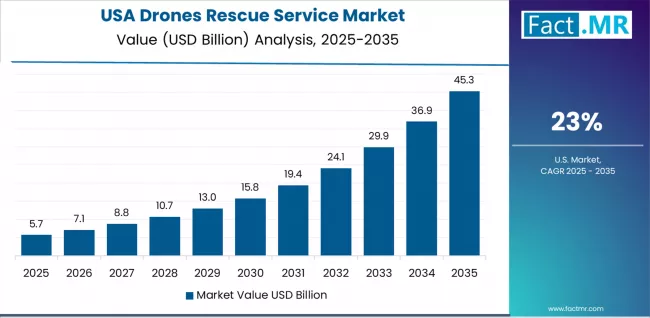
Drones Rescue Service Market Country Value Analysis | Source: Fact.MR
- North America represents the advanced emergency drone deployment center for public safety and disaster response operations. DJI, Skydio, and DroneSense maintain strong positioning through integrated aerial response capability and emergency management software solutions.
- United States: Demand for drones rescue services in the United States is projected to rise at 23.5% CAGR. Public safety agencies are increasing drone deployment across search operations and disaster response programs. Emergency management departments are adopting aerial assessment systems to improve response speed during floods and wildfires.
Latin America Drones Rescue Service Market Analysis
- Latin America represents an emerging disaster response technology market supported by increasing climate resilience investment and emergency preparedness initiatives. Public safety agencies are expanding drone integration across disaster assessment and rescue operations.
- Mexico: Mexico is projected to expand at 22.8% CAGR supported by rising disaster management modernization and emergency response investment. Rescue organizations are increasing aerial monitoring capability across flood and earthquake assessment missions. Public authorities are adopting drone technology to improve operational coordination during large scale emergencies.
Europe Drones Rescue Service Market Analysis
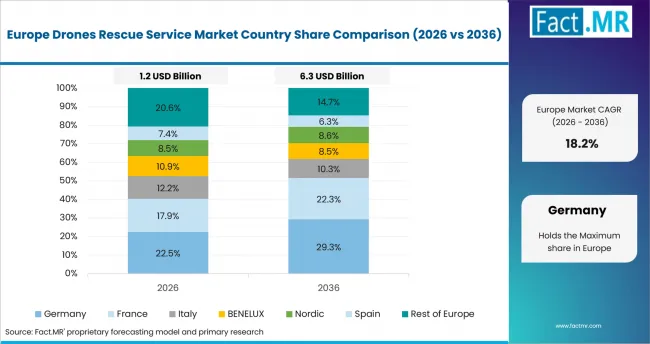
Drones Rescue Service Market Europe Country Market Share Analysis, 2026 & 2036 | Source: Fact.MR
- Europe represents the public safety technology development center for rescue drone deployment and emergency response innovation. DJI, Parrot, and Flyability maintain competitive positioning through inspection capability and advanced aerial imaging solutions. Public sector digitization supports stronger regional demand.
- Germany: Germany is estimated to witness 21.4% CAGR supported by emergency management digitization and disaster preparedness planning. Public authorities are increasing drone integration across rescue coordination and infrastructure incident response activities. Advanced public safety frameworks support wider deployment across regional emergency services. Technology investment strengthens adoption across government organizations.
- France: France is likely to register 20.9% CAGR by 2036 due to rising public sector investment in emergency response technology. Rescue authorities are increasing aerial monitoring deployment across disaster assessment operations. National safety modernization initiatives support wider use of drone enabled response systems.
Asia Pacific Drones Rescue Service Market Analysis
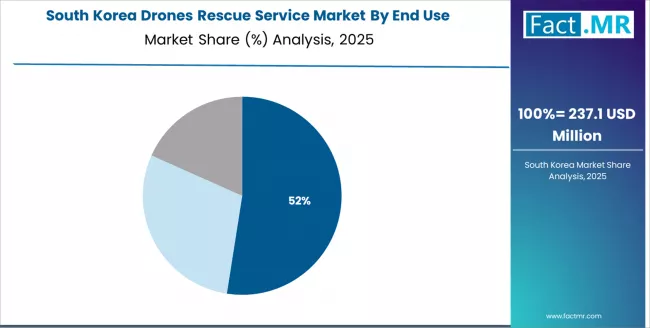
Drones Rescue Service Market South Korea Market Share Analysis By End Use | Source: Fact.MR
- Asia Pacific represents a major technology adoption center for emergency response drones and aerial rescue systems. Domestic drone manufacturers and public safety organizations are increasing investment across disaster management applications.
- South Korea: South Korea is projected to expand at 21.0% CAGR through 2036 attributable to smart city safety investment and advanced emergency response infrastructure. Public agencies are increasing drone deployment across urban monitoring and rescue assessment operations. Digital public safety programs support integration of aerial response systems. Technology driven emergency management supports long term growth.
- Japan: Japan is projected to record 19.8% CAGR by 2036 driven by disaster preparedness programs and emergency monitoring investment. Rescue organizations are increasing drone deployment across earthquake and weather-related response operations. Strong focus on operational readiness supports wider adoption of aerial assessment technologies. Emergency planning frameworks support recurring investment activity.
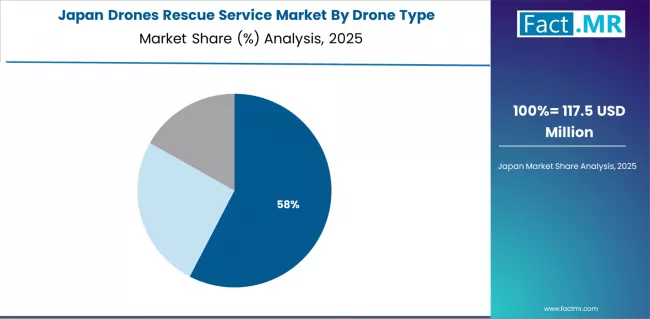
Drones Rescue Service Market Japan Market Share Analysis By Drone Type | Source: Fact.MR
Competitive Aligners for Market Players
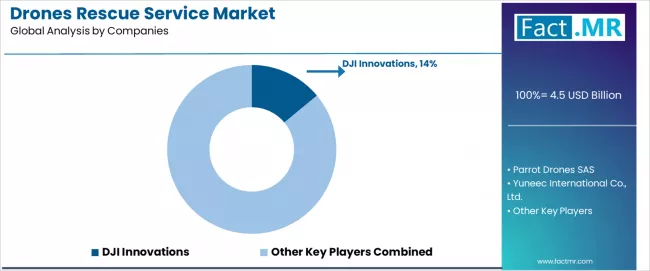
Drones Rescue Service Market Analysis By Company | Source: Fact.MR
- The drones rescue service market is moderately concentrated around established drone manufacturers and emergency response technology providers. Imaging capability and operational reliability shape competitive positioning across rescue missions. Companies with integrated software and hardware platforms maintain stronger positioning across public safety contracts.
- Large drone manufacturers benefit from established production capability and broad technology portfolios. Public safety organizations prefer suppliers that combine aerial imaging, thermal detection, and mission management functionality. Product reliability influences supplier selection across emergency response operations.
- Government agencies increasingly prefer long term technology partnerships to improve deployment consistency and operational readiness. Rescue authorities favor vendors with training capability and technical support infrastructure. Service quality influences contract renewals across public sector organizations. Competition is shifting toward autonomous response systems and AI assisted emergency assessment. Technology providers are increasing investment in advanced analytics and automated mission planning capability. Companies with stronger software ecosystems and emergency workflow integration maintain higher differentiation.
Key Players
- DJI Technology Co., Ltd.
- Skydio, Inc.
- Parrot SA
- Autel Robotics Co., Ltd.
- DroneSense, Inc.
Bibliography
- Draganfly Inc.. (2024). Squamish Search and Rescue selects Draganfly as UAV solutions provider to support lifesaving emergency response operations.
- DroneXL. (2025). DJI launches Dock 3 and Matrice 4D series to support autonomous drone deployment and remote emergency response missions.
- Parsons Corporation. (2025). Parsons Corporation launches BlueFly autonomous drone platform for public safety and emergency response applications.
- ZenaTech, Inc.. (2025). ZenaDrone commences testing of IQ Square drone platform for public safety and emergency response operations.
- WRAP Technologies, Inc.. (2025). WRAP launches next-generation Drone as First Responder platform to improve emergency response capability and public safety operations.
This Report Addresses
- Analysis of drones rescue service demand across drone platforms, rescue applications, payload systems, and deployment models.
- Market forecast from USD 5.6 billion in 2026 to USD 35.7 billion by 2036 at 20.4% CAGR.
- Growth opportunity assessment across public safety agencies, humanitarian organizations, and emergency management departments.
- Segment analysis covering drone type, application, payload type, and deployment model with 2026 benchmarks.
- Regional forecast analysis across the United States, Mexico, Germany, France, South Korea, and Japan.
- Competitive assessment of DJI, Skydio, DroneSense, AeroVironment, Flyability, and other technology providers.
- Technology tracking covering thermal imaging systems, autonomous flight capability, and emergency communication payloads.
- Report coverage is supported by primary interviews and deployment analysis.
Drones Rescue Service Market Definition
The drones rescue service market covers unmanned aerial systems and associated emergency response services used for search operations, disaster assessment, fire response, medical delivery, and public safety missions. These systems provide aerial imaging, thermal detection, communication support, and rapid situational awareness across emergency environments.
Drones Rescue Service Market Inclusions
The study covers global and regional forecasts from 2026 to 2036 by drone type, end use, application, payload type, and deployment model. It includes rescue drone platforms, thermal imaging systems, emergency communication payloads, disaster assessment operations, and aerial response services deployed across public safety and humanitarian missions.
Drones Rescue Service Market Exclusions
The study excludes military combat drones, commercial package delivery drones, agricultural monitoring drones, and industrial inspection drone services. It omits consumer recreational drones and defense surveillance systems unless deployed directly within civilian rescue and emergency response operations.
Drones Rescue Service Market Research Methodology
- Primary Research
- Interviews conducted with emergency management officials, public safety agencies, drone service providers, humanitarian organizations, and rescue technology specialists across major regional markets.
- Desk Research
- Analysis of public safety drone deployment announcements, emergency management publications, aviation authority updates, and rescue technology developments released during 2024 and 2025.
- Market-Sizing and Forecasting
- Hybrid top-down and bottom-up model using emergency response spending, drone deployment rates, disaster management budgets, and public safety technology investment analysis.
- Data Validation and Update Cycle
- Validated through agency deployment records, public safety purchase disclosures, emergency response program assessments, and annual technology adoption reviews.
Segmentation
Scope of the Report
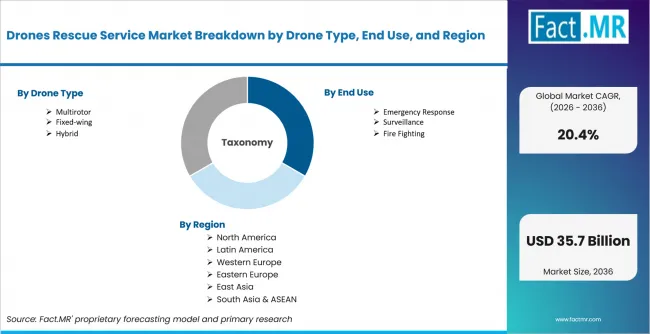
Drones Rescue Service Market Breakdown By Drone Type, End Use, And Region | Source: Fact.MR
| Attribute | Details |
|---|---|
| Quantitative Units | USD 5.6 billion (2026) to USD 35.7 billion (2036) at a CAGR of 20.4% |
| Market Definition | Drone based rescue services used across emergency response, disaster assessment, search operations, and public safety missions |
| Drone Type Segmentation | Multirotor, Fixed-wing, Hybrid |
| End Use Segmentation | Emergency Response, Surveillance, Fire Fighting |
| Application Segmentation | Search and Rescue, Missing Person Detection, Disaster Assessment, Medical Supply Delivery, Flood Response |
| Payload Type Segmentation | Imaging Cameras, Thermal Cameras, LiDAR Sensors, Medical Payload Systems, Communication Equipment |
| Deployment Model Segmentation | Government Agencies, Private Rescue Service Providers, Public Safety Organizations, Humanitarian Organizations |
| Regions Covered | North America, Europe, Asia Pacific, Latin America, Middle East and Africa |
| Countries Covered | United States, Canada, Mexico, Germany, France, United Kingdom, China, Japan, South Korea, India, ASEAN, Australia and New Zealand, Brazil, Saudi Arabia, UAE, South Africa |
| Key Companies Profiled | DJI Technology Co., Ltd., Skydio, Inc., Parrot SA, Autel Robotics Co., Ltd., DroneSense, Inc. |
| Forecast Period | 2026 to 2036 |
| Approach | Hybrid top-down and bottom-up model using emergency response spending, public safety budgets, and drone deployment analysis. |
Source: Fact.MR analysis. Updated Jun 2, 2026
Drones Rescue Service Market by Segment
-
By Drone Type
- Multirotor
- Fixed-wing
- Hybrid
-
By End Use
- Emergency Response
- Surveillance
- Fire Fighting
-
By Application
- Search and Rescue
- Missing Person Detection
- Disaster Assessment
- Medical Supply Delivery
- Flood Response
-
By Payload Type
- Imaging Cameras
- Thermal Cameras
- LiDAR Sensors
- Medical Payload Systems
- Communication Equipment
-
By Deployment Model
- Government Agencies
- Private Rescue Service Providers
- Public Safety Organizations
- Humanitarian Organizations
-
By Region
- North America
- United States
- Canada
- Mexico
- Latin America
- Brazil
- Argentina
- Colombia
- Rest of Latin America
- Western Europe
- Germany
- United Kingdom
- France
- Italy
- Spain
- Netherlands
- Nordic Countries
- BENELUX
- Rest of Western Europe
- East Asia
- China
- Japan
- South Korea
- South Asia and Pacific
- India
- ASEAN
- Australia and New Zealand
- Rest of South Asia and Pacific
- Middle East and Africa
- Kingdom of Saudi Arabia
- Other GCC Countries
- Turkey
- South Africa
- Rest of Middle East and Africa
- North America
Frequently Asked Questions
How big is the drones rescue service market in 2025?
What will be the size of drones rescue service market in 2035?
How much will be the drones rescue service market growth between 2025 and 2035?
What are the key product types in the drones rescue service market?
Which end use segment to contribute significant share in the drones rescue service market in 2025?
Who worked on this report


Preview the report firsthand - request a free sample
Free SampleGet the brochure for pricing and purchase details
Download PDF