- Base Value(2026): 3.2 Bn
- Forecast Value (2036): 6.2 Bn
- CAGR (2036): 6.9%
Regenerating Hair Masks Market Forecast and Outlook 2026 to 2036
Regenerating hair masks market is likely to be valued at USD 3.2 billion in 2026 and is projected to reach USD 6.2 billion by 2036, reflecting a 6.9% CAGR, according to Fact.MR analysis.
Regenerating Hair Masks Market Key Takeaways
- Regenerating Hair Masks Market Value (2026): USD 3.2 billion
- Regenerating Hair Masks Forecast Value (2036): USD 6.2 billion
- Regenerating Hair Masks Forecast CAGR (2026-2036): 6.9%
- Regenerating Hair Masks Leading Ingredient Type: Natural & Organic Ingredients (43%)
- Regenerating Hair Masks Key Growth Regions: China, India, Germany, Brazil, USA
- Regenerating Hair Masks Top Players: L’Oréal S.A., Unilever plc, Procter & Gamble, Estée Lauder Companies Inc., Shiseido Company Limited, Henkel AG & Co. KGaA, Coty Inc., Kao Corporation
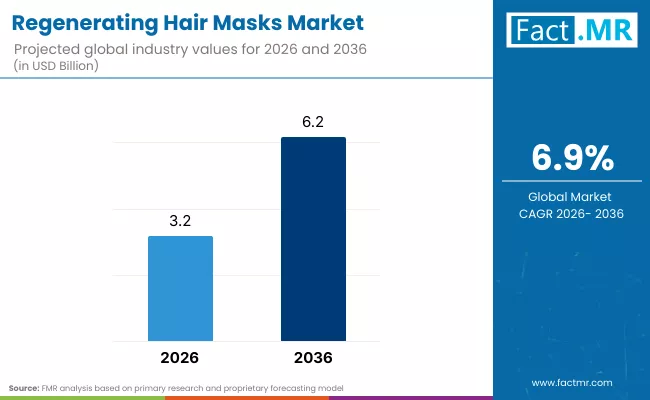
Regenerating Hair Masks Market By Industry | Source: Fact.MR
Market growth is being shaped by the increasing emphasis on scalp and hair fiber health, driving adoption of formulations designed to enhance strength, manageability, and resilience across diverse consumer segments. Operational priorities focus on scalable production processes, reproducible ingredient performance, and packaging solutions that preserve efficacy throughout distribution networks.
Supply chain alignment and multi-channel strategies, including mass retail and professional salons, support predictable inventory turnover and consistent product delivery. Competitive differentiation arises from leaders investing in scientific innovation and standardized formulation protocols, while regional players address localized hair concerns. Evidence indicates that efficient logistics, quality assurance, and consistent performance are central to accelerated adoption. The market trajectory demonstrates a structural shift toward operationally robust, high-performance hair care solutions that deliver measurable consumer benefit and supply chain reliability at scale.
Regenerating Hair Masks Market
| Metric | Value |
|---|---|
| Market Value (2026) | USD 3.2 billion |
| Forecast Value (2036) | USD 6.2 billion |
| Forecast CAGR (2026-2036) | 6.9% |
Source: Fact.MR analysis. Updated Feb 5, 2026
Category
| Category | Segments |
|---|---|
| Ingredient Type | Natural & organic ingredients; Synthetic ingredients; Botanical extracts; Protein & amino acid based |
| Hair Type | Dry & damaged hair; Colored & treated hair; Curly & wavy hair; Normal hair |
| Distribution Channel | Online retail; Supermarkets & hypermarkets; Specialty beauty stores; Pharmacy & drug stores |
| Region | North America; Europe; Asia Pacific; Latin America; Middle East & Africa |
Source: Fact.MR analysis. Updated Feb 5, 2026
Segmental Analysis
By Ingredient Type, Why Do Natural and Organic Ingredients Lead the Market?
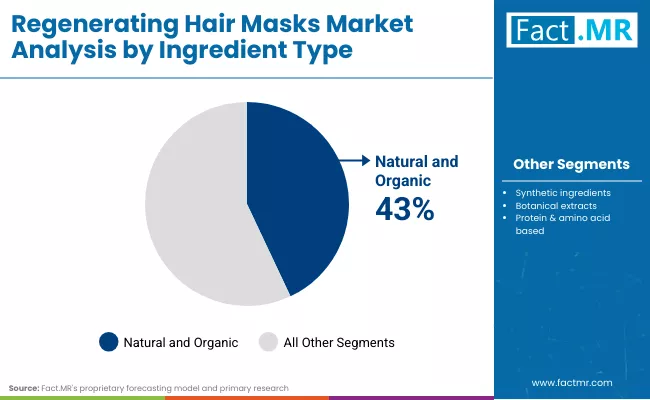
Regenerating Hair Masks Market By Ingredient Type | Source: Fact.MR
Natural and organic ingredients lead the market with 43% share, reflecting consistent adoption across retail, e-commerce, and salon channels where repeat purchasing drives predictable demand. Market growth is shaped by high-frequency replenishment cycles, multi-channel distribution, and operational efficiency that support scalable logistics and inventory management. Suppliers benefit from repeatable production and standardized supply chain workflows. Segment prominence arises from structural market drivers such as recurring demand, channel penetration, and procurement predictability rather than the specific characteristics of individual ingredients. Market adoption is determined by workflow integration, high turnover, and reliable supply patterns.
By Hair Type, Why Do Dry and Damaged Hair Consumers Represent the Largest Segment?
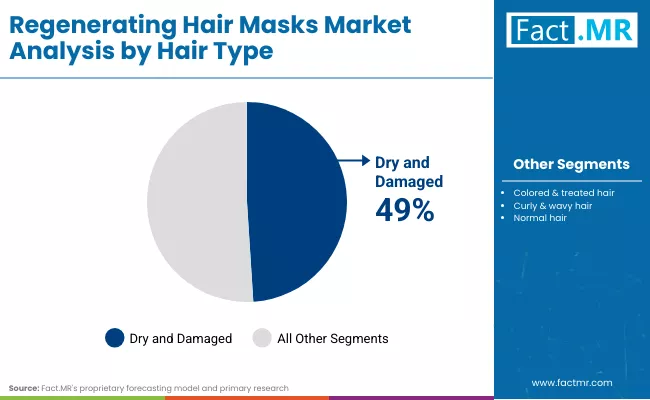
Regenerating Hair Masks Market By Hair Type | Source: Fact.MR
Dry and damaged hair accounts for 49% share, reflecting the largest consumer demographic with frequent, repeatable purchasing behavior. Market demand is concentrated in channels that support predictable replenishment, multi-outlet distribution, and inventory standardization. Suppliers benefit from recurring orders, scalable production, and streamlined logistics. Segment prominence is defined by structural market factors such as consumption frequency, channel coverage, and operational repeatability rather than hair-specific formulation features. Adoption is guided by repeatable demand patterns and distribution efficiency, making dry and damaged hair the central driver of overall market activity.
Country/Region
| Country/Region | Driver | Restraint | Trend |
|---|---|---|---|
| USA | Rising demand for repair and anti-breakage hair care → drives premium regenerating hair mask launches | FDA MoCRA 2026 cGMP and safety substantiation → increases compliance costs for smaller brands | Growth of dermatologist-tested, high-efficacy hair masks for damaged hair |
| India | Urbanization and e-commerce adoption → accelerates penetration of regenerating hair masks | Supply chain and regulatory reporting challenges → slow rollout for smaller brands | Rapid expansion of online-ready, professional-grade regenerating hair masks |
| Brazil | Demand for natural-origin and locally sourced conditioning actives → drives differentiated product launches | Import and ingredient restrictions → increase formulation costs | Growth of locally sourced, sustainable regenerating hair mask products |
| China | Rising middle-class concern for hair health → fuels premium regenerating mask launches | GMP tightening → delays approvals for new formulations | Expansion of automated testing for conditioning efficacy and product safety |
Source: Fact.MR analysis. Updated Feb 5, 2026
Analysis of the Regenerating Hair Masks Market by Key Country
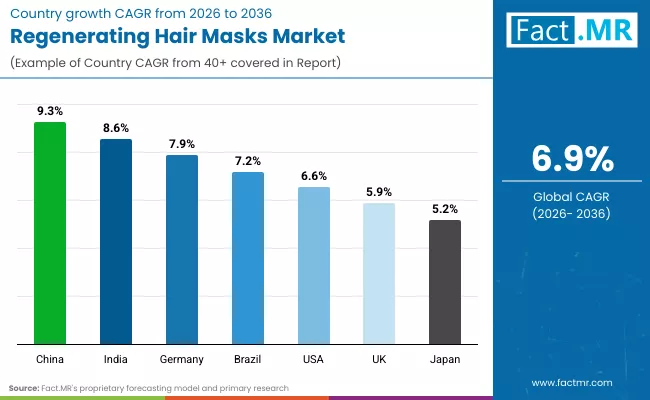
Regenerating Hair Masks Market By Country | Source: Fact.MR
| Country | CAGR (2026-2036) |
|---|---|
| China | 9.3% |
| India | 8.6% |
| Germany | 7.9% |
| Brazil | 7.2% |
| USA | 6.6% |
| UK | 5.9% |
| Japan | 5.2% |
Source: Fact.MR analysis. Updated Feb 5, 2026
The report covers an in-depth analysis of 40+ countries; top-performing countries are highlighted below.
How Is Demand for Regenerating Hair Masks Growing in China?
Demand for regenerating hair masks in China grows at 9.3% CAGR through 2036. Urban consumers increasingly seek products that repair hair damage while improving strength, shine, and manageability. E-commerce platforms and social media campaigns accelerate awareness, trial, and repeat purchases. Manufacturers invest in high-performance formulations, incorporating actives such as keratin and botanical extracts. Operational focus emphasizes regional distribution efficiency, inventory management, and supply chain responsiveness. Premium and mid-tier segments show rapid adoption due to functional benefits. Consumer education highlights hair repair efficacy, while digital traceability ensures product quality. Growth reflects the integration of restorative haircare into daily beauty routines across urban and semi-urban populations.
What Is the Growth in Adoption of Regenerating Hair Masks in India?
Growth in adoption of regenerating hair masks in India reaches 8.6% CAGR through 2036. Rising urbanization, disposable incomes, and awareness of hair health support demand for functional restorative products. Retail modernization and e-commerce penetration improve accessibility and replenishment cycles. Manufacturers tailor formulations to local hair types and climate conditions while ensuring stability and efficacy. Operational improvements focus on regional distribution, quality control, and regulatory compliance. Premium and mid-tier segments drive adoption. Consumer education emphasizes repair, nourishment, and smoothness. Market expansion reflects growing integration of specialized haircare into daily routines and increased preference for functional, results-driven products.
How Is the Regenerating Hair Masks Market Shaping in Germany?
Adoption of regenerating hair masks in Germany grows at 7.9% CAGR through 2036. Consumers prioritize safe, effective, and clinically validated formulations. Retailers allocate shelf space for premium and mass-market restorative haircare products, while online channels expand reach. Operational improvements emphasize quality control, traceable ingredient sourcing, and regulatory alignment. Urban adoption drives premium segment growth, while regional coverage sustains mass-market penetration. Manufacturers invest in formulation innovation and operational standardization to meet consumer expectations. Market expansion is steady, reflecting the combination of functional efficacy, reliability, and consumer trust in validated restorative haircare solutions.
What Is the Outlook on Regenerating Hair Masks in Brazil?
Outlook on regenerating hair masks in Brazil grows at 7.2% CAGR through 2036. Climate and humidity influence hair damage and frizz, increasing demand for restorative masks. Urban retail and specialty stores offer curated assortments with premium and mid-tier offerings. Manufacturers optimize formulations for hydration, repair, and manageability, and operational improvements focus on supply chain efficiency and inventory reliability. Marketing emphasizes functional benefits and visible results. Adoption is strongest in metropolitan and coastal regions. Market growth is supported by rising consumer awareness of hair care needs, premiumization trends, and reliable distribution networks that maintain product availability.
How Is the Regenerating Hair Masks Market Growing in the United States?
Growth in the regenerating hair masks market in the United States reaches 6.6% CAGR through 2036. Consumers integrate hair repair and nourishment products into daily routines to improve strength, smoothness, and shine. Retailers expand offerings across department stores, specialty shops, and e-commerce channels. Manufacturers focus on formulation consistency, ingredient efficacy, and supply chain reliability. Operational improvements include inventory management and distribution optimization. Urban and suburban adoption supports premium and mid-tier segments. Market expansion reflects consumer preference for functional, high-performance products, where efficacy, safety, and availability are key drivers for repeat purchase and long-term category growth.
What Are the Growth Patterns in the Regenerating Hair Masks Market in the United Kingdom?
Growth patterns in the regenerating hair masks market in the United Kingdom reach 5.9% CAGR through 2036. Consumers seek restorative and nourishing formulations to improve hair texture, manageability, and appearance. Retailers expand assortments in specialty stores and online channels to meet urban demand. Operational improvements focus on consistent quality, supply chain efficiency, and regulatory compliance. Premium urban segments drive adoption, while mid-tier products sustain broader market coverage. Marketing emphasizes functional efficacy and visible results. Market growth is gradual yet steady, reflecting informed consumer preference for high-quality, effective haircare solutions integrated into daily routines.
How Is the Regenerating Hair Masks Market Developing in Japan?
Outlook on the regenerating hair masks market in Japan grows at 5.2% CAGR through 2036. Consumers prioritize gentle, effective, and restorative formulations for damaged or chemically treated hair. Urban retail, specialty stores, and e-commerce channels feature curated product lines highlighting hydration, repair, and strength. Operational improvements focus on formulation consistency, quality assurance, and supply chain reliability. Premium segments lead adoption, supported by informed consumer awareness of hair wellness. Market growth is measured, reflecting cautious but consistent uptake in a mature market, where functional efficacy, visible results, and product safety determine long-term adoption and brand preference.
How Are Clinical Validation, Supply Integration, and Performance Consistency Defining Competitive Moats in the Regenerating Hair Masks Market?
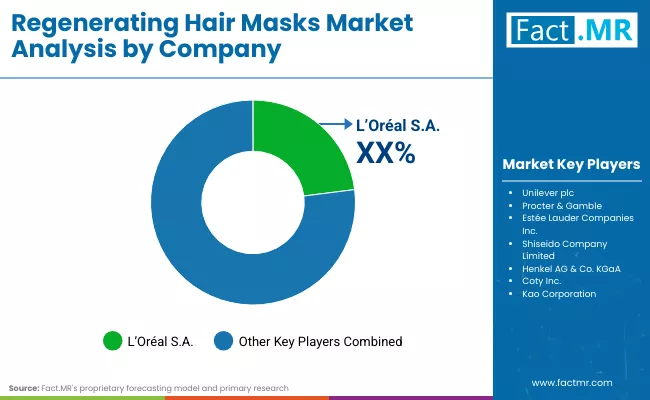
Regenerating Hair Masks Market By Company | Source: Fact.MR
As per Fact.MR analysis, the regenerating hair masks market in 2026 has shifted from simple moisture claims to clinically substantiated repair outcomes, where validated efficacy, regulatory compliance, and deep distribution networks determine competitive advantage. L’Oréal and Estée Lauder emphasise advanced repair science supported by laboratory‑verified protein and lipid replenishment systems, which strengthens their presence in professional and premium channels. Unilever and Procter & Gamble scale clinically proven regeneration technologies across broad portfolios, which expands penetration into mass‑market and emerging regions while maintaining consistent performance. Shiseido integrates multi‑step hair care regimens that include regenerative masks, which increases basket value and repeat purchase. Henkel balances professional salon adoption with retail availability, which enhances cross‑channel influence. Coty and Kao Corporation focus on formulation stability and sensory performance, which increases consumer satisfaction and reduces return rates. Together, performance validation, supply continuity, and integrated distribution form competitive moats, reducing reliance on superficial claims or single‑ingredient positioning.
Key Players in Regenerating Hair Masks Market
- L’Oréal S.A.
- Unilever plc
- Procter & Gamble
- Estée Lauder Companies Inc.
- Shiseido Company Limited
- Henkel AG & Co. KGaA
- Coty Inc.
- Kao Corporation
References
- U.S. Food and Drug Administration. (2023). Current good manufacturing practice (CGMP) regulations for cosmetics (Proposed rule). Federal Register.
- Scientific Committee on Consumer Safety (SCCS). (2023). Guidance on the safety assessment of cosmetic ingredients (12th revision). European Commission.
- Organisation for Economic Co-operation and Development. (2023). Guidance on consumer exposure assessment (Series on Testing and Assessment No. 203). OECD Publishing.
- Health Canada. (2024). Cosmetic Regulations (C.R.C., c. 869) and Cosmetic Ingredient Hotlist. Government of Canada.
Segmentation
Scope of the Report
| Items | Values |
|---|---|
| Quantitative Units (2026) | USD billion |
| Ingredient Type | Natural & organic ingredients, Synthetic ingredients, Botanical extracts, Protein & amino acid based |
| Hair Type | Dry & damaged hair, Colored & treated hair, Curly & wavy hair, Normal hair |
| Distribution Channel | Online retail, Supermarkets & hypermarkets, Specialty beauty stores, Pharmacy & drug stores |
| Region | Asia Pacific, North America, Europe, Latin America, Middle East & Africa |
| Countries Covered | China, Japan, South Korea, India, Australia & New Zealand, ASEAN, Rest of Asia Pacific, Germany, UK, France, Italy, Spain, Nordic, BENELUX, Rest of Europe, USA, Canada, Mexico, Brazil, Chile, Rest of Latin America, KSA, Other GCC, Turkey, South Africa, Other African Union, Rest of MEA |
| Key Companies Profiled | L’Oréal S.A., Unilever plc, Procter & Gamble, Estée Lauder Companies Inc., Shiseido Company Limited, Henkel AG & Co. KGaA, Coty Inc., Kao Corporation |
| Additional Attributes | Dollar by sales by ingredient and hair type; validated repair and hydration efficacy; supply chain efficiency; multi-channel availability; repeatable formulation performance; operational scalability; professional salon and retail adoption; e-commerce readiness; consistent texture and sensory quality; regional adaptation; climate-stable formulations; regulatory compliance; high-frequency consumer replenishment. |
Source: Fact.MR analysis. Updated Feb 5, 2026
Regenerating Hair Masks Market Segmentation
-
Ingredient Type :
- Natural & organic ingredients
- Synthetic ingredients
- Botanical extracts
- Protein & amino acid based
-
Hair Type :
- Dry & damaged hair
- Colored & treated hair
- Curly & wavy hair
- Normal hair
-
Distribution Channel :
- Online retail
- Supermarkets & hypermarkets
- Specialty beauty stores
- Pharmacy & drug stores
-
Region :
- Asia Pacific
- China
- Japan
- South Korea
- India
- Australia & New Zealand
- ASEAN
- Rest of Asia Pacific
- Europe
- Germany
- United Kingdom
- France
- Italy
- Spain
- Nordic
- BENELUX
- Rest of Europe
- North America
- United States
- Canada
- Mexico
- Latin America
- Brazil
- Chile
- Rest of Latin America
- Middle East & Africa
- Kingdom of Saudi Arabia
- Other GCC Countries
- Turkey
- South Africa
- Other African Union
- Rest of Middle East & Africa
- Asia Pacific
Frequently Asked Questions
How big is the global regenerating hair masks market in 2026?
What will be the size of the regenerating hair masks market in 2036?
How much will the demand for regenerating hair masks grow between 2026 and 2036?
Which ingredient type holds a significant share in the regenerating hair masks market in 2026?
Which hair type segment leads the regenerating hair masks market in 2026?
Who worked on this report


Preview the report firsthand - request a free sample
Free SampleGet the brochure for pricing and purchase details
Download PDF