Regenerative Agriculture Transition Services Market Size, Share, Growth and Forecast (2026 - 2036)

The Regenerative Agriculture Transition Services Market is segmented by Service Type, by Farm System, by Customer Type, by Delivery Model, by End Use, and Region. Forecast for 2026 to 2036.

What is the regenerative agriculture transition services market forecast to be worth by 2036?

USD 1.5 billion in 2026 to USD 27.5 billion by 2036, at 33.8% CAGR.

  • The regenerative agriculture transition services market surpassed a valuation of USD 1.1 billion in 2025.
  • Demand is expected to increase from USD 1.5 billion in 2026 to USD 27.5 billion by 2036.
  • The market is forecast to record 33.8% CAGR during 2026 to 2036 as food companies fund farmer advisory and verified sourcing programs.
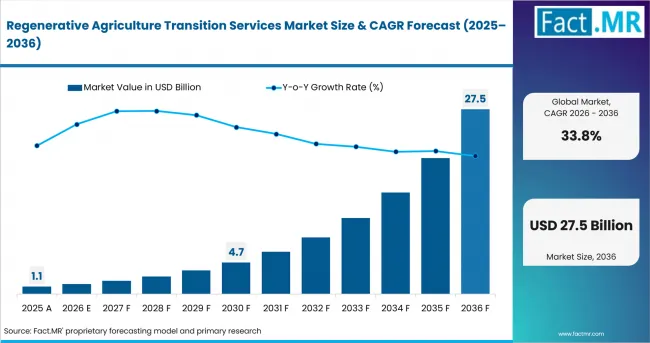
Regenerative Agriculture Transition Services Market Value Analysis

What are the defining numbers behind regenerative agriculture transition services growth?

USD 26.0 billion absolute opportunity by 2036, led by the United States and France.

  • Demand Drivers in the Market
    • Food companies need verified farm practice changes to reduce Scope 3 emissions.
    • Farmers need agronomy support before changing tillage and input systems.
    • Brands need traceable supply chains that can prove soil and biodiversity improvements.
    • Transition platforms need farmer incentives because practice change can create early cost risk.
  • Key Segments Analyzed
    • By Service Type: Agronomy Advisory and Transition Planning is expected to hold 34.0% share in 2026 because practice change starts with farm-level guidance.
    • By Farm System: Row Crop Farms lead because cereals and oilseeds cover large supply chain acreage. The share is projected at 38.0% in 2026.
    • By Customer Type: Food and Beverage Companies lead because Scope 3 targets push brands to fund farm transition. This customer group is likely to account for 42.0% share in 2026.
    • By Delivery Model: Managed Transition Programs lead as brands need one partner to coordinate farmers and incentives. The model is projected to hold 40.0% share in 2026.
    • By End Use: Scope 3 Emissions Reduction is expected to hold 37.0% share in 2026 because food companies need measurable on-farm abatement.
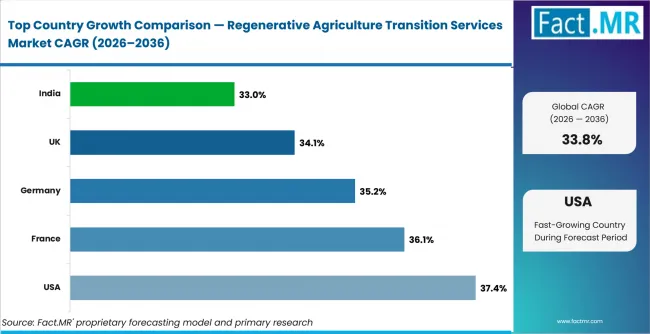
    • By Geography: The United States is projected to record 37.4% CAGR through 2036 as row-crop transition programs and soil-carbon platforms scale.
  • Analyst Opinion at Fact.MR
    • Shambhu Nath Jha, Senior Analyst at Fact.MR, states, “Regenerative agriculture is becoming a transition-services market. We see food companies asking how to move farms from commitments to verified practice change. Providers that combine agronomy and farmer incentives will gain stronger access to Scope 3 and resilient sourcing budgets.”
  • Strategic Implications
    • Food companies should fund farm-level support before asking suppliers to report outcomes.
    • Farmers need clear payments that offset early transition risk and operational complexity.
    • MRV providers should connect field data with brand reporting requirements.
    • Agronomy platforms need regional crop expertise because regenerative practices differ by farm system.

Agronomy advisory and offtake-contract services move farms from conventional to regenerative practice. Nestlé states that it aims for 50% of key ingredients to be sourced from farmers adopting regenerative agriculture practices by 2030. [1] This creates direct demand for farm transition services across dairy and other ingredient supply chains.

The United States is projected to record 37.4% CAGR through 2036 as food majors and soil-carbon platforms scale row-crop transition programs. France will gain from Nestlé and Soil Capital-style partnerships across cereals and sugar beet. The country is expected to post 36.1% CAGR through 2036. Germany is likely to record 35.2% CAGR as EU eco-schemes and food supply chain reporting support adoption. The United Kingdom is forecast to advance at 34.1% CAGR as soil-carbon programs and retailer-led sourcing models expand. India is set to record 33.0% CAGR as food brands and public programs support climate-smart farming transitions.

How does the regenerative agriculture transition services market break down by segment?

Agronomy Advisory and Transition Planning leads at 34.0%; Row Crop Farms lead at 38.0%.

Which service type dominates?

Agronomy Advisory and Transition Planning holds 34.0% share in 2026.
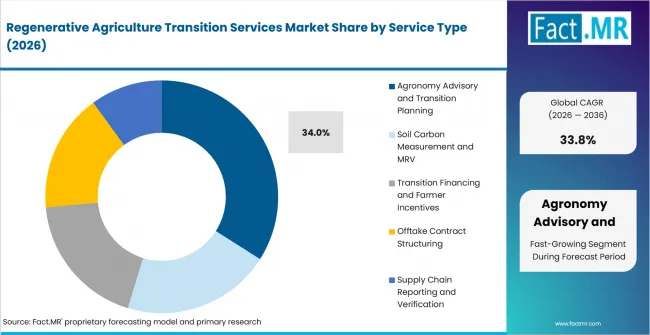
Regenerative Agriculture Transition Services Market Analysis By Service Type

Agronomy Advisory and Transition Planning is expected to hold 34.0% share in 2026 because farmers need practical guidance before changing systems. The work includes baseline review and input reduction pathways. Soil Capital’s Nestlé partnership includes agronomic advice and financial incentives for farmers in France, Belgium and the UK. [2] Advisory leads because farmers need locally relevant transition plans before MRV or incentive payments can work.

Which farm system dominates?

Row Crop Farms lead because cereals and oilseeds cover large supply chain acreage.
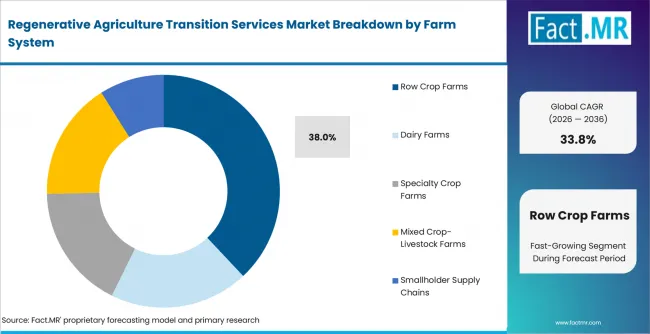
Regenerative Agriculture Transition Services Market Analysis By Farm System

Row Crop Farms lead because wheat and barley are central to large food and beverage supply chains. These farms can support cover crops, reduced tillage and crop rotation across large acreage. The farm system is projected to capture 38.0% share in 2026. PepsiCo’s regenerative agriculture goal covers land supporting key crops and ingredients, which makes row-crop transition programs commercially important. [3]

Which customer type dominates?

Food and Beverage Companies lead because Scope 3 targets push brands to fund farm transition.
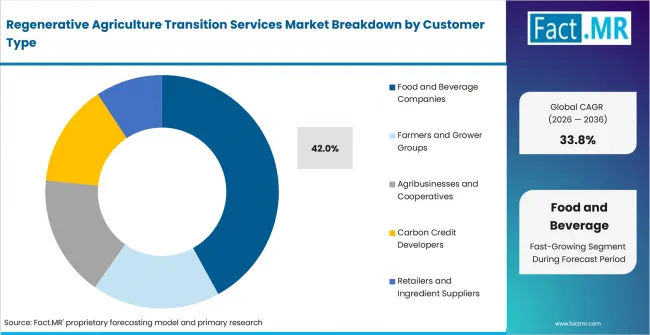
Regenerative Agriculture Transition Services Market Analysis By Customer Type

Food and Beverage Companies lead because most farm-level emissions sit inside upstream supply chains. Nestlé, PepsiCo and Danone-style programs require farmer enrollment, practice tracking and verified progress. This customer type is likely to account for 42.0% share in 2026. Brands fund services because farm transition affects sourcing resilience, emissions accounting and sustainability claims.

Which delivery model dominates?

Managed Transition Programs lead because brands need coordinated farmer support.
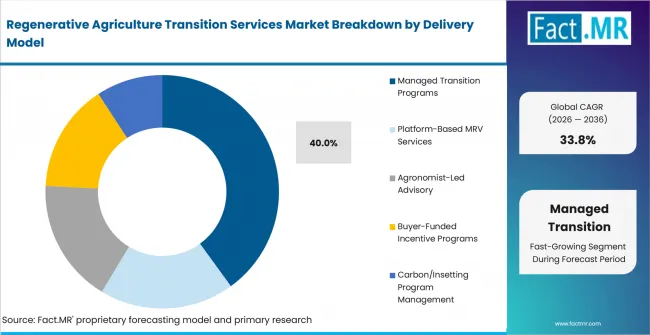
Regenerative Agriculture Transition Services Market Analysis By Delivery Model

Managed Transition Programs lead because food companies need one operating model for agronomy, data, farmer payments and reporting. The model is projected to hold 40.0% share in 2026. Managed programs lead because they reduce complexity for both brands and growers.

Which end use dominates?

Scope 3 Emissions Reduction holds 37.0% share in 2026.
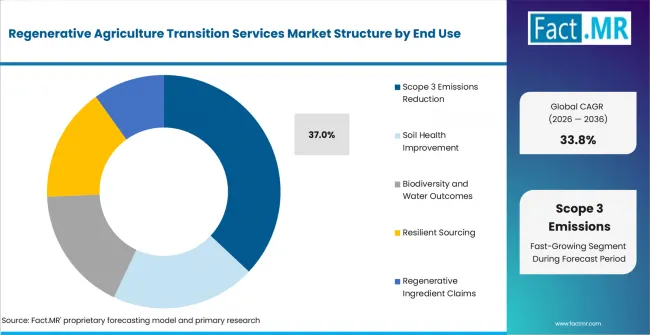
Regenerative Agriculture Transition Services Market Analysis By End Use

Scope 3 Emissions Reduction leads because food companies need measurable on-farm cuts to meet climate targets. The end use is expected to hold 37.0% share in 2026. Demand is strongest among brands that need farm-level proof for reporting and supplier engagement.

What is accelerating regenerative agriculture transition services demand, and what is holding it back?

Food company commitments, EU eco-schemes and soil-carbon MRV drive demand; farmer transition risk restrains adoption.
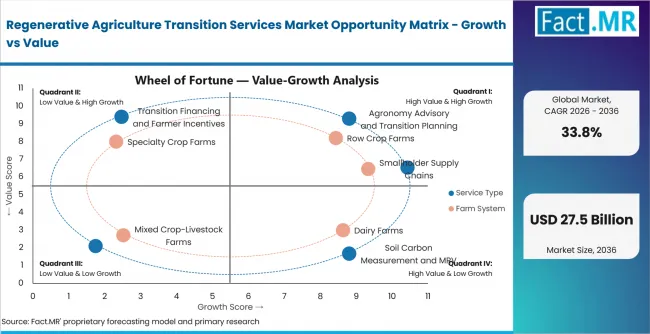
Regenerative Agriculture Transition Services Market Opportunity Matrix Growth Vs Value

Food company commitments are the main driver of demand for regenerative agriculture transition services. Unilever stated in 2024 that it aims to implement regenerative agriculture practices across 1 million hectares by 2030 and works with farmers and implementation partners to create individualized transition plans [4]. Large food brands need support to move supplier farms toward soil health and more traceable sourcing. This creates demand for advisory services and supplier engagement programs.

The main restraint is transition risk for farmers. Practice changes can affect yields and cash flow during early seasons. Measurement rules can also be complex. Service providers must pair agronomy with incentives and clear offtake demand before farmers commit acreage at scale.

Where do the biggest regenerative agriculture transition service opportunities sit?

Agronomy transition planning and farmer incentive programs.

  • Agronomy Transition Planning: Advisers can help farms choose practical regenerative practices for local crops.
  • Soil-Carbon MRV: Platforms can measure field outcomes and support brand reporting.
  • Farmer Incentive Programs: Service firms can structure payments that reduce early transition risk.

Which countries are scaling regenerative agriculture transition services fastest?

United States 37.4%, France 36.1%, Germany 35.2%, United Kingdom 34.1%, India 33.0%.

Based on regional analysis, the regenerative agriculture transition services market is segmented into North America, Western Europe, South Asia, Latin America, East Asia, and Middle East and Africa.

Top Country Growth Comparison Regenerative Agriculture Transition Services Market Cagr (2026 2036)

Country CAGR
United States 37.4%
France 36.1%
Germany 35.2%
United Kingdom 34.1%
India 33.0%

Regenerative Agriculture Transition Services Market Cagr Analysis By Country

What is powering the United States lead?
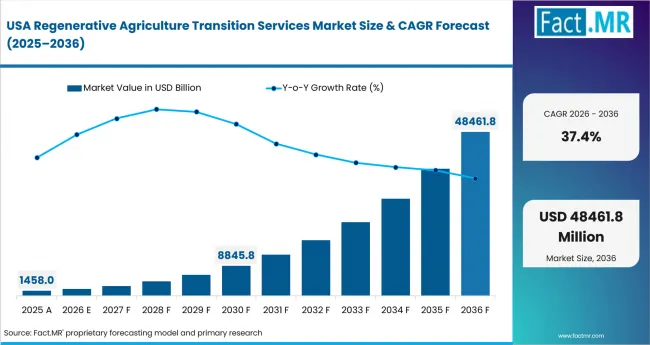
Regenerative Agriculture Transition Services Market Country Value Analysis

The United States is projected to record 37.4% CAGR by 2036 as row-crop transition programs and soil-carbon platforms scale. Indigo Ag states that its Carbon by Indigo program has developed nearly 1 million soil carbon credits using the U.S. Soil Enrichment Protocol. [5] Large row-crop acreage gives service providers a wide base for agronomy support and MRV. Food companies also need verified Scope 3 reductions from U.S. suppliers. Demand will favor platforms that connect farmers and corporate clients.

How is France scaling regenerative agriculture transition demand?

France will gain from cereal and sugar beet transition programs tied to European food supply chains. The country is expected to post 36.1% CAGR through 2036. French demand will focus on wheat and sugar beet supply chains. Providers that combine local agronomy with verified outcome payments will be better placed.

What underpins Germany’s growth?

Germany is likely to record 35.2% CAGR from 2026 to 2036 as EU eco-schemes and food supply chain reporting support adoption. German food and grain supply chains need verifiable transition evidence. Farmers will need practical advice and payment clarity. Demand will favor providers that can work with cooperatives and food brands across large sourcing regions.

What supports the United Kingdom outlook?

The United Kingdom is forecast to advance at 34.1% CAGR through 2036 as soil-carbon programs and retailer-led sourcing models expand. UK brands and retailers need verified regenerative sourcing to support climate and nature claims. Farmers need incentive-backed plans before changing rotations and input use. Service demand will favor programs that combine agronomy and carbon accounting.

How is India scaling regenerative agriculture transition services?

India is set to record 33.0% CAGR through 2036 as food brands and public programs support climate-smart farming transitions. Large crop systems and smallholder networks create a major need for advisory and farmer financing. Service providers must adapt transition models for small plots and regional water stress. Demand will favor low-cost advisory and buyer-backed incentives.

Who leads the regenerative agriculture transition services landscape?

Indigo Ag and Agreena lead through farmer transition programs and corporate supply chain support.
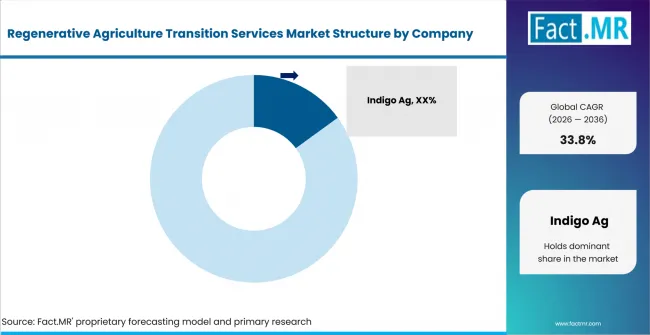
Regenerative Agriculture Transition Services Market Analysis By Company

Regenerative agriculture transition services are used by food companies and farmers that need practice change with evidence. Indigo Ag supports soil carbon credits and sustainable agriculture solutions through agribusiness and corporate partnerships. Soil Capital supports European arable farms through agronomy and financial incentives.

Agreena operates one of Europe’s major soil carbon programs and helps farmers transition to regenerative agriculture. Regrow Ag provides agriculture resilience and MRV tools for companies seeking on-farm emissions reduction. Klim supports farmers and food companies through transition financing and carbon insetting. Competition through 2036 will depend on farmer trust and supply chain integration.

Providers with agronomy and finance expertise will be better placed. MRV platforms can support reporting-led programs. Agronomy advisers can drive farmer adoption. Carbon and insetting platforms can gain traction as brands pay for verified outcomes.

Which companies are the key players?

Indigo Ag, Soil Capital, Agreena, Regrow Ag and Klim.

  • Indigo Ag
  • Soil Capital
  • Agreena
  • Regrow Ag
  • Klim

Bibliography

  • [1] Nestlé. (n.d.). Regenerative agriculture.
  • [2] Soil Capital. (2026, April 14). Embedding regenerative farming in European sourcing.
  • [3] PepsiCo. (2025, August 28). PepsiCo reports 2024 progress against PepsiCo Positive (pep+) sustainability and nutrition goals.
  • [4] Unilever. (2024, September 18). How Unilever is implementing regenerative agriculture practices across 1 million hectares.
  • [5] Indigo Agriculture. (2025, November 4). Milestone for soil carbon removal: Integrity body recognizes regenerative agriculture as credible climate solution.

This Report Addresses

  • Strategic intelligence on regenerative agriculture transition services across service type, farm system and customer type.
  • Segment analysis covering agronomy advisory and transition planning, row crop farms, food and beverage companies, managed transition programs and scope 3 emissions reduction.
  • Regional outlook covering the United States, France, Germany, United Kingdom and India.
  • Competitive analysis of Indigo Ag, Soil Capital, Agreena, Regrow Ag and Klim.
  • Service assessment covering agronomy advisory, soil carbon MRV, transition financing and offtake support.
  • Farm-system assessment covering row crops, dairy, specialty crops, mixed farms and smallholder supply chains.
  • Primary interviews, provider checks, official source review and regenerative transition validation support the forecast.

What does the regenerative agriculture transition services market cover?

Services that help farms move from conventional practice to regenerative agriculture.

The regenerative agriculture transition services market covers advisory and contracting services that support changes in farming practices. It includes cover cropping and farmer incentive programs. The market differs from regenerative agriculture as a farming-method market because the focus is the service layer that helps farms transition.

What is included in the scope?

Agronomy advice and offtake support.

The scope includes farm baseline assessment and practice-change coaching. It covers soil-carbon measurement and farm-level MRV. It includes transition financing and verified outcome contracts. It also includes food company reporting and offtake-contract support for regenerative supply chains.

What is excluded from the scope?

Standard farming inputs and commodity sourcing without transition services.

The scope excludes seed and machinery sales unless transition advisory or MRV is included. It excludes general farm consulting with no regenerative practice-change plan. It excludes commodity offtake with no farmer support or verified outcomes. It also excludes carbon credit trading unless farm transition measurement or verification services are delivered.

How was the analysis built?

100+ sources, 45+ company portfolios, 25+ countries, 20+ interviews.

  • Primary Research:
    • Primary research includes interviews with agronomy advisers and regenerative program operators. It includes input from food company sourcing teams and farm finance specialists.
  • Desk Research:
    • Desk research reviews food major regenerative agriculture targets and EU policy support. It covers provider platforms and farmer transition programs.
  • Market-Sizing and Forecasting:
    • Forecasting uses commercial farm counts and per-acre advisory intensity. Food company commitments and soil-carbon program activity support the market assessment.
  • Data Validation and Update Cycle:
    • Forecasts are validated through provider checks and food supply chain program review. Corporate acreage updates and policy changes help confirm market direction.

What is the report’s scope and coverage?
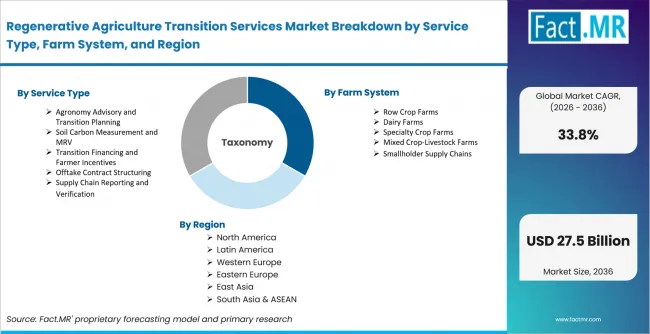
Regenerative Agriculture Transition Services Market Breakdown By Service Type, Farm System, And Region

Attribute Details
Quantitative Units USD Billion in services in 2026 to USD Billion by 2036
Market Definition Agronomy advisory, soil-carbon measurement, transition financing and offtake-contract services that move farms from conventional to regenerative practice
Service Type Agronomy Advisory and Transition Planning, Soil Carbon Measurement and MRV, Transition Financing and Farmer Incentives, Offtake Contract Structuring, Supply Chain Reporting and Verification
Farm System Row Crop Farms, Dairy Farms, Specialty Crop Farms, Mixed Crop-Livestock Farms, Smallholder Supply Chains
Customer Type Food and Beverage Companies, Farmers and Grower Groups, Agribusinesses and Cooperatives, Carbon Credit Developers, Retailers and Ingredient Suppliers
Delivery Model Managed Transition Programs, Platform-Based MRV Services, Agronomist-Led Advisory, Buyer-Funded Incentive Programs, Carbon/Insetting Program Management
End Use Scope 3 Emissions Reduction, Soil Health Improvement, Biodiversity and Water Outcomes, Resilient Sourcing, Regenerative Ingredient Claims
Regions Covered North America, Western Europe, South Asia, Latin America, East Asia, Middle East and Africa
Countries Covered United States, France, Germany, United Kingdom, India
Key Companies Profiled Indigo Ag, Soil Capital, Agreena, Regrow Ag and Klim
Forecast Period 2026 to 2036
Approach Hybrid top-down and bottom-up approach using commercial farm counts, regenerative transition acreage, food company targets, MRV adoption and provider validation

How is the market segmented?

  • By Service Type:

    • Agronomy Advisory and Transition Planning
    • Soil Carbon Measurement and MRV
    • Transition Financing and Farmer Incentives
    • Offtake Contract Structuring
    • Supply Chain Reporting and Verification
  • By Farm System:

    • Row Crop Farms
    • Dairy Farms
    • Specialty Crop Farms
    • Mixed Crop-Livestock Farms
    • Smallholder Supply Chains
  • By Customer Type:

    • Food and Beverage Companies
    • Farmers and Grower Groups
    • Agribusinesses and Cooperatives
    • Carbon Credit Developers
    • Retailers and Ingredient Suppliers
  • By Delivery Model:

    • Managed Transition Programs
    • Platform-Based MRV Services
    • Agronomist-Led Advisory
    • Buyer-Funded Incentive Programs
    • Carbon/Insetting Program Management
  • By End Use:

    • Scope 3 Emissions Reduction
    • Soil Health Improvement
    • Biodiversity and Water Outcomes
    • Resilient Sourcing
    • Regenerative Ingredient Claims
  • Region:

    • North America
      • United States
      • Canada
    • Europe
      • France
      • Germany
      • United Kingdom
      • Belgium
      • Netherlands
    • Asia Pacific
      • India
      • China
      • Japan
      • Australia
      • South Korea
    • Latin America
      • Brazil
      • Argentina
      • Mexico
      • Chile
    • Middle East & Africa
      • GCC Countries
      • South Africa
      • Israel

- Frequently Asked Questions -

Which service type leads the Regenerative Agriculture Transition Services Market?

Agronomy Advisory and Transition Planning leads with 34.0% share in 2026 because practice change starts with farm-level guidance.

Which country expands faster in the Regenerative Agriculture Transition Services Market?

The United States is projected to record 37.4% CAGR through 2036 as row-crop transition programs and soil-carbon platforms scale.

How does France perform in the Regenerative Agriculture Transition Services Market?

France is expected to post 36.1% CAGR through 2036 as cereal and sugar beet transition programs expand.

How does Germany perform in the Regenerative Agriculture Transition Services Market?

Germany is likely to record 35.2% CAGR through 2036 as EU eco-schemes and supply chain reporting support adoption.

How does the United Kingdom perform in the Regenerative Agriculture Transition Services Market?

The United Kingdom is forecast to advance at 34.1% CAGR through 2036 as soil-carbon programs and retailer-led sourcing models expand.

How does India perform in the Regenerative Agriculture Transition Services Market?

India is set to record 33.0% CAGR through 2036 as food brands and public programs support climate-smart farming transitions.

What is the primary driver in the Regenerative Agriculture Transition Services Market?

The primary driver is food company commitment to regenerative sourcing and Scope 3 emissions reduction.

What is the main restraint in the Regenerative Agriculture Transition Services Market?

The main restraint is farmer transition risk because practice changes can affect yield and labor needs.

Why are row crop farms important in this market?

Row crop farms are important because cereals and oilseeds cover large supply chain acreage and support scalable transition programs.

Table of Content

  1. Executive Summary
    • Global Market Outlook
    • Demand to side Trends
    • Supply to side Trends
    • Technology Roadmap Analysis
    • Analysis and Recommendations
  2. Market Overview
    • Market Coverage / Taxonomy
    • Market Definition / Scope / Limitations
  3. Research Methodology
    • Chapter Orientation
    • Analytical Lens and Working Hypotheses
      • Market Structure, Signals, and Trend Drivers
      • Benchmarking and Cross-market Comparability
      • Market Sizing, Forecasting, and Opportunity Mapping
    • Research Design and Evidence Framework
      • Desk Research Programme (Secondary Evidence)
        • Company Annual and Sustainability Reports
        • Peer-reviewed Journals and Academic Literature
        • Corporate Websites, Product Literature, and Technical Notes
        • Earnings Decks and Investor Briefings
        • Statutory Filings and Regulatory Disclosures
        • Technical White Papers and Standards Notes
        • Trade Journals, Industry Magazines, and Analyst Briefs
        • Conference Proceedings, Webinars, and Seminar Materials
        • Government Statistics Portals and Public Data Releases
        • Press Releases and Reputable Media Coverage
        • Specialist Newsletters and Curated Briefings
        • Sector Databases and Reference Repositories
        • Fact.MR Internal Proprietary Databases and Historical Market Datasets
        • Subscription Datasets and Paid Sources
        • Social Channels, Communities, and Digital Listening Inputs
        • Additional Desk Sources
      • Expert Input and Fieldwork (Primary Evidence)
        • Primary Modes
          • Qualitative Interviews and Expert Elicitation
          • Quantitative Surveys and Structured Data Capture
          • Blended Approach
        • Why Primary Evidence is Used
        • Field Techniques
          • Interviews
          • Surveys
          • Focus Groups
          • Observational and In-context Research
          • Social and Community Interactions
        • Stakeholder Universe Engaged
          • C-suite Leaders
          • Board Members
          • Presidents and Vice Presidents
          • R&D and Innovation Heads
          • Technical Specialists
          • Domain Subject-matter Experts
          • Scientists
          • Physicians and Other Healthcare Professionals
        • Governance, Ethics, and Data Stewardship
          • Research Ethics
          • Data Integrity and Handling
      • Tooling, Models, and Reference Databases
    • Data Engineering and Model Build
      • Data Acquisition and Ingestion
      • Cleaning, Normalisation, and Verification
      • Synthesis, Triangulation, and Analysis
    • Quality Assurance and Audit Trail
  4. Market Background
    • Market Dynamics
      • Drivers
      • Restraints
      • Opportunity
      • Trends
    • Scenario Forecast
      • Demand in Optimistic Scenario
      • Demand in Likely Scenario
      • Demand in Conservative Scenario
    • Opportunity Map Analysis
    • Product Life Cycle Analysis
    • Supply Chain Analysis
    • Investment Feasibility Matrix
    • Value Chain Analysis
    • PESTLE and Porter’s Analysis
    • Regulatory Landscape
    • Regional Parent Market Outlook
    • Production and Consumption Statistics
    • Import and Export Statistics
  5. Global Market Analysis 2021 to 2025 and Forecast, 2026 to 2036
    • Historical Market Size Value (USD Million) Analysis, 2021 to 2025
    • Current and Future Market Size Value (USD Million) Projections, 2026 to 2036
      • Y to o to Y Growth Trend Analysis
      • Absolute $ Opportunity Analysis
  6. Global Market Pricing Analysis 2021 to 2025 and Forecast 2026 to 2036
  7. Global Market Analysis 2021 to 2025 and Forecast 2026 to 2036, By Service Type
    • Introduction / Key Findings
    • Historical Market Size Value (USD Million) Analysis By Service Type , 2021 to 2025
    • Current and Future Market Size Value (USD Million) Analysis and Forecast By Service Type , 2026 to 2036
      • Agronomy Advisory and Transition Planning
      • Soil Carbon Measurement and MRV
      • Transition Financing and Farmer Incentives
      • Offtake Contract Structuring
      • Supply Chain Reporting and Verification
    • Y to o to Y Growth Trend Analysis By Service Type , 2021 to 2025
    • Absolute $ Opportunity Analysis By Service Type , 2026 to 2036
  8. Global Market Analysis 2021 to 2025 and Forecast 2026 to 2036, By Farm System
    • Introduction / Key Findings
    • Historical Market Size Value (USD Million) Analysis By Farm System, 2021 to 2025
    • Current and Future Market Size Value (USD Million) Analysis and Forecast By Farm System, 2026 to 2036
      • Row Crop Farms
      • Dairy Farms
      • Specialty Crop Farms
      • Mixed Crop-Livestock Farms
      • Smallholder Supply Chains
    • Y to o to Y Growth Trend Analysis By Farm System, 2021 to 2025
    • Absolute $ Opportunity Analysis By Farm System, 2026 to 2036
  9. Global Market Analysis 2021 to 2025 and Forecast 2026 to 2036, By Customer Type
    • Introduction / Key Findings
    • Historical Market Size Value (USD Million) Analysis By Customer Type, 2021 to 2025
    • Current and Future Market Size Value (USD Million) Analysis and Forecast By Customer Type, 2026 to 2036
      • Food and Beverage Companies
      • Farmers and Grower Groups
      • Agribusinesses and Cooperatives
      • Carbon Credit Developers
      • Retailers and Ingredient Suppliers
    • Y to o to Y Growth Trend Analysis By Customer Type, 2021 to 2025
    • Absolute $ Opportunity Analysis By Customer Type, 2026 to 2036
  10. Global Market Analysis 2021 to 2025 and Forecast 2026 to 2036, By Delivery Model
    • Introduction / Key Findings
    • Historical Market Size Value (USD Million) Analysis By Delivery Model, 2021 to 2025
    • Current and Future Market Size Value (USD Million) Analysis and Forecast By Delivery Model, 2026 to 2036
      • Managed Transition Programs
      • Platform-Based MRV Services
      • Agronomist-Led Advisory
      • Buyer-Funded Incentive Programs
      • Carbon/Insetting Program Management
    • Y to o to Y Growth Trend Analysis By Delivery Model, 2021 to 2025
    • Absolute $ Opportunity Analysis By Delivery Model, 2026 to 2036
  11. Global Market Analysis 2021 to 2025 and Forecast 2026 to 2036, By End Use
    • Introduction / Key Findings
    • Historical Market Size Value (USD Million) Analysis By End Use, 2021 to 2025
    • Current and Future Market Size Value (USD Million) Analysis and Forecast By End Use, 2026 to 2036
      • Scope 3 Emissions Reduction
      • Soil Health Improvement
      • Biodiversity and Water Outcomes
      • Resilient Sourcing
      • Regenerative Ingredient Claims
    • Y to o to Y Growth Trend Analysis By End Use, 2021 to 2025
    • Absolute $ Opportunity Analysis By End Use, 2026 to 2036
  12. Global Market Analysis 2021 to 2025 and Forecast 2026 to 2036, By Region
    • Introduction
    • Historical Market Size Value (USD Million) Analysis By Region, 2021 to 2025
    • Current Market Size Value (USD Million) Analysis and Forecast By Region, 2026 to 2036
      • North America
      • Latin America
      • Western Europe
      • Eastern Europe
      • East Asia
      • South Asia and Pacific
      • Middle East & Africa
    • Market Attractiveness Analysis By Region
  13. North America Market Analysis 2021 to 2025 and Forecast 2026 to 2036, By Country
    • Historical Market Size Value (USD Million) Trend Analysis By Market Taxonomy, 2021 to 2025
    • Market Size Value (USD Million) Forecast By Market Taxonomy, 2026 to 2036
      • By Country
        • USA
        • Canada
        • Mexico
      • By Service Type
      • By Farm System
      • By Customer Type
      • By Delivery Model
      • By End Use
    • Market Attractiveness Analysis
      • By Country
      • By Service Type
      • By Farm System
      • By Customer Type
      • By Delivery Model
      • By End Use
    • Key Takeaways
  14. Latin America Market Analysis 2021 to 2025 and Forecast 2026 to 2036, By Country
    • Historical Market Size Value (USD Million) Trend Analysis By Market Taxonomy, 2021 to 2025
    • Market Size Value (USD Million) Forecast By Market Taxonomy, 2026 to 2036
      • By Country
        • Brazil
        • Chile
        • Rest of Latin America
      • By Service Type
      • By Farm System
      • By Customer Type
      • By Delivery Model
      • By End Use
    • Market Attractiveness Analysis
      • By Country
      • By Service Type
      • By Farm System
      • By Customer Type
      • By Delivery Model
      • By End Use
    • Key Takeaways
  15. Western Europe Market Analysis 2021 to 2025 and Forecast 2026 to 2036, By Country
    • Historical Market Size Value (USD Million) Trend Analysis By Market Taxonomy, 2021 to 2025
    • Market Size Value (USD Million) Forecast By Market Taxonomy, 2026 to 2036
      • By Country
        • Germany
        • UK
        • Italy
        • Spain
        • France
        • Nordic
        • BENELUX
        • Rest of Western Europe
      • By Service Type
      • By Farm System
      • By Customer Type
      • By Delivery Model
      • By End Use
    • Market Attractiveness Analysis
      • By Country
      • By Service Type
      • By Farm System
      • By Customer Type
      • By Delivery Model
      • By End Use
    • Key Takeaways
  16. Eastern Europe Market Analysis 2021 to 2025 and Forecast 2026 to 2036, By Country
    • Historical Market Size Value (USD Million) Trend Analysis By Market Taxonomy, 2021 to 2025
    • Market Size Value (USD Million) Forecast By Market Taxonomy, 2026 to 2036
      • By Country
        • Russia
        • Poland
        • Hungary
        • Balkan & Baltic
        • Rest of Eastern Europe
      • By Service Type
      • By Farm System
      • By Customer Type
      • By Delivery Model
      • By End Use
    • Market Attractiveness Analysis
      • By Country
      • By Service Type
      • By Farm System
      • By Customer Type
      • By Delivery Model
      • By End Use
    • Key Takeaways
  17. East Asia Market Analysis 2021 to 2025 and Forecast 2026 to 2036, By Country
    • Historical Market Size Value (USD Million) Trend Analysis By Market Taxonomy, 2021 to 2025
    • Market Size Value (USD Million) Forecast By Market Taxonomy, 2026 to 2036
      • By Country
        • China
        • Japan
        • South Korea
      • By Service Type
      • By Farm System
      • By Customer Type
      • By Delivery Model
      • By End Use
    • Market Attractiveness Analysis
      • By Country
      • By Service Type
      • By Farm System
      • By Customer Type
      • By Delivery Model
      • By End Use
    • Key Takeaways
  18. South Asia and Pacific Market Analysis 2021 to 2025 and Forecast 2026 to 2036, By Country
    • Historical Market Size Value (USD Million) Trend Analysis By Market Taxonomy, 2021 to 2025
    • Market Size Value (USD Million) Forecast By Market Taxonomy, 2026 to 2036
      • By Country
        • India
        • ASEAN
        • Australia & New Zealand
        • Rest of South Asia and Pacific
      • By Service Type
      • By Farm System
      • By Customer Type
      • By Delivery Model
      • By End Use
    • Market Attractiveness Analysis
      • By Country
      • By Service Type
      • By Farm System
      • By Customer Type
      • By Delivery Model
      • By End Use
    • Key Takeaways
  19. Middle East & Africa Market Analysis 2021 to 2025 and Forecast 2026 to 2036, By Country
    • Historical Market Size Value (USD Million) Trend Analysis By Market Taxonomy, 2021 to 2025
    • Market Size Value (USD Million) Forecast By Market Taxonomy, 2026 to 2036
      • By Country
        • Kingdom of Saudi Arabia
        • Other GCC Countries
        • Turkiye
        • South Africa
        • Other African Union
        • Rest of Middle East & Africa
      • By Service Type
      • By Farm System
      • By Customer Type
      • By Delivery Model
      • By End Use
    • Market Attractiveness Analysis
      • By Country
      • By Service Type
      • By Farm System
      • By Customer Type
      • By Delivery Model
      • By End Use
    • Key Takeaways
  20. Key Countries Market Analysis
    • USA
      • Pricing Analysis
      • Market Share Analysis, 2025
        • By Service Type
        • By Farm System
        • By Customer Type
        • By Delivery Model
        • By End Use
    • Canada
      • Pricing Analysis
      • Market Share Analysis, 2025
        • By Service Type
        • By Farm System
        • By Customer Type
        • By Delivery Model
        • By End Use
    • Mexico
      • Pricing Analysis
      • Market Share Analysis, 2025
        • By Service Type
        • By Farm System
        • By Customer Type
        • By Delivery Model
        • By End Use
    • Brazil
      • Pricing Analysis
      • Market Share Analysis, 2025
        • By Service Type
        • By Farm System
        • By Customer Type
        • By Delivery Model
        • By End Use
    • Chile
      • Pricing Analysis
      • Market Share Analysis, 2025
        • By Service Type
        • By Farm System
        • By Customer Type
        • By Delivery Model
        • By End Use
    • Germany
      • Pricing Analysis
      • Market Share Analysis, 2025
        • By Service Type
        • By Farm System
        • By Customer Type
        • By Delivery Model
        • By End Use
    • UK
      • Pricing Analysis
      • Market Share Analysis, 2025
        • By Service Type
        • By Farm System
        • By Customer Type
        • By Delivery Model
        • By End Use
    • Italy
      • Pricing Analysis
      • Market Share Analysis, 2025
        • By Service Type
        • By Farm System
        • By Customer Type
        • By Delivery Model
        • By End Use
    • Spain
      • Pricing Analysis
      • Market Share Analysis, 2025
        • By Service Type
        • By Farm System
        • By Customer Type
        • By Delivery Model
        • By End Use
    • France
      • Pricing Analysis
      • Market Share Analysis, 2025
        • By Service Type
        • By Farm System
        • By Customer Type
        • By Delivery Model
        • By End Use
    • India
      • Pricing Analysis
      • Market Share Analysis, 2025
        • By Service Type
        • By Farm System
        • By Customer Type
        • By Delivery Model
        • By End Use
    • ASEAN
      • Pricing Analysis
      • Market Share Analysis, 2025
        • By Service Type
        • By Farm System
        • By Customer Type
        • By Delivery Model
        • By End Use
    • Australia & New Zealand
      • Pricing Analysis
      • Market Share Analysis, 2025
        • By Service Type
        • By Farm System
        • By Customer Type
        • By Delivery Model
        • By End Use
    • China
      • Pricing Analysis
      • Market Share Analysis, 2025
        • By Service Type
        • By Farm System
        • By Customer Type
        • By Delivery Model
        • By End Use
    • Japan
      • Pricing Analysis
      • Market Share Analysis, 2025
        • By Service Type
        • By Farm System
        • By Customer Type
        • By Delivery Model
        • By End Use
    • South Korea
      • Pricing Analysis
      • Market Share Analysis, 2025
        • By Service Type
        • By Farm System
        • By Customer Type
        • By Delivery Model
        • By End Use
    • Russia
      • Pricing Analysis
      • Market Share Analysis, 2025
        • By Service Type
        • By Farm System
        • By Customer Type
        • By Delivery Model
        • By End Use
    • Poland
      • Pricing Analysis
      • Market Share Analysis, 2025
        • By Service Type
        • By Farm System
        • By Customer Type
        • By Delivery Model
        • By End Use
    • Hungary
      • Pricing Analysis
      • Market Share Analysis, 2025
        • By Service Type
        • By Farm System
        • By Customer Type
        • By Delivery Model
        • By End Use
    • Kingdom of Saudi Arabia
      • Pricing Analysis
      • Market Share Analysis, 2025
        • By Service Type
        • By Farm System
        • By Customer Type
        • By Delivery Model
        • By End Use
    • Turkiye
      • Pricing Analysis
      • Market Share Analysis, 2025
        • By Service Type
        • By Farm System
        • By Customer Type
        • By Delivery Model
        • By End Use
    • South Africa
      • Pricing Analysis
      • Market Share Analysis, 2025
        • By Service Type
        • By Farm System
        • By Customer Type
        • By Delivery Model
        • By End Use
  21. Market Structure Analysis
    • Competition Dashboard
    • Competition Benchmarking
    • Market Share Analysis of Top Players
      • By Regional
      • By Service Type
      • By Farm System
      • By Customer Type
      • By Delivery Model
      • By End Use
  22. Competition Analysis
    • Competition Deep Dive
      • Indigo Ag
        • Overview
        • Product Portfolio
        • Profitability by Market Segments (Product/Age /Sales Channel/Region)
        • Sales Footprint
        • Strategy Overview
          • Marketing Strategy
          • Product Strategy
          • Channel Strategy
      • Soil Capital
      • Agreena
      • Regrow Ag
      • Klim
  23. Assumptions & Acronyms Used

List Of Table

  • Table 1: Global Market Value (USD Million) Forecast by Region, 2021 to 2036
  • Table 2: Global Market Value (USD Million) Forecast by Service Type , 2021 to 2036
  • Table 3: Global Market Value (USD Million) Forecast by Farm System, 2021 to 2036
  • Table 4: Global Market Value (USD Million) Forecast by Customer Type, 2021 to 2036
  • Table 5: Global Market Value (USD Million) Forecast by Delivery Model, 2021 to 2036
  • Table 6: Global Market Value (USD Million) Forecast by End Use, 2021 to 2036
  • Table 7: North America Market Value (USD Million) Forecast by Country, 2021 to 2036
  • Table 8: North America Market Value (USD Million) Forecast by Service Type , 2021 to 2036
  • Table 9: North America Market Value (USD Million) Forecast by Farm System, 2021 to 2036
  • Table 10: North America Market Value (USD Million) Forecast by Customer Type, 2021 to 2036
  • Table 11: North America Market Value (USD Million) Forecast by Delivery Model, 2021 to 2036
  • Table 12: North America Market Value (USD Million) Forecast by End Use, 2021 to 2036
  • Table 13: Latin America Market Value (USD Million) Forecast by Country, 2021 to 2036
  • Table 14: Latin America Market Value (USD Million) Forecast by Service Type , 2021 to 2036
  • Table 15: Latin America Market Value (USD Million) Forecast by Farm System, 2021 to 2036
  • Table 16: Latin America Market Value (USD Million) Forecast by Customer Type, 2021 to 2036
  • Table 17: Latin America Market Value (USD Million) Forecast by Delivery Model, 2021 to 2036
  • Table 18: Latin America Market Value (USD Million) Forecast by End Use, 2021 to 2036
  • Table 19: Western Europe Market Value (USD Million) Forecast by Country, 2021 to 2036
  • Table 20: Western Europe Market Value (USD Million) Forecast by Service Type , 2021 to 2036
  • Table 21: Western Europe Market Value (USD Million) Forecast by Farm System, 2021 to 2036
  • Table 22: Western Europe Market Value (USD Million) Forecast by Customer Type, 2021 to 2036
  • Table 23: Western Europe Market Value (USD Million) Forecast by Delivery Model, 2021 to 2036
  • Table 24: Western Europe Market Value (USD Million) Forecast by End Use, 2021 to 2036
  • Table 25: Eastern Europe Market Value (USD Million) Forecast by Country, 2021 to 2036
  • Table 26: Eastern Europe Market Value (USD Million) Forecast by Service Type , 2021 to 2036
  • Table 27: Eastern Europe Market Value (USD Million) Forecast by Farm System, 2021 to 2036
  • Table 28: Eastern Europe Market Value (USD Million) Forecast by Customer Type, 2021 to 2036
  • Table 29: Eastern Europe Market Value (USD Million) Forecast by Delivery Model, 2021 to 2036
  • Table 30: Eastern Europe Market Value (USD Million) Forecast by End Use, 2021 to 2036
  • Table 31: East Asia Market Value (USD Million) Forecast by Country, 2021 to 2036
  • Table 32: East Asia Market Value (USD Million) Forecast by Service Type , 2021 to 2036
  • Table 33: East Asia Market Value (USD Million) Forecast by Farm System, 2021 to 2036
  • Table 34: East Asia Market Value (USD Million) Forecast by Customer Type, 2021 to 2036
  • Table 35: East Asia Market Value (USD Million) Forecast by Delivery Model, 2021 to 2036
  • Table 36: East Asia Market Value (USD Million) Forecast by End Use, 2021 to 2036
  • Table 37: South Asia and Pacific Market Value (USD Million) Forecast by Country, 2021 to 2036
  • Table 38: South Asia and Pacific Market Value (USD Million) Forecast by Service Type , 2021 to 2036
  • Table 39: South Asia and Pacific Market Value (USD Million) Forecast by Farm System, 2021 to 2036
  • Table 40: South Asia and Pacific Market Value (USD Million) Forecast by Customer Type, 2021 to 2036
  • Table 41: South Asia and Pacific Market Value (USD Million) Forecast by Delivery Model, 2021 to 2036
  • Table 42: South Asia and Pacific Market Value (USD Million) Forecast by End Use, 2021 to 2036
  • Table 43: Middle East & Africa Market Value (USD Million) Forecast by Country, 2021 to 2036
  • Table 44: Middle East & Africa Market Value (USD Million) Forecast by Service Type , 2021 to 2036
  • Table 45: Middle East & Africa Market Value (USD Million) Forecast by Farm System, 2021 to 2036
  • Table 46: Middle East & Africa Market Value (USD Million) Forecast by Customer Type, 2021 to 2036
  • Table 47: Middle East & Africa Market Value (USD Million) Forecast by Delivery Model, 2021 to 2036
  • Table 48: Middle East & Africa Market Value (USD Million) Forecast by End Use, 2021 to 2036

List Of Figures

  • Figure 1: Global Market Pricing Analysis
  • Figure 2: Global Market Value (USD Million) Forecast 2021-2036
  • Figure 3: Global Market Value Share and BPS Analysis by Service Type , 2026 and 2036
  • Figure 4: Global Market Y-o-Y Growth Comparison by Service Type , 2026-2036
  • Figure 5: Global Market Attractiveness Analysis by Service Type
  • Figure 6: Global Market Value Share and BPS Analysis by Farm System, 2026 and 2036
  • Figure 7: Global Market Y-o-Y Growth Comparison by Farm System, 2026-2036
  • Figure 8: Global Market Attractiveness Analysis by Farm System
  • Figure 9: Global Market Value Share and BPS Analysis by Customer Type, 2026 and 2036
  • Figure 10: Global Market Y-o-Y Growth Comparison by Customer Type, 2026-2036
  • Figure 11: Global Market Attractiveness Analysis by Customer Type
  • Figure 12: Global Market Value Share and BPS Analysis by Delivery Model, 2026 and 2036
  • Figure 13: Global Market Y-o-Y Growth Comparison by Delivery Model, 2026-2036
  • Figure 14: Global Market Attractiveness Analysis by Delivery Model
  • Figure 15: Global Market Value Share and BPS Analysis by End Use, 2026 and 2036
  • Figure 16: Global Market Y-o-Y Growth Comparison by End Use, 2026-2036
  • Figure 17: Global Market Attractiveness Analysis by End Use
  • Figure 18: Global Market Value (USD Million) Share and BPS Analysis by Region, 2026 and 2036
  • Figure 19: Global Market Y-o-Y Growth Comparison by Region, 2026-2036
  • Figure 20: Global Market Attractiveness Analysis by Region
  • Figure 21: North America Market Incremental Dollar Opportunity, 2026-2036
  • Figure 22: Latin America Market Incremental Dollar Opportunity, 2026-2036
  • Figure 23: Western Europe Market Incremental Dollar Opportunity, 2026-2036
  • Figure 24: Eastern Europe Market Incremental Dollar Opportunity, 2026-2036
  • Figure 25: East Asia Market Incremental Dollar Opportunity, 2026-2036
  • Figure 26: South Asia and Pacific Market Incremental Dollar Opportunity, 2026-2036
  • Figure 27: Middle East & Africa Market Incremental Dollar Opportunity, 2026-2036
  • Figure 28: North America Market Value Share and BPS Analysis by Country, 2026 and 2036
  • Figure 29: North America Market Value Share and BPS Analysis by Service Type , 2026 and 2036
  • Figure 30: North America Market Y-o-Y Growth Comparison by Service Type , 2026-2036
  • Figure 31: North America Market Attractiveness Analysis by Service Type
  • Figure 32: North America Market Value Share and BPS Analysis by Farm System, 2026 and 2036
  • Figure 33: North America Market Y-o-Y Growth Comparison by Farm System, 2026-2036
  • Figure 34: North America Market Attractiveness Analysis by Farm System
  • Figure 35: North America Market Value Share and BPS Analysis by Customer Type, 2026 and 2036
  • Figure 36: North America Market Y-o-Y Growth Comparison by Customer Type, 2026-2036
  • Figure 37: North America Market Attractiveness Analysis by Customer Type
  • Figure 38: North America Market Value Share and BPS Analysis by Delivery Model, 2026 and 2036
  • Figure 39: North America Market Y-o-Y Growth Comparison by Delivery Model, 2026-2036
  • Figure 40: North America Market Attractiveness Analysis by Delivery Model
  • Figure 41: North America Market Value Share and BPS Analysis by End Use, 2026 and 2036
  • Figure 42: North America Market Y-o-Y Growth Comparison by End Use, 2026-2036
  • Figure 43: North America Market Attractiveness Analysis by End Use
  • Figure 44: Latin America Market Value Share and BPS Analysis by Country, 2026 and 2036
  • Figure 45: Latin America Market Value Share and BPS Analysis by Service Type , 2026 and 2036
  • Figure 46: Latin America Market Y-o-Y Growth Comparison by Service Type , 2026-2036
  • Figure 47: Latin America Market Attractiveness Analysis by Service Type
  • Figure 48: Latin America Market Value Share and BPS Analysis by Farm System, 2026 and 2036
  • Figure 49: Latin America Market Y-o-Y Growth Comparison by Farm System, 2026-2036
  • Figure 50: Latin America Market Attractiveness Analysis by Farm System
  • Figure 51: Latin America Market Value Share and BPS Analysis by Customer Type, 2026 and 2036
  • Figure 52: Latin America Market Y-o-Y Growth Comparison by Customer Type, 2026-2036
  • Figure 53: Latin America Market Attractiveness Analysis by Customer Type
  • Figure 54: Latin America Market Value Share and BPS Analysis by Delivery Model, 2026 and 2036
  • Figure 55: Latin America Market Y-o-Y Growth Comparison by Delivery Model, 2026-2036
  • Figure 56: Latin America Market Attractiveness Analysis by Delivery Model
  • Figure 57: Latin America Market Value Share and BPS Analysis by End Use, 2026 and 2036
  • Figure 58: Latin America Market Y-o-Y Growth Comparison by End Use, 2026-2036
  • Figure 59: Latin America Market Attractiveness Analysis by End Use
  • Figure 60: Western Europe Market Value Share and BPS Analysis by Country, 2026 and 2036
  • Figure 61: Western Europe Market Value Share and BPS Analysis by Service Type , 2026 and 2036
  • Figure 62: Western Europe Market Y-o-Y Growth Comparison by Service Type , 2026-2036
  • Figure 63: Western Europe Market Attractiveness Analysis by Service Type
  • Figure 64: Western Europe Market Value Share and BPS Analysis by Farm System, 2026 and 2036
  • Figure 65: Western Europe Market Y-o-Y Growth Comparison by Farm System, 2026-2036
  • Figure 66: Western Europe Market Attractiveness Analysis by Farm System
  • Figure 67: Western Europe Market Value Share and BPS Analysis by Customer Type, 2026 and 2036
  • Figure 68: Western Europe Market Y-o-Y Growth Comparison by Customer Type, 2026-2036
  • Figure 69: Western Europe Market Attractiveness Analysis by Customer Type
  • Figure 70: Western Europe Market Value Share and BPS Analysis by Delivery Model, 2026 and 2036
  • Figure 71: Western Europe Market Y-o-Y Growth Comparison by Delivery Model, 2026-2036
  • Figure 72: Western Europe Market Attractiveness Analysis by Delivery Model
  • Figure 73: Western Europe Market Value Share and BPS Analysis by End Use, 2026 and 2036
  • Figure 74: Western Europe Market Y-o-Y Growth Comparison by End Use, 2026-2036
  • Figure 75: Western Europe Market Attractiveness Analysis by End Use
  • Figure 76: Eastern Europe Market Value Share and BPS Analysis by Country, 2026 and 2036
  • Figure 77: Eastern Europe Market Value Share and BPS Analysis by Service Type , 2026 and 2036
  • Figure 78: Eastern Europe Market Y-o-Y Growth Comparison by Service Type , 2026-2036
  • Figure 79: Eastern Europe Market Attractiveness Analysis by Service Type
  • Figure 80: Eastern Europe Market Value Share and BPS Analysis by Farm System, 2026 and 2036
  • Figure 81: Eastern Europe Market Y-o-Y Growth Comparison by Farm System, 2026-2036
  • Figure 82: Eastern Europe Market Attractiveness Analysis by Farm System
  • Figure 83: Eastern Europe Market Value Share and BPS Analysis by Customer Type, 2026 and 2036
  • Figure 84: Eastern Europe Market Y-o-Y Growth Comparison by Customer Type, 2026-2036
  • Figure 85: Eastern Europe Market Attractiveness Analysis by Customer Type
  • Figure 86: Eastern Europe Market Value Share and BPS Analysis by Delivery Model, 2026 and 2036
  • Figure 87: Eastern Europe Market Y-o-Y Growth Comparison by Delivery Model, 2026-2036
  • Figure 88: Eastern Europe Market Attractiveness Analysis by Delivery Model
  • Figure 89: Eastern Europe Market Value Share and BPS Analysis by End Use, 2026 and 2036
  • Figure 90: Eastern Europe Market Y-o-Y Growth Comparison by End Use, 2026-2036
  • Figure 91: Eastern Europe Market Attractiveness Analysis by End Use
  • Figure 92: East Asia Market Value Share and BPS Analysis by Country, 2026 and 2036
  • Figure 93: East Asia Market Value Share and BPS Analysis by Service Type , 2026 and 2036
  • Figure 94: East Asia Market Y-o-Y Growth Comparison by Service Type , 2026-2036
  • Figure 95: East Asia Market Attractiveness Analysis by Service Type
  • Figure 96: East Asia Market Value Share and BPS Analysis by Farm System, 2026 and 2036
  • Figure 97: East Asia Market Y-o-Y Growth Comparison by Farm System, 2026-2036
  • Figure 98: East Asia Market Attractiveness Analysis by Farm System
  • Figure 99: East Asia Market Value Share and BPS Analysis by Customer Type, 2026 and 2036
  • Figure 100: East Asia Market Y-o-Y Growth Comparison by Customer Type, 2026-2036
  • Figure 101: East Asia Market Attractiveness Analysis by Customer Type
  • Figure 102: East Asia Market Value Share and BPS Analysis by Delivery Model, 2026 and 2036
  • Figure 103: East Asia Market Y-o-Y Growth Comparison by Delivery Model, 2026-2036
  • Figure 104: East Asia Market Attractiveness Analysis by Delivery Model
  • Figure 105: East Asia Market Value Share and BPS Analysis by End Use, 2026 and 2036
  • Figure 106: East Asia Market Y-o-Y Growth Comparison by End Use, 2026-2036
  • Figure 107: East Asia Market Attractiveness Analysis by End Use
  • Figure 108: South Asia and Pacific Market Value Share and BPS Analysis by Country, 2026 and 2036
  • Figure 109: South Asia and Pacific Market Value Share and BPS Analysis by Service Type , 2026 and 2036
  • Figure 110: South Asia and Pacific Market Y-o-Y Growth Comparison by Service Type , 2026-2036
  • Figure 111: South Asia and Pacific Market Attractiveness Analysis by Service Type
  • Figure 112: South Asia and Pacific Market Value Share and BPS Analysis by Farm System, 2026 and 2036
  • Figure 113: South Asia and Pacific Market Y-o-Y Growth Comparison by Farm System, 2026-2036
  • Figure 114: South Asia and Pacific Market Attractiveness Analysis by Farm System
  • Figure 115: South Asia and Pacific Market Value Share and BPS Analysis by Customer Type, 2026 and 2036
  • Figure 116: South Asia and Pacific Market Y-o-Y Growth Comparison by Customer Type, 2026-2036
  • Figure 117: South Asia and Pacific Market Attractiveness Analysis by Customer Type
  • Figure 118: South Asia and Pacific Market Value Share and BPS Analysis by Delivery Model, 2026 and 2036
  • Figure 119: South Asia and Pacific Market Y-o-Y Growth Comparison by Delivery Model, 2026-2036
  • Figure 120: South Asia and Pacific Market Attractiveness Analysis by Delivery Model
  • Figure 121: South Asia and Pacific Market Value Share and BPS Analysis by End Use, 2026 and 2036
  • Figure 122: South Asia and Pacific Market Y-o-Y Growth Comparison by End Use, 2026-2036
  • Figure 123: South Asia and Pacific Market Attractiveness Analysis by End Use
  • Figure 124: Middle East & Africa Market Value Share and BPS Analysis by Country, 2026 and 2036
  • Figure 125: Middle East & Africa Market Value Share and BPS Analysis by Service Type , 2026 and 2036
  • Figure 126: Middle East & Africa Market Y-o-Y Growth Comparison by Service Type , 2026-2036
  • Figure 127: Middle East & Africa Market Attractiveness Analysis by Service Type
  • Figure 128: Middle East & Africa Market Value Share and BPS Analysis by Farm System, 2026 and 2036
  • Figure 129: Middle East & Africa Market Y-o-Y Growth Comparison by Farm System, 2026-2036
  • Figure 130: Middle East & Africa Market Attractiveness Analysis by Farm System
  • Figure 131: Middle East & Africa Market Value Share and BPS Analysis by Customer Type, 2026 and 2036
  • Figure 132: Middle East & Africa Market Y-o-Y Growth Comparison by Customer Type, 2026-2036
  • Figure 133: Middle East & Africa Market Attractiveness Analysis by Customer Type
  • Figure 134: Middle East & Africa Market Value Share and BPS Analysis by Delivery Model, 2026 and 2036
  • Figure 135: Middle East & Africa Market Y-o-Y Growth Comparison by Delivery Model, 2026-2036
  • Figure 136: Middle East & Africa Market Attractiveness Analysis by Delivery Model
  • Figure 137: Middle East & Africa Market Value Share and BPS Analysis by End Use, 2026 and 2036
  • Figure 138: Middle East & Africa Market Y-o-Y Growth Comparison by End Use, 2026-2036
  • Figure 139: Middle East & Africa Market Attractiveness Analysis by End Use
  • Figure 140: Global Market - Tier Structure Analysis
  • Figure 141: Global Market - Company Share Analysis

Regenerative Agriculture Transition Services Market

Buy Report Now