- Market Value (2025): USD 1.1 Bn
- Estimated Value (2026): USD 1.2 Bn
- Forecast Value (2036): USD 2.2 Bn
- CAGR (2026-2036): 6.2%
What is the Pumpkin Seed Oil Market forecast to be worth by 2036?
USD 1.2 billion in 2026 to USD 2.2 billion by 2036 at 6.2% CAGR.
- The pumpkin seed oil market crossed a valuation of USD 1.1 billion in 2025 as specialty oil brands expanded culinary and supplement-led formats.
- Demand is projected to increase from USD 1.2 billion in 2026 to USD 2.2 billion by 2036.
- The market is forecast to record 6.2% CAGR from 2026 to 2036. Cold-pressed positioning and packaged retail access remain relevant demand considerations.
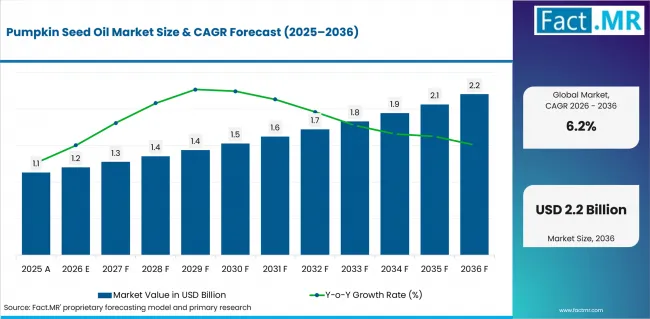
Pumpkin Seed Oil Market Value Analysis | Source: Fact.MR
What are the defining numbers behind Pumpkin Seed Oil Market growth?
USD 1.0 billion absolute opportunity by 2036, led by Cold-Pressed Pumpkin Seed Oil and Food & Beverages alongside Food Processing Companies and Glass Bottles.
- Demand Drivers in the Market
- Cold-pressed formats are expected to hold shopper attention because they give a clear quality signal at the shelf. This fits the wider vegetable oils category where taste and extraction method affect trust.
- Food & Beverages applications are expected to create repeat use through dressings and finishing oil occasions. Retailers can place pumpkin seed oil near organic foods and beverages when the product message is simple.
- Dietary supplements and softgel formats are expected to widen the use case beyond kitchen shelves. This route works when dose format and label clarity make pumpkin seed oil easier to explain inside softgel dietary supplements.
- Personal care applications are expected to add a careful second route. Brands in mass beauty and personal care products need ingredient consistency before pumpkin seed oil can move beyond trial blends.
- Key Segments Analyzed
- By Product Type: Cold-Pressed Pumpkin Seed Oil is projected to hold 37.5% share in 2026 because it gives shoppers the clearest quality cue.
- By Application: Food & Beverages is expected to account for 30.8% share in 2026. Culinary use gives the simplest route to trial and repeat purchase.
- By End User: Food Processing Companies are forecast to hold 30.4% share in 2026. Processors can use the oil in dressings and functional foods when batch quality remains stable.
- By Distribution Channel: Supermarkets & Hypermarkets are estimated to hold 31.6% share in 2026. Shelf placement helps shoppers compare pack size and oil type before purchase.
- By Packaging Type: Glass Bottles are anticipated to hold 36.8% share in 2026 due to their fit with premium edible oils and shelf display.
- Analyst Opinion at Fact.MR
- Shambhu Nath Jha, Sr. Consultant at Fact.MR, opines, “Pumpkin seed oil companies must make the quality promise visible at the shelf and credible after purchase. Product acceptance is expected to depend on cold-pressed proof, stable aroma and a simple use case that helps shoppers buy the oil again.”
- Strategic Implications
- Retail brands can explain how cold-pressed oil fits everyday use before adding more pack sizes. This gives shoppers a clear reason to switch.
- Processors need to decide whether the oil is sold for cooking or as a product ingredient. This affects testing and labeling needs.
- Investors should separate bulk oil from branded specialty products. Supplement channels work best when quality is reliable and customers buy again.
The USA is projected to record 8.0% CAGR from 2026 to 2036, followed by Germany at 7.4%, the UK at 6.8%, Japan at 6.2%, Canada at 5.5%, Australia at 5.0%, and Brazil at 4.3%.
How does the Pumpkin Seed Oil Market break down by segment?
Cold-Pressed Pumpkin Seed Oil is expected to lead Product Type at 37.5% share in 2026. Food & Beverages is projected to lead Application at 30.8% share in 2026.
Why does Cold-Pressed Pumpkin Seed Oil lead Product Type?
Cold-Pressed Pumpkin Seed Oil is projected to account for 37.5% share in 2026.
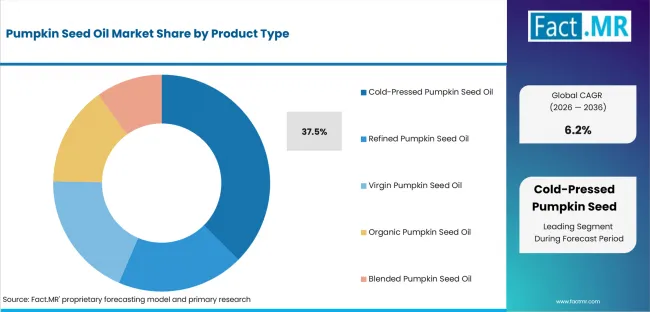
Pumpkin Seed Oil Market Analysis By Product Type | Source: Fact.MR
Cold-Pressed Pumpkin Seed Oil holds the largest share because shoppers connect the extraction method with better taste and product quality. Organic Cold-Pressed Oil attracts buyers seeking certified options, while Conventional Cold-Pressed Oil supports more affordable pricing. Refined Pumpkin Seed Oil appeals to users who prefer a milder flavor and more consistent cooking performance.
Why does Food & Beverages lead Application?
With 30.8% share in 2026, Food & Beverages is expected to lead Application.
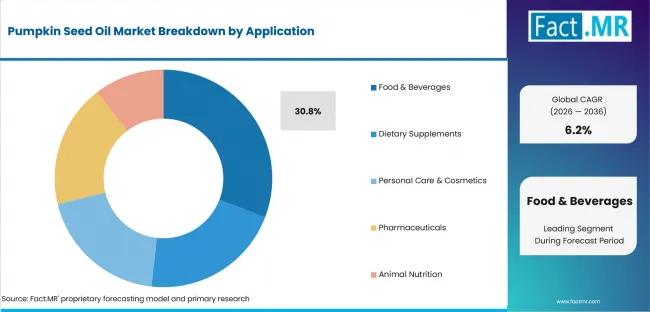
Pumpkin Seed Oil Market Analysis By Application | Source: Fact.MR
Everyday uses such as salads, dressings and light cooking make Food & Beverages the main application. These familiar uses encourage product trials at home. Dietary Supplements create a separate demand route by offering pumpkin seed oil in measured wellness formats.
What supports Food Processing Companies within End User?
Food Processing Companies are forecast to represent 30.4% share in 2026.
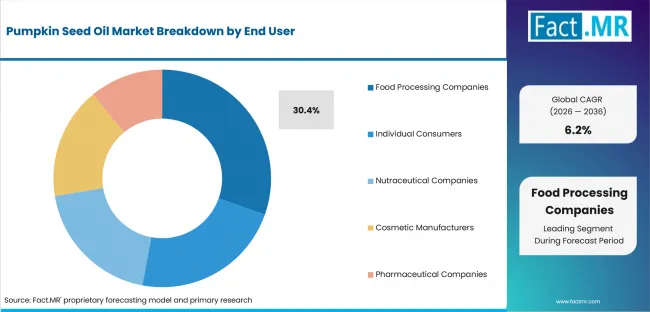
Pumpkin Seed Oil Market Analysis By End User | Source: Fact.MR
The largest demand comes from processors that use pumpkin seed oil in dressings, condiments and functional foods. Functional Food Manufacturers and Condiment Producers require consistent aroma, color and quality before increasing orders. Individual Consumers add retail demand when smaller packs clearly explain daily use.
What supports Supermarkets & Hypermarkets within Distribution Channel?
Supermarkets & Hypermarkets are estimated to hold 31.6% share in 2026.
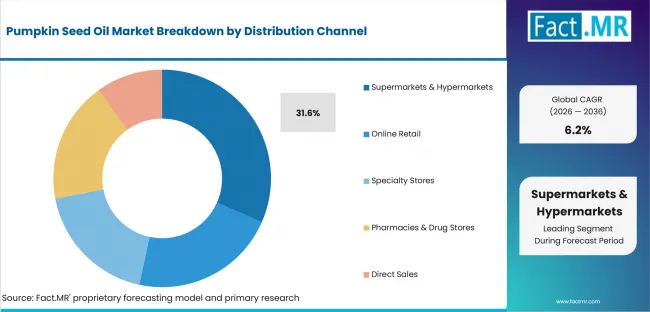
Pumpkin Seed Oil Market Analysis By Distribution Channel | Source: Fact.MR
Physical stores allow shoppers to compare bottle sizes, prices and oil types in one place. This makes Supermarkets & Hypermarkets useful for first-time purchases. Online Retail becomes more important for repeat orders once customers are familiar with the product.
Why do Glass Bottles lead Packaging Type?
Glass Bottles are anticipated to account for 36.8% share in 2026.
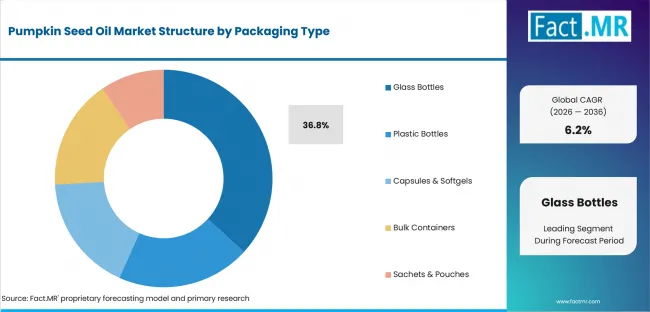
Pumpkin Seed Oil Market Analysis By Packaging Type | Source: Fact.MR
Premium appearance and product protection support the use of Glass Bottles. Dark Glass Bottles help reduce light exposure and protect oil quality. Clear Glass Bottles depend more on fast shelf turnover and careful storage.
What is accelerating Pumpkin Seed Oil Market adoption, and what is holding it back?
Demand will rise with cold-pressed products and suitable packaging. Private-label pricing and storage issues may limit adoption.
Drivers Impact Analysis
| DRIVER | QUALITATIVE RELEVANCE | GEOGRAPHIC RELEVANCE | IMPACT TIMELINE |
|---|---|---|---|
| Cold-pressed quality positioning | High | USA and Germany | Short term (<= 2 years) |
| Food & beverages repeat-use occasions | High | USA, UK and Germany | Short term (<= 2 years) |
| Retail shelf and online visibility | Moderate | USA, Canada and Australia | Medium term (2-4 years) |
| Food processing pack conversion | Moderate | Germany, UK and Japan | Medium term (2-4 years) |
| Personal care and supplement positioning | Selective | Japan and premium retail markets | Long term (>= 4 years) |
Source: Fact.MR analysis. Updated Jul 29, 2026
- Cold-pressed quality positioning: Cold-pressed formats are expected to raise purchase confidence where aroma and extraction method matter. Brands gain more shelf support when packs explain why the oil is different from standard cooking oils.
- Food & beverages repeat-use occasions: Food use is anticipated to anchor demand through salads and finishing applications. Retailers benefit when product placement teaches shoppers how to use the oil more than once.
- Retail shelf and online visibility: Wider discovery across stores and online platforms is expected to improve trial. Channel managers still need product education because pumpkin seed oil is less familiar than olive oil.
- Food processing pack conversion: Food processors are forecast to use pumpkin seed oil when taste and color improve a finished recipe. Small-batch testing must lead to stable sourcing before larger orders are approved.
- Personal care and supplement positioning: Plant oil use in beauty and supplement formats is projected to create adjacent demand. Formulators still need ingredient consistency before trial blends become routine orders.
Opportunity Impact Analysis
| OPPORTUNITY | QUALITATIVE RELEVANCE | GEOGRAPHIC RELEVANCE | IMPACT TIMELINE |
|---|---|---|---|
| Occasion-led culinary assortments | Moderate | USA and Germany | Medium term (2-4 years) |
| Private-label specialty oil programs | Moderate | UK and Canada | Medium term (2-4 years) |
| Capsule and softgel formats | Selective | USA, Japan and Australia | Medium term (2-4 years) |
| Personal care ingredient positioning | Selective | Japan and premium retail markets | Long term (>= 4 years) |
Source: Fact.MR analysis. Updated Jul 29, 2026
- Occasion-led culinary assortments: Retailers are expected to gain more value by pairing pumpkin seed oil with salads and sauces. This route explains the product through use cases instead of only through ingredient origin.
- Private-label specialty oil programs: Private-label programs are anticipated to widen access when retailers need a premium oil tier below imported brands. Store brands still need careful packaging so lower price does not weaken quality cues.
- Capsule and softgel formats: Capsule and softgel formats are forecast to improve adoption among supplement shoppers who prefer measured doses. This route can move pumpkin seed oil into beauty-from-within and wellness shelves.
- Personal care ingredient positioning: Cosmetic brands are projected to test pumpkin seed oil in hair and skin care blends. Premium beauty and personal care products can use the ingredient only when formulation stability and plain documentation are ready.
Restraints Impact Analysis
| RESTRAINT | QUALITATIVE RELEVANCE | GEOGRAPHIC RELEVANCE | IMPACT TIMELINE |
|---|---|---|---|
| Private-label competition and discretionary spending pressure | Moderate | USA and UK | Short term (<= 2 years) |
| Price sensitivity around premium food use | Selective | Germany, Canada and Brazil | Short term (<= 2 years) |
| Slow conversion without customer-side validation | Selective | Food processing channels | Medium term (2-4 years) |
| Oxidation and storage-control risk | Selective | Retail and online channels | Medium term (2-4 years) |
Source: Fact.MR analysis. Updated Jul 29, 2026
- Private-label competition and discretionary spending pressure: Premium oil brands face pressure when shoppers compare pumpkin seed oil with cheaper specialty oils. Retailers are expected to demand clearer value proof before adding more facings.
- Price sensitivity around premium food use: Pumpkin seed oil carries a higher price point than mass cooking oils. Foodservice and household customers are expected to limit repeat orders unless taste and pack size justify the price.
- Slow conversion without customer-side validation: Food processors need evidence that color and taste remain consistent across batches. Without this proof, trial use is expected to stay separate from larger procurement decisions.
- Oxidation and storage-control risk: Cold-pressed oils need careful packaging and storage to protect quality. Weak bottle selection or poor channel handling is expected to reduce confidence among retailers and online sellers.
Which countries are scaling Pumpkin Seed Oil Market fastest?
The country comparison is defined by the tight spread between the highest and lowest listed markets. The total spread between the USA and Brazil is 3.7 percentage points. The USA and Germany form the upper pair. The UK stays close behind them. Japan and Canada create a measured middle group. Australia and Brazil hold slower positions where distance and distributor support affect adoption. This pattern reflects channel depth and product education more than market size.
- Specialty retail gives the USA the strongest listed position by adding more discovery points for cold-pressed pumpkin seed oil. Supplement shelves add another route when the product message is clear.
- Culinary familiarity keeps Germany close to the USA through premium oil expectations. Retailers are expected to value glass-bottle formats and origin-led explanations.
- Health-store placement gives the UK a route through online retail and foodservice testing. Repeat buying depends on a simple use case that shoppers understand.
- Premium gifting helps Japan support trial through compact packaging. Personal care uses can add interest when ingredient quality is explained patiently.
- Canada depends on reliable distribution across a wide retail geography. Specialty stores and online sellers need dependable supply before the product reaches broader shelves.
- Australia needs clear shelf education because imported specialty oils must justify higher prices. Premium retail access can still support trial among health-focused shoppers.
- Brazil records the lowest listed CAGR as regional distributors shape early access. Smaller packs can reduce price hesitation and help retailers test demand.
Comparable CAGRs still produce different entry conditions across these countries. Growth timing depends on channel proof and ingredient education. Packaging quality gives retailers another purchase test because cold-pressed oils need confidence at the shelf.
The full report provides country-level CAGR analysis across North America, Latin America, Europe, East Asia, South Asia, Oceania and the Middle East and Africa.
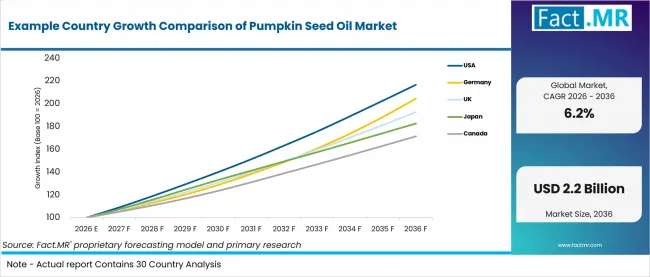
Example Country Growth Comparison Of Pumpkin Seed Oil Market | Source: Fact.MR
| Country | CAGR (2026-2036) |
|---|---|
| USA | 8.0% |
| Germany | 7.4% |
| UK | 6.8% |
| Japan | 6.2% |
| Canada | 5.5% |
| Australia | 5.0% |
| Brazil | 4.3% |
Source: Fact.MR analysis. Updated Jul 29, 2026
What supports USA adoption?
8.0% CAGR, supported by retail depth and cold-pressed oil positioning.
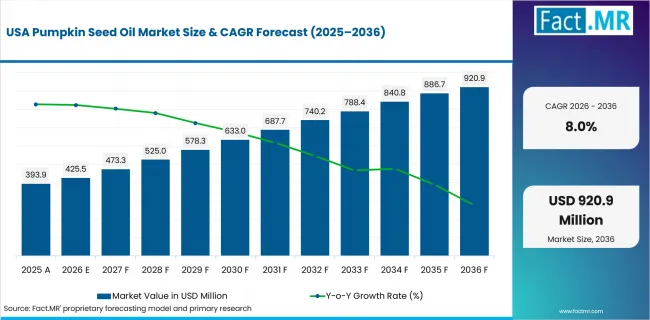
Pumpkin Seed Oil Market Country Value Analysis | Source: Fact.MR
The USA’s retail base gives specialty oil brands several ways to reach shoppers. Supermarkets support discovery through shelf comparison. Online platforms help repeat orders once consumers understand taste and use. Supplement aisles add a further route when brands can explain ingredient quality in plain language.
How is Germany scaling demand?
7.4% CAGR, driven by culinary familiarity and quality-led purchasing.
Germany’s demand is shaped by a stronger cooking-oil culture and close attention to origin. Food processors are expected to assess oxidation control and sourcing before expanding assortments. Glass bottles work well where premium cues matter. Local culinary acceptance gives the oil a clearer path than price-led alternatives.
What is driving UK growth from 2026 to 2036?
6.8% CAGR, backed by online retail and health-store placement.
Health-oriented shoppers give the UK a direct route for specialty oils. Online retail helps smaller brands explain taste and serving ideas. Foodservice testing can add credibility when the oil performs in dressings and finishing use. Private-label competition may still limit price power.
How does Japan perform?
6.2% CAGR, led by premium gifting and compact pack formats.
Japan’s market is expected to favor careful product selection and smaller packs. Premium gifting can support trial when the bottle design protects aroma and color. Personal care positioning adds a second path through plant-oil ingredients. Wider adoption still depends on simple use education.
What supports Canada’s growth?
5.5% CAGR, supported by specialty retail and serviceable distribution.
Canada’s geography makes dependable supply an important purchase condition. Specialty retailers can introduce pumpkin seed oil to health-focused shoppers. Online sellers help close access gaps between large cities and smaller markets. Repeat purchase depends on price comfort and a clear serving message.
How is Australia developing demand?
5.0% CAGR, driven by premium retail and imported specialty oil access.
Australia’s growth is expected to come from premium food retail and wellness-oriented shoppers. Import costs make pack economics important. Retailers need simple shelf education so consumers understand where the oil fits. Local distribution support can improve availability before broader grocery adoption.
What shapes Brazil’s outlook?
4.3% CAGR, supported by distributor-led expansion and selective retail trial.
Brazil’s growth is expected to move through premium retail and distributor relationships. Price sensitivity remains visible because consumers can choose lower-cost edible oils. Smaller packs are expected to reduce hesitation. Point-of-sale explanation can help shoppers understand the product before a repeat purchase.
Who leads the Pumpkin Seed Oil Market?
Olmuhle Fandler GmbH shows strong specialty-oil relevance, while Henry Lamotte Oils GmbH and AOS Products Pvt. Ltd. widen the ingredient-supply landscape.
Olmuhle Fandler GmbH adds premium edible-oil positioning and cold-pressed product experience. Henry Lamotte Oils GmbH strengthens bulk and specialty oil supply for food and formulation use. AOS Products Pvt. Ltd. contributes plant-based oils for food, cosmetic and wellness applications. La Tourangelle and NOW Foods extend market reach through retail food and supplement channels.
From 2026 to 2036, competition is expected to depend on cold-pressed quality, product origin and packaging performance. Retailers are also likely to compare aroma stability, glass-bottle quality and suitability for culinary or supplement use. Providers that explain everyday applications clearly and maintain consistent product quality may gain stronger demand from food processors, specialty retailers and wellness brands.
Which companies are the key providers?
Key companies include Olmuhle Fandler GmbH; Henry Lamotte Oils GmbH; AOS Products Pvt. Ltd.; La Tourangelle; and NOW Foods.
- Olmuhle Fandler GmbH
- Henry Lamotte Oils GmbH
- AOS Products Pvt. Ltd.
- La Tourangelle
- NOW Foods
Bibliography
- U.S. Department of Agriculture, Economic Research Service. (2025, April 24). Vegetables and pulses outlook: April 2025.
- U.S. Food and Drug Administration. (2025, January). Guidance for industry: Questions and answers regarding food allergen labeling—Edition 5.
- Food Standards Agency. (2026, June 25). Food supplements guidance. Government of the United Kingdom.
- La Tourangelle. (2025, August 28). More than just a pretty bottle: Olive oil packaging is key to keeping your oil fresh.
This Report Answers
- The report provides strategic intelligence on the Pumpkin Seed Oil Market across Product Type and Application choices that shape specialty oil demand.
- Segment analysis covers Cold-Pressed Pumpkin Seed Oil and Food & Beverages as the share leaders within the 2026 market.
- Country outlook evaluates the USA and Germany alongside the UK and Japan. Canada, Australia and Brazil complete the growth comparison across the profiled markets.
- Competitive analysis profiles Olmuhle Fandler GmbH alongside Henry Lamotte Oils GmbH. AOS Products Pvt. Ltd. broaden the provider set. La Tourangelle and NOW Foods complete the profiled names.
- Channel assessment covers Supermarkets & Hypermarkets and Online Retail. Specialty Stores, Pharmacies & Drug Stores and Direct Sales complete the channel view alongside glass-bottle and softgel packaging formats.
What does the Pumpkin Seed Oil Market cover?
Pumpkin seed oil products are used in culinary and supplement applications where taste and pack quality affect purchase decisions.
The Pumpkin Seed Oil Market covers cold-pressed and refined oil products. Virgin, organic and blended formats are included when pumpkin seed oil is the named product. Coverage extends to cooking oils and salad dressings. Softgels and liquid nutritional supplements are included. Skin care products and hair care products are covered when pumpkin seed oil is the named ingredient. Nutraceutical formulations and animal nutrition uses are included where the oil is purchased directly.
The market differs from general edible oil demand because commercial value comes from specialty positioning and origin proof. Extraction method and packaging quality give retailers another purchase test. Unrelated vegetable oils remain outside the boundary unless they are blended pumpkin seed oil formats. Finished foods and finished cosmetics are excluded unless the purchase decision depends directly on pumpkin seed oil.
What is included in the scope?
Pumpkin seed oil is used by food processors and individual consumers. Supplement companies, cosmetic manufacturers and pharmaceutical companies are included as well.
The scope includes Product Type and Application alongside End User, Distribution Channel and Packaging Type. Coverage spans Cold-Pressed Pumpkin Seed Oil and Organic Cold-Pressed Oil. Conventional Cold-Pressed Oil and Refined Pumpkin Seed Oil complete the main product view. Food & Beverages and Dietary Supplements are included. Personal Care & Cosmetics and Pharmaceuticals are included where pumpkin seed oil is purchased as a defined input.
What is excluded from the scope?
General cooking oils and unrelated personal care ingredients remain outside the scope of this market.
Edible oils that do not contain pumpkin seed oil are excluded. Finished food products are excluded when pumpkin seed oil is not the primary product or named ingredient. Finished beauty products are excluded unless demand depends on pumpkin seed oil sourcing. General grocery and wellness spending remains outside the scope unless it is directly tied to pumpkin seed oil purchase or formulation decisions.
How Was the Analysis Built?
The analysis draws on 120+ sources, 35+ company portfolios, 25+ countries, and more than 20 industry interviews.
- Primary Research: Primary research includes discussions with manufacturers, service providers, technology developers, distributors, end users, procurement teams, and subject-matter experts. These conversations examine purchasing priorities, product adoption, operational challenges, approval requirements, competitive positioning, and the factors that influence wider market acceptance.
- Desk Research: Desk research covers government statistics, regulatory publications, company filings, trade data, technical studies, industry associations, standards, public policy, and other authoritative sources. Every source used in the analysis is documented in the bibliography.
- Market Sizing and Forecasting: Market estimates combine historical performance, demand indicators, pricing and volume trends, segment shares, company participation, country-level growth, adoption patterns, investment activity, and barriers to market expansion.
- Data Validation and Update Cycle: Findings are validated by comparing primary interviews with public data, company activity, regulatory changes, trade patterns, and industry developments. Regular updates review new product launches, capacity changes, partnerships, approvals, procurement trends, and shifts in commercial adoption.
Segmentation
What is the report’s scope and coverage?
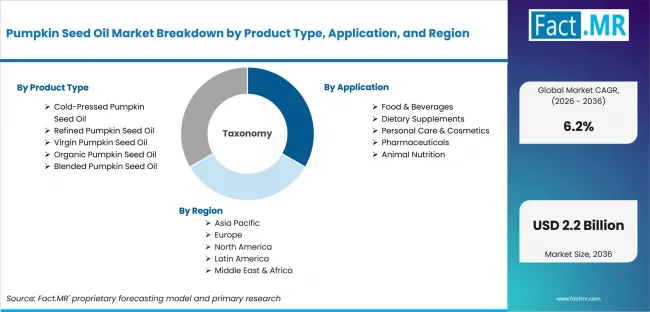
Pumpkin Seed Oil Market Breakdown By Product Type, Application, And Region | Source: Fact.MR
| Attribute | Details |
|---|---|
| Quantitative Units | USD billion in 2026 to USD billion by 2036 at CAGR |
| Market Definition | Pumpkin seed oil covers commercial sales of cold-pressed, refined, virgin, organic, blended and packaged oil formats used in food, supplement, personal care, pharmaceutical and animal nutrition applications. |
| Product Type | Cold-Pressed Pumpkin Seed Oil; Organic Cold-Pressed Oil; Conventional Cold-Pressed Oil; Refined Pumpkin Seed Oil; Food Grade Refined Oil; Cosmetic Grade Refined Oil; Virgin Pumpkin Seed Oil; Unfiltered Virgin Oil; Filtered Virgin Oil; Organic Pumpkin Seed Oil; USDA Organic Oil; EU Organic Oil; Blended Pumpkin Seed Oil; Culinary Oil Blends; Functional Nutrition Blends |
| Application | Food & Beverages; Cooking Oil; Salad Dressings; Dietary Supplements; Softgel Capsules; Liquid Nutritional Supplements; Personal Care & Cosmetics; Skin Care Products; Hair Care Products; Pharmaceuticals; Nutraceutical Formulations; Therapeutic Preparations; Animal Nutrition; Pet Nutrition; Livestock Feed Supplements |
| End User | Food Processing Companies; Functional Food Manufacturers; Condiment Producers; Individual Consumers; Health-Conscious Consumers; Home Cooks; Nutraceutical Companies; Dietary Supplement Manufacturers; Functional Nutrition Brands; Cosmetic Manufacturers; Skin Care Companies; Hair Care Companies; Pharmaceutical Companies; Herbal Medicine Manufacturers; OTC Product Manufacturers |
| Distribution Channel | Supermarkets & Hypermarkets; Hypermarkets; Supermarkets; Online Retail; E-Commerce Platforms; Brand Websites; Specialty Stores; Organic Food Stores; Health & Wellness Stores; Pharmacies & Drug Stores; Retail Pharmacies; Health Supplement Stores; Direct Sales; Manufacturer Outlets; B2B Supply Contracts |
| Packaging Type | Glass Bottles; Dark Glass Bottles; Clear Glass Bottles; Plastic Bottles; PET Bottles; HDPE Bottles; Capsules & Softgels; Softgel Capsules; Hard Capsules; Bulk Containers; Foodservice Containers; Industrial Drums; Sachets & Pouches; Single-Serve Sachets; Stand-Up Pouches |
| Regions Covered | North America; Latin America; Europe; East Asia; South Asia and Pacific; Middle East and Africa |
| Countries Covered | USA; Germany; UK; Japan; Canada; Australia; Brazil |
| Key Companies Profiled | Olmuhle Fandler GmbH; Henry Lamotte Oils GmbH; AOS Products Pvt. Ltd.; La Tourangelle; NOW Foods |
| Forecast Period | 2026 to 2036 |
| Approach | Hybrid top-down and bottom-up assessment using retail demand, specialty oil positioning, food processing use, supplement applications, country growth, channel activity and company participation. |
Source: Fact.MR analysis. Updated Jul 29, 2026
How is the market segmented?
-
By Product Type
- Cold-Pressed Pumpkin Seed Oil
- Organic Cold-Pressed Oil
- Conventional Cold-Pressed Oil
- Refined Pumpkin Seed Oil
- Food Grade Refined Oil
- Cosmetic Grade Refined Oil
- Virgin Pumpkin Seed Oil
- Unfiltered Virgin Oil
- Filtered Virgin Oil
- Organic Pumpkin Seed Oil
- USDA Organic Oil
- EU Organic Oil
- Blended Pumpkin Seed Oil
- Culinary Oil Blends
- Functional Nutrition Blends
-
By Application
- Food & Beverages
- Cooking Oil
- Salad Dressings
- Dietary Supplements
- Softgel Capsules
- Liquid Nutritional Supplements
- Personal Care & Cosmetics
- Skin Care Products
- Hair Care Products
- Pharmaceuticals
- Nutraceutical Formulations
- Therapeutic Preparations
- Animal Nutrition
- Pet Nutrition
- Livestock Feed Supplements
-
By End User
- Food Processing Companies
- Functional Food Manufacturers
- Condiment Producers
- Individual Consumers
- Health-Conscious Consumers
- Home Cooks
- Nutraceutical Companies
- Dietary Supplement Manufacturers
- Functional Nutrition Brands
- Cosmetic Manufacturers
- Skin Care Companies
- Hair Care Companies
- Pharmaceutical Companies
- Herbal Medicine Manufacturers
- OTC Product Manufacturers
-
By Distribution Channel
- Supermarkets & Hypermarkets
- Hypermarkets
- Supermarkets
- Online Retail
- E-Commerce Platforms
- Brand Websites
- Specialty Stores
- Organic Food Stores
- Health & Wellness Stores
- Pharmacies & Drug Stores
- Retail Pharmacies
- Health Supplement Stores
- Direct Sales
- Manufacturer Outlets
- B2B Supply Contracts
-
By Packaging Type
- Glass Bottles
- Dark Glass Bottles
- Clear Glass Bottles
- Plastic Bottles
- PET Bottles
- HDPE Bottles
- Capsules & Softgels
- Softgel Capsules
- Hard Capsules
- Bulk Containers
- Foodservice Containers
- Industrial Drums
- Sachets & Pouches
- Single-Serve Sachets
- Stand-Up Pouches
-
By Region
- North America
- Latin America
- Europe
- East Asia
- South Asia and Oceania
- Middle East and Africa
Frequently Asked Questions
Which Product Type leads the market?
Which Application leads the market?
Which End User leads the market?
Which Distribution Channel leads the market?
Which Packaging Type leads the market?
Which country records the highest listed CAGR?
What is the primary driver in this market?
What is the main restraint?
Why do Food Processing Companies lead demand?
Who worked on this report


Preview the report firsthand - request a free sample
Free SampleGet the brochure for pricing and purchase details
Download PDF