- Base Value(2026): 0.3 Bn
- Estimated Value(2026): 0.3 Bn
- Forecast Value (2036): 1.1 Bn
- CAGR (2026 - 2036): 13.3%
Regenerative Brake Calibration Services Market Forecast and Outlook 2026 to 2036
Valuation of the global regenerative brake calibration services market is projected to grow from USD 0.31 billion in 2026 to USD 0.93 billion by 2036, depicting a compound annual growth rate (CAGR) of 13.3% between 2026 and 2036.
This translates into a total growth of 200%, with the market forecast to expand at a compound annual growth rate (CAGR) of 13.3% between 2026 and 2036. The vehicle-level calibration segment is set to register 48.3% of the regenerative brake calibration services market in 2026.
Key Takeaways from Regenerative Brake Calibration Services Market
- Regenerative Brake Calibration Services Market Value (2026): USD 0.31 billion
- Regenerative Brake Calibration Services Market Forecast Value (2036): USD 0.93 billion
- Regenerative Brake Calibration Services Market Forecast CAGR: 13.3%
- Leading Service Category in Regenerative Brake Calibration Services Market: Vehicle-Level Calibration (48.3%)
- Key Growth Regions in Regenerative Brake Calibration Services Market: North America, Europe, Asia Pacific
- Key Players in Regenerative Brake Calibration Services Market: AVL, Bosch Engineering, FEV, Ricardo, KPIT
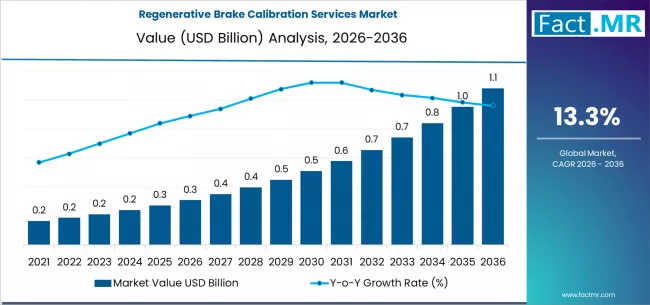
Regenerative Brake Calibration Services Market Market Value Analysis | Source: Fact.MR
Vehicle-level calibration services enable automotive manufacturers to deliver enhanced braking performance capabilities and comprehensive energy recovery management with improved operational efficiency characteristics and consistent performance across multiple vehicle deployment environments, providing superior cost-effectiveness characteristics for electric vehicle braking, energy recovery, and performance optimization requirements. Passenger EV applications are projected to register 69.0% of the regenerative brake calibration services market in 2026. Passenger EV applications in automotive facilities enable advanced energy recovery protocols, standardized performance procedures, and operational control optimization that are essential for braking system monitoring, regulatory adherence, and vehicle performance environments.
Regenerative Brake Calibration Services Market
| Metric | Value |
|---|---|
| Estimated Value in (2026E) | USD 0.31 billion |
| Forecast Value in (2036F) | USD 0.93 billion |
| Forecast CAGR (2026 to 2036) | 13.3% |
Source: Fact.MR analysis. Updated Jan 13, 2026
Category
| Category | Segments |
|---|---|
| Service Type | Vehicle-Level Calibration; HIL or SiL Validation; Safety or Compliance Testing; Other |
| Customer | OEMs; Tier-1 Suppliers; Startups or Autonomy Teams; Other |
| Engagement Model | Project-Based; Retainer or CoE Support; On-Site Campaigns; Other |
| Vehicle Segment | Passenger EVs; LCV EVs; Heavy-Duty EVs; Other |
| Region | North America; Europe; Asia Pacific; Latin America; Middle East & Africa |
Source: Fact.MR analysis. Updated Jan 13, 2026
Segmental Analysis
By Service Type, Which Segment Holds the Dominant Share in the Regenerative Brake Calibration Services Market?
Regenerative Brake Calibration Services Market Analysis By Service Type | Source: Fact.MR
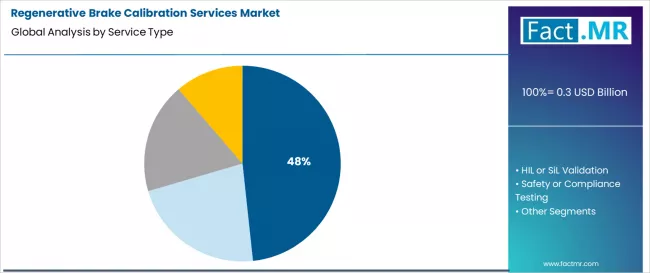
In terms of service type, the vehicle-level calibration segment leads the market with 48.3% share. Automotive professionals and electric vehicle specialists increasingly utilize vehicle-level calibration services for their superior precision control properties and operational efficiency characteristics.
- Manufacturing investments in advanced energy recovery technology and vehicle infrastructure continue to strengthen adoption among performance-focused automotive facilities.
- With automotive professionals prioritizing braking system performance and operational validation, vehicle-level calibration modules align with both efficiency objectives and operational requirements, making them the central component of comprehensive vehicle energy recovery monitoring strategies.
By Customer, Which Segment Registers the Highest Share in the Regenerative Brake Calibration Services Market?
Regenerative Brake Calibration Services Market Analysis By Customer | Source: Fact.MR
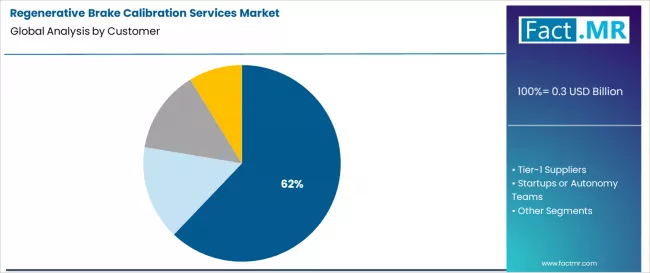
By customer, OEMs dominates with 62.1% share, underscoring its critical role as the primary customer category for automotive facilities seeking superior brake calibration capabilities and enhanced operational compliance credentials. Vehicle development engineers and facility operators prefer regenerative brake calibration solutions for OEMs due to their established performance validation requirements.
- Automotive facilities are optimizing service selections to support customer-specific requirements and comprehensive operational control strategies.
- As energy recovery technology continues to advance and operators seek efficient vehicle management methods, OEM applications will continue to drive market growth while supporting operational performance optimization and compliance cost reduction strategies.
What are the Drivers, Restraints, and Key Trends of the Regenerative Brake Calibration Services Market?
- Drivers: Vehicle manufacturer demand for enhanced energy recovery performance and advanced braking management initiatives drive mandatory adoption of high-performance regenerative brake calibration services across automotive facilities.
- Restraint: High service costs and technical complexity of integrating specialized energy recovery protocols into existing vehicle management processes limit market penetration.
- Trend 1: Shift toward automated calibration configurations that minimize operational requirements and reduce deployment costs for vehicle management.
- Trend 2: Development of specialized multi-parameter compatibility systems supporting multiple vehicle applications and operational condition compatibility.
Analysis of the Regenerative Brake Calibration Services Market by Key Country
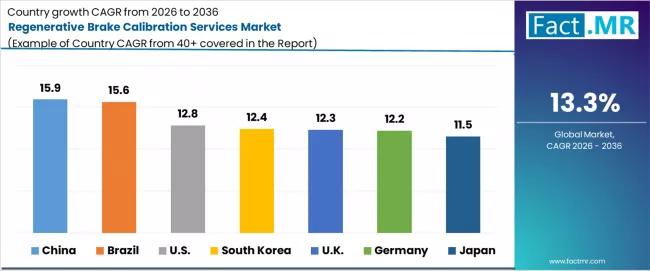
Regenerative Brake Calibration Services Market Cagr Analysis By Country | Source: Fact.MR
| Country | CAGR 2026 to 2036 |
|---|---|
| China | 15.9% |
| Brazil | 15.6% |
| U.S. | 12.8% |
| South Korea | 12.4% |
| Germany | 12.2% |
| U.K. | 12.3% |
| Japan | 11.5% |
Source: Fact.MR analysis. Updated Jan 13, 2026
The report covers an in-depth analysis of 40+ countries; top-performing countries are highlighted below.
What Opportunities Can Regenerative Brake Calibration Services Providers Expect in China?
Revenue from regenerative brake calibration services consumption and sales in China is projected to exhibit exceptional growth with a CAGR of 15.9% through 2036, driven by the country's rapidly expanding electric vehicle infrastructure, regulatory frameworks promoting energy efficiency initiatives, and initiatives supporting advanced brake calibration technologies across major industrial regions.
- Established automotive infrastructure and expanding operational consciousness are driving demand for regenerative brake calibration services across vehicle facilities, energy recovery developments, and comprehensive performance systems throughout Chinese automotive markets.
- Strong regulatory development and technology initiatives are supporting the rapid adoption of premium calibration services among quality-focused operators seeking to meet evolving operational standards and performance requirements.
What is the Brazilian Regenerative Brake Calibration Services Market Size?
Revenue from regenerative brake calibration services in Brazil is projected to expand at a CAGR of 15.6%, supported by rising automotive investment, growing operational consciousness, and expanding technology service capabilities. The country's developing infrastructure and increasing investment in vehicle management technologies are driving demand for brake calibration services across both traditional and modern automotive applications.
- Rising infrastructure development and expanding performance capabilities are creating opportunities for energy recovery adoption across vehicle management monitoring projects.
- Growing operational awareness initiatives and brake calibration technology advancement are driving the adoption of specialized performance equipment and services among fleet users.
What is the U.S. Regenerative Brake Calibration Services Market Size?
Revenue from regenerative brake calibration services in the U.S. is projected to grow at a CAGR of 12.8% through 2036, supported by the country's emphasis on operational precision, vehicle excellence, and advanced technology integration requiring efficient brake calibration solutions. American vehicle operators and performance-focused establishments prioritize performance monitoring and cost efficiency precision, making specialized regenerative brake calibration services essential components for both traditional and modern automotive applications.
- Advanced precision energy recovery technology capabilities and growing automotive applications are driving demand for brake calibration services across specialty performance applications.
- Strong focus on operational precision and vehicle excellence is encouraging users and service providers to adopt calibration solutions.
What Opportunities Can Regenerative Brake Calibration Services Providers Expect in Germany?
Revenue from regenerative brake calibration services in Germany is projected to grow at a CAGR of 12.2% through 2036, supported by the country's emphasis on analytical precision, technology excellence, and advanced vehicle system integration requiring efficient brake calibration solutions. German vehicle system operators and technology-focused establishments prioritize precision performance and operational control, making specialized regenerative brake calibration services essential components for both traditional and modern automotive applications.
- Advanced precision technology capabilities and growing automotive applications are driving demand for calibration services across specialty performance applications.
- Strong focus on analytical precision and technology excellence is encouraging users and service providers to adopt brake calibration solutions that support operational objectives.
What Challenges Can Regenerative Brake Calibration Services Providers Expect in South Korea?
Revenue from regenerative brake calibration services in South Korea is projected to grow at a CAGR of 12.4% through 2036, supported by established performance standards, expanding vehicle management markets, and emphasis on operational innovation accuracy across automotive sectors. South Korean vehicle system operators and quality management professionals prioritize quality performance and service consistency, creating steady demand for premium brake calibration solutions.
- Established vehicle management markets and expanding performance infrastructure are driving demand for quality regenerative brake calibration services across performance facilities.
- Strong emphasis on quality standards and operational efficiency is supporting the adoption of premium calibration varieties among users seeking proven performance.
What is the UK Regenerative Brake Calibration Services Market Size?
Revenue from regenerative brake calibration services in the UK is projected to grow at a CAGR of 12.3% through 2036, supported by the country's emphasis on analytical precision, technology excellence, and advanced vehicle system integration requiring efficient brake calibration solutions. British vehicle system operators and technology-focused establishments prioritize precision performance and operational control, making specialized regenerative brake calibration services essential components for both traditional and modern automotive applications.
- Advanced precision technology capabilities and growing automotive applications are driving demand for calibration services across specialty performance applications.
- Strong focus on analytical precision and technology excellence is encouraging users and service providers to adopt brake calibration solutions that support operational objectives.
What Challenges Do Japanese Regenerative Brake Calibration Services Providers Face?
Revenue from regenerative brake calibration services in Japan is projected to grow at a CAGR of 11.5% through 2036, supported by the country's emphasis on analytical precision, technology excellence, and advanced vehicle system integration requiring efficient brake calibration solutions. Japanese vehicle system operators and technology-focused establishments prioritize precision performance and operational control, making specialized regenerative brake calibration services essential components for both traditional and modern automotive applications.
- Advanced precision technology capabilities and growing automotive applications are driving demand for calibration services across specialty automotive applications.
- Strong focus on analytical precision and technology excellence is encouraging users and service providers to adopt brake calibration solutions that support operational objectives.
Competitive Landscape of the Regenerative Brake Calibration Services Market
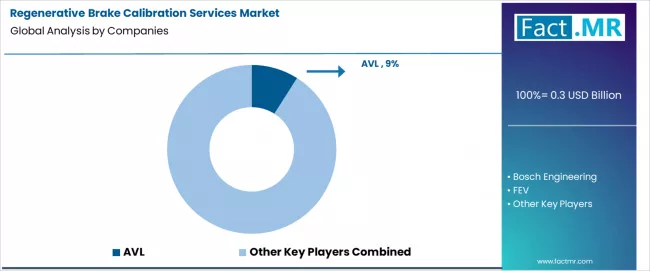
Regenerative Brake Calibration Services Market Analysis By Company | Source: Fact.MR
The regenerative brake calibration services market is characterized by competition among established automotive technology manufacturers, specialized energy recovery service providers, and integrated vehicle management solution companies. Companies are investing in advanced brake calibration technology, specialized performance platforms, innovation capabilities, and comprehensive service networks to deliver consistent, high-quality, and reliable regenerative brake calibration services.
Market players include AVL, Bosch Engineering, FEV, Ricardo, and others, offering institutional and commercial services with emphasis on operational excellence and energy recovery heritage. AVL provides integrated brake calibration automation with a focus on automotive market applications and precision performance networks.
Key Players in the Regenerative Brake Calibration Services Market
- AVL
- Bosch Engineering
- FEV
- Ricardo
- KPIT
- Tata Technologies
- dSPACE Services
- Capgemini Engineering
- ALTEN
- EDAG
Bibliography
- International Automotive Technology Association Research Committee. (2023). Energy recovery technologies and performance optimization in automotive calibration systems. International Automotive Technology Association.
- International Organization for Standardization. (2023). Vehicle quality management: Assessment of brake calibration technology, operational efficiency, and quality control of regenerative systems (ISO Technical Report). ISO.
- European Committee for Standardization. (2022). Vehicle quality management: Evaluation of energy recovery processing, quality control, and operational compliance in automotive facilities (EN Technical Report). CEN.
- Journal of Automotive Energy Recovery Editorial Board. (2024). Brake calibration processing, quality control, and performance optimization in modern automotive facilities. Journal of Automotive Energy Recovery, 150(4), 245-262.
- Automotive Technology Agency, Technical Committee. (2023). Advances in brake calibration processing and quality control technologies for automotive and transportation applications. Automotive Technology Agency.
Segmentation
Scope of the Report
| Items | Values |
|---|---|
| Quantitative Units (2026) | USD 0.31 Billion |
| Service Type | Vehicle-Level Calibration, HIL or SiL Validation, Safety or Compliance Testing, Other |
| Customer | OEMs, Tier-1 Suppliers, Startups or Autonomy Teams, Other |
| Engagement Model | Project-Based, Retainer or CoE Support, On-Site Campaigns, Other |
| Vehicle Segment | Passenger EVs, LCV EVs, Heavy-Duty EVs, Other |
| Regions Covered | North America, Europe, Asia Pacific, Latin America, Middle East & Africa |
| Countries Covered | China, Brazil, U.S., Germany, South Korea, U.K., Japan, and other countries |
| Key Companies Profiled | AVL, Bosch Engineering, FEV, Ricardo, KPIT, and other leading energy recovery companies |
| Additional Attributes | Dollar revenue by service type, customer, engagement model, vehicle segment, and region; regional demand trends, competitive landscape, technological advancements in brake calibration technology, operational performance optimization initiatives, vehicle enhancement programs, and premium energy recovery development strategies |
Source: Fact.MR analysis. Updated Jan 13, 2026
Regenerative Brake Calibration Services Market by Segments
-
Service Type :
- Vehicle-Level Calibration
- HIL or SiL Validation
- Safety or Compliance Testing
- Other
-
Customer :
- OEMs
- Tier-1 Suppliers
- Startups or Autonomy Teams
- Other
-
Engagement Model :
- Project-Based
- Retainer or CoE Support
- On-Site Campaigns
- Other
-
Vehicle Segment :
- Passenger EVs
- LCV EVs
- Heavy-Duty EVs
- Other
-
Region :
-
North America
- U.S.
- Canada
- Mexico
-
Europe
- Germany
- UK
- France
- Italy
- Spain
- Nordic Countries
- BENELUX
- Rest of Europe
-
Asia Pacific
- China
- Japan
- South Korea
- India
- Australia
- Rest of Asia Pacific
-
Latin America
- Brazil
- Argentina
- Rest of Latin America
-
Middle East and Africa
- Kingdom of Saudi Arabia
- United Arab Emirates
- South Africa
- Rest of Middle East and Africa
-
Other Regions
- Oceania
- Central Asia
- Other Markets
-
Frequently Asked Questions
How big is the regenerative brake calibration services market in 2026?
What will be the size of regenerative brake calibration services market in 2036?
How much will be the regenerative brake calibration services market growth between 2026 and 2036?
What are the key product types in the regenerative brake calibration services market?
Which customer segment to contribute significant share in the regenerative brake calibration services market in 2026?
Who worked on this report


Preview the report firsthand - request a free sample
Free SampleGet the brochure for pricing and purchase details
Download PDF