- Base Value(2025): 0.5 Bn
- Estimated Value(2026): 0.6 Bn
- Forecast Value (2036): 1.2 Bn
- CAGR (2026 - 2036): 8.3%
Residue-Minimized Fungicide for Fresh-Cut Produce Market Forecast and Outlook By FACT.MR
In 2025, the residue-minimized fungicide for fresh-cut produce market was valued at USD 0.5 billion. Based on Fact.MR analysis, demand for residue-minimized fungicides is estimated to grow to USD 0.6 billion in 2026 and USD 1.2 billion by 2036. FACT.MR projects a CAGR of 8.3% during the forecast period.
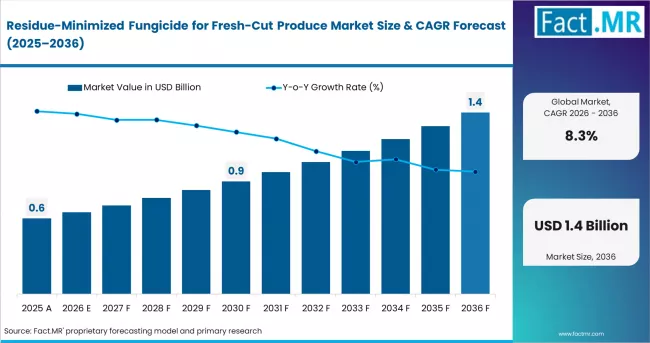
Residue Minimized Fungicide For Fresh Cut Produce Market Value Analysis | Source: Fact.MR
Summary of Residue-Minimized Fungicide for Fresh-Cut Produce Market
- Market Definition
- Covers synthetic low-residue, bio-based, and hybrid fungicides for fresh-cut produce treatment across global processing and storage channels.
- Demand Drivers
- EU MRL tightening under Regulation (EC) No 396/2005 is lowering allowable residue levels for fresh-cut imports.
- India FSSAI aligned MRL standards with Codex in 2024, increasing demand for compliant fungicide programs.
- U.S. retailers require third-party residue testing for fresh-cut supply chains.
- Key Segments Analyzed
- By Product Type: Synthetic low-residue fungicides lead with 46% share in 2026 due to proven efficacy and regulatory acceptance.
- By Application: Fresh-cut fruits lead with 55% share driven by spoilage sensitivity and export compliance.
- By End Use: Processing facilities lead with 50% share as treatment is applied immediately post-cutting.
- Analyst Opinion at FACT.MR
- Shambhu Nath Jha, Principal Consultant at Fact.MR, opines, 'MRL-compliant fungicide protocols are now the key procurement driver. Suppliers without validated low-residue performance risk losing contracts.'
- Strategic Implications
- Invest in low-residue and bio-based fungicide formulations aligned with EU, U.S., and India standards.
- Develop third-party residue testing and compliance documentation support.
- Expand bio-based product lines targeting organic-certified fresh-cut processors.
- Methodology
- Market sizing uses formulator revenues and application volumes. Validated with 2024–2025 procurement and audit data.
- Incorporates EFSA, EPA, and FSSAI regulatory inputs along with company filings.
- Forecasts consider retail expansion, regulatory tightening, and expert insights.
| Metric | Value |
|---|---|
| Estimated Value in 2026 | USD 0.6 billion |
| Forecast Value in 2036 | USD 1.2 billion |
| Forecast CAGR (2026 to 2036) | 8.3% |
Source: Fact.MR analysis. Updated Apr 28, 2026
Between 2026 and 2036, the market is expected to generate an absolute opportunity of USD 0.6 billion. Growth is anchored in regulatory tightening and evolving retail requirements. Demand is being reinforced by the rapid expansion of fresh-cut and ready-to-eat produce categories. Export-oriented suppliers are increasingly adopting residue-minimized fungicide solutions to meet strict compliance thresholds. At the same time, high formulation costs and extended approval timelines for new active substances continue to limit pace of expansion.
Procurement dynamics are shifting toward compliance-backed sourcing models. Buyers now prioritise fungicide programs with validated low-residue performance and third-party certification. Retail supply chains in Europe and the United States require detailed residue tracking at the batch level. Established players such as BASF and Bayer retain strong positioning due to their regulatory depth and established product portfolios. Large processing facilities are also diversifying sourcing strategies to reduce exposure to regulatory risks tied to specific active ingredients.
Regionally, growth is concentrated in export-driven economies. India emerges as the fastest-growing market, supported by processing capacity expansion and regulatory alignment. China follows, driven by large-scale infrastructure and export compliance requirements. Brazil continues to expand on the back of tropical produce exports and stricter hygiene mandates. Spain remains a key European hub due to its export intensity and regulatory enforcement. The United States shows steady growth supported by food safety frameworks, while mature European markets remain largely stable with compliance-driven replacement demand.
Segmental Analysis
Residue-Minimized Fungicide for Fresh-Cut Produce Market Analysis by Product Type
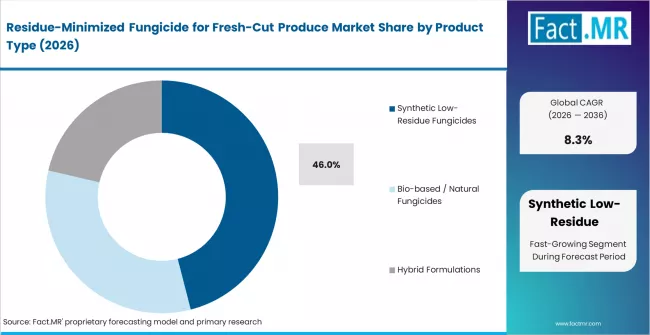
Residue Minimized Fungicide For Fresh Cut Produce Market Analysis By Product Type | Source: Fact.MR
Based on FACT.MR's report, synthetic low-residue fungicides hold 46% share in 2026. This segment leads due to proven efficacy. Regulatory documentation is well established. These products are already approved in export certification systems. Processors prefer them due to lower switching risk.
- BASF Formulation Investment: BASF updated Scala formulation in Q1 2025. Application rates were revised to meet EU MRL limits. The product supports processor certification requirements. [1]
- Syngenta Bio-based Development: Syngenta launched bio-based trials in Q3 2024. Focus is on citrus and stone fruits. Testing is aligned with EU MRL thresholds. Target market is organic and reduced-residue retail segments. [4]
- Hybrid Adoption Trend: Hybrid fungicide use increased 17% in Spain in 2024. Data from ASAJA confirms rising adoption. Retailers demand residue logs with partial bio-based content. Premium private-label segments are driving this shift. [5]
Residue-Minimized Fungicide for Fresh-Cut Produce Market Analysis by Application
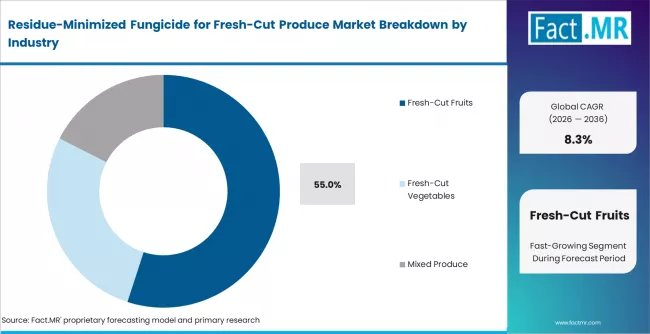
Residue Minimized Fungicide For Fresh Cut Produce Market Analysis By Application | Source: Fact.MR
Based on FACT.MR's report, fresh-cut fruits hold 55% share in 2026. This segment leads due to high spoilage risk. Residue requirements are also strict. Cut fruits like berries and citrus are highly sensitive. This increases demand for certified fungicide protocols.
- AgroFresh Expansion: AgroFresh expanded fungicide compatibility programmes in Q2 2024. Focus is on mango and papaya processors. Integration with ethylene systems supports export packhouses. [6]
- Nufarm Product Development: Nufarm launched low-residue fludioxonil in Q1 2025. Product meets FSANZ residue limits. Target is fresh-cut vegetable processors in Australia. [7]
- Mixed Produce Trend: FDA FSMA inspection data (2024) shows high non-compliance in mixed produce facilities. Residue issues are more frequent in multi-line processing. This drives demand for validated fungicide protocols. [3]
Drivers, Restraints, and Opportunities
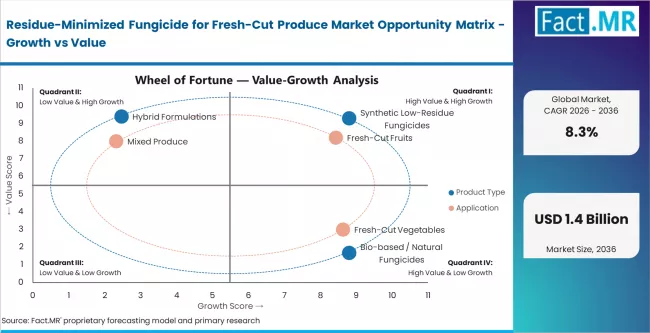
Residue Minimized Fungicide For Fresh Cut Produce Market Opportunity Matrix Growth Vs Value | Source: Fact.MR
Fact.MR analysis indicates that the residue-minimized fungicide market is a growing niche. Growth is driven by stricter retail residue standards. Regulatory MRL convergence across trade regions is accelerating adoption. The market has shifted from broad-spectrum fungicides. Demand is now specification-driven. Export compliance requirements define product selection.
Conventional fungicides are losing relevance in fresh-cut applications. Low-residue synthetic and bio-based options are gaining share. These products command 25–40% price premiums. Growth in India and Brazil supports volume expansion.
- EU MRL Enforcement: EU Regulation (EC) No 396/2005 tightened residue limits in 2024. Fourteen fungicide actives were affected. Non-compliant products are excluded from EU supply chains. BASF updated Scala fungicide dossiers in Q1 2025. Retailers like Tesco and Edeka embedded MRL audits into supplier requirements.
- India MRL Alignment: India aligned 65 pesticide MRLs with Codex in August 2024. This created new compliance requirements for processors. UPL Limited updated fungicide labels in Q4 2024. Adoption is rising across Maharashtra and Karnataka processing hubs. [2]
- U.S. RTE Compliance: U.S. FDA updated produce safety guidance in 2024. Zero-tolerance residue rules apply to fresh-cut RTE products. Corteva expanded bio-based fungicide validation in Q3 2024. Focus is on salad and fresh-cut fruit processors.
Regional Analysis
The residue-minimized fungicide for fresh-cut produce market is assessed across Asia Pacific, North America, Europe, Latin America, and Middle East and Africa, covering 40+ countries with distinct demand profiles shaped by MRL regulatory stringency, fresh-cut export volumes, food safety certification requirements, and retail private label residue mandates. The full report offers market attractiveness analysis by region and country.
.webp "Top Country Growth Comparison Residue Minimized Fungicide For Fresh Cut Produce Market Cagr (2026 2036)")
Top Country Growth Comparison Residue Minimized Fungicide For Fresh Cut Produce Market Cagr (2026 2036) | Source: Fact.MR
| Country | CAGR (2026 to 2036) |
|---|---|
| India | 9.0% |
| China | 8.7% |
| Brazil | 8.5% |
| Spain | 8.2% |
| United States | 7.8% |
Source: Fact.MR analysis. Updated Apr 28, 2026
Source: Fact.MR (FACT.MR) analysis, based on proprietary forecasting model and primary research
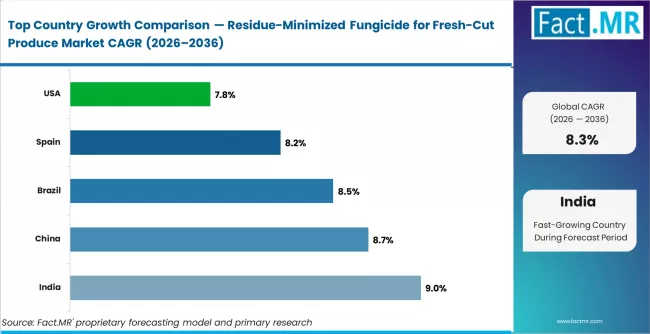
Residue Minimized Fungicide For Fresh Cut Produce Market Cagr Analysis By Country | Source: Fact.MR
Asia Pacific Residue-Minimized Fungicide for Fresh-Cut Produce Market Analysis
Asia Pacific is the fastest-growing region, driven by contrasting demand structures across India and China. India combines rapid processing capacity expansion with new FSSAI MRL compliance requirements, creating structured certification-driven demand. China anchors volume through large-scale fresh produce export infrastructure and evolving export residue compliance standards. BASF and UPL Limited operate established regional distribution networks, while local formulators compete in volume segments.
- India: Regulatory alignment and processing expansion drive 9.0% CAGR through 2036. FSSAI aligned 65 pesticide MRLs with Codex in August 2024. This created immediate compliance pressure for fresh-cut processors. Retail chains such as Reliance Fresh and DMart require certified residue protocols. UPL Limited updated Aris fungicide labels in Q4 2024. Processing hubs in Maharashtra and Karnataka increased adoption. National Horticulture Board programmes are expanding export-ready capacity. Growth is driven by compliance, retail demand, and processing scale-up.
- China: Export compliance and industrial scale support 8.7% CAGR through 2036. Ministry of Agriculture updated national MRL standards in 2024. Residue limits were tightened across key fungicide actives. Export processors in Shandong and Guangdong are upgrading treatment protocols. Compliance is required for EU, Japan, and South Korea markets. BASF expanded low-residue fungicide distribution in H2 2024. Domestic production capacity is increasing. Growth is driven by export alignment, regulation, and infrastructure scale.
FACT.MR's analysis of residue-minimized fungicide market in Asia Pacific covers India, China, Japan, South Korea, ASEAN, and Australia and New Zealand. Readers can find MRL compliance benchmarks, export fresh-cut volume data, and packhouse certification procurement trends.
Latin America Residue-Minimized Fungicide for Fresh-Cut Produce Market Analysis
Latin America is an export-driven, high-volume fresh-cut production region where Brazil and Chile anchor supply to European and North American retail. Post-harvest residue compliance is a direct market access requirement rather than a voluntary commitment. Syngenta and AgroFresh maintain strong positions through export-certified product lines and packhouse supply relationships.
- Brazil: Export certification and tropical supply chains support 8.5% CAGR through 2036. MAPA updated post-harvest MRL requirements in Q2 2024. Export packhouses must provide residue-tested documentation. Syngenta expanded validation programmes in H2 2024. Key regions include Sao Francisco Valley and Petrolina. GLOBALG.A.P. standards are being adopted across processors. Demand is linked to mango, papaya, and melon exports. Growth is driven by export compliance and certification standards.
FACT.MR's analysis of residue-minimized fungicide market in Latin America covers Brazil, Argentina, Chile, and Rest of Latin America. Readers can find export compliance trends, MAPA and SENASA regulatory data, and tropical fresh-cut packhouse procurement benchmarks.
Europe Residue-Minimized Fungicide for Fresh-Cut Produce Market Analysis
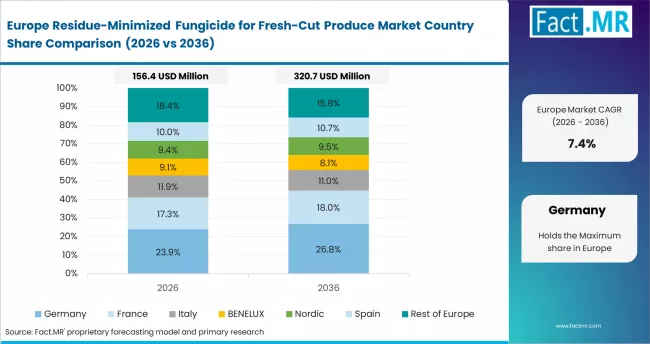
Residue Minimized Fungicide For Fresh Cut Produce Market Europe Country Market Share Analysis, 2026 & 2036 | Source: Fact.MR
Europe is the global MRL regulatory benchmark, functioning as both the most compliance-intensive consumption market and the origin of the residue standards that govern global fresh-cut produce export. EU Regulation (EC) No 396/2005 MRL review cycles directly determine product viability across all export-linked fresh-cut supply chains globally. BASF and Bayer hold strong positions through established EU registration depth for key post-harvest actives.
- Spain: EU regulatory leadership and export scale support 8.2% CAGR through 2036. Spain is the largest fresh produce exporter in Europe. EFSA updated MRL assessments in Q3 2024. This affected fungicide approval timelines. BASF revised Scala application rates in Q1 2025. Adoption is increasing across Murcia processing hubs. Retailers like Mercadona and Lidl require residue audits. Growth is driven by regulation, export intensity, and retail compliance.
FACT.MR's analysis of residue-minimized fungicide market in Europe covers Germany, France, the UK, Italy, Spain, and Rest of Europe. Readers can find EU MRL regulatory impact data, retail residue compliance benchmarks, and fresh-cut export processor procurement trends.
North America Residue-Minimized Fungicide for Fresh-Cut Produce Market Analysis
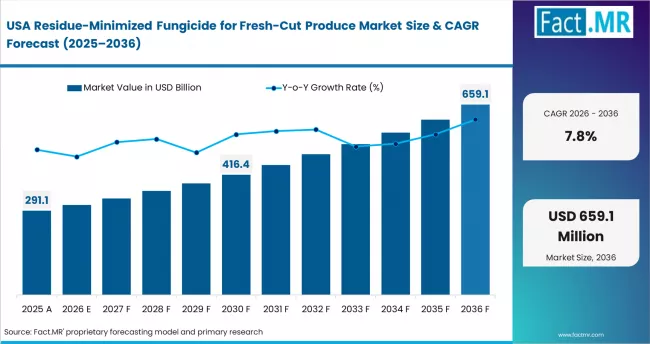
Residue Minimized Fungicide For Fresh Cut Produce Market Country Value Analysis | Source: Fact.MR
North America is a compliance-mature market anchored by U.S. FDA FSMA produce safety enforcement and ready-to-eat retailer residue specifications. Fresh-cut processing is a large, consolidated industry where fungicide procurement is embedded in documented SOP-level food safety protocols. Corteva Agriscience and Nufarm serve processing facility segments with certified low-residue and bio-based product lines.
- United States: Retail compliance and food safety enforcement support 7.8% CAGR through 2036. FDA updated produce safety guidance in 2024. Zero-tolerance residue rules apply to fresh-cut RTE supply chains. Corteva expanded bio-based fungicide validation in Q3 2024. Focus is on processors in California and Florida. USDA organic programme updates expanded approved actives in 2024. Adoption is rising in certified organic segments. Growth is driven by regulation, retail standards, and bio-based adoption.
FACT.MR's analysis of residue-minimized fungicide market in North America covers the United States, Canada, and Mexico. Readers can find FSMA enforcement data, retailer residue specification trends, and bio-based fungicide adoption benchmarks across fresh-cut processing facilities.
Competitive Aligners for Market Players
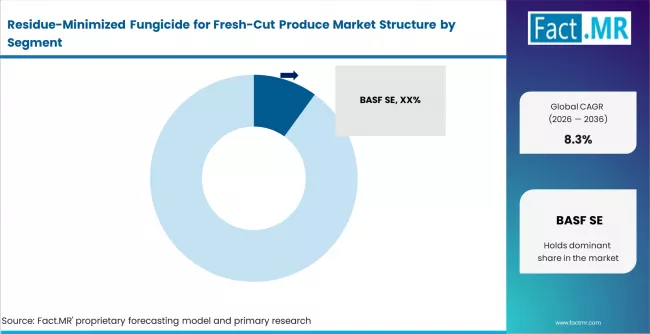
Residue Minimized Fungicide For Fresh Cut Produce Market Analysis By Company | Source: Fact.MR
The residue-minimized fungicide market for fresh-cut produce operates within a tightly regulated and specification-driven competitive environment. Market positioning is defined less by scale and more by the ability to meet evolving residue compliance standards across multiple jurisdictions. Companies such as BASF, Bayer, and Syngenta maintain strong footholds due to their established regulatory portfolios and deep experience in post-harvest chemistry. Their advantage lies in the ability to provide validated residue data, support dossier submissions, and align formulations with EU, U.S., and Codex MRL frameworks.
Competitive intensity is increasing as the market shifts toward low-residue and bio-based solutions. While large players retain leadership in synthetic low-residue formulations, emerging competitors are focusing on hybrid and bio-based alternatives to address retailer-driven demand for cleaner labels. This transition is not immediate, as bio-based products face efficacy consistency challenges and longer approval timelines, limiting rapid displacement of established actives. Buyer dynamics play a critical role in shaping competition. Fresh-cut processors and export pack houses operate under strict audit regimes, where fungicide protocols are embedded into certification systems. Once approved, switching suppliers becomes complex and risk-laden. This creates long-term supplier lock-in for qualified vendors.
At the same time, large processors are increasingly qualifying multiple suppliers to reduce dependency on a single active ingredient. This dual strategy balances compliance assurance with supply continuity, reinforcing a competitive landscape defined by regulatory credibility rather than price alone.
Key Players
- BASF SE
- Bayer AG
- Syngenta AG
- AgroFresh Solutions
- Nufarm Limited
- UPL Limited
- Corteva Agriscience
Bibliography
- [1] European Food Safety Authority (EFSA). (2024). MRL Assessment Opinions 2024: Maximum Residue Limit Review for Five Post-Harvest Fungicide Active Substances Applied to Fresh Citrus, Stone Fruit, and Leafy Vegetable Categories Under EU Regulation (EC) No 396/2005. efsa.europa.eu/en/topics/topic/pesticides
- [2] Food Safety and Standards Authority of India (FSSAI). (August 2024). MRL Alignment Notification 2024: Codex Alimentarius Maximum Residue Limit Standards for 65 Pesticide Actives on Fresh Produce Incorporated Into Indian Food Safety Standards Under FSSA 2006. fssai.gov.in
- [3] U.S. Food and Drug Administration. (2024). Produce Safety Guidance Update 2024: Zero-Tolerance Pesticide Residue Enforcement for Fresh-Cut Ready-to-Eat Produce Supplied to Federal Institutional and School Nutrition Procurement Channels Under FSMA Produce Safety Rule. fda.gov/food/guidance-documents-regulatory-information
- [4] Syngenta AG. (Q3 2024). Programme Update: Bio-based Fungicide Trial Programme for Fresh-Cut Citrus and Stone Fruit Export Packhouses in Spain and Morocco Validating Botanical Extract Antifungal Actives at EU MRL Thresholds for European Retail Fresh-Cut Categories. syngenta.com/en/news
- [5] ASAJA (Asociacion Agraria de Jovenes Agricultores). (2024). Spanish Fresh Produce Post-Harvest Handling Report 2024: Hybrid Fungicide Adoption Data at Fresh-Cut Processing Facilities Including Retailer Private Label Residue Specification Compliance Benchmarks. asaja.com
- [6] AgroFresh Solutions Inc. (Q2 2024). Programme Update: Post-Harvest Fungicide Compatibility and Low-Residue Treatment Protocol Integration with Ethylene Management Systems at Fresh-Cut Mango and Papaya Export Packhouses in Brazil and India. agrofresh.com/news
- [7] Nufarm Limited. (Q1 2025). Product Launch: Certified Low-Residue Fludioxonil Formulation for Fresh-Cut Vegetable Processors in Australia Certified Under FSANZ Food Safety Residue Thresholds Targeting Asian Vegetable Processing Facilities in Victoria and Queensland. nufarm.com/au
This Report Addresses
- Strategic intelligence on residue-minimized fungicide demand across synthetic low-residue, bio-based, and hybrid formats for fresh-cut fruit, vegetable, and mixed produce processing and packhouse applications globally.
- Market forecast from USD 0.6 billion in 2026 to USD 1.2 billion by 2036, at a CAGR of 8.3%.
- Growth opportunity mapping across India FSSAI MRL alignment, China post-harvest export compliance, Brazil MAPA regulation, Spain EU MRL enforcement, and U.S. FDA FSMA produce safety requirements.
- Segment analysis by product type (synthetic, bio-based, hybrid), application (fresh-cut fruits, vegetables, mixed), and end use (processing facilities, packhouses, cold storage) across global and regional markets.
- Regional outlook covering Asia Pacific MRL compliance-driven demand, Latin America export certification growth, North America FSMA enforcement, and Europe EU MRL regulation-led procurement.
- Competitive landscape of BASF, Bayer, Syngenta, AgroFresh, Nufarm, UPL Limited, and Corteva Agriscience covering MRL registration depth, processor supply relationships, and bio-based product positioning.
- Regulatory impact analysis covering EU Regulation (EC) No 396/2005 MRL reviews, U.S. FDA FSMA produce safety guidance, India FSSAI Codex alignment, Brazil MAPA post-harvest standards, and GLOBALG.A.P. fresh-cut certification requirements.
- Report delivered in PDF, Excel datasets, and presentation formats, supported by primary interviews, MRL compliance records, and formulator regulatory filings.
Residue-Minimized Fungicide for Fresh-Cut Produce Market Definition
The residue-minimized fungicide market for fresh-cut produce includes synthetic low-residue, bio-based, and hybrid formulations. These are applied to fresh-cut fruits, vegetables, and mixed produce. The purpose is to control post-harvest fungal decay.
Residue-Minimized Fungicide for Fresh-Cut Produce Market Inclusions
Covers global and regional forecasts from 2026 to 2036. Segmentation includes product type, application, and end use. Product types include synthetic low-residue, bio-based, and hybrid fungicides. Applications cover fresh-cut fruits, vegetables, and mixed produce. End uses include processing facilities, pack houses, and cold storage operators.
Residue-Minimized Fungicide for Fresh-Cut Produce Market Exclusions
Excludes pre-harvest fungicide applications. Also excludes broad-spectrum fungicides not designed for fresh-cut use. Standalone sanitizing washes without antifungal properties are omitted. Wax coatings without active fungicides are excluded.
Residue-Minimized Fungicide for Fresh-Cut Produce Market Research Methodology
- Primary Research
- Interviews conducted with fresh-cut processors, packhouse managers, and compliance officers. Also includes inputs from fungicide formulators. Key regions include India, the United States, Spain, Brazil, and China.
- Desk Research
- Analysis includes regulatory data and company filings. Sources include BASF, Bayer, Syngenta, and UPL Limited. Also includes EU EFSA reports, U.S. EPA standards, and India FSSAI updates (2024–2025).
- Market-Sizing and Forecasting
- Hybrid model using formulator revenues and application-level volumes. Includes average selling prices across product types. Segmentation is based on residue compliance grades.
- Data Validation and Update Cycle
- Validated using processor procurement data and MRL audit records. Supported by expert interviews. Updated annually.
Segmentation
Scope of Report
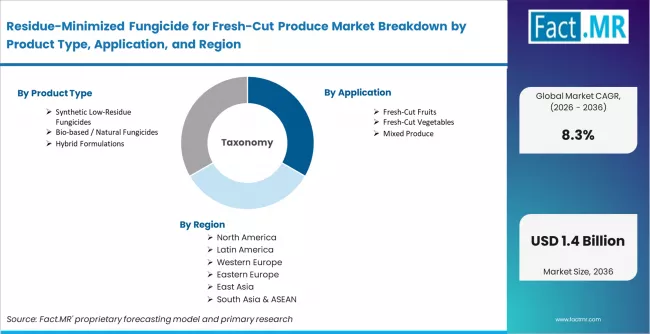
Residue Minimized Fungicide For Fresh Cut Produce Market Breakdown By Product Type Application And Region | Source: Fact.MR
| Attribute | Details |
|---|---|
| Quantitative Units | USD 0.6 billion (2026) to USD 1.2 billion (2036), at a CAGR of 8.3% |
| Market Definition | Market covers synthetic low-residue, bio-based, and hybrid fungicide formulations applied post-harvest to fresh-cut fruits, vegetables, and mixed produce, compliant with MRL thresholds across EU, U.S. EPA, and Codex-aligned regulatory frameworks globally. |
| Product Type Segmentation | Synthetic Low-Residue Fungicides, Bio-based/Natural Fungicides, Hybrid Formulations |
| Application Segmentation | Fresh-Cut Fruits, Fresh-Cut Vegetables, Mixed Produce |
| End Use Segmentation | Processing Facilities, Packhouses, Cold Storage |
| Application Coverage | Post-harvest antifungal treatment at fresh-cut processing facilities, packhouse fungicide protocol certification, cold storage decay control, export residue compliance documentation, and organic and reduced-residue certified fresh-cut production. |
| Regions Covered | North America, Europe, Asia Pacific, Latin America, Middle East and Africa |
| Countries Covered | USA, Canada, Mexico, Germany, UK, France, Italy, Spain, Nordic, BENELUX, China, Japan, South Korea, India, ASEAN, Australia and New Zealand, Brazil, Argentina, Chile, Saudi Arabia, UAE, Turkey, South Africa, Rest of MEA |
| Key Companies Profiled | BASF SE, Bayer AG, Syngenta AG, AgroFresh Solutions, Nufarm Limited, UPL Limited, Corteva Agriscience |
| Forecast Period | 2026 to 2036 |
| Approach | Hybrid top-down and bottom-up model using formulator revenues, application-level volume estimates by end use, average selling prices by product type and MRL certification tier, packhouse and processor procurement benchmarks, and primary interviews with post-harvest food safety and fungicide registration specialists. |
Source: Fact.MR analysis. Updated Apr 28, 2026
Residue-Minimized Fungicide for Fresh-Cut Produce Market by Segments
-
By Product Type:
- Synthetic Low-Residue Fungicides
- Bio-based / Natural Fungicides
- Hybrid Formulations
-
By Application:
- Fresh-Cut Fruits
- Fresh-Cut Vegetables
- Mixed Produce
-
By End Use:
- Processing Facilities
- Packhouses
- Cold Storage
-
By Region:
- North America
- United States
- Canada
- Mexico
- Latin America
- Brazil
- Argentina
- Chile
- Rest of Latin America
- Western Europe
- Germany
- United Kingdom
- France
- Italy
- Spain
- Nordic Countries
- BENELUX
- Rest of Western Europe
- Eastern Europe
- Russia
- Poland
- Hungary
- Balkan and Baltic
- Rest of Eastern Europe
- East Asia
- China
- Japan
- South Korea
- South Asia and Pacific
- India
- ASEAN
- Australia and New Zealand
- Rest of South Asia and Pacific
- Middle East and Africa
- Kingdom of Saudi Arabia
- UAE
- Other GCC Countries
- Turkey
- South Africa
- Rest of Middle East and Africa
- North America
Frequently Asked Questions
How large is the global residue-minimized fungicide for fresh-cut produce market in 2025?
What will the market size be in 2026?
What is the projected market size by 2036?
What is the expected CAGR from 2026 to 2036?
Which product type segment is poised to lead the market?
Which application segment holds the largest share?
Which end use segment dominates the market?
Which country shows the fastest growth?
What drives demand in this market?
Who are the key players in the market?
Who worked on this report


Preview the report firsthand - request a free sample
Free SampleGet the brochure for pricing and purchase details
Download PDF