- Market Value (2025): USD 310.4 Mn
- Estimated Value (2026): USD 325.0 Mn
- Forecast Value (2036): USD 515.0 Mn
- CAGR (2026-2036): 4.7%
What is the Ring Displays Market forecast to be worth by 2036?
USD 325.0 million in 2026 to USD 515.0 million by 2036, at 4.7% CAGR.
- The market was approximately USD 310.4 million in 2025, supported by recurring purchases across jewelry stores, trade shows, department stores, boutiques, and online-content studios.
- Revenue is projected to grow from USD 325.0 million in 2026 to USD 515.0 million by 2036 as jewelry sellers refresh presentation, expand assortments, and create more sale-ready imagery.
- The expected CAGR of 4.7% from 2026 to 2036 reflects store renovation, ring-focused visual merchandising, portable event presentation, and replacement of worn fabric-covered units.
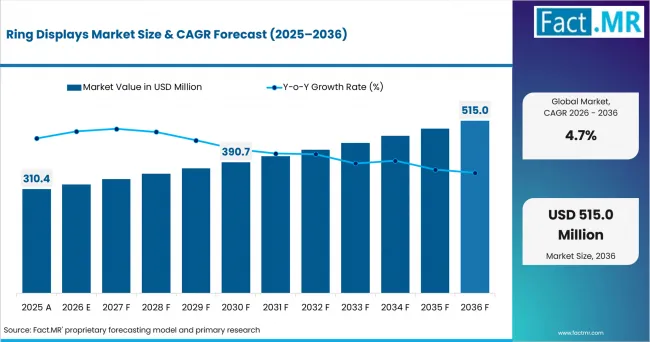
Ring Displays Market Value Analysis | Source: Fact.MR
What are the defining numbers behind Ring Displays Market growth?
USD 190.0 million absolute opportunity by 2036, led by Velvet ring displays and Single ring holder within their respective segments.
- Demand Drivers in the Market
- Retailers use individual holders and risers to create hierarchy around engagement, wedding, fashion, and statement rings.
- Multi-slot trays let staff present a broad assortment while keeping rings organized for comparison and return to the display case.
- E-commerce teams need neutral, repeatable props that support product images without competing with the ring itself.
- Trade-show vendors favor displays that protect presentation quality while packing efficiently for repeated transport.
- Key Segments Analyzed
- By Display Material: Velvet Ring Displays are expected to hold 33.0% share in 2026, supported by their soft, low-sheen surface, premium appearance, and ability to protect jewellery at contact points.
- By Display Configuration: Single Ring Holders are projected to account for 28.0% share in 2026 because they isolate one product clearly and are easy to reposition within display cases, shop windows, and product photography setups.
- By Retail Setting: Jewellery Stores are anticipated to capture 45.0% share in 2026 due to the continuous use of ring displays across counters, windows, consultations, and stock-handling areas.
- By Price Tier: Mid-range Displays are estimated to represent 38.0% share in 2026 as retailers seek a polished look and dependable durability without assigning luxury-level costs to every display point.
- By Sales Channel: Wholesale Distributors are forecast to hold 35.0% share in 2026 since they offer a wide range of fixture formats and allow retailers to replenish several related display products through one trade order.
- Analyst Opinion at Fact.MR
- Shambhu Nath Jha, Senior Analyst at Fact.MR, states, "Ring displays are small fixtures, but they shape how quickly a customer notices, compares, and handles the product. Suppliers that understand the difference between a selling counter, a window, a traveling tray, and a photography set can move beyond commodity competition."
- Strategic Implications
- Jewelry stores should assign display density according to the selling task, using open visual space for hero pieces and trays for comparison-led assortments.
- Brands need consistent color, texture, and height across replenishment orders so replacement pieces do not disrupt the presentation system.
- Manufacturers can reduce retailer friction by offering coordinated single holders, trays, risers, and travel-ready cases within one material palette.
- Online sellers should test reflections, lint, color cast, and ring stability under their actual camera and lighting setup before buying at scale.
Rio Grande's clear acrylic ring display illustrates a presentation approach that minimizes the visual weight of the fixture itself. Kling's broader standard and custom jewelry-presentation offering shows how suppliers can coordinate small ring units with a complete point-of-sale environment.
United States 5.6% CAGR. United Arab Emirates 4.9% CAGR. Italy 4.6% CAGR. Japan 4.3% CAGR. South Korea 4.1% CAGR.
How does the Ring Displays Market break down by segment?
The leading shares are Jewellery Stores at 45.0% by Retail Setting and Mid-range Displays at 38.0% by Price Tier.
Why do velvet ring displays lead the material segment?
Velvet Ring Displays hold 33.0% share in 2026.
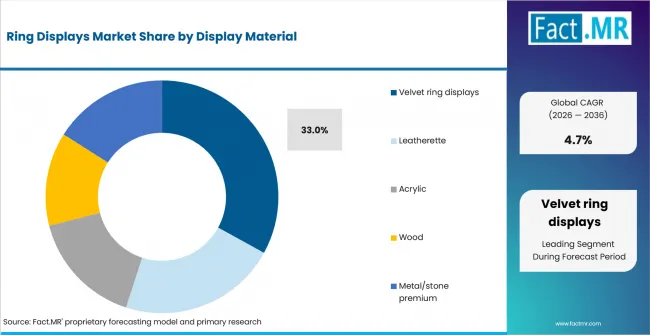
Ring Displays Market Analysis By Display Material | Source: Fact.MR
Velvet ring displays lead demand and remain common in display cases, trays, and presentation boxes. Leatherette follows, offering a wipeable, structured surface with a polished appearance. Acrylic, metal or stone premium formats, and wood create clearer, more architectural, or more natural visual identities.
What makes the single ring holder the leading configuration?
Single Ring Holders account for 28.0% share in 2026.
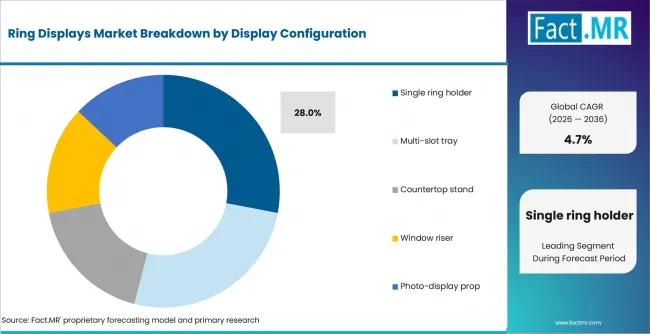
Ring Displays Market Analysis By Display Configuration | Source: Fact.MR
Single ring holders lead, giving merchants the greatest freedom to feature an individual piece. Multi-slot trays follow closely because staff can organize and compare a larger assortment efficiently. Countertop stands, window risers, and photo-display props address broader visibility, layered windows, and controlled image creation.
Why are jewelry stores the largest retail setting for ring displays?
Jewellery Stores represent 45.0% share in 2026.
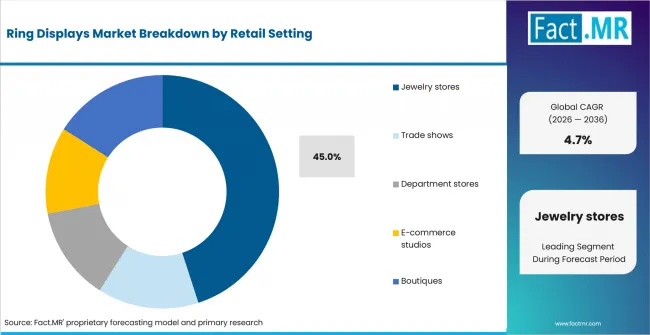
Ring Displays Market Analysis By Retail Setting | Source: Fact.MR
Jewelry stores lead demand, combining permanent presentation with regular replacement and assortment changes. Boutiques follow and often use more curated or distinctive display language. Trade shows, department stores, and e-commerce studios prioritize portability, merchandising consistency, or camera performance in different proportions.
Why does the mid-range tier capture the largest share?
Mid-range Displays capture 38.0% share in 2026.
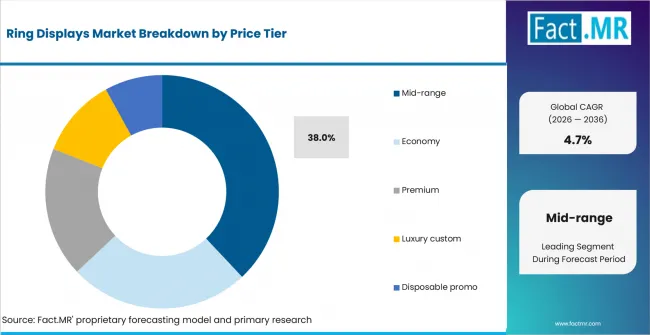
Ring Displays Market Analysis By Price Tier | Source: Fact.MR
Mid-range ring displays lead and offer the broadest fit across independent stores, chains, and exhibition sellers. Economy products follow, serving high-density trays, starter assortments, and frequent replacement. Premium, luxury custom, and disposable promotional units divide demand between premium brand expression and short-use practicality.
Why do wholesale distributors lead ring display sales?
Wholesale Distributors hold 35.0% share in 2026.
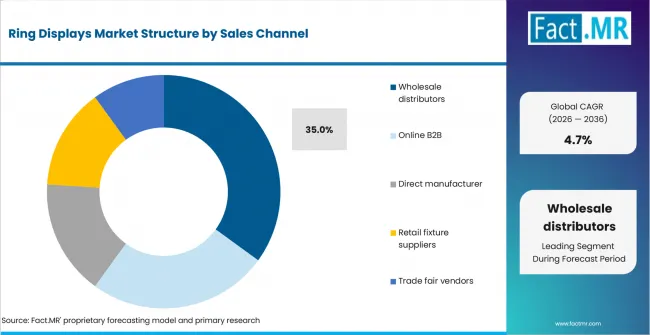
Ring Displays Market Analysis By Sales Channel | Source: Fact.MR
Wholesale distributors lead sales and serve buyers that need breadth, stock availability, and business pricing. Online B2B channels follow, making it easy to compare dimensions, colors, pack sizes, and delivery. Direct manufacturers, retail fixture suppliers, and trade-fair vendors compete through customization, project coordination, and physical product inspection.
What is accelerating Ring Displays Market adoption, and what is holding it back?
Store refresh and the need to present rings consistently across physical and digital touchpoints are the clearest accelerators. Demand is tempered by low-cost substitution and by the long useful life of durable trays and holders that remain visually compatible with a store's fixtures.
Drivers Impact Analysis
| DRIVER | (~) % IMPACT ON CAGR | GEOGRAPHIC RELEVANCE | IMPACT TIMELINE |
|---|---|---|---|
| Ring-category storytelling | +0.7% | United States, Italy, and premium retail centers | Short term (<= 2 years) |
| Retail footprint expansion | +0.6% | Europe and the United Arab Emirates | Medium term (2-4 years) |
| E-commerce photography | +0.5% | Global | Short term (<= 2 years) |
| Traveling jewelry events | +0.4% | Trade and consumer exhibition hubs | Medium term (2-4 years) |
| Fixture replacement cycles | +0.3% | Established jewelry markets | Long term (>= 4 years) |
Source: Fact.MR analysis. Updated Jul 22, 2026
- Ring-category storytelling: Merchants use height, spacing, and material to distinguish bridal, fine, fashion, and promotional ring groups. More deliberate category storytelling raises demand for coordinated holders and risers.
- Retail footprint expansion: New counters and stores require complete display inventories before opening. Subsequent assortment changes and wear create a continuing replenishment stream.
- E-commerce photography: Online sellers need rings to sit at repeatable angles for catalog and social content. Acrylic, neutral fabric, and specialized props can shorten setup time across a large product list.
Opportunity Impact Analysis
| OPPORTUNITY | (~) % IMPACT ON CAGR | GEOGRAPHIC RELEVANCE | IMPACT TIMELINE |
|---|---|---|---|
| Coordinated modular families | +0.4% | Independent and chain jewelry stores | Medium term (2-4 years) |
| Low-reflection photo props | +0.3% | E-commerce studios worldwide | Short term (<= 2 years) |
| Custom brand colors | +0.3% | Luxury boutiques and bridal specialists | Medium term (2-4 years) |
| Repairable display cores | +0.2% | Europe and North America | Long term (>= 4 years) |
Source: Fact.MR analysis. Updated Jul 22, 2026
- Coordinated modular families: A shared design language across single holders, trays, risers, and pads lets stores change layouts without mixing unrelated fixtures. Repeatable dimensions also simplify replenishment and planogram development.
- Low-reflection photo props: Materials that resist glare, lint, and color contamination can reduce image retouching. Suppliers can pair the prop with positioning guidance for common ring profiles.
- Custom brand colors: Retailers want presentation materials that support their interior and packaging identity. Small-batch color and texture programs can create value beyond a standard catalog item.
Restraints Impact Analysis
| RESTRAINT | (~) % IMPACT ON CAGR | GEOGRAPHIC RELEVANCE | IMPACT TIMELINE |
|---|---|---|---|
| Commodity price pressure | -0.3% | Online and wholesale channels | Short term (<= 2 years) |
| Style obsolescence | -0.3% | Fashion-led retail | Medium term (2-4 years) |
| Cleaning and wear | -0.2% | High-traffic jewelry stores | Short term (<= 2 years) |
| Inventory complexity | -0.2% | Distributors and multi-store chains | Medium term (2-4 years) |
Source: Fact.MR analysis. Updated Jul 22, 2026
- Commodity price pressure: Simple holders and trays are easy for buyers to compare by image and price. Suppliers must make dimensions, finish consistency, ring fit, and durability visible before purchase.
- Style obsolescence: A strong color or decorative treatment can age faster than a neutral display. Retailers may avoid distinctive products if matching replacements are uncertain.
- Cleaning and wear: Velvet and other fabric surfaces can show lint, dust, handling, and pressure marks. Acrylic is easier to wipe but can reveal scratches and reflections.
Where is ring display demand strongest?
United States 5.6% CAGR. United Arab Emirates 4.9% CAGR. Italy 4.6% CAGR. Japan 4.3% CAGR. South Korea 4.1% CAGR.
Regional analysis covers country chapters on United States, India, United Arab Emirates, Italy, Japan, and South Korea. Analysis on more than 30 countries is included in the full report.
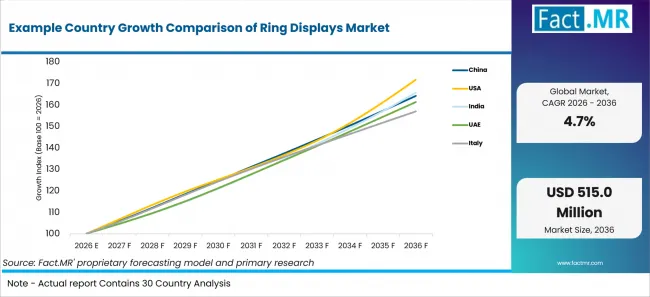
Example Country Growth Comparison Of Ring Displays Market | Source: Fact.MR
| COUNTRY | CAGR |
|---|---|
| United States | 5.6% |
| United Arab Emirates | 4.9% |
| Italy | 4.6% |
| Japan | 4.3% |
| South Korea | 4.1% |
Source: Fact.MR analysis. Updated Jul 22, 2026
How is the United States market likely to develop?
A 5.6% CAGR is projected for United States during 2026-2036.
The United Arab Emirates market is supported by luxury retail, tourism, jewellery exhibitions, and a strong concentration of gold and diamond stores. Retailers often prefer premium finishes, compact layouts, and display systems that highlight high-value rings while maintaining security. Frequent events and product launches also create demand for displays that are easy to install, transport, and reuse. Manufacturers that combine an upscale appearance with practical handling are expected to find wider opportunities across malls, jewellery districts, and exhibition venues.
How is the United Arab Emirates market positioned?
A 4.9% CAGR is projected for United Arab Emirates during 2026-2036.
United Arab Emirates' outlook is shaped by country-specific operating conditions. The Ministry of Economy promotes exhibitions as a business activity, and Sharjah's jewellery-show reporting demonstrates concentrated visitor and exhibitor traffic. Display suppliers therefore compete on fast installation, premium finish, secure presentation, and reuse across event calendars. For ring displays, that requirement reaches secure presentation, premium finish, rapid merchandising changes, and consistent photography-ready layouts. That makes country-specific operating evidence more useful than a broad demand statement: suppliers need to match the offer to local qualification, channel, and service requirements.
How is the Italy market likely to develop?
A 4.6% CAGR is projected for Italy during 2026-2036.
Italy's outlook is shaped by country-specific operating conditions. Official retail and service reporting reflects a design-led commercial environment. Buyers look for display or material choices that protect presentation quality, support specialist channels, and allow frequent refreshes without disrupting store operations. For ring displays, that requirement reaches secure presentation, premium finish, rapid merchandising changes, and consistent photography-ready layouts. That makes country-specific operating evidence more useful than a broad demand statement: suppliers need to match the offer to local qualification, channel, and service requirements.
How is the Japan market likely to develop?
A 4.3% CAGR is projected for Japan during 2026-2036.
Japan’s ring displays market is shaped by compact retail spaces, careful product arrangement, and strong attention to finish and detail. Jewellery stores often favour neat, space-efficient formats that separate individual pieces and maintain an uncluttered appearance. Demand is also expected to rise with bridal jewellery sales, gifting occasions, department-store counters, and online product photography. Display companies that offer precise construction, consistent quality, and adaptable designs are expected to gain greater acceptance.
How is the South Korea market likely to develop?
A 4.1% CAGR is projected for South Korea during 2026-2036.
South Korea’s market is expected to grow with the expansion of fashion jewellery, online retail, department stores, and trend-led product launches. Retailers frequently update collections to respond to changing styles, which increases demand for flexible displays that allow quick rearrangement. Clean layouts, modern finishes, and photography-friendly formats are especially important for brands selling through both physical and digital channels. Companies offering lightweight, modular, and visually consistent display systems are expected to benefit from these purchasing trends.
Who leads the Ring Displays Market?
Kling, Displays2go, U.S. Display Group, and Rio Grande compete through assortment breadth, material finish, customization, availability, and jewelry-channel familiarity.
Kling leads the company group, followed by Displays2go and U.S. Display Group. Kling's presentation focus supports standard and custom programs, while broad online catalogs compete on selection, product visibility, and rapid ordering.
Rio Grande is also active in the space. Their connection to working jewelers and bench buyers can support ring-display sales alongside tools, packaging, and related merchandising supplies; specialist fixture providers can counter through project service and exact brand matching.
Which companies are the key providers?
The company set includes Kling, Displays2go, U.S. Display Group, and Rio Grande.
- Kling
- Displays2go
- U.S. Display Group
- Rio Grande
Bibliography
- U.S. Census Bureau. (2026, July 16). Monthly retail trade: June 2026 sales report. U.S. Department of Commerce.
- Sharjah Chamber of Commerce and Industry. (2025, September 29). “Emirati Goldsmiths” platform shines at the 56th Watch and Jewellery Middle East Show with a dazzling array of unique collections. Government of Sharjah.
- Italian Exhibition Group. (2025). Vicenzaoro September 2025: High jewellery in continuous evolution. Vicenzaoro.
- RX Japan Ltd. (2025). IJT 2025 exhibitor directory: International Jewellery Tokyo.
This Report Addresses
- The report establishes the 2025 ring-display baseline and forecasts market revenue through 2036.
- It reviews United States, India, United Arab Emirates, Italy, Japan, and South Korea, within coverage that reaches more than 30 countries.
- It assesses Kling, Displays2go, U.S. Display Group, and Rio Grande.
- It evaluates velvet, leatherette, acrylic, wood, and premium metal or stone presentation.
- It covers jewelry-store, trade-show, department-store, e-commerce-studio, and boutique demand.
- It connects the forecast to retail expansion, category storytelling, photography, event mobility, wear, and replenishment.
What does the Ring Displays Market cover?
The study focuses on fixtures whose primary purpose is to display rings rather than the wider universe of jewelry presentation.
Revenue includes new ring holders, cones, trays, stands, risers, and dedicated props sold individually, in packs, or as ring-only sets. Standard, premium, custom, economy, and short-use promotional products are modeled at their realized selling value.
Demand is segmented by material, configuration, setting, price tier, and sales channel. Country estimates reflect jewelry retail activity, exhibitions, store development, online selling, local supply, and design preferences.
What is included in the scope?
A fixture enters scope when its form is designed specifically to secure or present rings.
Single-ring holders, cones, fingers, clips, multi-slot pads and trays, ring-focused countertop stands, window risers, and photography supports are included. Covered products may be fabric-covered, leatherette, acrylic, wood, metal, stone, or hybrid constructions.
Custom colors, logos, inserts, and protective travel features are included when reported as part of the display. Sales to physical retailers, event sellers, studios, and direct online merchants are all covered.
What is excluded from the scope?
Broader jewelry fixtures and packaging are separated to avoid counting the same presentation spend twice.
Necklace busts, earring stands, bracelet bars, mixed-category towers, display cases, plinths, lighting, store cabinetry, and gift packaging are excluded. Used fixtures, cleaning services, and replacement fabric reported without a covered ring-display unit are also outside scope.
How Was the Analysis Built?
The analysis draws on 120+ sources, 35+ company portfolios, 25+ countries, and more than 20 industry interviews.
- Primary Research: Primary research includes discussions with manufacturers, service providers, technology developers, distributors, end users, procurement teams, and subject-matter experts. These conversations examine purchasing priorities, product adoption, operational challenges, approval requirements, competitive positioning, and the factors that influence wider market acceptance.
- Desk Research: Desk research covers government statistics, regulatory publications, company filings, trade data, technical studies, industry associations, standards, public policy, and other authoritative sources. Every source used in the analysis is documented in the bibliography.
- Market Sizing and Forecasting: Market estimates combine historical performance, demand indicators, pricing and volume trends, segment shares, company participation, country-level growth, adoption patterns, investment activity, and barriers to market expansion.
- Data Validation and Update Cycle: Findings are validated by comparing primary interviews with public data, company activity, regulatory changes, trade patterns, and industry developments. Regular updates review new product launches, capacity changes, partnerships, approvals, procurement trends, and shifts in commercial adoption.
Segmentation
What is the report's scope and coverage?
| ATTRIBUTE | DETAILS |
|---|---|
| Quantitative Units | USD Million in 2026 to USD Million by 2036 at CAGR |
| Market Definition | The market covers ring-specific holders, cones, slots, trays, stands, risers, and photography props used to present, organize, or image one or more rings. |
| Display Material | Velvet ring displays; Leatherette; Acrylic; Wood; Metal/stone premium |
| Display Configuration | Single ring holder; Multi-slot tray; Countertop stand; Window riser; Photo-display prop |
| Retail Setting | Jewelry stores; Trade shows; Department stores; E-commerce studios; Boutiques |
| Price Tier | Mid-range; Economy; Premium; Luxury custom; Disposable promo |
| Sales Channel | Wholesale distributors; Online B2B; Direct manufacturer; Retail fixture suppliers; Trade fair vendors |
| Regions Covered | North America; Europe; Middle East & Africa |
| Countries Covered | United States; India; United Arab Emirates; Italy; Japan; South Korea (analysis extends to 30+ countries) |
| Key Companies Profiled | Kling; Displays2go; U.S. Display Group; Rio Grande |
| Forecast Period | 2026 to 2036 |
| Approach | Demand is evaluated using jewelry retail expansion, ring assortment size, display replacement cycles, material and configuration mix, price-tier trends, sales-channel activity, trade-show participation. |
Source: Fact.MR analysis. Updated Jul 22, 2026
How is the market segmented?
-
By Display Material:
- Velvet ring displays
- Leatherette
- Acrylic
- Wood
- Metal/stone premium
-
By Display Configuration:
- Single ring holder
- Multi-slot tray
- Countertop stand
- Window riser
- Photo-display prop
-
By Retail Setting:
- Jewelry stores
- Trade shows
- Department stores
- E-commerce studios
- Boutiques
-
By Price Tier:
- Mid-range
- Economy
- Premium
- Luxury custom
- Disposable promo
-
By Sales Channel:
- Wholesale distributors
- Online B2B
- Direct manufacturer
- Retail fixture suppliers
- Trade fair vendors
-
By Region:
- North America
- United States
- Europe
- Germany
- Italy
- Russia
- United Kingdom
- Asia Pacific
- Japan
- South Korea
- India
- Latin America
- Brazil
- Middle East and Africa
- Morocco
- Saudi Arabia
- United Arab Emirates
- North America
Frequently Asked Questions
What is the ring displays market worth in 2026?
What market value is expected in 2036?
What CAGR is forecast for ring displays?
Which display material leads?
Which configuration has the largest share?
Which retail setting buys the most ring displays?
Which price tier is largest?
Which sales channel leads?
Who worked on this report


Preview the report firsthand - request a free sample
Free SampleGet the brochure for pricing and purchase details
Download PDF