- Base Value(2025): 742 Mn
- Forecast Value (2035): 1077 Mn
- CAGR (2035): 4.9%
Road Saw Market Outlook 2025 to 2035
The global road saw market is expected to reach USD 1,077 million by 2035, up from USD 742 million in 2025. During the forecast period 2025 to 2035, the industry is projected to expand at a CAGR of 3.8%.
The road market is guided by the high pace of urbanization, growth of infrastructures and the need to have efficient and accurate road construction machines. Growing attention to the safety of the roads, quality pavement maintenance, and the timely construction of the projects stimulate their adoption in highways, urban roads, and industrial sites.
The use of advanced technologies such as diamond-tipped blades, automated depth control, energy-efficient engines, and other technologies lower the operations cost, increase blade precision, productivity, and regulatory standards and sustainability initiatives also stimulate the market to grow.
Quick Stats for Road Saw Market
- Industry Value (2025): USD 742 million
- Projected Value (2035): USD 1,077 million
- Forecast CAGR (2025 to 2035): 3.8%
- Leading Segment (2025): Walk-behind Road Saws (38.7% Market Share)
- Fastest Growing Country (2025-2035): India (6.9% CAGR)
- Top Key Players: Makita Corporation, Husqvarna AB, Hilti AG, Andreas Stihl AG & Co. KG, Robert Bosch GmbH, Wacker Neuson SE, and Eibenstock Elektrowerkzeuge
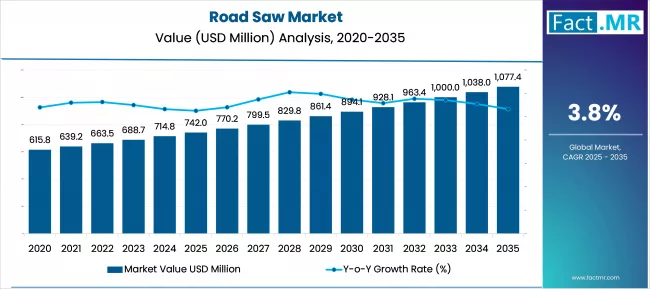
Road Saw Market Market Value Analysis | Source: Fact.MR
What are the drivers of the Road Saw Market?
The road saw market is expanding with the focus of industries putting on energy efficiency, safety of operators, and smart building developments. High-performance road cutting equipment with high precision is demanded more with rapid urbanization, industrialization and massive infrastructure projects. Recent inventions such as automated depth control, diamond-tipped blades and IoT-enabled monitoring enable remote control, lower maintenance, and enhance accuracy of the cuts.
There is also increased adoption due to increasing safety regulations, demand of timely road repairs, and improved quality standards in highways and urban roads as well as in industrial locations. The trends in sustainability compel manufacturers to come up with durable saws, energy-efficient, and environmentally friendly saws which will help in the development of long-term infrastructure with minimal ecological effects.
What are the regional trends of the Road Saw Market?
The road saw market demonstrates different adoption rates depending on the development of infrastructure, urbanization and modernization of construction in different areas.
North America has experienced high demand of high quality, energy saving and automated highway, industrial and civic project road cutting equipment.
Western Europe is concerned about the durable and environmentally friendly saws that are under strict safety and sustainability regulations.
Asia-Pacific spearheaded by China, India and Southeast Asia has witnessed a fast pace of investment in urban infrastructure, highways and industrial zones.
Latin America follows slowly because of few big-scale projects whereas, Middle East and Africa focus on efficiency and safety in building and industrial use.
What are the challenges and restraining factors of the Road Saw Market?
The road saw market experiences a number of threats that limit growth. Small and medium enterprises can enter the market with low barriers which means they provide low quality saws, which impacts the general adoption. The other differences in regional infrastructure, installation requirements and differences in maintenance expectations give rise to uneven performance.
The extreme environments, such as heat, dust and heavy use, hasten the wear and tear of the blade thus increasing the costs of operation. The manufacturing operations across the world are burdened by the need to comply with the safety, environmental, and efficiency policies. Scalability is further constrained by fragmented supply chains, lack of standardization as well as the absence of skilled operators in the developing regions. The cost of entry is also very high with high maintenance needs, which limits uptake in small and medium-sized constructions.
Country-Wise Insights
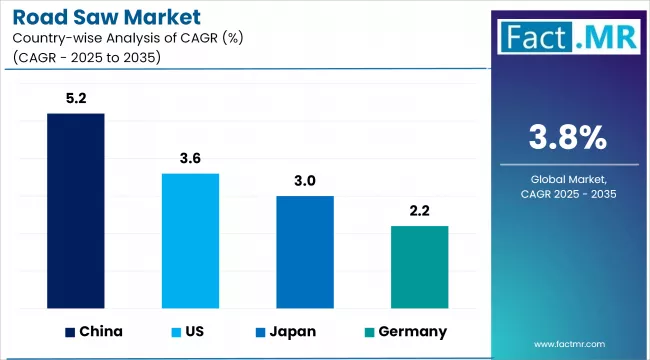
Road Saw Market Cagr Analysis By Country | Source: Fact.MR
Rapid urbanization and infrastructure growth drive China’s Road Saw Market
The Asia-Pacific road saw market is dominated by China due to high rate of urbanization, massive infrastructure development and highway expansions. The demand of the advanced cutting equipment is stimulated by government efforts to enhance transportation systems and smart cities.
Walk-behind and ride-on saws are commonly used in municipal, industrial and commercial applications. Domestic and foreign manufacturers are increasing the number of distribution channels and technological improvements such as diamond blades, fuel-efficient engines and automated depth control are making adoption more. Construction boom and industrial and commercial growth makes China the largest contributor to the global Road Saw Market.
Highway maintenance and urban projects boost United States’ demand
U.S market has the advantage of having a mature construction industry interested in highway systems maintenance, urban development, and industrial construction. The federal and state infrastructure initiatives such as bridge renovation and road maintenance have been supporting the demand of road saw.
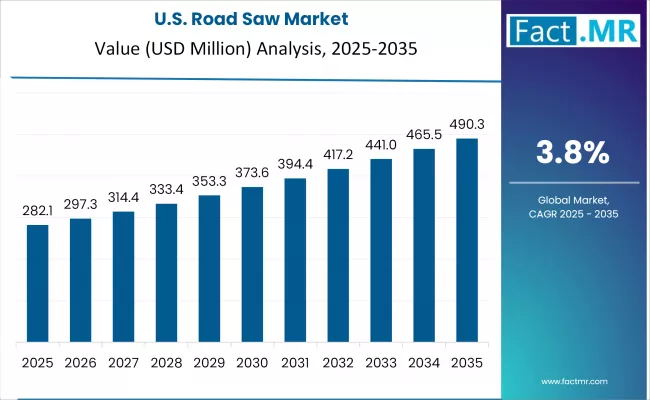
Road Saw Market Country Value Analysis | Source: Fact.MR
The use of energy efficient, long-lasting equipment is increasing, and the contractors are opting to use the automated, precision-cutting tools that enhance productivity. The growth of the market is further fueled by technological improvements, safety standards and the supply of qualified operators. The U.S. remains a major North American distribution center of both home-produced as well as imported road saw products.
Renovation, industrial, and municipal projects support Germany’s market growth
The market of the road saw in Europe is dominated by Germany, which is motivated by massive road maintenance, urban development and commercial infrastructural development. Handheld and ride-on road saws are in constant demand due to the municipal and industrial projects.
The market is defined by the high-quality and precision-engineered equipment, and the safety, efficiency, and sustainability. Environmental guidelines and laws are also promoting saws that are energy saving and low-emitting. Cooperation with manufacturers and construction contractors enhance the adoption. The location of Germany is central and it allows distribution to other European markets and therefore is a strategic market by international players. Good infrastructure investment and modernization of highways, and urban development initiatives favor the uninterrupted growth.
Category-Wise Analysis
Walk-behind saws lead with versatility and precise cutting
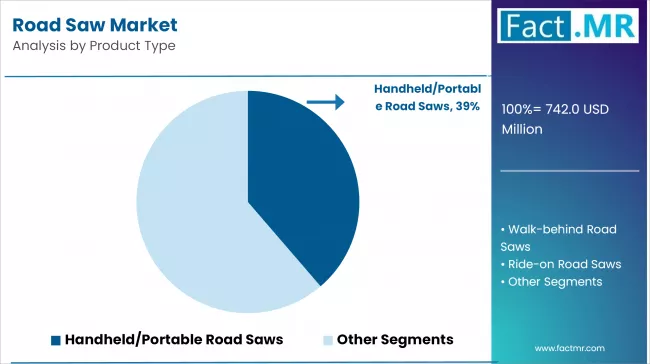
Road Saw Market Analysis By Product Type | Source: Fact.MR
Walk-behind road saws are more predominant in the market since they are versatile, easy to work with, and effective in several construction works. They are commonly employed in the cutting of concrete, asphalt, and other hard surfaces on the highways, roads in urban areas and municipal projects.
Contractors and maintenance practitioners like walk behind saws on small and medium scale buildings due to its mobility and accuracy in cutting. They are adopted more by technological advancements like variable cutting depth, dampening, safety measures, etc. Walk-behind saws are experiencing great demand globally in developed and emerging markets especially in Asia-Pacific and North America.
Diesel-powered saws dominate heavy-duty construction applications globally
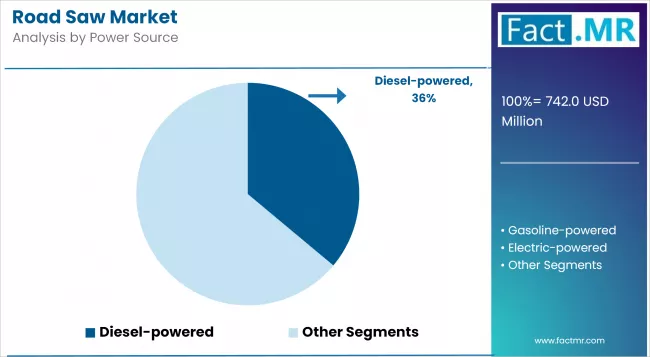
Road Saw Market Analysis By Power Source | Source: Fact.MR
Road saws that use diesel are popular because they are used in heavy construction work where a lot of power is needed and long working hours are needed. They are widely applied in road work, industrial work and in municipal infrastructure where gasoline or electric types might not provide the necessary torque.
Diesel engines are fuel efficient and economical in operations that are continuous thus are suitable to a large scale cutting. Their strong construction can sustain excessive temperatures and heavy loads that improve productivity. As more contractors invest in road repair and city improvement, the use of diesel-powered saws still continues to be popular among them, especially where there are larger infrastructure developments like China, India, and the United States.
Road saws enable precision cutting in architectural engineering projects
Road saws are utilized in the architectural engineering sector as one of the main applications, where they are needed in the precision cutting of concrete and asphalt during building, road, and towns design projects. Road saws are used to make detailed cuts that are used in sidewalks, facades, parking lots, and decorative pavements, which are in line with aesthetic and structural needs. These applications are made with high-performance saws with diamond blades, and variable cutting depths.
The field of architectural engineering is influenced by the need to introduce road saws due to the growing urbanization, smart cities, and infrastructure improvements in commercial and municipal locations. Its most common application is in Europe, North America and Asia-Pacific because of high standards of construction.
Competitive Analysis
Key players in the Road Saw Market include Makita Corporation, Husqvarna AB, Hilti AG, Andreas Stihl AG & Co. KG, Robert Bosch GmbH, Wacker Neuson SE, DEWALT Industrial Tool Co., Diamond Products Limited and Eibenstock Elektrowerkzeuge
The Road Saw Market is very competitive and the major players are distinguishing themselves in terms of technology, durability, energy saving, and innovation. The focus of leading companies such as Husqvarna, STIHL, Hilti, Makita, and Bosch is on sophisticated saws with diamond-tipped blades, automated depth controls, and fuel- / battery-efficient engines to the commercial, industrial, and infrastructure projects. Immense investment in R&D contributes to increase the life of the blades, precision in cutting, and safety of the operators.
Partnerships with contractors, road construction industry, and OEMs increase the market coverage. The competitive pricing, high-performance equipment, low maintenance, intelligent features and reliable service make success possible in case a company can remain at the prestigious baseline in this dynamic market.
Recent Development
- In March 2023, Husqvarna FS 600 E walk-behind electronic floor saw was first seen in the World of Concrete (WOC) 2023 trade show. Sustainability is also addressed in this model because it reduces the amounts of emissions and noise that make it suitable in the indoor and overcrowded spaces. FS 600 E will be accurate and efficient competent in the face of increasing requirements on environmentally friendly construction machinery.
- In March 2025, Makita's entry into the road saw market is marked by the introduction of its GEC01Z model, an 80V max (40V max X2) XGT® Brushless 14" Power Cutter. This electric-powered saw offers performance comparable to a 75.6cc gas saw, delivering up to 25% faster cutting and 26% less vibration, making it suitable for both indoor and outdoor applications.
Fact.MR has provided detailed information about the price points of key manufacturers of Road Saw Market positioned across regions, sales growth, production capacity, and speculative technological expansion, in the recently published report.
Methodology and Industry Tracking Approach
The Fact.MR 2025 global Road Saw Market survey was conducted with 7,500 participants who answered the survey in 24 countries with at least 200 respondents per country. Two-thirds of them were end-users (contractors, managers of infrastructural projects, municipal or industrial facility operators, and engineers of equipment), and a third were industry professionals (safety consultants, regulatory specialists, and engineers). The information about product acceptance, propensity towards automated and energy saving road saws, performance, cost and market prospects was gathered between July 2024 and June 2025. Over 160 secondary sources and analytical applications, such as regression analysis, scenario-based models and trend extrapolation models, were used to produce market forecasts.
With Fact.MR monitoring consumer behavior, product efficacy, industry trends, and market opportunities since 2018, this report is becoming an authoritative source of information that stakeholders can rely on.
Segmentation
Segmentation of Road Saw Market
-
By Product Type :
- Handheld/Portable Road Saws
- Walk-behind Road Saws
- Ride-on Road Saws
-
By Power Source :
- Diesel-powered
- Gasoline-powered
- Electric-powered
-
By Application :
- Architectural Engineering
- Dam Engineering
- Mine and Well Engineering
- Others
-
By End User :
- Highways & Roads
- Municipal & Urban Projects
- Maintenance Service Providers
-
By Region :
- North America
- Latin America
- Western Europe
- Eastern Europe
- East Asia
- South Asia & Pacific
- Middle East & Africa
Frequently Asked Questions
What was the global Road Saw Market Size Reported by Fact.MR for 2025?
Who are the major players operating in the Road Saw Market?
What is the estimated valuation of the Road Saw Market in 2035?
What value CAGR did the Road Saw Market Exhibit Over the Last Five Years?
Who worked on this report


Preview the report firsthand - request a free sample
Free SampleGet the brochure for pricing and purchase details
Download PDF