F-15EX GaN-Enhanced Fighter Radars Market

F-15EX GaN-Enhanced Fighter Radars Market Size and Share Forecast Outlook 2026 to 2036

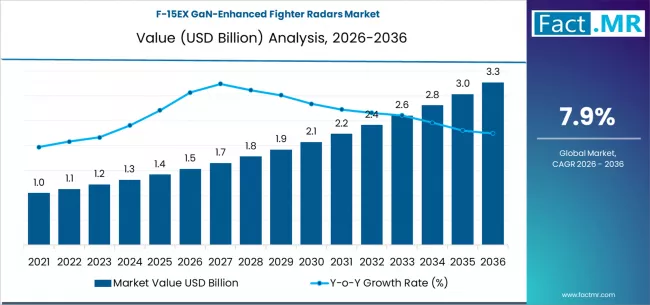
F-15ex gan-enhanced fighter radars market is projected to grow from USD 1.5 billion in 2026 to USD 3.3 billion by 2036, at a CAGR of 7.9%. GaN AESA Radars will dominate with a 58.0% market share, while f-15ex fighters will lead the platform segment with a 72.0% share.

F-15EX GaN-Enhanced Fighter Radars Market Forecast and Outlook 2026 to 2036

The global market for GaN-enhanced fighter radars, centered on the F-15EX platform, is projected to grow from USD 1.53 billion in 2026 to USD 3.27 billion by 2036, reflecting a CAGR of 7.9%. This expansion is primarily driven by a strategic shift towards air dominance platforms equipped with next-generation sensors that provide unparalleled detection range, resolution, and electronic warfare resilience.

Key Takeaways from the F-15EX GaN-Enhanced Fighter Radars Market

  • Market Value for 2026: USD 1.53 Billion
  • Market Value for 2036: USD 3.27 Billion
  • Forecast CAGR (2026-2036): 7.9%
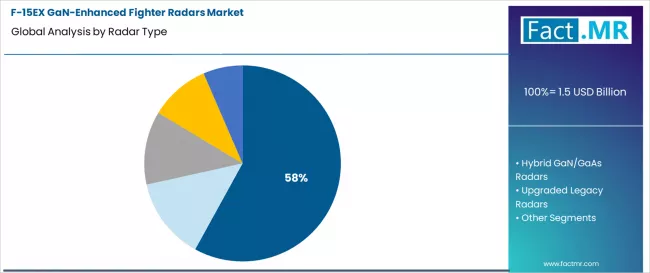
  • Leading Radar Type Segment (2026): GaN AESA Radars (58%)
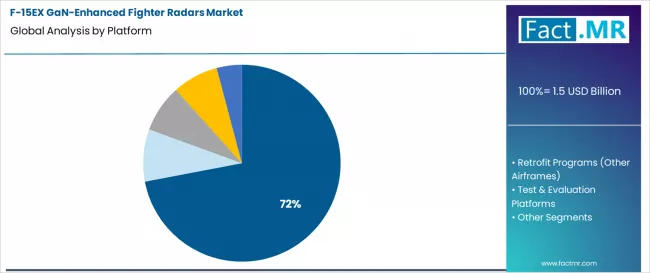
  • Leading Platform Segment (2026): F-15EX Fighters (72%)
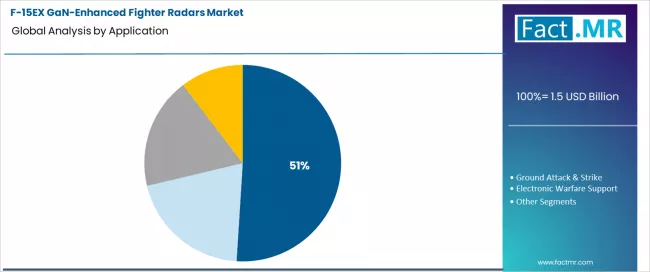
  • Leading Application Segment (2026): Air Superiority Missions (51%)
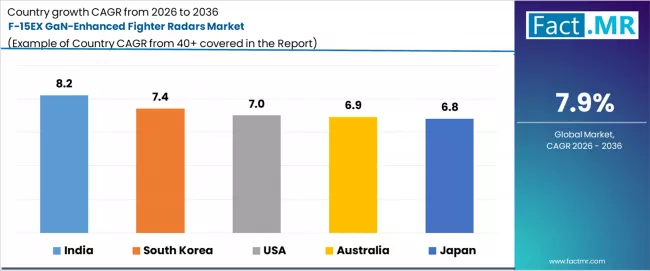
  • Key Growth Countries: India (8.20% CAGR), South Korea (7.40% CAGR), USA (7.00% CAGR), Australia (6.90% CAGR), Japan (6.80% CAGR)
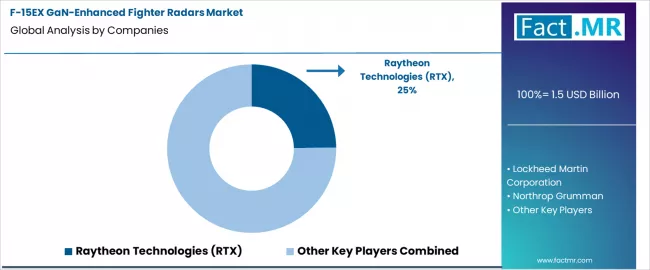
  • Key Players in the Market: Raytheon Technologies (RTX), Lockheed Martin Corporation, Northrop Grumman, BAE Systems, Thales Group, Others

F 15ex Gan Enhanced Fighter Radars Market Market Value Analysis

The integration of GaN technology represents a critical advancement, enabling radars to generate higher power in more compact form factors, essential for maintaining tactical overmatch against evolving airborne and ground-based threats. Market growth is inextricably linked to the procurement and upgrade roadmaps of key allied nations seeking interoperable, advanced capabilities to counter near-peer adversaries.

Metric

Metric Value
Market Value (2026) USD 1.53 Billion
Market Forecast Value (2036) USD 3.27 Billion
Forecast CAGR (2026-2036) 7.9%

Category

Category Segments
Radar Type GaN AESA Radars, Hybrid GaN/GaAs Radars, Upgraded Legacy Radars, Others
Platform F-15EX Fighters, Retrofit Programs (Other Airframes), Test & Evaluation Platforms, Trainer/Simulation Units, Others
Application Air Superiority Missions, Ground Attack & Strike, Electronic Warfare Support, Training & Simulation
Region North America, Latin America, Western Europe, Eastern Europe, East Asia, South Asia & Pacific, MEA

Segmental Analysis

By Radar Type, Which Technology Defines the Market Standard?

F 15ex Gan Enhanced Fighter Radars Market Analysis By Radar Type

GaN AESA radars lead the segment with a commanding 58% share. Their dominance is based on the transformative advantages of GaN technology, which provides significantly greater power density, efficiency, and thermal management compared to legacy GaAs systems.

This results in dramatically improved detection range, capability for simultaneous multi-mode operations (search, track, electronic attack), and enhanced reliability, establishing GaN AESA as the new benchmark for next-generation fighter radar systems.

By Platform, Where is the Core Demand Originating?

F 15ex Gan Enhanced Fighter Radars Market Analysis By Platform

F-15EX Fighters constitute the dominant platform segment, holding 72% of the market. This overwhelming share is directly tied to new procurement programs, where the advanced radar is a foundational, factory-integrated system critical to the aircraft's mission profile.

The F-15EX’s role as a dedicated quarterback or weapons truck in contested airspace necessitates the most powerful and sophisticated sensor suite available, making it the primary driver for both initial production and long-term upgrade contracts.

By Application, Which Mission Drives Primary Development?

F 15ex Gan Enhanced Fighter Radars Market Analysis By Application

Air Superiority Missions are the leading application, accounting for 51% of demand. The development of GaN-enhanced radars is fundamentally geared towards achieving and maintaining control of the air domain.

Their extended detection range for low-observable threats, high track-fidelity for engagement solutions, and inherent electronic protection features are all optimized for defeating advanced enemy aircraft and missiles, making air superiority the core operational requirement shaping radar capabilities.

What Factors are Driving, Restraining, and Shaping the GaN Fighter Radar Market?

The primary market driver is the urgent need to counter advanced integrated air defense systems and fifth-generation fighter threats, necessitating radars with longer detection ranges and superior electronic warfare resilience. A significant restraint is the exceptionally high development and unit cost of advanced GaN AESA systems, which can limit procurement numbers and slow retrofit programs for legacy fleets.

A key opportunity exists in adapting F-15EX radar technology for retrofit programs on other allied fourth- and 4.5-generation fighter platforms (like F-16s, Eurofighters, or Rafales), creating a substantial secondary market.

The dominant trend is the evolution of these radars beyond simple sensors into multi-functional systems capable of electronic attack, high-speed data linking, and serving as nodes in a broader combat cloud network, enabled by software-defined architectures and artificial intelligence for threat prioritization.

Analysis of the F-15EX GaN-Enhanced Fighter Radars Market by Key Countries

F 15ex Gan Enhanced Fighter Radars Market Cagr Analysis By Country

Country CAGR (2026-2036)
India 8.20%
South Korea 7.40%
USA 7.00%
Australia 6.90%
Japan 6.80%

How does the USA's Role as the Launch Customer and Technology Leader Influence Growth?

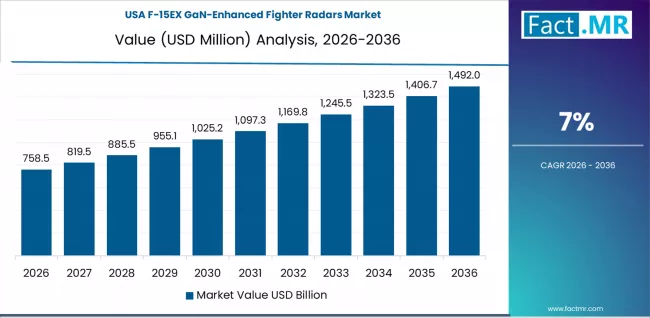
F 15ex Gan Enhanced Fighter Radars Market Country Value Analysis

The USA's 7.00% CAGR is anchored in its position as the developer, launch customer, and primary integrator of the F-15EX radar system. Growth is sustained through the phased procurement of F-15EX aircraft for the U.S. Air Force and continuous capability insertion via software updates.

The market is driven by the DoD's imperative to field a potent sensor suite that can network with F-35s and other assets under the JADC2 framework, ensuring the platform's relevance in high-end warfare.

What drives Japan's Strategic Investment in Air Defense Capabilities?

Japan's 6.80% CAGR reflects its sustained investment in next-generation air defense to address regional security dynamics. While focused on the F-35, Japan's interest in GaN radar technology for potential F-15J upgrades and future indigenous fighter programs (F-X) drives R&D and collaboration. The need for long-range sensors to monitor and defend vast maritime territories underpins demand for advanced radar capabilities.

Why is South Korea a Key Market for Technology Integration and Retrofit?

South Korea's 7.40% CAGR is fueled by its aggressive defense modernization and indigenous KF-21 Boramae program. South Korea seeks the most advanced radar technologies to integrate into its new fighter and for potential upgrades to its legacy F-15K Slam Eagle fleet. This focus on achieving technological parity and enhancing stand-off strike capabilities positions it as a high-growth market for GaN radar systems and subsystems.

What Factors Underpin India's High-Growth Trajectory in Advanced Avionics?

India's leading 8.20% CAGR is driven by its comprehensive fighter modernization strategy. This includes the potential procurement of new advanced fighter types and major upgrade programs for its Su-30MKI and other fleet aircraft.

The desire to integrate best-in-class AESA radar technology, often through strategic partnerships and technology transfer as part of Make in India, creates significant demand for advanced GaN radar systems and related know-how.

How does Australia's Strategic Alignment Shape Its Market Participation?

Australia's 6.90% growth is linked to its force structure planning and alliance commitments. While its core fighter capability is the F-35, Australia's interest in complementary capabilities like the F-15EX and its need to upgrade its EA-18G Growler electronic warfare fleet with cutting-edge sensors drive engagement with GaN radar technology. Participation in allied development programs and a focus on interoperability ensure sustained investment in this sector.

Competitive Landscape

F 15ex Gan Enhanced Fighter Radars Market Analysis By Company

A small group of established defense primes with deep expertise defines the competitive environment in RF systems, AESA technology, and fighter aircraft integration. Competition hinges on technological leadership in GaN module performance, system power management, and advanced software algorithms for target identification and electronic warfare.

Success is determined by securing the prime contract for the F-15EX radar system and leveraging that position to win derivative and retrofit programs on other global platforms. Strategic priorities include investing in open-system architectures to facilitate future upgrades and international sales, forming partnerships with airframe OEMs and allied nations to capture upgrade markets, and demonstrating cost-effective life-cycle management to win long-term support contracts.

Key Players in the F-15EX GaN-Enhanced Fighter Radars Market

  • Raytheon Technologies (RTX)
  • Lockheed Martin Corporation
  • Northrop Grumman
  • BAE Systems
  • Thales Group
  • Others

Scope of Report

Items Values
Quantitative Units USD Billion
Radar Type GaN AESA Radars, Hybrid GaN/GaAs Radars, Upgraded Legacy Radars, Others
Platform F-15EX Fighters, Retrofit Programs (Other Airframes), Test & Evaluation Platforms, Trainer/Simulation Units, Others
Application Air Superiority Missions, Ground Attack & Strike, Electronic Warfare Support, Training & Simulation
Key Countries India, South Korea, USA, Australia, Japan
Key Companies Raytheon Technologies (RTX), Lockheed Martin Corporation, Northrop Grumman, BAE Systems, Thales Group, Others
Additional Analysis Technical comparison of GaN vs. GaAs module performance and reliability; lifecycle cost analysis of new-build vs. retrofit installations; study of integration challenges with legacy fighter avionics architectures; assessment of AI/ML software impact on radar resource allocation and target classification; analysis of supply chain security for GaN semiconductor materials.

Market by Segments

  • Radar Type :

    • GaN AESA Radars
    • Hybrid GaN/GaAs Radars
    • Upgraded Legacy Radars
    • Others
  • Platform :

    • F-15EX Fighters
    • Retrofit Programs (Other Airframes)
    • Test & Evaluation Platforms
    • Trainer/Simulation Units
    • Others
  • Application :

    • Air Superiority Missions
    • Ground Attack & Strike
    • Electronic Warfare Support
    • Training & Simulation
  • Region :

    • North America

      • USA
      • Canada
    • Latin America

      • Brazil
      • Mexico
      • Argentina
      • Rest of Latin America
    • Western Europe

      • Germany
      • France
      • Italy
      • Spain
      • UK
      • BENELUX
      • Rest of Western Europe
    • Eastern Europe

      • Russia
      • Poland
      • Czech Republic
      • Rest of Eastern Europe
    • East Asia

      • China
      • Japan
      • South Korea
      • Rest of East Asia
    • South Asia & Pacific

      • India
      • ASEAN
      • Australia
      • Rest of South Asia & Pacific
    • MEA

      • GCC Countries
      • South Africa
      • Turkiye
      • Rest of MEA

References

  • Air Force Materiel Command. (2024). F-15EX Eagle II systems handbook. U.S. Department of the Air Force.
  • Balanis, C. A. (2023). GaN-based technology for radar and electronic warfare (2nd ed.). Wiley-IEEE Press.
  • Defense Acquisition Program Administration (DAPA). (2024). KF-21 Boramae avionics integration roadmap. Republic of Korea.
  • Hecht, J. (2023). The rise of AESA: How active arrays revolutionized radar. SPIE Press.
  • North Atlantic Treaty Organization (NATO). (2024). STANAG 7085: Interoperability standard for fighter aircraft data links and sensors. NATO Standardization Office.
  • Smith, M. J., & Thompson, G. R. (2023). Sensor fusion and the future of air combat: The role of next-generation radars. Journal of Aerospace Information Systems, 20(4), 215-230.

Table of Content

  1. Executive Summary
    • Global Market Outlook
    • Demand to side Trends
    • Supply to side Trends
    • Technology Roadmap Analysis
    • Analysis and Recommendations
  2. Market Overview
    • Market Coverage / Taxonomy
    • Market Definition / Scope / Limitations
  3. Market Background
    • Market Dynamics
      • Drivers
      • Restraints
      • Opportunity
      • Trends
    • Scenario Forecast
      • Demand in Optimistic Scenario
      • Demand in Likely Scenario
      • Demand in Conservative Scenario
    • Opportunity Map Analysis
    • Product Life Cycle Analysis
    • Supply Chain Analysis
    • Investment Feasibility Matrix
    • Value Chain Analysis
    • PESTLE and Porter’s Analysis
    • Regulatory Landscape
    • Regional Parent Market Outlook
    • Production and Consumption Statistics
    • Import and Export Statistics
  4. Global Market Analysis 2021 to 2025 and Forecast, 2026 to 2036
    • Historical Market Size Value (USD Million) Analysis, 2021 to 2025
    • Current and Future Market Size Value (USD Million) Projections, 2026 to 2036
      • Y to o to Y Growth Trend Analysis
      • Absolute $ Opportunity Analysis
  5. Global Market Pricing Analysis 2021 to 2025 and Forecast 2026 to 2036
  6. Global Market Analysis 2021 to 2025 and Forecast 2026 to 2036, By Radar Type
    • Introduction / Key Findings
    • Historical Market Size Value (USD Million) Analysis By Radar Type, 2021 to 2025
    • Current and Future Market Size Value (USD Million) Analysis and Forecast By Radar Type, 2026 to 2036
      • GaN AESA Radars
      • Hybrid GaN/GaAs Radars
      • Upgraded Legacy Radars
      • Others
      • Others
    • Y to o to Y Growth Trend Analysis By Radar Type, 2021 to 2025
    • Absolute $ Opportunity Analysis By Radar Type, 2026 to 2036
  7. Global Market Analysis 2021 to 2025 and Forecast 2026 to 2036, By Platform
    • Introduction / Key Findings
    • Historical Market Size Value (USD Million) Analysis By Platform, 2021 to 2025
    • Current and Future Market Size Value (USD Million) Analysis and Forecast By Platform, 2026 to 2036
      • F-15EX Fighters
      • Retrofit Programs (Other Airframes)
      • Test & Evaluation Platforms
      • Trainer/Simulation Value (USD Million)s
      • Others
    • Y to o to Y Growth Trend Analysis By Platform, 2021 to 2025
    • Absolute $ Opportunity Analysis By Platform, 2026 to 2036
  8. Global Market Analysis 2021 to 2025 and Forecast 2026 to 2036, By Application
    • Introduction / Key Findings
    • Historical Market Size Value (USD Million) Analysis By Application, 2021 to 2025
    • Current and Future Market Size Value (USD Million) Analysis and Forecast By Application, 2026 to 2036
      • Air Superiority Missions
      • Ground Attack & Strike
      • Electronic Warfare Support
      • Training & Simulation
    • Y to o to Y Growth Trend Analysis By Application, 2021 to 2025
    • Absolute $ Opportunity Analysis By Application, 2026 to 2036
  9. Global Market Analysis 2021 to 2025 and Forecast 2026 to 2036, By Region
    • Introduction
    • Historical Market Size Value (USD Million) Analysis By Region, 2021 to 2025
    • Current Market Size Value (USD Million) Analysis and Forecast By Region, 2026 to 2036
      • North America
      • Latin America
      • Western Europe
      • Eastern Europe
      • East Asia
      • South Asia and Pacific
      • Middle East & Africa
    • Market Attractiveness Analysis By Region
  10. North America Market Analysis 2021 to 2025 and Forecast 2026 to 2036, By Country
    • Historical Market Size Value (USD Million) Trend Analysis By Market Taxonomy, 2021 to 2025
    • Market Size Value (USD Million) Forecast By Market Taxonomy, 2026 to 2036
      • By Country
        • USA
        • Canada
        • Mexico
      • By Radar Type
      • By Platform
      • By Application
    • Market Attractiveness Analysis
      • By Country
      • By Radar Type
      • By Platform
      • By Application
    • Key Takeaways
  11. Latin America Market Analysis 2021 to 2025 and Forecast 2026 to 2036, By Country
    • Historical Market Size Value (USD Million) Trend Analysis By Market Taxonomy, 2021 to 2025
    • Market Size Value (USD Million) Forecast By Market Taxonomy, 2026 to 2036
      • By Country
        • Brazil
        • Chile
        • Rest of Latin America
      • By Radar Type
      • By Platform
      • By Application
    • Market Attractiveness Analysis
      • By Country
      • By Radar Type
      • By Platform
      • By Application
    • Key Takeaways
  12. Western Europe Market Analysis 2021 to 2025 and Forecast 2026 to 2036, By Country
    • Historical Market Size Value (USD Million) Trend Analysis By Market Taxonomy, 2021 to 2025
    • Market Size Value (USD Million) Forecast By Market Taxonomy, 2026 to 2036
      • By Country
        • Germany
        • UK
        • Italy
        • Spain
        • France
        • Nordic
        • BENELUX
        • Rest of Western Europe
      • By Radar Type
      • By Platform
      • By Application
    • Market Attractiveness Analysis
      • By Country
      • By Radar Type
      • By Platform
      • By Application
    • Key Takeaways
  13. Eastern Europe Market Analysis 2021 to 2025 and Forecast 2026 to 2036, By Country
    • Historical Market Size Value (USD Million) Trend Analysis By Market Taxonomy, 2021 to 2025
    • Market Size Value (USD Million) Forecast By Market Taxonomy, 2026 to 2036
      • By Country
        • Russia
        • Poland
        • Hungary
        • Balkan & Baltic
        • Rest of Eastern Europe
      • By Radar Type
      • By Platform
      • By Application
    • Market Attractiveness Analysis
      • By Country
      • By Radar Type
      • By Platform
      • By Application
    • Key Takeaways
  14. East Asia Market Analysis 2021 to 2025 and Forecast 2026 to 2036, By Country
    • Historical Market Size Value (USD Million) Trend Analysis By Market Taxonomy, 2021 to 2025
    • Market Size Value (USD Million) Forecast By Market Taxonomy, 2026 to 2036
      • By Country
        • China
        • Japan
        • South Korea
      • By Radar Type
      • By Platform
      • By Application
    • Market Attractiveness Analysis
      • By Country
      • By Radar Type
      • By Platform
      • By Application
    • Key Takeaways
  15. South Asia and Pacific Market Analysis 2021 to 2025 and Forecast 2026 to 2036, By Country
    • Historical Market Size Value (USD Million) Trend Analysis By Market Taxonomy, 2021 to 2025
    • Market Size Value (USD Million) Forecast By Market Taxonomy, 2026 to 2036
      • By Country
        • India
        • ASEAN
        • Australia & New Zealand
        • Rest of South Asia and Pacific
      • By Radar Type
      • By Platform
      • By Application
    • Market Attractiveness Analysis
      • By Country
      • By Radar Type
      • By Platform
      • By Application
    • Key Takeaways
  16. Middle East & Africa Market Analysis 2021 to 2025 and Forecast 2026 to 2036, By Country
    • Historical Market Size Value (USD Million) Trend Analysis By Market Taxonomy, 2021 to 2025
    • Market Size Value (USD Million) Forecast By Market Taxonomy, 2026 to 2036
      • By Country
        • Kingdom of Saudi Arabia
        • Other GCC Countries
        • Turkiye
        • South Africa
        • Other African Union
        • Rest of Middle East & Africa
      • By Radar Type
      • By Platform
      • By Application
    • Market Attractiveness Analysis
      • By Country
      • By Radar Type
      • By Platform
      • By Application
    • Key Takeaways
  17. Key Countries Market Analysis
    • USA
      • Pricing Analysis
      • Market Share Analysis, 2025
        • By Radar Type
        • By Platform
        • By Application
    • Canada
      • Pricing Analysis
      • Market Share Analysis, 2025
        • By Radar Type
        • By Platform
        • By Application
    • Mexico
      • Pricing Analysis
      • Market Share Analysis, 2025
        • By Radar Type
        • By Platform
        • By Application
    • Brazil
      • Pricing Analysis
      • Market Share Analysis, 2025
        • By Radar Type
        • By Platform
        • By Application
    • Chile
      • Pricing Analysis
      • Market Share Analysis, 2025
        • By Radar Type
        • By Platform
        • By Application
    • Germany
      • Pricing Analysis
      • Market Share Analysis, 2025
        • By Radar Type
        • By Platform
        • By Application
    • UK
      • Pricing Analysis
      • Market Share Analysis, 2025
        • By Radar Type
        • By Platform
        • By Application
    • Italy
      • Pricing Analysis
      • Market Share Analysis, 2025
        • By Radar Type
        • By Platform
        • By Application
    • Spain
      • Pricing Analysis
      • Market Share Analysis, 2025
        • By Radar Type
        • By Platform
        • By Application
    • France
      • Pricing Analysis
      • Market Share Analysis, 2025
        • By Radar Type
        • By Platform
        • By Application
    • India
      • Pricing Analysis
      • Market Share Analysis, 2025
        • By Radar Type
        • By Platform
        • By Application
    • ASEAN
      • Pricing Analysis
      • Market Share Analysis, 2025
        • By Radar Type
        • By Platform
        • By Application
    • Australia & New Zealand
      • Pricing Analysis
      • Market Share Analysis, 2025
        • By Radar Type
        • By Platform
        • By Application
    • China
      • Pricing Analysis
      • Market Share Analysis, 2025
        • By Radar Type
        • By Platform
        • By Application
    • Japan
      • Pricing Analysis
      • Market Share Analysis, 2025
        • By Radar Type
        • By Platform
        • By Application
    • South Korea
      • Pricing Analysis
      • Market Share Analysis, 2025
        • By Radar Type
        • By Platform
        • By Application
    • Russia
      • Pricing Analysis
      • Market Share Analysis, 2025
        • By Radar Type
        • By Platform
        • By Application
    • Poland
      • Pricing Analysis
      • Market Share Analysis, 2025
        • By Radar Type
        • By Platform
        • By Application
    • Hungary
      • Pricing Analysis
      • Market Share Analysis, 2025
        • By Radar Type
        • By Platform
        • By Application
    • Kingdom of Saudi Arabia
      • Pricing Analysis
      • Market Share Analysis, 2025
        • By Radar Type
        • By Platform
        • By Application
    • Turkiye
      • Pricing Analysis
      • Market Share Analysis, 2025
        • By Radar Type
        • By Platform
        • By Application
    • South Africa
      • Pricing Analysis
      • Market Share Analysis, 2025
        • By Radar Type
        • By Platform
        • By Application
  18. Market Structure Analysis
    • Competition Dashboard
    • Competition Benchmarking
    • Market Share Analysis of Top Players
      • By Regional
      • By Radar Type
      • By Platform
      • By Application
  19. Competition Analysis
    • Competition Deep Dive
      • Raytheon Technologies (RTX)
        • Overview
        • Product Portfolio
        • Profitability by Market Segments (Product/Age /Sales Channel/Region)
        • Sales Footprint
        • Strategy Overview
          • Marketing Strategy
          • Product Strategy
          • Channel Strategy
      • Lockheed Martin Corporation
      • Northrop Grumman
      • BAE Systems
      • Thales Group
      • Others
  20. Assumptions & Acronyms Used
  21. Research Methodology

List Of Table

  • Table 1: Global Market Value (USD Million) Forecast by Region, 2021 to 2036
  • Table 2: Global Market Value (USD Million) Forecast by Radar Type, 2021 to 2036
  • Table 3: Global Market Value (USD Million) Forecast by Platform, 2021 to 2036
  • Table 4: Global Market Value (USD Million) Forecast by Application, 2021 to 2036
  • Table 5: North America Market Value (USD Million) Forecast by Country, 2021 to 2036
  • Table 6: North America Market Value (USD Million) Forecast by Radar Type, 2021 to 2036
  • Table 7: North America Market Value (USD Million) Forecast by Platform, 2021 to 2036
  • Table 8: North America Market Value (USD Million) Forecast by Application, 2021 to 2036
  • Table 9: Latin America Market Value (USD Million) Forecast by Country, 2021 to 2036
  • Table 10: Latin America Market Value (USD Million) Forecast by Radar Type, 2021 to 2036
  • Table 11: Latin America Market Value (USD Million) Forecast by Platform, 2021 to 2036
  • Table 12: Latin America Market Value (USD Million) Forecast by Application, 2021 to 2036
  • Table 13: Western Europe Market Value (USD Million) Forecast by Country, 2021 to 2036
  • Table 14: Western Europe Market Value (USD Million) Forecast by Radar Type, 2021 to 2036
  • Table 15: Western Europe Market Value (USD Million) Forecast by Platform, 2021 to 2036
  • Table 16: Western Europe Market Value (USD Million) Forecast by Application, 2021 to 2036
  • Table 17: Eastern Europe Market Value (USD Million) Forecast by Country, 2021 to 2036
  • Table 18: Eastern Europe Market Value (USD Million) Forecast by Radar Type, 2021 to 2036
  • Table 19: Eastern Europe Market Value (USD Million) Forecast by Platform, 2021 to 2036
  • Table 20: Eastern Europe Market Value (USD Million) Forecast by Application, 2021 to 2036
  • Table 21: East Asia Market Value (USD Million) Forecast by Country, 2021 to 2036
  • Table 22: East Asia Market Value (USD Million) Forecast by Radar Type, 2021 to 2036
  • Table 23: East Asia Market Value (USD Million) Forecast by Platform, 2021 to 2036
  • Table 24: East Asia Market Value (USD Million) Forecast by Application, 2021 to 2036
  • Table 25: South Asia and Pacific Market Value (USD Million) Forecast by Country, 2021 to 2036
  • Table 26: South Asia and Pacific Market Value (USD Million) Forecast by Radar Type, 2021 to 2036
  • Table 27: South Asia and Pacific Market Value (USD Million) Forecast by Platform, 2021 to 2036
  • Table 28: South Asia and Pacific Market Value (USD Million) Forecast by Application, 2021 to 2036
  • Table 29: Middle East & Africa Market Value (USD Million) Forecast by Country, 2021 to 2036
  • Table 30: Middle East & Africa Market Value (USD Million) Forecast by Radar Type, 2021 to 2036
  • Table 31: Middle East & Africa Market Value (USD Million) Forecast by Platform, 2021 to 2036
  • Table 32: Middle East & Africa Market Value (USD Million) Forecast by Application, 2021 to 2036

List Of Figures

  • Figure 1: Global Market Pricing Analysis
  • Figure 2: Global Market Value (USD Million) Forecast 2021 to 2036
  • Figure 3: Global Market Value Share and BPS Analysis by Radar Type, 2026 and 2036
  • Figure 4: Global Market Y to o to Y Growth Comparison by Radar Type, 2026 to 2036
  • Figure 5: Global Market Attractiveness Analysis by Radar Type
  • Figure 6: Global Market Value Share and BPS Analysis by Platform, 2026 and 2036
  • Figure 7: Global Market Y to o to Y Growth Comparison by Platform, 2026 to 2036
  • Figure 8: Global Market Attractiveness Analysis by Platform
  • Figure 9: Global Market Value Share and BPS Analysis by Application, 2026 and 2036
  • Figure 10: Global Market Y to o to Y Growth Comparison by Application, 2026 to 2036
  • Figure 11: Global Market Attractiveness Analysis by Application
  • Figure 12: Global Market Value (USD Million) Share and BPS Analysis by Region, 2026 and 2036
  • Figure 13: Global Market Y to o to Y Growth Comparison by Region, 2026 to 2036
  • Figure 14: Global Market Attractiveness Analysis by Region
  • Figure 15: North America Market Incremental Dollar Opportunity, 2026 to 2036
  • Figure 16: Latin America Market Incremental Dollar Opportunity, 2026 to 2036
  • Figure 17: Western Europe Market Incremental Dollar Opportunity, 2026 to 2036
  • Figure 18: Eastern Europe Market Incremental Dollar Opportunity, 2026 to 2036
  • Figure 19: East Asia Market Incremental Dollar Opportunity, 2026 to 2036
  • Figure 20: South Asia and Pacific Market Incremental Dollar Opportunity, 2026 to 2036
  • Figure 21: Middle East & Africa Market Incremental Dollar Opportunity, 2026 to 2036
  • Figure 22: North America Market Value Share and BPS Analysis by Country, 2026 and 2036
  • Figure 23: North America Market Value Share and BPS Analysis by Radar Type, 2026 and 2036
  • Figure 24: North America Market Y to o to Y Growth Comparison by Radar Type, 2026 to 2036
  • Figure 25: North America Market Attractiveness Analysis by Radar Type
  • Figure 26: North America Market Value Share and BPS Analysis by Platform, 2026 and 2036
  • Figure 27: North America Market Y to o to Y Growth Comparison by Platform, 2026 to 2036
  • Figure 28: North America Market Attractiveness Analysis by Platform
  • Figure 29: North America Market Value Share and BPS Analysis by Application, 2026 and 2036
  • Figure 30: North America Market Y to o to Y Growth Comparison by Application, 2026 to 2036
  • Figure 31: North America Market Attractiveness Analysis by Application
  • Figure 32: Latin America Market Value Share and BPS Analysis by Country, 2026 and 2036
  • Figure 33: Latin America Market Value Share and BPS Analysis by Radar Type, 2026 and 2036
  • Figure 34: Latin America Market Y to o to Y Growth Comparison by Radar Type, 2026 to 2036
  • Figure 35: Latin America Market Attractiveness Analysis by Radar Type
  • Figure 36: Latin America Market Value Share and BPS Analysis by Platform, 2026 and 2036
  • Figure 37: Latin America Market Y to o to Y Growth Comparison by Platform, 2026 to 2036
  • Figure 38: Latin America Market Attractiveness Analysis by Platform
  • Figure 39: Latin America Market Value Share and BPS Analysis by Application, 2026 and 2036
  • Figure 40: Latin America Market Y to o to Y Growth Comparison by Application, 2026 to 2036
  • Figure 41: Latin America Market Attractiveness Analysis by Application
  • Figure 42: Western Europe Market Value Share and BPS Analysis by Country, 2026 and 2036
  • Figure 43: Western Europe Market Value Share and BPS Analysis by Radar Type, 2026 and 2036
  • Figure 44: Western Europe Market Y to o to Y Growth Comparison by Radar Type, 2026 to 2036
  • Figure 45: Western Europe Market Attractiveness Analysis by Radar Type
  • Figure 46: Western Europe Market Value Share and BPS Analysis by Platform, 2026 and 2036
  • Figure 47: Western Europe Market Y to o to Y Growth Comparison by Platform, 2026 to 2036
  • Figure 48: Western Europe Market Attractiveness Analysis by Platform
  • Figure 49: Western Europe Market Value Share and BPS Analysis by Application, 2026 and 2036
  • Figure 50: Western Europe Market Y to o to Y Growth Comparison by Application, 2026 to 2036
  • Figure 51: Western Europe Market Attractiveness Analysis by Application
  • Figure 52: Eastern Europe Market Value Share and BPS Analysis by Country, 2026 and 2036
  • Figure 53: Eastern Europe Market Value Share and BPS Analysis by Radar Type, 2026 and 2036
  • Figure 54: Eastern Europe Market Y to o to Y Growth Comparison by Radar Type, 2026 to 2036
  • Figure 55: Eastern Europe Market Attractiveness Analysis by Radar Type
  • Figure 56: Eastern Europe Market Value Share and BPS Analysis by Platform, 2026 and 2036
  • Figure 57: Eastern Europe Market Y to o to Y Growth Comparison by Platform, 2026 to 2036
  • Figure 58: Eastern Europe Market Attractiveness Analysis by Platform
  • Figure 59: Eastern Europe Market Value Share and BPS Analysis by Application, 2026 and 2036
  • Figure 60: Eastern Europe Market Y to o to Y Growth Comparison by Application, 2026 to 2036
  • Figure 61: Eastern Europe Market Attractiveness Analysis by Application
  • Figure 62: East Asia Market Value Share and BPS Analysis by Country, 2026 and 2036
  • Figure 63: East Asia Market Value Share and BPS Analysis by Radar Type, 2026 and 2036
  • Figure 64: East Asia Market Y to o to Y Growth Comparison by Radar Type, 2026 to 2036
  • Figure 65: East Asia Market Attractiveness Analysis by Radar Type
  • Figure 66: East Asia Market Value Share and BPS Analysis by Platform, 2026 and 2036
  • Figure 67: East Asia Market Y to o to Y Growth Comparison by Platform, 2026 to 2036
  • Figure 68: East Asia Market Attractiveness Analysis by Platform
  • Figure 69: East Asia Market Value Share and BPS Analysis by Application, 2026 and 2036
  • Figure 70: East Asia Market Y to o to Y Growth Comparison by Application, 2026 to 2036
  • Figure 71: East Asia Market Attractiveness Analysis by Application
  • Figure 72: South Asia and Pacific Market Value Share and BPS Analysis by Country, 2026 and 2036
  • Figure 73: South Asia and Pacific Market Value Share and BPS Analysis by Radar Type, 2026 and 2036
  • Figure 74: South Asia and Pacific Market Y to o to Y Growth Comparison by Radar Type, 2026 to 2036
  • Figure 75: South Asia and Pacific Market Attractiveness Analysis by Radar Type
  • Figure 76: South Asia and Pacific Market Value Share and BPS Analysis by Platform, 2026 and 2036
  • Figure 77: South Asia and Pacific Market Y to o to Y Growth Comparison by Platform, 2026 to 2036
  • Figure 78: South Asia and Pacific Market Attractiveness Analysis by Platform
  • Figure 79: South Asia and Pacific Market Value Share and BPS Analysis by Application, 2026 and 2036
  • Figure 80: South Asia and Pacific Market Y to o to Y Growth Comparison by Application, 2026 to 2036
  • Figure 81: South Asia and Pacific Market Attractiveness Analysis by Application
  • Figure 82: Middle East & Africa Market Value Share and BPS Analysis by Country, 2026 and 2036
  • Figure 83: Middle East & Africa Market Value Share and BPS Analysis by Radar Type, 2026 and 2036
  • Figure 84: Middle East & Africa Market Y to o to Y Growth Comparison by Radar Type, 2026 to 2036
  • Figure 85: Middle East & Africa Market Attractiveness Analysis by Radar Type
  • Figure 86: Middle East & Africa Market Value Share and BPS Analysis by Platform, 2026 and 2036
  • Figure 87: Middle East & Africa Market Y to o to Y Growth Comparison by Platform, 2026 to 2036
  • Figure 88: Middle East & Africa Market Attractiveness Analysis by Platform
  • Figure 89: Middle East & Africa Market Value Share and BPS Analysis by Application, 2026 and 2036
  • Figure 90: Middle East & Africa Market Y to o to Y Growth Comparison by Application, 2026 to 2036
  • Figure 91: Middle East & Africa Market Attractiveness Analysis by Application
  • Figure 92: Global Market - Tier Structure Analysis
  • Figure 93: Global Market - Company Share Analysis

- FAQs -

How big is the f-15ex gan-enhanced fighter radars market in 2026?

The global f-15ex gan-enhanced fighter radars market is estimated to be valued at USD 1.5 billion in 2026.

What will be the size of f-15ex gan-enhanced fighter radars market in 2036?

The market size for the f-15ex gan-enhanced fighter radars market is projected to reach USD 3.3 billion by 2036.

How much will be the f-15ex gan-enhanced fighter radars market growth between 2026 and 2036?

The f-15ex gan-enhanced fighter radars market is expected to grow at a 7.9% CAGR between 2026 and 2036.

What are the key product types in the f-15ex gan-enhanced fighter radars market?

The key product types in f-15ex gan-enhanced fighter radars market are gan aesa radars, hybrid gan/gaas radars, upgraded legacy radars, others and others.

Which platform segment to contribute significant share in the f-15ex gan-enhanced fighter radars market in 2026?

In terms of platform, f-15ex fighters segment to command 72.0% share in the f-15ex gan-enhanced fighter radars market in 2026.
F-15EX GaN-Enhanced Fighter Radars Market