- Base Value(2026): 718.0 Mn
- Estimated Value(2026): 718.0 Mn
- Forecast Value (2036): 1073.1 Mn
- CAGR (2026 - 2036): 4.1%
Rotary Swaging Machine Market Forecast and Outlook 2026 to 2036
The global rotary swaging machine market is anticipated to expand steadily from USD 718 million in 2026 to approximately USD 1,073.1 million by 2036, reflecting a CAGR of 4.1%.
Key Takeaways from Rotary Swaging Machine Market
- Rotary Swaging Machine Market Value 2026: USD 718 million
- Rotary Swaging Machine Market Forecast Value 2036: USD 1,073.1 million
- Rotary Swaging Machine Market Forecast CAGR: 4.1%
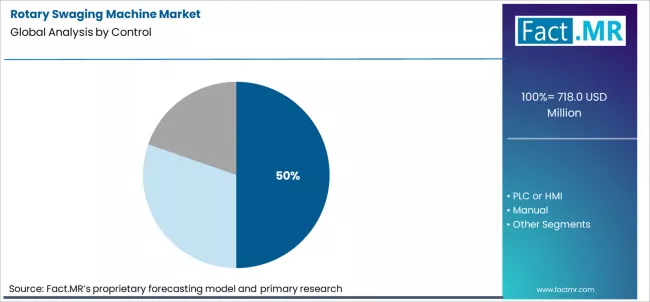
- Leading Control Type in Rotary Swaging Machine Market: CNC or NC 50%
- Key Growth Regions in Rotary Swaging Machine Market: U.S., Japan, South Korea, Europe, Germany, China, U.K., Brazil
- Key Players in Rotary Swaging Machine Market: Fenn Torin, Felss Group, ECM Technologies, HMP (Hausmann), Hindustan Hydraulics, Shuz Tung, MJC Engineering, JYF Machinery, Sms Meer (Swaging legacy), Profiroll
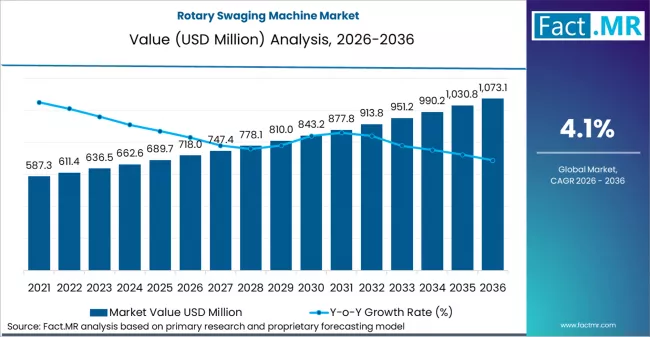
Rotary Swaging Machine Market Market Value Analysis | Source: Fact.MR
Demand is being driven by the need for precise, reliable metal forming solutions across industries such as automotive, aerospace, oil and gas, power, and general engineering. Radial swaging machines lead due to their versatility and consistent performance in forming tubes and pipes, while rotary/orbital, hydraulic-powered, and electric-servo machines cater to rods, wires, hollow shafts, and fittings.
Tubes and pipes remain the most common workpiece, followed by rods, hollow shafts, wires, and fittings. The automotive sector accounts for the largest end-industry demand, supported by aerospace, defense, oil and gas, and general engineering applications. CNC or NC machines dominate the control segment, providing precision and repeatability, while PLC/HMI and manual systems are used in specialized or lower-volume production. Asia-Pacific, particularly the U.S., Japan, and South Korea, shows strong adoption, while Europe and China maintain steady demand. Manufacturers focus on durability, flexibility, and accuracy to meet diverse forming needs and evolving industrial standards.
Rotary Swaging Machine Market
| Metric | Value |
|---|---|
| Estimated Value in (2026E) | USD 718.0 million |
| Forecast Value in (2036F) | USD 1,073.1 million |
| Forecast CAGR (2026 to 2036) | 4.1% |
Source: Fact.MR analysis. Updated Jan 27, 2026
Category
| Category | Segments |
|---|---|
| Machine Type | Radial Swaging; Rotary or Orbital Swaging; Hydraulic-Powered; Electric-Servo; Other |
| Workpiece | Tubes or Pipes; Rods or Wires; Hollow Shafts; Fittings or Nozzles; Other |
| End Industry | Automotive; Aerospace or Defense; Oil and Gas or Power; General Engineering; Other |
| Control | CNC or NC; PLC or HMI; Manual; Hybrid Control; Other |
| Region | North America; Europe; Asia Pacific; Latin America; Middle East & Africa |
Source: Fact.MR analysis. Updated Jan 27, 2026
Segmental Analysis
By Machine Type, Which Segment Holds the Dominant Share in the Rotary Swaging Machine Market?
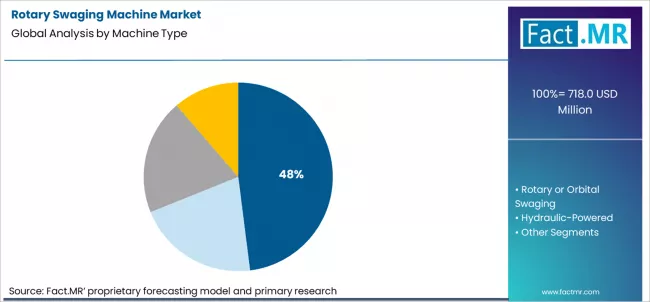
Rotary Swaging Machine Market Analysis By Machine Type | Source: Fact.MR
In terms of machine type, radial swaging holds a 48.0% share, making it the most widely used configuration in the rotary swaging machine market. Manufacturers rely on radial swaging machines for their consistent forming accuracy and stable output across repetitive production tasks.
- Radial swaging equipment supports controlled material deformation in components with tight dimensional tolerances.
- Operational flexibility across varied production settings sustains continued use of this machine type.
By Workpiece, Which Segment Accounts for the Largest Share in the Rotary Swaging Machine Market?
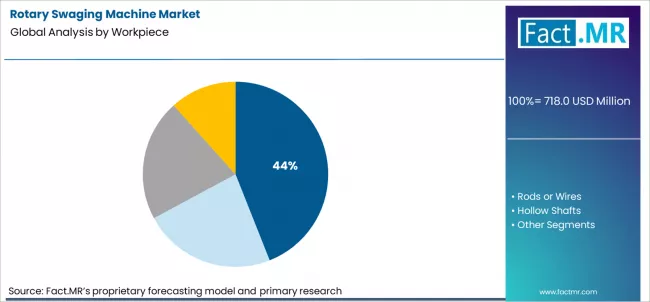
Rotary Swaging Machine Market Analysis By Workpiece | Source: Fact.MR
Tubes and pipes account for a 44.0% share, representing the most common workpiece category processed using rotary swaging machines. Demand remains concentrated around tubular components due to their extensive use in industrial manufacturing.
- Tube and pipe swaging requires uniform shaping to maintain wall thickness and structural integrity.
- Machines configured for these geometries support efficient processing across high volume production lines.
By End Industry, Which Segment Leads Demand in the Rotary Swaging Machine Market?
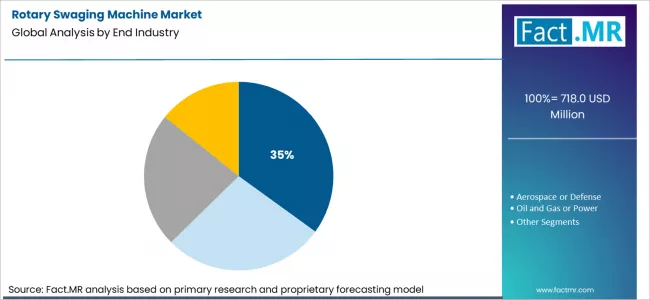
Rotary Swaging Machine Market Analysis By End Industry | Source: Fact.MR
Automotive applications hold a 35.0% share, positioning this sector as the leading end industry for rotary swaging machines. Production scale and component standardization drive steady equipment utilization within automotive manufacturing facilities.
- Swaging machines are applied in the production of automotive shafts, fittings, and fluid handling parts.
- Equipment usage aligns with industry requirements for repeatable forming and material strength control.
By Control, Which Segment Maintains the Highest Share in the Rotary Swaging Machine Market?
Rotary Swaging Machine Market Analysis By Control | Source: Fact.MR
CNC or NC control systems represent a 50.0% share, making them the most commonly adopted control option. Automated control supports precise forming operations and consistent process execution across complex part designs.
- CNC and NC systems allow manufacturers to maintain tight control over swaging parameters.
- Adoption reflects preference for reduced manual intervention and improved process consistency.
What are the Drivers, Restraints, and Key Trends of the Rotary Swaging Machine Market?
- Drivers: Manufacturers use rotary swaging when they need to shape tubes, shafts, and fittings without cutting away material, making it a preferred process in automotive, aerospace, and industrial applications where strength, accuracy, and material efficiency matter on the shop floor.
- Restraint: Running a swaging operation still depends heavily on correct tooling setup and experienced operators, and switching between different part sizes or materials can slow production and raise operating complexity, especially in mixed job environments.
- Trend 1: CNC and NC controlled swaging machines are becoming more common as producers look for consistent part quality, easier repeatability, and better control over complex forming profiles without constant manual adjustment.
- Trend 2: Buyers are increasingly choosing between electric servo and hydraulic swaging systems based on how they actually use the machine, with servo models favored for precision work and lower energy use, and hydraulic machines remaining popular for heavy duty, high force forming tasks.
Analysis of the Rotary Swaging Machine Market by Key Country
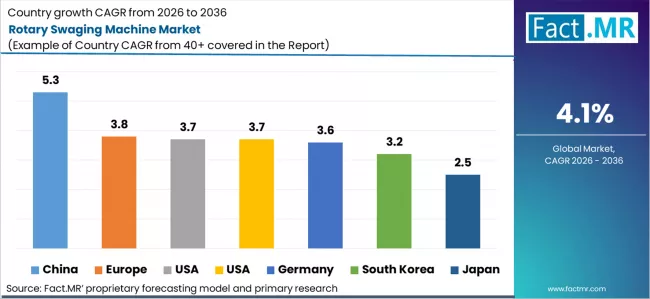
Rotary Swaging Machine Market Cagr Analysis By Country | Source: Fact.MR
| Country | CAGR |
|---|---|
| China | 5.3% |
| Brazil | 4.9% |
| Europe | 3.8% |
| U.S. | 3.7% |
| U.K. | 3.7% |
| Germany | 3.6% |
| South Korea | 3.2% |
| Japan | 2.5% |
Source: Fact.MR analysis. Updated Jan 27, 2026
The report covers an in depth analysis of 8 countries; higher growth markets are highlighted below.
What Is Driving Growth of Rotary Swaging Machines in China?
China shows the fastest expansion at 5.3%, reflecting strong demand for tube, pipe, and shaft forming across automotive and industrial manufacturing. Rotary swaging equipment is widely adopted for high volume component shaping. Buyers increasingly favor CNC controlled machines that support repeatable output and stable production quality across extended operating cycles.
- High manufacturing throughput supports steady machine demand.
- CNC control improves dimensional consistency.
How Is Brazil Emerging as a Growth Market for Rotary Swaging Equipment?
Brazil is projected to grow at 4.9%, supported by automotive suppliers and general engineering workshops seeking flexible metal forming solutions. Hydraulic powered swaging machines remain common due to their ability to handle varied part sizes. Purchasing decisions focus on robustness and adaptability rather than advanced automation.
- Automotive component production sustains equipment demand.
- Hydraulic systems suit mixed production needs.
What Is Supporting Market Activity Across Europe?
Europe is expected to expand at 3.8%, driven by steady requirements from aerospace, energy, and precision engineering applications. Electric servo and rotary swaging machines are selected for controlled deformation of high value components. Equipment accuracy and integration with existing production lines influence buying behavior.
- Aerospace and energy applications support demand.
- Precision requirements favor servo driven machines.
What Defines Market Conditions in the U.S.?
The U.S. market is forecast to grow at 3.7%, shaped by ongoing use of swaging machines in automotive, defense, and industrial fabrication. Radial swaging is widely applied to tubes and pipes. Buyers emphasize reliability and compatibility with established CNC environments.
- Industrial fabrication sustains baseline demand.
- CNC compatibility supports replacement cycles.
How Is the U.K. Positioned in the Rotary Swaging Machine Market?
The U.K. is projected to grow at 3.7%, supported by specialty manufacturing and general engineering operations. Swaging machines are used for fittings, nozzles, and small precision parts. Compact machine footprints and flexibility for short production runs influence purchasing preferences.
- Specialty manufacturing drives equipment usage.
- Flexible batch capability supports adoption.
What Role Does Germany Play in Market Development?
Germany is expected to grow at 3.6%, reflecting strong emphasis on process control and dimensional accuracy. Electric servo and CNC swaging machines are widely used for high tolerance components. Demand follows capital investment cycles within automotive and machinery manufacturing sectors.
- Precision engineering supports advanced equipment demand.
- Investment cycles shape purchasing activity.
How Is South Korea Contributing to Market Growth?
South Korea is forecast to grow at 3.2%, driven by aerospace and defense manufacturing that requires controlled forming of rods and wires. PLC and HMI controlled machines support stable production output. Equipment upgrades align with broader factory modernization efforts.
- Aerospace manufacturing sustains demand.
- Automation improves production control.
What Factors Shape Market Development in Japan?
Japan is expected to register a CAGR of 2.5%, reflecting mature manufacturing operations and long equipment service life. Radial swaging machines continue to serve automotive and industrial applications. Demand remains steady as production lines are already optimized for efficiency and reliability.
- Mature manufacturing supports stable demand.
- Long machine lifecycles limit rapid expansion.
Competitive Landscape of the Rotary Swaging Machine Market
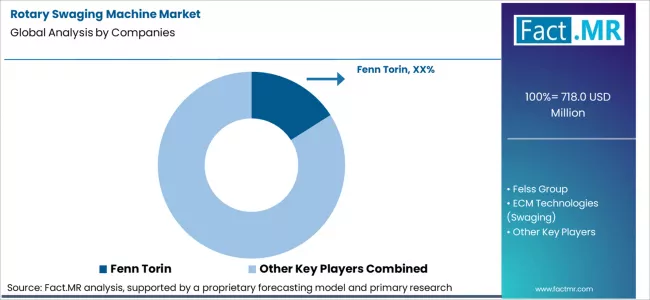
Rotary Swaging Machine Market Analysis By Company | Source: Fact.MR
The rotary swaging machine market supports manufacturers that need precise, repeatable metal forming without cutting or material waste. These machines are commonly used to reduce diameters, form ends, and improve strength in tubes, pipes, rods, wires, hollow shafts, and fittings. Buyers in this market care deeply about reliability on the shop floor, ease of setup, and consistent results across long production runs. Competition is shaped by how well machines handle different materials, maintain tight tolerances, and fit into modern production environments.
Machine suppliers differentiate through radial, rotary, and orbital swaging designs that suit both high-volume automotive parts and lower-volume, high-precision aerospace or energy components. Radial swaging remains the most widely adopted due to its flexibility across workpiece sizes and shapes. Hydraulic systems are favored for high-force applications, while electric-servo machines gain attention for their control accuracy and energy efficiency. CNC, NC, and PLC controls are increasingly important as manufacturers look to automate forming processes, reduce operator dependency, and improve repeatability.
Market players include Fenn Torin, Felss Group, ECM Technologies, HMP Hausmann, Hindustan Hydraulics, Shuz Tung, MJC Engineering, JYF Machinery, SMS Meer, and Profiroll. Established European and Japanese suppliers lead in precision and automation, while regional manufacturers compete on customization, cost efficiency, and service support.
Key Players in the Rotary Swaging Machine Market
- Fenn Torin
- Felss Group
- ECM Technologies
- HMP Hausmann
- Hindustan Hydraulics
- Shuz Tung
- MJC Engineering
- JYF Machinery
- SMS Meer
- Profiroll
Bibliography
- United Nations Industrial Development Organization. (2024). Metal forming, machining, and advanced manufacturing equipment trends. Vienna, Austria: UNIDO.
- International Trade Centre. (2024). Global trade and industrial demand patterns for metalworking and forming machinery. Geneva, Switzerland: ITC.
- Organisation for Economic Co-operation and Development. (2024). Industrial machinery, automation adoption, and precision manufacturing developments. Paris, France: OECD.
- U.S. Department of Commerce, International Trade Administration. (2024). Advanced manufacturing technologies and metal forming equipment industry overview. Washington, DC: ITA.
- World Intellectual Property Organization. (2025). Technological developments in metal forming, swaging, and precision deformation processes. Geneva, Switzerland: WIPO.
Segmentation
Scope of the Report
| Items | Values |
|---|---|
| Quantitative Units 2026 | USD 718 Million |
| Machine Type | Radial swaging machines, Rotary or orbital swaging machines, Hydraulic-powered swaging machines, Electric-servo swaging machines |
| Workpiece | Tubes or pipes, Rods or wires, Hollow shafts, Fittings or nozzles |
| End Industry | Automotive manufacturing, Aerospace and defense, Oil and gas or power equipment, General engineering |
| Control | CNC or NC control systems, PLC or HMI control systems, Manual control |
| Regions Covered | North America, Europe, Asia Pacific, Latin America, Middle East & Africa |
| Countries Covered | U.S., Japan, South Korea, Germany, China, U.K., Brazil |
| Key Companies Profiled | Fenn Torin, Felss Group, ECM Technologies, HMP Hausmann, Hindustan Hydraulics, Shuz Tung, MJC Engineering, JYF Machinery, SMS Meer, Profiroll |
| Additional Attributes | Dollar revenue by rotary swaging machine type, workpiece category, end industry, and control system; regional demand trends; adoption of CNC-controlled forming lines; precision and repeatability requirements for high-strength components; integration with automated production cells; modernization of metal forming operations |
Source: Fact.MR analysis. Updated Jan 27, 2026
Rotary Swaging Machine Market Segments
-
Machine Type:
- Radial Swaging
- Rotary or Orbital Swaging
- Hydraulic Powered
- Electric Servo
-
Workpiece:
- Tubes or Pipes
- Rods or Wires
- Hollow Shafts
- Fittings or Nozzles
-
End Industry:
- Automotive
- Aerospace or Defense
- Oil and Gas or Power
- General Engineering
-
Control:
- CNC or NC
- PLC or HMI
- Manual
-
Region:
- North America
- U.S.
- Canada
- Mexico
- Europe
- Germany
- Italy
- UK
- France
- Spain
- Netherlands
- Switzerland
- Rest of Europe
- Asia Pacific
- Japan
- Australia
- South Korea
- China
- India
- Rest of Asia Pacific
- Latin America
- Brazil
- Argentina
- Rest of Latin America
- Middle East and Africa
- United Arab Emirates
- South Africa
- Rest of Middle East and Africa
- North America
Frequently Asked Questions
How big is the rotary swaging machine market in 2026?
What will be the size of rotary swaging machine market in 2036?
How much will be the rotary swaging machine market growth between 2026 and 2036?
What are the key product types in the rotary swaging machine market?
Which workpiece segment to contribute significant share in the rotary swaging machine market in 2026?
Who worked on this report


Preview the report firsthand - request a free sample
Free SampleGet the brochure for pricing and purchase details
Download PDF