- Base Value(2025): 298.0 Bn
- Estimated Value(2026): 309.0 Bn
- Forecast Value (2036): 432.0 Bn
- CAGR (2026 - 2036): 3.5%
Sailplane Market Forecast and Outlook 2026 to 2036
In 2025, the sailplane market was valued at USD 298.0 billion. Based on Fact.MR analysis, demand for sailplanes is estimated to reach USD 309.0 billion in 2026 and USD 432.0 billion by 2036. FACT.MR projects a CAGR of 3.5% during the forecast period. Market expansion reflects steady participation in gliding sports, continued use of sailplanes in pilot training environments, and selective adoption by military and cadet programs for basic flight skill development.
The market adds approximately USD 134.0 billion in value over the forecast window, indicating structurally stable growth rather than cyclical acceleration. Early-period gains are supported by replacement of ageing training fleets in Europe and Asia, alongside gradual uptake of electric self-launching sailplanes by flight schools seeking operational flexibility. Mid-period growth aligns with competitive soaring participation and recreational aviation recovery. In the later years, value growth is shaped by incremental technology upgrades, including lightweight materials and electric propulsion, which lift unit values without materially expanding fleet size.
China leads growth at 9.5% CAGR, supported by expanding aviation training infrastructure and recreational aviation policy support. India follows at 8.8%, driven by cadet programs and flight school expansion. France records 6.9% linked to a strong gliding culture, while the United States posts 6.2% supported by recreational flying and training demand. The United Kingdom grows at 5.9%, and South Africa at 5.8%, both reflecting active gliding communities. Germany remains steady at 3.5%, constrained by a mature fleet base and long replacement cycles.
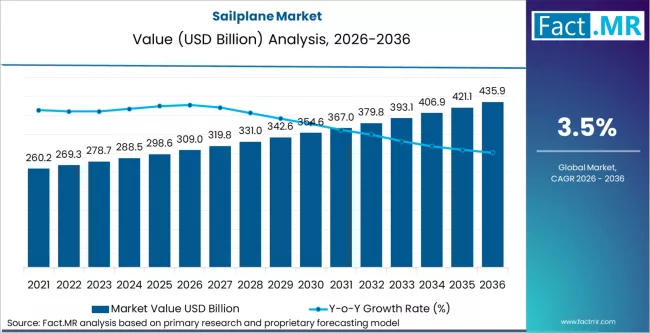
Sailplane Market Market Value Analysis | Source: Fact.MR
Sailplane Market Definition
The sailplane market covers the manufacture and sale of engine free glider aircraft designed to fly using natural air currents such as thermals and ridge lift. Sailplanes are lightweight fixed wing aircraft with long wingspans that enable efficient unpowered flight. They are used for sport aviation, pilot training, and competitive gliding activities. Airworthiness, certification, and operational standards for sailplanes are regulated by aviation authorities such as the US Federal Aviation Administration and international civil aviation frameworks under the International Civil Aviation Organization. [1]
Sailplane Market Inclusions
The report covers global and regional market size estimates in volume and value terms with a forecast period from 2026 to 2036. Segmentation includes sailplane type such as single seat and two seat gliders, construction material including composite airframes, and application across sport flying and training. The scope also includes regional demand patterns, pricing benchmarks, and international trade flows for certified glider aircraft.
Sailplane Market Exclusions
The scope excludes powered aircraft, motor gliders equipped with engines for sustained propulsion, and unmanned aerial vehicles. Hang gliders, paragliders, and ultralight recreational aircraft are not included. Aircraft components sold separately such as avionics, wings, or landing gear are excluded. Flight training services, maintenance services, laboratory scale prototypes without airworthiness certification, and simulation systems are also outside the scope.
Sailplane Market Research Methodology
- Primary Research: Primary research involved interviews with sailplane manufacturers, flight training schools, aviation clubs, and aircraft maintenance organizations.
- Desk Research: Desk research used airworthiness certification standards and aircraft registry data published by the US Federal Aviation Administration and safety and operational frameworks issued by the International Civil Aviation Organization, along with company annual reports and regulatory filings.
- Market Sizing and Forecasting: Market sizing applied a hybrid top down and bottom up model using aircraft production data, fleet registry counts, and replacement demand indicators across sport aviation segments.
- Data Validation and Update Cycle; Outputs were cross checked against aircraft registration records, certification databases, trade statistics, and publicly disclosed production data, with updates applied when verified public sources issue revisions.
Summary of Sailplane Market
- Market Definition
- The sailplane market covers the manufacture and sale of engine-free glider aircraft designed for unpowered flight using natural lift such as thermals and ridge lift. Sailplanes are primarily used in recreational aviation, competitive soaring, and structured pilot training environments, including cadet and limited military familiarization programs.
- Demand Drivers
- Demand is driven by pilot training pipelines, aeroclub activity, and recreational aviation culture, where fleet renewal cycles and utilization rates matter more than short-term aircraft sales volatility.
- Airworthiness certification, licensing, and operational oversight by civil aviation authorities directly influence production approval, fleet registration, and continued airworthiness of sailplanes.
- International standards and safety frameworks under shape harmonized operational rules, enabling cross-border competition, training exchanges, and manufacturer certification acceptance.
- Key Segments Analyzed
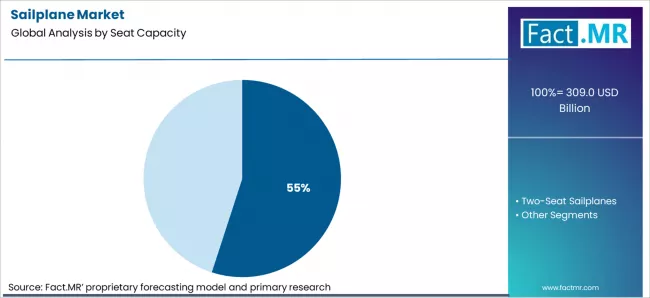
- Single-seat sailplanes lead with about 55% share, reflecting suitability for solo training, competitive soaring, and recreational ownership.
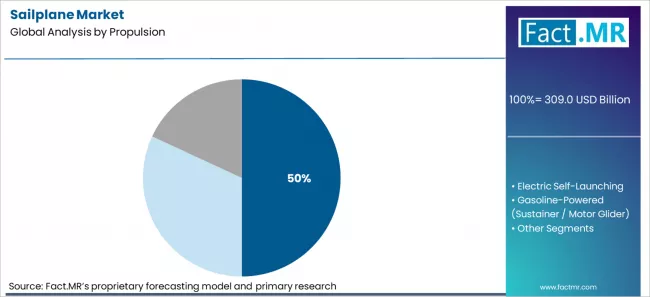
- Unpowered pure sailplanes account for roughly 50% share, supported by lower operating complexity, reduced maintenance requirements, and strong alignment with traditional gliding practices.
- Growth is strongest in China and India due to expanding aviation training infrastructure, while Europe remains replacement-led, supported by established gliding cultures and mature fleets.
- Analyst Opinion at Fact.MR
- Shambhu Nath Jha, Principal Consultant at Fact.MR, opines, ‘CXOs will find this report useful for understanding how training demand, aeroclub fleet economics, and regulatory certification frameworks are shaping long-term demand for sailplanes across recreational and institutional aviation segments.’
- Strategic Implications / Executive Takeaways
- Manufacturers should align product portfolios with training-focused and single-seat configurations.
- Fleet renewal opportunities in Europe and emerging training demand in Asia offer stable order visibility.
- Compliance with international airworthiness standards remains critical for multi-region market access.
- Methodology
- Market sizing is based on aircraft production, registry data, and replacement demand indicators.
- Validation uses certification records, fleet databases, and disclosed production statistics.
- Forecasts apply reproducible top-down and bottom-up aviation demand models grounded in verified data.
Segmental Analysis
Sailplane Market Analysis by Seat Capacity
Sailplane Market Analysis By Seat Capacity | Source: Fact.MR
Based on Fact.MR analysis, consumption of single-seat sailplanes is estimated to hold 55% share of the global sailplane market. Fact.MR analysts note that single-seat configurations lead due to their lower structural weight, competitive performance characteristics, and suitability for solo training and sport flying. As per Fact.MR, this seat capacity addresses pilot demand for glide efficiency, reduced operating complexity, and compliance with sport aviation licensing frameworks across gliding clubs and private ownership segments worldwide today supporting recreational aviation growth trends.
- Airworthiness oversight: Sailplanes must meet national airworthiness and certification standards before operation. [2]
- Training pattern: Fact.MR analysts note solo qualification requires single-seat aircraft experience.
- Performance focus: Lighter single-seat airframes support higher glide ratios.
Sailplane Market Analysis by Propulsion
Sailplane Market Analysis By Propulsion | Source: Fact.MR
Based on Fact.MR analysis, consumption of unpowered sailplanes is estimated to hold 50% share of the global market. Fact.MR analysts note that pure sailplanes lead due to reliance on thermal lift rather than onboard propulsion, reducing mechanical complexity and fuel dependency. As per Fact.MR, unpowered configurations address pilot preferences for traditional gliding performance, lower maintenance requirements, and eligibility under recreational aviation classifications across glider clubs and sport aviation communities worldwide today.
- Regulatory classification: International civil aviation authorities classify gliders separately from powered aircraft under licensing and operational rules.
- Operational simplicity: Fact.MR analysts note unpowered sailplanes require fewer onboard systems.
- Cost structure: Absence of propulsion reduces maintenance and operating expenses.
Sailplane Market Drivers, Restraints, And Opportunities
Fact.MR analysis indicates that the sailplane market exists as a specialised recreational and sport aviation segment within light-aircraft and aero-sports ecosystems, supported by clubs, flight training schools, and competition circuits where unpowered aviation is practised. As per Fact.MR assessment, sailplanes also known as gliders are aircraft designed to sustain controlled flight without an engine, with performance and safety expectations influenced by regulatory frameworks such as Federal Aviation Administration (FAA) glider certification and airworthiness criteria, which govern the design, production, and continued operation of gliders in the United States. [3] Fact.MR analysts observe that the current market size is anchored in participation levels, flight school adoption, and club fleets in regions where soaring culture and pilot training infrastructure are established.
Fact.MR is of the opinion that current market dynamics reflect shifts toward advanced composite materials, improved aerodynamics, and enhanced instrumentation that drive performance differentiation in sailplane design. Based on Fact.MR assessment, traditional metal-framed gliders remain in use due to legacy fleets and cost considerations, but demand is growing for composite-structure sailplanes that offer higher lift-to-drag ratios and lighter weight for improved soaring performance. Advanced sailplanes generally command higher per-unit pricing because of material costs, certification expenses, and bespoke performance features, meaning realised market value can rise even where shipment volumes grow at a measured pace. Fact.MR analysis suggests that this combination of moderate volume adoption and premium unit placement defines near-term market progression.
- Regulatory certification provisions: Fact.MR analysts note that frameworks such as FAA glider certification and airworthiness criteria influence sailplane design, testing, and operational approvals in major markets like the United States. [4]
- Material and performance evolution: Based on Fact.MR assessment, adoption of advanced composite materials and aerodynamic refinements supports demand for higher-performance sailplanes in competitive and recreational segments.
- Europe and Australasia gliding participation: Fact.MR opines that established soaring communities and aero-sports clubs in Europe and Australasia sustain market demand through training, events, and fleet renewals, supporting both OEM supply and aftermarket support.
Regional Analysis
Based on regional assessment, the sailplane sector is analyzed across North America, Europe, East Asia, South Asia, and other aviation activity hubs, spanning more than 40 countries. Regional performance varies according to recreational aviation participation, gliding club density, pilot training activity, and investment in lightweight composite aircraft technologies. The analysis also presents a comparative market attractiveness evaluation grounded in region-specific demand trends.
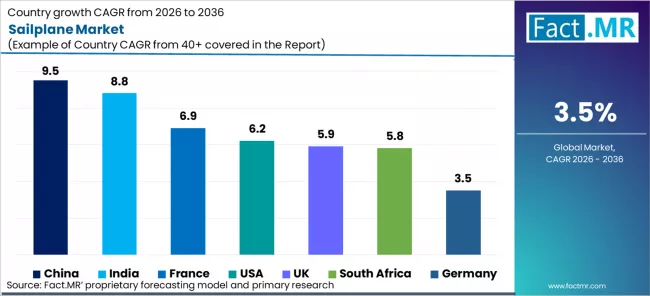
Sailplane Market Cagr Analysis By Country | Source: Fact.MR
| Country | CAGR |
|---|---|
| China | 9.5% |
| India | 8.8% |
| France | 6.9% |
| United States | 6.2% |
| United Kingdom | 5.9% |
| South Africa | 5.8% |
| Germany | 3.5% |
Source: Fact.MR analysis. Updated Feb 24, 2026
Source: Fact.MR analysis, based on proprietary forecasting models and primary research.
Asia Pacific Sailplane Market Analysis
Asia Pacific operates as an emerging training and recreational aviation driven sailplane region supported by growing aeroclub activity defense affiliated flight training and expansion of civil aviation sports infrastructure. Demand is shaped by pilot training programs regulatory approval for non-powered aircraft and investment in gliding clubs. Adoption is concentrated in China and India where civil aviation authorities permit expanded recreational flying. Growth reflects aerodrome development youth aviation programs and increasing participation in competitive gliding activities regionwide.
- China: Demand for sailplanes in China is projected to rise at 9.5% CAGR through 2036. Growth is linked to expansion of civil aviation sports programs and increased approvals for recreational and training gliding operations, as per Fact.MR.
- India: Demand for sailplanes in India is projected to rise at 8.8% CAGR through 2036. Usage reflects expansion of aeroclubs and inclusion of gliding in pilot training and aviation sports activities, according to Fact.MR.
Fact.MR’s analysis of the Sailplane Market in Asia Pacific consists of country-wise assessment that includes China and India. Readers can find aviation sports policies, training infrastructure trends, and fleet expansion references.
Europe Sailplane Market Analysis
Europe functions as a mature and regulation aligned sailplane market supported by long established gliding traditions certified manufacturers and dense aeroclub networks. Demand is shaped by sport aviation regulations club ownership models and competitive gliding culture. Adoption is concentrated in Germany France and the United Kingdom where sailplanes are used for training recreation and competition. Market activity reflects replacement demand fleet modernization and continued participation in regional and international gliding events across European aviation hubs.
- Germany: Demand for sailplanes in Germany is projected to rise at 3.5% CAGR through 2036. Usage reflects established aeroclub fleets competitive gliding participation and steady replacement of existing aircraft, as per Fact.MR.
- France: Demand for sailplanes in France is projected to rise at 6.9% CAGR through 2036. Adoption is supported by strong aeroclub participation and structured gliding training programs, according to Fact.MR.
- United Kingdom: Demand for sailplanes in the United Kingdom is projected to rise at 5.9% CAGR through 2036. Consumption is driven by recreational aviation clubs and competitive gliding activity, as per Fact.MR.
Fact.MR’s analysis of the Sailplane Market in Europe consists of country-wise assessment that includes Germany, France, and the United Kingdom. Readers can find club ownership models, regulatory frameworks, and fleet renewal trends.
North America Sailplane Market Analysis
North America operates as a recreational and training oriented sailplane market supported by private ownership aeroclubs and soaring associations. Demand is influenced by pilot certification pathways sport aviation regulations and availability of suitable flying sites. Adoption is centered in the United States where sailplanes are used for recreational soaring training and competition. Market activity reflects replacement purchases upgrades to higher performance models and continued participation in national soaring events within established general aviation ecosystems.
- United States: Demand for sailplanes in the United States is projected to rise at 6.2% CAGR through 2036. Usage is supported by strong aeroclub networks recreational aviation culture and structured glider pilot training programs, according to Fact.MR.
Fact.MR’s analysis of the Sailplane Market in North America consists of country-wise assessment that includes the United States. Readers can find training structures participation trends and fleet demand references.
Africa Sailplane Market Analysis
Africa functions as a niche but growing sailplane market supported by favorable flying conditions and established gliding communities. Demand is shaped by recreational aviation participation aeroclub activity and access to suitable airfields. Adoption remains limited but stable with usage focused on training and sport flying. Growth reflects gradual expansion of aviation sports and replacement of aging fleets within select markets.
- South Africa: Demand for sailplanes in South Africa is projected to rise at 5.8% CAGR through 2036. Usage reflects active gliding clubs favorable weather conditions and continued participation in recreational soaring, as per Fact.MR.
Fact.MR’s analysis of the Sailplane Market in Africa consists of country-wise assessment that includes South Africa. Readers can find recreational aviation trends and aeroclub activity references.
What is the Competitive Landscape of Sailplane Market in Key Countries?
Sailplane Market Analysis By Company | Source: Fact.MR
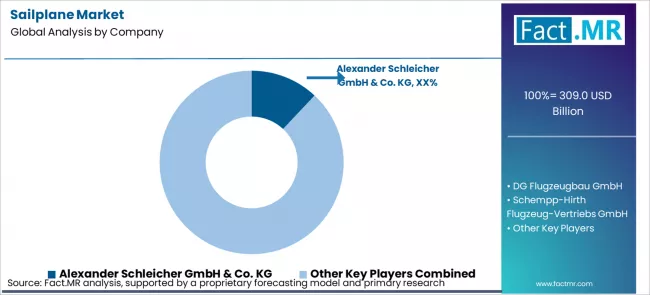
As per Fact.MR analysis, the 2026 sailplane market is shaped by manufacturing capabilities, regulatory compliance, and consumer adoption, which determine competitive advantage. China leads with 9.5% market share due to rapid expansion of flight training academies and increased production of lightweight composite sailplanes, which accelerates domestic adoption. India follows with 8.8%, driven by growing aero-sport clubs and government-supported aviation programs, which improve accessibility and pilot training. France (6.9%) and Germany (3.5%) maintain strong positions through heritage aerospace manufacturing and compliance with stringent EASA standards, which ensures safety and quality. The United States (6.2%) and United Kingdom (5.9%) focus on certified glider programs and integrated aero-sport facilities, which strengthens pilot adoption and recreational participation. South Africa (5.8%) benefits from local manufacturing and regional pilot clubs, which sustain niche demand. Across these countries, validated airworthiness, local manufacturing capacity, and structured training infrastructure form competitive moats, reducing reliance on price or single-product appeal.
Recent Industry Developments
- Jonker Sailplanes (Jan 2026): Unveiled the SOLO 2625 02i NEO Silent engine, a next-gen vibration-balanced propulsion system for the JS2 and JS5 models, while commissioning advanced R&D facilities to secure its electric supply chain. [5]
- Alexander Schleicher (Oct 2025): Successfully completed the maiden flight of the AS 35 Mi, the firm’s new flagship open-class glider, integrating modern ERP systems to streamline custom composite production. [6]
Key Players in Sailplane Market
- Alexander Schleicher GmbH & Co. KG
- DG Flugzeugbau GmbH
- Schempp-Hirth Flugzeug-Vertriebs GmbH
- Jonker Sailplanes (Pty) Ltd
- Pipistrel d.o.o. (Textron Inc.)
- Stemme AG
- Lange Aviation GmbH
- AMS Flight d.o.o.
- HPH Ltd. (HPH Sailplanes)
- Alisport Srl
- Allstar PZL Glider Sp. z o.o.
- Aeros Company
- LAK (Lithuanian Glider Manufacturer)
- Diamond Aircraft Industries GmbH
- Europa Aircraft Ltd.
Bibliography
- [1] U.S. Environmental Protection Agency. (2024). Chemical research and chemical substance safety programs. U.S. Environmental Protection Agency; U.S. Department of Energy. (2024). Bioenergy Technologies Office: Industrial bio-manufacturing and renewable chemical pathways. Office of Energy Efficiency and Renewable Energy, U.S. Department of Energy.
- [2] U.S. Department of Energy. (2024). Bioenergy Technologies Office: Bio-based chemicals and bioproducts. Office of Energy Efficiency and Renewable Energy, U.S. Department of Energy.
- [3] U.S. Department of Energy. (2024). Bioenergy Technologies Office overview. Office of Energy Efficiency and Renewable Energy, U.S. Department of Energy.
- [4] U.S. Environmental Protection Agency. (2024). Chemical Data Reporting (CDR) under the Toxic Substances Control Act. U.S. Environmental Protection Agency.
- [5] U.S. Environmental Protection Agency. (2024). Toxic Substances Control Act (TSCA) inventory. U.S. Environmental Protection Agency.
- [6] National Renewable Energy Laboratory. (2026). Advances in lignocellulosic fermentation pathways for muconic acid production. National Renewable Energy Laboratory; Royal Society of Chemistry. (2026). Renewable muconic acid from lignin-derived aromatics. Green Chemistry.
- [7] Elsevier. (2025). In-situ product recovery strategies for organic acid fermentation. Biochemical Engineering Journal.
This Report Addresses
- Market intelligence to support structured strategic decision making across recreational aviation, pilot training, and institutional sailplane deployment ecosystems
- Market size estimation and ten year revenue forecasts from 2026 to 2036, supported by validated aircraft production data, fleet registry counts, and replacement cycle benchmarking
- Growth opportunity assessment across seat capacity and propulsion configurations with emphasis on single-seat training fleets, unpowered sailplanes, and electric self-launching adoption
- Segment and regional revenue forecasts covering end use across recreational flying, competitive soaring, pilot training, flight schools, gliding clubs, cadet programs, and limited military applications
- Competitive strategy assessment including manufacturer certification capability, composite airframe expertise, production scale, and alignment with aeroclub and training fleet requirements
- Technology evolution tracking covering lightweight composite materials, aerodynamic efficiency improvements, and gradual integration of electric self-launching propulsion systems
- Regulatory impact analysis covering airworthiness certification, licensing frameworks, and international civil aviation standards influencing sailplane approval and cross-border operations
- Market report delivery in PDF, Excel, PowerPoint, and interactive dashboard formats for executive, operational, and institutional decision support
Segmentation
Scope of the Report
| Metric | Value |
|---|---|
| Quantitative Units | USD 309.0 billion (2026) to USD 432.0 billion (2036), CAGR 3.5% |
| Market Definition | The sailplane market covers the manufacture and sale of engine-free glider aircraft designed to fly using natural air currents such as thermals and ridge lift. Sailplanes are lightweight fixed-wing aircraft with long wingspans enabling efficient unpowered flight. Applications include sport aviation, pilot training, competitive soaring, and limited military flight familiarization programs. Certification follows FAA and ICAO frameworks. |
| Seat Capacity Segmentation | Single-Seat Sailplanes, Two-Seat Sailplanes |
| Propulsion Segmentation | Unpowered (Pure Sailplanes), Electric Self-Launching, Gasoline-Powered Sustainer / Motor Gliders |
| End-Use Segmentation | Sports and Recreational Activities, Competitive Soaring, Recreational Flying, Pilot Training, Flight Schools, Gliding Clubs, Cadet Programs, Military Applications (Basic Flight Training, Limited Surveillance Roles) |
| Regions Covered | Asia Pacific, Europe, North America, Latin America, Middle East & Africa |
| Countries Covered | India, China, Japan, South Korea, Indonesia, Australia & New Zealand, ASEAN, Rest of Asia Pacific, Germany, Italy, France, United Kingdom, Spain, Benelux, Nordics, Central & Eastern Europe, Rest of Europe, United States, Canada, Mexico, Brazil, Argentina, Chile, Rest of Latin America, Kingdom of Saudi Arabia, United Arab Emirates, South Africa, Turkey, Rest of Middle East & Africa |
| Key Companies Profiled | Alexander Schleicher GmbH & Co. KG, DG Flugzeugbau GmbH, Schempp-Hirth Flugzeug-Vertriebs GmbH, Jonker Sailplanes (Pty) Ltd, Pipistrel d.o.o. (Textron Inc.), Stemme AG, Lange Aviation GmbH, AMS Flight d.o.o., HPH Ltd. (HPH Sailplanes), Alisport Srl, Allstar PZL Glider Sp. z o.o., Aeros Company, LAK (Lithuanian Glider Manufacturer), Diamond Aircraft Industries GmbH, Europa Aircraft Ltd. |
| Forecast Period | 2026 to 2036 |
| Approach | Hybrid top-down and bottom-up modeling validated with interviews from sailplane manufacturers, flight schools, aeroclubs, and maintenance organizations, cross-checked with FAA and ICAO certification data and aircraft registration statistics. |
Source: Fact.MR analysis. Updated Feb 24, 2026
Sailplane Market Analysis by Segments
-
By Seat Capacity:
- Single-Seat Sailplanes
- Two-Seat Sailplanes
-
By Propulsion:
- Unpowered (Pure Sailplanes)
- Electric Self-Launching
- Gasoline-Powered (Sustainer / Motor Glider)
-
By End User:
- Sports and Recreational Activities
- Competitive Soaring
- Recreational Flying
- Pilot Training
- Flight Schools
- Gliding Clubs
- Cadet Programs
- Military Applications
- Basic Flight Training
- Surveillance (Limited Operational Roles)
-
Region
- Asia Pacific
- India
- China
- Japan
- South Korea
- Indonesia
- Australia & New Zealand
- ASEAN
- Rest of Asia Pacific
- Europe
- Germany
- Italy
- France
- United Kingdom
- Spain
- Benelux
- Nordics
- Central & Eastern Europe
- Rest of Europe
- North America
- United States
- Canada
- Mexico
- Latin America
- Brazil
- Argentina
- Chile
- Rest of Latin America
- Middle East & Africa
- Kingdom of Saudi Arabia
- United Arab Emirates
- South Africa
- Turkey
- Rest of Middle East & Africa
- Asia Pacific
Frequently Asked Questions
How large is the global sailplane market in 2026?
What will the sailplane market size be by 2036?
What is the expected CAGR of the sailplane market during 2026–2036?
How much absolute value is the sailplane market expected to add over the forecast window?
What are the primary factors driving growth in the sailplane market?
Which seat capacity segment dominates the sailplane market?
Why do single-seat sailplanes account for a larger share of demand?
Which propulsion type holds the largest share of the sailplane market?
Why do unpowered sailplanes remain dominant despite electric alternatives?
How significant is electric self-launching sailplane adoption in early years?
Which country is expected to record the fastest growth in the sailplane market?
What is driving strong sailplane demand growth in China?
How does India compare in terms of sailplane market growth?
What is the growth outlook for the sailplane market in France?
How fast is the sailplane market expected to grow in the United States?
What factors support sailplane demand in the United Kingdom?
How does South Africa fit into the global sailplane market outlook?
Why does Germany show slower growth compared to emerging markets?
How important are training fleets to overall sailplane market stability?
What will shape sailplane market value growth in the later years of the forecast period?
Who worked on this report


Preview the report firsthand - request a free sample
Free SampleGet the brochure for pricing and purchase details
Download PDF