- Market Value (2025): USD 15.3 Bn
- Estimated Value (2026): USD 17.5 Bn
- Forecast Value (2036): USD 68.4 Bn
- CAGR (2026-2036): 14.6%
What is the Drone Tower Inspection Market forecast to be worth by 2036?
USD 17.5 billion in 2026 to USD 68.4 billion by 2036 at a 14.6% CAGR.
- The Drone Tower Inspection Market was valued at USD 15.3 billion in 2025.
- Demand is projected to increase from USD 17.5 billion in 2026 to USD 68.4 billion by 2036.
- The market is forecast to record 14.6% CAGR from 2026 to 2036.
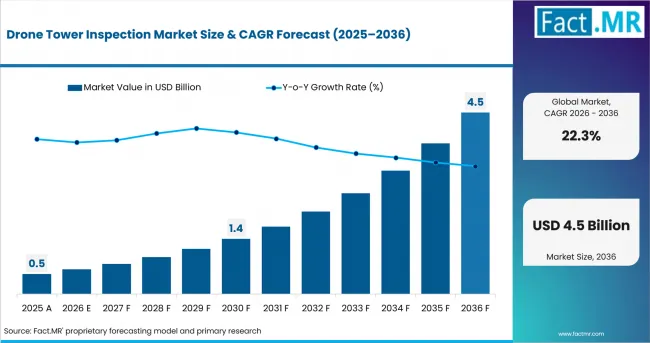
Drone Tower Inspection Market Value Analysis | Source: Fact.MR
What are the defining numbers behind Drone Tower Inspection Market growth?
An absolute opportunity of USD 50.9 billion is expected between 2026 and 2036.
- Demand Drivers in the Market
- Tower owners need safer inspection methods because manual climbing exposes crews to height and energized-equipment risk. Drone flights create photo and thermal records before repair crews visit the site.
- Linear inspection work is expanding as power utilities rebuild older assets. Transmission rebuilding keeps corridor inspection close to capital-work planning and follow-up maintenance.
- BVLOS rulemaking is expected to improve the economics of long-corridor inspection. In August 2025, the Federal Aviation Administration proposed a BVLOS rule covering drone operations and safe separation, providing operators with a clearer pathway for routine and scalable beyond-visual-line-of-sight missions.
- Telecom operators need frequent visual checks as 5G equipment raises the value of uptime. Drones help document antenna alignment, tower corrosion and site access issues before technicians plan repair visits.
- Key Segments Analyzed
- By Product: Fixed Wing Drones are expected to hold 65% share in 2026 because long-range flight supports corridor coverage across transmission routes and rural tower clusters.
- By Operation: Remotely Piloted is projected to account for 55.90% share in 2026 as tower inspections still require pilot judgment near lines, antennas and restricted spaces.
- By End Use: Telecommunication is anticipated to capture 39% share in 2026 since tower companies require repeat image records for antennas, mounts and safety hardware.
- By Application: Power Transmission Tower Inspection is forecast to represent 41.60% share in 2026 owing to larger asset spacing and the need for frequent line-condition records.
- Analyst Opinion at Fact.MR
- Shambhu Nath Jha, Principal Consultant at Fact.MR, states, “Drone tower inspection is increasingly becoming a documentation and asset-management workflow alongside flight operations. Asset owners need clear images, defect tagging and repeat inspection records that reduce unnecessary tower climbs, while providers can differentiate through certified operations, suitable airframes and consistent reporting.”
- Strategic Implications
- Drone manufacturers should pair endurance with stable imaging because fixed wing coverage is valuable only when inspection photos remain clear enough for engineering review.
- Service providers should build tower-specific report templates so utilities and telecom operators can compare defects across repeat visits.
- Telecom operators should align drone records with maintenance tickets because antenna and mount issues need fast assignment to field crews.
- Utility inspection teams should prioritize BVLOS readiness where transmission lines run across long rural corridors.
USA is projected to record 22.0% CAGR through 2036 supported by BVLOS rulemaking and transmission rebuild activity. UK is expected to post 18.0% as mobile networks expand full 5G coverage. Germany is forecast to reach 17.0% through broad 5G surface coverage and domestic drone capability. South Korea is anticipated to advance at 16.0% as public drone commercialization programs widen technical capacity. France records 15.0% through dense 5G site deployment. Italy is estimated to post 14.0% with 5G Stand Alone service obligations. Japan is projected to record 12.0% as drone-route planning supports safer unmanned operations.
How does the Drone Tower Inspection Market break down by segment?
Fixed Wing Drones lead Product at 65%; Power Transmission Tower Inspection leads Application at 41.60%.
Which Product dominates?
Fixed Wing Drones are expected to hold 65% share in 2026.
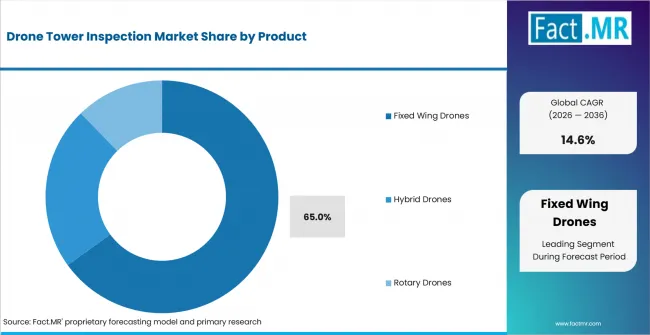
Drone Tower Inspection Market Analysis By Product | Source: Fact.MR
Fixed wing drones lead product demand because they cover longer routes than close-range multicopters. Tower inspection teams use them for line patrols, vegetation overview and site approach planning before close inspection work begins. Long Range Inspection Drones and Industrial Survey Drones support larger projects where fewer flight cycles reduce time on site. Hybrid drones are gaining attention where operators want runway-free launch with more endurance than a small multirotor.
What leads the Operation segment?
Remotely Piloted is projected to account for 55.90% share in 2026.
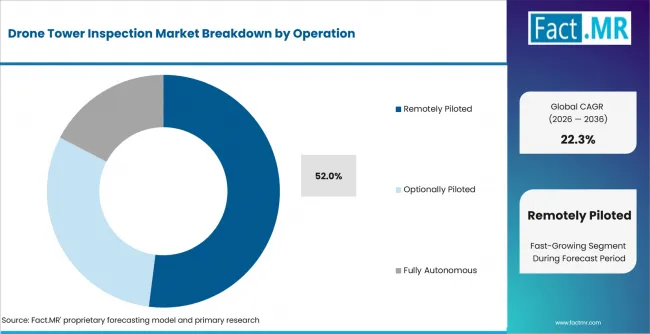
Drone Tower Inspection Market Analysis By Operation | Source: Fact.MR
Remotely piloted operations remain the practical choice for tower inspection because flight paths often run near energized lines, telecom antennas and site boundaries. Manual Flight Operations support close visual checks when a pilot needs to adjust angle or distance. Assisted Flight Operations add route support and safety prompts. Fully Autonomous operations are expected to expand as rules and client approvals mature across repeat corridor routes.
How does End Use shape demand?
Telecommunication is anticipated to capture 39% share in 2026.
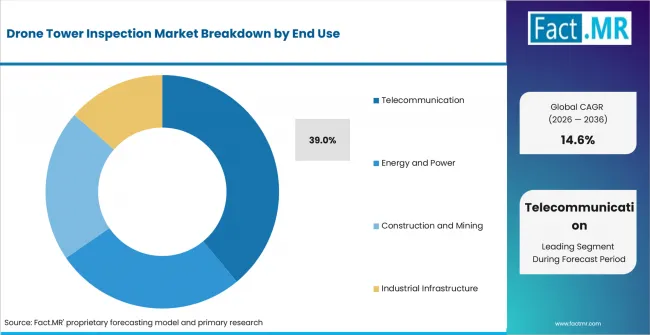
Drone Tower Inspection Market Analysis By End Use | Source: Fact.MR
Telecommunication leads end-use demand because cell towers need recurring checks for antennas, mounts, corrosion and cabling. Drone images reduce repeat site visits by giving engineers a clearer record before they dispatch a repair crew. Signal Infrastructure Inspection and Cell Tower Inspection remain natural use cases because a tower fault can affect many subscribers. Energy and Power continues to grow as transmission assets require corridor-level inspection and thermal checks.
What supports Application demand?
Power Transmission Tower Inspection is forecast to represent 41.60% share in 2026.
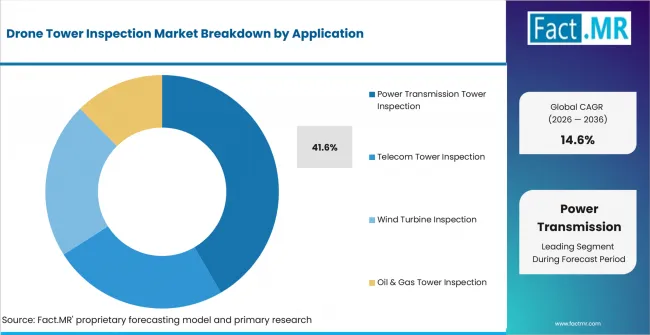
Drone Tower Inspection Market Analysis By Application | Source: Fact.MR
Power Transmission Tower Inspection leads application demand because line assets are spread across long routes and difficult terrain. Drones give utilities a repeatable way to inspect tower arms, insulators and nearby vegetation. Telecom Tower Inspection remains a visible application because equipment density is increasing on many sites. Wind Turbine Inspection and Oil & Gas Tower Inspection add specialized demand where access cost and safety planning shape inspection timing.
What is accelerating Drone Tower Inspection Market adoption, and what is holding it back?
Safer access drives it; approval and data-quality requirements restrain it.
Driver Impact Analysis
| DRIVER | (~) % IMPACT ON CAGR | GEOGRAPHIC RELEVANCE | IMPACT TIMELINE |
|---|---|---|---|
| Transmission corridor inspection demand | +2.1% | North America, Europe, East Asia | Short term (<= 2 years) |
| Telecom tower maintenance and 5G rollout | +1.7% | Global | Medium term (2-4 years) |
| BVLOS route economics | +1.4% | USA, Japan, Europe | Medium term (2-4 years) |
| Thermal and visual defect records | +1.0% | Global | Long term (>= 4 years) |
Source: Fact.MR analysis. Updated Sep 2, 2026
- Transmission corridor inspection demand: Power utilities need repeatable inspection records for towers, insulators and lines. Drone flights reduce work at height and help engineers screen routes before repair crews travel to the site.
- Telecom tower maintenance and 5G rollout: Antenna density is expected to raise the value of faster site checks. Full 5G rollout increases the need for accurate tower condition records.
- BVLOS route economics: Long flights are expected to improve inspection productivity on power routes and rural tower clusters. FAA rulemaking gives operators a clearer pathway for repeat missions beyond direct visual range.
- Thermal and visual defect records: Thermal cameras and zoom imaging are anticipated to improve fault screening. Asset owners can compare images across visits and route repair crews to towers with visible defects.
Opportunity Impact Analysis
| OPPORTUNITY | (~) % IMPACT ON CAGR | GEOGRAPHIC RELEVANCE | IMPACT TIMELINE |
|---|---|---|---|
| AI-assisted defect tagging | +1.2% | Global | Medium term (2-4 years) |
| Hybrid drones for remote towers | +1.0% | USA, Europe, Japan | Long term (>= 4 years) |
| Telecom audit workflows | +0.8% | UK, France, South Korea | Short term (<= 2 years) |
Source: Fact.MR analysis. Updated Sep 2, 2026
- AI-assisted defect tagging: Software-based image review is expected to reduce time spent sorting tower photos. Providers can build value by linking defects with coordinates and past inspection records.
- Hybrid drones for remote towers: Hybrid systems are projected to gain work where operators need vertical launch and longer endurance. These platforms suit remote corridors where fixed-wing recovery space is limited.
- Telecom audit workflows: Tower owners are expected to use drone records for tenancy, antenna and safety checks. A structured photo record can shorten planning time before field teams visit congested sites.
Restraints Impact Analysis
| RESTRAINT | (~) % IMPACT ON CAGR | GEOGRAPHIC RELEVANCE | IMPACT TIMELINE |
|---|---|---|---|
| Flight approval and Remote ID compliance | -0.8% | USA, UK, Japan | Short term (<= 2 years) |
| Image quality variation near steel structures | -0.5% | Global | Medium term (2-4 years) |
| Weather exposure on towers and ridgelines | -0.4% | Europe, East Asia | Short term (<= 2 years) |
Source: Fact.MR analysis. Updated Sep 2, 2026
- Flight approval and Remote ID compliance: Commercial drone teams need to align flights with national aviation rules, site permissions, and identification requirements. Compliance planning adds operational steps before tower inspections can begin, particularly for repeat or complex missions.
- Image quality variation near steel structures: Tower steelwork can make close-range inspection difficult when wind, glare, obstruction, or viewing angle affects image clarity. Buyers therefore value providers that can repeat flights, document uncertain findings, and maintain consistent inspection quality.
- Weather exposure on towers and ridgelines: Wind, poor visibility, and exposed terrain can reduce safe flight windows around towers and elevated infrastructure. Inspection teams need flexible scheduling and contingency planning to maintain reliable service delivery across changing weather conditions.
Which countries are scaling the Drone Tower Inspection Market through 2036?
- The country comparison spans 10.0 percentage points and forms four practical growth bands across the forecast period.
- USA remains 4.0 percentage points above the UK through BVLOS progress and transmission rebuild activity.
- The UK remains 1.0 percentage point above Germany as full 5G coverage supports more tower audit work.
- Germany remains 1.0 percentage point above South Korea through wide 5G surface coverage and domestic drone engineering.
- South Korea remains 1.0 percentage point above France as public drone commercialization programs widen technical capacity.
- France remains 1.0 percentage point above Italy through dense 5G site deployment and long-range drone development.
- Italy remains 2.0 percentage points above Japan as 5G Stand Alone service obligations support infrastructure monitoring.
Comparable CAGRs create different entry conditions because airspace rules, tower density, grid rebuilding and telecom investment vary by country. Full report coverage includes North America, Latin America, Western Europe, Eastern Europe, East Asia, South Asia and Pacific, and Middle East and Africa.
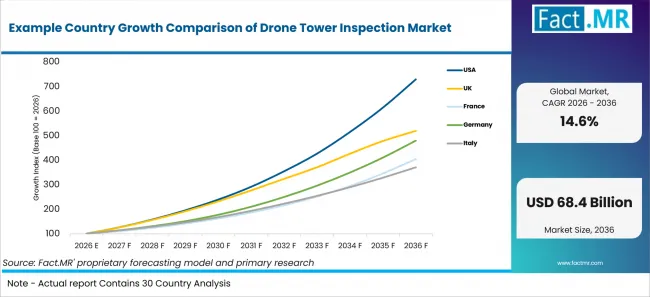
Example Country Growth Comparison Of Drone Tower Inspection Market | Source: Fact.MR
| Country | CAGR (2026-2036) |
|---|---|
| USA | 22.0% |
| UK | 18.0% |
| Germany | 17.0% |
| South Korea | 16.0% |
| France | 15.0% |
| Italy | 14.0% |
| Japan | 12.0% |
Source: Fact.MR analysis. Updated Sep 2, 2026
What supports USA adoption?
22.0% CAGR, supported by transmission rebuilding and BVLOS rulemaking.
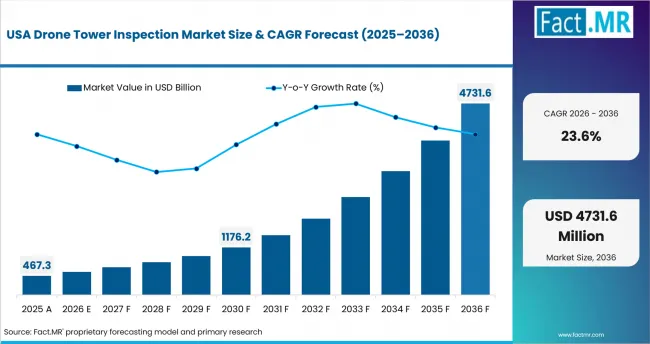
Drone Tower Inspection Market Country Value Analysis | Source: Fact.MR
USA utilities are expected to use drone tower inspection more often as transmission corridors undergo planned rebuild work. In October 2025, the U.S. Department of Energy reported that AEP Transmission’s project would reconductor or rebuild around 5,000 miles of transmission lines across five states. BVLOS progress gives inspection providers a clearer route to serve long rural routes with fewer site visits.
How is the UK scaling demand?
18.0% CAGR, backed by full 5G rollout and drone rule updates.
The UK outlook is shaped by telecom network densification and clearer drone compliance rules. Ofcom reported in November 2025 that full 5G, or 5G Standalone, was available across 83% of areas outside premises in the UK at its High Confidence level. Tower owners are expected to use drone inspection records for antenna audits and safety checks as data traffic becomes more dependent on high-availability sites.
What supports Germany’s growth?
17.0% CAGR, reinforced by wide 5G coverage and local drone capability.
Germany combines dense industrial infrastructure with broad mobile network coverage. Bundesnetzagentur reported in December 2025 that about 95% of Germany’s surface area had 5G coverage as of October 2025. Drone inspection providers are expected to benefit where utilities and telecom operators want repeatable records across dispersed assets.
How is South Korea developing demand?
16.0% CAGR, driven by public drone commercialization programs.
South Korea is building drone capability through public programs that move unmanned systems toward commercial use. MOLIT reported in August 2025 that 119 companies across 22 consortia participated in a public competition for two next-generation drone development projects covering heavy-lift drones for wildfire suppression and AI drones for bird detection and control at airports. The participation demonstrates broad industry involvement in Korea’s drone development programs.
What supports France’s adoption?
15.0% CAGR, supported by 5G site density and long-range drone development.
France has a dense telecom infrastructure base that requires regular visual and structural checks. Arcep reported in June 2026 that more than 73,900 5G sites were in service in metropolitan France. Drone inspection providers can use that asset density to build repeat service schedules for telecom towers and connected infrastructure.
What underpins Italy’s outlook?
14.0% CAGR, shaped by 5G Stand Alone service obligations.
Italy’s tower inspection demand is linked to network-quality obligations and mixed terrain. In July 2026, AGCOM approved the launch of a public consultation proposing that new 5G Stand Alone networks, at full implementation, guarantee at least 150 Mbit/s downlink, 30 Mbit/s uplink and end-to-end latency of no more than 15 ms under typical peak-traffic conditions for 95% of the population. The proposed service-quality framework increases the value of reliable infrastructure monitoring where antenna position, backhaul access or tower condition affect performance.
How does Japan perform?
12.0% CAGR, supported by drone-route planning and safety controls.
Japan is building a structured environment for unmanned operations. In May 2025, METI and IPA’s Digital Architecture Design Center issued drone-route specifications and standards, operational guidelines, and a nationwide drone-route development map. METI identifies transmission-equipment patrol and inspection among the applications considered for the drone-route system.
Who leads the Drone Tower Inspection Market?
Delair and Terra Drone have direct infrastructure- or tower-inspection capabilities, while Quantum Systems and SkySpecs provide adjacent infrastructure and renewable-asset inspection capabilities.
Delair supports long-range inspection through fixed-wing and VTOL platforms. Its DT61 unveiling in June 2025 added a platform designed for the inspection and surveillance of large land and sea areas. Terra Drone offers tower and pole inspection with zoom-camera workflows. AgEagle’s senseFly eBee family supports fixed wing mapping that can support route and corridor assessment before close tower inspection work.
Quantum Systems brings autonomous aerial intelligence systems that fit mapping and infrastructure inspection needs. SkySpecs is active in renewable asset inspection, including autonomous drone workflows for wind assets. Intertek adds third-party asset inspection capability, while Valmont connects tower engineering knowledge with UAV inspection services for difficult infrastructure locations.
Which companies are the key providers?
Key companies include Delair, Terra Drone Corporation, AgEagle Aerial Systems, Quantum Systems, SkySpecs, Intertek Group plc and Valmont Industries.
- Delair
- Terra Drone Corporation
- AgEagle Aerial Systems Inc. (senseFly)
- Quantum Systems
- SkySpecs
- Intertek Group plc
- Valmont Industries, Inc.
Bibliography
- Federal Aviation Administration. (2025, August 6). U.S. Transportation Secretary Sean P. Duffy unveils proposed rule to unleash American drone dominance as part of his innovation agenda.
- U.S. Department of Energy. (2025, October 16). Energy Department closes loan guarantee to strengthen U.S. grid reliability.
- Ofcom. (2025, November 19). Brits devour data at record levels as mobile networks race to improve 5G.
- UK Civil Aviation Authority. (2025, May 8). Updated rules confirmed to support safe growth of drone sector.
- Bundesnetzagentur. (2025, December 15). Bundesnetzagentur publishes latest figures from mobile communications monitoring.
- Arcep. (2026, June 18). Couverture mobile.
- Ministry of Land, Infrastructure and Transport. (2025, August 22). Drone technologies to cope with wildfires and airport safety.
- Autorità per le Garanzie nelle Comunicazioni. (2026, July 29). Avvio di una consultazione pubblica sul rinnovo dei diritti d’uso delle bande radiomobili in scadenza nel 2029.
- Delair. (2025, June 16). Delair unveils a new drone at Paris Air Show 2025: The DT61.
This Report Answers
- The report explains where tower inspection drones are used across Product and Operation. It also covers End Use and Application, together with regional adoption.
- Segment analysis identifies Fixed Wing Drones and Power Transmission Tower Inspection as the leading subsegments for 2026.
- Country analysis examines USA, UK, Germany, South Korea, France, Italy and Japan through regulatory and infrastructure indicators.
- Competitive analysis reviews Delair, Terra Drone, AgEagle Aerial Systems, Quantum Systems, SkySpecs, Intertek Group plc and Valmont Industries.
- Application analysis assesses how transmission towers, telecom towers and wind towers influence service needs.
What does the Drone Tower Inspection Market cover?
The Drone Tower Inspection Market covers drones and inspection services used to inspect elevated telecom, power, wind and industrial structures. It includes fixed wing, hybrid and rotary drones used with imaging payloads, thermal cameras, route planning and inspection reporting workflows.
The assessment covers drone-based inspection work tied to tower condition, route assessment and repair planning. General aerial photography is outside scope when the flight record is unrelated to tower inspection.
What is included in the scope?
The scope includes fixed wing, hybrid and rotary drones used for tower inspection across telecom, utility, renewable-energy and industrial settings. It includes remotely piloted, optionally piloted and autonomous workflows where the output is an inspection record. Thermal drone inspection, drone bridge inspection services, drone roof inspection and fixed wing drone gives adjacent context without changing the tower-specific scope.
What is excluded from the scope?
The scope excludes drone hardware sold only for consumer photography, military-only surveillance and delivery systems with no inspection record. General construction monitoring is outside the scope unless the same flight package includes documented tower-condition assessment. Broader surveying is treated separately when the output is terrain mapping rather than tower inspection.
How Was the Analysis Built?
The analysis draws on 120+ sources, 35+ company portfolios, 25+ countries, and more than 20 industry interviews.
- Primary Research: Primary research includes discussions with manufacturers, service providers, technology developers, distributors, end users, and subject-matter experts. These conversations examine purchasing priorities, product adoption, operational challenges, approval requirements, competitive positioning, and the factors that influence wider market acceptance.
- Desk Research: Desk research covers government statistics, regulatory publications, company filings, trade data, technical studies, industry associations, standards, public policy, and other authoritative sources. Every source used in the analysis is documented in the bibliography.
- Market Sizing and Forecasting: Market estimates combine historical performance, demand indicators, pricing and volume trends, segment shares, company participation, country-level growth, adoption patterns, investment activity, and barriers to market expansion.
- Data Validation and Update Cycle: Findings are validated by comparing primary interviews with public data, company activity, regulatory changes, trade patterns, and industry developments. Regular updates review new product launches, capacity changes, partnerships, approvals, and shifts in commercial adoption.
Segmentation
What is the report’s scope and coverage?
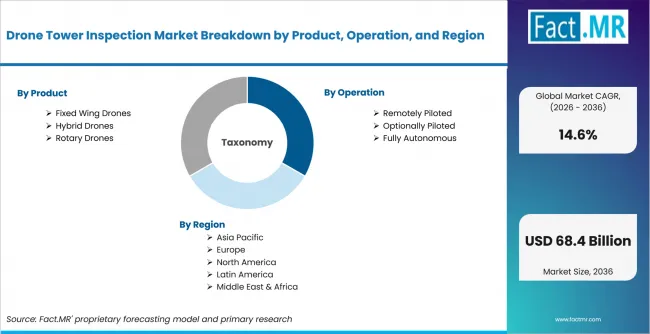
Drone Tower Inspection Market Breakdown By Product, Operation, And Region | Source: Fact.MR
| Attribute | Details |
|---|---|
| Quantitative Units | USD billion |
| Market Definition | Drone systems and inspection services used to capture visual, thermal or mapping records for telecom towers, transmission towers, substations, wind towers and related elevated infrastructure. |
| Product | Fixed Wing Drones, Hybrid Drones, Rotary Drones |
| Operation | Remotely Piloted, Optionally Piloted, Fully Autonomous |
| End Use | Telecommunication, Energy and Power, Construction and Mining, Industrial Infrastructure |
| Application | Power Transmission Tower Inspection, Telecom Tower Inspection, Wind Turbine Inspection, Oil & Gas Tower Inspection |
| Regions Covered | North America; Latin America; Western Europe; Eastern Europe; East Asia; South Asia and Pacific; Middle East and Africa |
| Countries Covered | USA; UK; Germany; South Korea; France; Italy; Japan |
| Companies Profiled | Delair; Terra Drone Corporation; AgEagle Aerial Systems Inc.; Quantum Systems; SkySpecs; Intertek Group plc; Valmont Industries, Inc. |
| Forecast Period | 2026 to 2036 |
| Approach | Hybrid top-down and bottom-up approach using tower asset density, drone operation rules, application mix, country adoption and provider portfolio review. |
Source: Fact.MR analysis. Updated Sep 2, 2026
How is the market segmented?
-
By Product
- Fixed Wing Drones
- Long Range Inspection Drones
- Industrial Survey Drones
- Hybrid Drones
- Vertical Take Off and Landing Drones
- Utility Inspection Drones
- Rotary Drones
- Single Rotor Drones
- Multi Rotor Drones
- Fixed Wing Drones
-
By Operation
- Remotely Piloted
- Manual Flight Operations
- Assisted Flight Operations
- Optionally Piloted
- Dual Mode Operations
- Advanced Mission Operations
- Fully Autonomous
- Autonomous Navigation
- Autonomous Inspection Systems
- Remotely Piloted
-
By End Use
- Telecommunication
- Cell Tower Inspection
- Signal Infrastructure Inspection
- Energy and Power
- Transmission Infrastructure Inspection
- Renewable Energy Inspection
- Construction and Mining
- Construction Site Inspection
- Mining Infrastructure Inspection
- Industrial Infrastructure
- Oil and Gas Infrastructure Inspection
- Transportation Infrastructure Inspection
- Telecommunication
-
By Application
- Power Transmission Tower Inspection
- High Voltage Line Inspection
- Substation Inspection Applications
- Telecom Tower Inspection
- 5G Infrastructure Inspection
- Cell Tower Structural Inspection
- Wind Turbine Inspection
- Blade Surface Inspection
- Tower Structural Inspection
- Oil & Gas Tower Inspection
- Refinery Structure Inspection
- Offshore Platform Inspection
- Power Transmission Tower Inspection
-
By Region
- North America
- Latin America
- Western Europe
- Eastern Europe
- East Asia
- South Asia and Pacific
- Middle East and Africa
Frequently Asked Questions
How big is the drone tower inspection market in 2026?
What is the CAGR of the drone tower inspection market from 2026 to 2036?
Which product leads the drone tower inspection market?
Which operation leads the drone tower inspection market?
Who are the leading companies in the drone tower inspection market?
Who worked on this report


Preview the report firsthand - request a free sample
Free SampleGet the brochure for pricing and purchase details
Download PDF