- Base Value(2025): 1.2 Bn
- Estimated Value(2026): 1.3 Bn
- Forecast Value (2036): 2.0 Bn
- CAGR (2026 - 2036): 4.6%
Savory Yogurt Market Forecast and Outlook By Fact.MR
In 2025, the savory Yogurt market was valued at USD 1.2 billion. Based on Fact MR analysis, demand for savory yogurt is estimated to grow to USD 1.3 billion in 2026 and USD 2 billion by 2036. FMR projects a CAGR of 4.6% during the forecast period.
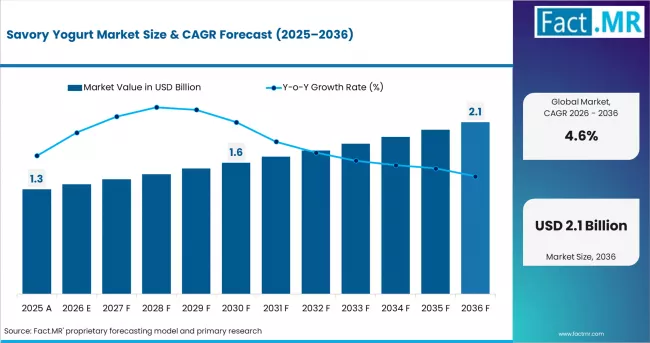
Savory Yogurt Market Market Value Analysis | Source: Fact.MR
Savory Yogurt Market
| Metric | Details |
|---|---|
| Industry Size (2026E) | USD 1.3 billion |
| Industry Value (2036F) | USD 2 billion |
| CAGR (2026 to 2036) | 4.6% |
Source: Fact.MR analysis. Updated Apr 20, 2026
Summary of the Savory Yogurt Market
- Market Definition
- The market includes yogurt products formulated with non sweet flavor profiles such as herbs, spices, vegetables, and salt based ingredients. These products are produced through standard dairy fermentation processes and positioned as meal accompaniments, dips, spreads, or protein rich snacks across retail and food service channels.
- Demand Drivers
- Increasing consumer preference for protein rich snacks and meal complement dairy products
- Expansion of flavor diversification in yogurt categories including herb and spice variants
- Rising demand for convenient dairy based snack formats suited for savory consumption occasions
- Growth in retail availability of differentiated yogurt products across supermarket channels
- Key Segments Analyzed
- Product: Stirred yogurt leads with around 40% share in 2026 supported by texture consistency and flavor integration capability
- Sales Channel: Supermarkets and hypermarkets dominate with about 45% share driven by strong cold chain retail infrastructure
- Application Positioning: Savory yogurt is widely used as dips, spreads, and meal accompaniment products
- Geography: Asia Pacific shows relatively higher growth, while Europe and North America maintain stable demand patterns
- Analyst Opinion at Fact MR
- Shambhu Nath Jha, Principal Consultant, Fact MR, opines, "In this updated edition of the Savory Yogurt Market report, industry participants will observe that product differentiation within cultured dairy categories remains centered on flavor expansion and positioning yogurt beyond dessert consumption. Savory yogurt formats are being integrated into snack and meal applications where protein content and fermentation benefits support consumer acceptance. Manufacturers that optimize formulation stability, supply chain efficiency, and retail positioning are expected to maintain competitive balance through 2036."
- Strategic Implications/Executive Takeaways
- Invest in flavor development aligned with regional taste preferences and culinary compatibility
- Expand retail presence through supermarket and hypermarket distribution channels
- Strengthen cold chain logistics to maintain product stability and shelf life
- Focus on product differentiation within cultured dairy categories to support category visibility
- Methodology
- Primary interviews conducted with dairy manufacturers, product developers, and retail distributors
- Desk research based on dairy industry publications, company reports, agricultural databases, and trade statistics
- Market sizing derived using a hybrid approach combining bottom up production analysis with top down consumption assessment
- Data validation performed through cross verification with industry datasets and internal peer review aligned with Fact MR standards
The increase of USD 0.7 billion indicates incremental expansion, reflecting steady category acceptance rather than structural disruption. Growth remains supported by rising demand for protein-rich snacks and flavor diversification, while moderated by substitution pressure from plant-based yogurt and cost sensitivity linked to dairy input price volatility.
India leads with a projected CAGR of 5.4%, supported by rising consumption of protein rich breakfast products and increasing preference for savory dairy formats. China follows with a CAGR of 4.9%, driven by expanding adoption of fermented dairy within functional food consumption patterns. The United Kingdom records a CAGR of 4.5%, reflecting increasing availability of savory yogurt variants across retail channels and private label portfolios. Germany shows a CAGR of 4.3%, supported by stable demand for cultured dairy within established dietary patterns. The United States records the slowest growth at 4.2%, reflecting a mature market where demand is largely tied to replacement cycles and limited new category penetration. Mature markets generate a significant share of replacement demand as product differentiation remains constrained by established taste preferences and saturated yogurt consumption patterns.
Segmental Analysis
Savory Yogurt Market Analysis by Product
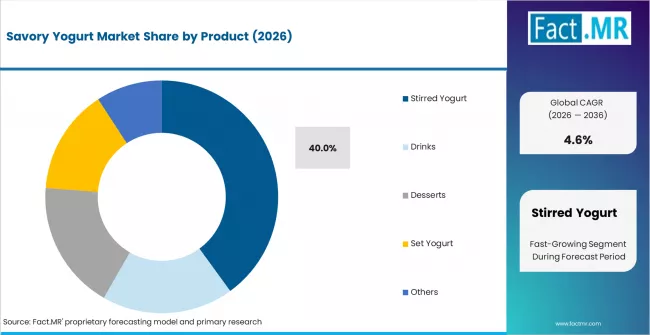
Savory Yogurt Market Analysis By Product | Source: Fact.MR
- Market Overview: Based on Fact MR assessment, stirred yogurt is projected to account for 40% share of the savory yogurt market in 2026. Demand is supported by consumption patterns favoring spoonable dairy formats with stable texture and consistent flavor distribution. Stirred savory yogurt products are positioned across protein-rich snacking, meal accompaniment, and functional dairy categories. Product formulation flexibility allows incorporation of herbs, spices, and vegetable inclusions, aligning with regional taste preferences across Asia Pacific and European markets. Processing compatibility with existing cultured dairy infrastructure supports scalable production volumes without major modification to fermentation or blending lines.
- Demand Drivers:
- Texture Standardization: Uniform viscosity achieved through stirred processing supports predictable mouthfeel, enabling consistent batch production across flavored savory yogurt varieties.
- Flavor Integration Efficiency: Even distribution of salt, botanical extracts, and spice inclusions improves product stability during cold chain storage and retail display conditions.
- Shelf Life Optimization: Controlled fermentation parameters support extended refrigerated stability, reducing spoilage exposure across multi-channel dairy distribution networks.
Savory Yogurt Market Analysis by Sales Channel
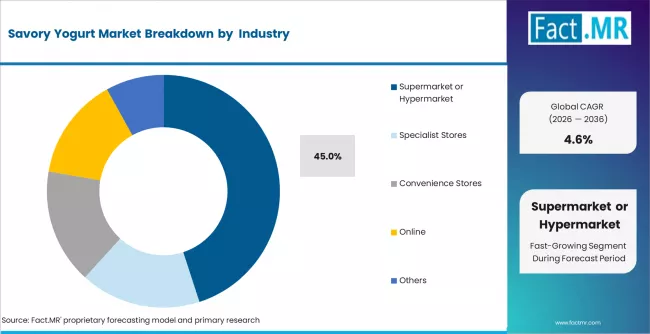
Savory Yogurt Market Analysis By Sales Channel | Source: Fact.MR
- Market Overview: Supermarket and hypermarket distribution channels are estimated to hold 45% share of the savory yogurt market in 2026. Organized retail infrastructure supports high product visibility, controlled refrigeration systems, and standardized merchandising formats for cultured dairy products. Shelf placement strategies within chilled dairy aisles enable cross-category positioning alongside dips, spreads, and probiotic yogurt formats. Large retail chains maintain structured procurement cycles, allowing dairy processors to plan production volumes aligned with consistent offtake agreements.
- Demand Drivers:
- Cold Chain Availability: Supermarket refrigeration infrastructure supports temperature-controlled display conditions required for maintaining bacterial culture viability and product texture stability.
- Category Visibility: Placement within dairy aisles increases consumer exposure to savory yogurt variants positioned as alternatives to sweet yogurt and dairy snacks.
- Private Label Expansion: Retail chains are expanding private label cultured dairy portfolios, supporting higher shelf allocation for savory yogurt formats across multi-brand assortments.
Key Dynamics
Savory Yogurt Market Drivers, Restraints, and Opportunities
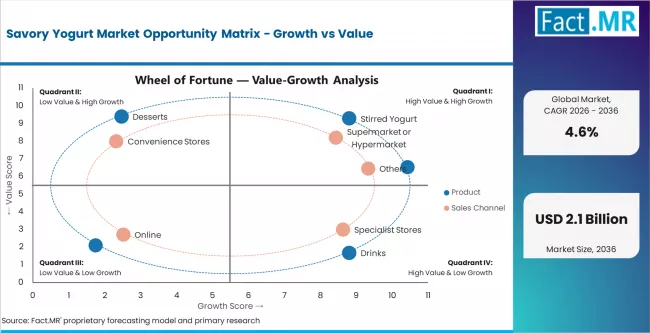
Savory Yogurt Market Opportunity Matrix Growth Vs Value | Source: Fact.MR
Fact MR analysis indicates that the savory yogurt market developed from traditional fermented dairy products consumed in regional cuisines where yogurt was prepared with salt, herbs, and spices. Early consumption patterns were concentrated in Middle Eastern, South Asian, and Mediterranean diets where yogurt served as a staple accompaniment to meals. The current market valuation reflects the expansion of flavored yogurt categories beyond sweet variants into savory formulations used as snacks, dips, and meal components. Demand persists because savory yogurt provides protein-rich, fermented dairy options aligned with changing snack consumption patterns.
A structural shift is occurring as conventional sweet yogurt products face competition from differentiated yogurt formats designed for meal-based consumption and culinary versatility. Traditional fruit-flavored yogurt remains widely distributed through retail channels where sweetness and dessert positioning dominate category sales. Savory yogurt formulations incorporate herbs, vegetables, spices, and salt-based flavor profiles that require product reformulation and controlled fermentation processes. These products often involve higher ingredient and processing costs due to recipe complexity and shorter product runs. Even with moderate adoption volumes, higher unit pricing supports gradual market value expansion.
- Meal Based Snacking: Manufacturers position savory yogurt as a snack, dip, or side product that complements prepared meals and convenience food consumption patterns.
- Food Safety Standards: Regulatory frameworks such as Hazard Analysis and Critical Control Points (HACCP) and U.S. Food and Drug Administration dairy product regulations govern fermentation, storage, and labeling practices.
- Asia Pacific Consumption: India and Middle Eastern markets maintain established culinary traditions that incorporate savory yogurt in daily diets, supporting product familiarity and regional demand.
Regional Analysis
The savory yogurt market is assessed across North America, Europe, Asia Pacific, Latin America, and Middle East & Africa, segmented by country-level consumption patterns, product innovation, and retail distribution structures. Regional demand reflects evolving taste preferences, functional dairy positioning, and expansion of chilled product portfolios. The full report offers market attractiveness analysis.
.webp "Top Country Growth Comparison Savory Yogurt Market Cagr (2026 2036)")
Top Country Growth Comparison Savory Yogurt Market Cagr (2026 2036) | Source: Fact.MR
| Country | CAGR (2026–2036) |
|---|---|
| China | 4.9% |
| India | 5.4% |
| USA | 4.2% |
| UK | 4.5% |
| Germany | 4.3% |
Source: Fact.MR analysis. Updated Apr 20, 2026
Source: Fact MR analysis, based on proprietary forecasting model and primary research
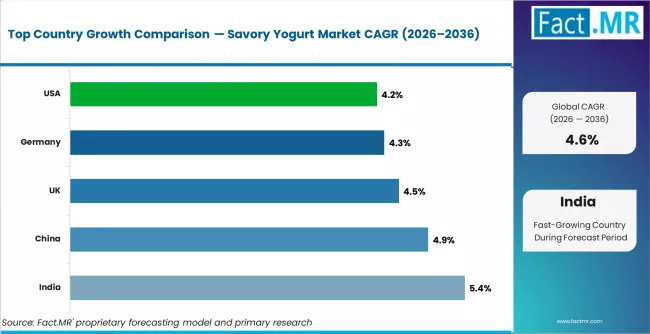
Savory Yogurt Market Cagr Analysis By Country | Source: Fact.MR
North America
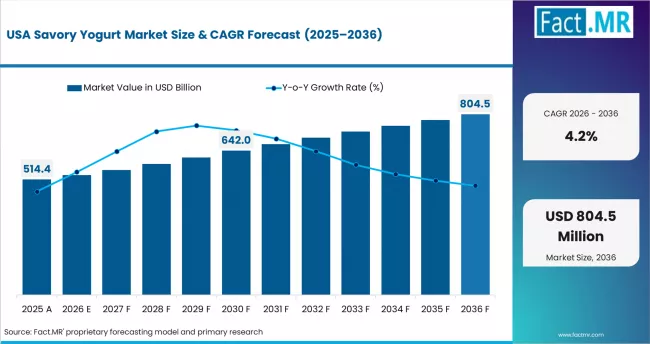
Savory Yogurt Market Country Value Analysis | Source: Fact.MR
North America functions as the flavor innovation and premium dairy differentiation hub, supported by product diversification and strong cold chain infrastructure. General Mills, Inc. maintains market presence through yogurt portfolio diversification. Chobani, LLC strengthens premium yogurt positioning. Danone S.A. expands savory yogurt product development.
- USA: Demand for savory yogurt in USA is projected to rise at 4.2% CAGR through 2036. Growth is supported by FDA dairy labeling standards (U.S. FDA, ongoing), ensuring product classification clarity. General Mills, Inc. expanded yogurt product lines including savory variants (March 2023), supporting retail availability.
Europe
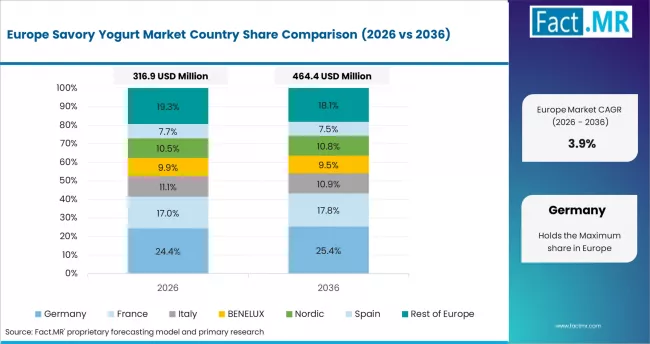
Savory Yogurt Market Europe Country Market Share Analysis, 2026 & 2036 | Source: Fact.MR
Europe operates as the traditional cultured dairy and product differentiation base, shaped by established yogurt consumption patterns and premium product positioning. Danone S.A. leads innovation in functional yogurt products. FAGE International S.A. maintains strong presence in strained yogurt formats. Arla Foods amba supports diversified yogurt offerings.
- UK: Demand for savory yogurt in UK is projected to rise at 4.5% CAGR through 2036. The UK National Food Strategy (updated 2021) supports diversified dairy consumption patterns. Arla Foods amba expanded yogurt product portfolio in the UK market (February 2023), supporting growth.
- Germany: Demand for savory yogurt in Germany is projected to rise at 4.3% CAGR through 2036. EU food labeling regulations (European Commission, updated 2022) support product transparency. Danone S.A. expanded yogurt product offerings in Germany (January 2023), supporting market penetration.
Asia Pacific
Asia Pacific serves as the emerging flavored dairy consumption market, supported by changing dietary habits and expanding refrigerated distribution networks. China Mengniu Dairy Company Limited strengthens yogurt product innovation. Yili Group expands fermented dairy product lines. Amul supports regional yogurt consumption growth.
- China: Demand for savory yogurt in China is projected to rise at 4.9% CAGR through 2036. The Healthy China initiative (State Council, ongoing) promotes diversified dairy consumption. China Mengniu Dairy Company Limited expanded yogurt product variants including savory options (April 2023), supporting demand.
- India: Demand for savory yogurt in India is projected to rise at 5.4% CAGR through 2036. The National Dairy Plan (Department of Animal Husbandry, ongoing) supports dairy production infrastructure. Amul expanded flavored and savory yogurt offerings (May 2023), supporting domestic consumption.
Fact MR's analysis of savory yogurt market in global regions consists of country-wise assessment that includes China, India, USA, UK, and Germany. Readers can find consumption trends, product development patterns, distribution expansion, and competitive positioning across key markets.
Competitive Landscape
Competitive Structure and Buyer Dynamics in the Savory Yogurt Market
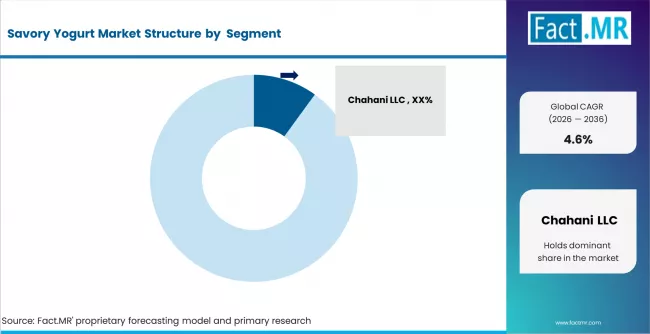
Savory Yogurt Market Analysis By Company | Source: Fact.MR
The competitive structure of the Savory Yogurt Market is moderately fragmented, with established yogurt manufacturers and niche dairy brands participating in product innovation and distribution. Companies such as General Mills, Inc., Chobani, LLC, FAGE International S.A., and Icelandic Milk & Skyr Corporation maintain strong positions through established dairy processing capabilities and retail distribution networks. These firms leverage brand recognition and product development expertise to expand into savory yogurt offerings positioned for snack and meal applications. Additional participants including Noosa Yoghurt, LLC, Wallaby Yogurt Company, Inc., Blue Hill Inc., and Chahani LLC operate in premium and specialty yogurt segments with differentiated formulations and flavor profiles. Competition is primarily influenced by taste profile, texture consistency, ingredient sourcing, and product positioning within refrigerated dairy categories. Retail shelf presence and innovation in flavor combinations also influence competitive positioning.
Several companies maintain structural advantages through integrated dairy sourcing and established relationships with retail distributors. Firms such as General Mills, Inc. and Chobani, LLC benefit from large scale production infrastructure and established cold chain distribution networks. Icelandic Milk & Skyr Corporation and FAGE International S.A. maintain advantages through strong brand recognition in cultured dairy products. Specialty producers such as Blue Hill Inc. and Noosa Yoghurt, LLC leverage differentiated ingredient combinations and premium positioning strategies. Retailers typically offer multiple yogurt brands to reduce reliance on a single supplier and to respond to evolving consumer preferences. Procurement decisions evaluate suppliers based on product consistency, brand demand, and supply reliability. This purchasing behavior moderates supplier pricing leverage, while brands with strong recognition and established distribution retain moderate negotiating influence.
Key Players of the Savory Yogurt Market
- Chahani LLC
- Noosa Yoghurt, LLC
- FAGE International S.A.
- General Mills, Inc.
- Blue Hill Inc.
- Icelandic Milk & Skyr Corporation
- Chobani, LLC
- Wallaby Yogurt Company, Inc.
Bibliographies
- [1] Fruselva. (2023, June 27). Plant-based yogurt alternatives: A tasty and convenient option. Fruselva Blog. Retrieved March 23, 2026.
- [2] Green Queen. (2023, September 3). Plant-based Greek yogurt: The 6 best, creamiest vegan brands to try. GreenQueen. Retrieved March 23, 2026.
- [3] Vegan in the Freezer. (2023, December 10). Best vegan yogurt: Tasted and reviewed. Vegan in the Freezer. Retrieved March 23, 2026.
- [4] Statista Market Insights. (2025, March 30). Yogurt – APAC | Statista market forecast. Statista. Retrieved March 23, 2026.
- [5] ReAnIn. (2024, November 15). Savory yogurt market growth drivers and analysis. ReAnIn. Retrieved March 23, 2026.
This Report Addresses
- Market size estimation and revenue forecasts for the Savory Yogurt Market from 2026 to 2036, supported by cultured dairy consumption trends and refrigerated product sales benchmarks.
- Growth opportunity mapping across stirred yogurt, drinks, desserts, and set yogurt formats, reflecting demand for protein rich and meal oriented dairy products.
- Segment and regional revenue forecasts covering product types, sales channels, and key markets including India, China, United States, United Kingdom, and Germany.
- Competition strategy assessment of leading companies such as General Mills, Inc., Chobani, LLC, FAGE International S.A., Icelandic Milk & Skyr Corporation, and Blue Hill Inc., including product differentiation and distribution benchmarking.
- Regulatory impact analysis covering HACCP standards, dairy labeling regulations, and food safety compliance frameworks influencing product formulation and commercialization.
- Market report delivery in PDF, Excel, PPT, and interactive dashboard formats designed for product planning, retail distribution strategy, and demand evaluation.
- Supply chain vulnerability assessments examining dairy input price volatility, cold chain dependency, and substitution pressure from plant based yogurt alternatives impacting category expansion.
Savory Yogurt Market Definition
The Savory Yogurt Market includes yogurt products formulated with non sweet flavor profiles such as herbs, spices, vegetables, and salt based ingredients. These products differ from traditional sweet yogurt by offering taste profiles suited for meals, snacks, and culinary use. Savory yogurt is produced through standard dairy fermentation processes using milk cultures, with additional ingredients added to create flavors such as garlic, cucumber, pepper, or mixed herbs. These products are consumed as dips, spreads, or side dishes in food service and retail channels. The primary function of savory yogurt is to provide a fermented dairy product with meal oriented flavor characteristics.
Savory Yogurt Market Inclusions
This report covers global and regional market sizes for savory yogurt with forecast analysis for the study period. The market is segmented by product type including drinks, stirred yogurt, desserts, set yogurt, and other formats. Distribution segmentation includes specialist stores, supermarket or hypermarket channels, convenience stores, online platforms, and other retail outlets. End users include individual consumers, food service operators, and retail distributors. The report also evaluates pricing patterns, production trends, and selected trade flow analysis across major dairy product markets.
Savory Yogurt Market Exclusions
The report excludes sweet flavored yogurt products such as fruit flavored or dessert style yogurt varieties. Plant based yogurt alternatives derived from almond, soy, or coconut are not included. The scope also excludes yogurt based beverages that are primarily sweetened or flavored with sugar. Culinary dairy products such as cheese, sour cream, and flavored milk products are outside the defined market scope, as the analysis focuses strictly on yogurt products with savory flavor profiles.
Savory Yogurt Market Research Methodology
- Primary Research: Interviews were conducted with dairy manufacturers, product developers, ingredient suppliers, and retail distribution managers.
- Desk Research: Public information was collected from dairy industry publications, company reports, government agricultural statistics, and trade data.
- Market-Sizing and Forecasting: A hybrid model combining bottom up production analysis with top down consumption assessment across dairy product markets was applied.
- Data Validation and Update Cycle: Findings were cross verified using multiple dairy industry sources and expert inputs, with periodic updates conducted as new production and consumption data becomes available.
Segmentation
Report Scope
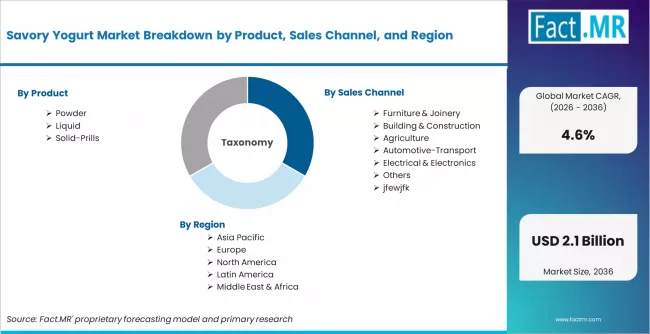
Savory Yogurt Market Breakdown By Product, Sales Channel, And Region | Source: Fact.MR
| Metric | Value |
|---|---|
| Quantitative Units | USD 1.3 billion (2026) to USD 2 billion (2036), at a CAGR of 4.6% |
| Market Definition | The savory yogurt market includes yogurt products formulated with salt, herbs, vegetables, and spices instead of sweet flavor profiles, positioned for consumption as snacks, meal accompaniments, or functional food products across retail and food service channels. |
| Product Segmentation | Drinks, Stirred Yogurt, Desserts, Set Yogurt, Others |
| Sales Channel Segmentation | Specialist Stores, Supermarket or Hypermarket, Convenience Stores, Online, Others (Independent Retailers and Mass Merchandisers) |
| Regions Covered | North America, Latin America, Europe, East Asia, South Asia, Oceania, Middle East and Africa |
| Countries Covered | United States, Canada, Mexico, Brazil, Germany, United Kingdom, France, Italy, Spain, China, India, Japan, South Korea, Australia, and 40+ countries |
| Key Companies Profiled | Chahani LLC, Noosa Yoghurt, LLC, FAGE International S.A., General Mills, Inc., Blue Hill Inc., Icelandic Milk and Skyr Corporation, Chobani, LLC, Wallaby Yogurt Company, Inc. |
| Forecast Period | 2026 to 2036 |
| Approach | Hybrid top-down and bottom-up market modeling supported by dairy consumption trend analysis, product innovation assessment, retail sales performance data, and validation through interviews with yogurt manufacturers, distributors, and food industry stakeholders. |
Source: Fact.MR analysis. Updated Apr 20, 2026
Savory Yogurt Market Key Segments
-
Product:
- Drinks
- Stirred Yogurt
- Desserts
- Set Yogurt
- Others
-
Sales Channel:
- Specialist Stores
- Supermarket or Hypermarket
- Convenience Stores
- Online
- Others
- Independent Retailers
- Mass Merchandisers
-
Region:
- North America
- USA
- Canada
- Mexico
- Europe
- Germany
- UK
- France
- Italy
- Spain
- Nordic Countries
- BENELUX
- Rest of Europe
- Asia Pacific
- China
- Japan
- South Korea
- India
- Australia
- Rest of Asia Pacific
- Latin America
- Brazil
- Argentina
- Rest of Latin America
- Middle East and Africa
- Kingdom of Saudi Arabia
- United Arab Emirates
- South Africa
- Rest of Middle East and Africa
- Other Regions
- Oceania
- Central Asia
- Other Markets
- North America
Frequently Asked Questions
How large is the demand for Savory Yogurt in the global market in 2026?
What will be the market size of Savory Yogurt in the global market by 2036?
What is the expected demand growth for Savory Yogurt in the global market between 2026 and 2036?
Which Sales Channel Segment is poised to lead global demand by 2026?
Which Company is Identified as a Leading Participant in the Savory Yogurt Market?
What is Driving Savory Yogurt Demand in the United States?
What is the United States Growth Outlook in this Report?
Why is China an Important Market for Savory Yogurt?
What is the China Growth Outlook in this Report?
What Factors Support Savory Yogurt Demand in India?
What is the India Growth Outlook in this Report?
What Factors Support Savory Yogurt Adoption in the United Kingdom?
What is the United Kingdom Growth Outlook in this Report?
Why is Germany Considered an Important Market for Savory Yogurt in Europe?
What is the Germany Growth Outlook in this Report?
What is Savory Yogurt and What is It Mainly Used For?
What does Savory Yogurt Market Mean in this Report?
What is Included in the Scope of this Savory Yogurt Market Report?
What is Excluded from the Scope of this Report?
What does Market Forecast Mean on this Page?
How is the Savory Yogurt Market Forecast Developed in this Report?
Who worked on this report


Preview the report firsthand - request a free sample
Free SampleGet the brochure for pricing and purchase details
Download PDF