- Market Value (2025): USD 524.2 Mn
- Estimated Value (2026): USD 550.0 Mn
- Forecast Value (2036): USD 890.0 Mn
- CAGR (2026-2036): 4.9%
What is the Flash Rust Inhibitors Market forecast to be worth by 2036?
USD 550.0 million in 2026 to USD 890.0 million by 2036, at 4.9% CAGR.
- The market crossed an estimated USD 524.2 million in 2025 as waterborne metal coatings moved through broader plant and field qualification.
- Demand is projected to increase from USD 550.0 million in 2026 to USD 890.0 million by 2036.
- The market is forecast to record a 4.9% CAGR from 2026 to 2036 as coating teams seek reliable early protection on reactive metal.
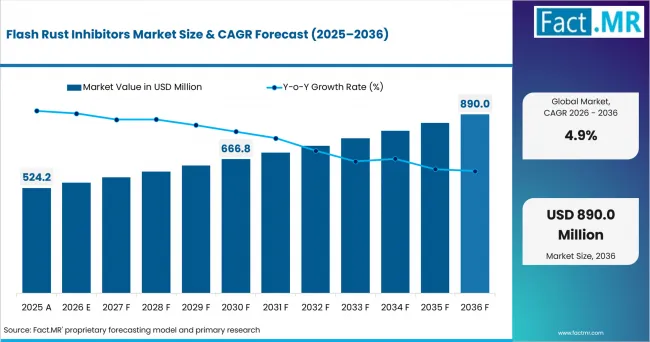
Flash Rust Inhibitors Market Market Value Analysis | Source: Fact.MR
What are the defining numbers behind Flash Rust Inhibitors Market growth?
USD 340.0 million absolute opportunity by 2036, led by Waterborne coatings and Organic salts alongside Steel applications.
- Demand Drivers in the Market
- Waterborne coatings need early protection because exposed steel can rust before the coating fully dries.
- Metal primers need flash-rust control that protects adhesion during testing and approval.
- Mixed-metal parts need protection across steel and machinery surfaces.
- Demand is also growing for nitrite-free and low VOC products with clear formulation and handling records.
- Key Segments Analyzed
- By Chemistry: Metal salts are likely to hold 34.0% share in 2026 supported by broad compatibility with waterborne coating systems.
- By Application: Waterborne coatings are projected to represent 57.0% share in 2026 driven by direct contact between water and reactive metal.
- By Substrate: Steel is expected to capture 32.0% share in 2026 reflecting extensive use across fabricated equipment and structures.
- By End Use: Industrial coatings are estimated to represent 34.0% share in 2026 across machinery and fabricated metal.
- By Regulatory Profile: Nitrite-free products are forecast to hold 32.0% share in 2026 owing to tighter product stewardship reviews.
- Analyst Opinion at Fact.MR
- Shambhu Nath Jha, Senior Analyst at Fact.MR, states, "Flash rust control is important during coating approval. If a coating fails in drying tests, approval can be delayed. Products that protect different metal surfaces and keep coating quality intact are more likely to be used in production."
- Strategic Implications
- Publish test results across different binders, metal surfaces and drying conditions before making broad performance claims.
- Evaluate rust control alongside adhesion, gloss, water resistance and salt-spray performance in a single trial.
- Test welded parts and cast iron separately because they often rust faster than smooth steel surfaces.
In January 2025, Ascotec announced its ASCOTRAN flash-rust inhibitors at the European Coatings Show in Nuremberg. The event gave formulators a chance to compare products and discuss dosage and compatibility before starting plant trials.
Germany is anticipated to reach 5.7% owing to demanding industrial coating specifications. Brazil is estimated at 5.2% with broader local technical support. The USA is forecast to advance at 4.7% as mature coating lines continue measured reformulation.
How does the Flash Rust Inhibitors Market break down by segment?
Organic salts lead with 34.0% by chemistry segment, while Waterborne coatings account for 57.0% by application.
Which Chemistry leads the market?
Organic salts are expected to hold 34.0% share in 2026.
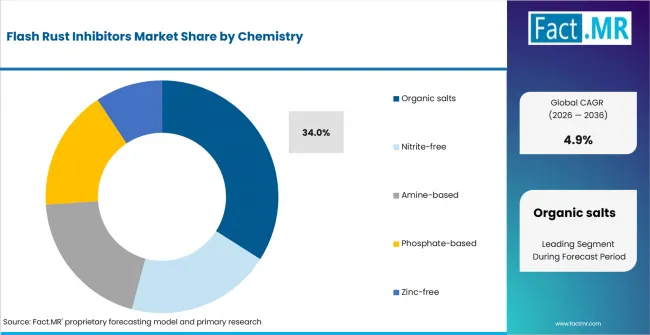
Flash Rust Inhibitors Market Analysis By Chemistry | Source: Fact.MR
Organic salts are widely used in water-based coatings. Manufacturers also offer nitrite-free, amine-based, phosphate-based and zinc-free options to meet different formulation needs. In March 2025, Halox introduced a water-based acrylic formulation containing 0.80% FLASH-X 150 for flash-rust protection.
Where is Application demand strongest?
Waterborne coatings are projected to account for 57.0% share in 2026.
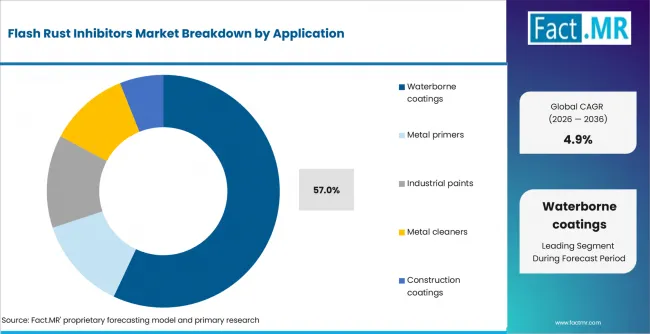
Flash Rust Inhibitors Market Analysis By Application | Source: Fact.MR
Waterborne coatings are the main application for flash-rust inhibitors. These products are also used in industrial coatings and metal cleaners where metal surfaces need protection during processing. In November 2025, Cortec highlighted M-240 and M-435 for water-based coating applications.
Which Substrate leads the market?
Steel is anticipated to capture 32.0% share in 2026.
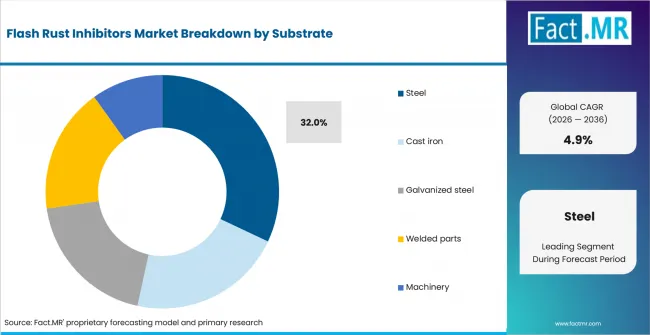
Flash Rust Inhibitors Market Analysis By Substrate | Source: Fact.MR
Steel is the most common substrate in industrial coatings because it is used in structures, equipment and fabricated products. Cast iron, galvanized steel and welded parts often need additional rust protection during coating and drying. Machinery applications can be more challenging due to oil residues and uneven surface conditions.
What leads the End Use segment?
Industrial coatings are estimated to represent 34.0% share in 2026.
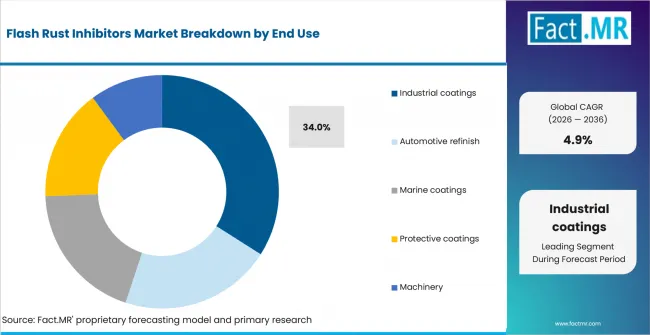
Flash Rust Inhibitors Market Analysis By End Use | Source: Fact.MR
Industrial coatings are the main end-use application for flash-rust inhibitors. They are used on equipment, fabricated products and maintenance coatings. Automotive refinish applications place greater emphasis on appearance, while marine and protective coatings require reliable rust protection. In February 2026, Lubrizol documented Lubrizol 2064 for alkyd and waterborne coatings used in rust-proofing applications.
Which Regulatory Profile is expected to lead?
Nitrite-free products are forecast to hold 32.0% share in 2026.
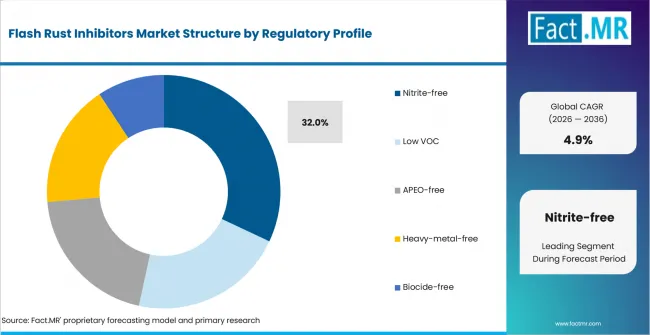
Flash Rust Inhibitors Market Analysis By Regulatory Profile | Source: Fact.MR
Nitrite-free products are used where customers prefer alternatives to nitrite-based ingredients. Low-VOC and APEO-free options help meet specific formulation requirements. Heavy-metal-free and biocide-free products must still provide effective rust protection. In February 2025, BASF documented Loxanol MI 6627 for industrial anticorrosive coatings.
What is accelerating Flash Rust Inhibitors Market adoption, and what is holding it back?
Waterborne coating conversion is anticipated to support adoption, while formulation compatibility and requalification cost restrain faster change.
Drivers Impact Analysis
| DRIVER | (~) % IMPACT ON CAGR | GEOGRAPHIC RELEVANCE | IMPACT TIMELINE |
|---|---|---|---|
| Waterborne conversion in industrial metal coatings | +0.8% | North America; Western Europe; East Asia | Medium term (2-4 years) |
| Metal primer approval requirements | +0.6% | North America and Western Europe | Short term (<= 2 years) |
| Mixed-metal fabrication requiring early corrosion control | +0.5% | East Asia and South Asia and Pacific | Medium term (2-4 years) |
| Low VOC and Nitrite-free product specifications | +0.4% | Western Europe and North America | Medium term (2-4 years) |
| Local formulation and plant-trial support | +0.3% | Latin America and Middle East & Africa | Long term (>= 4 years) |
Source: Fact.MR analysis. Updated Jul 15, 2026
- Waterborne coatings: Water-based coatings can allow rust to form before the coating dries. Inhibitors help protect the metal without affecting coating performance.
- Metal primers: Primers are the first layer applied to metal surfaces. Flash-rust protection helps prevent delays during coating testing and approval.
- Mixed-metal parts: Many products combine steel, cast iron, galvanized steel and welded sections. Manufacturers look for inhibitors that can protect all these surfaces in a single coating system.
Opportunity Impact Analysis
| OPPORTUNITY | (~) % IMPACT ON CAGR | GEOGRAPHIC RELEVANCE | IMPACT TIMELINE |
|---|---|---|---|
| Organic salt packages for Steel and Welded parts | +0.5% | East Asia and South Asia and Pacific | Medium term (2-4 years) |
| Low-dose grades for multi-metal coating lines | +0.4% | Global industrial hubs | Short term (<= 2 years) |
| Grades for Protective coatings and Construction coatings | +0.4% | Western Europe and North America | Medium term (2-4 years) |
| Local trial centers and distributor laboratories | +0.3% | Latin America and Middle East & Africa | Long term (>= 4 years) |
Source: Fact.MR analysis. Updated Jul 15, 2026
- Organic salt products: Organic salts are used in water-based coatings that need flash-rust protection without affecting coating appearance. Manufacturers look for products that work consistently across different formulations.
- Low-dose products: Using a smaller amount of inhibitor can help control formulation cost and maintain coating properties. Products that work on steel, cast iron and galvanized steel can reduce the need for multiple additives.
- Regional testing facilities: Local laboratories allow manufacturers to test additives under actual production conditions. This helps compare products more accurately and can speed up the move from laboratory testing to production trials.
Restraints Impact Analysis
| RESTRAINT | (~) % IMPACT ON CAGR | GEOGRAPHIC RELEVANCE | IMPACT TIMELINE |
|---|---|---|---|
| Cost and time required for coating requalification | -0.4% | Global | Medium term (2-4 years) |
| Binder, pigment, and pH compatibility limits | -0.3% | Global | Short term (<= 2 years) |
| Raw-material and logistics price changes | -0.3% | Europe and Asia | Medium term (2-4 years) |
| Variable humidity and surface preparation in field use | -0.2% | Global | Long term (>= 4 years) |
Source: Fact.MR analysis. Updated Jul 15, 2026
- Changing products: Companies rarely replace an additive that already works. Any change requires new testing, which takes time.
- Coating performance: A flash-rust inhibitor must protect against rust without affecting the final coating. Products that reduce gloss, stability or water resistance often need further testing.
- Material and transport costs: Changes in raw material and shipping costs can affect overall product cost. Companies often compare the total cost of the coating formulation rather than the additive price alone.
Which countries are scaling Flash Rust Inhibitors Market fastest?
Germany 5.7%, Brazil 5.2%, USA 4.7%.
Regional analysis covers North America; Latin America; Western Europe; Eastern Europe; East Asia; South Asia and Pacific; and Middle East & Africa.
.webp "Top Country Growth Comparison Flash Rust Inhibitors Market Cagr (2026 2036)")
Top Country Growth Comparison Flash Rust Inhibitors Market Cagr (2026 2036) | Source: Fact.MR
| COUNTRY | CAGR |
|---|---|
| Germany | 5.7% |
| Brazil | 5.2% |
| USA | 4.7% |
Source: Fact.MR analysis. Updated Jul 15, 2026
What shapes demand in Germany?
5.7% CAGR, linked to demanding industrial coating specifications.
Germany places high importance on coating quality and product performance. In June 2026, Germany reported growth in both chemical production and fabricated metal products. Demand for flash-rust inhibitors is expected to increase as more companies use lower-emission coating systems and continue testing new products for industrial applications.
How is Brazil developing market demand?
5.2% CAGR, backed by industrial maintenance and local service.
In June 2026, Brazil reported that industrial production increased 0.7% from March to April and 2.7% compared with the previous year. More manufacturing activity is supporting demand for maintenance coatings used on metal products and transport equipment. Demand for flash-rust inhibitors is expected to grow as local technical support helps companies test new products more quickly.
What supports the USA outlook?
4.7% CAGR, reflecting measured reformulation in mature coating lines.
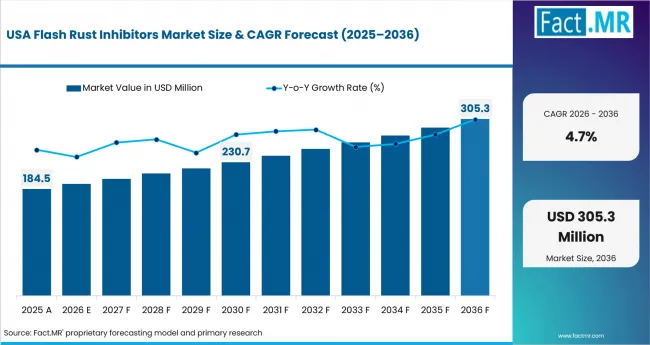
Flash Rust Inhibitors Market Country Value Analysis | Source: Fact.MR
Manufacturers usually make product changes gradually and prefer to test new additives before adopting them on a larger scale. In November 2025, the Federal Reserve Board reported that manufacturing capacity growth for 2025 was expected to exceed 1%. Demand is expected to increase as companies continue testing products for protective and automotive coatings.
Who leads the Flash Rust Inhibitors Market?
Halox, Ascotec, and Cortec lead specialist flash-rust coverage. Lubrizol, BYK, and BASF add broader corrosion-control and coating-additive capabilities.
Halox, Ascotec and Cortec focus on flash-rust protection, while Lubrizol, BYK and BASF offer a broader range of coating additives. Companies often compare products based on performance and ease of use.
In August 2025, BYK opened a new office in São Paulo, Brazil. The local presence helps customers get faster support during product testing and evaluation. Companies with strong product data and quick technical assistance are expected to remain competitive.
Which companies are the key players?
Halox, Ascotec, and Cortec form the specialist group. Lubrizol, BYK, and BASF complete the company set.
- Halox
- Ascotec
- Cortec
- Lubrizol
- BYK
- BASF
Bibliography
- Ascotec. (2025, March). We will attend the European Coatings Show 2025 in Nuremberg, Germany. Ascotec.
- BASF. (2025, February). Loxanol MI 6627. Technical data sheet. BASF.
- Brazilian Institute of Geography and Statistics. (2026, June 3). Brazilian industrial production changed 0.7% in April. IBGE News Agency.
- BYK. (2025, August 28). Strategic new course set in South America: Boosting BYK's presence and customer proximity in Brazil. BYK.
- Federal Reserve Board. (2025, November 24). Industrial production and capacity utilization: 2025 annual revision. Federal Reserve Board.
- Federal Statistical Office of Germany. (2026, June 9). Production in April 2026: +0.4% on the previous month. Destatis.
- Halox. (2025, March 3). Formulation proposal FP 2403/84 with HALOX 580 and FLASH-X 150. Halox.
- Lubrizol. (2026, February 20). Lubrizol 2064: Corrosion inhibitor. Lubrizol.
This Report Addresses
- The report provides insights into flash-rust inhibitors across different chemistries and applications used in water-based metal coatings.
- Regional analysis covers US, Germany, France, UK and 30+ countries.
- Company analysis includes Halox, Ascotec, Cortec, Lubrizol, BYK and BASF.
- Substrate analysis covers steel, cast iron, galvanized steel, welded parts and machinery.
- End-use analysis reviews industrial coatings, automotive refinish, marine coatings, protective coatings and machinery applications.
- The market outlook considers coating demand, country-level growth, product testing requirements and the shift toward water-based coating systems.
What does the Flash Rust Inhibitors Market cover?
Additives that control early rust during drying on reactive metal surfaces.
The Flash Rust Inhibitors Market covers products that help prevent rust from forming while water-based coatings are drying on metal surfaces. It includes different types of flash-rust inhibitors used in water-based coating applications.
These products are used to protect metal during coating application and drying. Rust removers and other corrosion-control products are not included unless they are specifically designed to prevent flash rust within the coating formulation.
What is included in the scope?
Flash-rust additives used across Chemistry, Application, Substrate, End Use, and Regulatory Profile.
The scope includes flash-rust inhibitors used across chemistry, application, substrate, end use and product type categories. Chemistry includes organic salts, nitrite-free, amine-based, phosphate-based and zinc-free products. Application covers waterborne coatings, metal primers, industrial paints, metal cleaners and construction coatings.
The report also reviews use across steel, cast iron, galvanized steel, welded parts and machinery. End-use applications include industrial coatings, automotive refinish, marine coatings, protective coatings and machinery. Product types include nitrite-free, low-VOC, APEO-free, heavy-metal-free and biocide-free options. Regional analysis covers all countries and regions included in the market segmentation.
What is excluded from the scope?
Rust removers and corrosion products without a flash-rust function are excluded.
The scope excludes standalone rust converters, abrasive preparation products, and long-term pigments that do not control rust during coating drying. Metal pretreatment chemicals used outside a coating formula are excluded. Corrosion inhibitors used only in pipelines, cooling water, or closed-loop systems also remain outside the analysis.
How was the analysis built?
120+ sources, 40+ product records, 25+ countries, and 20+ interviews.
- Primary Research: Primary research includes discussions with coating formulators, additive distributors, corrosion specialists and industrial users. These discussions focused on product use, testing requirements, coating performance and regional differences.
- Desk Research: Desk research reviews government statistics, company technical documents, product data sheets and verified company announcements. These sources help assess market trends and company activity.
- Market-Sizing and Forecasting: Forecasting considers water-based coating demand, inhibitor usage, product pricing, application trends and regional market activity. It also includes industrial production, metal use and technical support availability.
- Data Validation and Update Cycle: Market estimates are checked against segment and regional data. Technical interviews, official industry updates and company announcements are reviewed regularly to keep forecasts current.
Segmentation
What is the report’s scope and coverage?
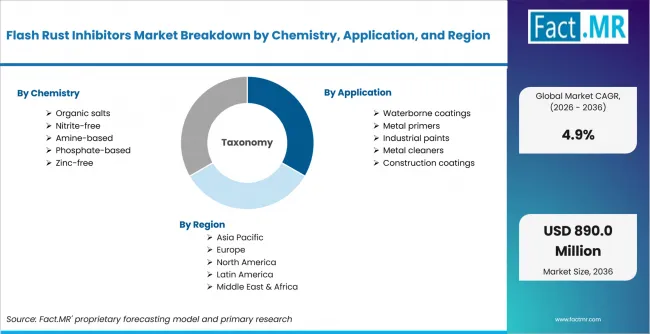
Flash Rust Inhibitors Market Breakdown By Chemistry, Application, And Region | Source: Fact.MR
| Attribute | Details |
|---|---|
| Quantitative Units | USD million in 2026 to USD million by 2036 at a CAGR |
| Market Definition | Additives used to limit flash rust while waterborne coatings dry on reactive metal surfaces |
| Chemistry | Organic salts; Nitrite-free; Amine-based; Phosphate-based; Zinc-free |
| Application | Waterborne coatings; Metal primers; Industrial paints; Metal cleaners; Construction coatings |
| Substrate | Steel; Cast iron; Galvanized steel; Welded parts; Machinery |
| End Use | Industrial coatings; Automotive refinish; Marine coatings; Protective coatings; Machinery |
| Regulatory Profile | Nitrite-free; Low VOC; APEO-free; Heavy-metal-free; Biocide-free |
| Regions Covered | North America; Latin America; Western Europe; Eastern Europe; East Asia; South Asia and Pacific; Middle East & Africa |
| Countries Covered | USA; Canada; Brazil; Mexico; Chile; Rest of Latin America; Germany; UK; Italy; Spain; France; Nordic; BENELUX; Rest of Western Europe; Russia; Poland; Hungary; Balkan & Baltic; Rest of Eastern Europe;Japan; South Korea; ASEAN; Australia & New Zealand; Rest of South Asia and Pacific; Kingdom of Saudi Arabia; Other GCC Countries; Türkiye; South Africa; Other African Union; Rest of Middle East & Africa |
| Key Companies Profiled | Halox; Ascotec; Cortec; Lubrizol; BYK; BASF |
| Forecast Period | 2026 to 2036 |
| Approach | Hybrid top-down and bottom-up approach using waterborne coating activity; inhibitor dosage; substrate exposure; qualification cycles; regional pricing; technical interviews; and model reconciliation |
Source: Fact.MR analysis. Updated Jul 15, 2026
How is the market segmented?
-
By Chemistry:
- Organic salts
- Nitrite-free
- Amine-based
- Phosphate-based
- Zinc-free
-
By Application:
- Waterborne coatings
- Metal primers
- Industrial paints
- Metal cleaners
- Construction coatings
-
By Substrate:
- Steel
- Cast iron
- Galvanized steel
- Welded parts
- Machinery
-
By End Use:
- Industrial coatings
- Automotive refinish
- Marine coatings
- Protective coatings
- Machinery
-
By Regulatory Profile:
- Nitrite-free
- Low VOC
- APEO-free
- Heavy-metal-free
- Biocide-free
-
By Region:
- North America
- USA
- Canada
- Latin America
- Brazil
- Mexico
- Chile
- Rest of Latin America
- Western Europe
- Germany
- UK
- Italy
- Spain
- France
- Nordic
- BENELUX
- Rest of Western Europe
- Eastern Europe
- Russia
- Poland
- Hungary
- Balkan & Baltic
- Rest of Eastern Europe
- East Asia
- China
- Japan
- South Korea
- South Asia and Pacific
- India
- ASEAN
- Australia & New Zealand
- Rest of South Asia and Pacific
- Middle East & Africa
- Kingdom of Saudi Arabia
- Other GCC Countries
- Türkiye
- South Africa
- Other African Union
- Rest of Middle East & Africa
- North America
Frequently Asked Questions
Which Chemistry leads the Flash Rust Inhibitors Market?
Which Substrate leads the Flash Rust Inhibitors Market?
Which End Use leads the Flash Rust Inhibitors Market?
How does Germany perform in the Flash Rust Inhibitors Market?
How does Brazil perform in the Flash Rust Inhibitors Market?
What is the primary driver in the Flash Rust Inhibitors Market?
What is the main restraint in the Flash Rust Inhibitors Market?
Why are Organic salts significant in this market?
Why do Waterborne coatings dominate demand?
Who worked on this report


Preview the report firsthand - request a free sample
Free SampleGet the brochure for pricing and purchase details
Download PDF