- Market Value (2025): USD 2843.0 Mn
- Estimated Value (2026): USD 3150.0 Mn
- Forecast Value (2036): USD 8784.3 Mn
- CAGR (2026-2036): 10.8%
What is the seaweed snacks market forecast to be worth by 2036?
USD 3,150.0 million in 2026 to USD 8,784.3 million by 2036, at 10.8% CAGR.
- The seaweed snacks market crossed a valuation of USD 2,843.0 million in 2025.
- Demand is expected to increase from USD 3,150.0 million in 2026 to USD 8,784.3 million by 2036 as repeat purchase expands beyond specialty food shoppers.
- The market is forecast to record a 10.8% CAGR from 2026 to 2036 supported by retailers and snack brands widening convenient seaweed formats for routine consumption.
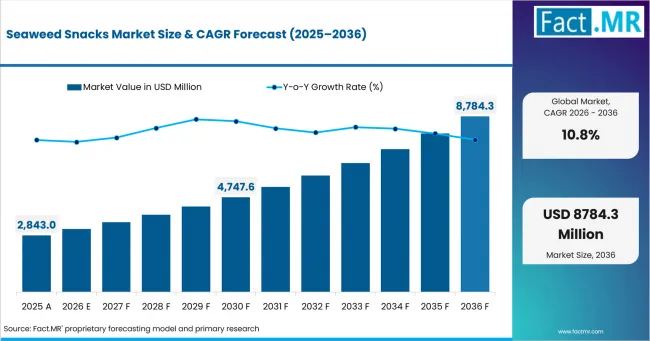
Seaweed Snacks Market Market Value Analysis | Source: Fact.MR
What are the defining numbers behind seaweed snacks market growth?
USD 5,634.3 million absolute opportunity by 2036, led by strips and chips, offline retail and nori.
- Demand Drivers in the Market
- Supermarket category managers prioritize recognizable pack formats supported by clear flavor cues that reduce purchase hesitation alongside established savory snacks.
- Snack brands depend on consistent nori quality because consumers are directly exposed to visible texture defects and seasoning variations.
- Online retailers require bundle-friendly assortments designed to withstand parcel delivery conditions and household storage requirements.
- Seaweed processors rely on dependable cultivation partnerships supported by sheet-grade specifications that help manage seasonal raw-material variation.
- Key Segments Analyzed
- By Product: Strips and Chips are expected to hold 51% share in 2026 supported by familiar shapes that simplify portioning and casual consumption.
- By Distribution Channel: Offline Retail is projected to account for 65% share in 2026 due to immediate discovery and side-by-side product comparison.
- By Source Species: Nori is anticipated to capture 46% share in 2026 attributable to established roasting methods and familiar crisp sheet applications.
- By Flavor Profile: Sea Salt is estimated to represent 28% share in 2026 reinforced by simple seasoning that keeps roasted seaweed taste recognizable.
- By Pack Size: Single-Serve Packs are forecast to hold 48% share in 2026 shaped by crispness protection and routine portioning needs.
- Analyst Opinion at Fact.MR
- Shambhu Nath Jha, Senior Analyst at Fact.MR states, “Seaweed snacks draw attention because the category turns a traditional food into a portable savory format. Demand is expected to broaden where brands make texture and seasoning easier for new shoppers to understand. Better-positioned portfolios should combine dependable sheet quality with clear flavor cues and protective packs suited to routine snacking.”
- Strategic Implications
- Snack brands should protect texture consistency before expanding flavor counts so first-purchase disappointment does not weaken repeat purchasing.
- Retailers should merchandise seaweed snacks beside familiar savory options while retaining enough explanation for shoppers unfamiliar with nori.
- Seaweed processors should diversify harvest relationships and quality specifications to reduce finished-product variation during seasonal supply shifts.
- Online sellers should prioritize rigid secondary packaging and mixed-flavor bundles that improve basket size without increasing sheet breakage.
Ocean’s Halo introduced an organic shelf-stable condiment line in March 2025 that included a seaweed salad scheduled for spring retail distribution. The move reflects a wider effort to bring seaweed into familiar meal occasions beyond roasted sheets while extending the brand’s seaweed identity from portable snacks into shelf-stable pantry products.
The United States is projected to record 12.2% CAGR through 2036 supported by wider mainstream retail access and domestic seaweed interest. India is expected to post 12.0% CAGR attributable to cultivation investment and wider value-chain development across coastal production areas. The United Kingdom is anticipated to advance at 11.5% CAGR due to wider Asian-inspired snack availability. Japan is estimated to record 10.9% CAGR reinforced by established nori consumption and frequent format experimentation. China is forecast to post 10.7% CAGR shaped by integrated cultivation and processing networks across coastal provinces.
How does the seaweed snacks market break down by segment?
Strips and Chips hold 51%, Offline Retail accounts for 65%.
Which product format dominates?
Strips and Chips are projected to hold 51% share in 2026.
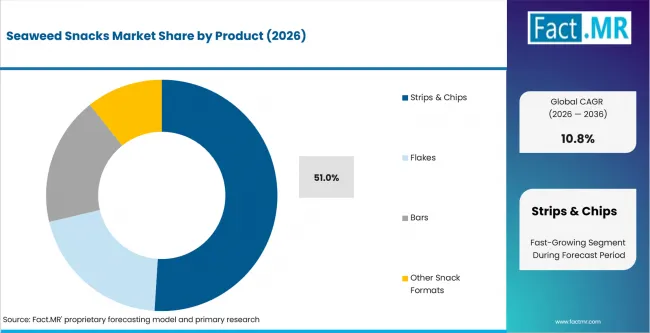
Seaweed Snacks Market Analysis By Product | Source: Fact.MR
Strips and Chips are projected to hold 51% share in 2026 supported by thin formats that preserve the crisp texture associated with roasted nori. Flakes serve shoppers seeking toppings for rice bowls while bars combine seaweed with grains or seeds. Other formats create room for clusters and coated bites that widen texture choices across premium and casual retail positions. The Food and Agriculture Organization reported 37.8 million tonnes of algae production in June 2024 using global production data for 2022. That production scale supports continued processing development across edible seaweed formats that reach domestic and export channels.
What leads the distribution channel segment?
Offline Retail is anticipated to account for 65% share in 2026.
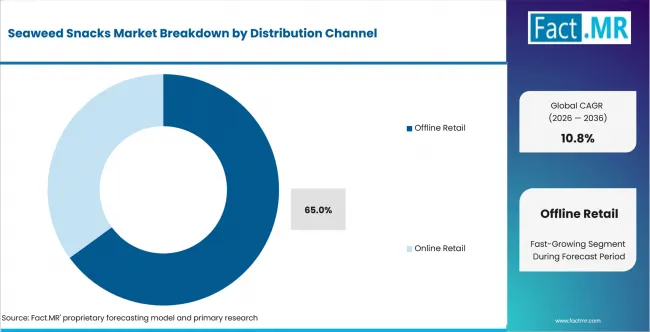
Seaweed Snacks Market Analysis By Distribution Channel | Source: Fact.MR
Offline Retail is anticipated to account for 65% share in 2026 due to impulse discovery and immediate comparison with familiar savory snacks. Online Retail remains relevant for flavor bundles and smaller brands without broad store placement. Subscription orders support convenient replenishment among consumers already familiar with seaweed taste and texture. The U.S. Census Bureau reported in May 2026 that e-commerce represented 16.9% of adjusted retail sales during the first quarter of 2026. Physical placement therefore remains central for discovery while digital ordering adds assortment depth and easier replenishment for repeat shoppers.
How does source species shape product demand?
Nori is forecast to capture 46% share in 2026.
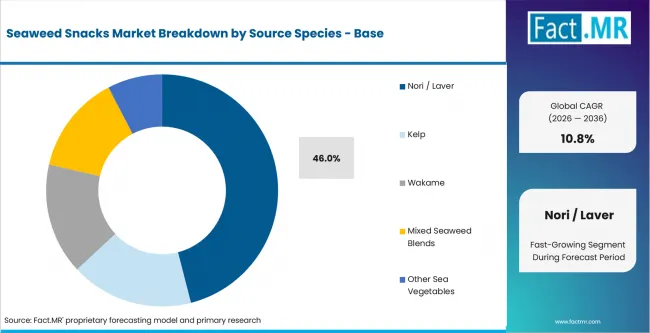
Seaweed Snacks Market Analysis By Source Species Base | Source: Fact.MR
Nori is forecast to capture 46% share in 2026 attributable to established roasting methods and familiar sheet-based consumption. Kelp supports thicker bites that carry stronger marine flavor across substantial snack textures and seasoning applications. Wakame serves lighter snack applications where softer taste supports brands seeking gentler marine flavor profiles. Mixed blends allow brands to vary color and texture while reducing dependence on one species. Korea’s Ministry of Oceans and Fisheries reported in December 2025 that gim exports reached USD 1.015 billion by November 20. The result reflects deep processing capacity around nori-style products serving domestic and export snack channels.
What supports the sea salt flavor profile?
Sea Salt is expected to represent 28% share in 2026.
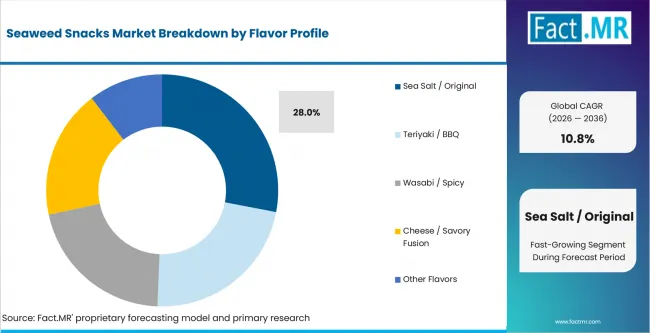
Seaweed Snacks Market Analysis By Flavor Profile | Source: Fact.MR
Sea Salt is expected to represent 28% share in 2026 reinforced by light seasoning that keeps roasted seaweed character recognizable. Teriyaki and barbecue variants serve shoppers who prefer sweeter savory profiles across familiar snack and meal accompaniment occasions. Wasabi and spicy formats target consumers already comfortable with stronger heat levels across conventional savory snack categories. In January 2025 the U.S. Food and Drug Administration proposed a front-of-package system using Low and Med labels alongside High labels for sodium. Clearer nutrition signals are expected to shape seasoning development and package communication across branded snack ranges and retailer assortments.
How does pack size shape seaweed snack demand?
Single-Serve Packs are estimated to hold 48% share in 2026.
Single-Serve Packs are estimated to hold 48% share in 2026 shaped by the need to protect thin sheets after package opening. Multipacks keep inner portions sealed while supporting household replenishment across several eating occasions and usage rates. Variety Packs support online discovery through mixed-flavor orders while serving household trial across several preferences. The U.S. Department of Agriculture reported in November 2024 that 19.4% of grocery shoppers bought groceries online during the prior month in 2022 and 2023. Pack design therefore needs to protect texture across physical stores and parcel delivery while keeping portion cues easy to understand.
What is accelerating Seaweed Snacks Market adoption, and what is holding it back?
Familiar savory formats drive adoption, harvest variability restrains consistent quality and pricing.
Drivers Impact Analysis
| DRIVER | (~) % IMPACT ON CAGR | GEOGRAPHIC RELEVANCE | IMPACT TIMELINE |
|---|---|---|---|
| Familiar savory formats lowering trial barriers | +1.8% | North America and Western Europe | Short term (2 years or less) |
| Retail channel expansion widening shelf access | +1.5% | Global retail centers | Short term (2 years or less) |
| K-food influence normalizing roasted nori snacks | +1.2% | United States and Europe | Medium term (2-4 years) |
| Cultivation investment widening raw material access | +0.9% | India and coastal Asia | Medium term (2-4 years) |
| Clear ingredient lists supporting label clarity | +0.7% | United States and Europe | Long term (4 years or more) |
Source: Fact.MR analysis. Updated Jul 7, 2026
- Familiar savory formats reduce trial barriers by giving new shoppers recognizable strips and chip-like pieces during their first category purchase. Familiar pack shapes also make seaweed easier to compare with conventional salty snacks during routine shopping. NOAA Fisheries explained in September 2025 that farmed seaweed is used across sushi and seasonings alongside sauces and salads. Familiar food contexts are expected to support trial among shoppers outside established seaweed-eating cultures across North America and Europe.
- Retail channel expansion increases category visibility during routine savory snack shopping and creates more first-purchase opportunities through broader supermarket placement. Online assortments then offer deeper flavor choice after shoppers understand seaweed taste and texture from an initial retail purchase. Retailers are projected to use physical shelves for discovery while digital ordering handles mixed bundles and repeat purchases.
- K-food influence gives roasted gim a clearer reference point for shoppers who encounter seaweed through Korean meals and snack occasions. A USDA Foreign Agricultural Service report published in May 2024 stated that food-related categories represented about 30% of Korea’s total online sales during 2023. Brands are anticipated to benefit where product education connects roasted seaweed with familiar Korean eating occasions.
- Cultivation investment supports processing scale by improving raw material availability before brands commit to wider retail programs across several seasons. The Press Information Bureau reported in April 2025 that India had approved 46,095 rafts for seaweed farming. Expanding cultivation infrastructure is estimated to create additional sourcing routes for local processors that manage drying and sheet quality.
- Clear ingredient lists support roasted seaweed products built around seaweed and oil with familiar seasonings. USDA Economic Research Service reported in January 2026 that inflation-adjusted U.S. organic food sales reached USD 65.4 billion in 2024 using Organic Trade Association data. Brands are forecast to emphasize clear ingredient statements where shoppers compare packaged snack labels closely.
Opportunity Impact Analysis
| OPPORTUNITY | (~) % IMPACT ON CAGR | GEOGRAPHIC RELEVANCE | IMPACT TIMELINE |
|---|---|---|---|
| Localized flavor development for regional palates | +1.1% | United States and Europe | Short term (2 years or less) |
| Single-serve convenience packs for routine snacking | +0.9% | Global urban retail | Short term (2 years or less) |
| India cultivation and processing scale-up | +0.8% | India and South Asia | Medium term (2-4 years) |
| Direct consumer bundles and subscription replenishment | +0.6% | North America and Europe | Medium term (2-4 years) |
Source: Fact.MR analysis. Updated Jul 7, 2026
- Localized flavor development is expected to reduce first-purchase hesitation by using regional seasoning profiles without hiding the seaweed base completely. The U.S. Food and Drug Administration stated in November 2024 that its Phase II targets would support sodium intake near 2,750 milligrams per day. Flavor teams are projected to balance stronger profiles with tighter sodium communication and recipe discipline.
- Single-serve convenience packs protect crisp sheets from humidity while supporting lunchboxes and routine snacking occasions across different daily schedules. The World Health Organization reported in May 2026 that global adult sodium intake averaged 4,278 milligrams per day during 2021. Portion cues are anticipated to carry greater weight as snack brands face closer scrutiny over sodium density and serving interpretation.
- India processing scale-up gives local brands a clearer sourcing route when cultivation expands near drying and seasoning operations. The Press Information Bureau reported in March 2025 that India produced 72,385 tonnes of wet seaweed during 2023. New farming capacity is estimated to support snack manufacturing where processing capability develops close to coastal production clusters.
- Direct consumer bundles let brands combine flavors and pack counts without asking retailers for additional physical shelf space through digital storefronts. The U.S. Census Bureau reported in June 2026 that nonstore retailer sales increased 12.2% year over year during May 2026. Digital bundles are forecast to support trial while giving smaller brands more control over assortment testing.
Restraints Impact Analysis
| RESTRAINT | (~) % IMPACT ON CAGR | GEOGRAPHIC RELEVANCE | IMPACT TIMELINE |
|---|---|---|---|
| Harvest variability affecting sheet quality and cost | -1.1% | East Asia and global importers | Short term (2 years or less) |
| Sodium perception increasing reformulation pressure | -0.8% | United States and United Kingdom | Medium term (2-4 years) |
| Texture unfamiliarity limiting repeat purchase | -0.7% | Newer consumer markets | Medium term (2-4 years) |
| Species consistency and labeling complexity | -0.6% | Global branded retail | Long term (4 years or more) |
Source: Fact.MR analysis. Updated Jul 7, 2026
- Harvest variability affects final quality because thin nori snacks expose uneven color and texture more visibly than mixed-ingredient snack products. FAO reported in its April 2026 quarterly analysis that world seaweed export volume fell 4.4% during January through September 2025. Brands are expected to require tighter supplier specifications and wider sourcing options when harvest quality changes between seasons.
- Sodium perception shapes recipe work due to closer scrutiny of added seasoning on a base product that already carries a naturally salty taste. The United Kingdom Department of Health and Social Care published guidance in June 2025 that explicitly places seaweed-based snacks within its savory snack category. Manufacturers are projected to review recipes and promotion plans more closely where nutrition profiling affects advertising access across major media channels.
- Texture unfamiliarity slows repeat purchase when some shoppers dislike marine aroma or thin sheet texture after their first category trial. Brands therefore need clear flavor descriptions and sampling routes that reduce surprise during purchase and improve expectations before first consumption. Adoption is anticipated to improve where products use recognizable seasoning language without unsupported wellness claims.
- Species consistency raises control requirements owing to variation in nutrient composition and processing behavior across seaweed species and growing conditions. A Codex working document published in April 2026 noted that edible seaweed and algae were traded by 98 countries into 150 destinations during 2023. Portfolio expansion is estimated to favor processors that maintain traceable species identification and repeatable drying specifications across export markets.
Which countries are scaling Seaweed Snacks Market fastest?
United States 12.2%, India 12.0%, United Kingdom 11.5%, Japan 10.9%, China 10.7%.
The seaweed snacks market is segmented into Asia Pacific and North America alongside Europe. Latin America and the Middle East and Africa complete the regional coverage used for demand comparison.
| Country | CAGR |
|---|---|
| United States | 12.2% |
| India | 12.0% |
| United Kingdom | 11.5% |
| Japan | 10.9% |
| China | 10.7% |
| Brazil | 10.5% |
| South Korea | 10.3% |
Source: Fact.MR analysis. Updated Jul 7, 2026
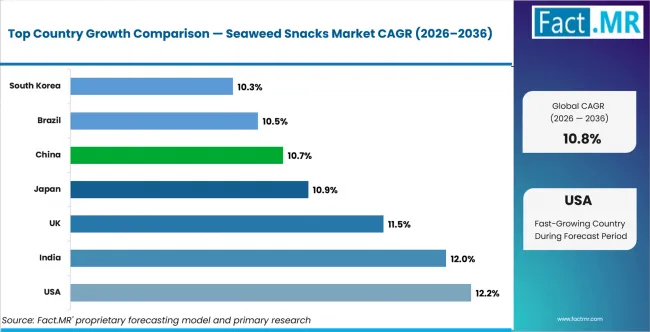
Seaweed Snacks Market Cagr Analysis By Country | Source: Fact.MR
What is powering the United States outlook?
12.2% CAGR through 2036, driven by mainstream retail access and wider familiarity with roasted seaweed formats.
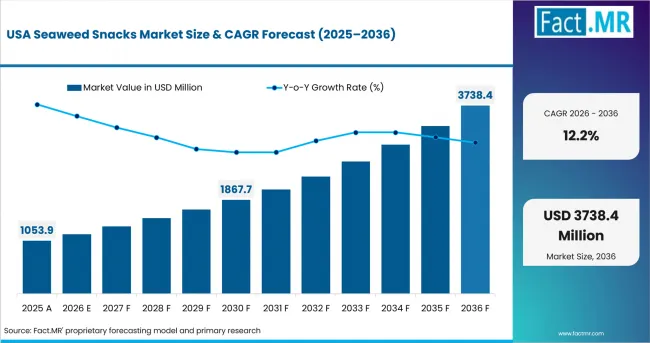
Seaweed Snacks Market Country Value Analysis | Source: Fact.MR
Domestic retail shelves now carry several seaweed snack brands across natural grocery and conventional supermarket channels. The United States is projected to record 12.2% CAGR through 2036 while gimme Seaweed and Ocean’s Halo widen flavor and pack choices. Brands are expected to gain where protective packaging preserves crisp texture and product descriptions explain marine flavor clearly.
How is India scaling seaweed snack demand?
12.0% CAGR through 2036, supported by cultivation investment and expanding domestic processing routes for edible seaweed.
Public programs are building cultivation infrastructure before a large domestic branded snack base has fully formed. India is expected to post 12.0% CAGR through 2036 as the Ministry of Fisheries supports seaweed value-chain development. Local processors are anticipated to gain where drying and seasoning capabilities develop near coastal production clusters and modern retail channels.
What supports the United Kingdom outlook?
11.5% CAGR through 2036, attributable to wider Asian snack availability and stronger retail familiarity with seaweed products.
Specialty Asian snacks increasingly sit beside wider savory assortments while supermarkets expand imported and private-label choices. The United Kingdom is anticipated to advance at 11.5% CAGR through 2036 under wider familiarity with Korean and Japanese food formats. Product selection is expected to emphasize clear flavor descriptions and nutrition communication under rules that specifically address seaweed-based snacks.
What underpins Japan’s continued expansion?
10.9% CAGR through 2036, reinforced by established nori consumption and frequent experimentation across convenient formats.
Nori already holds a familiar place in everyday eating which reduces the education burden for new snack formats. Japan is estimated to record 10.9% CAGR through 2036 while the Fisheries Agency tracks marine environmental change within its fisheries policy work. Suppliers are forecast to compete through texture control and seasonal flavors while preserving familiar quality cues for repeat consumers.
How is China supporting category expansion?
10.7% CAGR through 2036, shaped by integrated coastal processing and strong familiarity with edible seaweed products.
Xiapu county in Fujian, known as China’s “Seaweed Capital,” reported more than 1.6 million metric tons of seaweed production in 2024 across 23,000 hectares of marine farms. China is forecast to post 10.7% CAGR through 2036 as coastal processing networks support packaged seaweed distribution. Branded snack makers are projected to gain where consistent quality controls connect coastal sourcing with supermarket and digital storefront reach.
Who leads the seaweed snacks market?
TAOKAENOI FOOD & MARKETING PCL and gimme Seaweed provide direct snack coverage, Ocean’s Halo and Kimnori USA widen format choice.
Players in the industry such as TAOKAENOI FOOD & MARKETING PCL competes across roasted and fried seaweed formats while gimme Seaweed concentrates on seasoned roasted sheets and portable packs. SeaSnax remains directly relevant through ready-to-eat sheet products designed around portable use and routine snacking occasions. Competition among these brands centers on texture consistency and flavor clarity alongside reliable shelf execution across physical and digital channels during trial and repeat-purchase periods.
Ocean’s Halo combines seaweed snacks with a wider Asian pantry portfolio while Kimnori USA adds seasoned snack choices. BIBIGO and CJ Foods extend Korean food familiarity into seaweed products while Singha Corporation supports Masita formats. Competition through 2036 is expected to be shaped by raw material consistency and pack protection alongside retailer access and region-specific seasoning development across different national retail environments.
Which companies are the key providers?
TAOKAENOI FOOD & MARKETING PCL and gimme Seaweed are profiled. SeaSnax and Ocean’s Halo also feature, Kimnori USA, BIBIGO and Singha Corporation complete the set.
- TAOKAENOI FOOD & MARKETING PCL
- gimme Seaweed
- SeaSnax
- Ocean’s Halo
- Kimnori USA
- BIBIGO / CJ Foods
- Singha Corporation
Bibliography
- Food and Agriculture Organization of the United Nations. (2024, June 7). FAO report: Global fisheries and aquaculture production reaches a new record high. Food and Agriculture Organization of the United Nations.
- U.S. Department of Agriculture, Economic Research Service. (2024, November 7). Online grocery shopping participation varied by sociodemographic group in 2022 and 2023. U.S. Department of Agriculture.
- U.S. Department of Agriculture, Foreign Agricultural Service. (2024, May 3). Food processing ingredients annual: Korea. U.S. Department of Agriculture.
- U.S. Food and Drug Administration. (2024, November 1). FDA starts next phase of sodium reduction efforts. U.S. Department of Health and Human Services.
- U.S. Food and Drug Administration. (2025, January 14). FDA proposes requiring at-a-glance nutrition information on the front of packaged foods. U.S. Department of Health and Human Services.
- Press Information Bureau. (2025, March 18). Seaweed production. Government of India.
- Press Information Bureau. (2025, April 3). Seaweed: A nutritional powerhouse from the ocean. Government of India.
- NOAA Fisheries. (2025, September 12). Seaweed aquaculture. National Oceanic and Atmospheric Administration.
- Ministry of Oceans and Fisheries, Republic of Korea. (2025, December 8). Gim exports reach USD 1 billion for the first time. Ministry of Oceans and Fisheries.
- Department of Health and Social Care. (2025, June 4). Restricting advertising of less healthy food or drink on TV and online: Products in scope. UK Government.
- Ocean’s Halo. (2025, March 3). Ocean’s Halo introduces organic and shelf-stable kimchi, Banh Mi, and seaweed salad condiment line! Ocean’s Halo.
- U.S. Census Bureau. (2026, May 18). Quarterly retail e-commerce sales: First quarter 2026. U.S. Department of Commerce.
- U.S. Census Bureau. (2026, June 17). Advance monthly sales for retail and food services: May 2026. U.S. Department of Commerce.
- U.S. Department of Agriculture, Economic Research Service. (2026, January 27). Organic agriculture. U.S. Department of Agriculture.
- World Health Organization. (2026, May 11). Sodium reduction. World Health Organization.
- Food and Agriculture Organization of the United Nations. (2026, April). International markets for fisheries and aquaculture products: Quarterly seaweed analysis. Food and Agriculture Organization of the United Nations.
- Joint FAO/WHO Codex Alimentarius Commission. (2026, April 7). Proposal of new work on grouping seaweed and other algae. Food and Agriculture Organization of the United Nations.
- Fujian Provincial People’s Government. (2026, February 11). Fujian tops aquatic product exports for 13 consecutive years. Fujian Provincial People’s Government.
This Report Addresses
- The report provides strategic intelligence on Product and Distribution Channel decisions that influence shopper trial and repeat purchase in seaweed snacks.
- The segment analysis covers Strips and Chips and Offline Retail as the share leaders within their respective dimensions.
- The regional outlook covers the United States and India alongside the United Kingdom while also examining Japan and China through 2036.
- The competitive analysis profiles TAOKAENOI FOOD & MARKETING PCL and gimme Seaweed alongside SeaSnax and Ocean’s Halo. It also covers Kimnori USA and BIBIGO together with Singha Corporation.
- The product assessment covers Strips and Chips alongside Flakes and Bars while also examining Other Snack Formats across branded retail assortments.
- The channel assessment compares Offline Retail and Online Retail across product discovery and replenishment while examining bundle purchasing and direct ordering relationships.
- The source assessment covers Nori and Kelp alongside Wakame and Mixed Blends. The same analysis evaluates Sea Salt profiles and seasoned variants while comparing Single-Serve Packs and Multipacks with other pack formats.
What does the seaweed snacks market cover?
Roasted strips, crisp chips, flakes and bars prepared for direct consumer snacking across packaged retail channels.
The seaweed snacks market covers packaged seaweed products designed primarily for direct snacking instead of meal preparation. Core formats include roasted strips and chips alongside flakes and bars sold as ready-to-eat products.
The market differs from the broader commercial seaweed category by excluding bulk hydrocolloid inputs and most foodservice ingredients. Dried culinary seaweed is included only when packaged and positioned mainly as a ready-to-eat snack product for consumers.
What is included in the scope?
Packaged seaweed snack products sold through consumer retail and online channels for direct eating and portable snacking occasions.
Product coverage includes Strips and Chips alongside Flakes and Bars as well as Other Snack Formats. Distribution coverage includes Offline Retail and Online Retail across supermarkets and specialist stores in major consumer markets. Source coverage includes Nori and Laver alongside Kelp and Wakame as well as Mixed Blends. Flavor coverage spans Sea Salt profiles and seasoned variants including Teriyaki and Spicy options across several regional taste preferences. Pack coverage includes Single-Serve Packs and Multipacks alongside Family Packs and Variety Packs for different usage rates. The scope also considers how commercial seaweed supply affects snack-grade sheet availability while healthy snack categories shape shelf competition. It also tracks how wakame products broaden species familiarity beyond nori-based foods across several eating occasions.
What is excluded from the scope?
Bulk hydrocolloid seaweed inputs and meal-preparation seaweed products are outside the core scope used for this analysis.
The scope excludes carrageenan and alginate ingredients sold to industrial formulators alongside bulk seaweed supplied mainly for foodservice preparation. Supplements and cosmetics containing seaweed are also excluded because their purchase logic and regulatory requirements differ from packaged snack consumption.
How was the analysis built?
120+ sources, 45+ company portfolios, 25+ countries, 30+ participant interviews.
- Primary Research
- Primary research includes interviews with snack brand managers and category buyers alongside food distributors and seaweed processors. Discussions examine retail placement and repeat purchase alongside sheet quality and flavor acceptance across established and newer consumer markets. Interview questions also test pack protection and sourcing consistency against real assortment decisions across regional channels.
- Desk Research
- Desk research reviews government aquaculture statistics and fisheries policy updates alongside official company portfolios and retail channel disclosures. The review also checks nutrition regulation and seaweed value-chain programs that influence sourcing and formulation decisions. Company product pages are checked against active snack formats before a supplier enters the competitive set.
- Market-Sizing and Forecasting
- Forecasting combines branded retail expansion and repeat-purchase assumptions with seaweed input availability and channel mix changes. Product attachment rates and packaging economics are assessed alongside country familiarity and retailer assortment development. Country forecasts are checked against production capacity and channel access before final growth paths are accepted.
- Data Validation and Update Cycle
- Forecasts are validated through provider checks and portfolio mapping alongside interviews with channel and processing participants. Country direction is reviewed against official production and trade evidence before company relevance and product activity receive final verification. Evidence conflicts receive a second source check before numerical statements and company positions enter the final model.
Segmentation
What is the report’s scope and coverage?
| Attribute | Details |
|---|---|
| Quantitative Units | USD 3,150.0 Million in 2026 to USD 8,784.3 Million by 2036 at 10.8% CAGR |
| Market Definition | Packaged seaweed products designed primarily for direct snacking across roasted; crisp and other ready-to-eat consumer formats |
| Product | Strips and Chips; Flakes; Bars; Other Snack Formats |
| Distribution Channel | Offline Retail; Online Retail |
| Source Species | Nori and Laver; Kelp; Wakame; Mixed Blends |
| Flavor Profile | Sea Salt; Teriyaki; Barbecue; Wasabi; Spicy; Other Seasoned Variants |
| Pack Size | Single-Serve Packs; Multipacks; Family Packs; Variety Packs |
| Regions Covered | North America; Western Europe; East Asia; South Asia; Latin America; Middle East and Africa |
| Countries Covered | United States; India; United Kingdom; Japan; China |
| Key Companies Profiled | TAOKAENOI FOOD & MARKETING PCL; gimme Seaweed; SeaSnax; Ocean’s Halo; Kimnori USA; BIBIGO / CJ Foods; Singha Corporation |
| Forecast Period | 2026 to 2036 |
| Approach | Hybrid top-down and bottom-up approach using branded retail expansion; repeat-purchase assumptions; seaweed input availability; channel mix; packaging economics; retailer assortment development and brand validation |
Source: Fact.MR analysis. Updated Jul 7, 2026
How is the market segmented?
-
By Product
- Strips and Chips
- Flakes
- Bars
- Other Snack Formats
-
By Distribution Channel
- Offline Retail
- Online Retail
-
By Source Species
- Nori
- Kelp
- Wakame
- Mixed Blends
-
By Flavor Profile
- Sea Salt
- Teriyaki
- Barbecue
- Wasabi
- Spicy
- Other Seasoned Variants
-
By Pack Size
- Single-Serve Packs
- Multipacks
- Variety Packs
- Other Pack Formats
-
Region
- North America
- United States
- Canada
- Europe
- United Kingdom
- Germany
- France
- Netherlands
- Spain
- Asia Pacific
- Japan
- China
- South Korea
- India
- Thailand
- Indonesia
- Latin America
- Brazil
- Mexico
- Chile
- Middle East & Africa
- UAE
- Saudi Arabia
- South Africa
- North America
Frequently Asked Questions
Which product format leads the Seaweed Snacks Market?
Which distribution channel leads the Seaweed Snacks Market?
Which source species leads the Seaweed Snacks Market?
Which flavor profile leads the Seaweed Snacks Market?
Which pack size leads the Seaweed Snacks Market?
Which country records the highest CAGR in the Seaweed Snacks Market?
How does India perform in the Seaweed Snacks Market?
How does the United Kingdom perform in the Seaweed Snacks Market?
How does Japan perform in the Seaweed Snacks Market?
How does China perform in the Seaweed Snacks Market?
What is the primary driver in the Seaweed Snacks Market?
What is the main restraint in the Seaweed Snacks Market?
Why are Strips and Chips important for category expansion?
Why do retailers shape seaweed snack demand?
Who worked on this report


Preview the report firsthand - request a free sample
Free SampleGet the brochure for pricing and purchase details
Download PDF