- Forecast Value (2036): 1.83 Bn
- CAGR (2036): 13.9%
What is the self-sampling cervical kits market forecast to be worth by 2036?
USD 0.50 billion in 2026 to USD 1.83 billion by 2036, at 13.9% CAGR.
- The self-sampling cervical kits market crossed a valuation of USD 0.44 billion in 2025.
- Demand is expected to increase from USD 0.50 billion in 2026 to USD 1.83 billion by 2036.
- The market is forecast to record 13.9% CAGR from 2026 to 2036 as HPV screening programs adopt self-collected vaginal samples in clinical and home-based workflows.
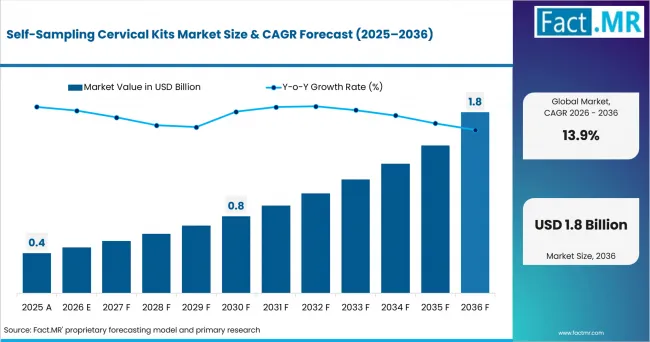
Self Sampling Cervical Kits Market Market Value Analysis | Source: Fact.MR
What are the defining numbers behind self-sampling cervical kits market growth?
USD 1.3 billion absolute opportunity by 2036, led by the United States and the United Kingdom.
- Demand Drivers in the Market
- Screening programs need kits that reduce barriers to cervical cancer testing.
- Diagnostic laboratories need samples that fit validated HPV assay workflows.
- Digital health providers need mail-back kits that support remote screening.
- Healthcare systems need private collection options for people avoiding pelvic exams.
- Key Segments Analyzed
- By Kit Type: Vaginal Swab-Based Kits are expected to hold 48.0% share in 2026 because swabs support simple self-collection.
- By Collection Setting: Healthcare-Site Self-Collection leads because early U.S. approvals focused on supervised settings. The share is projected at 42.0% in 2026.
- By Test Workflow: Primary HPV Screening is likely to account for 58.0% share in 2026 because self-sampling is mainly linked with HPV testing.
- By Distribution Channel: Provider-Ordered Mail-Back Kits lead with 37.0% share in 2026 because clinical oversight supports result follow-up.
- By End Use: Clinical Laboratories are expected to hold 40.0% share in 2026 because samples still require validated HPV testing.
- By Geography: The United States is projected to record 16.1% CAGR through 2036 as self-collection approvals expand access.
- Analyst Opinion at Fact.MR
- Shambhu Nath Jha, Senior Analyst at Fact.MR, states, “Self-sampling cervical kits are becoming an access tool for HPV-based screening. We see health systems using these kits to reach people who avoid pelvic exams or miss routine appointments. Suppliers that combine simple collection design with validated laboratory workflows will gain stronger access to screening programs.”
- Strategic Implications
- Kit suppliers should design instructions around low-error home collection.
- Diagnostic companies should align collection devices with approved HPV assays.
- Digital health providers should build strong follow-up workflows after positive results.
- Screening programs should test return logistics before scaling mail-back kits.
Self-sampling cervical kits include swabs, brushes, collection tubes and return packaging used for HPV-based cervical cancer screening. The category connects with molecular diagnostics because HPV DNA testing is the main laboratory workflow behind self-collected samples. The strongest adoption case comes from people who delay or avoid clinician-collected cervical screening.
Roche announced FDA approval in 2024 for its HPV self-collection solution in the United States. [2] BD also announced in 2024 that women in the United States can collect their own sample for cervical cancer screening through the BD Onclarity HPV Assay workflow. [3] These approvals created a stronger commercial base for self-sampling cervical kits.
American Cancer Society updated guidance in 2025 to include self-collected vaginal specimens for HPV testing in clinic or at home when approved devices are used. [4] This supports long-term kit demand because guidelines influence screening program design and payer coverage.
The United States is projected to record 16.1% CAGR through 2036 as Roche, BD and Teal Health expand self-collection access. The United Kingdom is expected to post 14.8% CAGR through 2036 as remote screening programs and digital health providers scale self-sampling. Germany is likely to record 14.2% CAGR as IVD laboratories use approved HPV workflows. Australia is forecast to advance at 13.6% CAGR as national screening experience supports self-collection. The Netherlands is set to record 13.0% CAGR as established self-sampling behavior supports kit use.
How does the self-sampling cervical kits market break down by segment?
Vaginal Swab-Based Kits lead at 48.0%; Primary HPV Screening leads at 58.0%.
Which kit type dominates?
Vaginal Swab-Based Kits hold 48.0% share in 2026.
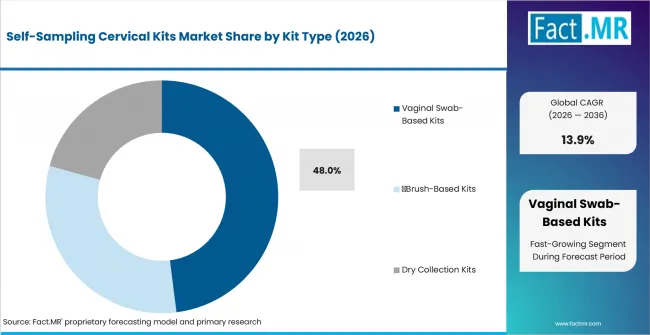
Self Sampling Cervical Kits Market Analysis By Kit Type | Source: Fact.MR
Vaginal Swab-Based Kits are expected to hold 48.0% share in 2026 because swabs are familiar and easy to package. The format suits clinic-supervised self-collection and mail-back workflows. Users can collect the sample without a speculum. The segment connects with diagnostic testing because simple sample collection can increase screening participation.
Which collection setting dominates?
Healthcare-Site Self-Collection accounts for 42.0% share in 2026.
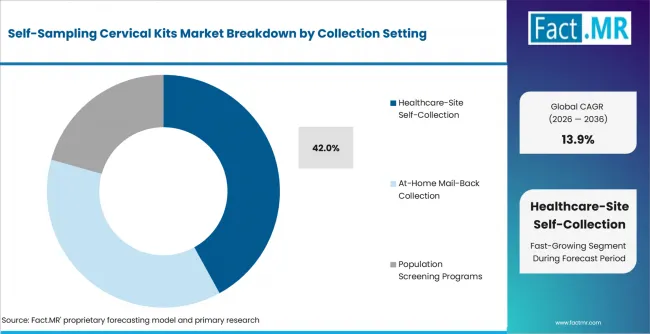
Self Sampling Cervical Kits Market Analysis By Collection Setting | Source: Fact.MR
Healthcare-Site Self-Collection leads because regulatory approvals first created stronger adoption inside clinics and healthcare offices. The collection setting is projected to capture 42.0% share in 2026. Users collect samples privately while providers manage ordering and result follow-up. This model helps laboratories control sample handling. At-home kits are growing as guidance and authorization expand.
Which test workflow dominates?
Primary HPV Screening holds 58.0% share in 2026.
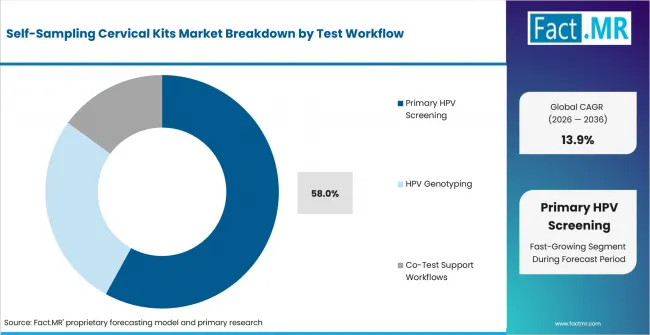
Self Sampling Cervical Kits Market Analysis By Test Workflow | Source: Fact.MR
Primary HPV Screening leads because self-sampling is designed around detecting high-risk HPV. The workflow is likely to account for 58.0% share in 2026. HPV testing identifies people at higher cervical cancer risk before disease develops. Roche and BD approvals support this workflow in U.S. healthcare settings. The PCR reagents link matters because molecular HPV workflows depend on stable amplification chemistry.
Which distribution channel dominates?
Provider-Ordered Mail-Back Kits lead with 37.0% share in 2026.
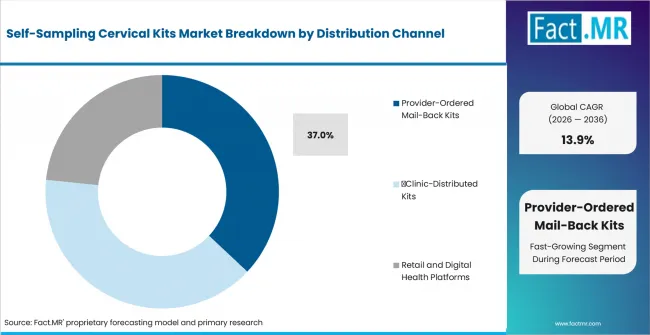
Self Sampling Cervical Kits Market Analysis By Distribution Channel | Source: Fact.MR
Provider-Ordered Mail-Back Kits lead because clinical oversight is important for eligibility and follow-up. The distribution channel is expected to hold 37.0% share in 2026. Users can collect samples privately while providers remain connected to the care pathway. Teal Health’s at-home model shows how provider involvement can sit inside a remote workflow. The digital health layer supports ordering and result communication.
Which end use dominates?
Clinical Laboratories hold 40.0% share in 2026.
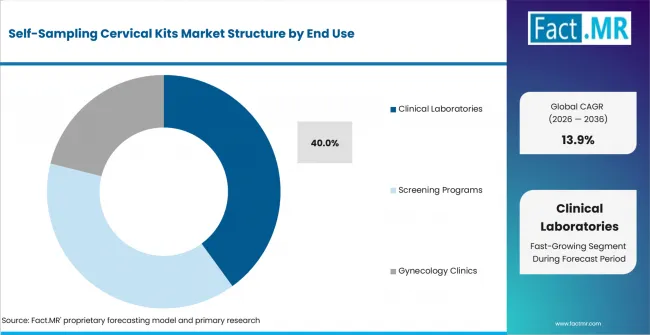
Self Sampling Cervical Kits Market Analysis By End Use | Source: Fact.MR
Clinical Laboratories lead because self-collected samples still need validated HPV testing. The end use is expected to hold 40.0% share in 2026. Laboratories manage accessioning, assay processing and result reporting. Digital health brands and clinics feed samples into these laboratory networks. The in-vitro diagnostics layer is important because kit adoption depends on approved assay compatibility.
What is accelerating self-sampling cervical kit demand, and what is holding it back?
Expanded HPV self-collection access drives demand; follow-up gaps restrain impact.
Expanded HPV self-collection access is the main driver. FDA approvals in 2024 allowed self-collected vaginal samples for specific HPV tests in healthcare settings. [1] This reduced dependence on clinician-collected cervical samples for eligible users.
At-home authorization adds another demand lane. Teal Health received FDA authorization in 2025 for an at-home cervical cancer screening device, according to Reuters. [5] This supports mail-back kit demand because users can collect samples privately and send them to a certified laboratory.
The main restraint is follow-up completion because a positive HPV result still requires clinical review and possible diagnostic follow-up. Kits can improve screening access, but care systems must close the loop after results.
Where do the biggest self-sampling cervical kit opportunities sit?
Underscreened populations, home collection and national screening programs.
- Underscreened Populations: Health systems can reach users who avoid pelvic exams or miss routine visits.
- Home Collection: Digital health providers can expand provider-ordered mail-back screening.
- National Screening Programs: Public programs can use kits to improve participation in hard-to-reach groups.
Which countries are scaling self-sampling cervical kits fastest?
United States 16.1%, United Kingdom 14.8%, Germany 14.2%, Australia 13.6%, Netherlands 13.0%.
Based on regional analysis, the self-sampling cervical kits market covers North America, Western Europe, Asia Pacific, Latin America, and Middle East and Africa complete the regional scope.
| Country | CAGR |
|---|---|
| United States | 16.1% |
| United Kingdom | 14.8% |
| Germany | 14.2% |
| Australia | 13.6% |
| Netherlands | 13.0% |
Source: Fact.MR analysis. Updated Jun 26, 2026
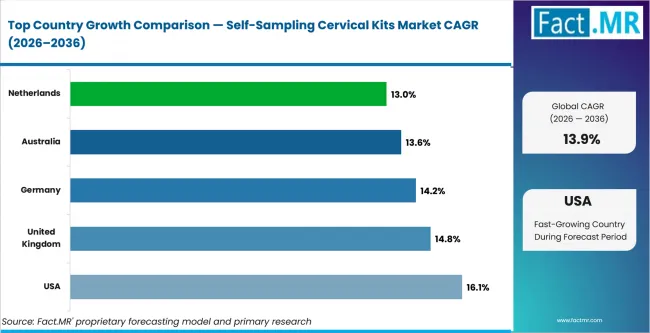
Self Sampling Cervical Kits Market Cagr Analysis By Country | Source: Fact.MR
What is powering the United States lead?
16.1% CAGR, driven by Roche Diagnostics and Teal Health authorization.
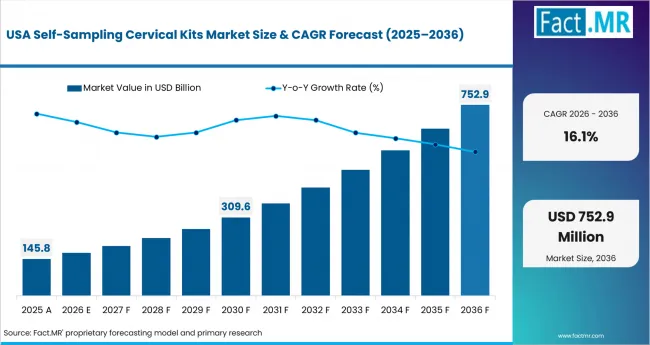
Self Sampling Cervical Kits Market Country Value Analysis | Source: Fact.MR
The United States is projected to record 16.1% CAGR from 2026 to 2036 as FDA-cleared self-collection workflows expand. Roche and BD support clinic-based self-collection through approved HPV assays. Teal Health adds at-home screening momentum. Growth will favor kits linked with provider oversight and laboratory follow-up.
How is the United Kingdom scaling self-sampling cervical kit demand?
14.8% CAGR, supported by remote screening programs and digital health access.
The United Kingdom is expected to post 14.8% CAGR through 2036 as remote collection models support cervical screening access. Mail-back kits can help reach users who do not attend appointments. Digital health providers can support ordering and result communication. Growth will favor kits with simple instructions and strong sample stability.
What supports Germany’s outlook?
14.2% CAGR, driven by IVD laboratories and HPV screening modernization.
Germany is likely to record 14.2% CAGR by 2036 as laboratories evaluate self-collected sample workflows. Roche and BD approvals in the United States support broader confidence in HPV self-collection technology. German providers need validated sample handling and clear follow-up pathways. Growth will favor assay-compatible kits.
How is Australia scaling self-sampling cervical kit adoption?
13.6% CAGR, backed by national screening experience and remote access needs.
Australia is forecast to advance at 13.6% CAGR through 2036 as self-collection supports screening access outside routine clinic visits. Rural and remote users benefit from easier sample collection. Programmatic screening can use kits to improve participation. Growth will favor standardized kits with clear user instructions.
What underpins Netherlands’ growth?
13.0% CAGR, driven by established self-sampling behavior and device familiarity.
The Netherlands is set to record 13.0% CAGR by 2036 as established screening behavior supports self-sampling. Users are familiar with mailed kit workflows in organized screening programs. Device suppliers can support programmatic demand with reliable collection tools. Growth will favor high-return-rate kit design.
Who leads the self-sampling cervical kits market?
Roche Diagnostics and BD lead through FDA-approved HPV self-collection workflows.
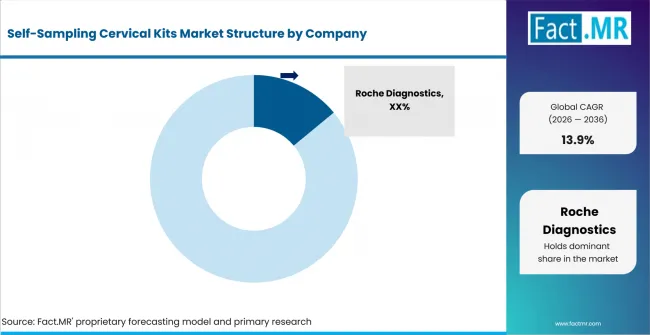
Self Sampling Cervical Kits Market Analysis By Company | Source: Fact.MR
Self-sampling cervical kits are supplied by diagnostic companies, digital health providers and collection device specialists. Roche Diagnostics leads through cobas HPV self-collection approval. BD supports self-collected samples through the BD Onclarity HPV Assay workflow.
Teal Health is active through its at-home cervical cancer screening kit and Teal Wand device. Rovers Medical Devices supports cervical self-sampling through Evalyn Brush.
Competition through 2036 will depend on approved device compatibility and follow-up support. Providers need user-friendly kits and reliable laboratory pathways. The molecular quality controls layer matters because laboratories need confidence in HPV test performance. The sample collection tubes link is relevant where sample transport and tube compatibility affect kit performance.
Which companies are the key providers?
Roche Diagnostics and BD are key providers. Teal Health are also profiled. Rovers Medical Devices complete the company set.
- Roche Diagnostics
- BD
- Teal Health
- Rovers Medical Devices
Bibliography
- [1] U.S. Food and Drug Administration. (2024, May 17). FDA roundup: May 17, 2024. FDA.
- [2] Roche. (2024, May 15). Roche announces FDA approval of one of the first HPV self-collection solutions in the U.S. Roche.
- [3] BD. (2024, May 15). Women in U.S. can now collect their own sample for cervical cancer screening. BD.
- [4] American Cancer Society. (2025, December 4). New cervical cancer screening guideline aims to reduce screening barriers. American Cancer Society.
- [5] Teal Health. (2025, May 9). FDA approves Teal Health’s Teal Wand™—the first and only at-home self-collection device for cervical cancer screening. Teal Health.
This Report Addresses
- Strategic intelligence on self-sampling cervical kits across kit type and collection setting.
- Segment analysis covering Vaginal Swab-Based Kits and Healthcare-Site Self-Collection.
- Regional outlook covering the United States, the United Kingdom, Germany, Australia, and the Netherlands.
- Competitive analysis of Roche Diagnostics, BD, Teal Health, and Rovers Medical Devices.
- Technology assessment covering swabs, brushes, wand-based devices and mail-back workflows.
- Use case assessment covering HPV primary screening, underscreened populations and provider-ordered home collection.
- Primary interviews, provider checks and official source review support the forecast.
What does the self-sampling cervical kits market cover?
Kits that allow users to collect vaginal samples for HPV-based cervical screening.
The self-sampling cervical kits market covers sterile collection devices and kit components used for self-collected HPV screening samples. It includes vaginal swab kits, cervical brush kits, wand-based devices, collection tubes and mail-back packaging. The scope connects with diagnostic access because easier sample collection can move screening closer to users.
The market differs from traditional Pap collection because the user collects the sample. The test still requires laboratory analysis and clinical follow-up after a positive result. Kit design must reduce collection error and support sample stability during transport.
What is included in the scope?
Vaginal swab kits, brush-based kits and mail-back cervical screening kits.
The scope includes clinic-supervised self-collection kits and at-home mail-back kits. It also includes provider-ordered kits used for HPV primary screening. The scope covers clinical diagnostics applications when the kit is used to support regulated cervical cancer screening.
The scope includes swabs, brushes and wand-style collection devices. It covers tubes, labels and return mailers when sold as part of a cervical self-sampling kit. It also includes kit assembly and logistics support for screening programs.
What is excluded from the scope?
Clinician-collected Pap tools without self-sampling use.
The scope excludes Pap smear brushes used only by clinicians. It excludes HPV assays sold without a self-collection kit. It excludes general STI self-swabs unless they are positioned for cervical cancer screening. It also excludes digital result platforms unless they are bundled with a cervical self-sampling kit.
How was the analysis built?
100+ sources, 40+ company portfolios, 25+ countries, 20+ interviews.
- Primary Research:
- Primary research includes interviews with cervical screening program managers and molecular diagnostics product teams. It includes input from kit assemblers and laboratory operations heads.
- Desk Research:
- Desk research reviews FDA approvals, screening guidance and official company sources. It covers HPV self-collection devices, mail-back kit workflows and sample preparation steps used before HPV testing.
- Market-Sizing and Forecasting:
- Forecasting uses self-collection adoption and HPV screening kit volumes. Laboratory pull-through and home-screening program expansion support the market assessment.
- Data Validation and Update Cycle:
- Forecasts are validated through provider checks and screening workflow references. FDA approvals and guideline changes help confirm market direction.
Segmentation
What is the report’s scope and coverage?
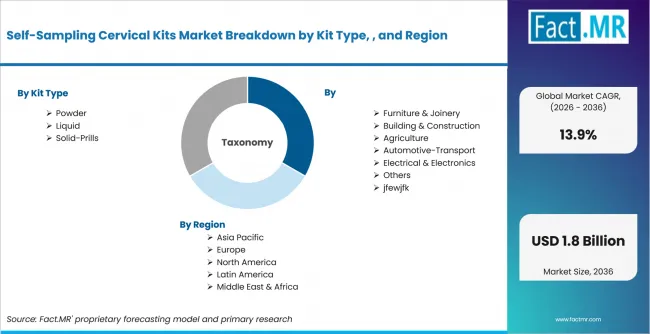
Self Sampling Cervical Kits Market Breakdown By Kit Type, , And Region | Source: Fact.MR
| Attribute | Details |
|---|---|
| Quantitative Units | USD Billion in 2026 to USD Billion by 2036 at CAGR |
| Market Definition | Self-collection kits used to collect vaginal samples for HPV-based cervical cancer screening |
| Kit Type | Vaginal Swab-Based Kits; Brush-Based Kits; Wand-Based Kits; Dry Collection Kits; Liquid-Based Collection Kits |
| Collection Setting | Healthcare-Site Self-Collection; At-Home Mail-Back Collection; Pharmacy-Based Collection; Mobile Clinic Collection; Population Screening Programs |
| Test Workflow | Primary HPV Screening; HPV Genotyping; Co-Test Support Workflows; Reflex Cytology Pathways; Digital Result Follow-Up |
| Distribution Channel | Provider-Ordered Mail-Back Kits; Clinic-Distributed Kits; Retail and Digital Health Platforms; Public Health Programs; Laboratory Direct Kits |
| End Use | Clinical Laboratories; Screening Programs; Digital Health Providers; Gynecology Clinics; Public Health Agencies |
| Regions Covered | North America; Western Europe; Asia Pacific; Latin America; Middle East and Africa |
| Countries Covered | United States; United Kingdom; Germany; Australia; Netherlands |
| Key Companies Profiled | Roche Diagnostics; BD; Teal Health; Rovers Medical Devices |
| Forecast Period | 2026 to 2036 |
| Approach | Hybrid top-down and bottom-up approach using HPV screening adoption, self-collection approvals, kit distribution activity and provider validation |
Source: Fact.MR analysis. Updated Jun 26, 2026
How is the market segmented?
-
By Kit Type:
- Vaginal Swab-Based Kits
- Brush-Based Kits
- Wand-Based Kits
- Dry Collection Kits
- Liquid-Based Collection Kits
-
By Collection Setting:
- Healthcare-Site Self-Collection
- At-Home Mail-Back Collection
- Pharmacy-Based Collection
- Mobile Clinic Collection
- Population Screening Programs
-
By Test Workflow:
- Primary HPV Screening
- HPV Genotyping
- Co-Test Support Workflows
- Reflex Cytology Pathways
- Digital Result Follow-Up
-
By Distribution Channel:
- Provider-Ordered Mail-Back Kits
- Clinic-Distributed Kits
- Retail and Digital Health Platforms
- Public Health Programs
- Laboratory Direct Kits
-
By End Use:
- Clinical Laboratories
- Screening Programs
- Digital Health Providers
- Gynecology Clinics
- Public Health Agencies
-
Region:
- North America
- United States
- Canada
- Europe
- United Kingdom
- Germany
- Netherlands
- France
- Italy
- Asia Pacific
- Australia
- Japan
- China
- South Korea
- India
- Latin America
- Brazil
- Mexico
- Argentina
- Middle East & Africa
- UAE
- Saudi Arabia
- South Africa
- Israel
- North America
Frequently Asked Questions
Which kit type leads the Self-Sampling Cervical Kits Market?
Which collection setting leads the Self-Sampling Cervical Kits Market?
Which test workflow leads the Self-Sampling Cervical Kits Market?
Which distribution channel leads the Self-Sampling Cervical Kits Market?
Which end use leads the Self-Sampling Cervical Kits Market?
Which country expands fastest in the Self-Sampling Cervical Kits Market?
How does the United Kingdom perform in the Self-Sampling Cervical Kits Market?
How does Germany perform in the Self-Sampling Cervical Kits Market?
How does Australia perform in the Self-Sampling Cervical Kits Market?
How does the Netherlands perform in the Self-Sampling Cervical Kits Market?
What is the primary driver in the Self-Sampling Cervical Kits Market?
What is the main restraint in the Self-Sampling Cervical Kits Market?
Why are vaginal swab-based kits important?
Why are provider-ordered mail-back kits gaining adoption?
Who worked on this report


Preview the report firsthand - request a free sample
Free SampleGet the brochure for pricing and purchase details
Download PDF