- Market Value (2025): USD 79.2 Mn
- Estimated Value (2026): USD 85 Mn
- Forecast Value (2036): USD 172 Mn
- CAGR (2026-2036): 7.3%
What is the Shaker Hydrogenation Reactors Market forecast to be worth by 2036?
USD 85 million in 2026 to USD 172 million by 2036, at 7.3% CAGR.
- The market stood at roughly USD 79.2 million in 2025 as pharmaceutical, fine chemical and academic laboratories maintained steady replacement and first-purchase demand.
- Revenue is projected to grow from USD 85 million in 2026 to USD 172 million by 2036 as synthesis laboratories expand with global pharmaceutical R&D and as teaching laboratories multiply in Asia.
- A 7.3% CAGR from 2026 to 2036 reflects replacement of aging apparatus, growth in contract synthesis, and continued preference for simple, proven hydrogenation equipment at bench scale.
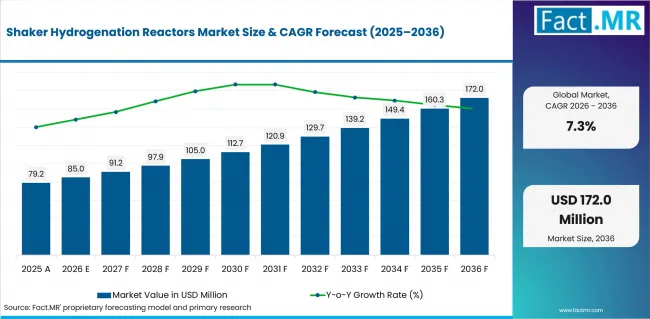
Shaker Hydrogenation Reactors Market Value Analysis | Source: Fact.MR
What are the defining numbers behind Shaker Hydrogenation Reactors Market growth?
USD 87 million absolute opportunity by 2036, led by Bottle shaker hydrogenators and Pharma synthesis within their respective segments.
- Demand Drivers in the Market
- Catalytic hydrogenation is one of the most frequently executed transformations in pharmaceutical synthesis, appearing across route development, intermediate reduction and final API steps, so every medicinal and process chemistry laboratory maintains hydrogenation capability at bench scale.
- The OECD records pharmaceutical industry R&D spending of USD 129 billion in 2022, up 76% in real terms since 2010, and the synthesis groups funded by that spending are the primary buyers of laboratory hydrogenation apparatus.
- Government health-related R&D budgets totaling USD 73 billion across OECD countries in 2022 equip university chemistry departments, where shaker hydrogenators remain standard teaching and research equipment.
- Contract research and manufacturing growth in India and China multiplies synthesis laboratories, each of which needs dependable small-scale hydrogenation from its first day of operation.
- Catalyst evaluation programs use shaker apparatus for comparative activity screening because the simple, reproducible gas-liquid contacting makes results comparable across laboratories and across decades of published data.
- Key Segments Analyzed
- By Apparatus Type: Bottle shaker hydrogenators lead at 50.1% of 2026 demand because the classic bottle-on-a-shaker design covers the majority of bench reductions up to a few hundred milliliters, needs no fixed installation beyond a hydrogen supply, and carries a learning curve measured in minutes rather than days.
- By Application: Pharma synthesis accounts for 40.0% of application demand because hydrogenation steps are embedded across drug substance routes, from nitro and olefin reductions to debenzylations, and medicinal chemistry groups run them daily at small scale.
- By End User: Pharmaceutical laboratories hold 37.0% of end user demand as the most intensive professional users, while academic laboratories at 29.0% represent the broadest installed base, with nearly every teaching and research chemistry department operating at least one shaker unit.
- Analyst Opinion at Fact.MR
- Shambhu Nath Jha, Senior Analyst at Fact.MR, states, “Every few years someone predicts the end of the shaker hydrogenator, usually in a brochure for a flow system. Then you walk into a medicinal chemistry lab and the shaker is still running in the corner, because it solves ninety percent of small reductions with zero engineering overhead. The real market story is not disruption, it is quiet accumulation: more synthesis labs, more units, more bottles and heads replaced every year.”
- Strategic Implications
- Suppliers should protect the simplicity advantage, adding safety interlocks and data logging without adding setup complexity that erodes the format’s core appeal.
- Pharmaceutical groups benefit from standardizing bottle and head inventories across sites, so methods transfer without revalidation of equipment differences.
- Academic purchasers should specify certified pressure relief and burst documentation, since teaching laboratories carry the widest range of operator experience.
- Vendors can build recurring revenue through bottle, gasket and seal replacement programs, the consumable tail that long-lived apparatus generates.
Parr Instrument’s 3910 series shaker hydrogenators remain the reference design for bench catalytic reduction, with rated bottles, safety interlocks and decades of published methods built around the format. The persistence of that reference position illustrates how this market rewards proven designs over novelty.
The United States is positioned for 7.9% annual growth from 2026 to 2036 on pharmaceutical synthesis depth. India is projected to grow at 7.6% on contract research expansion. Switzerland follows at 7.4% on discovery chemistry concentration, Germany advances at 7.1% on fine chemical and academic demand, and China records 6.8% as its synthesis laboratory base multiplies.
How does the Shaker Hydrogenation Reactors Market break down by segment?
The leading shares are Bottle shaker hydrogenators at 50.1% by Apparatus Type and Pharma synthesis at 40.0% by Application.
Why do bottle shaker hydrogenators lead the apparatus mix?
At 50.0% share in 2026, bottle shaker hydrogenators lead because the format covers most bench reductions with the least infrastructure and the fastest setup.
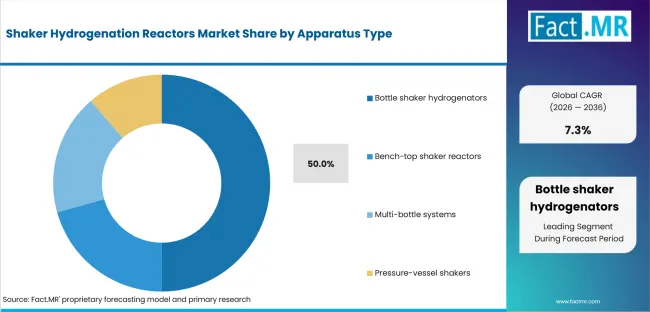
Shaker Hydrogenation Reactors Market Analysis By Apparatus Type | Source: Fact.MR
Bottle shaker hydrogenators account for 50.0% of demand because a rated glass bottle, a shaker head and a hydrogen supply solve the standard medicinal chemistry reduction without fixed installation, and the format’s published method base stretches back decades. Bench-top shaker reactors serve applications where higher pressures or temperatures exceed bottle ratings. Multi-bottle systems suit parallel comparative work, while pressure-vessel shakers serve the upper pressure range.
Why does pharma synthesis lead the application group?
A 40.0% share puts pharma synthesis first in 2026 because reduction chemistry is embedded across drug substance routes and run daily in discovery and process groups.
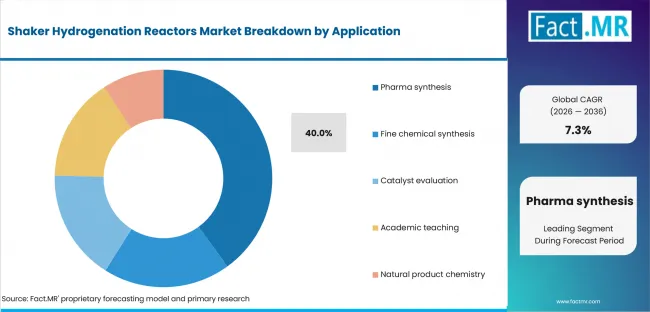
Shaker Hydrogenation Reactors Market Analysis By Application | Source: Fact.MR
Pharma synthesis represents 40.0% of application demand because hydrogenation appears across route chemistries at every stage, and the industry’s research economy, which the OECD totals at USD 129 billion in 2022, funds the laboratories that run them. Fine chemical synthesis uses the equipment for dyes, flavors and intermediates. Catalyst evaluation relies on comparative screening, academic teaching favors clear apparatus, and natural product chemistry uses selective reductions to finish complex syntheses.
Why do pharmaceutical laboratories lead the end user group?
The leading 2026 share is 37.0% for pharma labs because they run hydrogenation as a daily production technique rather than an occasional method.
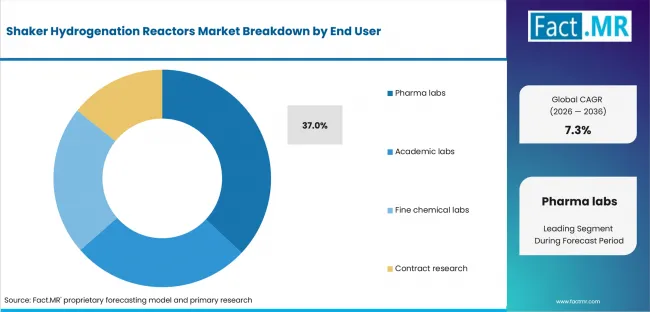
Shaker Hydrogenation Reactors Market Analysis By End User | Source: Fact.MR
Pharmaceutical laboratories represent 37.0% of demand because discovery and process groups operate shaker hydrogenators continuously, wearing bottles and seals and justifying multiple units per site. Academic laboratories form the broadest installed base across teaching and research departments. Fine chemical laboratories use the equipment for specialized synthesis, while contract research organizations add demand as outsourced synthesis work expands.
What is accelerating Shaker Hydrogenation Reactors Market adoption, and what is holding it back?
The principal accelerator is the expansion of synthesis laboratory capacity worldwide, especially in contract research and Asian academic institutions. Adoption is slowed by the long service life of existing apparatus, competition from flow hydrogenation at the high end, and hydrogen supply constraints in some laboratory buildings.
Drivers Impact Analysis
| DRIVER | (~) % IMPACT ON CAGR | GEOGRAPHIC RELEVANCE | IMPACT TIMELINE |
|---|---|---|---|
| Pharmaceutical synthesis expansion | +1.2% | United States, Switzerland, India | Long term (>= 4 years) |
| Contract research growth | +1.0% | India, China, Europe | Medium term (2-4 years) |
| Academic laboratory buildout | +0.9% | China, India, Southeast Asia | Long term (>= 4 years) |
| Catalyst screening programs | +0.7% | Global research hubs | Medium term (2-4 years) |
| Replacement of aging units | +0.6% | North America, Europe | Short term (<= 2 years) |
Source: Fact.MR analysis. Updated Jul 25, 2026
- Pharmaceutical synthesis expansion: With industry R&D spending up 76% in real terms since 2010 per OECD data, the global count of synthesis chemists keeps rising, and each new bench position eventually needs hydrogenation capability.
- Contract research growth: Indian and Chinese CROs win synthesis programs from Western sponsors and equip laboratories to run them, buying robust, simple hydrogenation apparatus that any hired chemist can operate.
- Academic laboratory buildout: Government research funding across the OECD and expanding university systems in Asia create new chemistry departments that purchase shaker hydrogenators as standard equipment.
Opportunity Impact Analysis
| OPPORTUNITY | (~) % IMPACT ON CAGR | GEOGRAPHIC RELEVANCE | IMPACT TIMELINE |
|---|---|---|---|
| Consumable bottle and head programs | +0.5% | Installed base globally | Short term (<= 2 years) |
| Interlocked safety upgrades | +0.4% | Regulated laboratories | Medium term (2-4 years) |
| Teaching-lab packages | +0.3% | Asian universities | Medium term (2-4 years) |
| Data-logged units for GMP-adjacent work | +0.3% | Pharma development groups | Long term (>= 4 years) |
Source: Fact.MR analysis. Updated Jul 25, 2026
- Consumable programs: Bottles, heads, gaskets and seals are wear items on every shaker. Scheduled replacement programs give suppliers annuity revenue on an installed base that otherwise buys nothing for years.
- Interlocked safety upgrades: Laboratory safety policies increasingly require hydrogen detection and automatic shut-off interlocks. Retrofit kits modernize older units without full replacement.
- Teaching-lab packages: Universities equipping multiple teaching stations buy bundled units with training materials and spares, a procurement pattern growing across Asian chemistry programs.
Restraints Impact Analysis
| RESTRAINT | (~) % IMPACT ON CAGR | GEOGRAPHIC RELEVANCE | IMPACT TIMELINE |
|---|---|---|---|
| Long apparatus service life | -0.5% | Global | Long term (>= 4 years) |
| Flow hydrogenation competition | -0.4% | Advanced pharma groups | Medium term (2-4 years) |
| Hydrogen supply constraints | -0.3% | Older laboratory buildings | Medium term (2-4 years) |
| Used equipment circulation | -0.2% | Academic buyers | Short term (<= 2 years) |
Source: Fact.MR analysis. Updated Jul 25, 2026
- Long service life: A maintained shaker hydrogenator runs for decades, so replacement demand depends on safety policy changes and laboratory expansion more than on wear.
- Flow hydrogenation competition: Continuous flow hydrogenation systems capture high-end process development work, offering better mass transfer and safety profiles, though at far higher cost and complexity.
- Hydrogen supply constraints: Laboratories without piped hydrogen or generator infrastructure face installation friction that delays or prevents apparatus purchase.
How do the leading shaker hydrogenation reactor markets compare?
United States 7.9% CAGR. India 7.6%. Switzerland 7.4%. Germany 7.1%.
Regional analysis addresses North America, Europe, and Asia Pacific through country sections on the United States, India, Switzerland and Germany with more than 30 countries treated in the complete report.
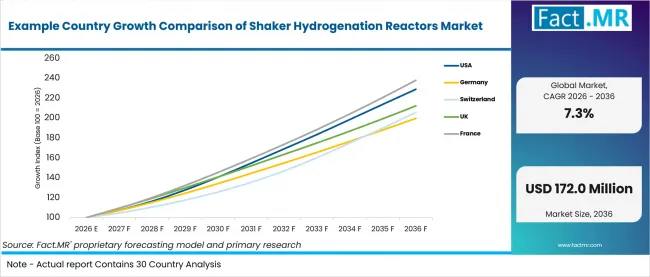
Example Country Growth Comparison Of Shaker Hydrogenation Reactors Market | Source: Fact.MR
| COUNTRY | CAGR |
|---|---|
| United States | 7.9% |
| Switzerland | 7.4% |
| Germany | 7.1% |
Source: Fact.MR analysis. Updated Jul 25, 2026
Why Does US Synthesis Depth Keep the Format Alive and Growing?
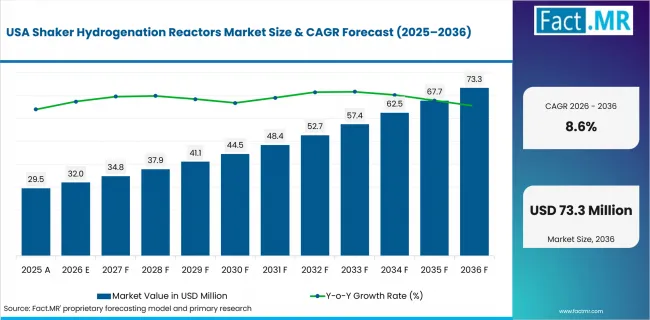
Shaker Hydrogenation Reactors Market Country Value Analysis | Source: Fact.MR
The United States runs the world’s largest pharmaceutical research economy, with the OECD recording USD 103.9 billion in industry R&D spending in 2022 and USD 49.5 billion in government health research funding. Behind those totals sit thousands of medicinal and process chemistry benches where hydrogenation is daily work, and the shaker format remains the default bench solution.
American academic chemistry adds a broad teaching and research installed base, and replacement demand is steady as safety policies push older units toward retirement. The United States carries a 7.9% CAGR from 2026 to 2036.
Why Does Switzerland Buy Fewer Units at Higher Specifications?
Switzerland’s pharmaceutical research concentration buys shaker hydrogenators as routine laboratory equipment, but Swiss procurement emphasizes documentation, certified pressure ratings and safety interlocks that raise value per unit. Basel-area discovery groups maintain large installed fleets with disciplined consumable replacement.
The country’s fine chemical and flavor chemistry sector adds specialist demand. Switzerland’s market grows at a 7.4% CAGR from 2026 to 2036.
Why Does Germany Combine Industrial Tradition with Academic Breadth?
Germany’s fine chemical industry and its university chemistry departments form a deep, stable market for bench hydrogenation equipment. German laboratories maintain apparatus meticulously and replace on safety policy rather than failure, creating predictable replacement cycles.
Catalyst research institutes add comparative screening demand where the shaker format’s reproducibility matters. Germany’s demand advances at a 7.1% CAGR from 2026 to 2036.
Who leads the Shaker Hydrogenation Reactors Market?
Parr Instrument, Amar Equipment, Vinci Technologies, Buchi AG, Chemglass Life Sciences, and Across International compete through proven design, safety certification, and consumable support.
Competition centers on proven bench design, documented pressure safety, and serviceable consumables. Parr Instrument’s 3910 Series illustrates the emphasis on rated bottles and safety interlocks; Amar Equipment, Vinci Technologies, Buchi AG, Chemglass Life Sciences, and Across International give laboratories alternatives across apparatus selection, safety retrofit, and consumable replacement.
Competitive differentiation centers on interlocked safety retrofits, teaching-laboratory packages, and consumable replacement programs.
Which companies are the key providers?
The company set includes Parr Instrument, Amar Equipment, Vinci Technologies, Buchi AG, Chemglass Life Sciences, and Across International.
- Parr Instrument
- Amar Equipment
- Vinci Technologies
- Buchi AG
- Chemglass Life Sciences
- Across International
The six named manufacturers anchor the comparison, and the full report reviews more than 15 laboratory apparatus suppliers.
Bibliography
- OECD. (2025). Health at a Glance 2025: Pharmaceutical knowledge and innovation (R&D expenditure data).
- Parr Instrument Company. (n.d.). Shaker Hydrogenation Apparatus, 3910 Series.
- Amar Equipment. (n.d.). Laboratory Hydrogenation Systems.
This Report Addresses
- The report quantifies the 2025 baseline and forecasts revenue from 2026 through 2036.
- It compares the United States, India, Switzerland, Germany, and China, drawing on country coverage of 30+ markets.
- It evaluates Parr Instrument, Amar Equipment, Vinci Technologies, Buchi AG, Chemglass Life Sciences, and Across International.
- It examines apparatus type, application, and end user choices.
- It separates pharmaceutical, fine chemical, catalyst, teaching, and natural product demand.
- It tests the forecast against synthesis laboratory expansion, contract research growth, and replacement cycles.
What does the Shaker Hydrogenation Reactors Market cover?
The study follows shaker hydrogenation apparatus from laboratory purchase through daily synthesis service and consumable replacement.
Revenue includes the shaker mechanism, rated bottles or vessels, heads, gaskets, seals, pressure gauges and safety components sold with the apparatus, plus replacement consumables billed by the manufacturer.
Demand is segmented by apparatus type, application, and end user. Country estimates reflect synthesis laboratory counts, research funding, hydrogen infrastructure availability, and supplier presence.
What is included in the scope?
Included systems are agitated apparatus designed for catalytic hydrogenation at laboratory scale under low to medium pressure.
Bottle shaker hydrogenators, bench-top shaker reactors, multi-bottle systems and pressure-vessel shakers are counted across all covered applications. Consumable bottles, heads, gaskets and seals are covered when supplied by the apparatus manufacturer.
What is excluded from the scope?
Stirred autoclaves, flow hydrogenation systems, and hydrogen generators are not included.
The study excludes stirred pressure reactors without shaking mechanisms, continuous flow hydrogenation platforms, hydrogen generation and supply equipment, and general laboratory shakers not rated for pressure.
How was the analysis built?
Laboratory counts, synthesis activity data, user interviews, and forecast cross-checks referencing more than 30 countries.
- Primary Research: Primary research targets medicinal and process chemistry managers, laboratory safety officers, apparatus manufacturers, and university procurement staff. Interviews test unit counts per laboratory, application mixes, safety requirements, consumable usage, and replacement triggers.
- Desk Research: Desk research reviews OECD research expenditure data, university program expansion, contract research sector growth, and manufacturer literature. Named statistics are used only when supported by the intergovernmental sources listed in the bibliography.
- Market-Sizing and Forecasting: Sizing is developed from laboratory counts, units per laboratory, apparatus prices by type, consumable attach rates, and replacement cycles. The result is reconciled to USD 85 million in 2026 and USD 172 million in 2036.
- Data Validation and Update Cycle: Validation compares segment shares, supplier positions, and country growth with funding data and laboratory construction. Update signals include CRO capacity additions, safety policy changes, new university programs, and product launches.
Segmentation
What is the report’s scope and coverage?
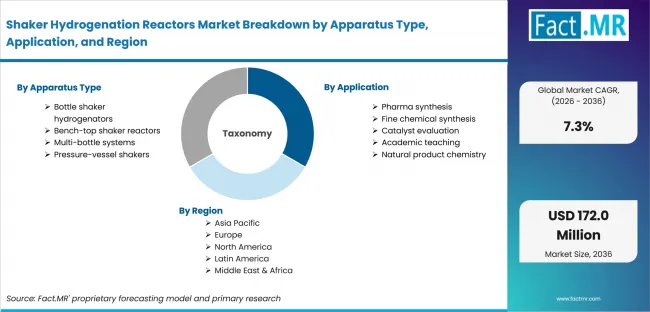
Shaker Hydrogenation Reactors Market Breakdown By Apparatus Type, Application, And Region | Source: Fact.MR
| ATTRIBUTE | DETAILS |
|---|---|
| Quantitative Units | USD 85 million in 2026 to USD 172 million by 2036 at 7.3% CAGR |
| Market Definition | The market covers shaker-type hydrogenation apparatus providing agitated gas-liquid contacting for laboratory catalytic hydrogenation at low to medium pressure, including bottle shakers, bench-top shaker reactors and multi-bottle systems. |
| Apparatus Type | Bottle shaker hydrogenators; Bench-top shaker reactors; Multi-bottle systems; Pressure-vessel shakers |
| Application | Pharma synthesis; Fine chemical synthesis; Catalyst evaluation; Academic teaching; Natural product chemistry |
| End User | Pharma labs; Academic labs; Fine chemical labs; Contract research |
| Regions Covered | North America; Europe; Asia Pacific |
| Countries Covered | United States; Switzerland; Germany(full report analyzes 30+ countries) |
| Key Companies Profiled | Parr Instrument; Amar Equipment; Vinci Technologies; Buchi AG; Chemglass Life Sciences; Across International |
| Forecast Period | 2026 to 2036 |
| Approach | Sizing combines laboratory counts and unit penetration by end user, apparatus prices by type, consumable replacement cycles, and separately billed safety retrofits and service. |
Source: Fact.MR analysis. Updated Jul 25, 2026
How is the market segmented?
-
By Apparatus Type:
- Bottle shaker hydrogenators
- Bench-top shaker reactors
- Multi-bottle systems
- Pressure-vessel shakers
-
By Application:
- Pharma synthesis
- Fine chemical synthesis
- Catalyst evaluation
- Academic teaching
- Natural product chemistry
-
By End User:
- Pharma labs
- Academic labs
- Fine chemical labs
- Contract research
-
By Region:
- North America
- Europe
- Asia Pacific
Frequently Asked Questions
What is the shaker hydrogenation reactors market worth in 2026?
What revenue level is projected for shaker hydrogenation reactors in 2036?
What CAGR is expected through 2036?
Which apparatus type leads demand?
Which application is the largest segment?
Which end user has the largest share?
Who worked on this report


Preview the report firsthand - request a free sample
Free SampleGet the brochure for pricing and purchase details
Download PDF