- Base Value(2025): 5.4 Bn
- Estimated Value(2026): 6.3 Bn
- Forecast Value (2036): 27.9 Bn
- CAGR (2026 - 2036): 16.1%
Shingles Vaccine Market Analysis and Forecast by Fact.MR
- The global market for shingles vaccines is estimated at US$ 6.27 billion in 2026 and is forecast to expand at a CAGR of 16.1% to reach US$ 27.9 billion by 2036.
- Shingles vaccines are designed to prevent herpes zoster reactivation in aging populations, using recombinant protein antigens, adjuvant systems, and mRNA platforms to trigger targeted immune responses.
- Recombinant zoster vaccines currently lead the product landscape, supported by strong clinical efficacy data and regulatory approvals across North America, Europe, and parts of Asia Pacific. The pipeline is expanding with next generation mRNA formulations and protein subunit candidates, which aim to improve thermostability, reduce dosing complexity, and widen access in lower income healthcare settings.
- As national immunization programs begin incorporating adult shingles vaccination, demand is expected to scale across both private and public healthcare delivery channels globally.
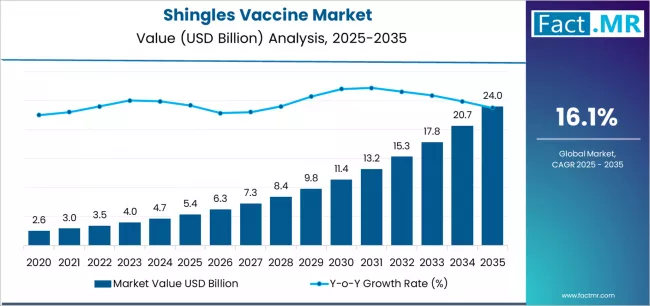
Shingles Vaccine Market Market Value Analysis | Source: Fact.MR
Summary of Shingles Vaccine Market
- Market Snapshot
- In 2025, the global Shingles Vaccine Market was valued at approximately USD 5.4 billion.
- The market is estimated to reach USD 6.27 billion in 2026 and is projected to attain USD 27.9 billion by 2036.
- The shingles vaccine market is likely to expand at a CAGR of 16.1% during the forecast period.
- The market is anticipated to create an absolute dollar opportunity of USD 21.63 billion between 2026 and 2036.
- Recombinant Zoster Vaccine accounts for 54% of product share in 2026.
- Australia (17.4%) and Canada (16.7%) are the key growth markets during the forecast period.
- Demand and Growth Drivers
- Aging global population is increasing the eligible patient pool for shingles vaccination, particularly in markets with growing 50 plus demographics.
- Expansion of national adult immunization programs across Europe, Asia Pacific, and North America is creating new public procurement channels.
- Strong clinical efficacy data for recombinant zoster vaccines is accelerating regulatory approvals and reimbursement coverage in multiple geographies.
- Expansion of distribution channels and direct to customer platforms is improving market access and product penetration across geographies.
- Growing investment in research and product development is supporting the introduction of higher specification and differentiated products.
- Product and Segment View
- Recombinant zoster vaccines hold 54% of the product type segment in 2026, supported by strong clinical efficacy data, regulatory approvals across major markets, and established procurement channels in both private and public healthcare settings.
- Preventive immunization represents 58% of the application segment in 2026, with routine adult vaccination schedules, high risk prevention protocols, and national immunization program expansions acting as the primary demand channels.
- mRNA based vaccines are growing faster in percentage terms, with their share projected to rise as pipeline candidates advance through clinical trials and regulatory agencies evaluate new formulation platforms for adult immunization.
- Key segmentation includes:
- Product: Recombinant Zoster Vaccine, Live Attenuated Zoster Vaccine, mRNA Based Vaccines, Protein Subunit Vaccines
- Application: Preventive Immunization, Elderly Vaccination Programs, Healthcare Institution Use, Public Health Programs
- End Use: Hospitals & Clinics, Pharmaceutical Companies, Government & Public Health Agencies, Elderly Care Facilities
- Technology: Recombinant DNA Technology, Adjuvant Technology, mRNA Vaccine Technology, Viral Vector Technology
- Formulation: Vaccine Dosage Systems, Delivery Systems, Advanced Formulations, Stability Based Formulations
- Geography and Competitive Outlook
- Australia leads growth at 17.4%, supported by expanding domestic demand, industry investment, and favorable policy conditions.
- North America shows mixed growth patterns, with the United States representing a mature market and Canada showing stronger growth driven by emerging applications.
- Europe demonstrates steady demand, with Germany and the UK supported by regulatory frameworks and established industrial infrastructure.
- Key players in this market include GlaxoSmithKline plc. (GSK), Pfizer Inc., Merck & Co. Inc., CanSinoBIO (CanSino Biologics Inc.), Vaccitech plc..
- Analyst Opinion
- Shambhu Nath Jha, Principal Consultant at Fact.MR, says 'The shingles vaccine market is entering a structural growth phase as national immunization programs expand adult vaccination coverage beyond high income markets. Recombinant platforms remain the primary revenue base, but mRNA candidates are advancing toward late stage trials, which could reshape the competitive and pricing landscape within the next five years. The real inflection point will come from reimbursement inclusion in public healthcare budgets across Europe and Asia Pacific, where coverage gaps remain wide despite aging population demographics. Companies that secure early positioning in government tender pipelines and establish cold chain partnerships in mid income markets are likely to capture the next wave of volume growth.'
Key Growth Drivers, Constraints, and Opportunities
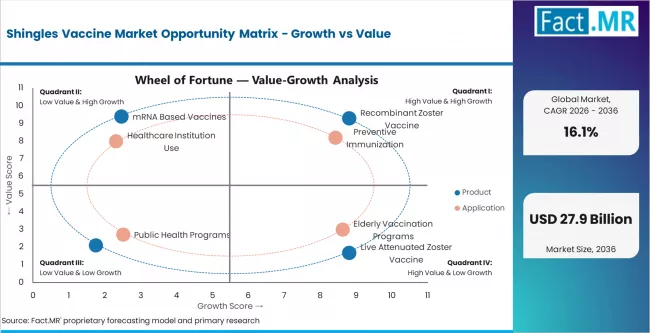
Shingles Vaccine Market Opportunity Matrix Growth Vs Value | Source: Fact.MR
Key Factors Driving Growth
- Aging global population is increasing the eligible patient pool for shingles vaccination, particularly in markets with growing 50 plus demographics.
- Expansion of national adult immunization programs across Europe, Asia Pacific, and North America is creating new public procurement channels.
- Strong clinical efficacy data for recombinant zoster vaccines is accelerating regulatory approvals and reimbursement coverage in multiple geographies.
Key Market Constraints
- High per dose cost of recombinant vaccines limits accessibility in price sensitive markets and public health budgets with competing priorities.
- Cold chain infrastructure gaps in emerging markets restrict distribution reach and storage integrity for temperature sensitive formulations.
- Low awareness of adult vaccination benefits among general populations and primary care providers slows voluntary uptake outside mandated programs.
Key Opportunity Areas
- mRNA vaccine platforms entering late stage development could create a new competitive tier with improved thermostability and simplified dosing regimens.
- Expanding elderly care facility networks in Asia Pacific and Latin America represent underpenetrated institutional demand channels.
- Government tender pipelines for adult vaccination programs in mid income countries are opening bulk procurement opportunities for established vaccine manufacturers.
Segment-wise Analysis of the Shingles Vaccine Market
- Recombinant zoster vaccines hold 54% of the product type segment in 2026, supported by strong clinical efficacy data, regulatory approvals across major markets, and established procurement channels in both private and public healthcare settings.
- Preventive immunization represents 58% of the application segment in 2026, with routine adult vaccination schedules, high risk prevention protocols, and national immunization program expansions acting as the primary demand channels.
- mRNA based vaccines are growing faster in percentage terms, with their share projected to rise as pipeline candidates advance through clinical trials and regulatory agencies evaluate new formulation platforms for adult immunization.
The shingles vaccine market is segmented by product type, application, end use, technology, and formulation. By product type, the market covers recombinant zoster vaccines, live attenuated zoster vaccines, mRNA based vaccines, and protein subunit vaccines. By application, coverage includes preventive immunization, elderly vaccination programs, healthcare institution use, and public health programs. Recombinant platforms lead by value in the near term because of their demonstrated efficacy and regulatory acceptance, while mRNA candidates are expected to drive the next phase of growth as clinical data matures and production scalability improves.
Which Product Type Segment Dominates the Shingles Vaccine Market?

Shingles Vaccine Market Analysis By Product | Source: Fact.MR
Recombinant zoster vaccines account for approximately 54% of the total market value in 2026. Established clinical efficacy profiles, strong regulatory approvals in North America and Europe, and inclusion in national adult immunization schedules are the main sources of support for this leadership. The recombinant platform offers superior long term protection compared to live attenuated alternatives, which continues to drive preference among healthcare providers and procurement agencies.
Recombinant vaccines are firmly positioned across private healthcare and government vaccination channels, where two dose regimens are becoming standard for adults aged 50 and above. Their strong safety data and consistent immune response profiles support adoption across diverse patient populations, including immunocompromised individuals who are not eligible for live vaccine alternatives.
Which Application Segment Dominates the Shingles Vaccine Market?
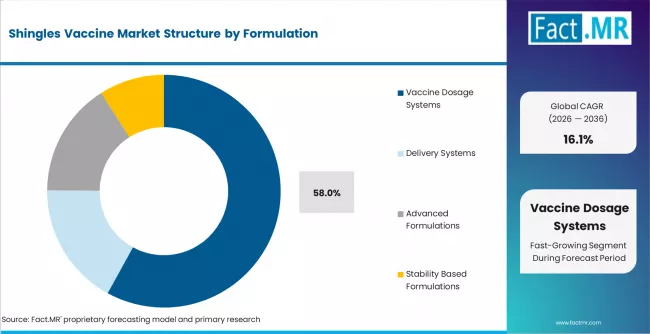
Shingles Vaccine Market Analysis By Formulation | Source: Fact.MR
Preventive immunization is expected to be the dominant application segment with 58% of global market value in 2026. Rising demand is shaped by the growing inclusion of shingles vaccination in routine adult health programs, expansion of high risk prevention protocols, and increased physician awareness of herpes zoster complications in aging populations.
Elderly vaccination programs remain a major application category, but preventive immunization is gaining broader institutional support because it targets a wider age range and integrates with existing healthcare delivery infrastructure. The segment is expected to strengthen its position over the forecast period as more countries add shingles vaccination to their standard adult immunization calendars.
Which Product Trend is Shaping the Next Phase of Growth in the Shingles Vaccine Market?
mRNA based shingles vaccines are not yet commercially dominant, but they are emerging as the fastest developing product category in the pipeline. Multiple candidates are advancing through clinical trials, with formulations that leverage lipid nanoparticle delivery, synthetic mRNA platforms, and self amplifying RNA systems to achieve targeted immune responses with simplified dosing and improved thermostability. This is particularly relevant for expanding vaccination access in markets where cold chain infrastructure remains a constraint.
The shift toward mRNA platforms reflects a broader change in vaccine development priorities. Regulatory agencies are increasingly open to platform based approval pathways, which could accelerate time to market for next generation shingles vaccines. As production scalability improves and clinical efficacy data matures, mRNA candidates could move from a development stage niche into a competitive force against established recombinant products, particularly in price sensitive public health markets.
Regional Outlook Across Key Markets
.webp "Top Country Growth Comparison Shingles Vaccine Market Cagr (2026 2036)")
Top Country Growth Comparison Shingles Vaccine Market Cagr (2026 2036) | Source: Fact.MR
- Australia leads growth at 17.4%, supported by expanding domestic demand and favorable industry conditions.
- North America shows varied growth, with USA at 15.4% and Canada at 16.7%.
- European demand remains steady, supported by established industrial infrastructure and regulatory frameworks.
CAGR Table
| Country | CAGR (%) |
|---|---|
| Australia | 17.4% |
| Canada | 16.7% |
| France | 16.3% |
| UK | 15.6% |
| USA | 15.4% |
| Germany | 15.1% |
| Japan | 14.8% |
Source: Fact.MR analysis. Updated May 20, 2026
Source: Fact MR (FMR) analysis, based on proprietary forecasting model and primary research.

Shingles Vaccine Market Cagr Analysis By Country | Source: Fact.MR
Market Outlook for Shingles Vaccine in Australia
The Australia shingles vaccine market is projected to grow at a CAGR of 17.4% through 2036.
- Growing domestic demand supports market expansion.
- Infrastructure development creates new opportunities.
- Regulatory environment is evolving to support industry growth.
Demand Trends for Shingles Vaccine in Canada
The Canada shingles vaccine market is projected to grow at a CAGR of 16.7% through 2036.
- Growing domestic demand supports market expansion.
- Infrastructure development creates new opportunities.
- Regulatory environment is evolving to support industry growth.
Growth Assessment for Shingles Vaccine in France
The France shingles vaccine market is projected to grow at a CAGR of 16.3% through 2036.
- Growing domestic demand supports market expansion.
- Infrastructure development creates new opportunities.
- Regulatory environment is evolving to support industry growth.
Market Demand Analysis for Shingles Vaccine in the United Kingdom
The UK shingles vaccine market is projected to grow at a CAGR of 15.6% through 2036.
- Growing domestic demand supports market expansion.
- Infrastructure development creates new opportunities.
- Regulatory environment is evolving to support industry growth.
Growth Outlook for Shingles Vaccine in the United States
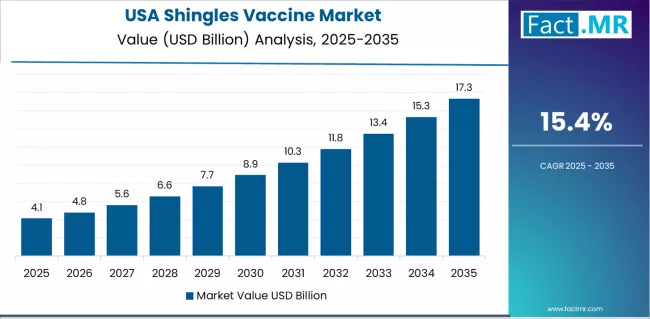
Shingles Vaccine Market Country Value Analysis | Source: Fact.MR
The USA shingles vaccine market is projected to grow at a CAGR of 15.4% through 2036.
- Growing domestic demand supports market expansion.
- Infrastructure development creates new opportunities.
- Regulatory environment is evolving to support industry growth.
Market Opportunity Outlook for Shingles Vaccine in Germany
The Germany shingles vaccine market is projected to grow at a CAGR of 15.1% through 2036.
- Growing domestic demand supports market expansion.
- Infrastructure development creates new opportunities.
- Regulatory environment is evolving to support industry growth.
Demand Patterns for Shingles Vaccine in Japan

Shingles Vaccine Market Japan Market Share Analysis By Product | Source: Fact.MR
The Japan shingles vaccine market is projected to grow at a CAGR of 14.8% through 2036.
- Growing domestic demand supports market expansion.
- Infrastructure development creates new opportunities.
- Regulatory environment is evolving to support industry growth.
Competitive Benchmarking and Company Positioning

Shingles Vaccine Market Analysis By Company | Source: Fact.MR
Shingles Vaccine Market Analysis By Company
- GlaxoSmithKline plc. (GSK), Pfizer Inc., Merck & Co. Inc., CanSinoBIO (CanSino Biologics Inc.) hold strong positions in the global shingles vaccine market through broad product portfolios, established customer relationships, and growing capabilities in their respective technology areas.
- Vaccitech plc., GC Biopharma Corp., GeneOne Life Science Inc. participate meaningfully across specific price tiers, user segments, and regional channels, with competition shaped by product quality, service capability, and geographic presence.
- Technology integration and service capabilities create important differentiation factors, especially in segments where product specification and after sales support influence buyer decisions.
The competitive landscape is moderately fragmented, with a mix of established industry leaders, specialized technology providers, and regional players. GlaxoSmithKline plc. (GSK), Pfizer Inc., Merck & Co. Inc. compete through product breadth, technology capabilities, and customer service infrastructure. These companies are positioned to capture value from both new installation demand and aftermarket service requirements.
Competition is shaped by differences in product specification, geographic coverage, and service capability. Companies with integrated product and service offerings, strong distribution networks, and established customer relationships are positioned to retain market share and improve margins over time.
Key Companies in the Shingles Vaccine Market
GlaxoSmithKline plc. (GSK), Pfizer Inc., Merck & Co. Inc., CanSinoBIO (CanSino Biologics Inc.) are among the leading players in the shingles vaccine market globally, supported by strong product portfolios, established market positions, and growing capabilities across key application and geographic segments.
Vaccitech plc., GC Biopharma Corp., GeneOne Life Science Inc. hold established positions across specific customer groups and application areas, supported by product reliability, service capabilities, and category familiarity among end users.
SK bioscience Co. Ltd., AIM Vaccine Co. Ltd., Dynavax Technologies Corporation continue to compete through focused product offerings, price point coverage, and niche strength in specific applications, reinforcing their relevance in a fragmented but evolving market.
Recent Industry Developments
- GlaxoSmithKline plc. (GSK) Regulatory Expansion / Market Access (2025)
- GSK secured expanded age based indications for Shingrix in multiple Asia Pacific markets, broadening the eligible vaccination population and strengthening the product's position in government immunization program tenders across the region.
- Pfizer Inc. Clinical Development / Pipeline Advancement (2025)
- Pfizer advanced its mRNA based shingles vaccine candidate into Phase 2 clinical trials, targeting improved thermostability and simplified dosing compared to existing recombinant products, with data readouts expected to inform late stage trial design.
- CanSinoBIO (CanSino Biologics Inc.) Product Launch / Regional Market Entry (2026)
- CanSinoBIO launched its recombinant shingles vaccine in select domestic and export markets, offering an alternative to GSK's Shingrix platform and expanding competitive options for public health procurement agencies in Asia and the Middle East.
Leading Companies Shaping the Shingles Vaccine Market
- GlaxoSmithKline plc. (GSK)
- Pfizer Inc.
- Merck & Co. Inc.
- CanSinoBIO (CanSino Biologics Inc.)
- Vaccitech plc.
- GC Biopharma Corp.
- GeneOne Life Science Inc.
- SK bioscience Co. Ltd.
- AIM Vaccine Co. Ltd.
- Dynavax Technologies Corporation
Sources and Research References
- GlaxoSmithKline plc. (GSK). Product portfolio, corporate announcements, and market disclosures.
- Pfizer Inc.. Product portfolio, corporate announcements, and market disclosures.
- Merck & Co. Inc.. Product portfolio, corporate announcements, and market disclosures.
- Industry association statistics, government agency publications, trade data, customs databases, and company product catalogs.
- Primary interviews with manufacturers, distributors, end users, and industry specialists.
This bibliography is provided for reader reference and is not exhaustive. The full report contains the complete reference list and detailed citations.
Key Questions This Report Addresses
- What is the current and future size of the Shingles Vaccine Market?
- How fast is the Shingles Vaccine Market expected to grow between 2026 and 2036?
- Which product type is likely to lead the market by 2026?
- Which application segment is expected to account for the highest demand by 2026?
- What factors are driving demand for shingles vaccine globally?
- Which countries are projected to show the fastest growth through 2036?
- What is driving market expansion in Australia and Canada?
- Who are the key companies active in the Shingles Vaccine Market?
- How does Fact.MR estimate and validate the market forecast?
- What are the key constraints and opportunity areas in this market?
Shingles Vaccine Market Definition
The shingles vaccine market covers prophylactic vaccines designed to prevent herpes zoster (shingles) reactivation in adult populations, including recombinant, live attenuated, mRNA based, and protein subunit formulations administered through healthcare institutions, public health programs, and elderly care settings.
Shingles Vaccine Market Inclusions
- The scope covers global and regional market size and forecasts for 2026 to 2036 across product type, application, end use, technology, and formulation.
- It includes regional demand analysis across major geographies, based on factors such as aging population demographics, immunization program coverage, regulatory approvals, and healthcare infrastructure maturity.
- The report includes pricing and cost analysis across vaccine types, dosing formats, and distribution channels, covering procurement, storage, and administration costs.
- It covers technology trends, market drivers and constraints, and the competitive landscape, including product portfolios, clinical pipelines, pricing strategy, and geographic coverage of leading vaccine manufacturers.
Shingles Vaccine Market Exclusions
- The scope excludes general purpose immunization products not specifically designed for herpes zoster prevention, including broad spectrum antiviral treatments, pain management therapies, and post herpetic neuralgia drugs.
- It excludes diagnostic tools, testing kits, and laboratory equipment used for shingles detection but not directly tied to vaccination.
- The report excludes veterinary vaccines, experimental compounds not yet in clinical trials, and informal or unregulated vaccine distribution channels.
- It also excludes general healthcare infrastructure spending, hospital construction, and public health administration costs not directly tied to shingles vaccination programs.
Shingles Vaccine Market Research Methodology
- The methodology combines secondary research, primary interviews, and forecast modelling.
- It draws on 100+ secondary sources and benchmarks 50+ company product portfolios.
- Market sizing covers 30+ countries through a demand side model, supported by top down validation.
- Key inputs include industry production data, trade statistics, pricing benchmarks, regulatory frameworks, and end use demand patterns.
- The model cross checks demand with shipments, pricing trends, channel mix, and product launches.
- Primary validation includes 20+ interviews across manufacturers, distributors, end users, and industry specialists.
- Final estimates go through trade flow checks, sales pattern review, and sensitivity testing.
Segmentation
Scope of Analysis
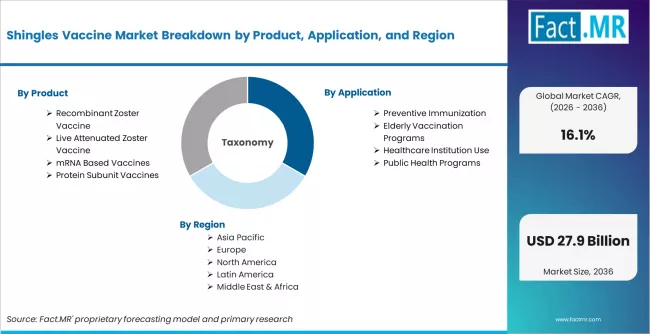
Shingles Vaccine Market Breakdown By Product, Application, And Region | Source: Fact.MR
| Parameter | Details |
|---|---|
| Quantitative Units | USD 6.27 billion to USD 27.9 billion, at a CAGR of 16.1% |
| Market Definition | The shingles vaccine market covers prophylactic vaccines designed to prevent herpes zoster (shingles) reactivation in adult populations, including recombinant, live attenuated, mRNA based, and protein subunit formulations administered through healthcare institutions, public health programs, and elderly care settings. |
| Regions Covered | North America, Latin America, Europe, East Asia, South Asia and Pacific, Middle East and Africa |
| Countries Covered | Australia, Canada, France, UK, USA, Germany, Japan, 30 plus countries |
| Key Companies | GlaxoSmithKline plc. (GSK), Pfizer Inc., Merck & Co. Inc., CanSinoBIO (CanSino Biologics Inc.), Vaccitech plc., GC Biopharma Corp., GeneOne Life Science Inc., SK bioscience Co. Ltd., AIM Vaccine Co. Ltd., Dynavax Technologies Corporation |
| Forecast Period | 2026 to 2036 |
| Approach | Hybrid demand side and top down methodology built on country level demand analysis, product benchmarking, pricing analysis, shipment validation, and primary interviews across manufacturers, distributors, and end users |
Source: Fact.MR analysis. Updated May 20, 2026
Shingles Vaccine Market Segmentation
-
Shingles Vaccine market Segmented by Product:
- Recombinant Zoster Vaccine
- Adjuvanted Recombinant Vaccines
- Glycoprotein E Subunit Vaccines
- AS01B Adjuvant Formulations
- Next Gen Recombinant Platforms
- Protein Expression Vaccines
- Immune Enhanced Antigen Systems
- Adjuvanted Recombinant Vaccines
- Live Attenuated Zoster Vaccine
- Traditional Live Vaccines
- High Potency Viral Vaccines
- Cell Culture Derived Vaccines
- Single Dose Live Formulations
- Standard Viral Strain Vaccines
- Attenuated Herpes Zoster Strains
- Traditional Live Vaccines
- mRNA Based Vaccines
- Lipid Nanoparticle Vaccines
- Synthetic mRNA Platforms
- Gene Expression Vaccines
- Experimental mRNA Formulations
- Therapeutic mRNA Systems
- Immune Programming Vaccines
- Lipid Nanoparticle Vaccines
- Protein Subunit Vaccines
- Purified Antigen Vaccines
- Recombinant Protein Antigens
- Virus Derived Subunits
- Recombinant Subunit Systems
- Engineered Protein Platforms
- Stabilized Antigen Systems
- Purified Antigen Vaccines
- Recombinant Zoster Vaccine
-
Shingles Vaccine market Segmented by Application:
- Preventive Immunization
- Routine Adult Vaccination
- Standard Immunization Schedules
- Preventive Health Programs
- High Risk Prevention
- Immunocompromised Patients
- Chronic Disease Patients
- Routine Adult Vaccination
- Elderly Vaccination Programs
- Age Based Immunization
- 50 Plus Vaccination Programs
- 65 Plus Vaccination Programs
- Long Term Care Immunization
- Nursing Home Vaccination
- Geriatric Clinic Programs
- Age Based Immunization
- Healthcare Institution Use
- Hospital Based Immunization
- Outpatient Vaccination Units
- Specialty Immunology Clinics
- Primary Care Settings
- Family Physician Clinics
- Community Health Centers
- Hospital Based Immunization
- Public Health Programs
- National Immunization Drives
- Government Vaccination Campaigns
- Mass Immunization Programs
- Global Health Initiatives
- WHO Supported Programs
- NGO Health Campaigns
- National Immunization Drives
- Preventive Immunization
-
Shingles Vaccine market Segmented by End Use:
- Hospitals & Clinics
- Private Healthcare Facilities
- Multi Specialty Hospitals
- Infectious Disease Clinics
- Public Healthcare Systems
- Government Hospitals
- Urban Health Centers
- Private Healthcare Facilities
- Pharmaceutical Companies
- Vaccine Manufacturers
- Large Scale Pharma Firms
- Biotech Vaccine Developers
- Contract Manufacturing Organizations
- Fill Finish Providers
- Vaccine Production CMOs
- Vaccine Manufacturers
- Government & Public Health Agencies
- National Health Authorities
- Disease Control Agencies
- Immunization Departments
- International Organizations
- WHO Programs
- Global Health Agencies
- National Health Authorities
- Elderly Care Facilities
- Senior Living Centers
- Assisted Living Facilities
- Long Term Care Homes
- Geriatric Healthcare Units
- Specialized Elder Care Clinics
- Preventive Care Units
- Senior Living Centers
- Hospitals & Clinics
-
Shingles Vaccine market Segmented by Technology:
- Recombinant DNA Technology
- Protein Expression Platforms
- Bacterial Expression Systems
- Mammalian Cell Expression
- Antigen Engineering Systems
- Glycoprotein Engineering
- Epitope Optimization Systems
- Protein Expression Platforms
- Adjuvant Technology
- Immune Enhancement Systems
- AS01B Adjuvant Systems
- Oil in Water Emulsion Systems
- Cytokine Activation Systems
- T Cell Activation Enhancers
- Memory Cell Induction Systems
- Immune Enhancement Systems
- mRNA Vaccine Technology
- Synthetic mRNA Platforms
- Lipid Nanoparticle Delivery
- Self Amplifying mRNA Systems
- Gene Expression Control
- RNA Stabilization Systems
- Targeted Expression Platforms
- Synthetic mRNA Platforms
- Viral Vector Technology
- Attenuated Virus Systems
- Recombinant Viral Vectors
- Replication Deficient Systems
- Virus Engineering Platforms
- Modified Herpes Virus Systems
- Vector Safety Optimization
- Attenuated Virus Systems
- Recombinant DNA Technology
-
Shingles Vaccine market Segmented by Formulation:
- Vaccine Dosage Systems
- Single Dose Formulations
- Pre Filled Syringes
- Ready To Use Vials
- Multi Dose Formulations
- Preserved Multi Dose Vials
- Bulk Immunization Packs
- Single Dose Formulations
- Delivery Systems
- Injectable Formulations
- Intramuscular Delivery Systems
- Subcutaneous Delivery Systems
- Reconstituted Formulations
- Lyophilized Powder Vaccines
- Diluent Mixed Vaccines
- Injectable Formulations
- Advanced Formulations
- Adjuvanted Formulations
- AS01B Based Vaccines
- Immune Boost Formulations
- Recombinant Formulations
- Protein Engineered Vaccines
- Antigen Stabilized Systems
- Adjuvanted Formulations
- Stability Based Formulations
- Cold Chain Dependent Formulations
- Refrigerated Vaccine Solutions
- Temperature Controlled Liquids
- Thermostable Formulations
- Heat Resistant Vaccines
- Buffer Stabilized Systems
- Cold Chain Dependent Formulations
- Vaccine Dosage Systems
-
Shingles Vaccine market Segmented by Formulation:
- Vaccine Dosage Systems
- Single Dose Formulations
- Pre Filled Syringes
- Ready To Use Vials
- Multi Dose Formulations
- Preserved Multi Dose Vials
- Bulk Immunization Packs
- Single Dose Formulations
- Delivery Systems
- Injectable Formulations
- Intramuscular Delivery Systems
- Subcutaneous Delivery Systems
- Reconstituted Formulations
- Lyophilized Powder Vaccines
- Diluent Mixed Vaccines
- Injectable Formulations
- Advanced Formulations
- Adjuvanted Formulations
- AS01B Based Vaccines
- Immune Boost Formulations
- Recombinant Formulations
- Protein Engineered Vaccines
- Antigen Stabilized Systems
- Adjuvanted Formulations
- Stability Based Formulations
- Cold Chain Dependent Formulations
- Refrigerated Vaccine Solutions
- Temperature Controlled Liquids
- Thermostable Formulations
- Heat Resistant Vaccines
- Buffer Stabilized Systems
- Cold Chain Dependent Formulations
- Vaccine Dosage Systems
-
Shingles Vaccine market by Region:
- North America
- USA
- Canada
- Mexico
- Latin America
- Brazil
- Chile
- Rest of Latin America
- Western Europe
- Germany
- UK
- Italy
- Spain
- France
- Nordic
- BENELUX
- Rest of Western Europe
- Eastern Europe
- Russia
- Poland
- Hungary
- Balkan & Baltic
- Rest of Eastern Europe
- East Asia
- China
- Japan
- South Korea
- South Asia and Pacific
- India
- ASEAN
- Australia & New Zealand
- Rest of South Asia and Pacific
- Middle East & Africa
- Kingdom of Saudi Arabia
- Other GCC Countries
- Turkiye
- South Africa
- Other African Union
- Rest of Middle East & Africa
- North America
Frequently Asked Questions
How big is the shingles vaccine market in 2025?
What will be the size of the shingles vaccine market in 2036?
How much will the shingles vaccine market grow between 2026 and 2036?
What are the key product types in the shingles vaccine market?
Which segment will contribute significant share in the shingles vaccine market in 2026?
Which are the fastest growing countries in the shingles vaccine market?
Who worked on this report


Preview the report firsthand - request a free sample
Free SampleGet the brochure for pricing and purchase details
Download PDF