- Market Value (2025): USD 113.4 Mn
- Estimated Value (2026): USD 117.0 Mn
- Forecast Value (2036): USD 172.0 Mn
- CAGR (2026-2036): 3.9%
What is the Shoe Polish Dyes Market forecast to be worth by 2036?
USD 117.0 million in 2026 to USD 172.0 million by 2036, at 3.9% CAGR.
- The market was worth about USD 113.4 million in 2025, sustained by routine black and brown restoration as well as specialty colors for leather care.
- Value is expected to rise from USD 117.0 million in 2026 to USD 172.0 million by 2036 as footwear-care brands widen formats, surfaces, and shade-matching services.
- The 3.9% CAGR reflects steady replenishment demand, continued need to repair scuffs and fading, and gradual improvement in low-transfer dye and concentrate systems.
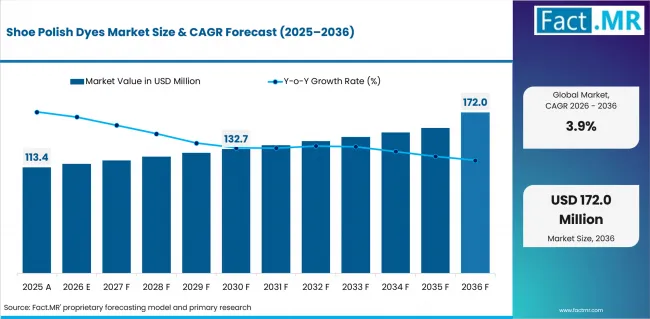
Shoe Polish Dyes Market Value Analysis | Source: Fact.MR
What are the defining numbers behind Shoe Polish Dyes Market growth?
USD 55.0 million absolute opportunity by 2036, led by Wax polish tins and Smooth leather within their respective segments.
- Demand Drivers in the Market
- Consumers and professional care services use colored polish to disguise wear while renewing shine on smooth leather footwear.
- Creams, liquids, and instant sponges create different flow and drying conditions, requiring dyes that develop evenly in each base.
- Footwear brands and private-label packers need dependable black and brown shades across repeated production lots.
- Technical buyers increasingly test color transfer, flex behavior, water spotting, and appearance after multiple applications rather than judging the first coat alone.
- Key Segments Analyzed
- By polish product type: Wax polish tins are estimated to lead the polish product type segment with a 31% share in 2026. They combine colour restoration, protective wax, and a buffed shine in a familiar format that remains widely used across household and professional footwear care.
- By footwear surface: Smooth leather is projected to account for 43% of the footwear surface segment in 2026. The material accepts repeated polishing, while improvements in colour depth, scuff coverage, and gloss are easy to see after application.
- By color family: Black is expected to hold the largest color family share at 45% in 2026. It is widely used across formal, work, and casual footwear, provides strong coverage for visible scuffs, and requires frequent replacement among regular users.
- By dye system: Solvent-soluble dyes are estimated to capture 34% of the dye system segment in 2026. These dyes provide transparent, penetrating colour and work effectively across a wide range of waxes, solvents, and carrier formulations.
- By buyer type: Polish brands are projected to lead the buyer type segment with a 35% share in 2026. These companies manage broad product ranges across polish formats, shades, footwear surfaces, performance claims, and retail price points.
- Analyst Opinion at Fact.MR
- Fact.MR analyst view: "Shoe polish color succeeds when the repair is visible to the owner but the dye itself is not. A supplier earns repeat business by helping the formulator manage coverage, rub-off, gloss, and compatibility with the target upper in one test program."
- Strategic Implications
- Dye companies should evaluate performance on smooth leather, coated synthetic uppers, edges, and luxury leather articles instead of extrapolating from a single test panel.
- Polish brands need separate shade and transfer limits for wax tins, creams, liquids, sponges, and edge dressings because application thickness varies sharply.
- Private-label packers can protect consistency by retaining approved leather standards and recording the number of buffing passes used during color assessment.
- Distributors should ask about the polish carrier and target surface before recommending a solvent- or wax-soluble dye, particularly for lighter shades.
SATRA's shoe-care testing guidance treats appearance, gloss, color change, scuff repair, water repellency, flex cracking, rub fastness, and breathability as separate performance questions. This broader evaluation raises the value of dyes that deliver coverage without excessive transfer or a brittle buildup after repeated polishing.
United States 2.9% CAGR.Germany 2.8% CAGR. Brazil 3.7% CAGR.
How does the Shoe Polish Dyes Market break down by segment?
The leading shares are wax polish tins at 31.0% by polish product type and smooth leather at 43.0% by footwear surface.
Why do traditional wax polish tins still lead product demand?
Wax polish tins hold 31.0% share in 2026.
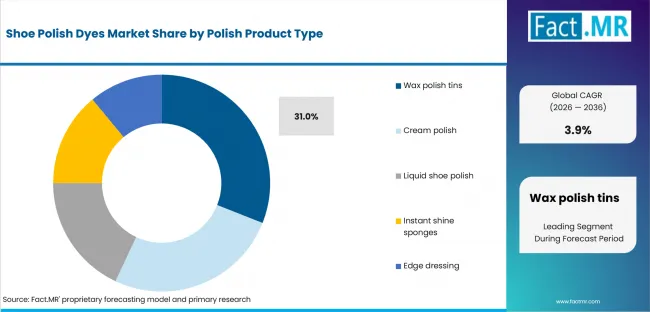
Shoe Polish Dyes Market Analysis By Polish Product Type | Source: Fact.MR
Wax polish tins lead product-type demand and remain a core vehicle for concentrated black and brown coloration. Cream polish follows, offering easier spreading and conditioning but requiring color to remain even in a softer emulsion. Liquid shoe polish and instant shine sponges favor rapid application, which leaves less opportunity for the user to correct streaks.
What makes smooth leather the dominant footwear surface?
Smooth leather accounts for 43.0% share in 2026.
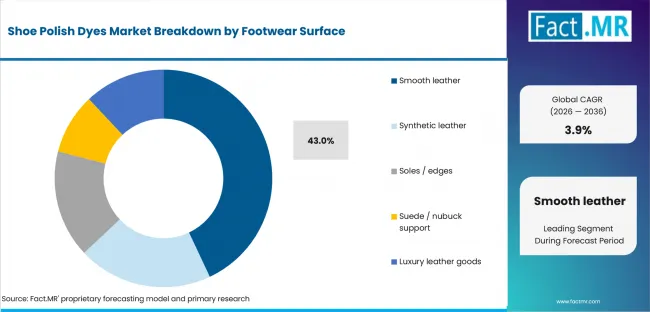
Shoe Polish Dyes Market Analysis By Footwear Surface | Source: Fact.MR
Smooth leather leads surface demand, giving dye suppliers the largest base for restorative color. Synthetic leather follows and may respond differently to solvents, waxes, and flexing, so formulas cannot be transferred without checks. Soles / edges and luxury leather goods demand careful shade strength and minimal rub-off.
Why does black command nearly half of color-family demand?
Black represents 45.0% share in 2026.
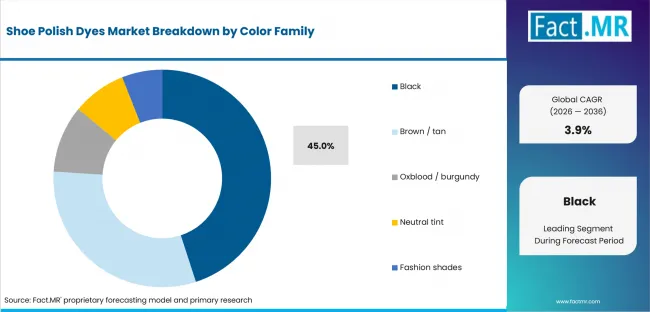
Shoe Polish Dyes Market Analysis By Color Family | Source: Fact.MR
Black leads color-family demand and offers the clearest route to visible restoration. Brown / tan follows but requires a broader tone range because too-red, too-yellow, or overly dark correction is easy to notice. Oxblood / burgundy, neutral tint, and fashion shades form smaller programs where exact matching can outweigh batch volume.
Why are solvent soluble dyes the largest dye system?
Solvent-soluble dyes capture 34.0% share in 2026.
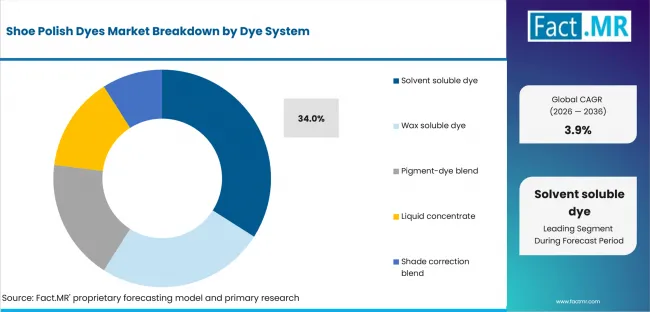
Shoe Polish Dyes Market Analysis By Dye System | Source: Fact.MR
Solvent soluble dye leads the system mix, making carrier compatibility a central selection criterion. Wax soluble dye follows and fits traditional polishing bases where color must remain integrated with the buffable film. Pigment-dye blends can add hiding power, while liquid concentrates simplify handling and shade adjustment.
Why are polish brands the largest direct buyer group?
Polish brands hold 35.0% share in 2026.
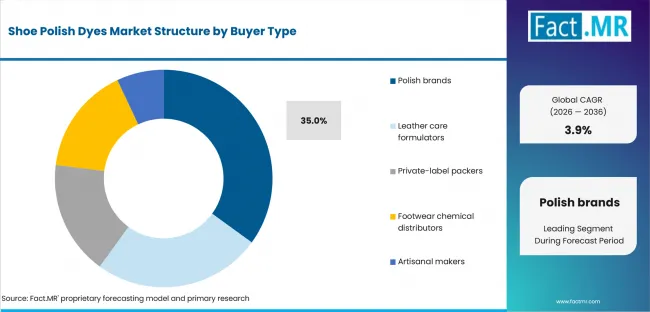
Shoe Polish Dyes Market Analysis By Buyer Type | Source: Fact.MR
Polish brands lead buyer demand and carry the commercial burden of consistent consumer-visible results. Leather care formulators follow, often supplying broader treatment systems beyond footwear alone. Private-label packers and footwear chemical distributors need dependable standard colors and quick access to replacements when a formula or source changes.
What is accelerating Shoe Polish Dyes Market adoption, and what is holding it back?
Repairing visible wear and renewing appearance provide a durable reason to use colored shoe polish. Growth remains measured because transfer, shade mismatch, surface damage, and consumer movement toward low-maintenance footwear can limit how often a dyed product is applied.
Drivers Impact Analysis
| DRIVER | (~) % IMPACT ON CAGR | GEOGRAPHIC RELEVANCE | IMPACT TIMELINE |
|---|---|---|---|
| Routine color restoration | +0.5% | Brazil and Latin America | Short term (<= 2 years) |
| Multi-format portfolios | +0.4% | Global retail markets | Medium term (2-4 years) |
| Leather-goods aftercare | +0.4% | United States and Germany | Long term (>= 4 years) |
| Private-label expansion | +0.3% | Asia Pacific and Latin America | Medium term (2-4 years) |
| Performance-based testing | +0.2% | Europe and North America | Long term (>= 4 years) |
Source: Fact.MR analysis. Updated Jul 22, 2026
- Routine color restoration: Polish extends the presentable life of frequently worn shoes by masking small scuffs and fading. Black and brown products capture most of that repeat need.
- Multi-format portfolios: Brands sell tins, creams, liquids, sponges, and edge products to suit different care habits. Every format creates a distinct flow, drying, and color-release problem for the formulator.
- Leather-goods aftercare: The same restorative color principles extend to bags, belts, and other smooth leather goods when the formula is suitable. These applications reward precise tones and low transfer rather than maximum coverage alone.
Opportunity Impact Analysis
| OPPORTUNITY | (~) % IMPACT ON CAGR | GEOGRAPHIC RELEVANCE | IMPACT TIMELINE |
|---|---|---|---|
| Low-transfer black systems | +0.3% | Global | Short term (<= 2 years) |
| Brown shade matching | +0.2% | United States, Germany, and Japan | Medium term (2-4 years) |
| Format-specific concentrates | +0.2% | High-volume footwear markets | Medium term (2-4 years) |
| Luxury leather correction | +0.2% | Europe and North America | Long term (>= 4 years) |
Source: Fact.MR analysis. Updated Jul 22, 2026
- Low-transfer black systems: Black represents the largest part of the color mix, so even incremental gains in rub fastness have a broad commercial address. Suppliers can differentiate with coverage and transfer results on several common upper materials.
- Brown shade matching: Brown / tan holds the next-largest position and covers many undertones rather than one universal shade. Curated blend systems can help polish brands offer useful choices without carrying an unmanageable number of finished products.
- Format-specific concentrates: A concentrate optimized for cream may not behave correctly in a fast-drying liquid or wax tin. Separate, well-documented bases can shorten development for regional brands and private-label packers.
Restraints Impact Analysis
| RESTRAINT | (~) % IMPACT ON CAGR | GEOGRAPHIC RELEVANCE | IMPACT TIMELINE |
|---|---|---|---|
| Color transfer | -0.2% | Global consumer use | Short term (<= 2 years) |
| Surface incompatibility | -0.2% | Synthetic and specialty uppers | Medium term (2-4 years) |
| Repeated-layer buildup | -0.1% | Frequent-use markets | Long term (>= 4 years) |
| Shade mismatch | -0.1% | Brown and fashion-color programs | Short term (<= 2 years) |
Source: Fact.MR analysis. Updated Jul 22, 2026
- Color transfer: Poorly fixed color can mark clothing, floors, hands, or the polishing cloth. One visible transfer event can damage confidence in the entire polish line.
- Surface incompatibility: Solvents or colorants suited to smooth leather may streak, soften, or sit unevenly on a coated synthetic surface. Broad claims therefore increase the amount of screening needed.
- Repeated-layer buildup: Successive polish layers can crack, whiten, or reduce breathability even when the first application appears acceptable. Testing over multiple cycles adds time to product approval.
How does shoe polish dye demand vary by country?
United States 2.9% CAGR. Germany 2.8% CAGR. Brazil 3.7% CAGR.
Regional analysis covers country chapters on United States, Germany, and Brazil. Analysis on more than 30 countries is included in the full report.
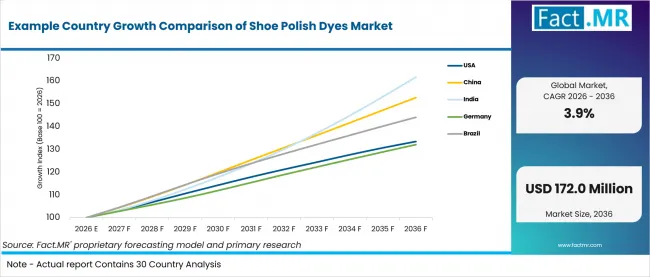
Example Country Growth Comparison Of Shoe Polish Dyes Market | Source: Fact.MR
| COUNTRY | CAGR |
|---|---|
| United States | 2.9% |
| Germany | 2.8% |
| Brazil | 3.7% |
Source: Fact.MR analysis. Updated Jul 22, 2026
How is the United States market likely to develop?
A 2.9% CAGR is projected for United States during 2026-2036.
EPA chemical-management rules shape material selection across the United States, which also has a large and closely measured manufacturing base. Before changing a material, companies usually review application fit, specification consistency, and the strength of the compliance records. In the shoe polish dyes market, product selection centres on shade restoration, rub resistance, formulation stability, and dependable results across footwear-care channels. Dye manufacturers are therefore expected to provide clear local evidence and align their products with approval, distribution, and service requirements.
How is the Germany market likely to develop?
A 2.8% CAGR is projected for Germany during 2026-2036.
Strict chemical controls and demanding manufacturing standards influence Germany’s market outlook. REACH restriction duties place close attention on substance management, while the country’s industrial base values traceability and controlled product changes. Companies also look for proof that a dye performs consistently within approved processes. For shoe polish dyes, the main selection points remain shade restoration, rub resistance, formulation stability, and reliable performance across footwear-care channels. Local qualification records are therefore expected to carry more weight than broad statements about demand.
How is the Brazil market likely to develop?
A 3.7% CAGR is projected for Brazil during 2026-2036.
Brazil’s market conditions differ across regions, so distributor reach, import exposure, and local production performance influence purchasing decisions. Mineral-resource governance and industrial statistics also provide important context for companies operating across varied locations. Documentation that remains useful from one production site to another adds further value. Within shoe polish dyes, companies assess shade restoration, rub resistance, formulation stability, and consistent results across footwear-care channels. Equipment and dye providers are expected to match their offers with local qualification, distribution, and service conditions.
Who leads the Shoe Polish Dyes Market?
Neelikon, Solar Organics, Orco, Keystone Aniline, and Abbey Color compete for shoe-polish programs on solubility, shade accuracy, transfer control, and formulation support.
Solar Organics is named in the market evidence alongside Keystone Aniline and Neelikon, among the largest named positions; across these positions, success depends on turning solvent-dye portfolios into repeatable black, brown, burgundy, and correction blends for distinct polish bases.
Abbey Color and Orco are also active in the space. Abbey's official application list includes polishes and leathers, and Orco publishes an oil-soluble dye bulletin covering shoe polish; neither reference substitutes for testing transfer, gloss, flex, and color on the customer's actual upper material.
Which companies are the key providers?
The company set includes Solar Organics, Keystone Aniline, Neelikon, Abbey Color, and Orco.
- Solar Organics
- Keystone Aniline
- Neelikon
- Abbey Color
- Orco
Bibliography
- Brazilian Footwear Industries Association. (2025, July 8). Footwear exports grow 8.8% in the first half of the year.
- European Chemicals Agency. (2025). Azocolourants and azodyes: Annex XVII restriction under REACH.
- SATRA Technology Centre. (2025). The testing of shoe care products.
- U.S. Environmental Protection Agency. (2025, August 14). Now available: Latest update to the TSCA Inventory.
- U.S. Environmental Protection Agency. (2025, July). EPA adds 18 chemicals to the Safer Chemical Ingredients List.
This Report Addresses
- It traces market value from the 2025 base through the 2026-2036 forecast period.
- It reviews United States, Germany, and Brazil, within coverage that reaches more than 30 countries.
- It profiles Orco, Neelikon, Solar Organics, Abbey Color, and Keystone Aniline within the source structure.
- It distinguishes solvent-soluble, wax-soluble, pigment-dye, liquid-concentrate, and shade-correction systems.
- It analyzes wax tins, creams, liquids, sponges, and edge dressings across leather and synthetic surfaces.
- It challenges the forecast with evidence on restoration frequency, shade mix, rub-off, flex, water spotting, repeated application, and private-label demand.
What does the Shoe Polish Dyes Market cover?
This study covers colorant revenue embedded in products intended to recolor or visibly restore footwear and related leather surfaces.
Product type, surface, color family, dye system, buyer group, country, and competitor are assessed together.
The commercial review also considers coverage, transparency, gloss, transfer, drying, flex, water exposure, and shade matching.
What is included in the scope?
Counted products must supply deliberate color to a shoe-polish or leather-care formulation.
Black, brown, burgundy, neutral-tint, and fashion-shade dyes are included across powder, liquid, blend, and concentrate routes represented by the source taxonomy.
Colorant value for smooth leather, synthetic leather, soles and edges, suede or nubuck support, and luxury leather goods remains in scope.
What is excluded from the scope?
The market does not include the finished care product or color applied earlier in leather and footwear manufacture.
Finished polish, shoe-care accessories, footwear, leather goods, base waxes, solvents, and packaging are excluded.
Tannery dyes, factory leather finishes, colorless cleaners or conditioners, and pigment value not sold as part of a dye system are outside the boundary.
How Was the Analysis Built?
The analysis draws on 120+ sources, 35+ company portfolios, 25+ countries, and more than 20 industry interviews.
- Primary Research: Primary research includes discussions with manufacturers, service providers, technology developers, distributors, end users, procurement teams, and subject-matter experts. These conversations examine purchasing priorities, product adoption, operational challenges, approval requirements, competitive positioning, and the factors that influence wider market acceptance.
- Desk Research: Desk research covers government statistics, regulatory publications, company filings, trade data, technical studies, industry associations, standards, public policy, and other authoritative sources. Every source used in the analysis is documented in the bibliography.
- Market Sizing and Forecasting: Market estimates combine historical performance, demand indicators, pricing and volume trends, segment shares, company participation, country-level growth, adoption patterns, investment activity, and barriers to market expansion.
- Data Validation and Update Cycle: Findings are validated by comparing primary interviews with public data, company activity, regulatory changes, trade patterns, and industry developments. Regular updates review new product launches, capacity changes, partnerships, approvals, procurement trends, and shifts in commercial adoption.
Segmentation
What is the report's scope and coverage?
| ATTRIBUTE | DETAILS |
|---|---|
| Quantitative Units | USD Million in 2026 to USD Million by 2036 at CAGR |
| Market Definition | Shoe polish dyes are solvent-soluble, wax-soluble, blended, or concentrated colorants sold for incorporation into footwear and leather-care products that restore or adjust surface color. |
| Polish Product Type | Wax polish tins; Cream polish; Liquid shoe polish; Instant shine sponges; Edge dressing |
| Footwear Surface | Smooth leather; Synthetic leather; Soles / edges; Suede / nubuck support; Luxury leather goods |
| Color Family | Black; Brown / tan; Oxblood / burgundy; Neutral tint; Fashion shades |
| Dye System | Solvent soluble dye; Wax soluble dye; Pigment-dye blend; Liquid concentrate; Shade correction blend |
| Buyer Type | Polish brands; Leather care formulators; Private-label packers; Footwear chemical distributors; Artisanal makers |
| Regions Covered | North America; Europe; Latin America |
| Countries Covered | United States; Germany; Brazil (analysis extends to 30+ countries) |
| Key Companies Profiled | Solar Organics; Keystone Aniline; Neelikon; Abbey Color; Orco |
| Forecast Period | 2026 to 2036 |
| Approach | Demand is evaluated using colored paraffin output, application-specific dye loading, concentrate strength, delivery-form mix, supplier pricing, and buyer purchasing patterns. |
Source: Fact.MR analysis. Updated Jul 22, 2026
How is the market segmented?
-
By Polish Product Type:
- Wax polish tins
- Cream polish
- Liquid shoe polish
- Instant shine sponges
- Edge dressing
-
By Footwear Surface:
- Smooth leather
- Synthetic leather
- Soles / edges
- Suede / nubuck support
- Luxury leather goods
-
By Color Family:
- Black
- Brown / tan
- Oxblood / burgundy
- Neutral tint
- Fashion shades
-
By Dye System:
- Solvent soluble dye
- Wax soluble dye
- Pigment-dye blend
- Liquid concentrate
- Shade correction blend
-
By Buyer Type:
- Polish brands
- Leather care formulators
- Private-label packers
- Footwear chemical distributors
- Artisanal makers
-
By Region:
- North America
- United States
- Europe
- Germany
- Italy
- Russia
- United Kingdom
- Asia Pacific
- Japan
- South Korea
- India
- Latin America
- Brazil
- Middle East and Africa
- Morocco
- Saudi Arabia
- United Arab Emirates
- North America
Frequently Asked Questions
What is the projected size of the shoe polish dyes market?
Which shoe polish format leads?
What footwear surface uses the most dye?
Which color family dominates?
What dye system has the largest share?
Who buys the largest share of shoe polish dyes?
Who are the named competitors?
Who worked on this report


Preview the report firsthand - request a free sample
Free SampleGet the brochure for pricing and purchase details
Download PDF