- Market Value (2025): USD 761.7 Mn
- Estimated Value (2026): USD 930.0 Mn
- Forecast Value (2036): USD 6849.2 Mn
- CAGR (2026-2036): 22.1%
What is the Silicon Carbide Breakers Market forecast to be worth by 2036?
USD 930.0 million in 2026 to USD 6,849.2 million by 2036, at 22.1% CAGR.
- The Silicon Carbide Breakers Market crossed a valuation of USD 761.7 million in 2025.
- Demand is projected to increase from USD 930.0 million in 2026 to USD 6,849.2 million by 2036.
- The market is forecast to record a 22.1% CAGR from 2026 to 2036 as data center operators and EV-charging integrators adopt faster DC protection.
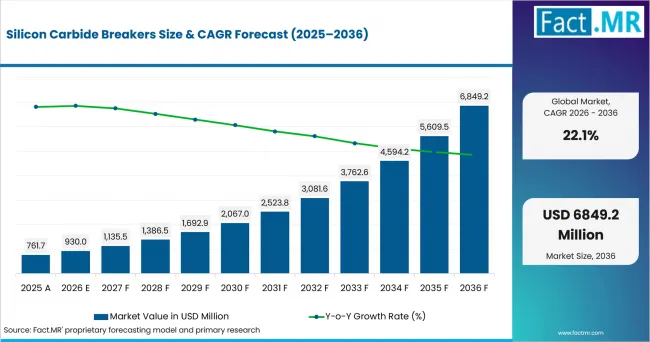
Silicon Carbide Breakers Value Analysis | Source: Fact.MR
What are the defining numbers behind Silicon Carbide Breakers Market growth?
USD 5,919.2 million absolute opportunity by 2036, led by SiC MOSFET solid-state breaker, 400-800 V systems and data centers.
- Demand Drivers in the Market
- Data center operators need faster DC fault clearing as dense power rooms shift toward semiconductor-based protection.
- EV charging site developers need compact interruption in 400-800 V cabinets where battery behavior and charger uptime guide equipment selection.
- Microgrid integrators need bidirectional DC protection as solar, storage and charger loads share common converter-heavy buses.
- Industrial and rail electrical teams need resettable breaker functions that reduce arc handling and contact wear in high-duty switching.
- Key Segments Analyzed
- By Device Topology: SiC MOSFET solid-state breaker is expected to hold 42.0% share in 2026 due to its fit with low-loss, high-speed switching.
- By Voltage Class: 400-800 V is projected to account for 29.0% share in 2026 as EV charging and low-voltage DC distribution use this band.
- By Application: Data centers are anticipated to capture 25.0% share in 2026 as AI power density raises the cost of electrical faults.
- By Breaker Function: Ultra-fast fault isolation is estimated to represent 35.0% share in 2026 owing to the need to interrupt DC faults before peak current.
- Analyst Opinion at Fact.MR
- Shambhu Nath Jha, Principal Consultant at Fact.MR, states, “The decisive test in this market is whether a breaker opens quickly and carries current efficiently during normal service. Suppliers are expected to compete on switching speed, thermal design, verification files and panel integration. The better route belongs to companies that connect SiC device control with a complete breaker assembly.”
- Strategic Implications
- SiC device suppliers should document short-circuit endurance and thermal behavior across breaker-duty switching cycles.
- Breaker manufacturers should package semiconductor modules, sensing and control software in assemblies that simplify panel integration.
- Data center electrical teams should test coordination between solid-state breakers, upstream protection and rack-level power supplies.
- EV infrastructure developers should qualify protection hardware around charger voltage, battery behavior and expected fault-current rise.
South Korea is projected to advance at 27.7% CAGR through 2036, led by EV charging scale and local power-semiconductor work. The UK is expected to post 25.6% CAGR as public charger deployment increases the value of fast DC protection. Germany is forecast to record 24.4% CAGR due to renewable power integration and data center electrification. The USA is anticipated to hold 19.3% CAGR as AI data center load and MVDC research move together. Japan is estimated to reach 18.0% CAGR as semiconductor support strengthens domestic power-electronics demand.
How does the Silicon Carbide Breakers Market break down by segment?
SiC MOSFET solid-state breaker leads at 42.0%; ultra-fast fault isolation leads at 35.0%.
Which Device Topology dominates?
SiC MOSFET solid-state breaker holds 42.0% share in 2026.
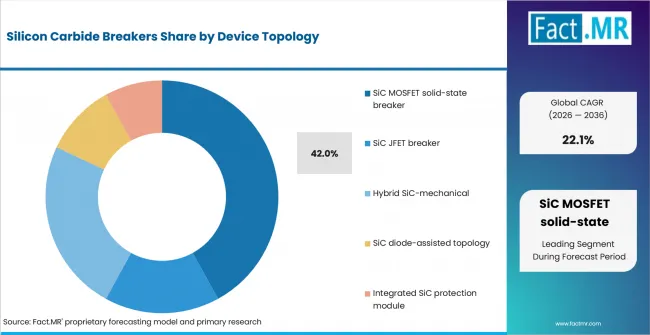
Silicon Carbide Breakers Analysis By Device Topology | Source: Fact.MR
SiC MOSFET solid-state breakers lead device topology by combining high switching speed with a power-device architecture familiar to inverter and converter engineers. The topology suits DC systems where fault current rises fast. It also gives designers a clearer path to thermal modelling and gate control.
The segment benefits from wide-bandgap device progress used in traction inverters and renewable converters. Silicon carbide MOSFETs reduce switching loss and support higher temperature operation. Breaker makers value that behavior since the device remains energized during service and must interrupt sharply during a fault.
What leads the Voltage Class segment?
400-800 V accounts for 29.0% share in 2026.
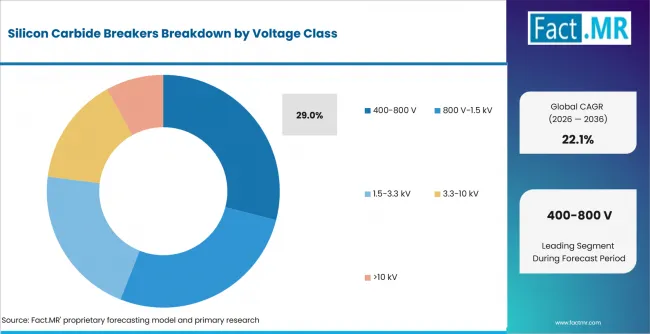
Silicon Carbide Breakers Analysis By Voltage Class | Source: Fact.MR
The 400-800 V class leads due to its fit with EV fast-charging cabinets and early low-voltage DC data center designs. These systems need compact protection that clears high current before cable insulation or power electronics face damage.
The voltage range is commercially practical for charger cabinets, battery-backed microgrids and power rooms that still connect to familiar low-voltage equipment. Higher bands are gaining technical interest, yet 400-800 V remains easier to validate across switchboards, connector systems and installation practices. That mix gives the segment a larger near-term installed base.
How does Application shape demand?
Data centers capture 25.0% share in 2026.
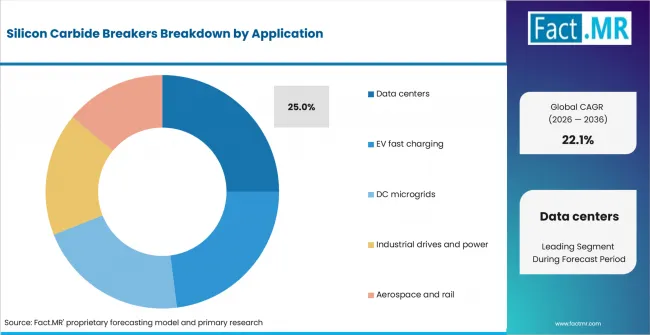
Silicon Carbide Breakers Analysis By Application | Source: Fact.MR
Data centers lead application demand since dense power architecture turns a fast electrical fault into a costly uptime risk. Lawrence Berkeley National Laboratory reported in June 2026 that U.S. data centers could account for 11.8% of total U.S. electricity use by 2030.
Data center operators evaluate protection around reset speed and space use. Mechanical devices need arc chambers and moving contacts, while semiconductor switching is designed to reduce response time. The commercial case improves when faster isolation protects high-value IT equipment and supports coordination around battery-backed DC distribution.
What supports Breaker Function demand?
Ultra-fast fault isolation represents 35.0% share in 2026.
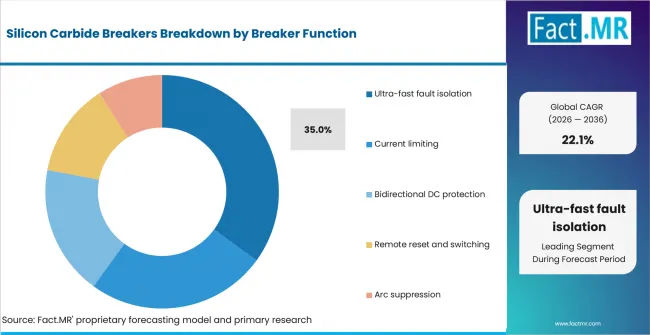
Silicon Carbide Breakers Analysis By Breaker Function | Source: Fact.MR
Ultra-fast fault isolation leads since DC faults rise quickly and lack the natural zero-crossing used in AC protection. Silicon carbide breakers answer that condition through electronic switching that reacts before fault energy reaches damaging levels. Data centers, chargers and microgrids prefer semiconductor protection for their most sensitive DC paths.
Wolfspeed introduced the industry’s first commercially available 10 kV silicon carbide power MOSFET in March 2026 for grid modernization, industrial electrification and AI data center infrastructure. Wolfspeed also lists solid-state circuit breakers as a typical application for several of its SiC MOSFET families.
What is accelerating Silicon Carbide Breakers Market adoption, and what is holding it back?
Demand is expected to rise through DC electrification, data center power density and EV charging. Adoption is constrained by thermal design, cost and coordination risk.
Drivers Impact Analysis
| DRIVER | (~) % IMPACT ON CAGR | GEOGRAPHIC RELEVANCE | IMPACT TIMELINE |
|---|---|---|---|
| Data center shift toward DC protection | +2.4% | USA, UK, Germany, Japan | Short term (<= 2 years) |
| EV fast-charging cabinet expansion | +2.0% | South Korea, UK, Japan | Medium term (2-4 years) |
| MVDC and HVDC protection research | +1.6% | USA, Germany, Japan | Medium term (2-4 years) |
| Microgrid and battery-storage protection | +1.2% | Global | Long term (>= 4 years) |
Source: Fact.MR analysis. Updated Sep 8, 2026
- Data center shift toward DC protection: Higher rack power increases the value of semiconductor interruption since faults must be isolated before they affect adjacent loads.
- EV fast-charging cabinet expansion: Faster chargers concentrate current in smaller cabinets, so protection devices need higher switching speed and predictable thermal behavior.
- MVDC and HVDC protection research: Public programs are moving breaker designs from laboratory validation toward product testing for medium-voltage direct-current systems.
Opportunity Impact Analysis
| OPPORTUNITY | (~) % IMPACT ON CAGR | GEOGRAPHIC RELEVANCE | IMPACT TIMELINE |
|---|---|---|---|
| 800 Vdc data center protection | +1.5% | USA, UK, Germany | Short term (<= 2 years) |
| Bidirectional DC microgrid safety | +1.1% | Global | Medium term (2-4 years) |
| High-voltage SiC module integration | +0.9% | Japan, Germany, USA | Long term (>= 4 years) |
Source: Fact.MR analysis. Updated Sep 8, 2026
- 800 Vdc data center protection: Direct-current distribution is expected to reduce conversion steps, but it needs breaker hardware that reacts quickly across rack-level loads.
- Bidirectional DC microgrid safety: Solar, storage and vehicle charging flows sometimes reverse direction, creating demand for protection that senses and isolates faults both ways.
- High-voltage SiC module integration: New high-voltage SiC devices improve the path for compact protection in grid modernization and industrial electrification projects.
Restraints Impact Analysis
| RESTRAINT | (~) % IMPACT ON CAGR | GEOGRAPHIC RELEVANCE | IMPACT TIMELINE |
|---|---|---|---|
| Semiconductor conduction loss and heat | -0.8% | Global | Short term (<= 2 years) |
| Protection coordination complexity | -0.6% | USA, UK, Germany | Medium term (2-4 years) |
| Higher upfront system cost | -0.5% | Global | Long term (>= 4 years) |
Source: Fact.MR analysis. Updated Sep 8, 2026
- Semiconductor conduction loss and heat: Solid-state breakers carry current through power devices during normal service, so thermal design affects panel size and lifetime.
- Protection coordination complexity: High-capacitance DC systems require careful testing so the closest device clears the fault without tripping upstream equipment.
- Higher upfront system cost: Semiconductor switching, sensing, cooling and control electronics raise the bill of materials before scale reduces module cost.
Which countries are scaling the Silicon Carbide Breakers Market through 2036?
- The country comparison spans 9.68 percentage points and forms three practical growth bands across the forecast period.
- South Korea remains 2.13 percentage points above the UK as EV charging deployment combines with local SiC power-module work.
- The UK remains 1.15 percentage points above Germany through public charging support and sharper data center grid-connection reform.
- Germany remains 5.16 percentage points above the USA as renewable generation and data center capacity targets reshape DC protection needs.
- The USA remains 1.24 percentage points above Japan through AI data center load and federally funded MVDC breaker research.
- Japan closes the displayed range through public semiconductor support and charger planning tied to domestic power-electronics demand.
Comparable CAGRs create different entry routes since each country combines electrification, data center power demand and semiconductor policy in a different way. Full report coverage includes North America, Latin America, Western Europe, Eastern Europe, East Asia, South Asia & Pacific, Middle East & Africa.
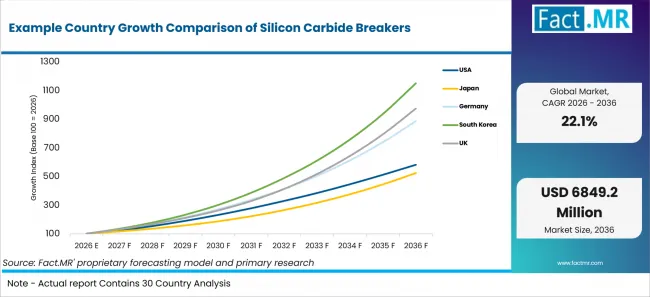
Example Country Growth Comparison Of Silicon Carbide Breakers | Source: Fact.MR
| Country | CAGR (2026-2036) |
|---|---|
| South Korea | 27.7% |
| United Kingdom | 25.6% |
| Germany | 24.4% |
| USA | 19.3% |
| Japan | 18.0% |
Source: Fact.MR analysis. Updated Sep 8, 2026
What supports South Korea adoption?
27.7% CAGR, supported by EV charging scale and compound power-semiconductor localization.
South Korea has a near-term route through charging infrastructure and local power-electronics activity. The Ministry of Climate, Energy and Environment reported in November 2025 that cumulative fast chargers reached 52,000 units by October 2025. The ministry also noted that improvements in charging infrastructure had influenced consumer preferences to some extent.
How is the United Kingdom scaling demand?
25.6% CAGR, backed by public charging support and data center connection reform.
The United Kingdom is scaling through public charger additions and reforms affecting large electricity-demand connections. The Department for Transport reported in August 2026 that completed On-Street Residential Chargepoint Scheme (ORCS) projects installed 5,676 public charging devices across local authorities in the 12 months to 1 July 2026. Ofgem separately launched a consultation on proposed data-centre connection reforms in July 2026 to manage the fast growth of data centres and support a more efficient network.
What supports Germany’s growth?
24.4% CAGR, supported by renewable power expansion and data center capacity targets.
Germany combines renewable power growth with infrastructure planning for digital capacity. Destatis reported in March 2026 that renewables supplied 58.6% of domestically generated and grid-fed electricity in 2025. In March 2026, the Federal Government also adopted a national data-centre strategy that places energy and sustainability among its core focus areas.
How does the USA perform?
19.3% CAGR, led by AI data center load and MVDC breaker research.
The USA links demand to AI data center power growth and medium-voltage direct-current research. Lawrence Berkeley National Laboratory reported in June 2026 that data centers could account for 11.8% of total U.S. electricity use by 2030. The U.S. Department of Energy separately documented a Lehigh University MVDC solid-state circuit-breaker project with milestones progressing from laboratory testing and validation to full product testing.
How does Japan develop demand?
18.0% CAGR, led by semiconductor support and EV charging infrastructure planning.
Japan’s demand case is tied to semiconductor and AI infrastructure support. METI stated in February 2025 that the Framework for Strengthening the AI and Semiconductor Industrial Infrastructure would provide more than JPY 10 trillion in public support over seven years, alongside financial support for next-generation semiconductor production and the introduction of high-performance servers.
Who leads the Silicon Carbide Breakers Market?
Infineon Technologies and Siemens have directly documented activity through their June 2026 collaboration on the SENTRON 3QD2 semiconductor circuit breaker, with Infineon supplying silicon carbide power modules for the Siemens platform. Wolfspeed also lists solid-state circuit breakers as a typical application for several of its SiC MOSFET families.
onsemi directly positions SiC JFETs, SiC Combo JFETs and SiC MOSFETs for solid-state circuit-breaker applications and provides a Combo JFET SSCB evaluation-board platform. Atom Power documents its UL-listed digital solid-state circuit-breaker architecture using an internally designed and produced silicon carbide power module.
Which companies are the key providers?
Key companies include Infineon Technologies; Siemens; Wolfspeed; onsemi; and Atom Power.
- Infineon Technologies
- Siemens
- Wolfspeed
- onsemi
- Atom Power
Bibliography
- International Energy Agency. (2025, April 10). Energy and AI.
- Infineon Technologies AG. (2026, June 8). Infineon and Siemens leverage silicon carbide technology to advance electrical protection in data centers and factories.
- Wolfspeed, Inc. (2026, March 5). Wolfspeed introduces industry’s first commercially available 10,000 V silicon carbide power MOSFET.
- Ministry of Climate, Energy and Environment. (2025, November 16). Annual EV supply hits 200,000... Driving mainstream adoption through stronger industry competitiveness.
- Department for Transport. (2026, August 27). Grant schemes for electric vehicle charging infrastructure statistics: 1 July 2026.
- Statistisches Bundesamt (Destatis). (2026, March 6). Stromerzeugung aus Photovoltaik und Erdgas erreicht im Jahr 2025 neue Höchstwerte.
- Smith, S. J., Hubbard, A., Newkirk, A., Ganeshalingam, M., Holecek, B., Sartor, D. A., Mills, M., & Shehabi, A. (2026, June). United States data center energy usage report: 2025 update. Lawrence Berkeley National Laboratory.
- Ministry of Economy, Trade and Industry. (2025, February 7). Press conference by Minister Muto (Excerpt).
- U.S. Department of Energy, Office of NEPA Policy and Compliance. (2025, February 27). CX-033009: Lehigh University -- Resonant Solid State Breaker Based on Wireless Coupling in Medium-Voltage Direct-Current (MVDC) Systems.
- Ofgem. (2026, July 29). Proposed data centre connection reforms.
- Federal Government of Germany. (2026, March 18). Mehr Rechenpower für Deutschland.
This Report Addresses
- The report explains where silicon carbide breakers are used across device topology, voltage class, application and breaker function.
- Segment analysis identifies the leading subsegments and the operating reasons engineering teams prioritize them.
- Country analysis examines the listed markets and the infrastructure or policy mechanisms supporting SiC breaker deployment.
- Competitive analysis reviews current providers across SiC devices, breaker assemblies, power modules and DC protection systems.
- Application analysis assesses how fault speed, heat, voltage range and coordination needs influence purchase decisions.
What does the Silicon Carbide Breakers Market cover?
The Silicon Carbide Breakers Market covers semiconductor-based breaker hardware that uses silicon carbide materials in power devices to interrupt fault current faster than mechanical-only protection. It includes SiC MOSFET, SiC JFET, diode-assisted and hybrid breaker designs used in DC and high-power electrical systems.
The assessment also covers adjacent demand across SiC and GaN power semiconductors, SiC traction modules and SiC power inverter applications. These related categories explain why device makers, module producers and breaker-system companies are converging around higher-frequency switching.
What is included in the scope?
The scope includes solid-state breaker systems, hybrid SiC-mechanical breakers, integrated protection modules and control-enabled breaker systems used in DC power distribution architectures. It also includes equipment sold into data centers, DC microgrids, EV charging and industrial power conversion.
The application scope connects with electric car battery charger infrastructure, high-power EV chargers installations and DC distribution network designs where protection speed and uptime carry direct operating value.
What is excluded from the scope?
The scope excludes conventional mechanical circuit breakers sold without silicon carbide semiconductor interruption. It also excludes raw SiC wafers, discrete devices sold only for inverter use, general digital power conversion controls and power supplies that exclude breaker or current-limiting functionality.
Data center servers, battery packs, transformers and power-conversion cabinets are outside the scope unless the product includes a SiC breaker function.
How Was the Analysis Built?
The analysis draws on 120+ sources, 35+ company portfolios, 25+ countries, and more than 20 industry interviews.
- Primary Research: Primary research includes discussions with manufacturers, service providers, technology developers, distributors, end users, and subject-matter experts. These conversations examine purchasing priorities, product adoption, operational challenges, approval requirements, competitive positioning, and the factors that influence wider market acceptance.
- Desk Research: Desk research covers government statistics, regulatory publications, company filings, trade data, technical studies, industry associations, standards, public policy, and other authoritative sources. Every source used in the analysis is documented in the bibliography.
- Market Sizing and Forecasting: Market estimates combine historical performance, demand indicators, pricing and volume trends, segment shares, company participation, country-level growth, adoption patterns, investment activity, and barriers to market expansion.
- Data Validation and Update Cycle: Findings are validated by comparing primary interviews with public data, company activity, regulatory changes, trade patterns, and industry developments. Regular updates review new product launches, capacity changes, partnerships, approvals, and shifts in commercial adoption.
Segmentation
What is the report’s scope and coverage?
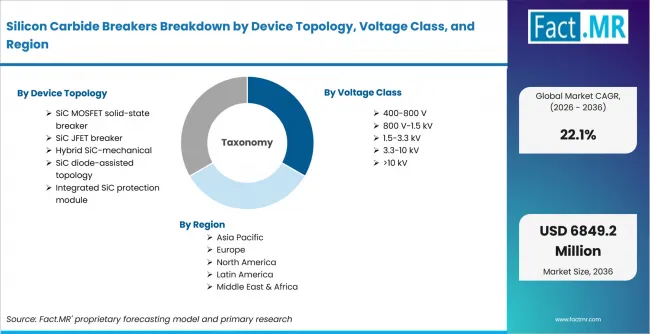
Silicon Carbide Breakers Breakdown By Device Topology, Voltage Class, And Region | Source: Fact.MR
| Attribute | Details |
|---|---|
| Quantitative Units | USD million |
| Market Definition | Circuit protection devices that use silicon carbide power semiconductors to interrupt or limit current in AC or DC systems, including solid-state breakers and hybrid semiconductor-mechanical breakers. |
| Device Topology | SiC MOSFET solid-state breaker; SiC JFET breaker; Hybrid SiC-mechanical; SiC diode-assisted topology; Integrated SiC protection module |
| Voltage Class | 400-800 V; 800 V-1.5 kV; 1.5-3.3 kV; 3.3-10 kV; >10 kV |
| Application | Data centers; EV fast charging; DC microgrids; Industrial drives and power; Aerospace and rail |
| Breaker Function | Ultra-fast fault isolation; Current limiting; Bidirectional DC protection; Remote reset and switching; Arc suppression |
| Regions Covered | North America; Latin America; Western Europe; Eastern Europe; East Asia; South Asia & Pacific; Middle East & Africa |
| Countries Covered | USA; Japan; Germany; South Korea; UK |
| Key Companies Profiled | Infineon Technologies; Siemens; Wolfspeed; onsemi; Atom Power |
| Forecast Period | 2026 to 2036 |
| Approach | Hybrid top-down and bottom-up approach using breaker topology, voltage range, application mix, country adoption, SiC device availability and provider portfolio review. |
Source: Fact.MR analysis. Updated Sep 8, 2026
How is the market segmented?
-
By Device Topology
- SiC MOSFET solid-state breaker
- SiC JFET breaker
- Hybrid SiC-mechanical
- SiC diode-assisted topology
- Integrated SiC protection module
-
By Voltage Class
- 400-800 V
- 800 V-1.5 kV
- 1.5-3.3 kV
- 3.3-10 kV
- >10 kV
-
By Application
- Data centers
- EV fast charging
- DC microgrids
- Industrial drives and power
- Aerospace and rail
-
By Breaker Function
- Ultra-fast fault isolation
- Current limiting
- Bidirectional DC protection
- Remote reset and switching
- Arc suppression
-
By Region
- North America
- Latin America
- Western Europe
- Eastern Europe
- East Asia
- South Asia & Pacific
- Middle East & Africa
Frequently Asked Questions
How big is the silicon carbide breakers market in 2026?
What is the CAGR of the silicon carbide breakers market from 2026 to 2036?
Which device topology leads the silicon carbide breakers market?
Which companies have documented activity in the silicon carbide breakers market?
Who worked on this report


Preview the report firsthand - request a free sample
Free SampleGet the brochure for pricing and purchase details
Download PDF