Silicone-Organic Hybrids Market (2026 - 2036)
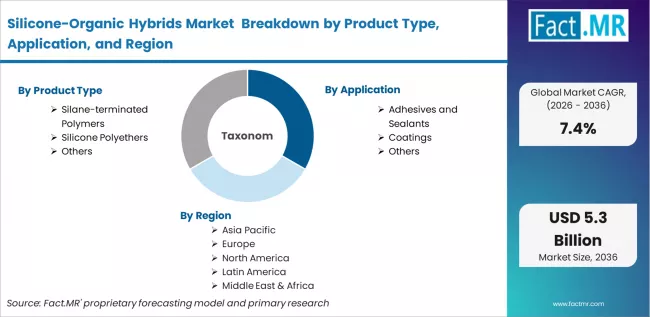
Silicone-organic hybrids market is segmented by Product Type (Silane-terminated Polymers, Silicone Polyethers, Silicone Acrylates, Silicone Urethanes, Others), Application (Adhesives and Sealants, Coatings, Personal Care, Medical Devices, Electronics, Others), End Use Industry (Construction, Personal Care and Cosmetics, Healthcare, Electronics, Transportation, Others), and Region. Forecast for 2026 to 2036.
Core Findings
Silicone-Organic Hybrids Market Forecast and Outlook By Fact.MR
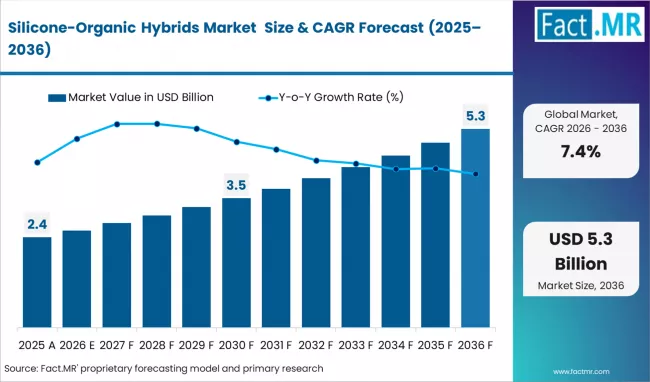
The silicone-organic hybrids market was valued at USD 2.4 billion in 2025 and is projected to reach USD 2.6 billion in 2026, growing to USD 5.3 billion by 2036 at a CAGR of 7.4%. Silane-terminated Polymers is forecast to lead product type at 36.7% share in 2026. Adhesives and Sealants holds the top application position at 33.4%, with Construction leading end use industry demand at 28.9% in 2026. The essential insight about this market is that it exists to solve a formulation problem: silicone chemistry is exceptional but often too expensive, too incompatible, or too process-disruptive to use in its pure form. Hybrid chemistry gets the formulators to the right property set without forcing them to commit to full silicone content, and that flexibility is the core of why the market keeps widening.
![]()
Key Drivers
- Formulation Versatility: Hybrid chemistries allow suppliers to combine silicone durability and water repellence with organic compatibility and application control.
- Sealant and Coating Demand: Construction and industrial users continue adopting hybrid systems that balance adhesion, flexibility, weatherability, and curing behavior.
- Personal Care Crossover: Silicone-organic structures deliver value in emulsion stability, sensorial tuning, and specialty ingredient performance in cosmetics formulations.
Key Segments Analyzed in the Report
- Product Type: Silane-Terminated Polymers, Silicone Polyethers, Silicone Acrylates, Silicone Urethanes, And Others
- Application: Adhesives And Sealants, Coatings, Personal Care, Medical Devices, Electronics, And Others
- End Use Industry: Construction, Personal Care And Cosmetics, Healthcare, Electronics, Transportation, And Others
- Region: North America, Latin America, Europe, Asia Pacific, And Middle East & Africa
Analyst Opinion
Shambhu Nath Jha, Principal Consultant, Fact.MR says silicone-organic hybrids win when customers do not want maximum silicone content. They want the right silicone effect in a system that still behaves well in processing, application, and downstream compatibility. The commercial appeal of this chemistry is that it lets a formulator tune a very specific property without walking away from everything else they know about their existing system.
Silicone-Organic Hybrids Market Definition
The silicone-organic hybrids market covers materials and formulations that combine silicone backbones or functionality with organic polymer structures to create performance profiles not achievable with either chemistry alone.
Silicone-Organic Hybrids Market Inclusions
- Revenue from silane-terminated polymers, silicone polyethers, silicone acrylates, silicone urethanes, and related hybrid chemistries.
- Applications across adhesives, sealants, coatings, personal care, medical devices, electronics, and associated specialty formulations.
- Demand across North America, Latin America, Europe, Asia Pacific, and the Middle East & Africa.
Silicone-Organic Hybrids Market Exclusions
- Pure commodity organic polymers without silicone-derived functional contribution.
- Standard silicone fluids or rubbers sold without hybrid chemistry positioning.
- Finished downstream consumer product revenue outside the hybrid-material transaction.
Silicone-Organic Hybrids Market Research Methodology
This study evaluates the silicone-organic hybrids market across product type, application, end use industry, and region, using 2025 as the base year and 2026 to 2036 as the forecast period. Market value is expressed in USD billion. Evidence inputs include first-party product technology materials from Dow, WACKER, Evonik, and other specialty silicone formulators, alongside demand signals from construction chemicals, advanced coatings, personal care ingredients, and electronics uses. Triangulation aligns hybrid formulation penetration, application value, replacement of traditional systems, and regional specification trends to derive segment and regional estimates.
Key Drivers, Restraints, and Trends in Silicone-Organic Hybrids Market
Drivers
Silicone-organic hybrids are expanding because they resolve formulation trade-offs. In many coatings, sealants, and specialty additives, users want silicone-like weatherability, hydrophobicity, or slip while still preserving the adhesion, compatibility, or curing control of organic polymers. Hybrid chemistry makes that compromise commercially usable.
Restraints
The market is still shaped by technical selling. Hybrids often require application-specific explanation and testing, which slows broad commoditization. Cost can also be a barrier in categories where buyers are willing to accept a conventional solution even if long-term performance is weaker.
Trends
The strongest trend is toward performance tuning over generic hybrid branding. Customers increasingly buy a precise effect, such as low dirt pickup, improved adhesion, smoother sensory profile, or better weather durability. That pushes suppliers toward narrower, higher-value hybrid platforms and closer collaboration with formulators.
Segmental Analysis
Silicone-Organic Hybrids Market Analysis by Product Type
![]()
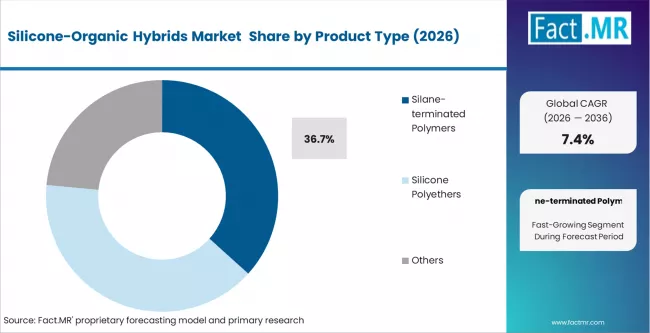
The Silane-terminated Polymers segment is expected to lead the product type category with a 36.7% share in 2026. Silane-terminated polymers lead because they are already well entrenched in adhesives and sealants where cure profile, adhesion, weatherability, and formulation flexibility all matter. They represent the most commercially mature route for combining silicone-linked performance with organic polymer handling.
Silicone-Organic Hybrids Market Analysis by Application
![]()
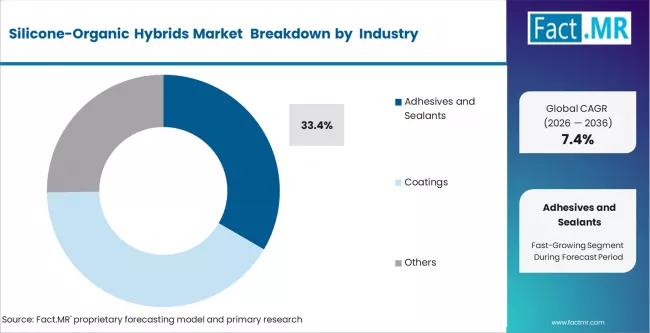
The Adhesives and Sealants segment is expected to lead the application category with a 33.4% share in 2026. Adhesives and sealants lead because hybrid chemistries create a valuable middle ground between pure silicone and traditional organic systems. That is especially useful in construction and industrial assembly where durability and substrate versatility are important but cost and application behavior still matter.
Competitive Aligners for Market Players
![]()
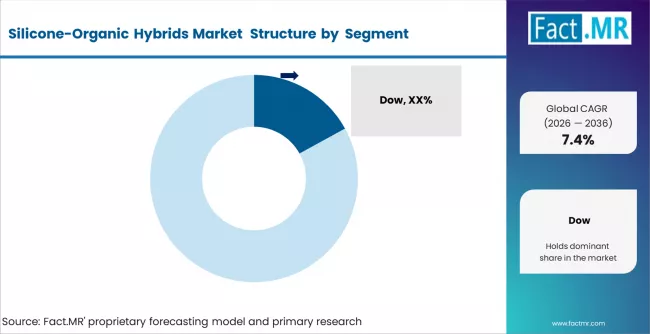
The competitive game in silicone-organic hybrids is fundamentally an application expertise game. The molecule itself is rarely enough. What matters is whether the supplier understands the customer's formulation problem deeply enough to specify the right hybrid balance, deliver the right technical data package, and support the qualification process end to end. That depth of application engagement is not something that gets built quickly, and it is why the established players in this space, Dow, WACKER, Evonik, and Momentive, tend to hold positions that price competition alone cannot easily erode.
The personal care segment is worth watching specifically because the competitive dynamics there differ from construction or industrial coatings. In personal care, hybrid silicones are evaluated on a sensory level as much as a functional one. Emolliency, spreadability, non-greasiness, and after-feel are all relevant performance variables, and the buyer is often a cosmetic chemist with a specific sensory target in mind. Suppliers that can offer a curated range of hybrid silicones with well-documented sensory profiles, rather than asking the customer to find the right product through formulation trial and error, are in a better commercial position in that channel.
For mid-tier producers trying to gain share, the path runs through narrow application ownership. Picking one or two end-use segments where the hybrid chemistry delivers a decisive performance advantage, investing in application development and regulatory support for those segments specifically, and building a reputation for solving a defined problem is a more durable strategy than competing across the full hybrid landscape. The market is wide enough to support focused specialists, and those specialists often command better margins than the broad-line competitors they share shelf space with.
Key Players in Silicone-Organic Hybrids Market
- Dow
- WACKER
- Evonik
- Momentive
- Shin-Etsu Chemical
- BRB International
- Siltech
- Elkem
- Gelest
- CHT Group
Strategic Outlook by Fact.MR on Silicone-Organic Hybrids Market
Fact.MR expects silicone-organic hybrids to keep growing as a specialty route for customers who want more tailored performance than standard organics can provide but do not need full silicone cost or content. Growth should be strongest in construction chemicals, coatings, and carefully engineered specialty formulations. The suppliers who invest most deliberately in application co-development relationships today are building the customer lock-in that will sustain their market position through the next decade.
Scope of the Report
![]()
| Metric | Value |
|---|---|
| Market Value | USD 2.4 billion in 2025 to USD 5.3 billion by 2036 |
| CAGR | 7.4% from 2026 to 2036 |
| Base Year | 2025 |
| Forecast Period | 2026 to 2036 |
| Product Type Segmentation | Silane-terminated Polymers, Silicone Polyethers, Silicone Acrylates, Silicone Urethanes, Others |
| Application Segmentation | Adhesives and Sealants, Coatings, Personal Care, Medical Devices, Electronics, Others |
| End Use Industry Segmentation | Construction, Personal Care and Cosmetics, Healthcare, Electronics, Transportation, Others |
| Regional Coverage | North America, Latin America, Europe, Asia Pacific, and Middle East & Africa |
Bibliography
- Dow. (n.d.). Silicones, silicone-organic hybrids and silanes.
- Wacker Chemie AG. (n.d.). Silicone resins.
- Evonik Industries AG. (2025). Financial and sustainability report 2024.
- Evonik Industries AG. (2025). Company presentation Q4 / FY 2024.
- Wacker Chemie AG. (n.d.). Interior paints and coatings.
- Dow. (2026). Silicone resins and intermediates.
Table of Content
- Executive Summary
- Global Market Outlook
- Demand to side Trends
- Supply to side Trends
- Technology Roadmap Analysis
- Analysis and Recommendations
- Market Overview
- Market Coverage / Taxonomy
- Market Definition / Scope / Limitations
- Research Methodology
- Chapter Orientation
- Analytical Lens and Working Hypotheses
- Market Structure, Signals, and Trend Drivers
- Benchmarking and Cross-market Comparability
- Market Sizing, Forecasting, and Opportunity Mapping
- Research Design and Evidence Framework
- Desk Research Programme (Secondary Evidence)
- Company Annual and Sustainability Reports
- Peer-reviewed Journals and Academic Literature
- Corporate Websites, Product Literature, and Technical Notes
- Earnings Decks and Investor Briefings
- Statutory Filings and Regulatory Disclosures
- Technical White Papers and Standards Notes
- Trade Journals, Industry Magazines, and Analyst Briefs
- Conference Proceedings, Webinars, and Seminar Materials
- Government Statistics Portals and Public Data Releases
- Press Releases and Reputable Media Coverage
- Specialist Newsletters and Curated Briefings
- Sector Databases and Reference Repositories
- Fact.MR Internal Proprietary Databases and Historical Market Datasets
- Subscription Datasets and Paid Sources
- Social Channels, Communities, and Digital Listening Inputs
- Additional Desk Sources
- Expert Input and Fieldwork (Primary Evidence)
- Primary Modes
- Qualitative Interviews and Expert Elicitation
- Quantitative Surveys and Structured Data Capture
- Blended Approach
- Why Primary Evidence is Used
- Field Techniques
- Interviews
- Surveys
- Focus Groups
- Observational and In-context Research
- Social and Community Interactions
- Stakeholder Universe Engaged
- C-suite Leaders
- Board Members
- Presidents and Vice Presidents
- R&D and Innovation Heads
- Technical Specialists
- Domain Subject-matter Experts
- Scientists
- Physicians and Other Healthcare Professionals
- Governance, Ethics, and Data Stewardship
- Research Ethics
- Data Integrity and Handling
- Primary Modes
- Tooling, Models, and Reference Databases
- Desk Research Programme (Secondary Evidence)
- Data Engineering and Model Build
- Data Acquisition and Ingestion
- Cleaning, Normalisation, and Verification
- Synthesis, Triangulation, and Analysis
- Quality Assurance and Audit Trail
- Market Background
- Market Dynamics
- Drivers
- Restraints
- Opportunity
- Trends
- Scenario Forecast
- Demand in Optimistic Scenario
- Demand in Likely Scenario
- Demand in Conservative Scenario
- Opportunity Map Analysis
- Product Life Cycle Analysis
- Supply Chain Analysis
- Investment Feasibility Matrix
- Value Chain Analysis
- PESTLE and Porter’s Analysis
- Regulatory Landscape
- Regional Parent Market Outlook
- Production and Consumption Statistics
- Import and Export Statistics
- Market Dynamics
- Global Market Analysis 2021 to 2025 and Forecast, 2026 to 2036
- Historical Market Size Value (USD Million) Analysis, 2021 to 2025
- Current and Future Market Size Value (USD Million) Projections, 2026 to 2036
- Y to o to Y Growth Trend Analysis
- Absolute $ Opportunity Analysis
- Global Market Pricing Analysis 2021 to 2025 and Forecast 2026 to 2036
- Global Market Analysis 2021 to 2025 and Forecast 2026 to 2036, By Product Type
- Introduction / Key Findings
- Historical Market Size Value (USD Million) Analysis By Product Type, 2021 to 2025
- Current and Future Market Size Value (USD Million) Analysis and Forecast By Product Type, 2026 to 2036
- Silane-terminated Polymers
- Silicone Polyethers
- Others
- Silane-terminated Polymers
- Y to o to Y Growth Trend Analysis By Product Type, 2021 to 2025
- Absolute $ Opportunity Analysis By Product Type, 2026 to 2036
- Global Market Analysis 2021 to 2025 and Forecast 2026 to 2036, By Application
- Introduction / Key Findings
- Historical Market Size Value (USD Million) Analysis By Application, 2021 to 2025
- Current and Future Market Size Value (USD Million) Analysis and Forecast By Application, 2026 to 2036
- Adhesives and Sealants
- Coatings
- Others
- Adhesives and Sealants
- Y to o to Y Growth Trend Analysis By Application, 2021 to 2025
- Absolute $ Opportunity Analysis By Application, 2026 to 2036
- Global Market Analysis 2021 to 2025 and Forecast 2026 to 2036, By Region
- Introduction
- Historical Market Size Value (USD Million) Analysis By Region, 2021 to 2025
- Current Market Size Value (USD Million) Analysis and Forecast By Region, 2026 to 2036
- North America
- Latin America
- Western Europe
- Eastern Europe
- East Asia
- South Asia and Pacific
- Middle East & Africa
- Market Attractiveness Analysis By Region
- North America Market Analysis 2021 to 2025 and Forecast 2026 to 2036, By Country
- Historical Market Size Value (USD Million) Trend Analysis By Market Taxonomy, 2021 to 2025
- Market Size Value (USD Million) Forecast By Market Taxonomy, 2026 to 2036
- By Country
- USA
- Canada
- Mexico
- By Product Type
- By Application
- By Country
- Market Attractiveness Analysis
- By Country
- By Product Type
- By Application
- Key Takeaways
- Latin America Market Analysis 2021 to 2025 and Forecast 2026 to 2036, By Country
- Historical Market Size Value (USD Million) Trend Analysis By Market Taxonomy, 2021 to 2025
- Market Size Value (USD Million) Forecast By Market Taxonomy, 2026 to 2036
- By Country
- Brazil
- Chile
- Rest of Latin America
- By Product Type
- By Application
- By Country
- Market Attractiveness Analysis
- By Country
- By Product Type
- By Application
- Key Takeaways
- Western Europe Market Analysis 2021 to 2025 and Forecast 2026 to 2036, By Country
- Historical Market Size Value (USD Million) Trend Analysis By Market Taxonomy, 2021 to 2025
- Market Size Value (USD Million) Forecast By Market Taxonomy, 2026 to 2036
- By Country
- Germany
- UK
- Italy
- Spain
- France
- Nordic
- BENELUX
- Rest of Western Europe
- By Product Type
- By Application
- By Country
- Market Attractiveness Analysis
- By Country
- By Product Type
- By Application
- Key Takeaways
- Eastern Europe Market Analysis 2021 to 2025 and Forecast 2026 to 2036, By Country
- Historical Market Size Value (USD Million) Trend Analysis By Market Taxonomy, 2021 to 2025
- Market Size Value (USD Million) Forecast By Market Taxonomy, 2026 to 2036
- By Country
- Russia
- Poland
- Hungary
- Balkan & Baltic
- Rest of Eastern Europe
- By Product Type
- By Application
- By Country
- Market Attractiveness Analysis
- By Country
- By Product Type
- By Application
- Key Takeaways
- East Asia Market Analysis 2021 to 2025 and Forecast 2026 to 2036, By Country
- Historical Market Size Value (USD Million) Trend Analysis By Market Taxonomy, 2021 to 2025
- Market Size Value (USD Million) Forecast By Market Taxonomy, 2026 to 2036
- By Country
- China
- Japan
- South Korea
- By Product Type
- By Application
- By Country
- Market Attractiveness Analysis
- By Country
- By Product Type
- By Application
- Key Takeaways
- South Asia and Pacific Market Analysis 2021 to 2025 and Forecast 2026 to 2036, By Country
- Historical Market Size Value (USD Million) Trend Analysis By Market Taxonomy, 2021 to 2025
- Market Size Value (USD Million) Forecast By Market Taxonomy, 2026 to 2036
- By Country
- India
- ASEAN
- Australia & New Zealand
- Rest of South Asia and Pacific
- By Product Type
- By Application
- By Country
- Market Attractiveness Analysis
- By Country
- By Product Type
- By Application
- Key Takeaways
- Middle East & Africa Market Analysis 2021 to 2025 and Forecast 2026 to 2036, By Country
- Historical Market Size Value (USD Million) Trend Analysis By Market Taxonomy, 2021 to 2025
- Market Size Value (USD Million) Forecast By Market Taxonomy, 2026 to 2036
- By Country
- Kingdom of Saudi Arabia
- Other GCC Countries
- Turkiye
- South Africa
- Other African Union
- Rest of Middle East & Africa
- By Product Type
- By Application
- By Country
- Market Attractiveness Analysis
- By Country
- By Product Type
- By Application
- Key Takeaways
- Key Countries Market Analysis
- USA
- Pricing Analysis
- Market Share Analysis, 2025
- By Product Type
- By Application
- Canada
- Pricing Analysis
- Market Share Analysis, 2025
- By Product Type
- By Application
- Mexico
- Pricing Analysis
- Market Share Analysis, 2025
- By Product Type
- By Application
- Brazil
- Pricing Analysis
- Market Share Analysis, 2025
- By Product Type
- By Application
- Chile
- Pricing Analysis
- Market Share Analysis, 2025
- By Product Type
- By Application
- Germany
- Pricing Analysis
- Market Share Analysis, 2025
- By Product Type
- By Application
- UK
- Pricing Analysis
- Market Share Analysis, 2025
- By Product Type
- By Application
- Italy
- Pricing Analysis
- Market Share Analysis, 2025
- By Product Type
- By Application
- Spain
- Pricing Analysis
- Market Share Analysis, 2025
- By Product Type
- By Application
- France
- Pricing Analysis
- Market Share Analysis, 2025
- By Product Type
- By Application
- India
- Pricing Analysis
- Market Share Analysis, 2025
- By Product Type
- By Application
- ASEAN
- Pricing Analysis
- Market Share Analysis, 2025
- By Product Type
- By Application
- Australia & New Zealand
- Pricing Analysis
- Market Share Analysis, 2025
- By Product Type
- By Application
- China
- Pricing Analysis
- Market Share Analysis, 2025
- By Product Type
- By Application
- Japan
- Pricing Analysis
- Market Share Analysis, 2025
- By Product Type
- By Application
- South Korea
- Pricing Analysis
- Market Share Analysis, 2025
- By Product Type
- By Application
- Russia
- Pricing Analysis
- Market Share Analysis, 2025
- By Product Type
- By Application
- Poland
- Pricing Analysis
- Market Share Analysis, 2025
- By Product Type
- By Application
- Hungary
- Pricing Analysis
- Market Share Analysis, 2025
- By Product Type
- By Application
- Kingdom of Saudi Arabia
- Pricing Analysis
- Market Share Analysis, 2025
- By Product Type
- By Application
- Turkiye
- Pricing Analysis
- Market Share Analysis, 2025
- By Product Type
- By Application
- South Africa
- Pricing Analysis
- Market Share Analysis, 2025
- By Product Type
- By Application
- USA
- Market Structure Analysis
- Competition Dashboard
- Competition Benchmarking
- Market Share Analysis of Top Players
- By Regional
- By Product Type
- By Application
- Competition Analysis
- Competition Deep Dive
- Dow
- Overview
- Product Portfolio
- Profitability by Market Segments (Product/Age /Sales Channel/Region)
- Sales Footprint
- Strategy Overview
- Marketing Strategy
- Product Strategy
- Channel Strategy
- WACKER
- Evonik
- Momentive
- Shin-Etsu Chemical
- BRB International
- Dow
- Competition Deep Dive
- Assumptions & Acronyms Used
List Of Table
- Table 1: Global Market Value (USD Million) Forecast by Region, 2021 to 2036
- Table 2: Global Market Value (USD Million) Forecast by Product Type, 2021 to 2036
- Table 3: Global Market Value (USD Million) Forecast by Application, 2021 to 2036
- Table 4: North America Market Value (USD Million) Forecast by Country, 2021 to 2036
- Table 5: North America Market Value (USD Million) Forecast by Product Type, 2021 to 2036
- Table 6: North America Market Value (USD Million) Forecast by Application, 2021 to 2036
- Table 7: Latin America Market Value (USD Million) Forecast by Country, 2021 to 2036
- Table 8: Latin America Market Value (USD Million) Forecast by Product Type, 2021 to 2036
- Table 9: Latin America Market Value (USD Million) Forecast by Application, 2021 to 2036
- Table 10: Western Europe Market Value (USD Million) Forecast by Country, 2021 to 2036
- Table 11: Western Europe Market Value (USD Million) Forecast by Product Type, 2021 to 2036
- Table 12: Western Europe Market Value (USD Million) Forecast by Application, 2021 to 2036
- Table 13: Eastern Europe Market Value (USD Million) Forecast by Country, 2021 to 2036
- Table 14: Eastern Europe Market Value (USD Million) Forecast by Product Type, 2021 to 2036
- Table 15: Eastern Europe Market Value (USD Million) Forecast by Application, 2021 to 2036
- Table 16: East Asia Market Value (USD Million) Forecast by Country, 2021 to 2036
- Table 17: East Asia Market Value (USD Million) Forecast by Product Type, 2021 to 2036
- Table 18: East Asia Market Value (USD Million) Forecast by Application, 2021 to 2036
- Table 19: South Asia and Pacific Market Value (USD Million) Forecast by Country, 2021 to 2036
- Table 20: South Asia and Pacific Market Value (USD Million) Forecast by Product Type, 2021 to 2036
- Table 21: South Asia and Pacific Market Value (USD Million) Forecast by Application, 2021 to 2036
- Table 22: Middle East & Africa Market Value (USD Million) Forecast by Country, 2021 to 2036
- Table 23: Middle East & Africa Market Value (USD Million) Forecast by Product Type, 2021 to 2036
- Table 24: Middle East & Africa Market Value (USD Million) Forecast by Application, 2021 to 2036
List Of Figures
- Figure 1: Global Market Pricing Analysis
- Figure 2: Global Market Value (USD Million) Forecast 2021 to 2036
- Figure 3: Global Market Value Share and BPS Analysis by Product Type, 2026 and 2036
- Figure 4: Global Market Y-o-Y Growth Comparison by Product Type, 2026 to 2036
- Figure 5: Global Market Attractiveness Analysis by Product Type
- Figure 6: Global Market Value Share and BPS Analysis by Application, 2026 and 2036
- Figure 7: Global Market Y-o-Y Growth Comparison by Application, 2026 to 2036
- Figure 8: Global Market Attractiveness Analysis by Application
- Figure 9: Global Market Value (USD Million) Share and BPS Analysis by Region, 2026 and 2036
- Figure 10: Global Market Y-o-Y Growth Comparison by Region, 2026 to 2036
- Figure 11: Global Market Attractiveness Analysis by Region
- Figure 12: North America Market Incremental Dollar Opportunity, 2026 to 2036
- Figure 13: Latin America Market Incremental Dollar Opportunity, 2026 to 2036
- Figure 14: Western Europe Market Incremental Dollar Opportunity, 2026 to 2036
- Figure 15: Eastern Europe Market Incremental Dollar Opportunity, 2026 to 2036
- Figure 16: East Asia Market Incremental Dollar Opportunity, 2026 to 2036
- Figure 17: South Asia and Pacific Market Incremental Dollar Opportunity, 2026 to 2036
- Figure 18: Middle East & Africa Market Incremental Dollar Opportunity, 2026 to 2036
- Figure 19: North America Market Value Share and BPS Analysis by Country, 2026 and 2036
- Figure 20: North America Market Value Share and BPS Analysis by Product Type, 2026 and 2036
- Figure 21: North America Market Y-o-Y Growth Comparison by Product Type, 2026 to 2036
- Figure 22: North America Market Attractiveness Analysis by Product Type
- Figure 23: North America Market Value Share and BPS Analysis by Application, 2026 and 2036
- Figure 24: North America Market Y-o-Y Growth Comparison by Application, 2026 to 2036
- Figure 25: North America Market Attractiveness Analysis by Application
- Figure 26: Latin America Market Value Share and BPS Analysis by Country, 2026 and 2036
- Figure 27: Latin America Market Value Share and BPS Analysis by Product Type, 2026 and 2036
- Figure 28: Latin America Market Y-o-Y Growth Comparison by Product Type, 2026 to 2036
- Figure 29: Latin America Market Attractiveness Analysis by Product Type
- Figure 30: Latin America Market Value Share and BPS Analysis by Application, 2026 and 2036
- Figure 31: Latin America Market Y-o-Y Growth Comparison by Application, 2026 to 2036
- Figure 32: Latin America Market Attractiveness Analysis by Application
- Figure 33: Western Europe Market Value Share and BPS Analysis by Country, 2026 and 2036
- Figure 34: Western Europe Market Value Share and BPS Analysis by Product Type, 2026 and 2036
- Figure 35: Western Europe Market Y-o-Y Growth Comparison by Product Type, 2026 to 2036
- Figure 36: Western Europe Market Attractiveness Analysis by Product Type
- Figure 37: Western Europe Market Value Share and BPS Analysis by Application, 2026 and 2036
- Figure 38: Western Europe Market Y-o-Y Growth Comparison by Application, 2026 to 2036
- Figure 39: Western Europe Market Attractiveness Analysis by Application
- Figure 40: Eastern Europe Market Value Share and BPS Analysis by Country, 2026 and 2036
- Figure 41: Eastern Europe Market Value Share and BPS Analysis by Product Type, 2026 and 2036
- Figure 42: Eastern Europe Market Y-o-Y Growth Comparison by Product Type, 2026 to 2036
- Figure 43: Eastern Europe Market Attractiveness Analysis by Product Type
- Figure 44: Eastern Europe Market Value Share and BPS Analysis by Application, 2026 and 2036
- Figure 45: Eastern Europe Market Y-o-Y Growth Comparison by Application, 2026 to 2036
- Figure 46: Eastern Europe Market Attractiveness Analysis by Application
- Figure 47: East Asia Market Value Share and BPS Analysis by Country, 2026 and 2036
- Figure 48: East Asia Market Value Share and BPS Analysis by Product Type, 2026 and 2036
- Figure 49: East Asia Market Y-o-Y Growth Comparison by Product Type, 2026 to 2036
- Figure 50: East Asia Market Attractiveness Analysis by Product Type
- Figure 51: East Asia Market Value Share and BPS Analysis by Application, 2026 and 2036
- Figure 52: East Asia Market Y-o-Y Growth Comparison by Application, 2026 to 2036
- Figure 53: East Asia Market Attractiveness Analysis by Application
- Figure 54: South Asia and Pacific Market Value Share and BPS Analysis by Country, 2026 and 2036
- Figure 55: South Asia and Pacific Market Value Share and BPS Analysis by Product Type, 2026 and 2036
- Figure 56: South Asia and Pacific Market Y-o-Y Growth Comparison by Product Type, 2026 to 2036
- Figure 57: South Asia and Pacific Market Attractiveness Analysis by Product Type
- Figure 58: South Asia and Pacific Market Value Share and BPS Analysis by Application, 2026 and 2036
- Figure 59: South Asia and Pacific Market Y-o-Y Growth Comparison by Application, 2026 to 2036
- Figure 60: South Asia and Pacific Market Attractiveness Analysis by Application
- Figure 61: Middle East & Africa Market Value Share and BPS Analysis by Country, 2026 and 2036
- Figure 62: Middle East & Africa Market Value Share and BPS Analysis by Product Type, 2026 and 2036
- Figure 63: Middle East & Africa Market Y-o-Y Growth Comparison by Product Type, 2026 to 2036
- Figure 64: Middle East & Africa Market Attractiveness Analysis by Product Type
- Figure 65: Middle East & Africa Market Value Share and BPS Analysis by Application, 2026 and 2036
- Figure 66: Middle East & Africa Market Y-o-Y Growth Comparison by Application, 2026 to 2036
- Figure 67: Middle East & Africa Market Attractiveness Analysis by Application
- Figure 68: Global Market - Tier Structure Analysis
- Figure 69: Global Market - Company Share Analysis
- FAQs -
What is the projected size of the Silicone-Organic Hybrids Market by 2036?
The silicone-organic hybrids market is projected to reach USD 5.3 billion by 2036.
What is the CAGR of the Silicone-Organic Hybrids Market from 2026 to 2036?
The silicone-organic hybrids market is projected to expand at a CAGR of 7.4% from 2026 to 2036.
Which product type segment leads the Silicone-Organic Hybrids Market?
The Silane-terminated Polymers segment leads the silicone-organic hybrids market with a 36.7% share in 2026.
Which application segment dominates the Silicone-Organic Hybrids Market?
The Adhesives and Sealants segment holds the leading position in the silicone-organic hybrids market with a 33.4% share in 2026.
Which end use industry segment leads the Silicone-Organic Hybrids Market?
The Construction segment is expected to account for the largest share of the silicone-organic hybrids market at 28.9% in 2026.
Who are the key companies in the Silicone-Organic Hybrids Market?
Key companies active in the silicone-organic hybrids market include Dow, WACKER, Evonik, Momentive, Shin-Etsu Chemical, BRB International, and other specialized participants.
What is driving demand in the Silicone-Organic Hybrids Market?
Demand in the silicone-organic hybrids market is being driven by demand for higher-performance sealants and coatings, formulation flexibility, and rising use of specialty hybrids in personal care and electronics.