- Market Value (2025): USD 4.1 Bn
- Estimated Value (2026): USD 4.4 Bn
- Forecast Value (2036): USD 8.0 Bn
- CAGR (2026-2036): 6.2%
What is the Slat Wall Panel Market forecast to be worth by 2036?
USD 4.4 billion in 2026 to USD 8.0 billion by 2036 at 6.2% CAGR.
- The slat wall panel market reached USD 4.1 billion in 2025. Demand came from retail display resets and home interior upgrades that need useful wall surfaces.
- Demand is projected to increase from USD 4.4 billion in 2026 to USD 8.0 billion by 2036.
- The market is forecast to record 6.2% CAGR from 2026 to 2036. Buyers are expected to favor panels that combine finish appeal with usable grooves.
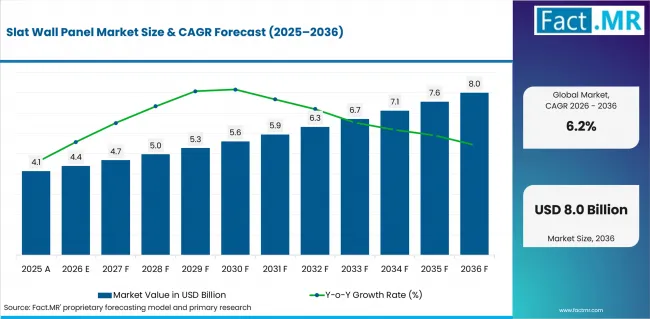
Slat Wall Panel Market Value Analysis | Source: Fact.MR
What are the defining numbers behind Slat Wall Panel Market growth?
USD 3.6 billion absolute opportunity by 2036, led by Wood Slat Wall Panels and Residential Interiors alongside Residential Customers and Specialty Stores.
- Demand Drivers in the Market
- Retail display needs are expected to raise demand for panels that hold shelves and hooks without fresh wall work. Stores can change product layouts faster when the groove pattern remains reliable.
- Residential interior upgrades are anticipated to support demand where buyers want a finished wall that looks designed and remains simple to install. Prefinished panels reduce cutting work at the site.
- Specialty stores are expected to help adoption by letting customers compare groove depth and surface finish before purchase. This support reduces uncertainty for homeowners and small contractors.
- MDF panel demand is likely to remain steady where suppliers need repeatable routing and consistent surface finishing. The material helps manufacturers keep panel sizes and colors easier to repeat.
- Key Segments Analyzed
- By Product Type: Wood Slat Wall Panels are expected to hold 37.3% share in 2026. The segment leads where buyers want a warm surface with practical merchandising use.
- By Application: Residential Interiors are projected to account for 30.5% share in 2026. Room upgrades and feature walls give this application the clearest purchase route.
- By End User: Residential Customers are anticipated to capture 30.4% share in 2026. Smaller projects can move quickly when panels are available through familiar channels.
- By Distribution Channel: Specialty Stores are estimated to represent 31.5% share in 2026. In-store comparison helps buyers judge finish quality and accessory fit.
- By Material: Medium Density Fiberboard (MDF) is forecast to hold 36.7% share in 2026. MDF supports clean groove cutting and repeatable surface finishing.
- Analyst Opinion at Fact.MR
- Shambhu Nath Jha, Senior Analyst at Fact.MR, states, "Slat wall panel demand depends on whether the panel solves a practical wall-use problem without adding installation risk. Buyers compare finish consistency and groove strength before they approve repeat orders."
- Strategic Implications
- Manufacturers can improve acceptance by giving buyers clear load limits and surface-care guidance before orders are placed. This reduces confusion between decorative panels and fixture-ready wall panels.
- Distributors need sample boards and simple installation notes that help customers compare MDF and solid wood options. A clearer sales package can shorten approval time in home improvement channels.
- Contractors can protect project margin by matching panel choice with wall condition and expected load. Poor substrate selection is expected to create rework when decorative walls later need hooks or shelves.
The U.S. Census Bureau reported in June 2025 that advance monthly retail and food services sales for May 2025 were USD 715.4 billion. The figure shows that measure slat wall panel revenue directly. It gives fixture suppliers context when retailers plan display resets and wall-merchandising upgrades.
The USA is expected to record a 8.0% CAGR from 2026 to 2036 with retail renovation and specialty-channel demand. Germany is projected to record a 7.4% CAGR through material-quality review. The UK is anticipated to grow at 6.9% through refurbishment projects. Japan is estimated to post a 6.2% CAGR through compact interiors. Canada is forecast at 5.6%. Australia is projected to reach 5.0% and Brazil is expected to register 4.4% through distributor-led replacement activity.
How does the Slat Wall Panel Market break down by segment?
Wood Slat Wall Panels are expected to lead Product Type at 37.3% share in 2026. Residential Interiors are projected to lead Application at 30.5% share in 2026.
Which product type dominates?
Wood Slat Wall Panels are projected to account for 37.3% share in 2026.
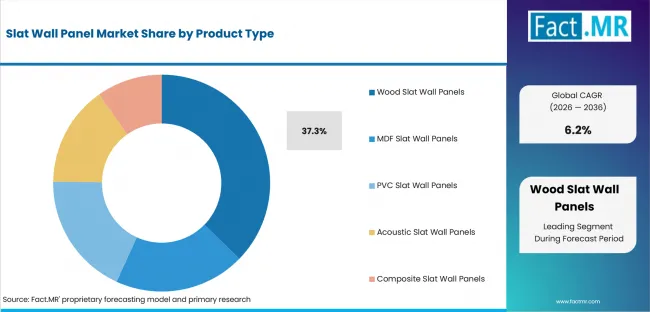
Slat Wall Panel Market Analysis By Product Type | Source: Fact.MR
Their leading position comes from the balance between visual appeal and practical display use. These panels can create decorative feature walls while supporting shelves, hooks, and other accessories. Solid Wood Slat Panels are preferred for premium interiors, while Engineered Wood Slat Panels provide better dimensional stability. MDF Slat Wall Panels remain a practical option for projects that require uniform grooves at a lower cost.
What leads the Application segment?
Residential Interiors are expected to hold 30.5% share in 2026.
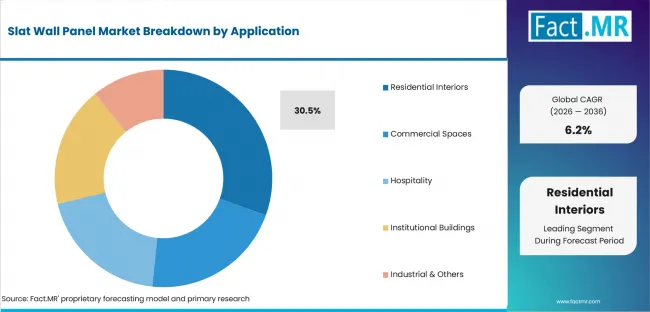
Slat Wall Panel Market Analysis By Application | Source: Fact.MR
Feature walls, television backdrops, bedrooms, and home-office upgrades are expanding the use of slat wall panels in residential projects. Homeowners can introduce texture without making major structural changes, which supports faster purchase decisions. Commercial Spaces generate larger individual orders, but residential demand occurs across a wider number of small renovation projects. Easy installation and broad finish options further strengthen adoption in homes.
How does End User shape demand?
Residential Customers are anticipated to lead with 30.4% share in 2026.
Slat Wall Panel Market Analysis By End User | Source: Fact.MR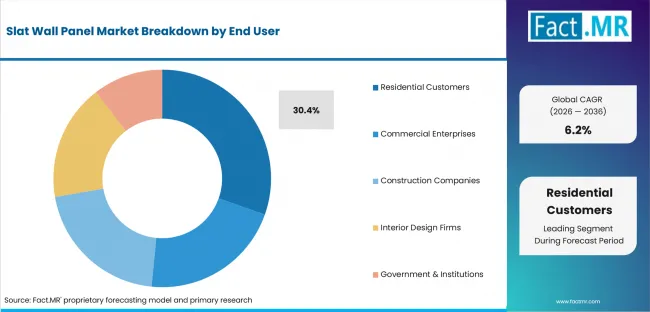
What supports Specialty Stores within Distribution Channel?
Specialty Stores are estimated to represent 31.5% share in 2026.
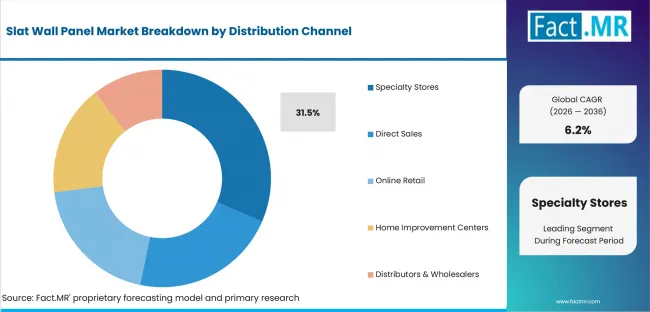
Slat Wall Panel Market Analysis By Distribution Channel | Source: Fact.MR
The ability to inspect panel color, surface texture, spacing, and groove quality gives Specialty Stores an advantage in this category. Sales staff can also explain fixing methods and recommend suitable accessories before the customer places an order. Building Material Stores offer broader product availability, while Interior Decor Stores attract design-focused buyers. Online Retail works best for repeat purchases and customers already familiar with the required specifications.
Which material leads the market?
Medium Density Fiberboard (MDF) is forecast to hold 36.7% share in 2026.
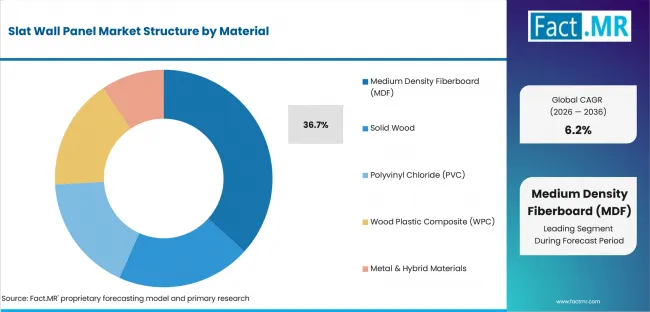
Slat Wall Panel Market Analysis By Material | Source: Fact.MR
Manufacturers rely on MDF because its smooth and uniform structure supports accurate cutting, routing, coating, and lamination. This consistency helps maintain the same appearance across large panel batches. Standard MDF is widely used in dry interior areas, whereas Moisture Resistant MDF is selected for spaces exposed to occasional humidity. Solid Wood provides a more natural finish, while PVC is chosen where easier cleaning and stronger moisture resistance are required.
What is accelerating Slat Wall Panel Market adoption, and what is holding it back?
Demand is growing as more people use wall panels for flexible displays and home decoration. Growth may be limited by changing material prices and uneven installation quality.
Drivers Impact Analysis
| DRIVER | (~) % IMPACT ON CAGR | GEOGRAPHIC RELEVANCE | IMPACT TIMELINE |
|---|---|---|---|
| Retail display reconfiguration | +1.6% | USA; UK; Canada | Short term (<= 2 years) |
| Residential feature-wall upgrades | +1.3% | USA; Germany; Australia | Short term (<= 2 years) |
| Specialty-store sampling support | +1.1% | USA and Germany | Medium term (2-4 years) |
| MDF finishing compatibility | +0.9% | Global supply channels | Medium term (2-4 years) |
| Acoustic and decorative wall use | +0.6% | Office and residential projects | Long term (>= 4 years) |
Source: Fact.MR analysis. Updated Jul 28, 2026
- Retail display reconfiguration: Stores use slatwall when product positions need to change without fresh wall construction. Panels with steady groove spacing help staff move hooks and shelves with less fitting work.
- Residential feature-wall upgrades: Homeowners are expected to use slat panels when they want a finished wall surface with a simple installation path. This demand favors prefinished boards and clear fixing guidance.
- Specialty-store sampling support: Specialty stores help buyers judge grain and color before purchase. The sales conversation can explain groove spacing and backing strength in plain terms.
- MDF finishing compatibility: MDF supports repeatable routing and smooth surface finishing across panel runs. Suppliers can keep pricing more predictable when the board cuts cleanly and accepts common finishes.
- Acoustic and decorative wall use: Felt-backed panels add a functional reason for buyers to compare panel systems. This use can support office and residential projects where appearance and sound control both matter.
Opportunity Impact Analysis
| OPPORTUNITY | (~) % IMPACT ON CAGR | GEOGRAPHIC RELEVANCE | IMPACT TIMELINE |
|---|---|---|---|
| Ready-to-install panel kits | +0.8% | USA; UK; Canada | Medium term (2-4 years) |
| Distributor installation guidance | +0.6% | Germany and Australia | Medium term (2-4 years) |
| Online sample and finish programs | +0.5% | USA and UK | Long term (>= 4 years) |
| Commercial display refresh cycles | +0.4% | Brazil and Canada | Long term (>= 4 years) |
Source: Fact.MR analysis. Updated Jul 28, 2026
- Ready-to-install panel kits: Suppliers can package panels with trims and fixing guidance for smaller residential jobs. This reduces uncertainty for buyers who want a cleaner wall finish without custom carpentry.
- Distributor installation guidance: Distributors can create value by explaining wall preparation and load limits before delivery. Clear instructions reduce site mistakes and make repeat orders easier to approve.
- Online sample and finish programs: Online sales can improve when buyers receive small samples before ordering full wall sets. This lowers hesitation around color match and texture in residential projects.
- Commercial display refresh cycles: Retailers and small service businesses can replace panels during store refreshes when the fixture system is already planned. Suppliers benefit when panels match common accessories.
Restraints Impact Analysis
| RESTRAINT | (~) % IMPACT ON CAGR | GEOGRAPHIC RELEVANCE | IMPACT TIMELINE |
|---|---|---|---|
| Wood and MDF cost movement | -0.8% | Global | Short term (<= 2 years) |
| Installation quality variation | -0.6% | Contractor-led projects | Short term (<= 2 years) |
| Finish durability concerns | -0.5% | Residential and retail buyers | Medium term (2-4 years) |
| Unclear load-rating evidence | -0.4% | Commercial applications | Long term (>= 4 years) |
Source: Fact.MR analysis. Updated Jul 28, 2026
- Wood and MDF cost movement: Input-cost changes can narrow margins when suppliers quote projects before board costs settle. Smaller distributors may delay larger stock orders until price visibility improves.
- Installation quality variation: Poor wall preparation and uneven fixing can make good panels perform badly. Buyers are expected to favor suppliers that provide simple fixing steps and clear accessory limits.
- Finish durability concerns: Scratches and edge wear can reduce confidence in repeat purchases. Suppliers need care instructions that explain how panels should be cleaned and where moisture exposure is risky.
- Unclear load-rating evidence: Commercial buyers may slow approvals when panel load limits are not documented. Fixture compatibility needs to be stated plainly before larger store projects move forward.
Which countries are scaling Slat Wall Panel Market fastest?
The global CAGR is 6.2%. Country rates show how slat wall panel demand moves through retail refurbishment and residential renovation. Channel reach and installation support explain why nearby growth rates can still create different entry conditions.
- The USA holds the highest listed CAGR where retail display resets and home upgrades create repeat panel needs. Specialty channels help buyers compare finishes before they order larger wall areas.
- Germany follows closely through quality-focused buying and stronger attention to installation proof. Buyers are expected to compare material finish and fixing guidance before switching suppliers.
- The UK remains above the global rate through refurbishment projects and specialty-channel access. Smaller commercial fit-outs can support demand when panels are easy to sample and install.
- Japan stays near the global line through compact interiors and quality-led buying. Projects are expected to favor panels that look clean and create usable wall space.
- Canada reflects stable replacement demand where service coverage and availability matter across wider geographies. Distributors need dependable stock to support repeat residential and small commercial orders.
- Australia trails the global average where distance and service availability affect purchase timing. Suppliers with clearer installation support are expected to compete better outside major cities.
- Brazil records the lowest listed CAGR because regional distribution and price comfort shape project timing. Smaller order sizes are expected to keep adoption gradual.
Comparable CAGRs can therefore produce different market entry conditions across these countries. Deployment timing depends on channel reach and installation support. Commercial readiness also reflects sample access and supplier response.
The full report provides country-level CAGR analysis across North America; Latin America; Europe; East Asia; South Asia and Oceania; and the Middle East and Africa.
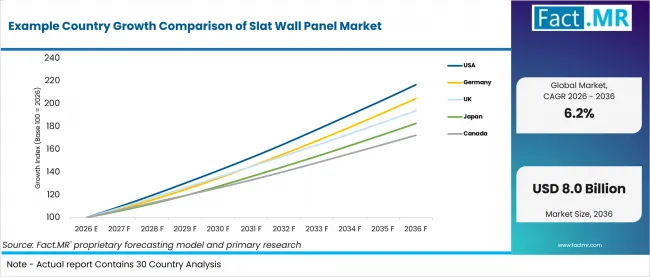
Example Country Growth Comparison Of Slat Wall Panel Market | Source: Fact.MR
| Country | CAGR (2026-2036) |
|---|---|
| USA | 8.0% |
| Germany | 7.4% |
| UK | 6.9% |
| Japan | 6.2% |
| Canada | 5.6% |
| Australia | 5.0% |
| Brazil | 4.4% |
Source: Fact.MR analysis. Updated Jul 28, 2026
What supports USA adoption?
8.0% CAGR, supported by retail refurbishment and residential upgrade demand.
The USA outlook reflects a market where buyers need panels for store resets and home improvement projects. Wood Slat Wall Panels are expected to benefit when retailers want walls that can hold accessories and still look finished. Specialty stores and home improvement channels help buyers compare finishes before approving repeat orders.
How is Germany scaling demand?
7.4% CAGR, backed by quality review and installation documentation.
Germany is projected to grow through buyers that compare panel quality and installation evidence before purchase. Residential Interiors support demand where clean finishes and durable boards matter to renovation decisions. Suppliers are likely to perform better when they explain material behavior and fixing methods clearly.
What is driving the UK's growth from 2026 to 2036?
6.9% CAGR, supported by refurbishment projects and specialty-channel access.
The UK market is shaped by residential refurbishment and smaller commercial upgrades. Residential Customers are expected to buy panels where products are easy to sample and simple to fit. Specialty stores can support adoption by helping buyers compare color and groove depth before purchase.
How is Japan developing demand?
6.2% CAGR, led by compact interiors and quality-led buying.
Japan is expected to show selective demand where compact homes and hospitality spaces require careful use of wall surfaces. Specialty Stores remain relevant because buyers want finish quality and reliable panel dimensions. Adoption depends on dependable supply and simple installation instructions that reduce site disruption.
What supports Canada's outlook?
5.6% CAGR, shaped by service coverage and replacement-led demand.
Canada is expected to track close to the global rate as homeowners and small businesses use slat panels for practical wall upgrades. Medium Density Fiberboard (MDF) supports value-focused projects that need stable machining and accessible finishes. Wider geography makes distributor coverage and stock availability important to repeat purchasing.
How does Australia perform?
5.0% CAGR, supported by renovation demand and service availability.
Australia is forecast below the global rate as buyers weigh panel appearance against delivery time and after-sale support. Wood Slat Wall Panels remain useful in residential and small commercial projects. Suppliers with reliable stock and clear installation instructions are expected to compete better outside major cities.
What is shaping Brazil's growth?
4.4% CAGR, backed by distributor-led replacement and price-sensitive buying.
Brazil is expected to expand at the slowest listed pace as regional distribution and affordability shape project timing. Residential Interiors create selective demand where buyers want decorative walls without custom carpentry. Suppliers are likely to gain acceptance when they offer consistent finishes and manageable order sizes for local installers.
Who leads the Slat Wall Panel Market?
Naturewall and The Wood Veneer Hub show direct relevance in decorative slat wall panels. MURdesign strengthen the provider set through wall panel ranges and specification-led supply.
Competition depends on whether suppliers can support Wood Slat Wall Panels with finish consistency and installation guidance. Wall Theory add visibility in acoustic and interior panel applications. Hunter Douglas and Dumaplast broaden the field through wider architectural and wall covering portfolios.
From 2026 to 2036, suppliers are expected to compete on sample access and delivery reliability. Buyers are likely to compare finish match and mounting guidance before approving larger repeat orders. Providers that make product limits clear may gain stronger demand from residential renovators and commercial display users.
Which companies are the key providers?
The profiled providers include Naturewall; The Wood Veneer Hub; MURdesign; Wall Theory; Hunter Douglas; Dumaplast.
- Naturewall
- The Wood Veneer Hub
- MURdesign
- Wall Theory
- Hunter Douglas
- Dumaplast
Bibliography
- U.S. Census Bureau. (2025, June 17). Advance monthly sales for retail and food services, May 2025.
- Office for National Statistics. (2026, May 14). Construction output in Great Britain: March 2026, new orders and construction output price indices, January to March 2026.
- Australian Bureau of Statistics. (2026, April 8). Building activity, Australia, December 2025.
- Hunter Douglas Architectural. (2025, September 22). HeartFelt® Groove Wall.
This Report Answers
- The report provides strategic intelligence on the Slat Wall Panel Market across Product Type and Application choices that shape retail display and residential interior use.
- Segment analysis covers Wood Slat Wall Panels and Residential Interiors as the share leaders within the 2026 market structure.
- Country outlook evaluates the USA and Germany alongside the UK and Japan. Canada and Australia complete the upper comparison before Brazil closes the listed group.
- Competitive analysis profiles Naturewall and The Wood Veneer Hub alongside MURdesign. Wall Theory completes the core decorative panel view with Hunter Douglas and Dumaplast.
- Material assessment covers Medium Density Fiberboard (MDF) and Solid Wood. PVC and WPC complete the material view alongside acoustic and composite panel formats.
What does the Slat Wall Panel Market cover?
Slat wall panels are grooved wall products used for retail fixtures; storage walls; decorative interiors; and acoustic-style room upgrades.
The Slat Wall Panel Market covers Wood Slat Wall Panels; MDF Slat Wall Panels; PVC Slat Wall Panels; acoustic panels; and composite panel systems. Coverage extends to products sold through specialty stores and building material stores. It also covers direct sales; online retail; distributors; and wholesalers where panels are purchased for display or interior finish work.
The market differs from general wall covering because commercial value comes from usable groove profiles and accessory compatibility. Decorative wall boards without a slat or fixture function remain outside the boundary. General carpentry materials are excluded unless they are sold as part of a slat wall panel system.
What is included in the scope?
Slat wall panel products are used across residential customers; retailers; contractors; interior designers; and institutional buyers.
The scope includes Product Type and Application alongside End User; Distribution Channel; and Material. Coverage spans Wood Slat Wall Panels; solid wood panels; engineered wood panels; MDF formats; PVC formats; acoustic panels; composite panels; WPC panels; and hybrid systems. Residential interiors and commercial spaces are included where panels are specified for wall display or room upgrades.
What is excluded from the scope?
General wall panels and unrelated construction materials remain outside the scope of this market.
The scope excludes products that do not use a slat or groove system for display; storage; decorative rhythm; or acoustic-style wall use. Standalone shelving systems are excluded unless they are sold with slat wall panels. Paint; wallpaper; and general cladding are excluded. Company revenue without a clear connection to slat wall panel sales or installation support is also excluded.
How Was the Analysis Built?
The analysis draws on 120+ sources, 35+ company portfolios, 25+ countries, and more than 20 industry interviews.
- Primary Research: Primary research includes discussions with manufacturers, service providers, technology developers, distributors, end users, procurement teams, and subject-matter experts. These conversations examine purchasing priorities, product adoption, operational challenges, approval requirements, competitive positioning, and the factors that influence wider market acceptance.
- Desk Research: Desk research covers government statistics, regulatory publications, company filings, trade data, technical studies, industry associations, standards, public policy, and other authoritative sources. Every source used in the analysis is documented in the bibliography.
- Market Sizing and Forecasting: Market estimates combine historical performance, demand indicators, pricing and volume trends, segment shares, company participation, country-level growth, adoption patterns, investment activity, and barriers to market expansion.
- Data Validation and Update Cycle: Findings are validated by comparing primary interviews with public data, company activity, regulatory changes, trade patterns, and industry developments. Regular updates review new product launches, capacity changes, partnerships, approvals, procurement trends, and shifts in commercial adoption.
Segmentation
What is the report's scope and coverage?
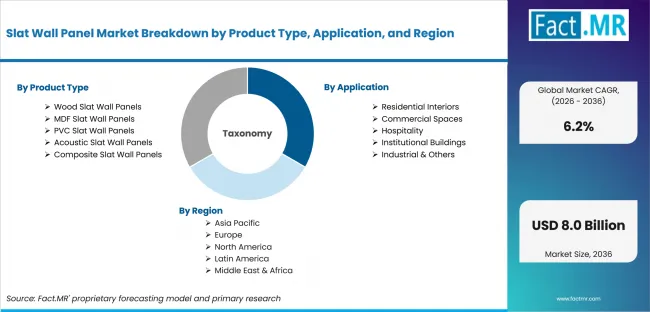
Slat Wall Panel Market Breakdown By Product Type, Application, And Region | Source: Fact.MR
| Attribute | Details |
|---|---|
| Quantitative Units | USD billion in 2026 to USD billion by 2036 at CAGR |
| Market Definition | Commercial buying and supply of slat wall panels used for retail display; residential interiors; storage walls; decorative wall systems; and related installation support |
| Product Type | Wood Slat Wall Panels; Solid Wood Slat Panels; Engineered Wood Slat Panels; MDF Slat Wall Panels; Melamine MDF Panels; Veneered MDF Panels; PVC Slat Wall Panels; Hollow PVC Panels; Solid PVC Panels; Acoustic Slat Wall Panels; Felt-Backed Panels; Sound Absorbing Panels; Composite Slat Wall Panels; WPC Panels; Hybrid Composite Panels |
| Application | Residential Interiors; Living Rooms; Bedrooms; Commercial Spaces; Offices; Retail Stores; Hospitality; Hotels; Restaurants; Institutional Buildings; Educational Facilities; Healthcare Facilities; Industrial & Others; Exhibition Spaces; Public Infrastructure |
| End User | Residential Customers; Homeowners; Interior Renovators; Commercial Enterprises; Corporate Offices; Retail Chains; Construction Companies; General Contractors; Real Estate Developers; Interior Design Firms; Architectural Firms; Interior Decorators; Government & Institutions; Public Infrastructure Agencies; Educational Institutions |
| Distribution Channel | Specialty Stores; Building Material Stores; Interior Decor Stores; Direct Sales; Project Sales; Manufacturer Sales; Online Retail; Company Websites; E-Commerce Platforms; Home Improvement Centers; DIY Retail Chains; Warehouse Clubs; Distributors & Wholesalers; Regional Distributors; National Wholesalers |
| Material | Medium Density Fiberboard (MDF); Standard MDF; Moisture Resistant MDF; Solid Wood; Oak; Walnut; Polyvinyl Chloride (PVC); Recycled PVC; Virgin PVC; Wood Plastic Composite (WPC); Standard WPC; High-Density WPC; Metal & Hybrid Materials; Aluminum Panels; Steel Composite Panels |
| Regions Covered | North America; Latin America; Europe; East Asia; South Asia and Oceania; Middle East and Africa |
| Countries Covered | USA; Germany; UK; Japan; Canada; Australia; Brazil |
| Key Companies Profiled | Naturewall; The Wood Veneer Hub; MURdesign; Wall Theory; Hunter Douglas; Dumaplast |
| Forecast Period | 2026 to 2036 |
| Approach | Hybrid top-down and bottom-up assessment using demand indicators; segment mix; country growth; company participation; channel evidence; renovation activity; retail fixture requirements; installation behavior; material selection; and supplier portfolio revieaw |
Source: Fact.MR analysis. Updated Jul 28, 2026
How is the market segmented?
-
By Product Type:
- Wood Slat Wall Panels
- Solid Wood Slat Panels
- Engineered Wood Slat Panels
- MDF Slat Wall Panels
- Melamine MDF Panels
- Veneered MDF Panels
- PVC Slat Wall Panels
- Hollow PVC Panels
- Solid PVC Panels
- Acoustic Slat Wall Panels
- Felt-Backed Panels
- Sound Absorbing Panels
- Composite Slat Wall Panels
- WPC Panels
- Hybrid Composite Panels
-
By Application:
- Residential Interiors
- Living Rooms
- Bedrooms
- Commercial Spaces
- Offices
- Retail Stores
- Hospitality
- Hotels
- Restaurants
- Institutional Buildings
- Educational Facilities
- Healthcare Facilities
- Industrial & Others
- Exhibition Spaces
- Public Infrastructure
-
By End User:
- Residential Customers
- Homeowners
- Interior Renovators
- Commercial Enterprises
- Corporate Offices
- Retail Chains
- Construction Companies
- General Contractors
- Real Estate Developers
- Interior Design Firms
- Architectural Firms
- Interior Decorators
- Government & Institutions
- Public Infrastructure Agencies
- Educational Institutions
-
By Distribution Channel:
- Specialty Stores
- Building Material Stores
- Interior Decor Stores
- Direct Sales
- Project Sales
- Manufacturer Sales
- Online Retail
- Company Websites
- E-Commerce Platforms
- Home Improvement Centers
- DIY Retail Chains
- Warehouse Clubs
- Distributors & Wholesalers
- Regional Distributors
- National Wholesalers
-
By Material:
- Medium Density Fiberboard (MDF)
- Standard MDF
- Moisture Resistant MDF
- Solid Wood
- Oak
- Walnut
- Polyvinyl Chloride (PVC)
- Recycled PVC
- Virgin PVC
- Wood Plastic Composite (WPC)
- Standard WPC
- High-Density WPC
- Metal & Hybrid Materials
- Aluminum Panels
- Steel Composite Panels
-
By Region:
- North America
- Latin America
- Europe
- East Asia
- South Asia and Oceania
- Middle East and Africa
Frequently Asked Questions
Which Product Type leads the market?
Which Application leads the market?
Which End User category leads the market?
Which Distribution Channel leads the market?
Which Material leads the market?
Which country records the highest listed CAGR?
What is the primary driver in this market?
What is the main restraint?
Why do Residential Customers lead demand?
Who worked on this report


Preview the report firsthand - request a free sample
Free SampleGet the brochure for pricing and purchase details
Download PDF