- Market Value (2025): USD 190.7 Mn
- Estimated Value (2026): USD 215.4 Mn
- Forecast Value (2036): USD 727.3 Mn
- CAGR (2026-2036): 12.9%
Sleep and Stress Patches Market Forecast and Outlook 2026 to 2036
Fact.MR studies, the sleep and stress patches market crossed a valuation of USD 190.7 million in 2025 and is projected to grow from USD 215.4 million in 2026 to USD 727.3 million by 2036. Demand for sleep and stress patches is likely to grow at a CAGR of 12.9% over the forecast period.
Demand for sleep and stress patches is rising as clinicians and consumers look for thin, adhesive sensors that capture sleep, breathing, heart rhythm and stress signals at home without bulky equipment. Suppliers of sleep and stress patches are miniaturizing sensors and moving home sleep testing toward single-use and rechargeable formats. For example, in May 2026, Sunrise received FDA clearance for Sunrise Air, a rechargeable next-generation home sleep test based on mandibular jaw movement sensing. Similar clearances are projected to drive sales of sleep and stress patches for home diagnosis.
Key Takeaways from the Sleep and Stress Patches Market
- Sleep and Stress Patches Market Value (2025): USD 190.7 million
- Sleep and Stress Patches Market Value (2026): USD 215.4 million
- Sleep and Stress Patches Market Forecast Value (2036): USD 727.3 million
- Sleep and Stress Patches Market Forecast CAGR (2026-2036): 12.9%
- Leading Measurement Principle: Multimodal sleep sensing (28.8%)
- Key Market Participants: Sunrise, ZOLL Itamar, BioIntelliSense, VitalConnect, Wesper, Onera Health
- Key Growth Regions: China, South Korea, United States, Germany, Japan
In November 2026, Germany's TK health insurer reported in its stress report that 66% of respondents feel stressed in daily or working life, and six in ten employees fear that persistent job stress will make them ill. Demand for sleep and stress patches is growing as employers, insurers and individuals look for objective measures of stress load and recovery. Suppliers of sleep and stress patches are offering heart rate variability, skin temperature and electrodermal sensing for workplace and personal programs. Similar stress levels are projected to drive sales of sleep and stress patches across Europe, East Asia and North America.
Sleep and Stress Patches Market
| Metric | Value |
|---|---|
| Estimated Value in (2026) | USD 215.4 million |
| Forecast Value in (2036) | USD 727.3 million |
| Forecast CAGR (2026 to 2036) | 12.9% |
Source: Fact.MR analysis. Updated Nov 20, 2026
Source: Fact.MR analysis.
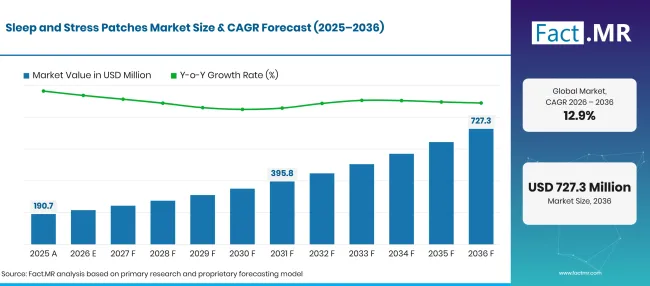
Sleep And Stress Patches Market Forecast Global | Source: Fact.MR
Category
| Category | Segments |
|---|---|
| Measurement Principle | Multimodal sleep sensing, ECG / HRV, Skin temperature, Sweat biomarkers, Electrodermal activity |
| Data Processing | Clinician-linked dashboard, Smartphone companion, Cloud AI, On-device algorithm, Hybrid edge-cloud |
| Sales Channel | Brand direct online, Retail electronics, Pharmacy / wellness retail, Clinical / professional, B2B / institutional |
| Region | China; South Korea; United States; Germany; Japan |
Source: Fact.MR analysis. Updated Nov 20, 2026
Segmental Analysis
Why does multimodal sleep sensing lead measurement demand in the Sleep and Stress Patches Market?
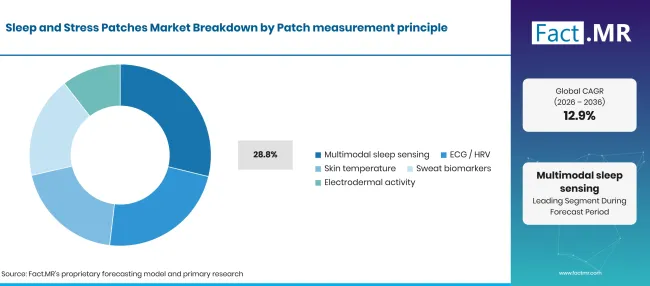
Sleep And Stress Patches Market Breakdown Patch Measurement Principle | Source: Fact.MR
Demand for multimodal sleep sensing accounts for 28.8% of the sleep and stress patches market in 2026, about USD 62.0 million, because combining motion, airflow, oxygen and cardiac signals on one patch gives a fuller picture of sleep than any single sensor. A 2026 review of smart patches reported that wearable patches with machine learning detected sleep apnoea with 88.5% accuracy. Suppliers of sleep and stress patches are adding sensors while keeping patches light enough to wear overnight. Similar demand for richer data is projected to keep multimodal sensing the leading measurement principle, alongside tools in the actigraphy sensors and PSG devices market.
How are clinician-linked dashboards leading data demand in the Sleep and Stress Patches Market?
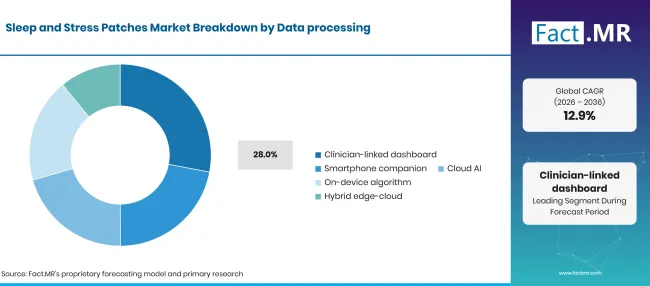
Sleep And Stress Patches Market Breakdown Data Processing | Source: Fact.MR
Clinician-linked dashboards segment to represent 28.0% of sleep and stress patches revenue in 2026, about USD 60.3 million, because home sleep tests and remote monitoring patches must deliver results that sleep physicians can review, score and bill. Dashboards also support remote patient monitoring programs in cardiology and post-acute care. Suppliers of sleep and stress patches are integrating cloud scoring and physician portals with their sensors. Similar clinical workflow needs are projected to keep clinician-linked dashboards the leading data model.
Why do brand direct online channels lead sales in the Sleep and Stress Patches Market?
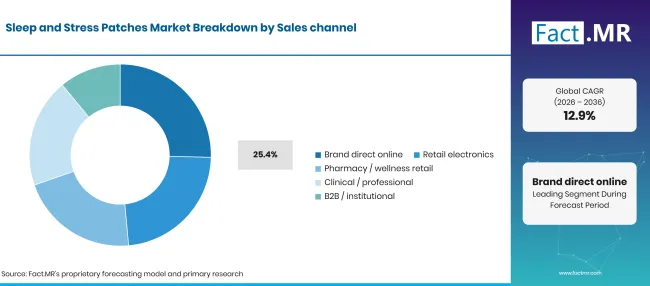
Sleep And Stress Patches Market Breakdown Sales Channel | Source: Fact.MR
Sales through brand direct online channels account for 25.4% of sleep and stress patches revenue in 2026, about USD 54.7 million, as consumer patch brands and telehealth sleep services ship tests directly to homes. Direct online models remove the need for patients to visit a sleep laboratory for screening. Suppliers of sleep and stress patches are pairing patches with virtual consultations and prescriptions, competing with products in the anti-snoring devices market. Similar convenience is projected to keep direct online the leading channel.
Sleep and Stress Patches Market-Drivers, Restraints & Trends
Drivers
Demand for sleep and stress patches is rising as stress becomes a measurable health priority in ageing workforces. For example, a nationwide online stress survey of 100,000 people in Japan, published in March 2026, classified 14.8% of men and 17.7% of women in the high-stress group. Suppliers of sleep and stress patches are offering objective stress and recovery metrics to employers and individuals. Similar stress prevalence is projected to drive sales of sleep and stress patches through the forecast period.
Restraints
Demand for sleep and stress patches is constrained when people with symptoms do not seek diagnosis or treatment. For example, in November 2026, a survey for Eisai Korea found that 89% of Korean adults reported sleep problems but only 6% sought treatment. Similar treatment gaps are projected to slow conversion of symptomatic consumers into patch users. Suppliers of sleep and stress patches must lower cost, simplify ordering and connect patch results to clear next steps.
Opportunity
Home Polysomnography Without the Lab In November 2026, ZOLL Itamar received FDA 510(k) clearance for PolySense accessories that expand its WatchPAT 400 platform from home sleep apnea testing to home polysomnography. Demand for fuller sleep studies at home is rising as sleep laboratories face waiting lists. Similar clearances are projected to drive sales of sleep and stress patches that capture EEG-like and respiratory signals in bed. Suppliers of sleep and stress patches are designing adhesive sensor sets that patients can apply without a technician.
Trend
Sleep Loss as an Economic Cost Demand for workplace sleep and stress monitoring is rising as employers recognize the cost of fatigue. Suppliers of sleep and stress patches are positioning programs that combine patches with coaching. For example, in November 2026, a German sleep expert cited research estimating the economic damage from poor sleep at about 3% of gross domestic product. Similar cost awareness is projected to drive sales of sleep and stress patches in employer and insurer programs, linked to the broader wearable biometric monitor market.
Sleep and Stress Patches Market by Analysis by Key Country
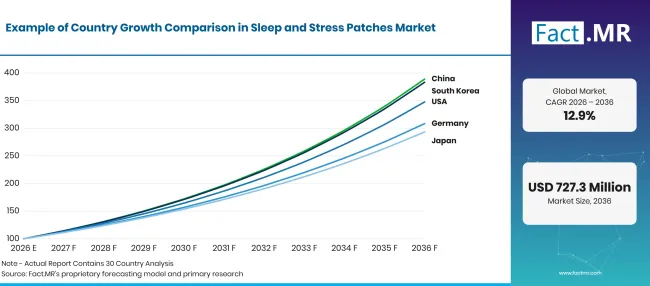
Sleep And Stress Patches Market Growth Index | Source: Fact.MR
| Country | CAGR (2026-2036) |
|---|---|
| China | 14.5% |
| South Korea | 14.4% |
| United States | 13.3% |
| Germany | 11.9% |
| Japan | 11.4% |
Source: Fact.MR analysis. Updated Nov 20, 2026
Source: Fact.MR analysis.
What is driving sleep and stress patches demand in China?
In April 2026, a national population-based study in The Lancet Regional Health – Western Pacific estimated the prevalence of poor sleep quality among Chinese people aged 15 and above at 23.9%, about 276 million individuals.
Demand for sleep and stress patches in China is projected to grow at a 14.5% CAGR, the fastest among the five key countries, as hospitals and consumers adopt home monitoring. Suppliers of sleep and stress patches are partnering with Chinese sleep centers and e-commerce platforms. Similar sleep burden is projected to drive sales in China.
How is mental health care supporting sleep and stress patches sales in South Korea?
Sales of sleep and stress patches in South Korea are estimated to record a 14.4% CAGR as more people are treated for sleep and mood conditions.
For example, data reported in September 2026 showed that more than one million Koreans were treated for depression and more than one million for sleep disorders in 2025. Suppliers of sleep and stress patches are offering objective monitoring to Korean clinics and digital therapeutics providers. Similar treatment volumes are projected to drive sales of sleep and stress patches in South Korea.
What is shaping sleep and stress patches demand in the United States?
Demand for sleep and stress patches in the United States is projected to grow at a 13.3% CAGR as home sleep testing replaces many in-lab studies.
For example, in May 2026, Sunrise received FDA clearance for Sunrise Air, and in November 2026, ZOLL Itamar received clearance for PolySense home polysomnography accessories. Suppliers of sleep and stress patches are working with U.S. sleep physicians, dentists and telehealth providers. Similar regulatory progress is projected to drive sales of sleep and stress patches in the United States.
Why is Germany an important market for sleep and stress patches?
Sales of sleep and stress patches in Germany are projected to grow at an 11.9% CAGR as insurers and employers focus on stress prevention.
In November 2026, TK's stress report found that 66% of respondents feel stressed in everyday or working life. Suppliers of sleep and stress patches are offering programs through German statutory health insurers and occupational health services. Similar prevention priorities are projected to sustain sales of sleep and stress patches in Germany.
How is short sleep shaping sleep and stress patches demand in Japan?
Demand for sleep and stress patches in Japan is projected to grow at an 11.4% CAGR, the slowest among the five countries, as employers address chronic sleep loss.
A study published in September 2026 cited a nationally representative survey in which 45.5% of Japanese workers slept fewer than six hours a day. Suppliers of sleep and stress patches are offering patches for corporate health checks and stress-management programs. Similar workplace concerns are projected to support sales of sleep and stress patches in Japan.
Competitive Landscape for Sleep and Stress Patches Market
Competition in the sleep and stress patches market is divided between home sleep testing companies and remote-monitoring patch makers. Sunrise, ZOLL Itamar, Wesper and Onera Health compete in home sleep apnea testing and patch-based polysomnography, BioIntelliSense and VitalConnect compete through medical-grade vital-sign patches, and Epicore Biosystems competes through sweat-sensing patches for hydration and stress-related biomarkers. Buyers select suppliers on clinical validation, comfort, data integration and cost per study.
From 2025 onward, competition shifted toward FDA-cleared home testing and fuller sleep studies. Sunrise won clearance for Sunrise Air in May 2026, ZOLL Itamar expanded WatchPAT to home polysomnography in November 2026, and research on machine-learning patches reported high apnea detection accuracy. Suppliers that combine cleared sensors with physician dashboards are best placed to win sleep-clinic and payer contracts.
Recent Developments
- In November 2026, ZOLL Itamar received FDA 510(k) clearance for PolySense accessories for WatchPAT 400.
- In November 2026, TK reported that 66% of respondents in Germany feel stressed in daily or working life.
- In June 2026, the American Academy of Sleep Medicine highlighted FDA clearance of the Sunrise Air home sleep test.
- In May 2026, Sunrise received FDA clearance for Sunrise Air, its rechargeable at-home sleep test.
Key Players in Sleep and Stress Patches Market
Key companies profiled include Sunrise; ZOLL Itamar; BioIntelliSense; VitalConnect; Wesper; Onera Health; and Epicore Biosystems.
- Sunrise
- ZOLL Itamar
- BioIntelliSense
- VitalConnect
- Wesper
- Onera Health
- Epicore Biosystems
Bibliography
- Eisai Korea Co., Ltd. (2026). Sleep problems survey of Korean adults. Seoul: Eisai Korea.
- Matsuki, Y., Haruki, T., Mizuno, K., Watanabe, Y., Katano, H., & Matsuki, H. (2026). Nationwide online stress survey of 100,000 people in Japan. Tokai Journal of Experimental and Clinical Medicine, 51(1), 13–22.
- Sunrise. (2026, May 20). Sunrise receives FDA clearance for its new rechargeable at-home sleep test. Namur, Belgium: Sunrise
- Techniker Krankenkasse. (2026, January 21). TK-Stressreport 2025. Hamburg, Germany: Techniker Krankenkasse.
- Sang, Y., Peng, Z., Zeng, X., Liu, Y., Wang, Y., Gao, X., Zhang, C., Zou, D., Huang, Z., Han, F., & Liu, S. (2026). Demographic and socioeconomic inequalities in sleep quality among Chinese aged 15 years and above: A national population-based study. The Lancet Regional Health – Western Pacific, 69, Article 101853.
- ZOLL Medical Corporation. (2026, November 2). New PolySense accessories for WatchPAT 400 receive FDA clearance. Chelmsford, MA: ZOLL Medical Corporation.
Segmentation
Scope of Report
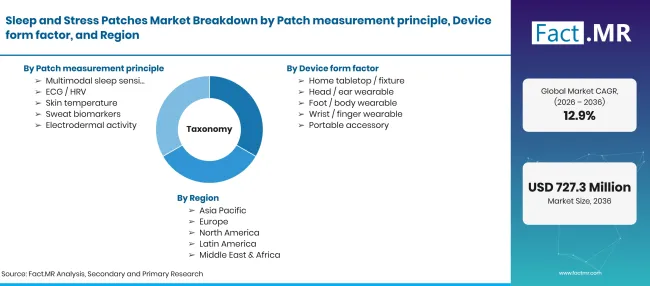
Sleep And Stress Patches Market Taxonomy | Source: Fact.MR
| Items | Values |
|---|---|
| Quantitative Units (2026) | USD 215.4 Million |
| Measurement Principle | Multimodal sleep sensing, ECG / HRV, Skin temperature, Sweat biomarkers, Electrodermal activity |
| Data Processing | Clinician-linked dashboard, Smartphone companion, Cloud AI, On-device algorithm, Hybrid edge-cloud |
| Sales Channel | Brand direct online, Retail electronics, Pharmacy / wellness retail, Clinical / professional, B2B / institutional |
| Regions Covered | North America, Latin America, Europe, East Asia, South Asia and Pacific, Middle East & Africa |
| Countries Covered | China, South Korea, United States, Germany, Japan, and other countries |
| Key Companies Profiled | Sunrise, ZOLL Itamar, BioIntelliSense, VitalConnect, Wesper, Onera Health, Epicore Biosystems |
| Additional Attributes | Dollar revenue in the Sleep and Stress Patches Market is segmented by measurement principle (multimodal sleep sensing, ECG / HRV, skin temperature, sweat biomarkers, electrodermal activity), data processing, sales channel and region. |
Source: Fact.MR analysis. Updated Nov 20, 2026
Sleep and Stress Patches Market by Segments
-
Measurement Principle
- Multimodal sleep sensing
- ECG / HRV
- Skin temperature
- Sweat biomarkers
- Electrodermal activity
-
Data Processing
- Clinician-linked dashboard
- Smartphone companion
- Cloud AI
- On-device algorithm
- Hybrid edge-cloud
-
Sales Channel
- Brand direct online
- Retail electronics
- Pharmacy / wellness retail
- Clinical / professional
- B2B / institutional
-
Region:
- North America
- United States
- Canada
- Mexico
- Europe
- Germany
- United Kingdom
- France
- Italy
- Spain
- Rest of Europe
- Asia Pacific
- China
- India
- Japan
- South Korea
- Australia
- Rest of Asia Pacific
- Latin America
- Brazil
- Mexico
- Argentina
- Rest of Latin America
- Middle East & Africa
- GCC Countries
- South Africa
- Rest of Middle East & Africa
- North America
Frequently Asked Questions
How big is the global Sleep and Stress Patches Market in 2026?
What will be the size of the Sleep and Stress Patches Market by 2036?
How fast will the Sleep and Stress Patches Market grow during the forecast period?
Which measurement principle segment holds the largest share of the Sleep and Stress Patches Market?
Who worked on this report


Preview the report firsthand - request a free sample
Free SampleGet the brochure for pricing and purchase details
Download PDF