- Market Value (2025): USD 332.5 Mn
- Estimated Value (2026): USD 390.0 Mn
- Forecast Value (2036): USD 1924 Mn
- CAGR (2026-2036): 17.3%
Smart Toilet Health Monitoring Market Forecast and Outlook 2026 to 2036
According to the Fact.MR analysis, the smart toilet health monitoring market was valued at USD 332.45 million in 2025 and is projected to grow from USD 390.0 million in 2026 to USD 1,924 million by 2036. Demand for smart toilet health monitoring is likely to grow at a CAGR of 17.3% over the forecast period.
Demand for smart toilet health monitoring is rising as households look for passive health checks that require no extra effort, with urine, stool and vital signs measured during an everyday routine. Manufacturers of smart toilet health monitoring products are offering clip-on sensors, camera-based analyzers and sensor-equipped seats linked to smartphone apps. For example, in November 2026, Kohler Health's Dekoda tracker, which clips onto the toilet bowl to give insights on gut health and hydration, was described as the first toilet-based health tracker able to detect the presence of blood. Similar product launches are projected to drive sales of smart toilet health monitoring.
Key Takeaways from the Smart Toilet Health Monitoring Market
- Smart Toilet Health Monitoring Market Value (2025): USD 332.5 million
- Smart Toilet Health Monitoring Market Value (2026): USD 390.0 million
- Smart Toilet Health Monitoring Market Forecast Value (2036): USD 1,924 million
- Smart Toilet Health Monitoring Market Forecast CAGR (2026-2036): 17.3%
- Leading Sensing Principle: Urinalysis cartridges (28.7%)
- Key Market Participants: TOTO, Kohler, Withings, Casana, Olive Diagnostics, Toi Labs
- Key Growth Regions: South Korea, China, United States, Japan, Germany
In July 2026, Rochester, New York-based Casana launched its Smart Seat, which automatically tracks blood pressure trends, heart rate, heart rate variability, blood oxygen and respiratory rate each time someone sits, after raising USD 46 million. Demand for smart toilet health monitoring is growing as cardiovascular monitoring joins urine and stool analysis in the bathroom. Manufacturers of smart toilet health monitoring are targeting older adults who want to age in place. Similar product expansion is projected to drive sales of smart toilet health monitoring across North America, East Asia and Europe.
Smart Toilet Health Monitoring Market
| Metric | Value |
|---|---|
| Estimated Value in (2026) | USD 390.0 million |
| Forecast Value in (2036) | USD 1,924 million |
| Forecast CAGR (2026 to 2036) | 17.3% |
Source: Fact.MR analysis. Updated Nov 20, 2026
Source: Fact.MR analysis.
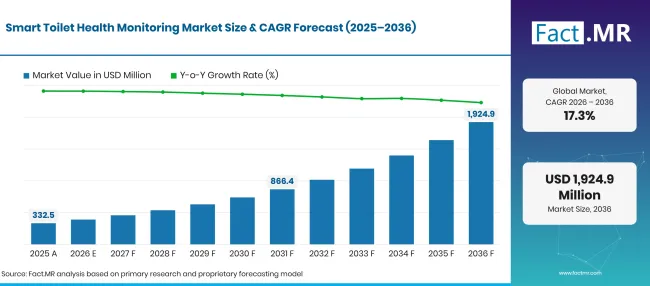
Smart Toilet Health Monitoring Market Forecast Global | Source: Fact.MR
Category
| Category | Segments |
|---|---|
| Sensing Principle | Urinalysis cartridges, Optical urine spectroscopy, Stool imaging, Seat-integrated vital sensing, Multi-biomarker sampling |
| Data Processing | Hybrid edge-cloud, Smartphone companion, Cloud AI, Clinician-linked dashboard, On-device algorithm |
| Sales Channel | Clinical / professional, Retail electronics, Pharmacy / wellness retail, Brand direct online, B2B / institutional |
| Region | South Korea; China; United States; Japan; Germany |
Source: Fact.MR analysis. Updated Nov 20, 2026
Segmental Analysis
Why do urinalysis cartridges lead sensing demand in the Smart Toilet Health Monitoring Market?
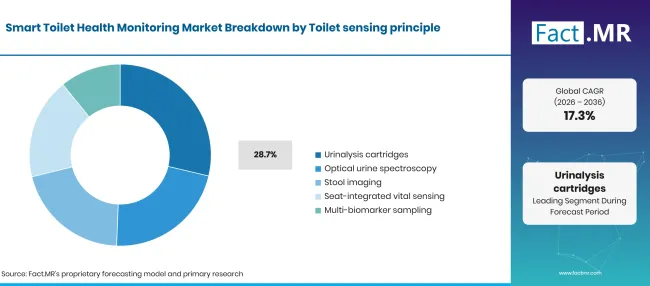
Smart Toilet Health Monitoring Market Breakdown Toilet Sensing Principle | Source: Fact.MR
Demand for urinalysis cartridges account for 28.7% of the smart toilet health monitoring market in 2026, about USD 111.9 million, because urine chemistry offers repeatable markers of hydration, nutrition, kidney health and metabolic status from each use. Withings' U-Scan, for example, clips to the front of the toilet bowl and analyzes urine through replaceable cartridges managed in the Withings app. Manufacturers of smart toilet health monitoring products earn recurring revenue from cartridge refills. Similar subscription economics are projected to keep urinalysis cartridges the leading sensing principle, building on the base of the smart toilet market.
How is hybrid edge-cloud processing leading data demand in the Smart Toilet Health Monitoring Market?
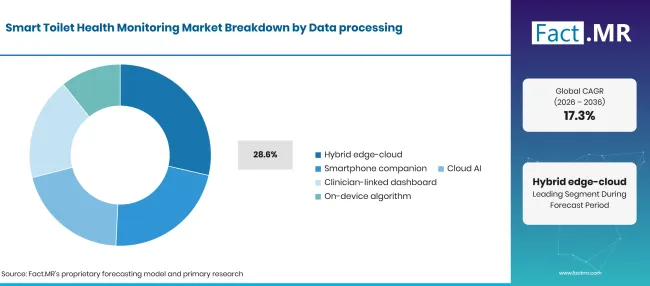
Smart Toilet Health Monitoring Market Breakdown Data Processing | Source: Fact.MR
Adoption of hybrid edge-cloud processing represents 28.6% of smart toilet health monitoring revenue in 2026, about USD 111.5 million, because devices must process images and sensor signals locally to protect privacy while syncing trends to cloud apps for long-term analysis. Kohler's Dekoda, for example, analyzes data through the Kohler Health app, where users can also record diet, exercise and medications. Manufacturers of smart toilet health monitoring are minimizing raw image transfer and sending only derived health metrics. Similar privacy expectations are projected to keep hybrid processing the leading data model.
Why do clinical and professional channels lead sales in the Smart Toilet Health Monitoring Market?
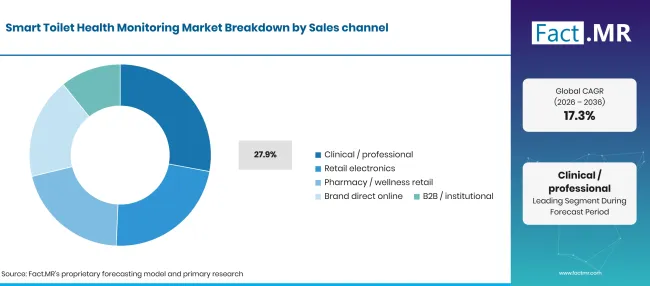
Smart Toilet Health Monitoring Market Breakdown Sales Channel | Source: Fact.MR
Sales through clinical and professional channels to hold 27.9% of smart toilet health monitoring revenue in 2026, about USD 108.8 million, as senior-living operators, care homes and health systems deploy toilet sensors to monitor residents without wearables. Continuous bathroom data can flag dehydration, infection and cardiovascular change earlier than periodic checks. Manufacturers of smart toilet health monitoring, such as Toi Labs with its TrueLoo platform, are building longitudinal data services for care providers. Similar institutional demand is projected to keep clinical channels the leading route to market, alongside the disabled and elderly assistive technology market.
Smart Toilet Health Monitoring Market-Drivers, Restraints & Trends
Drivers
Demand for smart toilet health monitoring is rising as regulators clear toilet-based devices for medical measurements. For example, in February 2026, Casana received FDA clearance for its Heart Seat to monitor heart rate and oxygen saturation in adults aged 22 and older. Manufacturers of smart toilet health monitoring are using such clearances to reach clinicians and insurers. Similar regulatory milestones are projected to drive sales of smart toilet health monitoring through the forecast period.
Restraints
Demand for smart toilet health monitoring is constrained by privacy concerns over sensors and cameras in the bathroom. For example, in April 2026, the New York Post reported that toilet technology is emerging as the next frontier of health data but might mean putting a camera on the bowl. Similar consumer hesitation is projected to slow sales of smart toilet health monitoring in households wary of data collection. Manufacturers of smart toilet health monitoring must offer on-device processing, clear consent and secure storage.
Opportunities
Aging in Place In July 2026, the Rochester Institute of Technology described how research behind Casana's Smart Seat aims to transform home health monitoring for older adults. Demand for passive monitoring is rising as families and care providers support older people living independently. Similar research is projected to drive sales of smart toilet health monitoring designed for seniors. Manufacturers of smart toilet health monitoring are simplifying installation and multi-user recognition for home and care settings.
Trend
Japan as a Collaboration Hub Demand for international partnerships in toilet-based health monitoring is rising as Japanese toilet makers and foreign start-ups explore joint development. Manufacturers of smart toilet health monitoring are presenting to Japanese partners familiar with high-tech toilets. For example, in November 2026, Toi Labs, developer of the TrueLoo platform, took part in Japan Week in Kyoto alongside Japanese industry participants including TOTO. Similar collaboration is projected to drive sales of smart toilet health monitoring integrated into bidet and washlet products.
Smart Toilet Health Monitoring Market by Analysis by Key Country
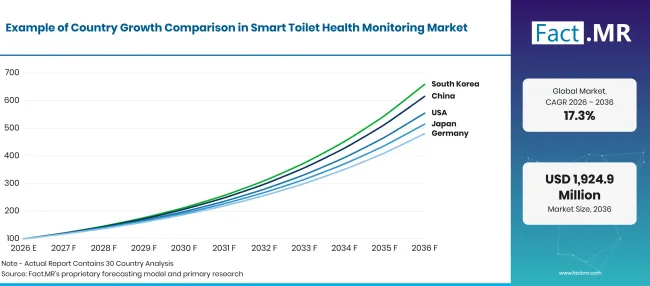
Smart Toilet Health Monitoring Market Growth Index | Source: Fact.MR
| Country | CAGR (2026-2036) |
|---|---|
| South Korea | 20.8% |
| China | 19.9% |
| United States | 18.7% |
| Japan | 17.8% |
| Germany | 17.0% |
Source: Fact.MR analysis. Updated Nov 20, 2026
Source: Fact.MR analysis.
What is driving smart toilet health monitoring demand in South Korea?
In August 2026, IndexBox estimated that household penetration of bidet and toilet combinations in South Korea would reach about 45% to 50% by 2026, up from roughly one-third a decade earlier.
Demand for smart toilet health monitoring in South Korea is projected to grow at a 20.8% CAGR, the fastest among the five key countries, as health sensing is added to already common electronic bidets. Manufacturers of smart toilet health monitoring are partnering with Korean appliance makers. Similar installed bases are projected to drive sales in South Korea.
How is smart toilet adoption supporting smart toilet health monitoring sales in China?
Sales of smart toilet health monitoring in China are estimated to increase at a 19.9% CAGR as smart toilet seats spread through urban homes.
For example, in August 2026, IndexBox projected that smart toilet seat penetration in urban Chinese households would rise from roughly 10% to 15% toward 25% to 30% by 2035. Manufacturers of smart toilet health monitoring are working with Chinese sanitaryware manufacturers that dominate global smart toilet production. Similar adoption is projected to drive sales of smart toilet health monitoring in China.
What is shaping smart toilet health monitoring demand in the United States?
Demand for smart toilet health monitoring in the United States is estimated to record a 18.7% CAGR as start-ups and established brands launch consumer products.
For example, Casana launched its Smart Seat in July 2026, and Kohler Health's Dekoda gained attention in 2026 for gut-health and blood detection. Manufacturers of smart toilet health monitoring are selling through direct online channels and senior-living partnerships. Similar product activity is projected to drive sales of smart toilet health monitoring in the United States.
Why is Japan an important market for smart toilet health monitoring?
Sales of smart toilet health monitoring in Japan are projected to represent a 17.8% CAGR as health sensing builds on near-universal washlet ownership.
In March 2026, 82.5% of Japanese households with two or more people had a warm-water washing toilet seat, more than had a car. Manufacturers of smart toilet health monitoring are developing add-on sensors and integrated seats for this installed base. Similar familiarity with high-tech toilets is projected to sustain sales of smart toilet health monitoring in Japan.
How is home care shaping smart toilet health monitoring demand in Germany?
Demand for smart toilet health monitoring in Germany is estimated to hold a 17.0% CAGR, the slowest among the five countries, as home care needs rise. In July 2026, Germany's Medical Service (MD Bund) reported that about 6 million people received long-term care insurance benefits at the end of 2025, nearly double the number in 2015.
Manufacturers of smart toilet health monitoring are positioning products for home care providers and families caring for relatives. Similar care demand is projected to support sales in Germany.
Competitive Landscape for Smart Toilet Health Monitoring Market
Competition in the smart toilet health monitoring market combines sanitaryware manufacturers and health-technology start-ups. TOTO and Kohler compete through integrated toilets and attachments backed by large retail and installer networks, Withings through its U-Scan urine lab, Casana through FDA-cleared vital-sign seats, Olive Diagnostics through optical urine analysis, and Toi Labs through its TrueLoo platform for senior living. Buyers select products on measured parameters, ease of installation, privacy safeguards, app quality and cartridge or subscription cost.
From 2025 onward, competition shifted toward medical-grade measurements and senior-care deployments. Casana received FDA clearance in February 2026 and launched its Smart Seat in July 2026, Kohler promoted Dekoda's blood detection, and Toi Labs engaged Japanese partners in November 2026. Manufacturers with regulatory clearances and privacy-first designs are best placed to win institutional and consumer demand.
Recent Developments
- In November 2026, Kohler Health's Dekoda was presented as the first toilet-based health tracker able to detect blood.
- In November 2026, Toi Labs participated in Japan Week in Kyoto with Japanese industry participants including TOTO.
- In July 2026, Casana launched its Smart Seat to monitor blood pressure trends and vital signs at home.
- In February 2026, Casana received FDA clearance for its Heart Seat to monitor heart rate and oxygen saturation.
Key Players in Smart Toilet Health Monitoring Market
Key companies profiled include TOTO; Kohler; Withings; Casana; Olive Diagnostics; and Toi Labs.
- TOTO
- Kohler
- Withings
- Casana
- Olive Diagnostics
- Toi Labs
Bibliography
- Casana. (2026, July 21). Casana introduces the first smart toilet seat to monitor blood pressure trends and vital signs at home.
- IndexBox. (2026). Bath and toilet appliances market in South Korea.
- IndexBox. (2026). Bath and toilet appliances market in China.
- Kohler Co. (2026). Dekoda health tracker.
- Medizinischer Dienst Bund. (2026). Report Pflegebedürftigkeit 2026: Entwicklung und Potenziale der Pflegebegutachtung.
- MobiHealthNews. (2026). Casana scores FDA clearance for health monitoring toilet seat
- Statistics Bureau of Japan, Cabinet Office. (2026). Consumer confidence survey: Diffusion of durable goods, March 2026.
Segmentation
Scope of Report
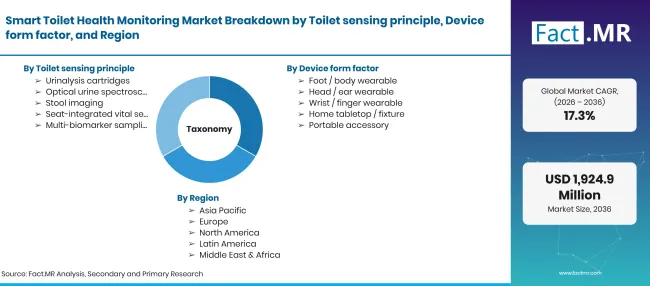
Smart Toilet Health Monitoring Market Taxonomy | Source: Fact.MR
| Items | Values |
|---|---|
| Quantitative Units (2026) | USD 390.0 Million |
| Sensing Principle | Urinalysis cartridges, Optical urine spectroscopy, Stool imaging, Seat-integrated vital sensing, Multi-biomarker sampling |
| Data Processing | Hybrid edge-cloud, Smartphone companion, Cloud AI, Clinician-linked dashboard, On-device algorithm |
| Sales Channel | Clinical / professional, Retail electronics, Pharmacy / wellness retail, Brand direct online, B2B / institutional |
| Regions Covered | North America, Latin America, Europe, East Asia, South Asia and Pacific, Middle East & Africa |
| Countries Covered | South Korea, China, United States, Japan, Germany, and other countries |
| Key Companies Profiled | TOTO, Kohler, Withings, Casana, Olive Diagnostics, Toi Labs |
| Additional Attributes | Dollar revenue in the Smart Toilet Health Monitoring Market is segmented by sensing principle (urinalysis cartridges, optical urine spectroscopy, stool imaging, seat-integrated vital sensing, multi-biomarker sampling), data processing, sales channel and region. |
Source: Fact.MR analysis. Updated Nov 20, 2026
Smart Toilet Health Monitoring Market by Segments
-
Sensing Principle
- Urinalysis cartridges
- Optical urine spectroscopy
- Stool imaging
- Seat-integrated vital sensing
- Multi-biomarker sampling
-
Data Processing
- Hybrid edge-cloud
- Smartphone companion
- Cloud AI
- Clinician-linked dashboard
- On-device algorithm
-
Sales Channel
- Clinical / professional
- Retail electronics
- Pharmacy / wellness retail
- Brand direct online
- B2B / institutional
-
Region:
- North America
- United States
- Canada
- Mexico
- Europe
- Germany
- United Kingdom
- France
- Italy
- Spain
- Rest of Europe
- Asia Pacific
- China
- India
- Japan
- South Korea
- Australia
- Rest of Asia Pacific
- Latin America
- Brazil
- Mexico
- Argentina
- Rest of Latin America
- Middle East & Africa
- GCC Countries
- South Africa
- Rest of Middle East & Africa
- North America
Frequently Asked Questions
How big is the global Smart Toilet Health Monitoring Market in 2026?
What will be the size of the Smart Toilet Health Monitoring Market by 2036?
How fast will the Smart Toilet Health Monitoring Market grow during the forecast period?
Which sensing principle segment holds the largest share of the Smart Toilet Health Monitoring Market?
Who worked on this report


Preview the report firsthand - request a free sample
Free SampleGet the brochure for pricing and purchase details
Download PDF