- Market Value (2025): USD 39.8 Mn
- Estimated Value (2026): USD 45.0 Mn
- Forecast Value (2036): USD 154.1 Mn
- CAGR (2026-2036): 13.1%
Type-1 Interferonopathy Inhibitors Market Forecast and Outlook 2026 to 2036
The type-1 interferonopathy inhibitors market is projected to grow from USD 45.0 million in 2026 to USD 154.1 million by 2036. Demand for type-1 interferonopathy inhibitors is likely to grow at a CAGR of 13.1% over the forecast period.
Buyers of type-1 interferonopathy inhibitors respond to clinicians treat rare inflammatory diseases driven by excess type I interferon signaling, such as Aicardi-Goutières syndrome, CANDLE and STING-associated vasculopathy, and related autoimmune diseases such as lupus. Drugs that block JAK1/2, TYK2, the interferon receptor or the cGAS-STING pathway can calm this signaling. For example, studies at the US National Institutes of Health reported benefit from the JAK inhibitor baricitinib in patients with CANDLE and related interferonopathies. Clinical evidence may expand the commercial opportunity for type-1 interferonopathy inhibitors during the forecast period.
Market Snapshot: Type-1 Interferonopathy Inhibitors Market
- Sales of type-1 interferonopathy inhibitors stood at USD 39.8 million in 2025
- Type-1 Interferonopathy Inhibitors Market Value (2026): USD 45.0 million
- Type-1 Interferonopathy Inhibitors Market Forecast Value (2036): USD 154.1 million
- Type-1 Interferonopathy Inhibitors Market Forecast CAGR (2026-2036): 13.1%
- Leading Interferonopathy inhibitor target: JAK1/2 (25.4%)
- Key Market Participants: Incyte, Pfizer, AstraZeneca, Eli Lilly and Company, Novartis, Boehringer Ingelheim
- Key Growth Regions: United States, United Kingdom, France, Germany, Japan
Type-1 Interferonopathy Inhibitors Market
| Metric | Value |
|---|---|
| Estimated Value in (2026) | USD 45.0 million |
| Forecast Value in (2036) | USD 154.1 million |
| Forecast CAGR (2026 to 2036) | 13.1% |
Source: Fact.MR analysis. Updated Nov 20, 2026
Source: Fact.MR analysis.
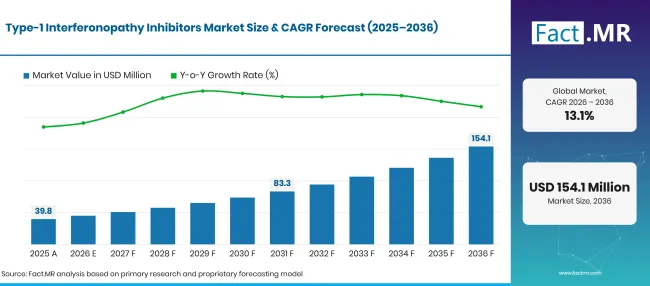
Type 1 Interferonopathy Inhibitors Forecast Global | Source: Fact.MR
Category
| Category | Segments |
|---|---|
| Interferonopathy inhibitor target | JAK1/2, TYK2, IFNAR1, STING / cGAS pathway, Other pathway inhibitors |
| Development / delivery route | Small molecule, Biologic, Gene therapy, Cell therapy, Combination / other |
| Care setting | Hospital inpatient, Specialist outpatient, Ambulatory center, Home-supported care, Research / clinical trial |
| Patient population | Pediatric, Adult, Older adult, Mixed age, Rare genotype-defined |
| Region | United States; United Kingdom; France; Germany; Japan |
Source: Fact.MR analysis. Updated Nov 20, 2026
Source: Fact.MR analysis.
Segmental Analysis
Why do JAK1/2 inhibitors lead target demand in the Type-1 Interferonopathy Inhibitors Market?
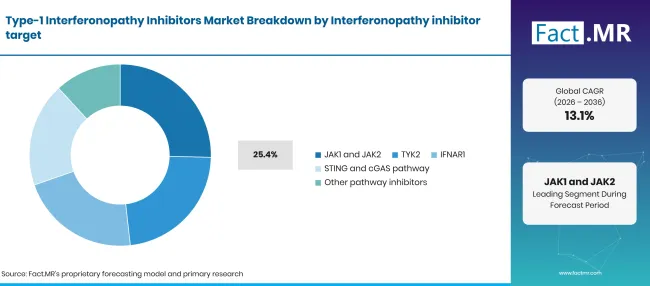
Type 1 Interferonopathy Inhibitors Breakdown Interferonopathy Inhibitor Target | Source: Fact.MR
JAK1/2 inhibitors account for 25.4% of revenue in 2026, approximately USD 11.4 million, supported by their ability to suppress interferon-mediated inflammatory signaling. Baricitinib and ruxolitinib are being investigated or used off-label for selected interferonopathies. STING/cGAS and TYK2 inhibitors represent additional development approaches. Pharmaceutical companies are evaluating JAK inhibitors to improve disease control and reduce inflammatory symptoms in patients with rare genetic disorders.
Why does cell therapy lead development-route demand in the Type-1 Interferonopathy Inhibitors Market?
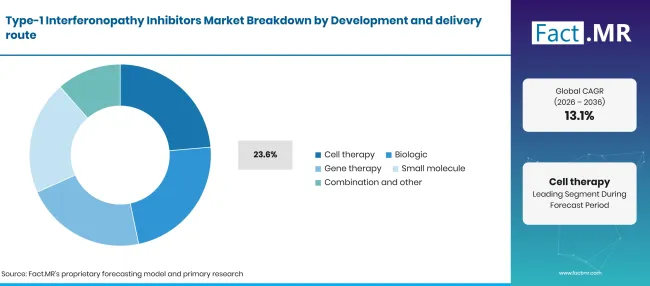
Type 1 Interferonopathy Inhibitors Breakdown Development And Delivery Route | Source: Fact.MR
Cell therapy represents an internally estimated 23.6% of revenue in 2026, approximately USD 10.6 million, reflecting research into engineered immune cells for severe autoimmune conditions. CAR-T therapies are being investigated for lupus but do not directly inhibit type I interferon signaling. Their inclusion requires a clearly defined market scope. Biologics and small molecules provide more direct therapeutic approaches.
Why do ambulatory centers lead care-setting demand in the Type-1 Interferonopathy Inhibitors Market?
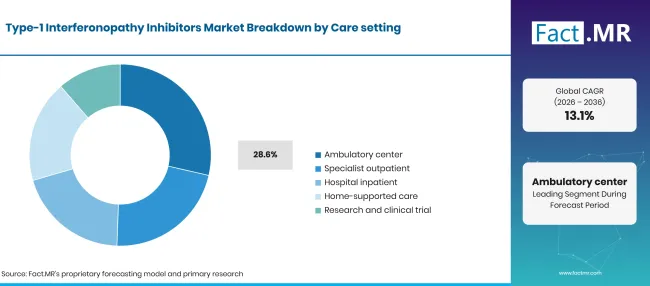
Type 1 Interferonopathy Inhibitors Breakdown Care Setting | Source: Fact.MR
Ambulatory centers account for 28.6% of revenue in 2026, approximately USD 12.9 million, as patients with lupus and rare inflammatory disorders often require specialist consultations, infusions and ongoing monitoring. Outpatient facilities provide treatment administration and follow-up assessments without extended hospitalization. Research institutions and inpatient departments serve more complex cases. Manufacturers are supporting outpatient treatment through specialized administration protocols and clinical monitoring programs.
Why does the adult population lead patient demand in the Type-1 Interferonopathy Inhibitors Market?
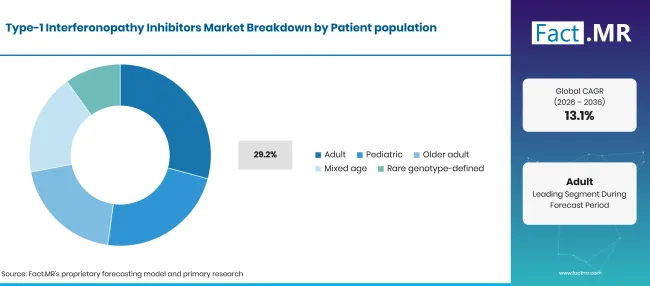
Type 1 Interferonopathy Inhibitors Breakdown Patient Population | Source: Fact.MR
The adult population represents 29.2% of revenue in 2026, valued at approximately USD 13.1 million, reflecting treatment requirements among working-age patients with lupus and related interferon-driven conditions. These disorders frequently affect adult women and require long-term disease management. Mixed-age populations and rare genetically defined patient groups contribute additional demand. Pharmaceutical developers are evaluating targeted therapies for persistent inflammation and autoimmune complications.
Type-1 Interferonopathy Inhibitors Market-Drivers, Restraints & Trends
Drivers:
Demand for type-1 interferonopathy inhibitors is increasing as genetic testing improves the identification of rare interferon-mediated disorders. Advances in lupus research are also encouraging pharmaceutical companies to investigate targeted treatments. Developers are conducting clinical studies involving JAK inhibitors and other inflammatory signaling pathways.
Restraints:
Infection risks, safety concerns and limited patient populations restrict the development of type-1 interferonopathy inhibitors. FDA boxed warnings highlight serious risks associated with certain JAK inhibitors. Pharmaceutical developers must demonstrate pathway selectivity, sustained clinical benefits and acceptable safety profiles while managing complex trial requirements.
Trend: CAR-T for Autoimmune Disease:
Research into CAR-T therapies for severe autoimmune diseases is expanding following early reports of remission in lupus patients. Biotechnology companies are evaluating engineered immune cells in clinical trials. These treatments target autoimmune activity rather than directly inhibiting type I interferon signaling, requiring separate therapeutic classification.
Trend: STING Pathway Inhibitors:
Pharmaceutical researchers are developing inhibitors targeting the cGAS-STING signaling pathway, which contributes to interferon production and inflammatory responses. These experimental medicines may offer treatment options for selected interferon-mediated disorders. Developers are investigating target selectivity, cellular activity and safety before advancing candidates into broader clinical studies.
Type-1 Interferonopathy Inhibitors Market by Analysis by Key Country
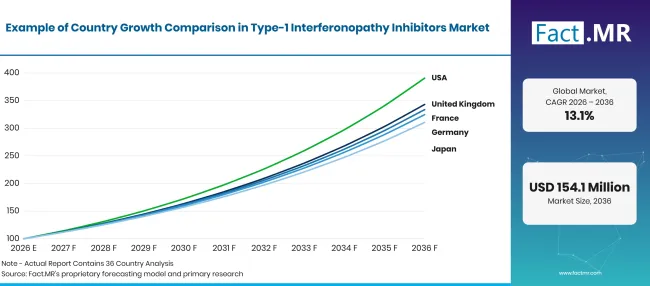
Type 1 Interferonopathy Inhibitors Growth Index | Source: Fact.MR
| Country | CAGR (2026-2036) |
|---|---|
| United States | 14.6% |
| United Kingdom | 12.7% |
| France | 12.6% |
| Germany | 12.5% |
| Japan | 12.0% |
Source: Fact.MR analysis. Updated Nov 20, 2026
Source: Fact.MR analysis.
Why is the United States the fastest-growing market for type-1 interferonopathy inhibitors?
Demand for type-1 interferonopathy inhibitors in the United States is forecast to rise at a 14.6% CAGR through 2036, the fastest among the five countries.
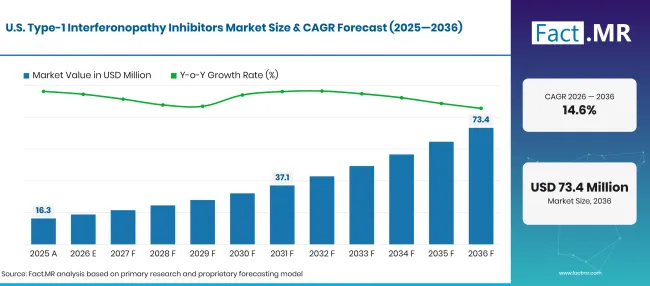
Type 1 Interferonopathy Inhibitors Forecast Usa | Source: Fact.MR
NIH-supported research and orphan drug incentives encourage investigation of rare interferon-mediated disorders. Clinical studies in lupus also broaden interest in treatments that modify inflammatory signaling. US-based companies, including Incyte, Pfizer and AstraZeneca, maintain immunology development capabilities. Future adoption will depend on clinical evidence for specific indications, treatment safety, regulatory clearance and access to specialized healthcare facilities.
What is shaping type-1 interferonopathy inhibitor demand in the United Kingdom?
Demand for type-1 interferonopathy inhibitors in the United Kingdom could increase at a 12.7% CAGR through 2036, supported by specialist pediatric services and genomic medicine programs.
Earlier identification of rare genetic conditions allows clinicians to evaluate targeted treatments and refer patients for research studies. Great Ormond Street Hospital in London provides specialist pediatric immunology expertise for complex disorders. Treatment development remains challenging because patient populations are small and disease mechanisms vary. Prescribing decisions will depend on molecular diagnosis, clinical evidence, safety monitoring and access to experienced multidisciplinary teams.
What is shaping type-1 interferonopathy inhibitor demand in France?
Demand for type-1 interferonopathy inhibitors in France is forecast to advance at a 12.6% CAGR through 2036 as rare disease research and specialist care networks support diagnosis and treatment development.
The Imagine Institute in Paris studies genetic inflammatory disorders, including Aicardi-Goutières syndrome. National rare disease plans also support reference centers and coordinated patient care. Pharmaceutical developers are examining targeted approaches for interferon-mediated conditions. Commercial opportunities will depend on patient recruitment, clinical trial outcomes, regulatory authorization and treatment access.
What is shaping type-1 interferonopathy inhibitor demand in Germany?
Demand for type-1 interferonopathy inhibitors in Germany is set to expand at a 12.5% CAGR through 2036, reflecting research activity in autoimmune and interferon-mediated diseases.
Researchers in Erlangen have explored CD19-directed CAR-T therapy for severe lupus, an approach distinct from direct type I interferon inhibition. Rheumatology departments and university hospitals are also investigating medicines targeting inflammatory pathways. These activities support clinical expertise and participation in specialized research programs. Treatment decisions will reflect molecular diagnosis, demonstrated effectiveness, adverse-event monitoring and reimbursement arrangements for advanced therapies.
Why is type-1 interferonopathy inhibitor growth slower in Japan?
Demand for type-1 interferonopathy inhibitors in Japan is forecast to increase at a 12.0% CAGR through 2036, the slowest among the five countries.
Regulatory review procedures and local development requirements can influence the availability of newer immunology treatments. Japanese researchers helped characterize Nakajo-Nishimura syndrome, a rare inflammatory condition associated with disrupted immune regulation. Specialist institutions are examining related therapeutic pathways and opportunities for targeted treatment development. Wider adoption will depend on approved indications, clinical safety, reimbursement decisions, diagnostic capabilities and access to specialized medical centers.
Competitive Market for Type-1 Interferonopathy Inhibitors Market
Competition in the type-1 interferonopathy inhibitors market is concentrated among immunology drug makers. Incyte and Pfizer compete with JAK inhibitors, and Eli Lilly and Company, Novartis and Boehringer Ingelheim with broad immunology and cell therapy pipelines. Buyers select therapies on efficacy, safety, evidence and access.
From 2025 onward, competition shifted toward selective inhibitors and cell therapies. An advantage may accrue to suppliers with targeted, safer options as they seek to grow.
Recent Developments
- In May 2025, AstraZeneca completed its acquisition of EsoBiotec, adding in vivo cell therapy technology designed to modify immune cells inside the body and support future treatments for cancer and immune-mediated diseases.
- In May 2026, Eli Lilly acquired Orna Therapeutics, adding circular RNA technology and an in vivo CAR-T therapy platform designed to target B cells involved in autoimmune diseases and other serious conditions.
Key Players in Type-1 Interferonopathy Inhibitors Market
Key companies operating in the market include Incyte, Pfizer, AstraZeneca, Eli Lilly and Company, Novartis, and Boehringer Ingelheim.
- Incyte
- Pfizer
- AstraZeneca
- Eli Lilly and Company
- Novartis
- Boehringer Ingelheim
Type-1 Interferonopathy Inhibitors Market by Segments
-
Interferonopathy inhibitor target
- JAK1/2
- TYK2
- IFNAR1
- STING / cGAS pathway
- Other pathway inhibitors
-
Development / delivery route
- Small molecule
- Biologic
- Gene therapy
- Cell therapy
- Combination / other
-
Care setting
- Hospital inpatient
- Specialist outpatient
- Ambulatory center
- Home-supported care
- Research / clinical trial
-
Patient population
- Pediatric
- Adult
- Older adult
- Mixed age
- Rare genotype-defined
-
Region:
- North America
- United States
- Canada
- Mexico
- Europe
- Germany
- United Kingdom
- France
- Italy
- Spain
- Rest of Europe
- Asia Pacific
- China
- India
- Japan
- South Korea
- Australia
- Rest of Asia Pacific
- Latin America
- Brazil
- Mexico
- Argentina
- Rest of Latin America
- Middle East & Africa
- GCC Countries
- South Africa
- Rest of Middle East & Africa
- North America
Bibliography
- AstraZeneca. (2025, May 20). Acquisition of EsoBiotec completed.
- Eli Lilly and Company. (2026, February 9). Lilly to acquire Orna Therapeutics to advance cell therapies.
- American College of Rheumatology. (2025, November 3). 2025 American College of Rheumatology guideline for the treatment of systemic lupus erythematosus.
- AstraZeneca. (2026, January 6). Saphnelo self-administration TULIP-SC trial demonstrates statistically significant and clinically meaningful reduction in systemic lupus erythematosus disease activity.
- AstraZeneca. (2026, April 27). Saphnelo approved in the US for subcutaneous self-administration as a new autoinjector for the treatment of systemic lupus erythematosus.
- Feng, J., Huo, D., Hong, R., Jin, X., Cao, H., Shao, M., et al. (2025). Co-infusion of CD19-targeting and BCMA-targeting CAR-T cells for treatment-refractory systemic lupus erythematosus: A phase 1 trial. Nature Medicine, 31, 3725–3736.
- Manzi, S., Bruce, I. N., Morand, E. F., Furie, R., Tanaka, Y., Kalunian, K. C., et al. (2025, December 29). Efficacy and safety of subcutaneous anifrolumab in systemic lupus erythematosus: A randomized, phase 3 study. Arthritis & Rheumatology.
- Müller, F., Hagen, M., Wirsching, A., Kharboutli, S., Aigner, M., Völkl, S., et al. (2026). CD19 CAR-T cells for treatment-refractory autoimmune diseases: The phase 1/2 CASTLE basket trial. Nature Medicine, 32, 1142–1151.
- Shu, J., Xie, W., Mei, C., Ren, A., Ke, S., Ma, M., et al. (2025). Safety and clinical efficacy of relmacabtagene autoleucel (relma-cel) for systemic lupus erythematosus: A phase 1 open-label clinical trial. EClinicalMedicine, 83, 103229.
- U.S. Food and Drug Administration. (2026, April). Saphnelo (anifrolumab-fnia) prescribing information.
- Wang, Q., Xiao, Z. X., Zheng, X., Wang, G., Yang, L., Shi, L., et al. (2025). In vivo CD19 CAR T-cell therapy for refractory systemic lupus erythematosus. The New England Journal of Medicine, 393, 1542–1544.
- Xu, J., Mei, C., Guan, X., et al. (2026). A bispecific CD3×CD19 antibody for systemic lupus erythematosus: A phase 1 trial. Nature Medicine, 32, 3372–3384.
Segmentation
Scope of Report
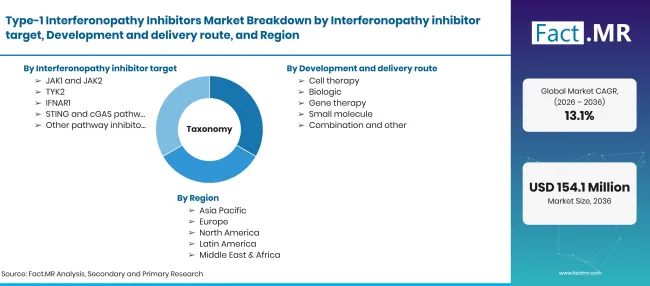
Type 1 Interferonopathy Inhibitors Taxonomy | Source: Fact.MR
| Items | Values |
|---|---|
| Quantitative Units (2026) | USD 45.0 Million |
| Interferonopathy inhibitor target | JAK1/2, TYK2, IFNAR1, STING / cGAS pathway, Other pathway inhibitors |
| Development / delivery route | Small molecule, Biologic, Gene therapy, Cell therapy, Combination / other |
| Care setting | Hospital inpatient, Specialist outpatient, Ambulatory center, Home-supported care, Research / clinical trial |
| Patient population | Pediatric, Adult, Older adult, Mixed age, Rare genotype-defined |
| Regions Covered | North America, Latin America, Europe, East Asia, South Asia and Pacific, Middle East & Africa |
| Countries Covered | United States, United Kingdom, France, Germany, Japan, and other countries |
| Key Companies Profiled | Incyte, Pfizer, AstraZeneca, Eli Lilly and Company, Novartis, Boehringer Ingelheim |
| Additional Attributes | Dollar revenue in the Type-1 Interferonopathy Inhibitors Market is segmented by interferonopathy inhibitor target (JAK1/2, TYK2, IFNAR1, STING / cGAS pathway, other pathway inhibitors); development / delivery route (small molecule, biologic, gene therapy, cell therapy, combination / other); care setting (hospital inpatient, specialist outpatient, ambulatory center, home-supported care, research / clinical trial); patient population (pediatric, adult, older adult, mixed age, rare genotype-defined) and region. |
Source: Fact.MR analysis. Updated Nov 20, 2026
Source: Fact.MR analysis.
Frequently Asked Questions
How big is the global Type-1 Interferonopathy Inhibitors Market in 2026?
What will be the size of the Type-1 Interferonopathy Inhibitors Market by 2036?
How fast will the Type-1 Interferonopathy Inhibitors Market grow during the forecast period?
Which interferonopathy inhibitor target segment holds the largest share of the Type-1 Interferonopathy Inhibitors Market?
Who worked on this report


Preview the report firsthand - request a free sample
Free SampleGet the brochure for pricing and purchase details
Download PDF