- Base Value(2025): 18.5 Bn
- Estimated Value(2026): 20.5 Bn
- Forecast Value (2036): 57.7 Bn
- CAGR (2026 - 2036): 10.9%
Smart Mining Market Forecast By Fact.MR
In 2025, the smart mining market was valued at USD 18.5 billion. Based on FMR analysis, demand for smart mining solutions is estimated to grow to USD 20.5 billion in 2026 and USD 57.7 billion by 2036. FMR projects a CAGR of 10.9% during the forecast period.
The absolute dollar growth from 2026 to 2036 is USD 37.2 billion. This expansion reflects increasing adoption of automated drilling, predictive maintenance systems, and real-time monitoring technologies across mining operations. Mining companies are investing in digital platforms to improve operational efficiency, worker safety, and resource recovery. Growth remains steady rather than unrestricted due to high capital expenditure requirements, fluctuating commodity prices, and integration challenges with legacy mining infrastructure.
China leads with a CAGR of 8.5%, supported by modernization of large-scale mining operations and domestic equipment manufacturing capacity. The United States follows with 7.8%, driven by automation investments in large mining companies. Japan records 7.6%, supported by demand for advanced mining equipment and robotics technologies. Australia grows at 7.4%, reflecting adoption of autonomous haulage and remote operations in major mining sites. Germany records 7.2%, where demand is linked to industrial equipment manufacturing and mining technology exports.
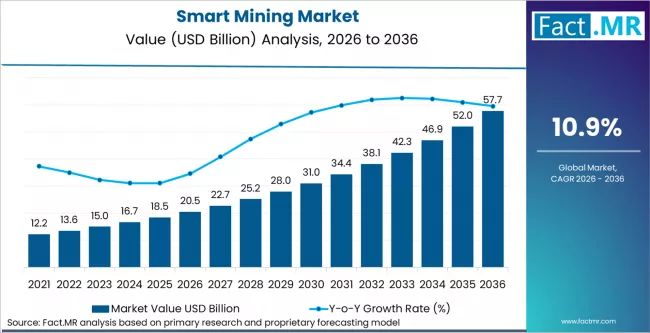
Smart Mining Market Market Value Analysis | Source: Fact.MR
Smart Mining Market
| Metric | Value |
|---|---|
| Estimated Value in (2026E) | USD 20.5 billion |
| Forecast Value in (2036F) | USD 57.7 billion |
| Forecast CAGR (2026 to 2036) | 10.9% |
Source: Fact.MR analysis. Updated Mar 13, 2026
Smart Mining Market Definition
The Smart Mining Market involves the deployment and sale of digital technologies, automation systems, and data-driven solutions that improve efficiency, safety, and productivity in mining operations. These solutions integrate technologies such as Internet of Things sensors, artificial intelligence, robotics, and analytics platforms to monitor equipment, manage resources, and automate extraction processes in both surface and underground mines. Smart mining transforms traditional mining methods into connected, data-driven operations where real-time information supports operational decisions and improves worker safety and resource utilization.
Market Inclusions
This report covers global and regional market sizes for smart mining across a defined forecast period. It includes digital hardware, software platforms, and integration services used in mining automation and monitoring, such as IoT sensors, fleet automation systems, analytics platforms, and connectivity infrastructure. Applications covered include mining operations management, safety and monitoring systems, predictive maintenance, and supply chain optimization across metal, mineral, and coal mining operations.
Market Exclusions
The scope excludes conventional mining machinery and equipment that do not include digital monitoring or automation capabilities. It also excludes general industrial automation technologies not specifically deployed for mining environments, and downstream mineral processing or manufacturing activities unrelated to mine site digitalization.
Research Methodology
- Primary Research: Interviews were conducted with mining technology providers, automation engineers, mining operators, and industry analysts.
- Desk Research: Data was sourced from mining technology reports, energy and resource industry publications, and trade association statistics.
- Market-Sizing and Forecasting: A hybrid model combining top-down mining investment forecasts with bottom-up deployment and revenue data for smart mining solutions was used.
- Data Validation and Update Cycle: Findings were validated through expert consultations and cross-checked with recent technology adoption, mining production, and industry investment data.
Summary of the Smart Mining Market
- Market Definition
- The Smart Mining Market involves the deployment and sale of digital technologies, automation systems, and data driven platforms designed to improve productivity, safety, and operational efficiency in mining operations. These solutions integrate sensors, robotics, analytics platforms, and connected equipment to monitor assets, automate extraction processes, and support real time decision making across surface and underground mining sites.
- Demand Drivers
- Increasing adoption of automated drilling systems, autonomous haulage equipment, and robotic mining vehicles.
- Growing deployment of sensors and connected monitoring devices for real time operational visibility.
- Rising demand for predictive maintenance platforms that reduce equipment downtime and maintenance costs.
- Expansion of digital mine management systems that improve resource planning and operational efficiency.
- Increasing focus on worker safety through remote monitoring, automated equipment, and digital risk detection systems.
- Key Segments Analyzed
- Component: Hardware dominates with 40% share in 2026, followed by Intelligent Systems, RFID Tags and Sensors, and Other Hardware.
- Solution: Data and Operation Management Software leads with 40% share in 2026, followed by Analytics Solutions and Connectivity Platforms.
- Automated Equipment: Driller and Breaker, Load Haul Dump, Mining Excavator, Robotic Trucks, and Other Automated Equipment.
- Services: Engineering and Maintenance Services, Consulting Services, Product Training Services, Implementation and Integration Services.
- Geography: East Asia and North America drive adoption. China records the highest CAGR at 8.5%, followed by USA (7.8%), Japan (7.6%), Australia (7.4%), and Germany (7.2%).
- Analyst Opinion at Fact MR
- Shambhu Nath Jha, Principal Consultant, Fact MR, opines, "In this updated edition of the Smart Mining Market report, industry participants will observe that value creation is shifting from isolated automation technologies toward integrated digital mining ecosystems. Smart mining platforms are no longer limited to equipment monitoring but increasingly combine automation, predictive analytics, and centralized operations management across entire mining sites. Companies that invest in autonomous equipment fleets, advanced data analytics platforms, and integrated operational control systems will capture productivity improvements and stronger operational efficiency. The convergence of automation technology, connected equipment, and data driven decision systems defines the competitive landscape through 2036."
- Strategic Implications or Executive Takeaways
- Invest in autonomous mining equipment such as robotic haul trucks and automated drilling systems.
- Deploy integrated digital platforms combining operational analytics, fleet management, and predictive maintenance.
- Strengthen sensor networks and real time monitoring systems across large scale mining operations.
- Develop partnerships between mining operators and technology providers to support digital transformation programs.
- Prioritize safety focused automation systems that reduce worker exposure to hazardous mining environments.
- Methodology
- Primary Research: Interviews with mining operators, automation engineers, equipment manufacturers, and mining technology specialists.
- Desk Research: Data compiled from mining industry reports, energy and resource sector publications, and trade association statistics.
- Market Sizing and Forecasting: Hybrid model combining top down mining investment forecasts with bottom up deployment and revenue data for automation and digital mining technologies.
- Data Validation: Findings validated through expert consultations and cross checked with recent mining production data, technology adoption trends, and industry investment statistics using Fact MR forecasting models.
Segmental Analysis
Smart Mining Market Analysis by Component
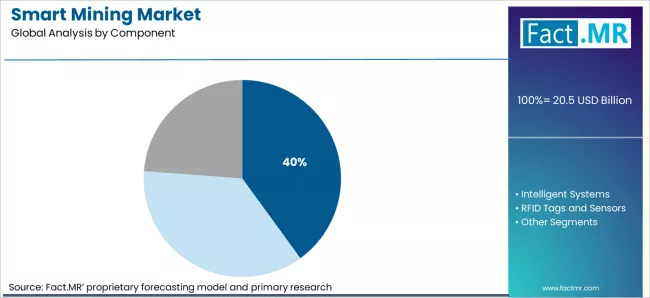
Smart Mining Market Analysis By Component | Source: Fact.MR
Market Overview: Hardware is expected to capture 40% of the market share by 2026. Hardware components such as sensors, controllers, communication devices, and monitoring systems form the foundation of smart mining operations. These devices enable real-time data collection, equipment monitoring, and automation across mining sites.
Demand Drivers:
- Adoption of Advanced Monitoring Systems: Mining companies deploy sensors and control devices to monitor equipment performance and environmental conditions in real time.
- Automation of Mining Operations: Hardware technologies support automated drilling, hauling, and material handling systems that improve operational efficiency.
- Improved Safety and Productivity: Hardware infrastructure enables better equipment control and monitoring, helping reduce operational risks while improving production efficiency.
Smart Mining Market Analysis by Solution
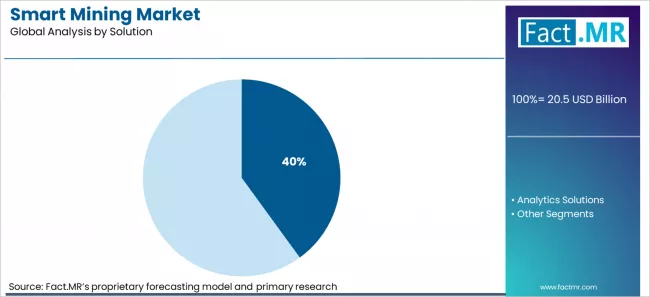
Smart Mining Market Analysis By Solution | Source: Fact.MR
Market Overview: Data and operation management software is projected to hold 40% of the market share by 2026. These software platforms help mining operators collect, analyze, and manage operational data to improve efficiency, resource utilization, and decision-making processes.
Demand Drivers:
- Real-Time Data Analytics: Software solutions process operational data from mining equipment and sensors, enabling informed decisions and optimized resource management.
- Predictive Maintenance Capabilities: Data management platforms help detect potential equipment failures, reducing downtime and maintenance costs.
- Operational Efficiency Improvements: Mining companies adopt software solutions to monitor production, manage assets, and streamline operational workflows across large mining sites.
Smart Mining Market Drivers, Restraints, and Opportunities
FMR analysts observe that historical patterns position mining among the most capital-intensive industrial sectors, where operational changes occur slowly due to long equipment lifecycles and high replacement costs. The current market valuation reflects the gradual integration of digital control systems into conventional extraction operations rather than a complete shift toward fully autonomous mining. Early adoption emerged in large open-pit operations where fleet management software, automated drilling systems, and predictive maintenance tools improved equipment utilization and reduced operational interruptions. Commodity price cycles historically dictated capital investment in mining infrastructure, which explains the uneven pace of digital system deployment across global mining operations.
A structural transition is now underway as operators replace isolated automation technologies with integrated digital mining platforms that combine equipment telemetry, operational analytics, and remote control capabilities. Conventional manual fleets remain widespread across mid-scale mines, limiting rapid equipment replacement volumes. Autonomous haulage systems, sensor networks, and centralized operations software require higher capital spending per installation. These systems are deployed selectively in high-output mines where productivity gains justify the investment. Higher per-deployment system costs offset slower adoption volumes, allowing market value to expand even while equipment replacement cycles remain gradual.
- Autonomous Fleet Expansion: Mining companies are introducing autonomous haul trucks, robotic drilling systems, and automated load haul dump equipment to reduce labor exposure and improve operational consistency.
- Safety Regulation Pressure: Standards such as the Mine Safety and Health Administration (MSHA) safety rules and International Council on Mining and Metals (ICMM) safety framework encourage remote monitoring and automated risk detection systems.
- Australia Automation Leadership: Mining operators in Western Australia’s Pilbara region deploy autonomous haulage systems and remote operations centers due to labor scarcity and remote mine locations.
Regional Analysis
The market analysis covers key global regions, including East Asia, North America, Oceania, and Europe. It is segmented geographically, with specific market dynamics for each region. The full report provides a detailed market attractiveness analysis.
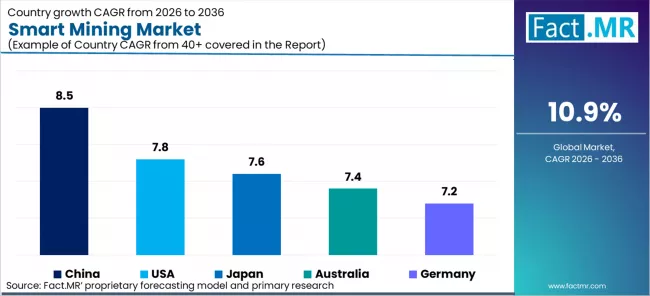
Smart Mining Market Cagr Analysis By Country | Source: Fact.MR
| Country | CAGR (2026-2036) |
|---|---|
| China | 8.5% |
| USA | 7.8% |
| Japan | 7.6% |
| Australia | 7.4% |
| Germany | 7.2% |
Source: Fact.MR analysis. Updated Mar 13, 2026
Source: Fact MR (FMR) analysis, based on proprietary forecasting model and primary research
East Asia
China and Japan are key markets supported by automation in mining operations, digital monitoring systems, and adoption of connected equipment. Major companies include China Shenhua Energy, Hitachi Construction Machinery, and Komatsu Ltd.
- China: Demand for smart mining solutions in China is projected to rise at 8.5% CAGR through 2036. Growth is supported by smart mine demonstration projects approved by the National Development and Reform Commission (03-2025) and expansion of automated mining equipment by China Shenhua Energy (08-2025).
- Japan: Demand for smart mining solutions in Japan is projected to rise at 7.6% CAGR through 2036. Growth is supported by mining automation programs promoted by the Ministry of Economy, Trade and Industry (04-2025) and Komatsu Ltd.’s expansion of autonomous haulage systems (09-2025).
North America
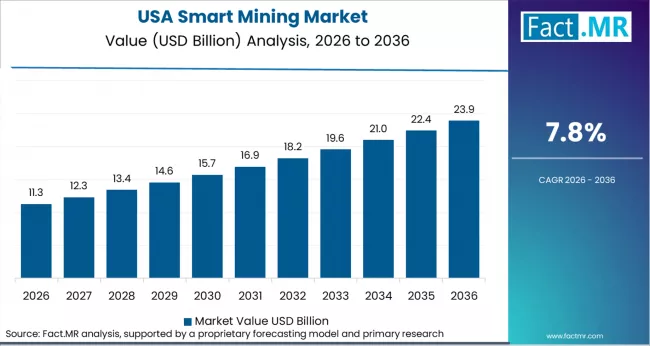
Smart Mining Market Country Value Analysis | Source: Fact.MR
The USA represents a major market supported by digital mine management systems, automation technologies, and investments in mining productivity tools.
- USA: Demand for smart mining solutions in the U.S. is projected to rise at 7.8% CAGR through 2036. Growth is supported by mining modernization programs supported by the Department of Energy (05-2025) and Caterpillar Inc.’s deployment of autonomous mining equipment (08-2025).
Oceania
Australia is a major mining technology market due to large scale mineral extraction, automated mine operations, and digital monitoring systems.
- Australia: Demand for smart mining solutions in Australia is projected to rise at 7.4% CAGR through 2036. Growth is supported by autonomous mining operations led by Rio Tinto (03-2025) and expansion of digital mine platforms by BHP Group (07-2025).
Europe
Germany is an important market supported by mining technology development, industrial automation expertise, and digital resource management.
- Germany: Demand for smart mining solutions in Germany is projected to rise at 7.2% CAGR through 2036. Growth is supported by industrial automation programs promoted by the Federal Ministry for Economic Affairs (02-2025) and Siemens AG’s deployment of digital mining platforms (06-2025).
Fact MR's analysis of the smart mining market in East Asia, North America, Oceania, and Europe consists of country-wise assessments that include China, the USA, Japan, Australia, and Germany. Readers can find detailed trends, regulatory updates, and company-specific investments shaping market growth in these countries.
What is the Competitive Structure and Buyer Behavior in the Smart Mining Market?
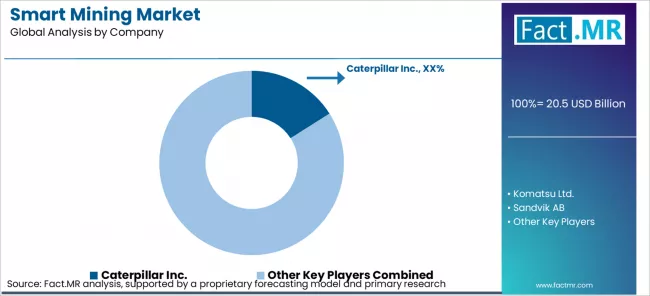
Smart Mining Market Analysis By Company | Source: Fact.MR
The smart mining market is moderately concentrated, with large mining equipment manufacturers and industrial automation firms accounting for a significant share of global deployments. Companies such as Caterpillar Inc., Komatsu Ltd., Sandvik AB, Hexagon AB, Hitachi Construction Machinery Co., Ltd., ABB Ltd., Siemens AG, Schneider Electric SE, Trimble Inc., and Epiroc AB operate across equipment automation, fleet management systems, and digital mining platforms. Large mining operators such as Rio Tinto Group also influence technology adoption through proprietary automation initiatives and partnerships with equipment suppliers. The primary competitive variables are equipment reliability, automation capability, data analytics performance, and integration with mine planning and operational control systems. Firms with extensive engineering expertise, established equipment portfolios, and strong software capabilities hold structural advantages because they can deliver integrated solutions covering autonomous vehicles, remote operations, and predictive maintenance.
Structural advantages are strongest among suppliers that combine heavy machinery manufacturing with digital analytics platforms and global service networks. Companies with long standing relationships with mining operators can support complex deployments across multiple sites and maintain equipment throughout its lifecycle. Large mining companies exercise significant buyer leverage because they purchase equipment and digital platforms in large volumes and typically qualify several suppliers for automation systems. To reduce operational risk, mining operators often adopt multi vendor technology environments and require interoperability between software platforms and equipment. This procurement approach limits individual suppliers pricing power and places greater emphasis on system reliability, operational efficiency improvements, and long term technical support.
Key Players
- Caterpillar Inc.
- Komatsu Ltd.
- Sandvik AB
- Hexagon AB
- Hitachi Construction Machinery Co., Ltd.
- ABB Ltd.
- Rio Tinto Group
- Siemens AG
- Schneider Electric SE
- Trimble Inc.
- Epiroc AB
Report Scope
| Metric | Value |
|---|---|
| Quantitative Units | USD 20.5 billion (2026) to USD 57.7 billion (2036), at a CAGR of 10.9% |
| Market Definition | The smart mining market includes deployment of automated equipment, digital systems, analytics platforms, and services that support remote monitoring, autonomous operations, and optimized mineral extraction processes in mining operations. |
| Automated Equipment | Driller & Breaker, Load Haul Dump, Mining Excavator, Robotic Trucks, Other Automated Equipment |
| Component Segmentation | Hardware, Intelligent Systems, RFID Tags and Sensors, Other Hardware |
| Solution Segmentation | Data & Operation Management Software, Analytics Solutions, Connectivity Platforms |
| Services | Engineering & Maintenance Services, Consulting Services, Product Training Services, Implementation & Integration Services |
| Key Companies Profiled | Caterpillar Inc., Komatsu Ltd., Sandvik AB, Hexagon AB, Hitachi Construction Machinery Co., Ltd., ABB Ltd., Rio Tinto Group, Siemens AG, Schneider Electric SE, Trimble Inc., Epiroc AB |
| Forecast Period | 2026 to 2036 |
| Approach | Hybrid top-down and bottom-up market modeling validated through interviews with mining equipment manufacturers and technology providers, supported by production capacity benchmarking, mine automation adoption analysis, and trade data assessment. |
Source: Fact.MR analysis. Updated Mar 13, 2026
Bibliography
- [1] National Development and Reform Commission, China. (2025). Smart mine demonstration projects.
- [2] Department of Energy, USA. (2025). Mining modernization programs.
- [3] Ministry of Economy, Trade and Industry, Japan. (2025). Mining automation programs.
- [4] Rio Tinto Group. (2025). Autonomous mining operations.
- [5] BHP Group. (2025). Digital mine platforms expansion.
- [6] Caterpillar Inc. (2025). Autonomous mining equipment deployment.
- [7] Komatsu Ltd. (2025). Autonomous haulage systems expansion.
- [8] Federal Ministry for Economic Affairs, Germany. (2025). Industrial automation programs.
- [9] Mine Safety and Health Administration. (2025). MSHA safety rules for automation.
This Report Addresses
- Market intelligence enabling evaluation of global smart mining technologies by automated equipment (driller and breaker, load haul dump, mining excavator, robotic trucks, other automated equipment), components (hardware, intelligent systems, RFID tags and sensors, other hardware), solutions (data and operation management software, analytics solutions, connectivity platforms), and services.
- Market volume (revenue) estimates and 10 year forecasts from 2026 to 2036, validated using mining automation investment trends, deployment of connected mining equipment, and digital mining technology adoption across major mining regions.
- Growth opportunity mapping across automated mining fleets, sensor networks, predictive maintenance systems, and digital mine management platforms, with major markets including China, the United States, Japan, Australia, and Germany.
- Segment and regional revenue forecasts for automated mining equipment, intelligent monitoring systems, analytics platforms, and connectivity infrastructure used in surface and underground mining operations.
- Competitive strategy analysis highlighting equipment automation capability, fleet management software performance, system interoperability, predictive maintenance analytics, and operational monitoring systems, with major players including Caterpillar Inc., Komatsu Ltd., Sandvik AB, Hexagon AB, Hitachi Construction Machinery Co., Ltd., ABB Ltd., Siemens AG, Schneider Electric SE, Trimble Inc., and Epiroc AB.
- Adoption dynamics emphasizing autonomous haulage systems, predictive equipment maintenance, centralized mine operations control centers, and deployment of sensor based monitoring systems across large scale mining operations.
- Report delivery in PDF, Excel, PowerPoint, and interactive dashboard formats suitable for executive, operational, and strategic planning.
Segmentation
Smart Mining Market Key Segments
-
Automated Equipment
- Driller & Breaker
- Load Haul Dump
- Mining Excavator
- Robotic Trucks
- Other Automated Equipment
-
Component
- Hardware
- Intelligent Systems
- RFID Tags and Sensors
- Other Hardware
-
Solution
- Data & Operation Management Software
- Analytics Solutions
- Connectivity Platforms
-
Services
- Engineering & Maintenance Services
- Consulting Services
- Product Training Services
- Implementation & Integration Services
-
Region
- North America
- USA
- Canada
- Mexico
- Europe
- Germany
- UK
- France
- Italy
- Spain
- Nordic Countries
- BENELUX
- Rest of Europe
- Asia Pacific
- China
- Japan
- South Korea
- India
- Australia
- Rest of Asia Pacific
- Latin America
- Brazil
- Argentina
- Rest of Latin America
- Middle East and Africa
- Kingdom of Saudi Arabia
- United Arab Emirates
- South Africa
- Rest of Middle East and Africa
- Other Regions
- Oceania
- Central Asia
- Other Markets
- North America
Frequently Asked Questions
How large is the demand for Smart Mining solutions in the global market in 2026?
What will be the market size of Smart Mining solutions in the global market by 2036?
What is the expected demand growth for Smart Mining solutions in the global market between 2026 and 2036?
Which component segment is expected to dominate the market?
Which region is expected to show the highest growth rate for Smart Mining solutions?
How significant is the growth outlook for the United States in this market?
What is the growth outlook for Japan in the Smart Mining market?
What is the growth forecast for Australia in the Smart Mining market?
What is the growth forecast for Germany in the Smart Mining market?
Which company is identified as a leading player in the Smart Mining market?
What are Smart Mining solutions used for?
What does the Smart Mining market include in this report?
How is the market forecast developed in this report?
What is meant by the Smart Mining market in this report?
Who worked on this report


Preview the report firsthand - request a free sample
Free SampleGet the brochure for pricing and purchase details
Download PDF