- Base Value(2025): 3502 Mn
- Forecast Value (2035): 6824.9 Mn
- CAGR (2035): 7.4%
Smart Suturing Systems Market Outlook 2025 to 2035
Global smart suturing systems market is expected to reach USD 6,824.9 million by 2035, up from USD 3,502 million in 2025. During the forecast period 2025 to 2035, the industry is projected to expand at a CAGR of 6.9%.
Smart suturing systems market has been acted by increasing number of surgical procedures and increasing need of having lesser invasive nature of solutions which enhance accuracy and healing. The recent developments in robotics, AI, and automation are increasing the accuracy, simplifying complications, and decreasing the operating times. Also, the problem of shortage of qualified surgeons is increasing its uptake because these systems can be used to make procedures safer and more efficient, as well as enhance patient outcomes.
Quick Stats for Smart Suturing Systems Market
- Industry Value (2025): USD 3,502 Million
- Projected Value (2035): USD 6,824.9 Million
- Forecast CAGR (2025 to 2035): 6.9%
- Leading Segment (2025): Disposable Devices (53.0% Market Share)
- Fastest Growing Country (2025-2035): Japan (7.0% CAGR)
- Top Key Players: Medtronic, B. Braun Melsungen AG, Smith & Nephew, Ethicon (Johnson & Johnson), and Peters Surgical
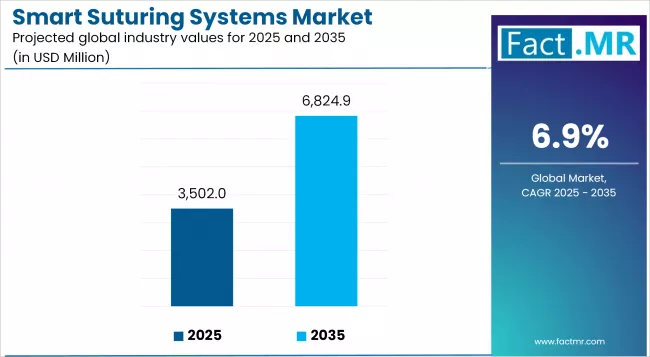
Smart Suturing Systems Market Industry Value Analysis | Source: Fact.MR
What are the drivers of the smart suturing systems market?
The increasing rates of chronic diseases, and the increased number of surgery operations across the world are the major trends that create the need to use smart suturing systems. The popularity of minimally invasive surgeries has increased their demand in the advanced equipment that would guarantee accuracy, minimize complications, and facilitate a quicker recovery process, which would further stimulate the growth of the market.
Surgical robotics and automated suture machines are also important factors that are defining the market. The healthcare providers are drawn to these systems because they can improve accuracy in suturing, reduce operating time and minimize the error of a human, as well as integration of AI, sensors and robotic-assisted platforms.
Another critical factor that enhances adoption is the shortage of skilled surgeons in the world. The gap can be narrowed with the assistance of smart suturing systems that allow less skilled practitioners to undertake complicated tasks with greater safety and efficiency, leading to better patient outcomes and the health care system that is at a breaking point.
What are the regional trends of the smart suturing systems market?
The region of North America has a good advantage in the market of smart suturing systems as it has a very good healthcare system, an adoption of robotic-assisted surgeries is very high and also high investment in medical technology.
Europe is evidenced by the high level of stable growth with the growing interest in the least invasive procedures, the government support programs, and the growth of health expenditures. Such countries as Germany, the UK, and France are major contributors having a great focus on surgical innovations.
The region is experiencing the very high growth driven by the increasing number of patients, increased medical tourism, and the enhancement of healthcare facilities in Asia-Pacific. There is an increased market demand in the use of advanced surgical technologies in countries such as China, India, and Japan.
There is a slow but steady growth in Latin America where healthcare systems are being modernized and enlightened on the benefits of advanced surgical solutions. Hospitals and specialty clinics have higher adoption rates in Brazil and Mexico, which are emerging markets.
The region of Middle East and Africa is steadily developing, as well as health care infrastructure and increasing demand of sophisticated surgical equipment. The growth is more evident in Gulf countries where hospitals are being more accepting of new innovations.
What are the challenges and restraining factors of smart suturing systems market?
The high prices of advanced devices and robotic-assisted platforms could be one of the biggest challenges of the smart suturing systems market. A lot of hospitals particularly in the developing countries have budget constraints that restrict their capability of adopting these technologies, which slows down levels of market penetration.
The other problem is that it has a high learning curve and requires specialized training to efficiently use such systems. The processes to adapt may demand more resources and time by surgeons and healthcare staff and may reduce the speed with which it is adopted in clinical practice.
One of the limitations of the market is that the agencies involved in medical device approval are very strict. The long and complicated certification processes may delay the availability of the products, contribute to widening the development costs, and interfere with the timely delivery of the innovative solutions.
Country-Wise Insights
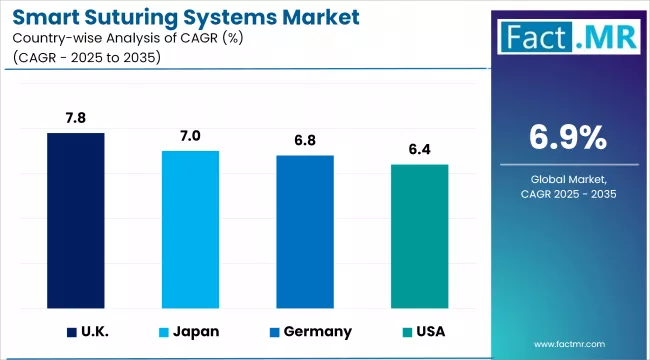
Smart Suturing Systems Market Cagr Analysis By Country | Source: Fact.MR
Advanced healthcare infrastructure and strong R&D investments drive the USA smart suturing systems market
The USA is experiencing high use of smart suturing systems due to the high level of healthcare amenities, surgeries conducted, and expenditure incurred in the sector. The increasing rate of chronic diseases and the increasing number of patients seeking minimally invasive surgeries is enhancing the transition into robotic-assisted and automated suturing technologies.
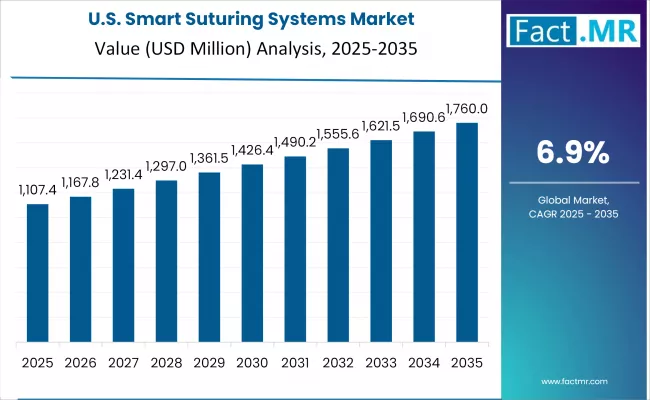
Smart Suturing Systems Market Country Value Analysis | Source: Fact.MR
Combination of AI, sensors, and robotic systems leads to increased accuracy, less complexity, and minimized recovery periods and is appealing in both hospital and surgical facilities. Good reimbursement policies, favorable regulatory environment, and existence of market leaders in medical devices bravery contribute further to the success of the country in the development and commercialization of the next-generation suturing solutions.
Technological excellence and surgical innovation drive the Germany smart suturing systems market
Germany is becoming one of the major markets in the smart suturing systems as a result of its superior infrastructure in healthcare, volume of surgical procedures and high population of manufactures of medical technology. The high focus on minimally invasive surgeries and state-of-the-art robotic-assisted systems in the country increases the need of precision suturing solutions.
The role of Germany in the European market is further improved by the support of healthcare innovation by the government, increased investments in the field of research and development, and the adoption of new technologies. The advantages of friendliness of the regulatory standards and presence of competent healthcare personnel also play a significant role in further boosting the uptake of smart suturing systems in the practice.
Growing aging population and early adoption of robotics drive the Japan smart suturing systems market
Japan offers a prime market target of smart suturing systems due to its aging population, a high incidence of chronic diseases as well as the growing need to perform complicated surgical operations in the country. The nation has a reputation of being among the first to embrace the use of robotic-assisted technologies, which contributes to the accuracy and efficiency of least invasive surgeries.
The high probability of the role of Japan in producing and implementing smart surgical solutions is also enhanced by the strong governmental assistance of healthcare innovation, quality hospital infrastructure, and high levels of investment in R&D. This market also continues to grow because of the availability of highly qualified surgeons and a technology-based medical ecosystem.
Category-Wise Analysis
Rising demand for minimally invasive surgeries and cost-effectiveness drive the disposable smart suturing devices segment
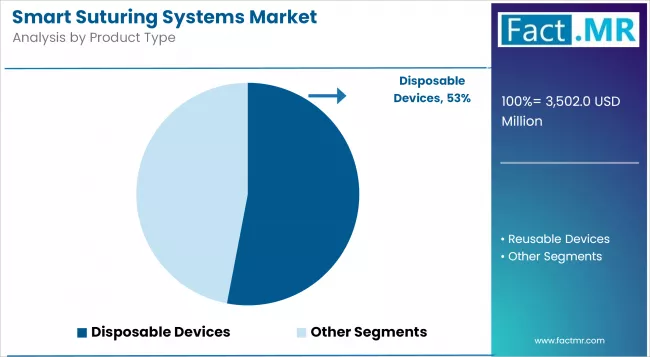
Smart Suturing Systems Market Analysis By Product Type | Source: Fact.MR
The single use suturing tool is coming up with tremendous growth over the disposable smart suturing devices segment, which is growing as a result of higher uptake of single-use suturing tools in hospitals and even surgical centres. Such devices decrease the chance of cross-contamination, decrease sterilization expenses, and simplify the workflow of surgery, which is why they are appealing in the high-volume surgeries.
Due to technological improvements in automated suturing systems, ergonomics, and incorporation with robotic-assisted systems, the level of accuracy, efficiency, and patient safety are improved. Increased awareness of surgeons, positive hospital procurement guidelines, and investment in the major medical device manufacturers are also conducive to the commercialization and use of disposable smart suturing devices in the world.
Increasing prevalence of cardiovascular diseases and need for precision drive the cardiovascular smart suturing systems segment
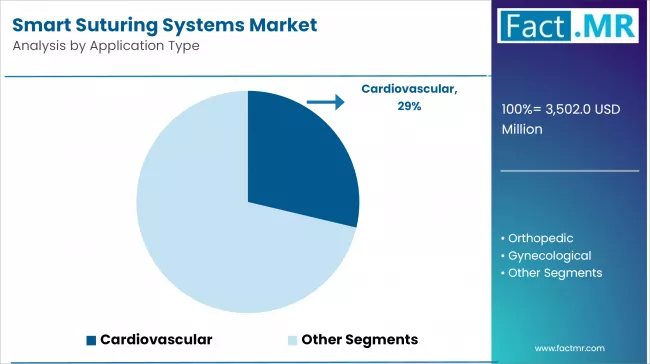
Smart Suturing Systems Market Analysis By Application Type | Source: Fact.MR
The cardiovascular part of the smart suture systems is in a strong growth because of the rising cases of heart diseases and the rise in the complicated cardiac surgeries. To achieve accuracy, minimize the time of operations, and patient outcomes, surgeons are implementing new technologies in automated and robotic-aided suturing devices to use in valve repair and bypass surgery.
The surgical precision, safety, and recovery are further enhanced by innovations in sensor technology, AI-based solutions, and minimally invasive methods. Conducive hospital policies, increased health care spending, and investments by major medical equipment firms are increasing the uptake and commercialization of cardiovascular smart suturing systems across many countries in the world.
Growing surgical volumes and advanced infrastructure drive the hospital segment of smart suturing systems
The hospital segment is boiling the smart suture system adoption because the volumes of the surgical procedures are high, and the health care infrastructure is advanced. Automated and robotically guided suture devices have helped hospitals achieve greater accuracy and efficiency in surgical operations, decreased time during operations, and a higher success rate in patients, particularly in minimally invasive and complicated surgeries.
The use of AI, real-time monitoring, and ergonomic designs of devices enhance even more efficiency and safety in the work of the surgery room. The extensive adoption of smart suturing systems in hospitals around the world is due to investments by major manufacturers of healthcare equipment, positive procurement policies, and increased awareness among medical practitioners.
Competitive Analysis
The smart suturing systems market is very competitive with the level of technological advancement being high and persistent innovation of the robotic assisted and automated suturing devices. Firms are concentrating on building systems which can boost accuracy of surgery, cut down operation time and enhancing patient outcomes. Strategic alliances, co-operations and mergers to broaden product lines, enhance regional coverage, and faster product commercialization are also being experienced in the market. One of the major ways to distinguish the offerings and address the increased demand of minimally invasive surgical solutions is to continue investing in R&D and adapt the technologies of AI and sensors.
In the search of solutions that will meet the need of the hospitals in terms of safety and efficiency, market players are now more focused on cost-effective and disposable products. Competitive forces are also driven by regulatory clearances, reimbursement initiatives, and the increased emphasis on minimally invasive procedures in both the developed and the emerging markets.
Key players in the smart suturing systems market are Medtronic, B. Braun Melsungen AG, Smith & Nephew, Ethicon (Johnson & Johnson), Peters Surgical, and others.
Recent Developments
- In December 2024, DuraStat launched an exclusive U.S. commercial partnership with a Medtronic operating unit on surgical tissue closure tech
- In October 2024, Meril, one of the India’s leading medical devices companies, announced the launch of Mizzo Endo 4000, a next generation soft tissue surgical robotic system.
Fact.MR has provided detailed information about the price points of key manufacturers of Smart Suturing Systems Market positioned across regions, sales growth, production capacity, and speculative technological expansion, in the recently published report.
Methodology and Industry Tracking Approach
The Global Smart Suturing Systems Market 2025 report relies on comprehensive research of the representatives of different healthcare sectors, such as surgery, medical devices, biomedical engineering, hospital management, and digital health. The sample will include surgical specialists, biomedical engineers, product development, clinical practice consultants, regulatory affairs professionals, and healthcare supply chain specialists that are directly engaged in the development, use, and adoption of smart suturing technologies.
The research design adopted in the study is a horizontal research design utilizing questionnaires that will be administered within the period of September 2024 and August 2025. The methodology centers on adoption rates, clinical accuracy and integration into surgical workflows and the general influence to patient outcomes. It analyses robotic-assisted systems, automated suturing systems, sensor and AI integration, and its use in cardiovascular, gastrointestinal surgery, general surgery and in hospitals and surgery centres.
With Fact.MR monitoring consumer behavior, product efficacy, industry trends, and market opportunities since 2018, this report is becoming an authoritative source of information that stakeholders can rely on.
Segmentation
Segmentation of Smart Suturing Systems Market
-
By Product Type :
- Reusable Devices
- Disposable Devices
-
By Application :
- Cardiovascular
- Gynecological
- Gastrointestinal
- Orthopedic
-
By End-User :
- Hospitals
- Clinics
- Ambulatory Surgical Centers
-
By Region :
- North America
- Latin America
- Western Europe
- Eastern Europe
- East Asia
- South Asia & Pacific
- Middle East & Africa
Frequently Asked Questions
What was the smart suturing systems market size reported by Fact.MR for 2025?
Who are the major players operating in the smart suturing systems market?
What is the estimated valuation of the smart suturing systems market in 2035?
What value CAGR did the smart suturing systems market exhibit over the last five years?
Who worked on this report


Preview the report firsthand - request a free sample
Free SampleGet the brochure for pricing and purchase details
Download PDF