- Market Value (2025): USD 3.8 Bn
- Estimated Value (2026): USD 4.34 Bn
- Forecast Value (2036): USD 16.4 Bn
- CAGR (2026-2036): 14.2%
What is the Smart Textiles for Wearable Technology Market forecast to be worth by 2036?
USD 4.34 billion in 2026 to USD 16.4 billion by 2036, at a 14.2% CAGR.
- The smart textiles for wearable technology market reached USD 3.8 billion in 2025.
- Revenue is projected to increase from USD 4.34 billion in 2026 to USD 16.4 billion by 2036 as sensor-equipped clothing reaches more professional and consumer uses.
- A 14.2% CAGR from 2026 to 2036 reflects interest in textile-based monitoring among healthcare providers and sports product developers.
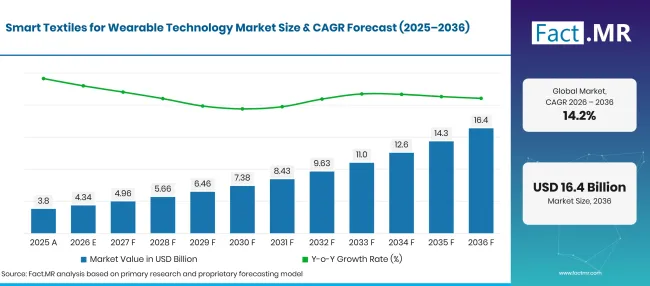
Smart Textiles For Wearable Technology Market Forecast Global | Source: Fact.MR
| Year | Basis | Market Value (USD billion) |
|---|---|---|
| 2025 | Actual | 3.8 |
| 2026 | Estimate | 4.34 |
| 2036 | Forecast | 16.4 |
| CAGR 2026 to 2036 | Forecast period | 14.2% |
Source: Fact.MR analysis. Updated Nov 4, 2026
What are the defining numbers behind Smart Textiles for Wearable Technology Market growth?
USD 12.1 billion of additional market value between 2026 and 2036, led by active smart textiles and sensing functions.
- Demand Drivers in the Market
- Clinical monitoring teams seek clothing that records changes while the wearer moves or sleeps. In November 2025, Hexoskin announced FDA 510(k) clearance for its Medical System smart shirt for continuous ECG, respiratory and activity signal recording [1].
- Coaches and rehabilitation teams use movement feedback to understand how a person performs an activity. Sensors placed in clothing can follow movement at particular body locations and offer an alternative to wrist devices, provided the garment stays comfortable and readings remain consistent.
- Clothing manufacturers need electrical connections that keep working as fabric bends and stretches. AiQ supplies textile electrodes and conductive connections that carry signals to detachable electronics, showing why garment construction and sensor design must be developed together.
- Consumers are familiar with connected devices worn on the body, providing a possible audience for sensor-equipped clothing. Eurostat reported in August 2025 that 29.9% of EU residents aged 16 to 74 used internet-connected wearables in 2024 [2].
- Key Segments Analyzed
- By Functionality Type: Active Smart Textiles account for 38.5% of 2026 market value as their sensing or response functions suit body-worn systems.
- By Function: Sensing represents 42.1% of 2026 demand because garment-based measurement is useful in clinical observation and exercise feedback.
- By Application: Healthcare contributes 36.8% in 2026, reflecting interest in longer periods of comfortable physiological observation.
- By End-User: Consumer Electronics accounts for 35.3% in 2026, including connected apparel sold with companion electronic systems.
- Analyst Opinion at Fact.MR
- Shambhu Nath Jha, Principal Consultant at Fact.MR, states, “A central technical challenge is making electronics work reliably inside clothing that people expect to wear and wash like ordinary fabric. Developers need useful sensor readings, but customers also expect comfort, clear care instructions and a good fit.”
- Strategic Implications
- Textile mills can verify conductive yarn continuity after stretching and washing so garment partners have a clearer view of material durability in use.
- Healthcare technology companies need to document sensor placement and explain how ordinary movement affects signal quality.
- Clothing brands benefit from detachable electronic modules and simple care instructions that make laundering easier for users.
- Component suppliers can align connector specifications early to reduce redesign risk across the complete garment system.
Germany is forecast at 16.3% CAGR, followed by Brazil at 14.9%. The USA is forecast at 13.5%, the UK at 12.1%, and Japan at 10.7%.
How does the Smart Textiles for Wearable Technology Market break down by segment?
Active Smart Textiles lead Functionality Type at 38.5%; Sensing leads Function at 42.1%; Healthcare leads Application at 36.8%.
Which Functionality Type dominates?
Active Smart Textiles represent 38.5% of 2026 market value.
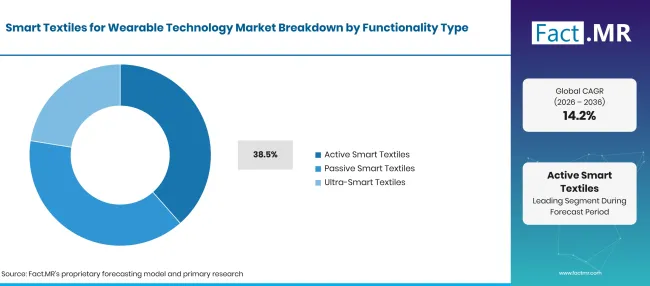
Smart Textiles For Wearable Technology Market Breakdown Functionality Type | Source: Fact.MR
| Segment | Share (2026) |
|---|---|
| Active Smart Textiles (Leading segment) | 38.5% |
| Other segments combined | 61.5% |
| Total | 100.0% |
Source: Fact.MR analysis. Updated Nov 4, 2026
Active smart textiles include sensing or responsive components within fabric intended for repeated wear. Connected shirts and movement-feedback garments use this construction to collect information during ordinary activity. Designers must position electronic parts carefully so that the garment remains comfortable and the measurements stay reliable.
An active fabric system also creates decisions about how to remove batteries or processing modules before washing. Suppliers who specify these interfaces clearly make production testing easier for clothing partners.
What leads the Function segment?
Sensing captures 42.1% of 2026 market value.
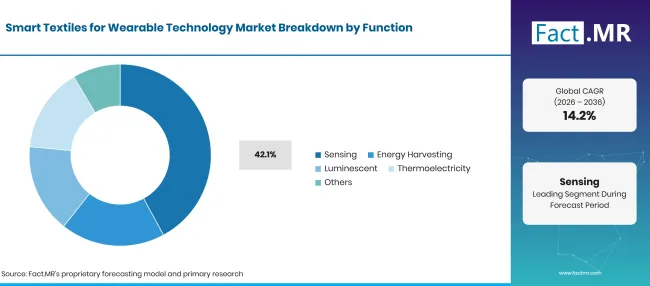
Smart Textiles For Wearable Technology Market Breakdown Function | Source: Fact.MR
| Segment | Share (2026) |
|---|---|
| Sensing (Leading segment) | 42.1% |
| Other segments combined | 57.9% |
| Total | 100.0% |
Source: Fact.MR analysis. Updated Nov 4, 2026
Soft electrodes and fabric-mounted sensors can capture signals during ordinary movement, making sensing an important function of smart textiles. The garment offers a broad contact area, although the quality of the reading still depends on fit and skin contact. Other designs explore energy harvesting and visible feedback for different uses.
AiQ describes its BioMan+ conductive textile electrodes as a way to capture electrical activity and transfer signals to a garment-mounted module. The product description provides a direct example of the sensing function.
How does Application shape demand?
Healthcare leads with 36.8% of 2026 market value.
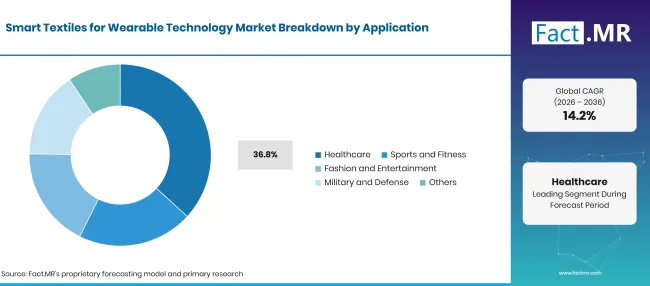
Smart Textiles For Wearable Technology Market Breakdown Application | Source: Fact.MR
| Segment | Share (2026) |
|---|---|
| Healthcare (Leading segment) | 36.8% |
| Other segments combined | 63.2% |
| Total | 100.0% |
Source: Fact.MR analysis. Updated Nov 4, 2026
Healthcare applications include physiological observation where clothing can support monitoring during ordinary activities. Hospitals and research teams need more than a comfortable garment. They ask for a defined intended use and clear records of measurement performance.
Healthcare teams need garments that capture dependable signals while patients move through daily activities. A close and consistent fit helps textile electrodes work as intended, so manufacturers must test garment sizing, stretch recovery and sensor position as carefully as they test the electronic components.
Which End-User group is ahead?
Consumer Electronics account for 35.3% of 2026 market value.
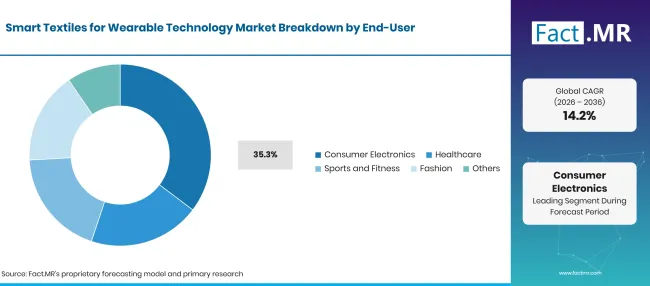
Smart Textiles For Wearable Technology Market Breakdown End User | Source: Fact.MR
| Segment | Share (2026) |
|---|---|
| Consumer Electronics (Leading segment) | 35.3% |
| Other segments combined | 64.7% |
| Total | 100.0% |
Source: Fact.MR analysis. Updated Nov 4, 2026
Consumer electronics brands sell smart garments with apps or removable control units. Customers usually want to understand how the clothing works and how to care for it before comparing technical specifications.
Wearable X sells Nadi X yoga apparel with embedded sensing and vibration feedback. Its product range illustrates a consumer route for fabric-based interactive wearables.
What is accelerating Smart Textiles for Wearable Technology Market adoption, and what is holding it back?
Body-signal sensing and comfortable monitoring support adoption; washing durability and medical qualification complicate deployment.
Drivers Impact Analysis
| Driver | (~) % Impact on CAGR | Geographic Relevance | Impact Timeline |
|---|---|---|---|
| Clinical monitoring in garments | +1.3% | North America, Western Europe | Medium term (2–4 years) |
| Sports movement feedback | +1.0% | North America, East Asia | Short term (≤2 years) |
| Conductive textile integration | +0.8% | Global | Medium term (2–4 years) |
| Connected-app consumer interest | +0.6% | Western Europe, East Asia | Medium term (2–4 years) |
| Professional protective applications | +0.5% | North America, Western Europe | Long term (≥4 years) |
Source: Fact.MR analysis. Updated Nov 4, 2026
Opportunity Impact Analysis
| Opportunity | (~) % Impact on CAGR | Geographic Relevance | Impact Timeline |
|---|---|---|---|
| Washable sensing modules | +0.8% | Global | Medium term (2–4 years) |
| Clinical research garments | +0.6% | North America, Western Europe | Medium term (2–4 years) |
| Textile-based rehabilitation feedback | +0.4% | East Asia, Western Europe | Long term (≥4 years) |
| Modular electronic attachments | +0.3% | Global | Short term (≤2 years) |
Source: Fact.MR analysis. Updated Nov 4, 2026
Restraints Impact Analysis
| Restraint | (~) % Impact on CAGR | Geographic Relevance | Impact Timeline |
|---|---|---|---|
| Washing and bending durability | -0.7% | Global | Short term (≤2 years) |
| Medical qualification requirements | -0.6% | North America, Western Europe | Medium term (2–4 years) |
| Higher assembly complexity | -0.5% | Global | Medium term (2–4 years) |
| Fit-sensitive measurement quality | -0.4% | Global | Long term (≥4 years) |
Source: Fact.MR analysis. Updated Nov 4, 2026
Which countries are scaling the Smart Textiles for Wearable Technology Market through 2036?
| Country | CAGR (2026 to 2036) |
|---|---|
| Germany | 16.3% |
| Brazil | 14.9% |
| USA | 13.5% |
| UK | 12.1% |
| Japan | 10.7% |
Source: Fact.MR analysis. Updated Nov 4, 2026
What supports Germany’s adoption?
16.3% CAGR, linked to specialist textile engineering and wearable sensing.
Germany's technical textile makers have a practical route into smart garments through specialist fabric design and electronic component integration. Healthcare buyers are likely to assess the stability of textile electrodes during movement before committing to routine use. Sportswear developers may find value in shirts that record exercise signals while remaining comfortable over several training sessions.
How is Brazil developing demand?
14.9% CAGR, supported by textile modernization opportunities.
Brazil's existing clothing production and mobile-connected consumer base provide routes for introducing sensor-equipped garments. The Brazilian Institute of Geography and Statistics (IBGE) reported in July 2026 that 90.5% of residents aged 10 or older used the internet in 2025 [4].
What supports adoption in the USA?
13.5% CAGR, centered on clinical uses and connected fitness products.
In the United States, healthcare monitoring provides a specific commercial use for garments that measure signals from the chest. The U.S. Food and Drug Administration listed the Hexoskin Medical System under clearance K243981 with a decision dated November 18, 2025 [5]. Clinical research groups can evaluate textile sensors for longer recording periods, while sportswear companies can use movement feedback to distinguish connected apparel from ordinary clothing.
How is the UK market developing?
12.1% CAGR, tied to niche textile production and specialist monitoring needs.
The UK market offers a route for smaller smart-textile developers supplying clinical studies and specialist sports applications. Research teams may favor garments that let a participant move freely while collecting a defined signal. Manufacturing partners can then develop short runs to test electrode placement and connection strength before wider orders. The UK also operates within a competitive wearable market where a clear purpose is needed to justify the added price of connected clothing.
How is Japan shaping future demand?
10.7% CAGR, linked to care monitoring and garment comfort.
Japan's older population creates a useful setting for wearable sensing research aimed at movement and daily health observation. The Statistics Bureau reported in September 2026 that people aged 65 and over represented 29.6% of the population [3]. Local product developers can explore comfortable textile electrodes and removable modules that support ordinary clothing routines.
Who leads the Smart Textiles for Wearable Technology Market?
Competition includes fabric-electronics developers and finished-garment brands. AiQ Smart Clothing supplies conductive textile electrodes and textile cables. Myant works on textile-based sensing systems, while Carré Technologies offers Hexoskin smart garments and recording software. Companies serve different buyer needs, and healthcare customers generally require more product evidence than ordinary sportswear users.
Competitors follow different purchasing routes depending on the purpose of a garment. Clinical buyers assess intended medical use and dependable readings during ordinary activity. Sportswear labels pay closer attention to garment comfort and customer use. Suppliers that understand these different requirements can make product testing more efficient and avoid expensive design changes after a clothing line is prepared for production.
Which companies are the key providers?
Key companies include Myant Inc., Interactive Wear AG, AiQ Smart Clothing Inc., Carré Technologies Inc. (Hexoskin), Sensoria Inc., LOOMIA Technologies Inc., and Wearable X.
- Myant Inc.
- Interactive Wear AG
- AiQ Smart Clothing Inc.
- Carré Technologies Inc. (Hexoskin)
- Sensoria Inc.
- LOOMIA Technologies Inc.
- Wearable X
Bibliography
- [1] Carré Technologies Inc. (2025, November 19). Hexoskin Medical System receives FDA 510(k) clearance for long-term ECG and respiratory monitoring.
- [2] Eurostat. (2025, August 28). Internet-connected devices are widely used in the EU.
- [3] Statistics Bureau of Japan. (2026, September 20). Statistical Topics No. 149: Older persons in Japan.
- [4] Instituto Brasileiro de Geografia e Estatística. (2026, July 2). Proportion of Internet users in Brazil exceeded 90% of the population aged 10 or over in 2025.
- [5] U.S. Food and Drug Administration. (2025, November 18). 510(k) Premarket Notification K243981: Hexoskin Medical System (7100-00016).
This Report Answers
- The report describes why textile-mounted sensing is commercially distinct from standalone wrist wearables.
- Segment analysis compares active fabrics with passive and ultra-smart designs and examines sensing as a purchasing function.
- Application analysis assesses healthcare use alongside sports feedback and specialized clothing tasks.
- Country analysis compares growth prospects for Germany, Brazil, the USA, the UK and Japan using their different operating conditions.
- The competitive review separates fabric component firms from complete smart-garment system providers.
What does the Smart Textiles for Wearable Technology Market cover?
The scope includes textiles intended to be worn that contain sensors or electrical pathways needed for a connected or responsive function. Revenue relates to smart fabric and garment systems within the stated market boundary.
What is included in the scope?
Included products cover sensor-integrated shirts, connected training garments and materials designed for body-worn electronic functions. Flexible textile electrodes and conductive pathways are considered when sold for wearable textile applications.
What is excluded from the scope?
Ordinary fabrics without integrated electronic or responsive features are excluded. Standalone watches and fitness trackers are also outside the textile revenue boundary.
How Was the Analysis Built?
The analysis draws on 120+ sources, 35+ company portfolios, 25+ countries, and more than 20 industry interviews.
- Primary Research: Primary research includes discussions with manufacturers, service providers, technology developers, distributors, end users, and subject-matter experts. These conversations examine purchasing priorities, product adoption, operational challenges, approval requirements, competitive positioning, and the factors that influence wider market acceptance.
- Desk Research: Desk research covers government statistics, regulatory publications, company filings, trade data, technical studies, industry associations, standards, public policy, and other authoritative sources. Every source used in the analysis is documented in the bibliography.
- Market Sizing and Forecasting: Market estimates combine historical performance, demand indicators, pricing and volume trends, segment shares, company participation, country-level growth, adoption patterns, investment activity, and barriers to market expansion.
- Data Validation and Update Cycle: Findings are validated by comparing primary interviews with public data, company activity, regulatory changes, trade patterns, and industry developments. Regular updates review new product launches, capacity changes, partnerships, approvals, and shifts in commercial adoption.
Segmentation
What is the report’s scope and coverage?
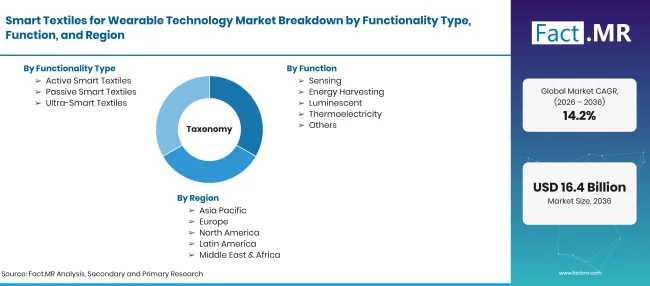
Smart Textiles For Wearable Technology Market Taxonomy | Source: Fact.MR
| Attribute | Details |
| Quantitative Units | USD billion |
| Market Definition | Textile fabrics or garments with integrated sensing, electrical pathways or responsive functions intended for body-worn use. |
| Functionality Type | Active Smart Textiles; Passive Smart Textiles; Ultra-Smart Textiles |
| Function | Sensing; Energy Harvesting; Luminescent; Thermoelectricity; Others |
| Application | Healthcare; Sports and Fitness; Fashion and Entertainment; Military and Defense; Others |
| End-User | Consumer Electronics; Healthcare; Sports and Fitness; Fashion; Others |
| Regions Covered | North America; Latin America; Western Europe; Eastern Europe; East Asia; South Asia & Pacific; Middle East & Africa |
| Countries Covered | Germany; Brazil; USA; UK; Japan |
| Companies Profiled | Myant Inc., Interactive Wear AG, AiQ Smart Clothing Inc., Carré Technologies Inc. (Hexoskin), Sensoria Inc., LOOMIA Technologies Inc., and Wearable X |
| Forecast Period | 2026 to 2036 |
| Approach | Use-case assessment, company portfolio review, application mapping and bottom-up demand analysis. |
Source: Fact.MR analysis. Updated Nov 4, 2026
How is the market segmented?
-
By Functionality Type
- Active Smart Textiles
- Passive Smart Textiles
- Ultra-Smart Textiles
-
By Function
- Sensing
- Energy Harvesting
- Luminescent
- Thermoelectricity
- Others
-
By Application
- Healthcare
- Sports and Fitness
- Fashion and Entertainment
- Military and Defense
- Others
-
By End-User
- Consumer Electronics
- Healthcare
- Sports and Fitness
- Fashion
- Others
-
By Region
- North America
- Latin America
- Western Europe
- Eastern Europe
- East Asia
- South Asia & Pacific
- Middle East & Africa
Frequently Asked Questions
How big is the Smart Textiles for Wearable Technology Market in 2026?
What is the CAGR of the Smart Textiles for Wearable Technology Market from 2026 to 2036?
Which functionality type leads the Smart Textiles for Wearable Technology Market?
Which function leads the Smart Textiles for Wearable Technology Market?
Who are the leading companies in the Smart Textiles for Wearable Technology Market?
Who worked on this report


Preview the report firsthand - request a free sample
Free SampleGet the brochure for pricing and purchase details
Download PDF