- Market Value (2025): USD 92.4 Bn
- Estimated Value (2026): USD 99.4 Bn
- Forecast Value (2036): USD 206.8 Bn
- CAGR (2026-2036): 7.6%
What is the 4G LTE Market forecast to be worth by 2036?
USD 99.4 billion in 2026 to USD 206.8 billion by 2036 at a 7.6% CAGR.
- According to Fact.MR estimates, the 4G LTE market was valued at USD 92.4 billion in 2025
- Market value is projected to rise from USD 99.4 billion in 2026 to USD 206.8 billion by 2036.
- The market is projected to grow at a 7.6% CAGR from 2026 to 2036 as telecom operators and enterprises continue investing in LTE coverage, network capacity, and connectivity solutions.
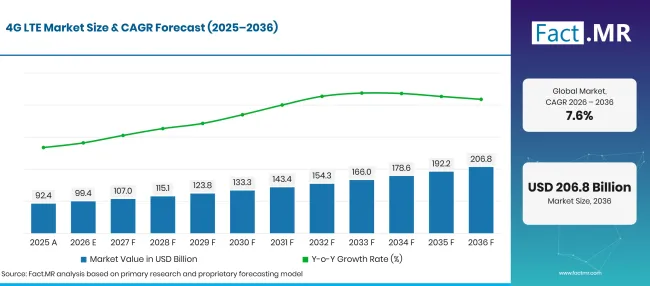
4G Lte Market Forecast Global | Source: Fact.MR
| Year | Basis | Market Value (USD billion) |
|---|---|---|
| 2025 | Actual | 92.4 |
| 2026 | Estimate | 99.4 |
| 2036 | Forecast | 206.8 |
| CAGR 2026 to 2036 | Forecast period | 7.6% |
Source: Fact.MR analysis. Updated Nov 2, 2026
What are the defining numbers behind 4G LTE Market growth?
USD 107.4 billion absolute opportunity between 2026 and 2036.
- Demand Drivers in the Market
- Continued mobile broadband consumption supports demand. Consumers and businesses require reliable mobile broadband for video streaming, online communication, cloud services, and connected applications. LTE networks continue to provide an established connectivity layer across markets where 5G coverage remains incomplete.
- Expansion of enterprise connectivity has created additional demand. Retailers, healthcare providers, logistics companies, and industrial enterprises use LTE connectivity for mobile point-of-sale systems, remote monitoring, connected devices, and operational communication. Private LTE networks also support dedicated wireless connectivity where organizations require greater control over network performance.enterprise connectivity
- Network modernization and rural coverage supports demand. Telecom operators continue upgrading radio access networks, expanding coverage, and improving spectrum utilization. LTE remains important for extending broadband access in rural and underserved locations and for supporting existing connected devices during the transition toward newer network generations.
- Key Segments Analyzed
- By Technology: FDD-LTE will account for 61.3% of the market in 2026, supported by its established deployment across commercial mobile networks and its use of separate frequency bands for uplink and downlink transmission.
- By Application: Consumer Electronics leads with a 38.7% share in 2026, reflecting the widespread use of LTE-enabled smartphones, tablets, routers, and connected devices.
- By Deployment Mode: Macro Cells will capture 66.8% of the market in 2026 because they provide broad geographical coverage and serve as a foundation for large-scale mobile networks.
- By End-User: Telecom Operators are set to represent 53.4% of the market in 2026, reflecting their central role in LTE network ownership, infrastructure investment, and service delivery.
- Analyst Opinion at Fact.MR
- Shambhu Nath Jha, Principal Consultant at Fact.MR, states, “The 4G LTE market continues to benefit from demand for dependable mobile broadband and enterprise connectivity. Network suppliers that support flexible FDD and TDD deployments while improving capacity and coverage can address the requirements of operators maintaining established LTE infrastructure.”
- Strategic Implications
- Network equipment manufacturers should prioritize LTE infrastructure upgrades to enhance capacity and spectrum efficiency while maintaining network reliability.
- Telecom operators need to evaluate FDD-LTE and TD-LTE deployment according to spectrum availability, traffic distribution, and geographical coverage requirements.
- Enterprise technology providers can develop LTE connectivity solutions for industrial monitoring, healthcare communication, retail operations, and public safety applications.
- Semiconductor manufacturers must maintain support for LTE modem and radio-frequency components used in smartphones and connected devices.
Germany is set to record an 8.7% CAGR through 2036. Brazil is set to post 8.0%, followed by the USA at 7.2%. The UK is estimated to advance at 6.5%, while Japan is forecast at 5.7%.
How does the 4G LTE Market break down by segment?
In Fact.MR’s segmentation, FDD-LTE leads Technology at 61.3%; Consumer Electronics leads Application at 38.7%; Macro Cells lead Deployment Mode at 66.8%; and Telecom Operators lead End-User at 53.4%.
Which Technology dominates?
FDD-LTE is projected to account for 61.3% of the market in 2026.
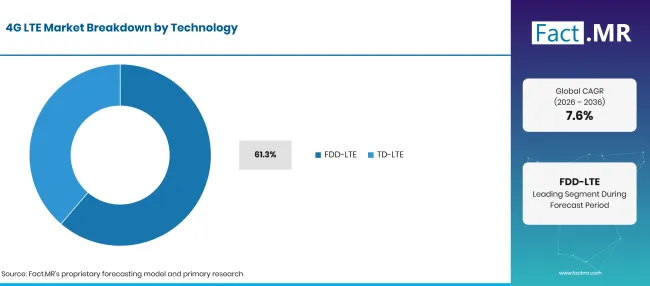
4G Lte Market Breakdown Technology | Source: Fact.MR
| Technology | Share (2026) |
|---|---|
| FDD-LTE (Leading segment) | 61.3% |
| Other segments combined | 38.7%* |
| Total | 100.0% |
Source: Fact.MR analysis. Updated Nov 2, 2026
FDD-LTE uses separate frequency bands for uplink and downlink transmission. This arrangement supports simultaneous transmission and reception and is widely adopted across commercial mobile networks. TD-LTE uses time-division duplexing where uplink and downlink transmissions share the same frequency band at different time intervals. Its deployment suits operators holding unpaired spectrum and seeking flexible capacity allocation. Technology selection depends on spectrum availability and network configuration as well as traffic requirements.
What leads the Application segment?
Consumer Electronics is projected to account for 38.7% of the market in 2026.
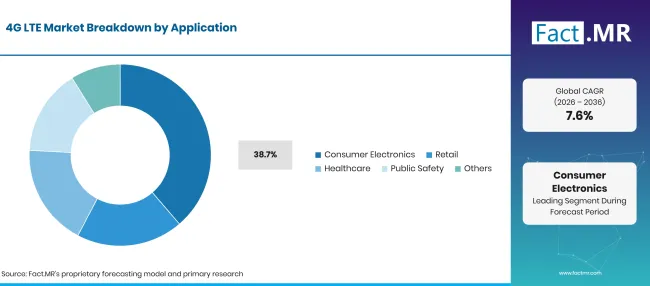
4G Lte Market Breakdown Application | Source: Fact.MR
| Application | Share (2026) |
|---|---|
| Consumer Electronics (Leading segment) | 38.7% |
| Other segments combined | 61.3%* |
| Total | 100.0% |
Source: Fact.MR analysis. Updated Nov 2, 2026
Consumer electronics account for substantial LTE demand through smartphones, tablets, wireless routers, and connected devices. These products rely on LTE modems and compatible radio-frequency components to provide mobile broadband connectivity. Retail applications use LTE for payment terminals, inventory management, and connected point-of-sale equipment. Healthcare providers use wireless connectivity for remote monitoring and mobile clinical communication, while public safety applications require dependable communication across emergency response environments.
How does Deployment Mode shape demand?
Macro Cells are likely to account for a 66.8% share in 2026.
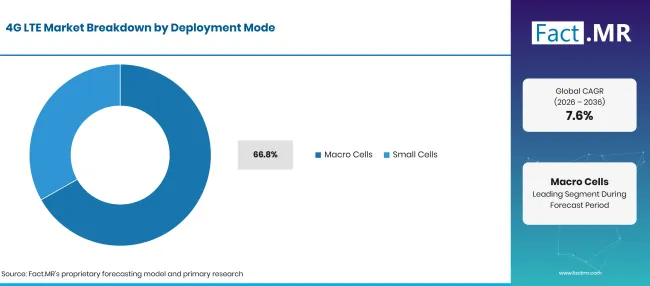
4G Lte Market Breakdown Deployment Mode | Source: Fact.MR
| Deployment Mode | Share (2026) |
|---|---|
| Macro Cells (Leading segment) | 66.8% |
| Other segments combined | 33.2%* |
| Total | 100.0% |
Source: Fact.MR analysis. Updated Nov 2, 2026
Macro cells provide broad geographical coverage while supporting large numbers of connected devices across urban and rural areas. Telecom operators rely on macro base stations to establish the primary coverage layer of their LTE networks. Small cells complement this infrastructure by improving indoor coverage and increasing capacity in high-traffic locations. Their deployment is relevant in shopping centers and office buildings as well as transport facilities and dense urban areas where macro network capacity may be insufficient.
What leads the End-User segment?
Telecom Operators are set to capture a 53.4% share in 2026.
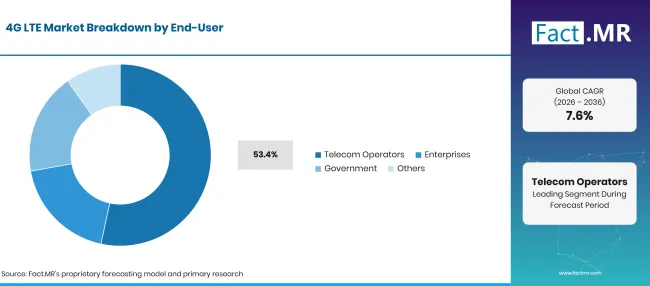
4G Lte Market Breakdown End User | Source: Fact.MR
| End-User | Share (2026) |
|---|---|
| Telecom Operators (Leading segment) | 53.4% |
| Other segments combined | 46.6%* |
| Total | 100.0% |
Source: Fact.MR analysis. Updated Nov 2, 2026
Telecom operators account for a major share of LTE infrastructure investment because they own or manage mobile networks and provide connectivity services to consumers and businesses. Enterprises also deploy LTE-based connectivity for dedicated operational requirements, particularly in industrial facilities, logistics, and remote locations. Government organizations use LTE networks for public services, emergency communication, and other connectivity requirements. Other end-users include organizations that depend on mobile broadband for connected operations.
What is accelerating 4G LTE Market adoption, and what is holding it back?
Demand for mobile broadband and enterprise connectivity supports LTE adoption alongside ongoing network modernization. However, spectrum limitations and infrastructure investment requirements as well as migration toward 5G can constrain market expansion.
Drivers Impact Analysis
| DRIVER | (~) % IMPACT ON CAGR | GEOGRAPHIC RELEVANCE | IMPACT TIMELINE |
|---|---|---|---|
| Rising mobile broadband consumption | +1.1% | Global | Short term (≤ 2 years) |
| Enterprise and private LTE deployments | +0.9% | North America, Europe, Asia | Medium term (2–4 years) |
| Rural mobile broadband expansion | +0.8% | Latin America, Asia, Africa | Medium term (2–4 years) |
| LTE network capacity modernization | +0.7% | Global | Medium term (2–4 years) |
| Growth in connected consumer electronics | +0.6% | Global | Long term (≥ 4 years) |
Source: Fact.MR analysis. Updated Nov 2, 2026
Opportunity Impact Analysis
| OPPORTUNITY | (~) % IMPACT ON CAGR | GEOGRAPHIC RELEVANCE | IMPACT TIMELINE |
|---|---|---|---|
| Private LTE networks for enterprises | +0.9% | North America, Europe, Asia | Medium term (2–4 years) |
| LTE coverage in underserved locations | +0.8% | Latin America, Asia, Africa | Long term (≥ 4 years) |
| Industrial IoT connectivity | +0.7% | Global | Medium term (2–4 years) |
| LTE-based public safety communication | +0.5% | North America, Europe | Long term (≥ 4 years) |
Source: Fact.MR analysis. Updated Nov 2, 2026
Restraints Impact Analysis
| RESTRAINT | (~) % IMPACT ON CAGR | GEOGRAPHIC RELEVANCE | IMPACT TIMELINE |
|---|---|---|---|
| Migration of network investment toward 5G | -0.9% | Global | Medium term (2–4 years) |
| Spectrum availability and allocation constraints | -0.7% | Global | Medium term (2–4 years) |
| High network deployment and maintenance costs | -0.6% | Emerging markets | Short term (≤ 2 years) |
| Legacy equipment and interoperability challenges | -0.4% | Global | Medium term (2–4 years) |
Source: Fact.MR analysis. Updated Nov 2, 2026
Which countries are scaling the 4G LTE Market through 2036?
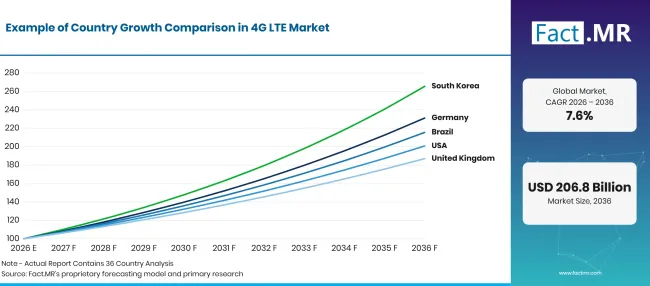
4G Lte Market Growth Index | Source: Fact.MR
| Country | CAGR (2026–2036) |
|---|---|
| Germany | 8.7% |
| Brazil | 8.0% |
| USA | 7.2% |
| UK | 6.5% |
| Japan | 5.7% |
Source: Fact.MR analysis. Updated Nov 2, 2026
What supports Germany adoption?
8.7% CAGR, supported by rising mobile data consumption and continued investment in LTE network capacity.
Germany's opportunity is supported by its established telecommunications infrastructure, industrial connectivity requirements, and demand for reliable mobile broadband. Telecom operators continue managing LTE infrastructure alongside newer 5G deployments. Enterprise applications across manufacturing, logistics, and connected operations also create demand for dependable wireless connectivity.
Germany's 4G LTE market benefits from rising mobile data consumption and continued investment in telecommunications infrastructure. According to Germany's Federal Network Agency (Bundesnetzagentur) 2026 report, mobile network data traffic reached 10.9 billion GB in 2025 compared with 9.6 billion GB in 2024. Average monthly data consumption per active SIM profile also increased by approximately 13% to 8.4 GB. These trends support continued LTE network capacity requirements alongside 5G expansion. [10]
How is Brazil developing 4G LTE adoption?
8.0% CAGR, shaped by expanding mobile broadband access and increasing demand for reliable wireless connectivity.
Brazil's market is supported by continued mobile broadband requirements across urban and rural areas. LTE infrastructure remains relevant for extending internet access and providing connectivity to consumers and enterprises. Telecom operators can expand macro-cell coverage and introduce small cells in locations experiencing higher traffic. Affordable LTE-enabled devices and improvements in network availability may further support adoption.
Brazil's market is supported by expanding mobile connectivity and increasing demand for broadband access across urban and rural communities. According to Brazil's National Telecommunications Agency (Anatel), the country recorded 276.4 million mobile connections in Q2 2026 with annual growth of 3.7%. The agency also reported 66.1 million 5G connections, representing 23.9% of total mobile connections. The continued presence of a large mobile subscriber base supports demand for LTE services and network infrastructure.[11]
What supports United States adoption?
7.2% CAGR, driven by enterprise wireless connectivity requirements and continued demand for mobile broadband services.
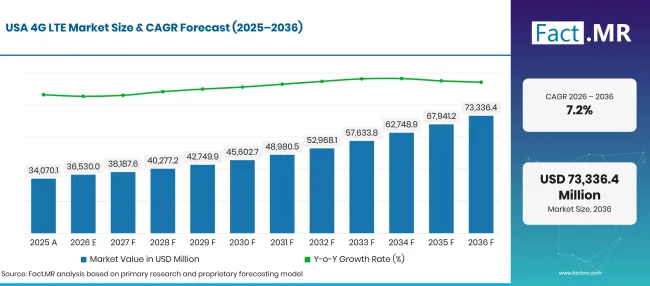
4G Lte Market Forecast Usa | Source: Fact.MR
The United States has an established mobile communications ecosystem with demand for enterprise wireless connectivity and connected devices. Private LTE networks can support industrial facilities, logistics operations, and other organizations requiring dedicated wireless infrastructure. Qualcomm's LTE modem and radio-frequency technologies also support the device ecosystem through connectivity components used in mobile products.
The United States benefits from strong demand for mobile broadband and enterprise wireless connectivity. The Federal Communications Commission's 2026 broadband assessment reported that more than 76% of Americans have a mobile data plan. The report also stated that 13.5% of households with a broadband subscription relied exclusively on mobile broadband [12].
How is the United Kingdom building adoption?
6.5% CAGR, supported by extensive 4G network coverage and continued demand for reliable mobile connectivity.
The UK's opportunity is associated with enterprise connectivity, mobile broadband services, and continued use of LTE infrastructure alongside 5G networks. Retail, healthcare, and industrial applications can use LTE connectivity for mobile operations and connected equipment. Telecom operators may prioritize network efficiency, indoor coverage, and capacity improvements to maintain service quality.
The UK's 4G LTE market is supported by extensive mobile network coverage and continued demand for reliable wireless connectivity. According to Ofcom's May 2026 Connected Nations update, 96% of the UK's landmass had predicted 4G geographic coverage from at least one mobile network operator as of January 2026. Good 4G coverage from all operators reached 84% of the landmass. This creates a strong foundation for mobile broadband services and continued LTE infrastructure use alongside expanding 5G networks. [13]
What supports Japan adoption?
5.7% CAGR, shaped by its substantial installed LTE subscriber base and continued demand for mobile connectivity.
Japan's market is supported by a large installed base of LTE connections and continued demand for mobile connectivity across consumer and enterprise applications. According to telecommunications subscription data released by Japan's Ministry of Internal Affairs and Communications in 2026, 4G LTE accounted for approximately 105.8 million subscriptions in June 2026 and represented 44.6% of mobile subscriptions. This substantial installed base supports continued LTE network maintenance and connectivity services while operators expand 5G infrastructure. [14]
Who leads the 4G LTE Market?
Fact.MR profiles Ericsson, Huawei Technologies, Nokia Corporation, Samsung Electronics, ZTE Corporation, Qualcomm Technologies, Cisco Systems, NEC Corporation, and Broadcom Inc. across LTE infrastructure, network software, semiconductor components, and enterprise connectivity.
Ericsson develops LTE radio access network solutions supporting FDD and TDD technologies. Its radio system portfolio includes macro and small-cell infrastructure alongside software for multi-standard network operations [1]. Huawei Technologies maintains LTE FDD and LTE TDD network products, including eNodeB equipment, terminals, small cells, and SingleRAN solutions [2]. Nokia Corporation participates in mobile radio access network infrastructure through its AirScale portfolio and network solutions. Its broader radio portfolio supports multi-generation mobile network deployments [3]. Samsung Electronics provides 4G LTE and LTE Advanced Pro network equipment, including radio access network and core network solutions for telecom operators and enterprises [4].
ZTE Corporation participates in LTE network infrastructure through wireless access network equipment and mobile communication solutions. Its portfolio includes LTE network technologies for operator deployments. Qualcomm Technologies supplies LTE modems, modem-to-antenna solutions, and radio-frequency components used in smartphones, tablets, and connected devices [5]. Cisco Systems participates in enterprise wireless connectivity and private 4G/5G network architecture through networking and integration technologies. Its relevance is stronger in enterprise networking and network solutions than in dedicated LTE macro-RAN equipment.
NEC Corporation supports 4G network operations through mobile core infrastructure and 4G/5G converged core solutions. Its technology supports the integration and continued handling of 4G traffic during network migration [6]. Broadcom Inc. supplies mobile RF front-end modules and semiconductor components supporting LTE frequency bands, carrier aggregation, and FDD and TDD applications [7].
Competition is shaped by network infrastructure capabilities, spectrum compatibility, LTE software development, semiconductor performance, and enterprise connectivity requirements. Equipment manufacturers compete through network capacity, energy efficiency, deployment flexibility, and integration with existing infrastructure. Semiconductor suppliers support the device ecosystem through LTE modems and radio-frequency components.
Which companies are the key providers?
Key companies include Ericsson; Huawei Technologies; Nokia Corporation; Samsung Electronics; ZTE Corporation; Qualcomm Technologies; Cisco Systems; NEC Corporation; Broadcom Inc.
- Ericsson
- Huawei Technologies
- Nokia Corporation
- Samsung Electronics
- ZTE Corporation
- Qualcomm Technologies
- Cisco Systems
- NEC Corporation
- Broadcom Inc.
Bibliography
- [1] Ericsson. (n.d.). LTE Radio Access Network.
- [2] Huawei Technologies. (n.d.). Wireless Network.
- [3] Nokia Corporation. (n.d.). Radio access networks.
- [4] Samsung Electronics. (n.d.). Networking and wireless solutions.
- [5] Qualcomm Technologies. (n.d.). Modem-RF.
- [6] NEC Corporation. (n.d.). Converged Core: 4G/5G Converged Core.
- [7] Broadcom Inc. (n.d.). RF Front End Modules.
- [8] GSMA. (2025, September). The State of Mobile Internet Connectivity 2025: Network Coverage and Infrastructure.
- [9] International Telecommunication Union. (2025). Measuring digital development: Facts and Figures 2025.
- [10] Bundesnetzagentur. (2026, June 5). Telecoms Annual Report 2025.
- [11] Agência Nacional de Telecomunicações. (2026, July 15). Anatel divulga Relatório de Monitoramento da Competição do segundo trimestre de 2026.
- [12] Federal Communications Commission. (2026, August 14). 2026 Section 706 Report (FCC 26-55).
- [13] Ofcom. (2026, May 13). Connected Nations update: Spring 2026.
- [14] Muto, S. (2026, September 28).[Rakuten's market share is 3.8%; MVNO communication modules increase 25%—Latest mobile subscription data from the Ministry of Internal Affairs and Communications]. ケータイ Watch.
This Report Answers
- The report describes how 4G LTE technologies support mobile broadband and enterprise connectivity.
- Technology analysis compares FDD-LTE and TD-LTE deployment.
- Application analysis examines consumer electronics, retail, healthcare, and public safety.
- Deployment analysis compares macro cells and small cells.
- Country analysis discusses Germany, Brazil, the USA, the UK, and Japan alongside growth estimates.
- The competitive overview profiles infrastructure manufacturers, semiconductor suppliers, and enterprise connectivity providers.
What does the 4G LTE Market cover?
The market covers LTE-based mobile communication technologies used to provide high-speed wireless connectivity. It includes radio access network infrastructure, LTE network equipment, associated semiconductor components, and related connectivity solutions. The market serves telecom operators, enterprises, government organizations, and consumer electronics applications.
What is included in the scope?
Included products comprise LTE radio access network equipment, macro-cell and small-cell infrastructure, LTE FDD and TD-LTE technologies, modem components, RF front-end products, and relevant mobile core network solutions. The scope includes applications across consumer electronics, retail, healthcare, public safety, and enterprise connectivity.
What is excluded from the scope?
The analysis excludes standalone 5G New Radio infrastructure and non-LTE wireless technologies such as Wi-Fi, Bluetooth, and satellite communication when sold independently. Fixed broadband equipment without LTE functionality is outside the defined market. General telecom services revenue is also excluded unless directly attributable to the defined LTE equipment and technology market.
How Was the Analysis Built?
The analysis draws on 120+ sources, 35+ company portfolios, 25+ countries, and more than 20 industry interviews.
- Primary Research: Primary research includes discussions with telecom equipment manufacturers, network operators, semiconductor suppliers, enterprise connectivity providers, distributors, and telecommunications specialists. These conversations examine network investment priorities, spectrum requirements, infrastructure, device compatibility, and adoption barriers.
- Desk Research: Desk research covers telecommunications statistics, spectrum regulations, company product documentation, network deployment announcements, industry reports, and technical publications. Sources used for the analysis are documented in the bibliography.
- Market Sizing and Forecasting: Market estimates combine the market values, historical performance, network infrastructure investment, technology adoption, segment shares, country-level growth, and enterprise connectivity requirements. The 2025 valuation is derived using the 2026 estimate and CAGR.
- Data Validation and Update Cycle: Findings are reviewed against company product portfolios, operator deployment activity, regulatory changes, spectrum allocation, and technological developments. Competitive profiles distinguish active LTE infrastructure providers from semiconductor suppliers and legacy product participants.
Segmentation
What is the report's scope and coverage?
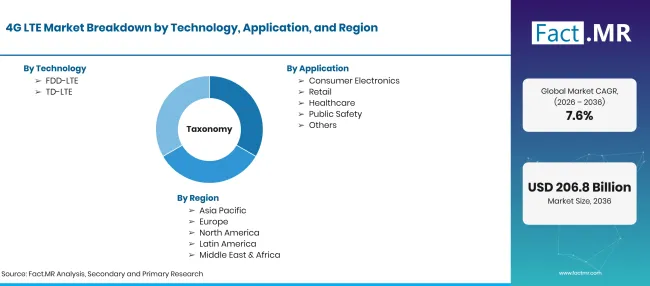
4G Lte Market Taxonomy | Source: Fact.MR
| Attribute | Details |
|---|---|
| Quantitative Units | USD billion in 2026 to USD billion by 2036, at CAGR |
| Market Definition | The 4G LTE market covers network infrastructure and equipment along with semiconductor components and related technologies used to deliver wireless connectivity. It includes base stations and LTE chipsets supporting mobile broadband services and enterprise communication across consumer and industrial applications. |
| Technology | FDD-LTE; TD-LTE |
| Application | Consumer Electronics; Retail; Healthcare; Public Safety; Others |
| Deployment Mode | Macro Cells; Small Cells |
| End-User | Telecom Operators; Enterprises; Government; Others |
| Regions Covered | North America; Latin America; Western Europe; Eastern Europe; East Asia; South Asia & Pacific; Middle East & Africa |
| Countries Covered | Germany; Brazil; USA; UK; Japan |
| Companies Profiled | Ericsson; Huawei Technologies; Nokia Corporation; Samsung Electronics; ZTE Corporation; Qualcomm Technologies; Cisco Systems; NEC Corporation; Broadcom Inc. |
| Forecast Period | 2026 to 2036 |
| Approach | Market segmentation and scenario-based analysis supported by telecommunications statistics and company product information |
Source: Fact.MR analysis. Updated Nov 2, 2026
How is the market segmented?
-
By Technology
- FDD-LTE
- TD-LTE
-
By Application
- Consumer Electronics
- Retail
- Healthcare
- Public Safety
- Others
-
By Deployment Mode
- Macro Cells
- Small Cells
-
By End-User
- Telecom Operators
- Enterprises
- Government
- Others
-
By Region
- North America
- Latin America
- Western Europe
- Eastern Europe
- East Asia
- South Asia & Pacific
- Middle East & Africa
Frequently Asked Questions
How big is the 4G LTE Market in 2026?
What is the CAGR from 2026 to 2036?
Which technology has the largest share?
Which application leads the market?
Which deployment mode has the largest share?
Which end-user leads?
Which country has the highest CAGR?
Which companies are covered?
Who worked on this report


Preview the report firsthand - request a free sample
Free SampleGet the brochure for pricing and purchase details
Download PDF