- Market Value (2025): USD 37.8 Mn
- Estimated Value (2026): USD 48.0 Mn
- Forecast Value (2036): USD 520.0 Mn
- CAGR (2026-2036): 26.9%
What is the Sodium-Ion Cathode Binders Market forecast to be worth by 2036?
USD 48.0 million in 2026 to USD 520.0 million by 2036, at a 26.9% CAGR.
- The sodium-ion cathode binders market crossed USD 37.8 million in 2025 as cell developers expanded trials across Prussian blue and Polyanionic cathodes.
- Demand is projected to increase from USD 48.0 million in 2026 to USD 520.0 million by 2036.
- The market is forecast to record a 26.9% CAGR from 2026 to 2036 as repeat coating runs convert laboratory recipes into approved cell programs.
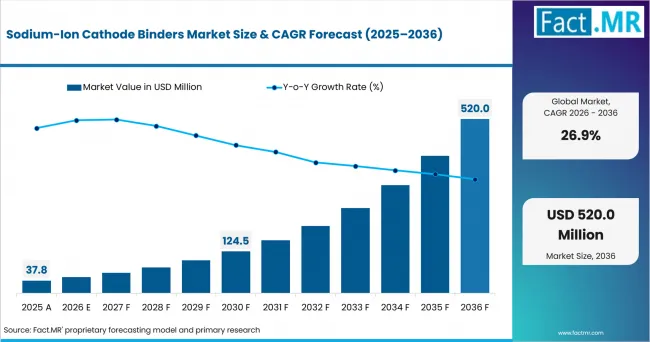
Sodium Ion Cathode Binders Market Market Value Analysis | Source: Fact.MR
What are the defining numbers behind Sodium-Ion Cathode Binders Market growth?
USD 472.0 million absolute opportunity by 2036, led by Prussian blue, PVDF, Wet slurry, and Stationary storage.
Demand Drivers in the Market
- Prussian blue programs need binders that preserve particle contact after moisture exposure, drying, calendering, and repeated sodium insertion.
- Stationary storage offers an early qualification route since system designers value cost, cycle life, cold-weather output, and safety records more than maximum driving range.
- PVDF supports initial trials through familiar film formation, chemical resistance, and cathode-coating behavior.
- Wet slurry remains practical for pilot teams that already operate mixing, coating, drying, calendering, and in-line quality checks.
Key Segments Analyzed
- By Cathode Chemistry: Prussian blue is expected to hold 30% share in 2026, supported by lower critical-mineral exposure and a clear fit with stationary storage.
- By Binder Type: PVDF is projected to account for 32% share in 2026, reflecting a familiar film-forming polymer used in cathode qualification.
- By Manufacturing Route: Wet slurry is anticipated to capture 28% share in 2026, owing to installed mixing, coating, drying, and calendering workflows.
- By Application: Stationary storage is estimated to represent 39% share in 2026, with system weight carrying less influence than cost, safety, and service life.
- By End User: Sodium-ion cell makers are forecast to account for 36% share in 2026, as they control electrode recipes, validation records, and repeat material approval.
Analyst Opinion at Fact.MR
- Shambhu Nath Jha, Senior Analyst at Fact.MR, states, “Cathode-binder approval is a process decision, not a simple polymer substitution. Cell developers are expected to favor grades that retain coating strength through drying and cycling. Complete safety files and practical pilot-line support are also expected to influence approval.”
Strategic Implications
- Binder manufacturers should prioritize coating and cycling evidence for Prussian blue cathodes instead of relying on broad battery-grade claims.
- Electrode teams should compare PVDF, CMC, SBR, PAA, and Fluorine-free grades under the same slurry and drying conditions before changing an approved recipe.
- Distributors should keep technical data sheets, safety files, restricted-substance declarations, and sample histories ready before formal review begins.
- Regional teams should track China for rapid cell-to-material feedback and India for manufacturing programs that require local application support.
Solvent reduction is becoming a material-selection issue for cathode teams, not only an equipment decision. Binder grades still need to protect adhesion and film integrity when NMP-based processing is reduced. Arkema detailed a Kynar PVDF emulsion route in September 2025 and identified PVDF for lithium-ion and sodium-ion cathode binders across dry and aqueous coating processes. The development gives pilot teams a current reference for testing familiar chemistry under lower-solvent routes.
China is expected to record a 36.3% CAGR through 2036 as sodium-ion cell programs move into larger qualification runs. Domestic battery policy is projected to support a 33.6% CAGR in India. Germany is anticipated to advance at a 30.9% CAGR through collaborative cell-development programs. Brazil is estimated to post a 28.2% CAGR as battery-storage procurement becomes clearer. The USA is forecast to record a 25.6% CAGR through long-duration storage research and safety validation.
How does the Sodium-Ion Cathode Binders Market break down by segment?
Prussian blue leads with 30%, while PVDF accounts for 32%.
How does Cathode Chemistry shape demand?
Prussian Blue holds 30% share in 2026.
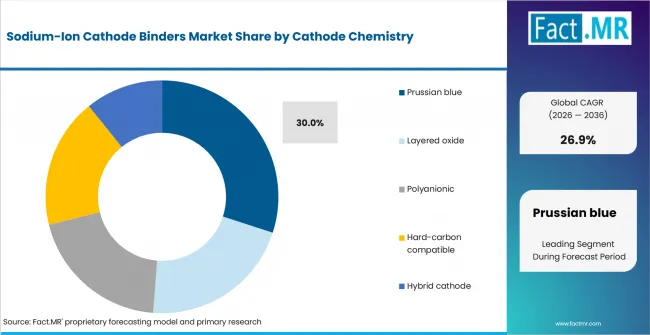
Sodium Ion Cathode Binders Market Analysis By Cathode Chemistry | Source: Fact.MR
Prussian Blue is expected to hold 30% share in 2026 because its open framework supports sodium transport without nickel or cobalt. Layered Oxide and Polyanionic systems require different adhesion behavior across moisture control and particle contact during electrode preparation. Hard-Carbon Compatible and Hybrid cathode programs also need binder approval data that reflects coating defects and cycle retention. In March 2025, Altris announced an investment and product development collaboration with Volvo Cars involving its proprietary Prussian White cathode technology. Volvo Cars will explore potential battery energy storage applications using the company’s sodium-ion technology.
Where is Binder Type demand most established?
PVDF accounts for 32% share in 2026.
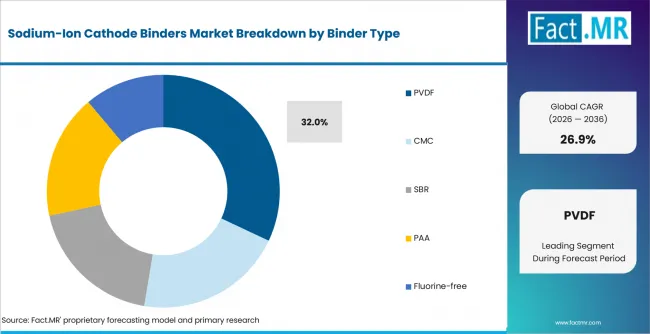
Sodium Ion Cathode Binders Market Analysis By Binder Type | Source: Fact.MR
PVDF is projected to account for 32% share in 2026 owing to familiar film formation and chemical resistance. CMC and SBR grades remain under review where developers prioritize Waterborne processing and lower solvent dependence during coating. PAA and Fluorine-Free binders must prove dispersion quality and adhesion without increasing impedance or shortening cycle life. In September 2025 Arkema detailed a PVDF emulsion route for solvent-free electrode manufacturing across lithium-ion and sodium-ion cells. This route broadens PVDF relevance while preserving adhesion and electrochemical stability during customer qualification programs.
What supports Manufacturing Route adoption?
Wet Slurry leads with 28% share in 2026.
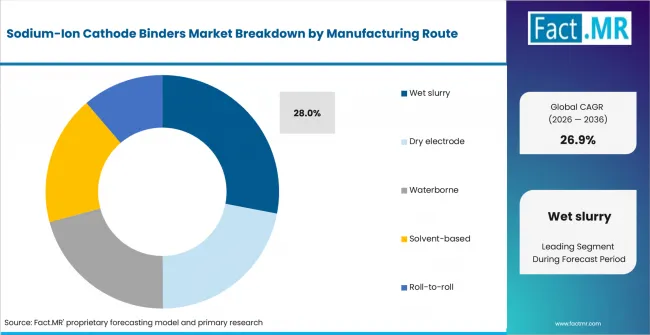
Sodium Ion Cathode Binders Market Analysis By Manufacturing Route | Source: Fact.MR
Wet Slurry is anticipated to capture 28% share in 2026 as existing pilot lines already support mixing and coating. These lines also include drying and calendering equipment that helps teams compare batches before changing production methods. Dry Electrode and Waterborne routes create separate requirements for film strength and line repeatability during scale-up.
Which Application dominates?
Stationary Storage represents 39% share in 2026.
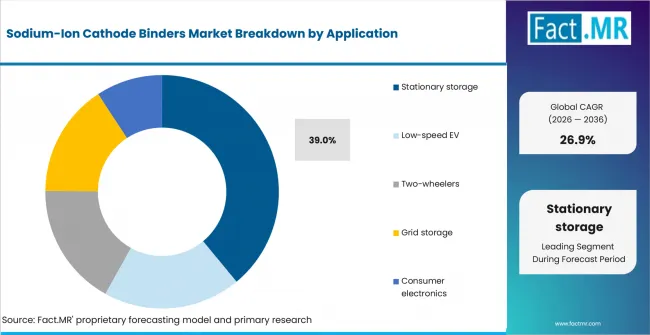
Sodium Ion Cathode Binders Market Analysis By Application | Source: Fact.MR
Stationary Storage is estimated to represent 39% share in 2026 since buyers prioritize cost and service life. These systems value cold-weather output and supply diversity more heavily than maximum energy density during procurement. Binder grades must withstand repeated cycling and long idle periods before suppliers can secure larger commercial orders. The agreement provides a large commercial reference point for sodium-ion materials qualified for stationary storage duty cycles.
What leads the End User segment?
Sodium-Ion Cell Makers account for 36% share in 2026.
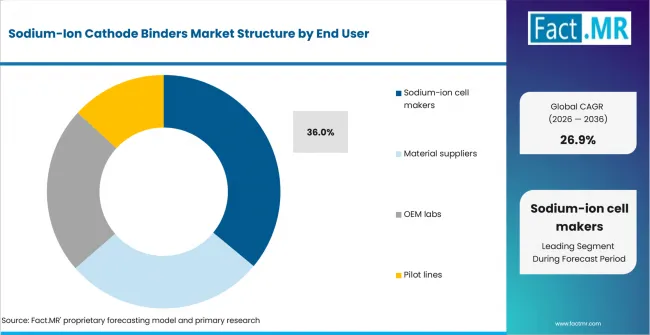
Sodium Ion Cathode Binders Market Analysis By End User | Source: Fact.MR
Sodium-Ion Cell Makers are forecast to account for 36% share in 2026 because they control electrode recipes and production risk. Material suppliers support early formulation while OEM laboratories establish performance targets before pilot-line validation begins. Repeat demand depends on whether cell makers can scale approved recipes without coating defects or warranty exposure.
What is accelerating Sodium-Ion Cathode Binders Market adoption, and what is holding it back?
Cycling stability, stationary-storage qualification, and local manufacturing programs are anticipated to support adoption, whereas process-change risk and documentation gaps are expected to slow approval.
Drivers Impact Analysis
| DRIVER | (~) % IMPACT ON CAGR | GEOGRAPHIC RELEVANCE | IMPACT TIMELINE |
|---|---|---|---|
| Cycling stress control in Prussian blue | +0.8% | China and East Asia | Medium term (2-4 years) |
| Stationary storage qualification programs | +0.6% | East Asia and North America | Medium term (2-4 years) |
| Wet slurry process familiarity | +0.5% | Global pilot lines | Short term (<= 2 years) |
| Local technical support near cell developers | +0.4% | China, India, and Western Europe | Medium term (2-4 years) |
| Battery manufacturing localization | +0.3% | India, United States, and Europe | Long term (>= 4 years) |
Source: Fact.MR analysis. Updated Jul 13, 2026
- Cycling stress in Prussian blue: Repeated sodium movement can weaken particle contact inside a Prussian blue cathode layer over many charging cycles. A suitable binder keeps the coating attached and reduces early capacity loss caused by cracking or particle movement. Demand will favor binder grades that deliver similar performance consistently across several electrode production batches.
- Stationary storage testing: Stationary storage developers can accept larger and heavier battery systems when service life and safety are well documented. This gives sodium-ion cells a practical entry point for early commercial use in storage projects. Binder suppliers can gain approval work when customers require long cycling and idle-storage testing programs.
- Familiar wet slurry processing: Pilot teams already understand slurry mixing and coating processes through their existing battery development work. Familiar equipment reduces process changes during early testing of new sodium-ion cathode chemistries. Wet slurry processing will remain the preferred starting route until other methods provide similar consistency at commercial scale.
- Technical support near cell developers: Slurry thickness and coating defects often require direct adjustments on the customer’s production line. Nearby application teams can reduce delays between a failed coating roll and the next production trial. Strong technical support may influence repeat orders more than the binder specifications listed in product catalogues.
- Local battery manufacturing: New battery programs require regional records covering material quality and batch consistency across regular production cycles. Cathode binders represent a small share of cell cost but directly affect manufacturing yield and battery life. Localization will increase demand for binder grades supported by regional inventory and local engineering teams.
Opportunity Impact Analysis
| OPPORTUNITY | (~) % IMPACT ON CAGR | GEOGRAPHIC RELEVANCE | IMPACT TIMELINE |
|---|---|---|---|
| Grades tuned for Stationary storage | +0.5% | Global | Medium term (2-4 years) |
| Waterborne and Fluorine-free binder systems | +0.4% | Western Europe and North America | Medium term (2-4 years) |
| Dry electrode application support | +0.4% | East Asia and Western Europe | Short term (<= 2 years) |
| Local trials with cell developers | +0.3% | India and Latin America | Long term (>= 4 years) |
Source: Fact.MR analysis. Updated Jul 13, 2026
- Binders for stationary storage: Large battery cells need binders that maintain strong adhesion during long operating periods and repeated cycling. Developers will prefer grades tested with specific cathode chemistries instead of products supported only by general battery claims. This creates opportunities for tailored binder packages with clear processing limits and documented coating performance.
- Waterborne and fluorine-free systems: Waterborne processing can reduce solvent use and lower the energy required for electrode drying. However the binder must still provide stable dispersion and strong cohesion throughout coating and cell operation. Demand will expand when CMC, SBR, PAA or fluorine-free grades match PVDF performance without major equipment changes.
- Support for dry electrode processing: Dry electrode production removes liquid slurry and changes powder handling along with film formation and lamination behavior. Binder producers can gain early positions by testing materials with equipment suppliers and sodium-ion cell developers. Commercial approval will depend on consistent full-width films because small laboratory samples cannot confirm production-scale performance.
- Local testing with cell developers: India and Latin America have less developed sodium-ion supply chains compared with leading East Asian markets. Regional testing can reduce sample delivery times and allow engineers to solve coating problems directly at production sites. Suppliers will benefit when technical support continues until the customer achieves repeatable commercial-scale electrode production.
Restraints Impact Analysis
| RESTRAINT | (~) % IMPACT ON CAGR | GEOGRAPHIC RELEVANCE | IMPACT TIMELINE |
|---|---|---|---|
| Qualification cost and long approval cycles | -0.5% | Global | Medium term (2-4 years) |
| Process limits in PVDF routes | -0.4% | Global | Short term (<= 2 years) |
| Documentation and batch-traceability burden | -0.3% | Western Europe and North America | Medium term (2-4 years) |
| Scale-up gap between coin cells and roll coating | -0.2% | Global pilot programs | Long term (>= 4 years) |
Source: Fact.MR analysis. Updated Jul 13, 2026
- High qualification costs and long approval periods: Changing a binder requires several electrode batches along with cycling tests and storage checks before customer approval. Cell makers may delay switching when small cost savings do not justify the risk of failed trial batches. Approved binder grades therefore remain in existing recipes for longer periods despite the availability of alternatives.
- PVDF processing limits: PVDF processing is familiar to battery teams but often requires solvent handling and high drying energy. Waterborne and fluorine-free binders receive more interest where NMP control increases operating costs for manufacturers. Adoption remains limited when alternative binders change slurry viscosity or reduce the required electrode density.
- Documentation and traceability requirements: Customers require clear records covering material origin and impurities during formal supplier approval audits. Smaller manufacturers may not have the regional documents needed for customer audits and compliance reviews. Approval can slow even when performance is acceptable because documents arrive late or differ between plants.
- Challenges during production scale-up: Good results in coin cells do not always produce stable coatings on full-width production lines. Drying and calendering can reveal edge defects or coating problems that small laboratory tests missed. Production teams protect manufacturing yield before approving any new binder for repeated commercial orders at scale.
Which countries are scaling Sodium-Ion Cathode Binders Market fastest?
China 36.3%, India 33.6%, Germany 30.9%, Brazil 28.2%, USA 25.6%.
Regional analysis covers North America, Latin America, Western Europe, Eastern Europe, East Asia, South Asia and Pacific, and Middle East & Africa. Mexico is placed under Latin America, and Türkiye is placed under Middle East & Africa.
.webp "Top Country Growth Comparison Sodium Ion Cathode Binders Market Cagr (2026 2036)")
Top Country Growth Comparison Sodium Ion Cathode Binders Market Cagr (2026 2036) | Source: Fact.MR
| COUNTRY | CAGR |
|---|---|
| China | 36.3% |
| India | 33.6% |
| Germany | 30.9% |
| Brazil | 28.2% |
| USA | 25.6% |
Source: Fact.MR analysis. Updated Jul 13, 2026
What supports China’s growth through 2036?
36.3% CAGR, driven by fast feedback across cathode development and pack validation within domestic production networks.
China offers a short route from cathode trials to pack testing across its expanding sodium-ion manufacturing landscape. The market is projected to record a 36.3% CAGR over the forecast period as local cell makers test binder performance across larger production runs. Dense links between cathode developers and pack teams shorten correction cycles after commercial-scale coating trials.
How is India developing Sodium-ion Battery Binder demand?
33.6% CAGR, supported by domestic cell-manufacturing programs and growing demand for local technical assistance services.
India is building component qualification systems around domestic cell-manufacturing plans and early sodium-ion pilot programs. In February 2026, the Ministry of Heavy Industries reported that the ACC scheme targeted 50 GWh of manufacturing capacity. The market is projected to expand at a 33.6% CAGR as pilot programs require local samples and on-site process support. The gap between awarded and operating capacity keeps technical service central to early binder orders.
What supports Germany’s growth through 2036?
30.9% CAGR, supported by collaborative cell programs and strong links between research institutes and industrial partners.
Germany connects battery research institutes with industrial partners that can test large-format sodium-ion cells and production methods. The market is anticipated to record a 30.9% CAGR as manufacturers demand repeatable coating performance and documented process control. Binder suppliers must also provide records that support qualification under European battery regulations and customer audit requirements.
What is driving Brazil’s growth through 2036?
28.2% CAGR, backed by grid-scale storage procurement plans and clearer testing routes for battery projects.
Brazil is preparing a clearer procurement route for grid-scale battery storage through planned capacity-market mechanisms. The market is estimated to post a 28.2% CAGR as developers compare cell chemistries and approved electrode recipes. This policy step gives imported and local cell programs a firmer horizon for testing and supplier qualification.
How is the United States scaling Sodium-ion Battery Binder demand?
25.6% CAGR, led by long-duration storage research and application-led qualification across national laboratory and pilot projects.
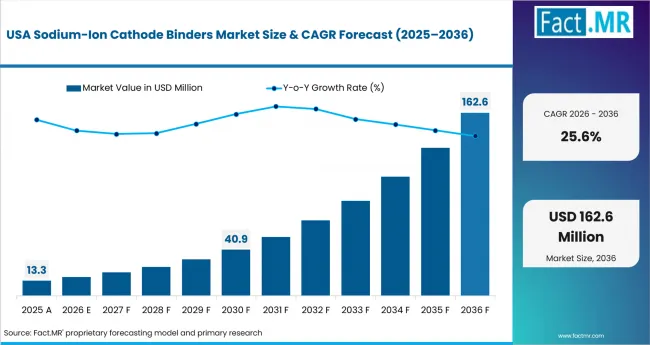
Sodium Ion Cathode Binders Market Country Value Analysis | Source: Fact.MR
The United States combines national laboratory research with storage projects that require long service life and documented safety performance. In August 2025, Argonne National Laboratory reported sodium-ion and water-based battery research aimed at improving performance and service life. The market is forecast to record a 25.6% CAGR as pilot programs request local troubleshooting and repeat coating evidence. Early orders are expected to remain tied to successful trial evidence instead of immediate volume commitments.
Who leads the Sodium-Ion Cathode Binders Market?
Syensqo and Arkema lead binder-material coverage across battery applications. Kureha Corporation and Zeon Corporation strengthen polymer expertise.
Arkema provides a current sodium-ion cathode-binder reference through Kynar PVDF, whereas Syensqo adds fluorine and specialty-chemistry experience to the profiled set. Kureha Corporation remains active in PVDF binder development and reported in May 2026 that its binder business was being repositioned under the FY2035 long-term plan. Competition is expected to center on adhesion, purity, batch control, and customer-line support. Zeon Corporation focuses on electrode binders and application service. Its June 2025 medium-term plan stated that supply agreements had been secured with major United States battery manufacturers.
Which companies are the key players?
Syensqo, Arkema, Kureha Corporation, Zeon Corporation complete the company set.
- Syensqo
- Arkema
- Kureha Corporation
- Zeon Corporation
Bibliography
- Arkema. (2025, September 1). Solvent-Free Battery Technology Powered by PVDF Emulsion Innovation. Arkema.
- Kureha Corporation. (2025, October). KUREHA Business Report 2025. Kureha Corporation.
- Ministry of Heavy Industries. (2026, February 6). PLI Scheme for Advance Chemistry Cells. Press Information Bureau, Government of India.
- Oak Ridge National Laboratory. (2025, July 30). Carbon fiber boosts dry-processed battery performance. Oak Ridge National Laboratory.
- Zeon Corporation. (2025). Medium-Term Business Plan - Phase 3 (FY2025-FY2028). Zeon Corporation.
- Syensqo. (2026). Solgain: Sustainable dry coating for battery cathodes. Syensqo.
- Daikin Chemical Europe. (2026, January 22). Project ProLiT concluded: Driving the future of battery manufacturing with solvent-free dry coating. Daikin Chemical Europe.
- Dürr AG. (2025, October 6). X.Cellify DC enables dry coating with free-standing film. Dürr AG.
This Report Addresses
- The report examines Cathode Chemistry and Binder Type choices that shape sodium-ion cathode coating and cell qualification.
- Segment analysis uses Prussian blue, Layered oxide, Polyanionic, Hard-carbon compatible, and Hybrid cathode under Cathode Chemistry.
- The report compares Wet slurry, Dry electrode, Waterborne, Solvent-based, and Roll-to-roll production routes.
- Regional analysis follows North America, Latin America, Western Europe, Eastern Europe, East Asia, South Asia and Pacific, and Middle East & Africa.
- Competitive analysis profiles Syensqo, Arkema, Kureha Corporation, Zeon Corporation.
- Application coverage includes Stationary storage, Low-speed EV, Two-wheelers, Grid storage, and Consumer electronics.
What does the Sodium-Ion Cathode Binders Market cover?
PVDF, CMC, SBR, PAA, and Fluorine-free binders used in sodium-ion cathode manufacturing and qualification.
The sodium-ion cathode binders market covers polymer grades used to hold cathode particles on current collectors through coating, drying, calendering, storage, and cycling. Cathode chemistry includes prussian blue, layered oxide, polyanionic, hard-carbon compatible, and hybrid cathode.
Commercial value comes from adhesion, slurry control and qualification support. Cathode active materials, electrolytes, separators, foils, equipment, and finished cells remain outside the boundary unless the purchase value is directly tied to binder function.
What is included in the scope?
Cathode-binder grades and technical support used in sodium-ion electrode manufacturing.
The scope includes wet slurry, dry electrode, waterborne, solvent-based, and roll-to-roll manufacturing routes. It also covers samples, formulation support, pilot coating, safety files, and customer qualification work when these services help convert a binder grade into repeat supply.
What is excluded from the scope?
Equipment-only offerings, cathode active materials, and polymers without a sodium-ion cathode-binder function.
The scope excludes lithium-ion-only demand, broad adhesive sales, and laboratory materials without a path to customer qualification. Electrolytes, separators, foils, cathode powders, cell packs, and coating equipment are excluded when no binder-related commercial value is present.
How was the analysis built?
120+ sources, 6 company profiles, 25+ countries, 20+ interviews.
- Primary Research: Primary research includes discussions with polymer manufacturers, cell makers, electrode engineers, material distributors, OEM labs, and pilot lines. Interviews test approval steps, sample-to-order conversion, coating problems, and the evidence required before repeat purchase.
- Desk Research: Desk research reviews official policy, company product information, technical publications, standards guidance, and public battery-safety material. The evidence is used to assess sodium-ion scale-up, Stationary storage fit, manufacturing policy, and regional activity.
- Market-Sizing and Forecasting: Forecasting combines starting value, end value, CAGR, segment weight, company presence, country signals, qualification barriers, and manufacturing-route adoption. The model assumes that demand expands only after cell makers repeat approved electrode recipes.
- Data Validation and Update Cycle: Forecasts are cross-checked against official announcements, company disclosures, trade data, and interview evidence. Updates are applied when cell projects, storage programs, safety rules, or binder launches change the expected approval pace.
Segmentation
What is the report’s scope and coverage?
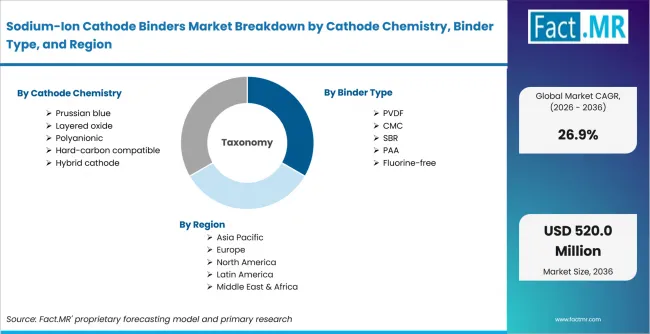
Sodium Ion Cathode Binders Market Breakdown By Cathode Chemistry, Binder Type, And Region | Source: Fact.MR
| Attribute | Details |
|---|---|
| Quantitative Units | USD million in 2026 to USD million by 2036 at a CAGR |
| Market Definition | Polymer binders used to hold sodium-ion cathode particles on current collectors during coating, drying, calendering, storage, and cycling |
| Cathode Chemistry | Prussian blue; Layered oxide; Polyanionic; Hard-carbon compatible; Hybrid cathode |
| Binder Type | PVDF; CMC; SBR; PAA; Fluorine-free |
| Manufacturing Route | Wet slurry; Dry electrode; Waterborne; Solvent-based; Roll-to-roll |
| Application | Stationary storage; Low-speed EV; Two-wheelers; Grid storage; Consumer electronics |
| End User | Sodium-ion cell makers; Material suppliers; OEM labs; Pilot lines |
| Regions Covered | North America; Latin America; Western Europe; Eastern Europe; East Asia; South Asia and Pacific; Middle East & Africa |
| Countries Covered | USA; Canada; Brazil; Mexico; Chile; Rest of Latin America; Germany; UK; Italy; Spain; France; Nordic; BENELUX; Rest of Western Europe; Russia; Poland; Hungary; Balkan & Baltic; Rest of Eastern Europe; China; Japan; South Korea; India; ASEAN; Australia & New Zealand; Rest of South Asia and Pacific; Kingdom of Saudi Arabia; Other GCC Countries; Türkiye; South Africa; Other African Union; Rest of Middle East & Africa |
| Key Companies Profiled | Syensqo; Arkema; Kureha Corporation; Zeon Corporation |
| Forecast Period | 2026 to 2036 |
| Approach | Hybrid top-down and bottom-up analysis using cell-program activity, cathode qualification, binder attachment rates, manufacturing-route adoption, application demand, pricing, and interview-based cross-checks |
Source: Fact.MR analysis. Updated Jul 13, 2026
How is the market segmented?
-
By Cathode Chemistry:
- Prussian blue
- Layered oxide
- Polyanionic
- Hard-carbon compatible
- Hybrid cathode
-
By Binder Type:
- PVDF
- CMC
- SBR
- PAA
- Fluorine-free
-
By Manufacturing Route:
- Wet slurry
- Dry electrode
- Waterborne
- Solvent-based
- Roll-to-roll
-
By Application:
- Stationary storage
- Low-speed EV
- Two-wheelers
- Grid storage
- Consumer electronics
-
By End User:
- Sodium-ion cell makers
- Material suppliers
- OEM labs
- Pilot lines
-
By Region:
- North America
- USA
- Canada
- Latin America
- Brazil
- Mexico
- Chile
- Rest of Latin America
- Western Europe
- Germany
- UK
- Italy
- Spain
- France
- Nordic
- BENELUX
- Rest of Western Europe
- Eastern Europe
- Russia
- Poland
- Hungary
- Balkan & Baltic
- Rest of Eastern Europe
- East Asia
- China
- Japan
- South Korea
- South Asia and Pacific
- India
- ASEAN
- Australia & New Zealand
- Rest of South Asia and Pacific
- Middle East & Africa
- Kingdom of Saudi Arabia
- Other GCC Countries
- Türkiye
- South Africa
- Other African Union
- Rest of Middle East & Africa
- North America
Frequently Asked Questions
Which Cathode Chemistry leads the Sodium-Ion Cathode Binders Market?
Which Binder Type leads the Sodium-Ion Cathode Binders Market?
Which Manufacturing Route leads the Sodium-Ion Cathode Binders Market?
Which Application leads the Sodium-Ion Cathode Binders Market?
Which End User leads the Sodium-Ion Cathode Binders Market?
Which country records the highest CAGR in the Sodium-Ion Cathode Binders Market?
How does India perform in the Sodium-Ion Cathode Binders Market?
How does Germany perform in the Sodium-Ion Cathode Binders Market?
How does Brazil perform in the Sodium-Ion Cathode Binders Market?
What is the primary driver in the Sodium-Ion Cathode Binders Market?
What is the main restraint in the Sodium-Ion Cathode Binders Market?
Who worked on this report


Preview the report firsthand - request a free sample
Free SampleGet the brochure for pricing and purchase details
Download PDF