- Base Value(2025): 286.9 Mn
- Forecast Value (2036): 498.6 Mn
- CAGR (2036): 5.1%
Sodium Cocoamphoacetate Market Forecast and Outlook By FACT.MR
The sodium cocoamphoacetate market reached USD 286.9 million in 2025. Fact MR estimates the market will expand to USD 304.2 million in 2026 and attain USD 498.6 million by 2036. The market is forecast to register a CAGR of 5.1% across the assessment period.
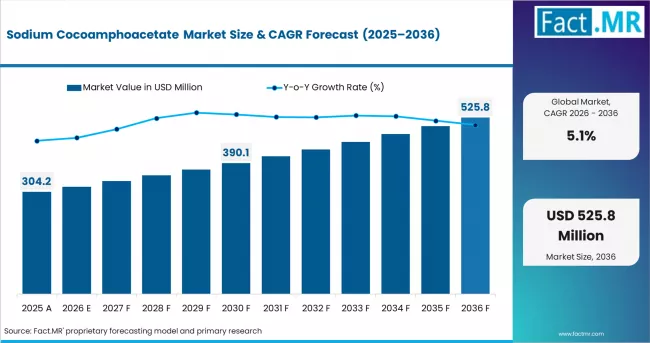
Sodium Cocoamphoacetate Market Value Analysis | Source: Fact.MR
Summary of the Sodium Cocoamphoacetate Market
- Market Definition
- The Sodium Cocoamphoacetate Market includes amphoteric surfactants derived from coconut fatty acids used as mild cleansing, foaming, conditioning, and emulsifying agents across shampoos, facial cleansers, body washes, baby products, liquid soaps, and specialty personal care formulations requiring balanced detergency and skin compatibility.
- Demand Drivers
- Stable utilization of mild amphoteric surfactants supporting reduced irritation cleansing performance across hair and skin care formulations
- Increasing formulation shift toward sulfate free surfactant systems supporting compatibility with sensitive skin product positioning
- Continued demand for balanced foam structure supporting conditioning performance across rinse off cosmetic products
- Consistent incorporation of amphoteric co surfactants supporting viscosity control and formulation stability across personal cleansing products
- Key Segments Analyzed
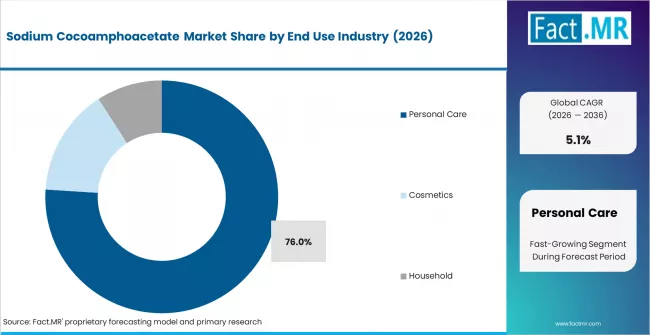
- End Use Industry: Personal care accounts for 76% share supported by demand for mild cleansing formulation ingredients
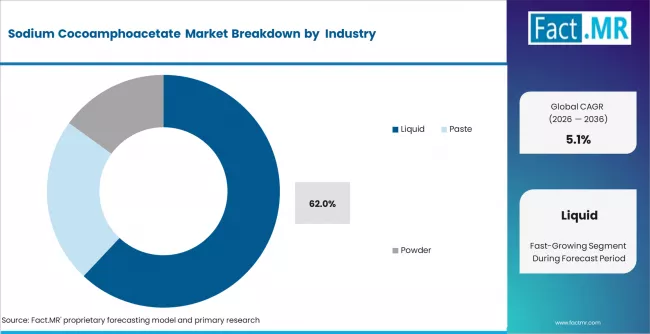
- Form: Liquid surfactant format represents 62% share driven by compatibility with aqueous cosmetic manufacturing processes
- Application: Hair care and skin care demonstrate stable consumption across sulfate free cleansing product formulations
- Geography: Europe and North America demonstrate steady utilization across cosmetic ingredient manufacturing environments
- Analyst Opinion at Fact MR
- Shambhu Nath Jha, Principal Consultant, Fact MR, opines, "In this updated edition of the Sodium Cocoamphoacetate Market report, demand remains aligned with continued incorporation of amphoteric surfactants supporting mild cleansing performance, foam stability, and formulation compatibility across personal care product manufacturing environments through 2036."
- Strategic Implications Executive Takeaways
- Maintain stable sourcing of coconut derived fatty acid feedstock supporting amphoteric surfactant production continuity
- Strengthen formulation compatibility supporting balanced foam performance across sulfate free cleansing product systems
- Monitor regulatory frameworks influencing cosmetic ingredient safety evaluation and labeling compliance requirements
- Optimize production efficiency supporting consistent surfactant purity and rheological performance across liquid formulation applications
- Methodology
- Primary interviews conducted with surfactant manufacturers, cosmetic formulators, and specialty chemical suppliers
- Desk research based on cosmetic ingredient databases, technical literature, regulatory documentation, and formulation guidelines
- Hybrid top-down personal care ingredient demand assessment combined with bottom-up sodium cocoamphoacetate consumption benchmarking
- Validation through supplier data triangulation, expert consultation, and monitoring of cosmetic formulation development trends
Sodium Cocoamphoacetate Market
| Metric | Details |
|---|---|
| Industry Size (2026E) | USD 304.2 million |
| Industry Value (2036F) | USD 498.6 million |
| CAGR (2026 to 2036) | 5.1% |
Source: Fact.MR analysis. Updated Apr 16, 2026
A CAGR of 5.1% indicates incremental expansion supported by continued adoption of mild amphoteric surfactants in sulfate-free shampoos and skin cleansers. Variability remains moderate due to fatty acid feedstock price exposure, while constraints persist from formulation cost sensitivity and substitution competition from other gentle surfactant systems.
The United Kingdom leads with a projected CAGR of 5.6%, supported by stable demand for mild amphoteric surfactants across personal cleansing product formulations. Germany follows with a CAGR of 5.4%, driven by consistent incorporation of low-irritation surfactant systems across hair and skin care product manufacturing. The United States records a CAGR of 5.1%, reflecting steady use of amphoteric surfactants across sulfate-free cleansing formulations. France shows a CAGR of 4.9%, supported by gradual expansion of mild surfactant ingredients across cosmetic product portfolios. Japan records the slowest growth at 4.6%, reflecting a mature market where demand is largely tied to replacement procurement cycles within established personal care formulation systems. Mature markets generate a significant share of replacement demand as formulation optimization remains focused on mildness balance, foam performance, and compatibility across cosmetic surfactant applications.
Segmental Analysis
Sodium Cocoamphoacetate Market Analysis by End Use Industry
Sodium Cocoamphoacetate Market Analysis By End Use Industry | Source: Fact.MR
- Market Overview: Based on Fact MR assessment, personal care industry is projected to account for 76% share of the sodium cocoamphoacetate market in 2026. Amphoteric surfactant functionality is incorporated into cleansing formulations requiring controlled foaming behavior and reduced irritation interaction across skin and scalp contact applications. Sodium cocoamphoacetate is utilized across shampoos, facial cleansers, baby wash products, and body cleansing formulations requiring balanced detergency and compatibility with anionic and nonionic surfactant systems. Ingredient inclusion supports formulation stability across varied pH conditions enabling consistent performance across rinse off personal care product manufacturing workflows.
- Demand Drivers:
- Mild Surfactant Performance Requirements: Sodium cocoamphoacetate demonstrates low irritation characteristics supporting suitability across sensitive skin cleansing formulations.
- Foam Stability Parameters: Amphoteric surfactant structure supports formation of stable foam texture across liquid cleansing products requiring uniform lather performance.
- Formulation Compatibility Needs: Ingredient demonstrates interaction stability with conditioning agents, emollients, and viscosity modifiers incorporated across cosmetic formulation systems.
Sodium Cocoamphoacetate Market Analysis by Form
Sodium Cocoamphoacetate Market Analysis By Form | Source: Fact.MR
- Market Overview: Liquid form is estimated to hold 62% share of the sodium cocoamphoacetate market in 2026, supported by compatibility with aqueous formulation systems requiring simplified mixing and controlled viscosity adjustment across liquid personal care products. Liquid surfactant format supports direct incorporation into shampoo, body wash, and facial cleansing formulations requiring uniform ingredient distribution across production batches. Processing compatibility supports efficient blending operations aligned with large scale cosmetic manufacturing workflows requiring controlled rheological behavior across liquid product development environments.
- Demand Drivers:
- Blending Efficiency Requirements: Liquid surfactant supports uniform dispersion across aqueous formulation matrices requiring stable viscosity performance.
- Processing Stability Characteristics: Liquid format demonstrates compatibility with automated dosing systems used in cosmetic production facilities.
- Storage and Handling Parameters: Liquid surfactant supports controlled packaging and transport conditions aligned with bulk ingredient supply chain requirements.
Key Dynamics
Sodium Cocoamphoacetate Market Drivers, Restraints, and Opportunities
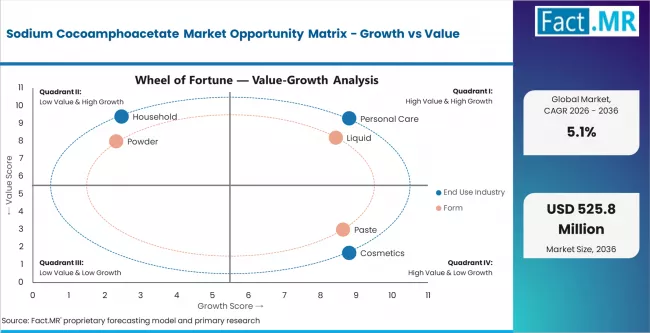
Sodium Cocoamphoacetate Market Opportunity Matrix Growth Vs Value | Source: Fact.MR
Fact MR analysis indicates that the sodium cocoamphoacetate market developed from amphoteric surfactant chemistry derived from coconut fatty acids used to improve mildness in cleansing formulations. Early demand emerged in baby care and sensitive skin products where traditional sulfate surfactants demonstrated higher irritation potential during frequent use. The current market valuation reflects expanded integration across shampoos, facial cleansers, body washes, and liquid soaps where balanced foam generation and skin compatibility are required. Demand persists because sodium cocoamphoacetate improves surfactant stability, reduces irritation potential, and supports formulation viscosity control across a wide pH range.
A structural shift is occurring as conventional sulfate-based surfactants face partial substitution in formulations positioned around mild cleansing performance and reduced skin barrier disruption. Sulfate surfactants remain widely used in cost-sensitive personal care products where strong detergency remains acceptable. Sodium cocoamphoacetate functions as a co-surfactant that modifies foam structure and reduces irritation associated with primary anionic surfactants. These formulation adjustments increase ingredient system costs compared with single-surfactant cleansing formulations. Even with moderate formulation growth, higher-value mild surfactant blends support gradual market value expansion.
- Mild Cleansing Systems: Personal care manufacturers incorporate sodium cocoamphoacetate to improve foam stability and reduce irritation potential in skin and hair cleansing products.
- Cosmetic Ingredient Regulation: Frameworks such as European Union Cosmetics Regulation (EC) No 1223/2009 influence ingredient safety evaluation and labeling requirements.
- Asia Personal Care Ma nufacturing: China, South Korea, and Japan maintain large production capacity for shampoos and skin cleansers using amphoteric surfactants.
Regional Analysis
The sodium cocoamphoacetate market is assessed across North America, Europe, Asia Pacific, Latin America, and Middle East & Africa, segmented by country-level demand in mild surfactant formulations, personal care cleansing products, and specialty chemical processing. Regional demand reflects cosmetic formulation standards, ingredient substitution trends, and specialty surfactant production capabilities. The full report offers market attractiveness analysis.
.webp "Top Country Growth Comparison Sodium Cocoamphoacetate Market Cagr (2026 2036)")
Top Country Growth Comparison Sodium Cocoamphoacetate Market Cagr (2026 2036) | Source: Fact.MR
| Country | CAGR (2026–2036) |
|---|---|
| United Kingdom | 5.6% |
| Germany | 5.4% |
| United States | 5.1% |
| France | 4.9% |
| Japan | 4.6% |
Source: Fact.MR analysis. Updated Apr 16, 2026
Source: Fact MR analysis, based on proprietary forecasting model and primary research
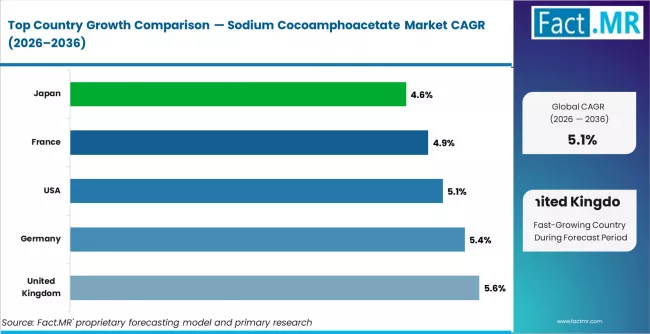
Sodium Cocoamphoacetate Market Cagr Analysis By Country | Source: Fact.MR
Europe
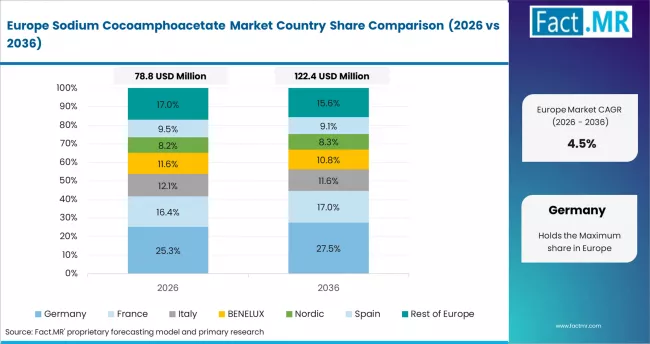
Sodium Cocoamphoacetate Market Europe Country Market Share Analysis, 2026 & 2036 | Source: Fact.MR
Europe functions as the cosmetic surfactant regulatory laboratory for mild cleansing ingredient formulation, supported by structured personal care safety standards and specialty chemical innovation frameworks. BASF SE strengthens amphoteric surfactant development capabilities. Clariant AG expands mild surfactant product portfolio. Solvay S.A. supports specialty surfactant formulation innovation.
- United Kingdom: Demand for sodium cocoamphoacetate in United Kingdom is projected to rise at 5.6% CAGR through 2036. The UK Cosmetics Regulation framework (Office for Product Safety and Standards, updated 2021) supports surfactant ingredient safety compliance. Clariant AG expanded amphoteric surfactant product offerings (March 2023), supporting formulation demand.
- Germany: Demand for sodium cocoamphoacetate in Germany is projected to rise at 5.4% CAGR through 2036. EU Cosmetics Regulation framework (European Commission, ongoing) supports formulation ingredient evaluation standards. BASF SE expanded mild surfactant production capacity (February 2023), supporting adoption.
- France: Demand for sodium cocoamphoacetate in France is projected to rise at 4.9% CAGR through 2036. The French Public Health Code cosmetic standards (updated 2022) support regulated formulation requirements. Solvay S.A. expanded personal care ingredient product portfolio (January 2023), supporting supply growth.
North America
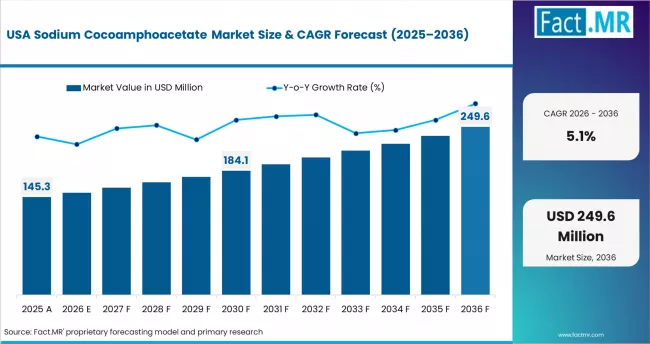
Sodium Cocoamphoacetate Market Country Value Analysis | Source: Fact.MR
North America functions as the personal care formulation innovation and specialty surfactant commercialization hub, supported by strong cosmetic product demand and ingredient performance optimization research. Stepan Company strengthens surfactant manufacturing capabilities. Innospec Inc. expands amphoteric surfactant ingredient portfolio. Dow Inc. supports formulation ingredient innovation.
- United States: Demand for sodium cocoamphoacetate in United States is projected to rise at 5.1% CAGR through 2036. FDA cosmetic ingredient regulatory framework (U.S. FDA, ongoing) supports formulation safety compliance. Stepan Company expanded mild surfactant manufacturing capabilities (April 2023), supporting market expansion.
Asia Pacific
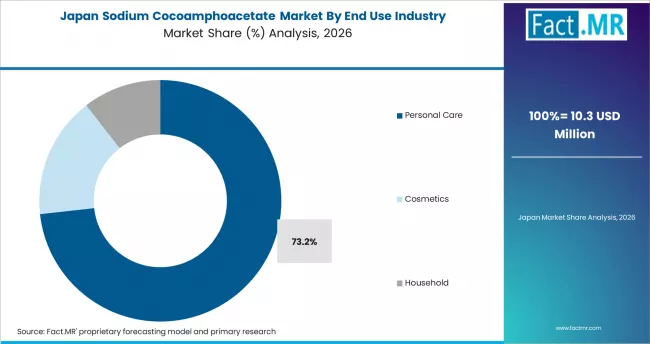
Sodium Cocoamphoacetate Market Japan Market Share Analysis By End Use Industry | Source: Fact.MR
Asia Pacific serves as the personal care ingredient manufacturing and surfactant formulation development market, supported by expanding cosmetic production capacity and specialty chemical demand. Kao Corporation strengthens surfactant ingredient innovation. Lion Corporation expands cleansing formulation product development. Nikko Chemicals Co., Ltd. supports amphoteric surfactant production capabilities.
- Japan: Demand for sodium cocoamphoacetate in Japan is projected to rise at 4.6% CAGR through 2036. The Pharmaceutical and Medical Device Act cosmetic ingredient standards (Ministry of Health, Labour and Welfare, updated 2021) support surfactant formulation compliance. Kao Corporation expanded mild surfactant product formulations (May 2023), supporting market demand.
Fact MR's analysis of sodium cocoamphoacetate market in global regions consists of country-wise assessment that includes United Kingdom, Germany, United States, France, and Japan. Readers can find surfactant formulation trends, cosmetic ingredient developments, regulatory frameworks, and competitive positioning across key markets.
Competitive Landscape
Competitive Structure and Buyer Dynamics in the Sodium Cocoamphoacetate Market
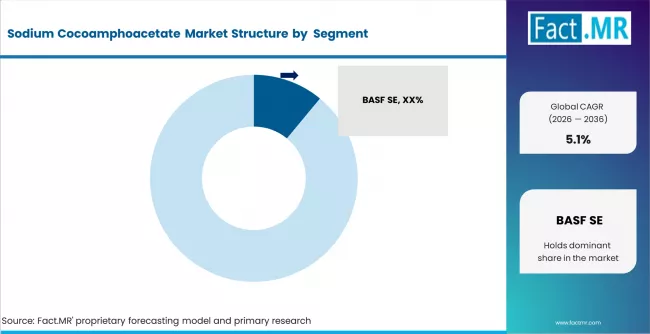
Sodium Cocoamphoacetate Market Analysis By Company | Source: Fact.MR
The competitive structure of the Sodium Cocoamphoacetate Market is moderately concentrated, with global specialty chemical and surfactant manufacturers controlling a significant share of amphoteric surfactant production. Companies such as BASF SE, Croda International Plc, Evonik Industries AG, Clariant AG, Solvay SA, Kao Corporation, and Lubrizol Corporation maintain strong positions through established surfactant chemistry expertise and global personal care ingredient distribution networks. Additional participants including Galaxy Surfactants Ltd., Innospec Inc., and Jeen International Corporation contribute through specialized mild surfactant formulations and regional manufacturing capabilities. Competition is primarily influenced by mildness performance, formulation compatibility, foaming properties, and compliance with cosmetic ingredient safety standards.
Several companies maintain structural advantages through vertically integrated oleochemical processing and access to coconut derived fatty acid feedstock used in amphoteric surfactant synthesis. Firms such as BASF SE, Croda International Plc, and Solvay SA benefit from strong raw material sourcing networks and advanced formulation capabilities. Galaxy Surfactants Ltd. and Kao Corporation maintain advantages through focused expertise in mild surfactant development for personal care formulations. Cosmetic manufacturers typically adopt multi supplier sourcing strategies to reduce dependence on a single ingredient provider and ensure formulation flexibility. Procurement decisions evaluate suppliers based on product consistency, regulatory compliance, and long term availability, moderating supplier pricing leverage across the market.
Key Players of the Sodium Cocoamphoacetate Market
- BASF SE
- Croda International Plc
- Evonik Industries AG
- Clariant AG
- Innospec Inc.
- Galaxy Surfactants Ltd.
- Solvay SA
- Kao Corporation
- Jeen International Corporation
- Lubrizol Corporation
Report Scope
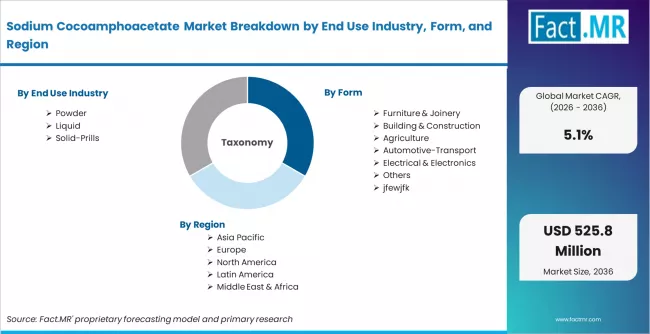
Sodium Cocoamphoacetate Market Breakdown By End Use Industry, Form, And Region | Source: Fact.MR
| Metric | Value |
|---|---|
| Quantitative Units | USD 304.2 million (2026) to USD 498.6 million (2036), at a CAGR of 5.1% |
| Market Definition | The sodium cocoamphoacetate market includes production and commercialization of amphoteric surfactants derived from coconut fatty acids, used as mild cleansing agents with foaming, conditioning, and skin compatibility properties across personal care and specialty formulation applications. |
| Application Segmentation | Hair care, Skin care, Bath products, Baby care, Pet care |
| Form Segmentation | Liquid, Paste, Powder |
| End Use Industry Segmentation | Personal care, Cosmetics, Household, Pet care |
| Regions Covered | North America, Latin America, Europe, East Asia, South Asia, Oceania, Middle East and Africa |
| Countries Covered | United States, Canada, Mexico, Brazil, Germany, France, United Kingdom, Italy, Spain, Netherlands, China, Japan, South Korea, India, Thailand, Indonesia, Australia, United Arab Emirates, and 40+ countries |
| Key Companies Profiled | BASF SE, Croda International Plc, Evonik Industries AG, Clariant AG, Innospec Inc., Galaxy Surfactants Ltd., Solvay SA, Kao Corporation, Jeen International Corporation, Lubrizol Corporation |
| Forecast Period | 2026 to 2036 |
| Approach | Hybrid top-down and bottom-up market estimation based on mild surfactant demand trends in personal cleansing formulations, ingredient consumption benchmarking across cosmetic manufacturing, formulation performance analysis, raw material supply evaluation, and validation through primary interviews with surfactant manufacturers, personal care formulators, and specialty chemical distributors. |
Source: Fact.MR analysis. Updated Apr 16, 2026
Sodium Cocoamphoacetate Market Key Segments
-
Application:
- Hair Care
- Skin Care
- Bath Products
- Baby Care
- Pet Care
-
Form:
- Liquid
- Paste
- Powder
-
End Use Industry:
- Personal Care
- Cosmetics
- Household
- Pet Care
-
Region:
- North America
- USA
- Canada
- Mexico
- Europe
- Germany
- UK
- France
- Italy
- Spain
- Nordic Countries
- BENELUX
- Rest of Europe
- Asia Pacific
- China
- Japan
- South Korea
- India
- Australia
- Rest of Asia Pacific
- Latin America
- Brazil
- Argentina
- Rest of Latin America
- Middle East and Africa
- Kingdom of Saudi Arabia
- United Arab Emirates
- South Africa
- Rest of Middle East and Africa
- Other Regions
- Oceania
- Central Asia
- Other Markets
- North America
Bibliographies
- [1] BASF SE. (2015). Dehyton® MC (Sodium cocoamphoacetate) – Amphoteric surfactant for mild cleansing formulations [Technical datasheet PRD 30530373]. BASF Care Creations.
- [2] Ataman Kimya A.Ş. (2005). Sodium cocoamphoacetate – Mild amphoteric surfactant for shampoos, baby care, and sensitive-skin cleansers. Ataman Chemicals.
- [3] MakingCosmetics Inc. (n.d.). Sodium cocoamphoacetate – Mild amphoteric surfactant for personal care. MakingCosmetics.
- [4] SpecialChem. (2022). Sodium cocoamphoacetate (CAS 90387-76-1): Cosmetic ingredient profile and commercial grades. SpecialChem Cosmetics.
- [5] European Union. (2009). Regulation (EC) No 1223/2009 of the European Parliament and of the Council on cosmetic products. Official Journal of the European Union.
This Report Addresses
- Market size estimation and revenue forecasts for the Sodium Cocoamphoacetate Market from 2026 to 2036, based on mild surfactant consumption benchmarks.
- Growth opportunity mapping across hair care, skin care, bath products, baby care, and pet care cleansing formulations.
- Segment and regional revenue forecasts covering liquid, paste, and powder surfactant forms used in cosmetic ingredient systems.
- Competition strategy assessment of BASF SE, Croda International Plc, Evonik Industries AG, Clariant AG, and Galaxy Surfactants Ltd.
- Regulatory impact analysis covering cosmetic ingredient safety standards, surfactant labeling requirements, and formulation compliance frameworks.
- Market report delivery in PDF, Excel, PPT, and interactive dashboard formats for personal care ingredient benchmarking.
- Supply chain vulnerability assessments examining coconut fatty acid feedstock availability, formulation compatibility requirements, surfactant substitution risk, and pricing sensitivity across mild cleansing ingredient systems.
Sodium Cocoamphoacetate Market Definition
The Sodium Cocoamphoacetate Market includes amphoteric surfactant compounds derived from coconut based fatty acids used as mild cleansing, foaming, conditioning, and emulsifying agents in personal care and home care formulations such as shampoos, body washes, facial cleansers, baby products, and liquid soaps.
Sodium Cocoamphoacetate Market Inclusions
The report includes global and regional market size estimates, forecast analysis, and segmentation by product grade, application area, formulation type, end use industry, pricing structure, and supply chain distribution patterns across surfactant and personal care ingredient markets.
Sodium Cocoamphoacetate Market Exclusions
The scope excludes other amphoteric surfactants such as cocamidopropyl betaine, finished cosmetic and detergent products, industrial cleaning formulations without sodium cocoamphoacetate composition specification, and surfactant manufacturing equipment.
Sodium Cocoamphoacetate Market Research Methodology
- Primary Research
- Interviews were conducted with surfactant manufacturers, personal care formulators, raw material suppliers, distributors, and cosmetic product developers.
- Desk Research
- Public sources included chemical technical literature, cosmetic ingredient databases, regulatory documentation, trade publications, and company technical datasheets describing amphoteric surfactant applications.
- Market-Sizing and Forecasting
- A hybrid model combining top-down personal care ingredient demand evaluation and bottom-up analysis of sodium cocoamphoacetate consumption across cleansing formulations was applied.
- Data Validation and Update Cycle
- Findings were validated through cross comparison of supplier data, expert consultation, and periodic monitoring of formulation trends and regulatory developments.
Frequently Asked Questions
How large is the demand for Sodium Cocoamphoacetate in the global market in 2026?
What will be the market size of Sodium Cocoamphoacetate in the global market by 2036?
What is the expected demand growth for Sodium Cocoamphoacetate in the global market between 2026 and 2036?
Which company is identified as a leading manufacturer in the Sodium Cocoamphoacetate market?
Which end use industry is projected to dominate Sodium Cocoamphoacetate demand by 2026?
Why is Sodium Cocoamphoacetate widely used in personal care formulations?
What is driving demand for Sodium Cocoamphoacetate in the United Kingdom?
What is the growth outlook for the Sodium Cocoamphoacetate market in the United Kingdom?
Why is Germany an important market for amphoteric surfactant consumption?
Established personal care manufacturing infrastructure and demand for gentle cleansing ingredients contribute to steady product utilization.
How is demand for Sodium Cocoamphoacetate evolving in the United States?
What is the growth outlook for the Sodium Cocoamphoacetate market in the United States?
What is the growth outlook for the Sodium Cocoamphoacetate market in France?
How is Japan positioned in the Sodium Cocoamphoacetate market?
What is the growth outlook for the Sodium Cocoamphoacetate market in Japan?
What is Sodium Cocoamphoacetate and what is it mainly used for?
What does the Sodium Cocoamphoacetate market include in this report?
What applications are included in the scope of the Sodium Cocoamphoacetate market?
What is excluded from the scope of the Sodium Cocoamphoacetate market report?
What does market forecast mean in the Sodium Cocoamphoacetate market report?
How is the Sodium Cocoamphoacetate market forecast developed in this report?
What does primary validation indicate in the Sodium Cocoamphoacetate market analysis?
Who worked on this report


Preview the report firsthand - request a free sample
Free SampleGet the brochure for pricing and purchase details
Download PDF