Solar Farm Predictive Maintenance Monitoring Market
Solar Farm Predictive Maintenance Monitoring Market Size and Share Forecast Outlook 2026 to 2036
Solar farm predictive maintenance monitoring market is projected to grow from USD 0.9 billion in 2026 to USD 1.7 billion by 2036, at a CAGR of 6.3%. Inverter monitoring will dominate with a 32.0% market share, while utility-scale (>50 mw) will lead the plant size segment with a 50.4% share.
Solar Farm Predictive Maintenance Monitoring Market Forecast and Outlook 2026 to 2036
The global market for solar farm predictive maintenance monitoring is projected to total USD 0.90 billion in 2026, advancing to USD 1.66 billion by 2036. A CAGR of 6.3% is forecast for the period from 2026 to 2036.
This expansion is fundamentally driven by the critical need to maximize the lifetime value and energy yield of utility-scale solar assets as the global fleet ages and operational excellence becomes a key competitive differentiator.
Key Takeaways from the Solar Farm Predictive Maintenance Monitoring Market
- Market Value for 2026: USD 0.90 Billion
- Market Value for 2036: USD 1.66 Billion
- Forecast CAGR 2026 to 2036: 6.3%
- Leading Monitoring Focus Segment (2026): Inverter Monitoring (32%)
- Leading Plant Size Segment (2026): Utility-scale >50 MW (50%)
- Leading Deployment Model Segment (2026): Cloud-based (46%)
- Key Growth Countries: China (7.6% CAGR), USA (7.1% CAGR), Spain (7.1% CAGR), India (6.7% CAGR)
- Key Players in the Market: Siemens Energy, GE Vernova, Schneider Electric, ABB, Hitachi Energy, SMA Solar
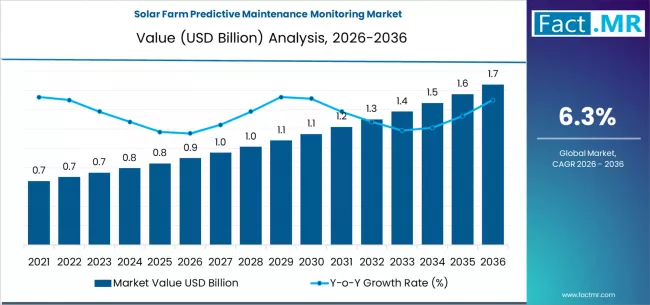
Reactive maintenance strategies are insufficient for managing geographically dispersed assets where minor inefficiencies in inverters or panel strings can lead to significant cumulative revenue losses. Predictive analytics, powered by AI and machine learning, have become indispensable, integrated into monitoring platforms to detect early signs of component failure, forecast energy production, and optimize cleaning schedules. These tools are critical for reducing operational expenditures, preventing catastrophic downtime, and securing project financing through proven reliability.
The market's growth is a direct product of the levelized cost of energy optimization imperative and the integration of solar into smart grids. This landscape, encompassing vast utility plants to distributed commercial arrays, makes AI-enhanced predictive monitoring a strategic enabler of solar energy's bankability and long-term profitability.
Metric
| Metric | Value |
|---|---|
| Market Value (2026) | USD 0.90 Billion |
| Market Forecast Value (2036) | USD 1.66 Billion |
| Forecast CAGR 2026 to 2036 | 6.3% |
Category
| Category | Segments |
|---|---|
| Monitoring Focus | Inverter Monitoring, Panel Health Analytics, String & Combiner Faults, Weather & Soiling AI, Energy Yield Forecasting |
| Plant Size | Utility-scale (>50 MW), Large Commercial (10-50 MW), Small Commercial (1-10 MW), Distributed Solar |
| Deployment Model | Cloud-based, Hybrid Cloud-Edge, Edge-only |
| Region | North America, Latin America, Western Europe, Eastern Europe, East Asia, South Asia & Pacific, MEA |
Segmental Analysis
By Monitoring Focus, Which Component is Most Critical to System Health?
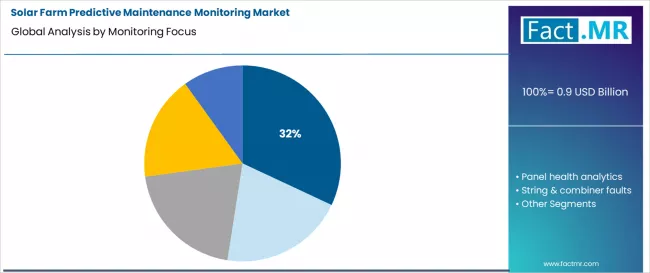
Inverter monitoring commands a leading 32% share. This segment's dominance is tied to the inverter's role as the most complex, failure-prone, and costly component in a solar array. Predictive algorithms analyze granular data on thermal performance, voltage output, and switching patterns to forecast failures weeks or months in advance.
This focus delivers the most direct operational cost savings by preventing catastrophic inverter downtime and enabling proactive component replacement, safeguarding the entire site's revenue generation.
By Plant Size, Which Segment Demands the Most Sophisticated Monitoring?
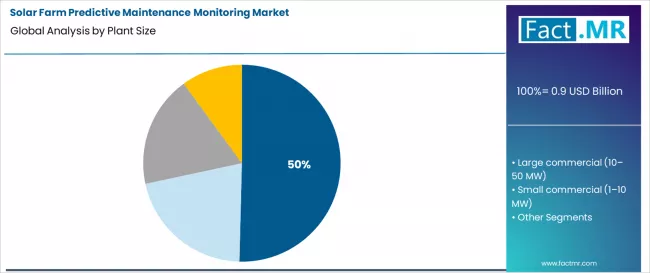
Utility-scale plants (>50 MW) lead the plant size segment with a 50% share. The financial scale of these assets makes even a 1% loss in performance significant. Operators of these sites require sophisticated, fleet-wide monitoring platforms that can process millions of data points to identify subtle underperformance patterns, prioritize maintenance across vast geographies, and provide the granular reporting required by investors and grid operators, justifying substantial investment in predictive capabilities.
By Deployment Model, Where is Processing Intelligence Located?
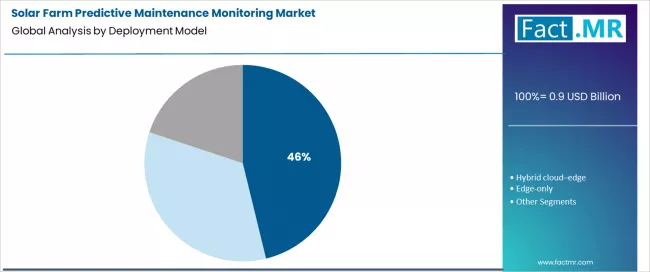
The cloud-based deployment model holds a leading 46% share. This reflects the need to centralize data from multiple, often remote sites to train powerful AI models that benefit from aggregated fleet data.
Cloud platforms enable advanced analytics, seamless software updates, and centralized dashboards for portfolio managers. They offer the scalability and computational power needed for complex tasks like energy yield forecasting and weather-impact modeling, making them the backbone for large-scale operational strategies.
What are the Principal Drivers, Constraints, and Evolving Dynamics of this Market?
The principal driver is intense economic pressure to maximize the return on investment of capital-intensive solar assets. Predictive maintenance directly boosts the levelized cost of energy by minimizing unplanned downtime, extending equipment life, and optimizing energy yield, making it essential for asset owners and operators. This financial imperative is amplified as solar farms age and component warranties expire, shifting risk to operators.
A major restraint is the high upfront cost and complexity of integrating predictive platforms with legacy supervisory control and data acquisition systems from multiple vendors. The need for skilled analysts to interpret insights and the variable quality of data from older sensors can hinder ROI realization, particularly for smaller operators, slowing widespread adoption.
A key opportunity exists in integrating predictive maintenance with automated robotic cleaning and drone-based inspection systems. AI can prescribe not just when to maintain, but how, triggering autonomous cleaning drones based on soiling forecasts or guiding repair crews with precise fault localization, creating a closed-loop system for autonomous farm management.
The defining trend is the shift from pure cloud analytics to hybrid cloud-edge architectures. Critical, time-sensitive analytics for fault detection are processed locally at the edge to enable immediate response, while rich historical data is synced to the cloud for long-term model training and portfolio-wide benchmarking. This balances real-time reliability with scalable intelligence.
Analysis of the Solar Farm Predictive Maintenance Monitoring Market by Key Countries
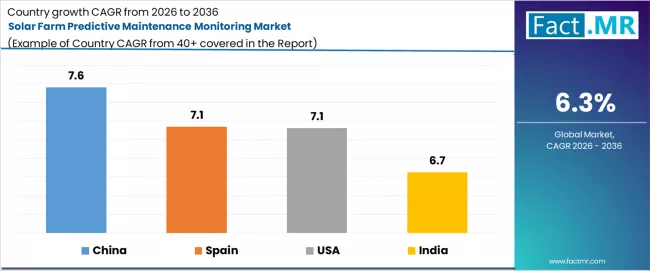
| Country | CAGR 2026 to 2036 |
|---|---|
| China | 7.6% |
| USA | 7.1% |
| Spain | 7.1% |
| India | 6.7% |
How does China's Unparalleled Scale of Solar Deployment Drive Market Needs?
China's leading growth rate of 7.6% CAGR is anchored in its position as the world's largest deployer of solar PV capacity. The market is driven by the operational management challenge of a massive, aging fleet of utility-scale plants.
Chinese operators, seeking to ensure grid stability and meet performance guarantees, are investing heavily in centralized, AI-powered monitoring platforms to optimize the performance of thousands of assets nationally, creating a vast domestic market for predictive solutions.
What Factors Underpin the USA's Mature Market Demand for Optimization?
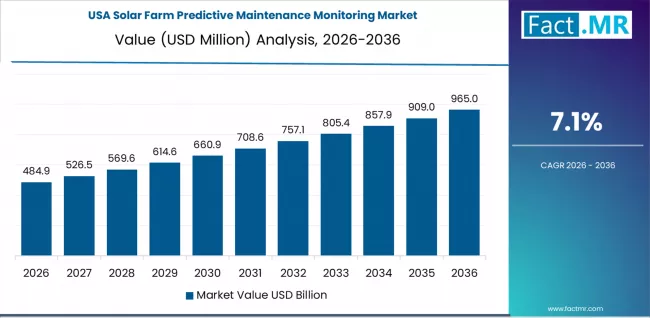
The USA's growth at 7.1% CAGR is propelled by a mature solar market where new build competes with the optimization of existing assets. Sophisticated independent power producers and utilities use predictive monitoring to meet power purchase agreement obligations, secure asset-backed financing, and participate in grid services markets. Demand is characterized by a preference for advanced analytics that integrate with asset management software and comply with stringent grid interconnection standards.
Why is Spain a Key European Market for Advanced Monitoring Solutions?
Spain's matching growth rate of 7.1% CAGR is driven by its high penetration of solar power and favorable irradiation, which makes yield optimization critically important. The market is characterized by a high proportion of merchant plants selling power on the spot market, where predictive yield forecasting is directly tied to profitability. This, coupled with the need to manage soiling in arid regions, fuels demand for advanced weather, soiling, and performance analytics tailored to the Mediterranean climate.
How does India's Rapid Expansion Shape Its Monitoring Requirements?
India's significant growth at 6.7% CAGR is driven by its aggressive utility-scale solar rollout, often in challenging environments with dust, heat, and grid instability. The focus for predictive monitoring is on robustness and cost-effectiveness, with an emphasis on inverter health and soiling loss prediction to schedule cost-efficient cleaning.
The market is shaped by the need for solutions that can operate reliably with intermittent data connectivity and provide clear, actionable alerts to manage large portfolios with limited on-site technical staff.
Competitive Landscape of the Solar Farm Predictive Maintenance Monitoring Market
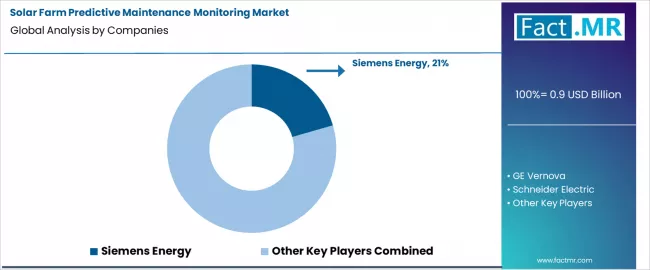
The competitive landscape is fragmented, featuring traditional power and grid giants like Siemens, GE, and ABB competing with pure-play solar inverter and monitoring specialists like SMA Solar. Competition revolves around the depth of AI algorithms, the breadth of integration with different inverter brands and balance-of-system components, and the ability to deliver actionable insights rather than just data.
Success is determined by forming partnerships with large developers and operators, proving a clear return on investment through case studies, and offering flexible deployment models that range from full-scope services to licensed software platforms.
Key Players in the Solar Farm Predictive Maintenance Monitoring Market
- Siemens Energy
- GE Vernova
- Schneider Electric
- ABB
- Hitachi Energy
- SMA Solar
Scope of Report
| Items | Values |
|---|---|
| Quantitative Units | USD Billion |
| Monitoring Focus | Inverter Monitoring, Panel Health Analytics, String & Combiner Faults, Weather & Soiling AI, Energy Yield Forecasting |
| Plant Size | Utility-scale (>50 MW), Large Commercial (10-50 MW), Small Commercial (1-10 MW), Distributed Solar |
| Deployment Model | Cloud-based, Hybrid Cloud-Edge, Edge-only |
| Key Countries | China, USA, Spain, India |
| Key Companies | Siemens Energy, GE Vernova, Schneider Electric, ABB, Hitachi Energy, SMA Solar |
| Additional Analysis | Comparative analysis of AI model accuracy for different failure modes; study of data standardization challenges across equipment vendors; total cost of ownership analysis for predictive vs. preventive maintenance; impact of monitoring on solar asset valuation and insurance premiums; assessment of cybersecurity risks in cloud-connected solar fleets. |
Market by Segments
-
Monitoring Focus :
- Inverter Monitoring
- Panel Health Analytics
- String & Combiner Faults
- Weather & Soiling AI
- Energy Yield Forecasting
-
Plant Size :
- Utility-scale (>50 MW)
- Large Commercial (10-50 MW)
- Small Commercial (1-10 MW)
- Distributed Solar
-
Deployment Model :
- Cloud-based
- Hybrid Cloud-Edge
- Edge-only
-
Region :
-
North America
- USA
- Canada
-
Latin America
- Brazil
- Mexico
- Argentina
- Rest of Latin America
-
Western Europe
- Germany
- France
- Italy
- Spain
- UK
- BENELUX
- Rest of Western Europe
-
Eastern Europe
- Russia
- Poland
- Czech Republic
- Rest of Eastern Europe
-
East Asia
- China
- Japan
- South Korea
- Rest of East Asia
-
South Asia & Pacific
- India
- ASEAN
- Australia
- Rest of South Asia & Pacific
-
MEA
- GCC Countries
- South Africa
- Turkiye
- Rest of MEA
-
References
- International Energy Agency. (2025).Photovoltaic Power Systems Programme (PVPS) Report: Operation and Maintenance of PV Systems. IEA.
- National Renewable Energy Laboratory (NREL). (2024).Artificial Intelligence for Solar Operations and Maintenance. NREL Technical Report.
- Rauschenbach, H. S. (2024).Solar Cell Array Design Handbook. Springer.
- Ristow, A., & Coles, L. (2025).Advanced Data Analytics for Renewable Energy Systems. Wiley-IEEE Press.
- Woyte, A., et al. (2024).Performance and Reliability of Photovoltaic Systems. Elsevier.
Table of Content
- Executive Summary
- Global Market Outlook
- Demand to side Trends
- Supply to side Trends
- Technology Roadmap Analysis
- Analysis and Recommendations
- Market Overview
- Market Coverage / Taxonomy
- Market Definition / Scope / Limitations
- Market Background
- Market Dynamics
- Drivers
- Restraints
- Opportunity
- Trends
- Scenario Forecast
- Demand in Optimistic Scenario
- Demand in Likely Scenario
- Demand in Conservative Scenario
- Opportunity Map Analysis
- Product Life Cycle Analysis
- Supply Chain Analysis
- Investment Feasibility Matrix
- Value Chain Analysis
- PESTLE and Porter’s Analysis
- Regulatory Landscape
- Regional Parent Market Outlook
- Production and Consumption Statistics
- Import and Export Statistics
- Market Dynamics
- Global Market Analysis 2021 to 2025 and Forecast, 2026 to 2036
- Historical Market Size Value (USD Million) Analysis, 2021 to 2025
- Current and Future Market Size Value (USD Million) Projections, 2026 to 2036
- Y to o to Y Growth Trend Analysis
- Absolute $ Opportunity Analysis
- Global Market Pricing Analysis 2021 to 2025 and Forecast 2026 to 2036
- Global Market Analysis 2021 to 2025 and Forecast 2026 to 2036, By Monitoring Focus
- Introduction / Key Findings
- Historical Market Size Value (USD Million) Analysis By Monitoring Focus, 2021 to 2025
- Current and Future Market Size Value (USD Million) Analysis and Forecast By Monitoring Focus, 2026 to 2036
- Inverter monitoring
- Panel health analytics
- String & combiner faults
- Weather & soiling AI
- Energy yield forecasting
- Inverter monitoring
- Y to o to Y Growth Trend Analysis By Monitoring Focus, 2021 to 2025
- Absolute $ Opportunity Analysis By Monitoring Focus, 2026 to 2036
- Global Market Analysis 2021 to 2025 and Forecast 2026 to 2036, By Plant Size
- Introduction / Key Findings
- Historical Market Size Value (USD Million) Analysis By Plant Size, 2021 to 2025
- Current and Future Market Size Value (USD Million) Analysis and Forecast By Plant Size, 2026 to 2036
- Utility-scale (>50 MW)
- Large commercial (10–50 MW)
- Small commercial (1–10 MW)
- Distributed solar
- Utility-scale (>50 MW)
- Y to o to Y Growth Trend Analysis By Plant Size, 2021 to 2025
- Absolute $ Opportunity Analysis By Plant Size, 2026 to 2036
- Global Market Analysis 2021 to 2025 and Forecast 2026 to 2036, By Deployment Model
- Introduction / Key Findings
- Historical Market Size Value (USD Million) Analysis By Deployment Model, 2021 to 2025
- Current and Future Market Size Value (USD Million) Analysis and Forecast By Deployment Model, 2026 to 2036
- Cloud-based
- Hybrid cloud–edge
- Edge-only
- Cloud-based
- Y to o to Y Growth Trend Analysis By Deployment Model, 2021 to 2025
- Absolute $ Opportunity Analysis By Deployment Model, 2026 to 2036
- Global Market Analysis 2021 to 2025 and Forecast 2026 to 2036, By Region
- Introduction
- Historical Market Size Value (USD Million) Analysis By Region, 2021 to 2025
- Current Market Size Value (USD Million) Analysis and Forecast By Region, 2026 to 2036
- North America
- Latin America
- Western Europe
- Eastern Europe
- East Asia
- South Asia and Pacific
- Middle East & Africa
- Market Attractiveness Analysis By Region
- North America Market Analysis 2021 to 2025 and Forecast 2026 to 2036, By Country
- Historical Market Size Value (USD Million) Trend Analysis By Market Taxonomy, 2021 to 2025
- Market Size Value (USD Million) Forecast By Market Taxonomy, 2026 to 2036
- By Country
- USA
- Canada
- Mexico
- By Monitoring Focus
- By Plant Size
- By Deployment Model
- By Country
- Market Attractiveness Analysis
- By Country
- By Monitoring Focus
- By Plant Size
- By Deployment Model
- Key Takeaways
- Latin America Market Analysis 2021 to 2025 and Forecast 2026 to 2036, By Country
- Historical Market Size Value (USD Million) Trend Analysis By Market Taxonomy, 2021 to 2025
- Market Size Value (USD Million) Forecast By Market Taxonomy, 2026 to 2036
- By Country
- Brazil
- Chile
- Rest of Latin America
- By Monitoring Focus
- By Plant Size
- By Deployment Model
- By Country
- Market Attractiveness Analysis
- By Country
- By Monitoring Focus
- By Plant Size
- By Deployment Model
- Key Takeaways
- Western Europe Market Analysis 2021 to 2025 and Forecast 2026 to 2036, By Country
- Historical Market Size Value (USD Million) Trend Analysis By Market Taxonomy, 2021 to 2025
- Market Size Value (USD Million) Forecast By Market Taxonomy, 2026 to 2036
- By Country
- Germany
- UK
- Italy
- Spain
- France
- Nordic
- BENELUX
- Rest of Western Europe
- By Monitoring Focus
- By Plant Size
- By Deployment Model
- By Country
- Market Attractiveness Analysis
- By Country
- By Monitoring Focus
- By Plant Size
- By Deployment Model
- Key Takeaways
- Eastern Europe Market Analysis 2021 to 2025 and Forecast 2026 to 2036, By Country
- Historical Market Size Value (USD Million) Trend Analysis By Market Taxonomy, 2021 to 2025
- Market Size Value (USD Million) Forecast By Market Taxonomy, 2026 to 2036
- By Country
- Russia
- Poland
- Hungary
- Balkan & Baltic
- Rest of Eastern Europe
- By Monitoring Focus
- By Plant Size
- By Deployment Model
- By Country
- Market Attractiveness Analysis
- By Country
- By Monitoring Focus
- By Plant Size
- By Deployment Model
- Key Takeaways
- East Asia Market Analysis 2021 to 2025 and Forecast 2026 to 2036, By Country
- Historical Market Size Value (USD Million) Trend Analysis By Market Taxonomy, 2021 to 2025
- Market Size Value (USD Million) Forecast By Market Taxonomy, 2026 to 2036
- By Country
- China
- Japan
- South Korea
- By Monitoring Focus
- By Plant Size
- By Deployment Model
- By Country
- Market Attractiveness Analysis
- By Country
- By Monitoring Focus
- By Plant Size
- By Deployment Model
- Key Takeaways
- South Asia and Pacific Market Analysis 2021 to 2025 and Forecast 2026 to 2036, By Country
- Historical Market Size Value (USD Million) Trend Analysis By Market Taxonomy, 2021 to 2025
- Market Size Value (USD Million) Forecast By Market Taxonomy, 2026 to 2036
- By Country
- India
- ASEAN
- Australia & New Zealand
- Rest of South Asia and Pacific
- By Monitoring Focus
- By Plant Size
- By Deployment Model
- By Country
- Market Attractiveness Analysis
- By Country
- By Monitoring Focus
- By Plant Size
- By Deployment Model
- Key Takeaways
- Middle East & Africa Market Analysis 2021 to 2025 and Forecast 2026 to 2036, By Country
- Historical Market Size Value (USD Million) Trend Analysis By Market Taxonomy, 2021 to 2025
- Market Size Value (USD Million) Forecast By Market Taxonomy, 2026 to 2036
- By Country
- Kingdom of Saudi Arabia
- Other GCC Countries
- Turkiye
- South Africa
- Other African Union
- Rest of Middle East & Africa
- By Monitoring Focus
- By Plant Size
- By Deployment Model
- By Country
- Market Attractiveness Analysis
- By Country
- By Monitoring Focus
- By Plant Size
- By Deployment Model
- Key Takeaways
- Key Countries Market Analysis
- USA
- Pricing Analysis
- Market Share Analysis, 2025
- By Monitoring Focus
- By Plant Size
- By Deployment Model
- Canada
- Pricing Analysis
- Market Share Analysis, 2025
- By Monitoring Focus
- By Plant Size
- By Deployment Model
- Mexico
- Pricing Analysis
- Market Share Analysis, 2025
- By Monitoring Focus
- By Plant Size
- By Deployment Model
- Brazil
- Pricing Analysis
- Market Share Analysis, 2025
- By Monitoring Focus
- By Plant Size
- By Deployment Model
- Chile
- Pricing Analysis
- Market Share Analysis, 2025
- By Monitoring Focus
- By Plant Size
- By Deployment Model
- Germany
- Pricing Analysis
- Market Share Analysis, 2025
- By Monitoring Focus
- By Plant Size
- By Deployment Model
- UK
- Pricing Analysis
- Market Share Analysis, 2025
- By Monitoring Focus
- By Plant Size
- By Deployment Model
- Italy
- Pricing Analysis
- Market Share Analysis, 2025
- By Monitoring Focus
- By Plant Size
- By Deployment Model
- Spain
- Pricing Analysis
- Market Share Analysis, 2025
- By Monitoring Focus
- By Plant Size
- By Deployment Model
- France
- Pricing Analysis
- Market Share Analysis, 2025
- By Monitoring Focus
- By Plant Size
- By Deployment Model
- India
- Pricing Analysis
- Market Share Analysis, 2025
- By Monitoring Focus
- By Plant Size
- By Deployment Model
- ASEAN
- Pricing Analysis
- Market Share Analysis, 2025
- By Monitoring Focus
- By Plant Size
- By Deployment Model
- Australia & New Zealand
- Pricing Analysis
- Market Share Analysis, 2025
- By Monitoring Focus
- By Plant Size
- By Deployment Model
- China
- Pricing Analysis
- Market Share Analysis, 2025
- By Monitoring Focus
- By Plant Size
- By Deployment Model
- Japan
- Pricing Analysis
- Market Share Analysis, 2025
- By Monitoring Focus
- By Plant Size
- By Deployment Model
- South Korea
- Pricing Analysis
- Market Share Analysis, 2025
- By Monitoring Focus
- By Plant Size
- By Deployment Model
- Russia
- Pricing Analysis
- Market Share Analysis, 2025
- By Monitoring Focus
- By Plant Size
- By Deployment Model
- Poland
- Pricing Analysis
- Market Share Analysis, 2025
- By Monitoring Focus
- By Plant Size
- By Deployment Model
- Hungary
- Pricing Analysis
- Market Share Analysis, 2025
- By Monitoring Focus
- By Plant Size
- By Deployment Model
- Kingdom of Saudi Arabia
- Pricing Analysis
- Market Share Analysis, 2025
- By Monitoring Focus
- By Plant Size
- By Deployment Model
- Turkiye
- Pricing Analysis
- Market Share Analysis, 2025
- By Monitoring Focus
- By Plant Size
- By Deployment Model
- South Africa
- Pricing Analysis
- Market Share Analysis, 2025
- By Monitoring Focus
- By Plant Size
- By Deployment Model
- USA
- Market Structure Analysis
- Competition Dashboard
- Competition Benchmarking
- Market Share Analysis of Top Players
- By Regional
- By Monitoring Focus
- By Plant Size
- By Deployment Model
- Competition Analysis
- Competition Deep Dive
- Siemens Energy
- Overview
- Product Portfolio
- Profitability by Market Segments (Product/Age /Sales Channel/Region)
- Sales Footprint
- Strategy Overview
- Marketing Strategy
- Product Strategy
- Channel Strategy
- GE Vernova
- Schneider Electric
- ABB
- Hitachi Energy
- SMA Solar
- Siemens Energy
- Competition Deep Dive
- Assumptions & Acronyms Used
- Research Methodology
List Of Table
- Table 1: Global Market Value (USD Million) Forecast by Region, 2021 to 2036
- Table 2: Global Market Value (USD Million) Forecast by Monitoring Focus, 2021 to 2036
- Table 3: Global Market Value (USD Million) Forecast by Plant Size, 2021 to 2036
- Table 4: Global Market Value (USD Million) Forecast by Deployment Model, 2021 to 2036
- Table 5: North America Market Value (USD Million) Forecast by Country, 2021 to 2036
- Table 6: North America Market Value (USD Million) Forecast by Monitoring Focus, 2021 to 2036
- Table 7: North America Market Value (USD Million) Forecast by Plant Size, 2021 to 2036
- Table 8: North America Market Value (USD Million) Forecast by Deployment Model, 2021 to 2036
- Table 9: Latin America Market Value (USD Million) Forecast by Country, 2021 to 2036
- Table 10: Latin America Market Value (USD Million) Forecast by Monitoring Focus, 2021 to 2036
- Table 11: Latin America Market Value (USD Million) Forecast by Plant Size, 2021 to 2036
- Table 12: Latin America Market Value (USD Million) Forecast by Deployment Model, 2021 to 2036
- Table 13: Western Europe Market Value (USD Million) Forecast by Country, 2021 to 2036
- Table 14: Western Europe Market Value (USD Million) Forecast by Monitoring Focus, 2021 to 2036
- Table 15: Western Europe Market Value (USD Million) Forecast by Plant Size, 2021 to 2036
- Table 16: Western Europe Market Value (USD Million) Forecast by Deployment Model, 2021 to 2036
- Table 17: Eastern Europe Market Value (USD Million) Forecast by Country, 2021 to 2036
- Table 18: Eastern Europe Market Value (USD Million) Forecast by Monitoring Focus, 2021 to 2036
- Table 19: Eastern Europe Market Value (USD Million) Forecast by Plant Size, 2021 to 2036
- Table 20: Eastern Europe Market Value (USD Million) Forecast by Deployment Model, 2021 to 2036
- Table 21: East Asia Market Value (USD Million) Forecast by Country, 2021 to 2036
- Table 22: East Asia Market Value (USD Million) Forecast by Monitoring Focus, 2021 to 2036
- Table 23: East Asia Market Value (USD Million) Forecast by Plant Size, 2021 to 2036
- Table 24: East Asia Market Value (USD Million) Forecast by Deployment Model, 2021 to 2036
- Table 25: South Asia and Pacific Market Value (USD Million) Forecast by Country, 2021 to 2036
- Table 26: South Asia and Pacific Market Value (USD Million) Forecast by Monitoring Focus, 2021 to 2036
- Table 27: South Asia and Pacific Market Value (USD Million) Forecast by Plant Size, 2021 to 2036
- Table 28: South Asia and Pacific Market Value (USD Million) Forecast by Deployment Model, 2021 to 2036
- Table 29: Middle East & Africa Market Value (USD Million) Forecast by Country, 2021 to 2036
- Table 30: Middle East & Africa Market Value (USD Million) Forecast by Monitoring Focus, 2021 to 2036
- Table 31: Middle East & Africa Market Value (USD Million) Forecast by Plant Size, 2021 to 2036
- Table 32: Middle East & Africa Market Value (USD Million) Forecast by Deployment Model, 2021 to 2036
List Of Figures
- Figure 1: Global Market Pricing Analysis
- Figure 2: Global Market Value (USD Million) Forecast 2021 to 2036
- Figure 3: Global Market Value Share and BPS Analysis by Monitoring Focus, 2026 and 2036
- Figure 4: Global Market Y to o to Y Growth Comparison by Monitoring Focus, 2026 to 2036
- Figure 5: Global Market Attractiveness Analysis by Monitoring Focus
- Figure 6: Global Market Value Share and BPS Analysis by Plant Size, 2026 and 2036
- Figure 7: Global Market Y to o to Y Growth Comparison by Plant Size, 2026 to 2036
- Figure 8: Global Market Attractiveness Analysis by Plant Size
- Figure 9: Global Market Value Share and BPS Analysis by Deployment Model, 2026 and 2036
- Figure 10: Global Market Y to o to Y Growth Comparison by Deployment Model, 2026 to 2036
- Figure 11: Global Market Attractiveness Analysis by Deployment Model
- Figure 12: Global Market Value (USD Million) Share and BPS Analysis by Region, 2026 and 2036
- Figure 13: Global Market Y to o to Y Growth Comparison by Region, 2026 to 2036
- Figure 14: Global Market Attractiveness Analysis by Region
- Figure 15: North America Market Incremental Dollar Opportunity, 2026 to 2036
- Figure 16: Latin America Market Incremental Dollar Opportunity, 2026 to 2036
- Figure 17: Western Europe Market Incremental Dollar Opportunity, 2026 to 2036
- Figure 18: Eastern Europe Market Incremental Dollar Opportunity, 2026 to 2036
- Figure 19: East Asia Market Incremental Dollar Opportunity, 2026 to 2036
- Figure 20: South Asia and Pacific Market Incremental Dollar Opportunity, 2026 to 2036
- Figure 21: Middle East & Africa Market Incremental Dollar Opportunity, 2026 to 2036
- Figure 22: North America Market Value Share and BPS Analysis by Country, 2026 and 2036
- Figure 23: North America Market Value Share and BPS Analysis by Monitoring Focus, 2026 and 2036
- Figure 24: North America Market Y to o to Y Growth Comparison by Monitoring Focus, 2026 to 2036
- Figure 25: North America Market Attractiveness Analysis by Monitoring Focus
- Figure 26: North America Market Value Share and BPS Analysis by Plant Size, 2026 and 2036
- Figure 27: North America Market Y to o to Y Growth Comparison by Plant Size, 2026 to 2036
- Figure 28: North America Market Attractiveness Analysis by Plant Size
- Figure 29: North America Market Value Share and BPS Analysis by Deployment Model, 2026 and 2036
- Figure 30: North America Market Y to o to Y Growth Comparison by Deployment Model, 2026 to 2036
- Figure 31: North America Market Attractiveness Analysis by Deployment Model
- Figure 32: Latin America Market Value Share and BPS Analysis by Country, 2026 and 2036
- Figure 33: Latin America Market Value Share and BPS Analysis by Monitoring Focus, 2026 and 2036
- Figure 34: Latin America Market Y to o to Y Growth Comparison by Monitoring Focus, 2026 to 2036
- Figure 35: Latin America Market Attractiveness Analysis by Monitoring Focus
- Figure 36: Latin America Market Value Share and BPS Analysis by Plant Size, 2026 and 2036
- Figure 37: Latin America Market Y to o to Y Growth Comparison by Plant Size, 2026 to 2036
- Figure 38: Latin America Market Attractiveness Analysis by Plant Size
- Figure 39: Latin America Market Value Share and BPS Analysis by Deployment Model, 2026 and 2036
- Figure 40: Latin America Market Y to o to Y Growth Comparison by Deployment Model, 2026 to 2036
- Figure 41: Latin America Market Attractiveness Analysis by Deployment Model
- Figure 42: Western Europe Market Value Share and BPS Analysis by Country, 2026 and 2036
- Figure 43: Western Europe Market Value Share and BPS Analysis by Monitoring Focus, 2026 and 2036
- Figure 44: Western Europe Market Y to o to Y Growth Comparison by Monitoring Focus, 2026 to 2036
- Figure 45: Western Europe Market Attractiveness Analysis by Monitoring Focus
- Figure 46: Western Europe Market Value Share and BPS Analysis by Plant Size, 2026 and 2036
- Figure 47: Western Europe Market Y to o to Y Growth Comparison by Plant Size, 2026 to 2036
- Figure 48: Western Europe Market Attractiveness Analysis by Plant Size
- Figure 49: Western Europe Market Value Share and BPS Analysis by Deployment Model, 2026 and 2036
- Figure 50: Western Europe Market Y to o to Y Growth Comparison by Deployment Model, 2026 to 2036
- Figure 51: Western Europe Market Attractiveness Analysis by Deployment Model
- Figure 52: Eastern Europe Market Value Share and BPS Analysis by Country, 2026 and 2036
- Figure 53: Eastern Europe Market Value Share and BPS Analysis by Monitoring Focus, 2026 and 2036
- Figure 54: Eastern Europe Market Y to o to Y Growth Comparison by Monitoring Focus, 2026 to 2036
- Figure 55: Eastern Europe Market Attractiveness Analysis by Monitoring Focus
- Figure 56: Eastern Europe Market Value Share and BPS Analysis by Plant Size, 2026 and 2036
- Figure 57: Eastern Europe Market Y to o to Y Growth Comparison by Plant Size, 2026 to 2036
- Figure 58: Eastern Europe Market Attractiveness Analysis by Plant Size
- Figure 59: Eastern Europe Market Value Share and BPS Analysis by Deployment Model, 2026 and 2036
- Figure 60: Eastern Europe Market Y to o to Y Growth Comparison by Deployment Model, 2026 to 2036
- Figure 61: Eastern Europe Market Attractiveness Analysis by Deployment Model
- Figure 62: East Asia Market Value Share and BPS Analysis by Country, 2026 and 2036
- Figure 63: East Asia Market Value Share and BPS Analysis by Monitoring Focus, 2026 and 2036
- Figure 64: East Asia Market Y to o to Y Growth Comparison by Monitoring Focus, 2026 to 2036
- Figure 65: East Asia Market Attractiveness Analysis by Monitoring Focus
- Figure 66: East Asia Market Value Share and BPS Analysis by Plant Size, 2026 and 2036
- Figure 67: East Asia Market Y to o to Y Growth Comparison by Plant Size, 2026 to 2036
- Figure 68: East Asia Market Attractiveness Analysis by Plant Size
- Figure 69: East Asia Market Value Share and BPS Analysis by Deployment Model, 2026 and 2036
- Figure 70: East Asia Market Y to o to Y Growth Comparison by Deployment Model, 2026 to 2036
- Figure 71: East Asia Market Attractiveness Analysis by Deployment Model
- Figure 72: South Asia and Pacific Market Value Share and BPS Analysis by Country, 2026 and 2036
- Figure 73: South Asia and Pacific Market Value Share and BPS Analysis by Monitoring Focus, 2026 and 2036
- Figure 74: South Asia and Pacific Market Y to o to Y Growth Comparison by Monitoring Focus, 2026 to 2036
- Figure 75: South Asia and Pacific Market Attractiveness Analysis by Monitoring Focus
- Figure 76: South Asia and Pacific Market Value Share and BPS Analysis by Plant Size, 2026 and 2036
- Figure 77: South Asia and Pacific Market Y to o to Y Growth Comparison by Plant Size, 2026 to 2036
- Figure 78: South Asia and Pacific Market Attractiveness Analysis by Plant Size
- Figure 79: South Asia and Pacific Market Value Share and BPS Analysis by Deployment Model, 2026 and 2036
- Figure 80: South Asia and Pacific Market Y to o to Y Growth Comparison by Deployment Model, 2026 to 2036
- Figure 81: South Asia and Pacific Market Attractiveness Analysis by Deployment Model
- Figure 82: Middle East & Africa Market Value Share and BPS Analysis by Country, 2026 and 2036
- Figure 83: Middle East & Africa Market Value Share and BPS Analysis by Monitoring Focus, 2026 and 2036
- Figure 84: Middle East & Africa Market Y to o to Y Growth Comparison by Monitoring Focus, 2026 to 2036
- Figure 85: Middle East & Africa Market Attractiveness Analysis by Monitoring Focus
- Figure 86: Middle East & Africa Market Value Share and BPS Analysis by Plant Size, 2026 and 2036
- Figure 87: Middle East & Africa Market Y to o to Y Growth Comparison by Plant Size, 2026 to 2036
- Figure 88: Middle East & Africa Market Attractiveness Analysis by Plant Size
- Figure 89: Middle East & Africa Market Value Share and BPS Analysis by Deployment Model, 2026 and 2036
- Figure 90: Middle East & Africa Market Y to o to Y Growth Comparison by Deployment Model, 2026 to 2036
- Figure 91: Middle East & Africa Market Attractiveness Analysis by Deployment Model
- Figure 92: Global Market - Tier Structure Analysis
- Figure 93: Global Market - Company Share Analysis
- FAQs -
How big is the solar farm predictive maintenance monitoring market in 2026?
The global solar farm predictive maintenance monitoring market is estimated to be valued at USD 0.9 billion in 2026.
What will be the size of solar farm predictive maintenance monitoring market in 2036?
The market size for the solar farm predictive maintenance monitoring market is projected to reach USD 1.7 billion by 2036.
How much will be the solar farm predictive maintenance monitoring market growth between 2026 and 2036?
The solar farm predictive maintenance monitoring market is expected to grow at a 6.3% CAGR between 2026 and 2036.
What are the key product types in the solar farm predictive maintenance monitoring market?
The key product types in solar farm predictive maintenance monitoring market are inverter monitoring, panel health analytics, string & combiner faults, weather & soiling ai and energy yield forecasting.
Which plant size segment to contribute significant share in the solar farm predictive maintenance monitoring market in 2026?
In terms of plant size, utility-scale (>50 mw) segment to command 50.4% share in the solar farm predictive maintenance monitoring market in 2026.