- Market Value (2025): USD 1.3 Bn
- Estimated Value (2026): USD 1.4 Bn
- Forecast Value (2036): USD 3.1 Bn
- CAGR (2026-2036): 8.4%
What is the Soluble Rice Flour Substitutes Market forecast to be worth by 2036?
USD 1.4 billion in 2026 to USD 3.1 billion by 2036 at an 8.4% CAGR.
- The soluble rice flour substitutes market reached USD 1.3 billion in 2025.
- Demand is projected to rise from USD 1.4 billion in 2026 to USD 3.1 billion by 2036.
- The market is forecast to record 8.4% CAGR from 2026 to 2036 as formulators use cleaner carriers.
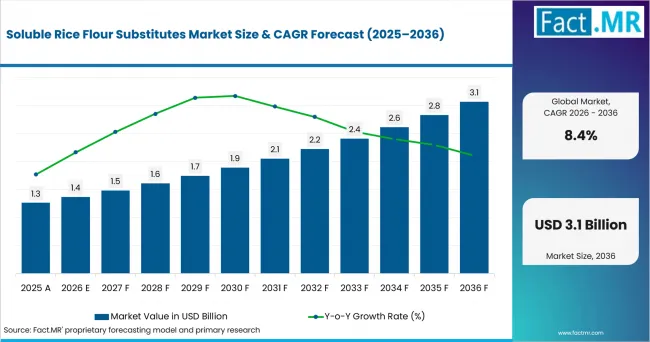
Soluble Rice Flour Substitutes Market Value Analysis | Source: Fact.MR
What are the defining numbers behind Soluble Rice Flour Substitutes Market growth?
USD 1.70 billion in absolute opportunity is expected between 2026 and 2036.
- Demand Drivers in the Market
- Dry-mix manufacturers need dispersible carriers that create body without a long technical ingredient name. The USDA Economic Research Service reported on April 30, 2026 that average annual U.S. food-at-home prices were 2.3% higher in 2025 than in 2024.
- Seasoning and sauce brands use food bulking agents to manage fill weight, mouthfeel and flavor distribution. Flour-based soluble solids fit these recipes when maltodextrin replacement must retain fast dispersion and mild taste.
- Bakery formulators need rice, oat and tapioca systems that hold water and create softer bite in gluten-managed recipes. These functions are relevant when the brand wants familiar cereal-derived wording on front and back labels.
- Beverage and nutrition powder producers require low-flavor carriers that suspend vitamins, flavors and sweeteners evenly. Soluble flour substitutes support that need when the final powder must dissolve quickly and avoid visible sediment.
- Key Segments Analyzed
- By Substitute Base: Tapioca flour and solids are expected to hold 29.0% share in 2026 due to neutral taste and broad use in dry seasoning and sauce blends.
- By Replacement Use: Maltodextrin replacement is projected to account for 30.0% share in 2026 because brands want carrier function with a simpler flour-based identity.
- By Application: Soups, sauces & seasonings are anticipated to capture 27.0% share in 2026 owing to high solids loading and repeated need for fast hydration.
- By Label Positioning: Simple flour declaration is estimated to represent 39.0% share in 2026 as product teams prioritize short ingredient panels.
- Analyst Opinion at Fact.MR
- Shambhu Nath Jha, Principal Consultant at Fact.MR, states, “The commercial test is whether a substitute behaves like a carrier while reading like a familiar flour. Brands are expected to evaluate dispersion, taste and allergen paperwork before production. Suppliers that combine clean naming, stable viscosity and application support are better placed for repeat reformulation work.”
- Strategic Implications
- Ingredient suppliers should document hydration behavior, solids contribution and flavor carryover by application so formulators can compare rice, tapioca, oat and pulse systems quickly.
- Application teams should build demonstration recipes for soups, sauces, seasonings and bakery mixes because these formats show carrier replacement benefits quickly.
- Sales teams should separate maltodextrin replacement from thickening claims, since each buyer group tests different performance measures during qualification.
The USA is projected to record 9.5% CAGR through 2036, supported by packaged-food reformulation. The UK is expected to post 8.8% CAGR as food manufacturing scale supports trials. Germany is forecast to advance at 8.0% CAGR where documentation shapes approvals. Japan is anticipated to reach 7.6% CAGR due to convenience-food texture needs. France is estimated to record 6.4% CAGR.
How does the Soluble Rice Flour Substitutes Market break down by segment?
Tapioca flour and solids lead Substitute Base at 29.0% share; Simple flour declaration leads Label Positioning at 39.0% share.
Which Substitute Base dominates?
Tapioca flour and solids are expected to hold 29.0% share in 2026.
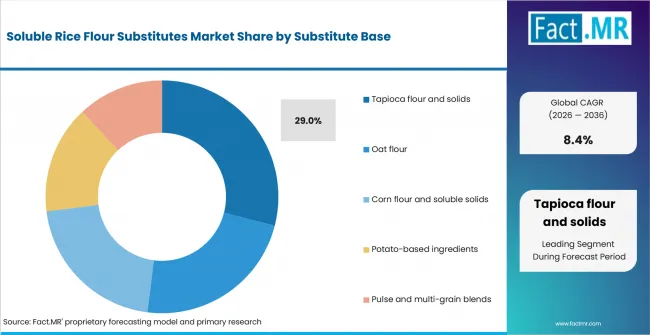
Soluble Rice Flour Substitutes Market Analysis By Substitute Base | Source: Fact.MR
Tapioca flour and solids are expected to lead substitute base demand because they disperse well and carry a mild taste profile. Oat flour supports bakery systems where cereal identity and texture are part of the consumer promise. Corn flour and soluble solids remain useful when scale and cost consistency are central to dry blending. Tapioca starch links the segment to an established ingredient family used for thickening, binding and texture control.
What leads the Replacement Use segment?
Maltodextrin replacement is projected to account for 30.0% share in 2026.
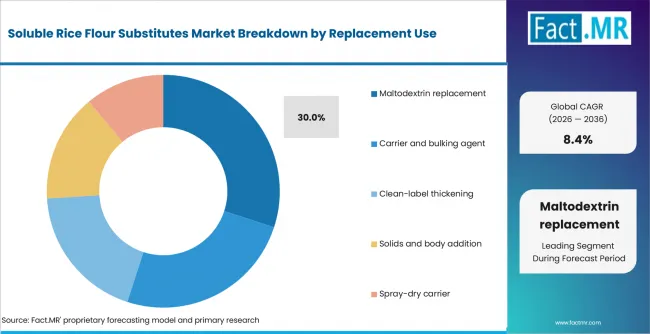
Soluble Rice Flour Substitutes Market Analysis By Replacement Use | Source: Fact.MR
Maltodextrin replacement is projected to lead replacement use as brands seek carrier performance with a shorter ingredient statement. Carrier and bulking agent use remains close behind in beverages and nutrition powders. Clean-label thickening gains relevance where sauces and soups need body after heat processing. Resistant maltodextrin remains an adjacent reference point for formulators comparing carbohydrate-based solids and powder behavior.
How does Application shape demand?
Soups, sauces & seasonings are anticipated to capture 27.0% share in 2026.
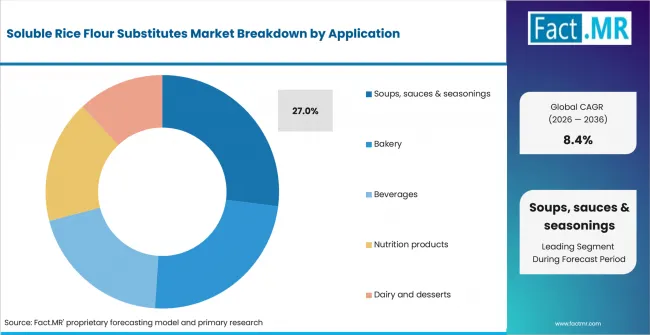
Soluble Rice Flour Substitutes Market Analysis By Application | Source: Fact.MR
Soups, sauces & seasonings are anticipated to lead application demand due to high dry-solids use and frequent reformulation cycles. Bakery follows where rice, oat and tapioca ingredients help manage structure in wheat-reduced recipes. Beverages need soluble carriers that dissolve cleanly and avoid grainy mouthfeel. The Office for National Statistics reported on July 24, 2026 that manufacture of food represented 22.9% of total UK manufacturers' sales in 2025.
What supports Label Positioning?
Simple flour declaration is estimated to represent 39.0% share in 2026.
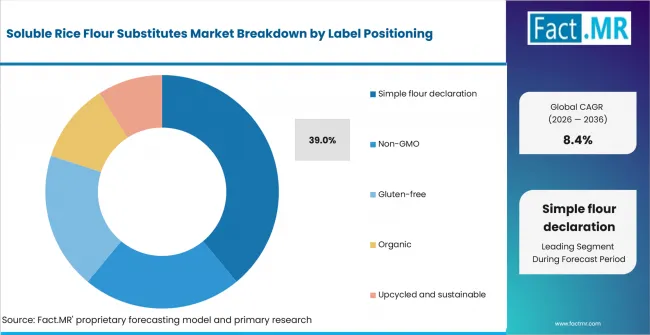
Soluble Rice Flour Substitutes Market Analysis By Label Positioning | Source: Fact.MR
Simple flour declaration is estimated to lead label positioning because it gives brands a familiar way to explain reformulation. Non-GMO positioning supports recipes where corn or soy avoidance affects ingredient screening. Gluten-free positioning remains relevant when gluten-free food brands require carriers that align with dietary claims. Organic positioning creates a narrower supplier pool and places more weight on traceability paperwork.
What is accelerating Soluble Rice Flour Substitutes Market adoption, and what is holding it back?
Clean-label carrier replacement drives it; sensory and documentation limits restrain it.
Drivers Impact Analysis
| DRIVER | (~) % IMPACT ON CAGR | GEOGRAPHIC RELEVANCE | IMPACT TIMELINE |
|---|---|---|---|
| Maltodextrin replacement in dry mixes | +1.5% | North America, Europe | Short term (<= 2 years) |
| Simple flour declaration in packaged food | +1.2% | Global | Short term (<= 2 years) |
| Gluten-free and non-GMO recipe work | +0.9% | North America, Europe, Japan | Medium term (2-4 years) |
| Hydration control in sauces and seasonings | +0.7% | Global | Medium term (2-4 years) |
- Maltodextrin replacement in dry mixes: Powdered beverages, seasonings and bakery mixes need carriers that distribute flavor and solids evenly. Soluble flour substitutes are expected to gain share where formulators want similar handling with a familiar ingredient name.
- Simple flour declaration in packaged food: Shorter labels remain a practical buyer requirement in retail food. Flour-based wording can be easier to explain than modified or highly technical carbohydrate ingredients.
- Gluten-free and non-GMO recipe work: Brands that operate in free-from shelves often screen ingredients for source, allergen status and processing history. Rice, tapioca and oat systems are anticipated to benefit when those checks are completed early.
- Hydration control in sauces and seasonings: Soluble solids help dry blends hydrate consistently after mixing with water or fat. That function is relevant in sauces, dips, soups and seasoning pastes where lumps damage consumer acceptance.
Opportunity Impact Analysis
| OPPORTUNITY | (~) % IMPACT ON CAGR | GEOGRAPHIC RELEVANCE | IMPACT TIMELINE |
|---|---|---|---|
| Application support for sauce and soup systems | +1.0% | Europe, North America | Short term (<= 2 years) |
| Beverage carrier reformulation | +0.8% | USA, Japan | Medium term (2-4 years) |
| Bakery systems for gluten-managed recipes | +0.7% | Europe, North America | Medium term (2-4 years) |
| Pulse and multi-grain blends | +0.5% | Europe, Japan | Long term (>= 4 years) |
- Application support for sauce and soup systems: Sauce and soup producers need evidence that viscosity holds after heating and storage. Suppliers that show side-by-side trials with native starches and maltodextrin substitutes are expected to shorten qualification work.
- Beverage carrier reformulation: Beverage powders need low-flavor carriers that dissolve quickly and keep colors uniform. Soluble rice and pea-based systems are projected to benefit where sediment control is tested before launch.
- Bakery systems for gluten-managed recipes: Gluten-managed bakery needs structure without wheat gluten. Gluten-free baking mixes provide an adjacent application base where rice and tapioca systems support crumb softness and water binding.
- Pulse and multi-grain blends: Pulse flour blends widen the substitute base beyond rice and tapioca. These blends are expected to gain interest when nutrition positioning and texture both influence product design.
Restraints Impact Analysis
| RESTRAINT | (~) % IMPACT ON CAGR | GEOGRAPHIC RELEVANCE | IMPACT TIMELINE |
|---|---|---|---|
| Flavor carryover in delicate applications | -0.5% | Japan, France | Short term (<= 2 years) |
| Viscosity drift after processing | -0.4% | Global | Medium term (2-4 years) |
| Certification and allergen paperwork | -0.3% | USA, Europe | Medium term (2-4 years) |
| Input-cost movement in rice and tapioca | -0.2% | Asia, Europe | Long term (>= 4 years) |
- Flavor carryover in delicate applications: Rice, oat or pulse notes can appear in light beverages and dairy desserts. Formulators are expected to require sensory testing before replacing neutral carbohydrate carriers.
- Viscosity drift after processing: Some substitutes thicken after heating or storage and change the eating experience. Sauce and dessert producers therefore test hydration curves before approving a new ingredient.
- Input-cost movement in rice and tapioca: Crop and starch input prices can move differently from finished-food prices. Long approval cycles make substitution slower when purchasing teams worry about ingredient availability.
Which countries are scaling the Soluble Rice Flour Substitutes Market through 2036?
- The country comparison spans 3.08 percentage points and forms three practical growth bands across the forecast period.
- The USA remains 0.68 percentage point above the UK through packaged-food scale and active reformulation programs.
- The UK remains 0.83 percentage point above Germany as food manufacturing and retailer label review support recipe testing.
- Germany remains 0.42 percentage point above Japan through technical documentation standards and clean-declaration focus.
- Japan remains 1.15 percentage points above France as convenience-food formats require stable carrier and texture systems.
Comparable CAGRs create different entry conditions due to manufacturing scale, label expectations, certification needs and application mix. Full report coverage includes North America, Latin America, Western Europe, Eastern Europe, East Asia, South Asia & Pacific, and Middle East & Africa.
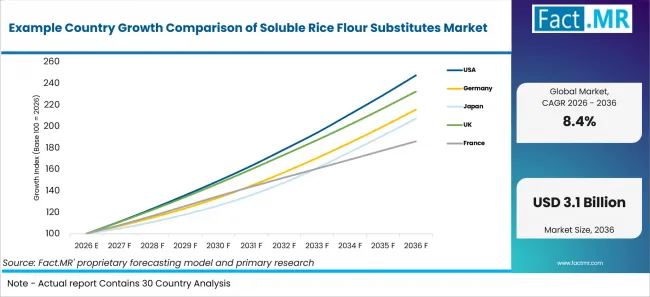
Example Country Growth Comparison Of Soluble Rice Flour Substitutes Market | Source: Fact.MR
| Country | CAGR (2026-2036) |
|---|---|
| United States | 9.5% |
| United Kingdom | 8.8% |
| Germany | 8.0% |
| Japan | 7.6% |
| France | 6.4% |
What supports USA adoption?
9.5% CAGR, supported by packaged-food reformulation and maltodextrin replacement.
U.S. packaged-food scale gives substitute suppliers a broad test bed across sauces, bakery mixes and nutrition powders. The Soluble Rice Flour Substitutes Market is projected to record 9.5% CAGR in the USA through 2036. USDA Economic Research Service reported on June 11, 2026 that inflation-adjusted U.S. food spending reached USD 2.51 trillion in 2025, providing broad context on the scale of U.S. food expenditure.
What supports the United Kingdom’s growth?
8.8% CAGR, backed by food manufacturing scale and retailer label review.
UK brands use flour-based substitutes where private-label ranges require familiar wording and reliable dry-mix handling. The market is expected to post 8.8% CAGR through 2036. The Office for National Statistics reported on August 19, 2026 that food and non-alcoholic beverage prices rose 1.3% in the 12 months to July 2026.
What supports Germany’s adoption?
8.0% CAGR, shaped by technical files and transparent ingredient declarations.
Germany’s food manufacturers evaluate soluble substitutes through documented viscosity, allergen status and claim readiness. The market is forecast to advance at 8.0% CAGR through 2036. Destatis reported an annual-average consumer price index of 136.2 (2020=100) for food and non-alcoholic beverages in Germany in 2025.
How does Japan perform?
7.6% CAGR, led by convenience-food texture needs and compact pack formats.
Japan’s convenience-food and nutrition-powder producers place high value on smooth dispersion and low flavor carryover. The market is anticipated to reach 7.6% CAGR through 2036. The Statistics Bureau of Japan reported on February 6, 2026 that average monthly consumption expenditure per two-or-more-person household was 314,001 yen in 2025.
How does France perform?
6.4% CAGR, driven by organic positioning and premium clean-label reformulation.
French brands use soluble flour substitutes where organic or simple-label positioning must fit taste and texture goals. The market is estimated to record 6.4% CAGR through 2036. INSEE reported on January 15, 2026 that food prices in France rose by 1.2% on average in 2025.
Who leads the Soluble Rice Flour Substitutes Market?
Ingredion, Tate & Lyle, BENEO, AGRANA, Cargill and Roquette have publicly verifiable starch, flour or texturizing portfolios relevant to this report's substitute set.
Ingredion, Tate & Lyle and Cargill are profiled for starch, texturizer and carrier portfolios used in reformulation. BENEO strengthens the set through rice ingredient knowledge, while AGRANA adds European starch processing depth. Competition is expected to center on application proof and batch consistency.
Roquette added a current company development through AMYSTA™ L 123, launched in October 2025 for applications including ready-to-mix beverages, dried soups, sauces, and condiment mixes. Its bulking, mouthfeel, and carrier functionality places it close to functional food texture systems and expands Roquette’s portfolio of soluble plant-based formulation ingredients. Supplier differentiation is increasingly influenced by label-friendly functionality, sensory performance, and technical application support.
Which companies are the key providers?
Key companies include Ingredion, Tate & Lyle, BENEO, AGRANA, Cargill and Roquette.
- Ingredion
- Tate & Lyle
- BENEO
- AGRANA
- Cargill
- Roquette
Bibliography
- Sinclair, W., & Stewart, H. (2026, April 30). U.S. food-at-home prices increased 2.3 percent in 2025, compared with 2024. U.S. Department of Agriculture, Economic Research Service.
- Zeballos, E., & Sinclair, W. (2026, June 11). Total U.S. food spending reached $2.51 trillion in 2025. U.S. Department of Agriculture, Economic Research Service.
- U.S. Food and Drug Administration. (2025, January 6). FDA releases allergen, food safety, and plant-based alternative labeling guidances.
- Office for National Statistics. (2026, July 24). UK manufacturers’ sales by product: 2025.
- Office for National Statistics. (2026, August 19). Consumer price inflation, UK: July 2026.
- Federal Statistical Office (Destatis). (2026, June 12). Consumer price index - overall index and by 12 divisions.
- Statistics Bureau of Japan. (2026, February 6). 2025 yearly average [Family Income and Expenditure Survey].
- Institut national de la statistique et des études économiques. (2026, January 15). Further slowdown in annual average consumer prices in 2025.
- Roquette. (2025, October 31). AMYSTA™ L 123, the New Label-Friendly Soluble Pea Starch.
This Report Answers
- The report explains where soluble flour substitutes are used across substitute base and replacement use. It also covers application and label positioning, together with regional demand patterns.
- Segment analysis identifies tapioca flour and solids, maltodextrin replacement, soups, sauces & seasonings, and simple flour declaration as the leading 2026 positions.
- Country analysis reviews the USA, United Kingdom, Germany, Japan and France through food manufacturing scale, label rules, consumer spending and recipe-conversion barriers.
- Competitive analysis reviews Ingredion, Tate & Lyle, BENEO, AGRANA, Cargill and Roquette by portfolio fit and current development activity.
- Application analysis evaluates how solubility, carrier function, body addition and claim support influence supplier selection in food and beverage formulations.
What does the Soluble Rice Flour Substitutes Market cover?
The Soluble Rice Flour Substitutes Market covers flour-adjacent ingredient systems used to replace or supplement maltodextrin, modified starch, bulking agents and soluble carriers in packaged food. It includes rice, tapioca, oat, corn, potato and multi-grain systems when they are sold for dispersion, texture or body-building functions.
The assessment is narrower than the whole starch or flour market. Conventional table flour, standard baking flour and commodity starch are excluded unless they are sold as soluble substitute systems for dry-mix or processed-food use.
What is included in the scope?
The scope includes ingredient systems used in soups, sauces, seasonings, bakery, beverages, nutrition products, dairy and desserts. It covers rice-based soluble systems, tapioca flour and solids, oat flour, potato-based ingredients, corn soluble solids and multi-grain blends.
The scope also covers substitutes used for maltodextrin replacement, carrier and bulking agent roles, clean-label thickening, solids addition and spray-dry carrier functions. Related ingredients are reviewed where their use overlaps with processed rice flour and soluble dry-mix systems.
What is excluded from the scope?
The scope excludes finished gluten-free bakery products, retail flour packs and commodity starch sold without a soluble substitute function. Standard crop trading and grain milling are outside the assessment when the product lacks food-application positioning.
Ready meals and finished soups are outside the scope except as downstream applications. Broader gluten-free food categories are referenced only where they create ingredient-level demand for soluble carriers and label-friendly body systems.
How Was the Analysis Built?
The analysis draws on 120+ sources, 35+ company portfolios, 25+ countries, and more than 20 industry interviews.
- Primary Research: Primary research includes discussions with manufacturers, service providers, technology developers, distributors, end users, and subject-matter experts. These conversations examine purchasing priorities, product adoption, operational challenges, approval requirements, competitive positioning, and the factors that influence wider market acceptance.
- Desk Research: Desk research covers government statistics, regulatory publications, company filings, trade data, technical studies, industry associations, standards, public policy, and other authoritative sources. Every source used in the analysis is documented in the bibliography.
- Market Sizing and Forecasting: Market estimates combine historical performance, demand indicators, pricing and volume trends, segment shares, company participation, country-level growth, adoption patterns, investment activity, and barriers to market expansion.
- Data Validation and Update Cycle: Findings are validated by comparing primary interviews with public data, company activity, regulatory changes, trade patterns, and industry developments. Regular updates review new product launches, capacity changes, partnerships, approvals, and shifts in commercial adoption.
What is the report’s scope and coverage?
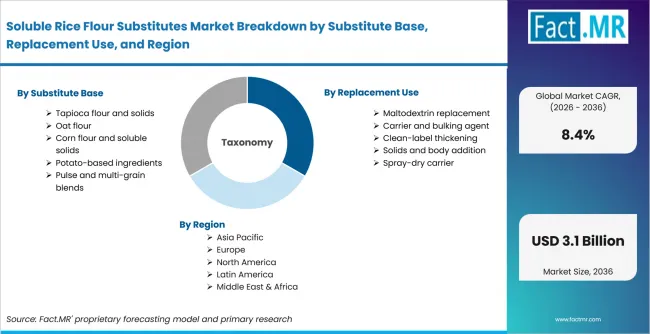
Soluble Rice Flour Substitutes Market Breakdown By Substitute Base, Replacement Use, And Region | Source: Fact.MR
| Attribute | Details |
|---|---|
| Quantitative Units | USD billion |
| Market Definition | Soluble rice flour substitutes are rice, tapioca, oat, corn, potato and pulse-based ingredient systems used to replace maltodextrin, carriers, bulking solids or thickening ingredients in food and beverage formulations. |
| Substitute Base | Tapioca flour and solids; Oat flour; Corn flour and soluble solids; Potato-based ingredients; Pulse and multi-grain blends |
| Replacement Use | Maltodextrin replacement; Carrier and bulking agent; Clean-label thickening; Solids and body addition; Spray-dry carrier |
| Application | Soups, sauces & seasonings; Bakery; Beverages; Nutrition products; Dairy and desserts |
| Label Positioning | Simple flour declaration; Non-GMO; Gluten-free; Organic; Upcycled and sustainable |
| Regions Covered | North America; Latin America; Western Europe; Eastern Europe; East Asia; South Asia & Pacific; Middle East & Africa |
| Countries Covered | United States; United Kingdom; Germany; Japan; France |
| Companies Profiled | Ingredion; Tate & Lyle; BENEO; AGRANA; Cargill; Roquette |
| Forecast Period | 2026 to 2036 |
| Approach | Hybrid top-down and bottom-up approach using food ingredient demand, application mix, segment shares, country adoption and provider portfolio review. |
How is the market segmented?
-
By Substitute Base
- Tapioca flour and solids
- Oat flour
- Corn flour and soluble solids
- Potato-based ingredients
- Pulse and multi-grain blends
-
By Replacement Use
- Maltodextrin replacement
- Carrier and bulking agent
- Clean-label thickening
- Solids and body addition
- Spray-dry carrier
-
By Application
- Soups, sauces & seasonings
- Bakery
- Beverages
- Nutrition products
- Dairy and desserts
-
By Label Positioning
- Simple flour declaration
- Non-GMO
- Gluten-free
- Organic
- Upcycled and sustainable
-
By Region
- North America
- Latin America
- Western Europe
- Eastern Europe
- East Asia
- South Asia & Pacific
- Middle East & Africa