Targeted Phage-based Bactericide for Specialty Crops Market
Targeted Phage-based Bactericide for Specialty Crops Market Size and Share Forecast Outlook 2026 to 2036
Targeted phage-based bactericide for specialty crops market is projected to grow from USD 162.0 million in 2026 to USD 765.5 million by 2036, at a CAGR of 16.8%. Xanthomonas spp. will dominate with a 32.0% market share, while fruits & vegetables will lead the crop type segment with a 46.0% share.
Targeted Phage-based Bactericide for Specialty Crops Market Forecast and Outlook 2026 to 2036
The global targeted phage-based bactericide market for specialty crops is projected to reach USD 765 million by 2036. The market is valued at USD 162 million in 2026 and is set to rise at a CAGR of 16.8% during the assessment period. By target pathogen type, Xanthomonas spp. commands a leading 32% share. The fruits & vegetables crop segment holds a dominant 46.0% share, while foliar spray is the preferred application method with 49% market share.
Key Takeaways from the Targeted Phage-based Bactericide for Specialty Crops Market
- Market Value for 2026: USD 162 Million
- Market Value for 2036: USD 765 Million
- Forecast CAGR (2026-2036): 16.8%
- Leading Target Pathogen Type Share (2026): Xanthomonas spp. (32%)
- Leading Crop Type Share (2026): Fruits & Vegetables (46.0%)
- Leading Application Method Share (2026): Foliar Spray (49%)
- Key Players in the Market: AgBiome, Armata Pharmaceuticals (Agri), Bayer CropScience, Syngenta Group, APS Biocontrol
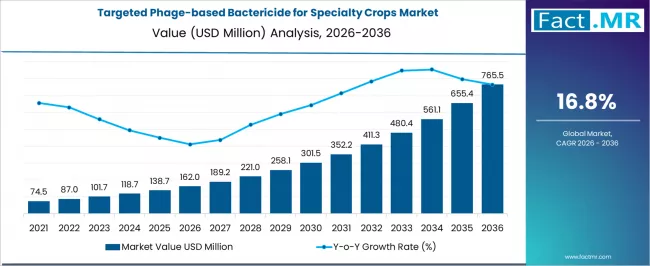
Important trends include accelerated research into phage cocktails targeting complex bacterial complexes like Pseudomonas and Erwinia. Integration of phage formulations with conventional spray programs is gaining traction to enhance efficacy. A growing focus on developing stable formulations for seed and transplant treatment reflects the need for early-stage disease prevention in high-value crops.
Regulatory frameworks are evolving to accommodate biological precision solutions. Expedited review pathways for phage-based biocontrols in several key countries lower market entry barriers. Policies promoting sustainable agriculture and reducing chemical residues directly support the adoption of these targeted bactericides, particularly in export-oriented crop sectors.
Targeted Phage-based Bactericide for Specialty Crops Market
| Metric | Value |
|---|---|
| Market Value (2026) | USD 162 Million |
| Market Forecast Value (2036) | USD 765 Million |
| Forecast CAGR (2026-2036) | 16.8% |
Category
| Category | Segments |
|---|---|
| Target Pathogen Type | Xanthomonas spp., Pseudomonas spp., Erwinia spp., Clavibacter spp., Others |
| Crop Type | Fruits & Vegetables, Vineyards, Plantation & Export Crops, Protected Greenhouse Crops, Others |
| Application Method | Foliar Spray, Seed & Transplant Treatment, Soil & Drip Application |
| Region | North America, Latin America, Western Europe, Eastern Europe, East Asia, South Asia & Pacific, MEA |
Segmental Analysis
By Target Pathogen, Which Genus Poses the Most Significant Threat?
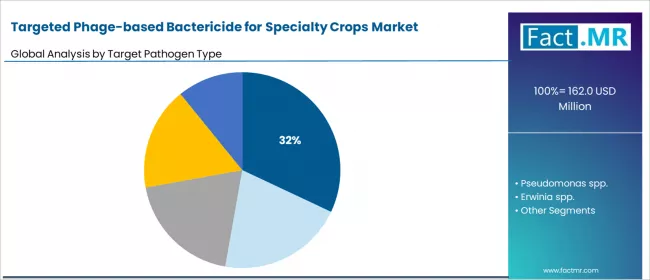
Xanthomonas spp. represents the primary target, accounting for a leading 32% pathogen segment share. This dominance is driven by the severe economic impact of diseases like bacterial spot and canker across a wide host range, including tomatoes, peppers, and citrus. The prevalence and destructiveness of xanthomonads in both field and greenhouse settings create a consistent and urgent demand for effective, specific biocontrol solutions among growers globally.
By Crop Type, Which Sector Demands the Highest Volume of Solutions?
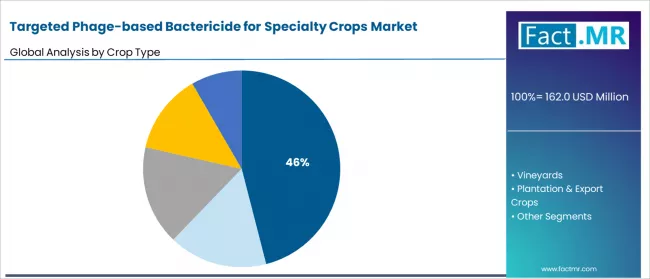
Fruits and vegetables constitute the dominant crop segment, holding a 46.0% share. The high intensity of cultivation, combined with the susceptibility of these crops to bacterial diseases that directly affect marketable yield and quality, fuels demand. Producers of leafy greens, solanaceous crops, and stone fruits are actively seeking alternatives to antibiotics and copper-based chemicals, turning to phage-based solutions to protect crop value and meet stringent food safety protocols.
By Application Method, Which Strategy Aligns with Standard Grower Practice?
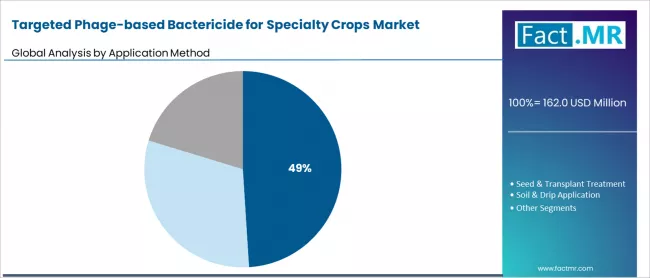
Foliar spray holds the largest application share at 49%. This method aligns seamlessly with existing crop protection schedules, allowing for easy adoption. It enables direct intervention at the first signs of foliar infection, providing growers with a sense of immediate control. The practicality of integrating phage solutions into standard sprayer equipment without major operational changes supports its widespread preference across diverse farming scales.
What are the Drivers, Restraints, and Key Trends of the Targeted Phage-based Bactericide for Specialty Crops Market?
Driver strength originates from the critical need to manage bacterial resistance to conventional chemicals and the rising consumer demand for residue-free produce. The high specificity of phages minimizes environmental impact, appealing to sustainable agriculture goals. Market expansion is further propelled by significant investment in agri-biotech.
A central restraint involves the high specificity itself, which necessitates precise pathogen diagnosis and can limit product use against mixed infections. Regulatory hurdles and variable efficacy under different environmental conditions also challenge consistent performance. Grower familiarity with and trust in biological alternatives remains a barrier to rapid adoption.
Key trends feature the development of multi-phage cocktails to broaden the spectrum of activity. Strategic partnerships between phage specialists and major agrochemical companies are crucial for scaling distribution. Increased focus on seed coating and transplant dip applications aims to provide earlier, systemic protection for crops.
Analysis of the Targeted Phage-based Bactericide for Specialty Crops Market by Key Countries
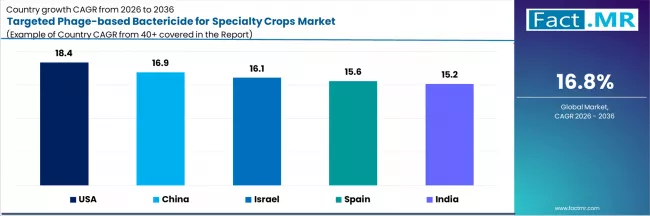
| Country | CAGR (2026-2036) |
|---|---|
| USA | 18.40% |
| China | 16.90% |
| Israel | 16.10% |
| Spain | 15.60% |
| India | 15.20% |
How does the USA Lead in Commercial Adoption and Regulatory Frameworks?
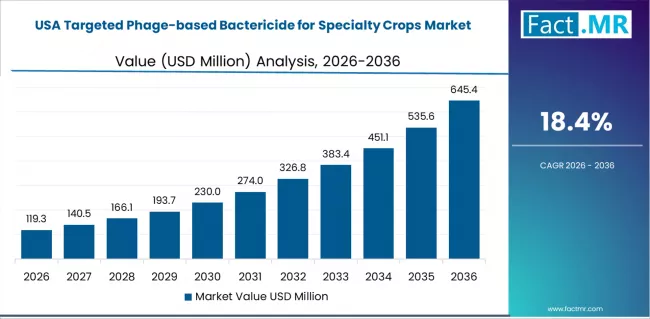
The USA exhibits the highest growth rate at 18.40%, driven by a mature biopesticide regulatory pathway and strong uptake in high-value specialty crops. Growers in California and Florida combat persistent bacterial diseases in citrus and vegetables, creating a ready market. Investment from established agribusinesses accelerates product development and farmer education, integrating phage solutions into mainstream IPM recommendations.
Why is China a Major Hub for Research and Scalable Application?
China's growth at 16.90% is fueled by substantial government investment in agricultural biotechnology and the vast scale of its protected horticulture and fruit production. Domestic research institutes are actively developing phage products tailored to local pathogen strains affecting rice and greenhouse vegetables. The push for green development in agriculture supports the adoption of these precision biological tools.
What Positions Israel as a Center for High-Tech Phage Innovation?
Israel's significant 16.10% growth stems from its advanced agritech ecosystem and focus on precision agriculture. The need for efficient water and input use in arid conditions makes targeted biocontrols like phages highly valuable. Local startups and research centers collaborate closely to develop solutions for export-oriented vineyards and greenhouse sectors, leveraging sophisticated delivery technologies.
How Does Spain's Intensive Agriculture Drive Demand for Specialty Solutions?
Spain's 15.60% growth is anchored in its massive greenhouse vegetable industry and vineyard sector. Producers in regions like Almería face severe pressure from bacterial pathogens, demanding effective alternatives to manage resistance and residue limits. The concentrated, technically advanced nature of Spanish specialty farming facilitates rapid trialing and adoption of novel biocontrols like phage sprays.
What Factors Underpin India's Emerging Growth in This Market?
India's 15.20% growth potential is linked to its large and diverse horticulture sector, where bacterial diseases cause significant post-harvest losses. Increasing awareness of sustainable practices and the need to meet quality standards for both domestic and export markets is driving interest. Cost-effective production and local adaptation of phage technologies are key to penetrating this vast and price-sensitive grower base.
Competitive Landscape of the Targeted Phage-based Bactericide for Specialty Crops Market
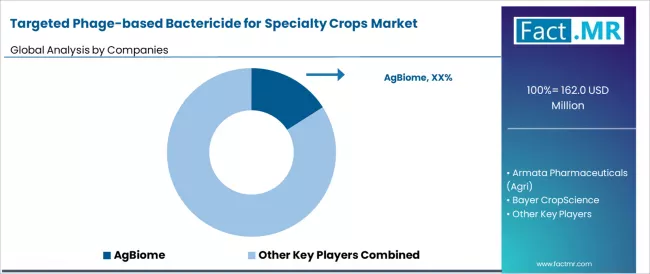
The competitive landscape features a dynamic mix of specialized biotechnology firms and diversified agricultural majors. AgBiome and APS Biocontrol represent focused players advancing proprietary phage discovery platforms. In contrast, large integrated companies like Bayer CropScience and Syngenta Group leverage their extensive distribution networks and R&D resources to develop and commercialize phage-based products within broader biocontrol portfolios.
Competition intensifies around intellectual property related to specific phage strains, formulation technologies, and delivery systems. Success hinges not only on scientific innovation but also on demonstrating consistent field efficacy and achieving regulatory approvals across different regions. Collaborations between phage specialists and large agribusinesses are becoming commonplace, combining discovery prowess with commercial scale and grower trust to accelerate market penetration.
Key Players in the Targeted Phage-based Bactericide for Specialty Crops Market
- AgBiome
- Armata Pharmaceuticals (Agri)
- Bayer CropScience
- Syngenta Group
- APS Biocontrol
Scope of Report
| Items | Values |
|---|---|
| Quantitative Units | USD Million |
| Target Pathogen Type | Xanthomonas spp., Pseudomonas spp., Erwinia spp., Clavibacter spp., Others |
| Crop Type | Fruits & Vegetables, Vineyards, Plantation & Export Crops, Protected Greenhouse Crops, Others |
| Application Method | Foliar Spray, Seed & Transplant Treatment, Soil & Drip Application |
| Key Countries | USA, China, Israel, Spain, India |
| Key Companies | AgBiome, Armata Pharmaceuticals (Agri), Bayer CropScience, Syngenta Group, APS Biocontrol |
| Additional Analysis | Analysis of pathogen prevalence by region, integration strategies with chemical programs, regulatory pathway comparison, formulation stability challenges, and impact on export market compliance. |
| Items | Values |
Targeted Phage-based Bactericide for Specialty Crops Market by Segments
-
Target Pathogen Type :
- Xanthomonas spp.
- Pseudomonas spp.
- Erwinia spp.
- Clavibacter spp.
- Others
-
Crop Type :
- Fruits & Vegetables
- Vineyards
- Plantation & Export Crops
- Protected Greenhouse Crops
- Others
-
Application Method :
- Foliar Spray
- Seed & Transplant Treatment
- Soil & Drip Application
-
Region :
-
North America
- USA
- Canada
-
Latin America
- Brazil
- Mexico
- Argentina
- Rest of Latin America
-
Western Europe
- Germany
- UK
- France
- Spain
- Italy
- BENELUX
- Rest of Western Europe
-
Eastern Europe
- Czech Republic
- Poland
- Russia
- Rest of Eastern Europe
-
East Asia
- China
- Japan
- South Korea
- Rest of East Asia
-
South Asia & Pacific
- India
- Indonesia
- Australia
- Rest of South Asia & Pacific
-
MEA
- GCC Countries
- Turkiye
- Saudi Arabia
- Rest of MEA
-
Table of Content
- Executive Summary
- Global Market Outlook
- Demand to side Trends
- Supply to side Trends
- Technology Roadmap Analysis
- Analysis and Recommendations
- Market Overview
- Market Coverage / Taxonomy
- Market Definition / Scope / Limitations
- Market Background
- Market Dynamics
- Drivers
- Restraints
- Opportunity
- Trends
- Scenario Forecast
- Demand in Optimistic Scenario
- Demand in Likely Scenario
- Demand in Conservative Scenario
- Opportunity Map Analysis
- Product Life Cycle Analysis
- Supply Chain Analysis
- Investment Feasibility Matrix
- Value Chain Analysis
- PESTLE and Porter’s Analysis
- Regulatory Landscape
- Regional Parent Market Outlook
- Production and Consumption Statistics
- Import and Export Statistics
- Market Dynamics
- Global Market Analysis 2021 to 2025 and Forecast, 2026 to 2036
- Historical Market Size Value (USD Million) Analysis, 2021 to 2025
- Current and Future Market Size Value (USD Million) Projections, 2026 to 2036
- Y to o to Y Growth Trend Analysis
- Absolute $ Opportunity Analysis
- Global Market Pricing Analysis 2021 to 2025 and Forecast 2026 to 2036
- Global Market Analysis 2021 to 2025 and Forecast 2026 to 2036, By Target Pathogen Type
- Introduction / Key Findings
- Historical Market Size Value (USD Million) Analysis By Target Pathogen Type, 2021 to 2025
- Current and Future Market Size Value (USD Million) Analysis and Forecast By Target Pathogen Type, 2026 to 2036
- Xanthomonas spp.
- Pseudomonas spp.
- Erwinia spp.
- Clavibacter spp.
- Others
- Xanthomonas spp.
- Y to o to Y Growth Trend Analysis By Target Pathogen Type, 2021 to 2025
- Absolute $ Opportunity Analysis By Target Pathogen Type, 2026 to 2036
- Global Market Analysis 2021 to 2025 and Forecast 2026 to 2036, By Crop Type
- Introduction / Key Findings
- Historical Market Size Value (USD Million) Analysis By Crop Type, 2021 to 2025
- Current and Future Market Size Value (USD Million) Analysis and Forecast By Crop Type, 2026 to 2036
- Fruits & Vegetables
- Vineyards
- Plantation & Export Crops
- Protected Greenhouse Crops
- Others
- Fruits & Vegetables
- Y to o to Y Growth Trend Analysis By Crop Type, 2021 to 2025
- Absolute $ Opportunity Analysis By Crop Type, 2026 to 2036
- Global Market Analysis 2021 to 2025 and Forecast 2026 to 2036, By Application Method
- Introduction / Key Findings
- Historical Market Size Value (USD Million) Analysis By Application Method, 2021 to 2025
- Current and Future Market Size Value (USD Million) Analysis and Forecast By Application Method, 2026 to 2036
- Foliar Spray
- Seed & Transplant Treatment
- Soil & Drip Application
- Foliar Spray
- Y to o to Y Growth Trend Analysis By Application Method, 2021 to 2025
- Absolute $ Opportunity Analysis By Application Method, 2026 to 2036
- Global Market Analysis 2021 to 2025 and Forecast 2026 to 2036, By Region
- Introduction
- Historical Market Size Value (USD Million) Analysis By Region, 2021 to 2025
- Current Market Size Value (USD Million) Analysis and Forecast By Region, 2026 to 2036
- North America
- Latin America
- Western Europe
- Eastern Europe
- East Asia
- South Asia and Pacific
- Middle East & Africa
- Market Attractiveness Analysis By Region
- North America Market Analysis 2021 to 2025 and Forecast 2026 to 2036, By Country
- Historical Market Size Value (USD Million) Trend Analysis By Market Taxonomy, 2021 to 2025
- Market Size Value (USD Million) Forecast By Market Taxonomy, 2026 to 2036
- By Country
- USA
- Canada
- Mexico
- By Target Pathogen Type
- By Crop Type
- By Application Method
- By Country
- Market Attractiveness Analysis
- By Country
- By Target Pathogen Type
- By Crop Type
- By Application Method
- Key Takeaways
- Latin America Market Analysis 2021 to 2025 and Forecast 2026 to 2036, By Country
- Historical Market Size Value (USD Million) Trend Analysis By Market Taxonomy, 2021 to 2025
- Market Size Value (USD Million) Forecast By Market Taxonomy, 2026 to 2036
- By Country
- Brazil
- Chile
- Rest of Latin America
- By Target Pathogen Type
- By Crop Type
- By Application Method
- By Country
- Market Attractiveness Analysis
- By Country
- By Target Pathogen Type
- By Crop Type
- By Application Method
- Key Takeaways
- Western Europe Market Analysis 2021 to 2025 and Forecast 2026 to 2036, By Country
- Historical Market Size Value (USD Million) Trend Analysis By Market Taxonomy, 2021 to 2025
- Market Size Value (USD Million) Forecast By Market Taxonomy, 2026 to 2036
- By Country
- Germany
- UK
- Italy
- Spain
- France
- Nordic
- BENELUX
- Rest of Western Europe
- By Target Pathogen Type
- By Crop Type
- By Application Method
- By Country
- Market Attractiveness Analysis
- By Country
- By Target Pathogen Type
- By Crop Type
- By Application Method
- Key Takeaways
- Eastern Europe Market Analysis 2021 to 2025 and Forecast 2026 to 2036, By Country
- Historical Market Size Value (USD Million) Trend Analysis By Market Taxonomy, 2021 to 2025
- Market Size Value (USD Million) Forecast By Market Taxonomy, 2026 to 2036
- By Country
- Russia
- Poland
- Hungary
- Balkan & Baltic
- Rest of Eastern Europe
- By Target Pathogen Type
- By Crop Type
- By Application Method
- By Country
- Market Attractiveness Analysis
- By Country
- By Target Pathogen Type
- By Crop Type
- By Application Method
- Key Takeaways
- East Asia Market Analysis 2021 to 2025 and Forecast 2026 to 2036, By Country
- Historical Market Size Value (USD Million) Trend Analysis By Market Taxonomy, 2021 to 2025
- Market Size Value (USD Million) Forecast By Market Taxonomy, 2026 to 2036
- By Country
- China
- Japan
- South Korea
- By Target Pathogen Type
- By Crop Type
- By Application Method
- By Country
- Market Attractiveness Analysis
- By Country
- By Target Pathogen Type
- By Crop Type
- By Application Method
- Key Takeaways
- South Asia and Pacific Market Analysis 2021 to 2025 and Forecast 2026 to 2036, By Country
- Historical Market Size Value (USD Million) Trend Analysis By Market Taxonomy, 2021 to 2025
- Market Size Value (USD Million) Forecast By Market Taxonomy, 2026 to 2036
- By Country
- India
- ASEAN
- Australia & New Zealand
- Rest of South Asia and Pacific
- By Target Pathogen Type
- By Crop Type
- By Application Method
- By Country
- Market Attractiveness Analysis
- By Country
- By Target Pathogen Type
- By Crop Type
- By Application Method
- Key Takeaways
- Middle East & Africa Market Analysis 2021 to 2025 and Forecast 2026 to 2036, By Country
- Historical Market Size Value (USD Million) Trend Analysis By Market Taxonomy, 2021 to 2025
- Market Size Value (USD Million) Forecast By Market Taxonomy, 2026 to 2036
- By Country
- Kingdom of Saudi Arabia
- Other GCC Countries
- Turkiye
- South Africa
- Other African Union
- Rest of Middle East & Africa
- By Target Pathogen Type
- By Crop Type
- By Application Method
- By Country
- Market Attractiveness Analysis
- By Country
- By Target Pathogen Type
- By Crop Type
- By Application Method
- Key Takeaways
- Key Countries Market Analysis
- USA
- Pricing Analysis
- Market Share Analysis, 2025
- By Target Pathogen Type
- By Crop Type
- By Application Method
- Canada
- Pricing Analysis
- Market Share Analysis, 2025
- By Target Pathogen Type
- By Crop Type
- By Application Method
- Mexico
- Pricing Analysis
- Market Share Analysis, 2025
- By Target Pathogen Type
- By Crop Type
- By Application Method
- Brazil
- Pricing Analysis
- Market Share Analysis, 2025
- By Target Pathogen Type
- By Crop Type
- By Application Method
- Chile
- Pricing Analysis
- Market Share Analysis, 2025
- By Target Pathogen Type
- By Crop Type
- By Application Method
- Germany
- Pricing Analysis
- Market Share Analysis, 2025
- By Target Pathogen Type
- By Crop Type
- By Application Method
- UK
- Pricing Analysis
- Market Share Analysis, 2025
- By Target Pathogen Type
- By Crop Type
- By Application Method
- Italy
- Pricing Analysis
- Market Share Analysis, 2025
- By Target Pathogen Type
- By Crop Type
- By Application Method
- Spain
- Pricing Analysis
- Market Share Analysis, 2025
- By Target Pathogen Type
- By Crop Type
- By Application Method
- France
- Pricing Analysis
- Market Share Analysis, 2025
- By Target Pathogen Type
- By Crop Type
- By Application Method
- India
- Pricing Analysis
- Market Share Analysis, 2025
- By Target Pathogen Type
- By Crop Type
- By Application Method
- ASEAN
- Pricing Analysis
- Market Share Analysis, 2025
- By Target Pathogen Type
- By Crop Type
- By Application Method
- Australia & New Zealand
- Pricing Analysis
- Market Share Analysis, 2025
- By Target Pathogen Type
- By Crop Type
- By Application Method
- China
- Pricing Analysis
- Market Share Analysis, 2025
- By Target Pathogen Type
- By Crop Type
- By Application Method
- Japan
- Pricing Analysis
- Market Share Analysis, 2025
- By Target Pathogen Type
- By Crop Type
- By Application Method
- South Korea
- Pricing Analysis
- Market Share Analysis, 2025
- By Target Pathogen Type
- By Crop Type
- By Application Method
- Russia
- Pricing Analysis
- Market Share Analysis, 2025
- By Target Pathogen Type
- By Crop Type
- By Application Method
- Poland
- Pricing Analysis
- Market Share Analysis, 2025
- By Target Pathogen Type
- By Crop Type
- By Application Method
- Hungary
- Pricing Analysis
- Market Share Analysis, 2025
- By Target Pathogen Type
- By Crop Type
- By Application Method
- Kingdom of Saudi Arabia
- Pricing Analysis
- Market Share Analysis, 2025
- By Target Pathogen Type
- By Crop Type
- By Application Method
- Turkiye
- Pricing Analysis
- Market Share Analysis, 2025
- By Target Pathogen Type
- By Crop Type
- By Application Method
- South Africa
- Pricing Analysis
- Market Share Analysis, 2025
- By Target Pathogen Type
- By Crop Type
- By Application Method
- USA
- Market Structure Analysis
- Competition Dashboard
- Competition Benchmarking
- Market Share Analysis of Top Players
- By Regional
- By Target Pathogen Type
- By Crop Type
- By Application Method
- Competition Analysis
- Competition Deep Dive
- AgBiome
- Overview
- Product Portfolio
- Profitability by Market Segments (Product/Age /Sales Channel/Region)
- Sales Footprint
- Strategy Overview
- Marketing Strategy
- Product Strategy
- Channel Strategy
- Armata Pharmaceuticals (Agri)
- Bayer CropScience
- Syngenta Group
- APS Biocontrol
- AgBiome
- Competition Deep Dive
- Assumptions & Acronyms Used
- Research Methodology
List Of Table
- Table 1: Global Market Value (USD Million) Forecast by Region, 2021 to 2036
- Table 2: Global Market Value (USD Million) Forecast by Target Pathogen Type, 2021 to 2036
- Table 3: Global Market Value (USD Million) Forecast by Crop Type, 2021 to 2036
- Table 4: Global Market Value (USD Million) Forecast by Application Method, 2021 to 2036
- Table 5: North America Market Value (USD Million) Forecast by Country, 2021 to 2036
- Table 6: North America Market Value (USD Million) Forecast by Target Pathogen Type, 2021 to 2036
- Table 7: North America Market Value (USD Million) Forecast by Crop Type, 2021 to 2036
- Table 8: North America Market Value (USD Million) Forecast by Application Method, 2021 to 2036
- Table 9: Latin America Market Value (USD Million) Forecast by Country, 2021 to 2036
- Table 10: Latin America Market Value (USD Million) Forecast by Target Pathogen Type, 2021 to 2036
- Table 11: Latin America Market Value (USD Million) Forecast by Crop Type, 2021 to 2036
- Table 12: Latin America Market Value (USD Million) Forecast by Application Method, 2021 to 2036
- Table 13: Western Europe Market Value (USD Million) Forecast by Country, 2021 to 2036
- Table 14: Western Europe Market Value (USD Million) Forecast by Target Pathogen Type, 2021 to 2036
- Table 15: Western Europe Market Value (USD Million) Forecast by Crop Type, 2021 to 2036
- Table 16: Western Europe Market Value (USD Million) Forecast by Application Method, 2021 to 2036
- Table 17: Eastern Europe Market Value (USD Million) Forecast by Country, 2021 to 2036
- Table 18: Eastern Europe Market Value (USD Million) Forecast by Target Pathogen Type, 2021 to 2036
- Table 19: Eastern Europe Market Value (USD Million) Forecast by Crop Type, 2021 to 2036
- Table 20: Eastern Europe Market Value (USD Million) Forecast by Application Method, 2021 to 2036
- Table 21: East Asia Market Value (USD Million) Forecast by Country, 2021 to 2036
- Table 22: East Asia Market Value (USD Million) Forecast by Target Pathogen Type, 2021 to 2036
- Table 23: East Asia Market Value (USD Million) Forecast by Crop Type, 2021 to 2036
- Table 24: East Asia Market Value (USD Million) Forecast by Application Method, 2021 to 2036
- Table 25: South Asia and Pacific Market Value (USD Million) Forecast by Country, 2021 to 2036
- Table 26: South Asia and Pacific Market Value (USD Million) Forecast by Target Pathogen Type, 2021 to 2036
- Table 27: South Asia and Pacific Market Value (USD Million) Forecast by Crop Type, 2021 to 2036
- Table 28: South Asia and Pacific Market Value (USD Million) Forecast by Application Method, 2021 to 2036
- Table 29: Middle East & Africa Market Value (USD Million) Forecast by Country, 2021 to 2036
- Table 30: Middle East & Africa Market Value (USD Million) Forecast by Target Pathogen Type, 2021 to 2036
- Table 31: Middle East & Africa Market Value (USD Million) Forecast by Crop Type, 2021 to 2036
- Table 32: Middle East & Africa Market Value (USD Million) Forecast by Application Method, 2021 to 2036
List Of Figures
- Figure 1: Global Market Pricing Analysis
- Figure 2: Global Market Value (USD Million) Forecast 2021 to 2036
- Figure 3: Global Market Value Share and BPS Analysis by Target Pathogen Type, 2026 and 2036
- Figure 4: Global Market Y to o to Y Growth Comparison by Target Pathogen Type, 2026 to 2036
- Figure 5: Global Market Attractiveness Analysis by Target Pathogen Type
- Figure 6: Global Market Value Share and BPS Analysis by Crop Type, 2026 and 2036
- Figure 7: Global Market Y to o to Y Growth Comparison by Crop Type, 2026 to 2036
- Figure 8: Global Market Attractiveness Analysis by Crop Type
- Figure 9: Global Market Value Share and BPS Analysis by Application Method, 2026 and 2036
- Figure 10: Global Market Y to o to Y Growth Comparison by Application Method, 2026 to 2036
- Figure 11: Global Market Attractiveness Analysis by Application Method
- Figure 12: Global Market Value (USD Million) Share and BPS Analysis by Region, 2026 and 2036
- Figure 13: Global Market Y to o to Y Growth Comparison by Region, 2026 to 2036
- Figure 14: Global Market Attractiveness Analysis by Region
- Figure 15: North America Market Incremental Dollar Opportunity, 2026 to 2036
- Figure 16: Latin America Market Incremental Dollar Opportunity, 2026 to 2036
- Figure 17: Western Europe Market Incremental Dollar Opportunity, 2026 to 2036
- Figure 18: Eastern Europe Market Incremental Dollar Opportunity, 2026 to 2036
- Figure 19: East Asia Market Incremental Dollar Opportunity, 2026 to 2036
- Figure 20: South Asia and Pacific Market Incremental Dollar Opportunity, 2026 to 2036
- Figure 21: Middle East & Africa Market Incremental Dollar Opportunity, 2026 to 2036
- Figure 22: North America Market Value Share and BPS Analysis by Country, 2026 and 2036
- Figure 23: North America Market Value Share and BPS Analysis by Target Pathogen Type, 2026 and 2036
- Figure 24: North America Market Y to o to Y Growth Comparison by Target Pathogen Type, 2026 to 2036
- Figure 25: North America Market Attractiveness Analysis by Target Pathogen Type
- Figure 26: North America Market Value Share and BPS Analysis by Crop Type, 2026 and 2036
- Figure 27: North America Market Y to o to Y Growth Comparison by Crop Type, 2026 to 2036
- Figure 28: North America Market Attractiveness Analysis by Crop Type
- Figure 29: North America Market Value Share and BPS Analysis by Application Method, 2026 and 2036
- Figure 30: North America Market Y to o to Y Growth Comparison by Application Method, 2026 to 2036
- Figure 31: North America Market Attractiveness Analysis by Application Method
- Figure 32: Latin America Market Value Share and BPS Analysis by Country, 2026 and 2036
- Figure 33: Latin America Market Value Share and BPS Analysis by Target Pathogen Type, 2026 and 2036
- Figure 34: Latin America Market Y to o to Y Growth Comparison by Target Pathogen Type, 2026 to 2036
- Figure 35: Latin America Market Attractiveness Analysis by Target Pathogen Type
- Figure 36: Latin America Market Value Share and BPS Analysis by Crop Type, 2026 and 2036
- Figure 37: Latin America Market Y to o to Y Growth Comparison by Crop Type, 2026 to 2036
- Figure 38: Latin America Market Attractiveness Analysis by Crop Type
- Figure 39: Latin America Market Value Share and BPS Analysis by Application Method, 2026 and 2036
- Figure 40: Latin America Market Y to o to Y Growth Comparison by Application Method, 2026 to 2036
- Figure 41: Latin America Market Attractiveness Analysis by Application Method
- Figure 42: Western Europe Market Value Share and BPS Analysis by Country, 2026 and 2036
- Figure 43: Western Europe Market Value Share and BPS Analysis by Target Pathogen Type, 2026 and 2036
- Figure 44: Western Europe Market Y to o to Y Growth Comparison by Target Pathogen Type, 2026 to 2036
- Figure 45: Western Europe Market Attractiveness Analysis by Target Pathogen Type
- Figure 46: Western Europe Market Value Share and BPS Analysis by Crop Type, 2026 and 2036
- Figure 47: Western Europe Market Y to o to Y Growth Comparison by Crop Type, 2026 to 2036
- Figure 48: Western Europe Market Attractiveness Analysis by Crop Type
- Figure 49: Western Europe Market Value Share and BPS Analysis by Application Method, 2026 and 2036
- Figure 50: Western Europe Market Y to o to Y Growth Comparison by Application Method, 2026 to 2036
- Figure 51: Western Europe Market Attractiveness Analysis by Application Method
- Figure 52: Eastern Europe Market Value Share and BPS Analysis by Country, 2026 and 2036
- Figure 53: Eastern Europe Market Value Share and BPS Analysis by Target Pathogen Type, 2026 and 2036
- Figure 54: Eastern Europe Market Y to o to Y Growth Comparison by Target Pathogen Type, 2026 to 2036
- Figure 55: Eastern Europe Market Attractiveness Analysis by Target Pathogen Type
- Figure 56: Eastern Europe Market Value Share and BPS Analysis by Crop Type, 2026 and 2036
- Figure 57: Eastern Europe Market Y to o to Y Growth Comparison by Crop Type, 2026 to 2036
- Figure 58: Eastern Europe Market Attractiveness Analysis by Crop Type
- Figure 59: Eastern Europe Market Value Share and BPS Analysis by Application Method, 2026 and 2036
- Figure 60: Eastern Europe Market Y to o to Y Growth Comparison by Application Method, 2026 to 2036
- Figure 61: Eastern Europe Market Attractiveness Analysis by Application Method
- Figure 62: East Asia Market Value Share and BPS Analysis by Country, 2026 and 2036
- Figure 63: East Asia Market Value Share and BPS Analysis by Target Pathogen Type, 2026 and 2036
- Figure 64: East Asia Market Y to o to Y Growth Comparison by Target Pathogen Type, 2026 to 2036
- Figure 65: East Asia Market Attractiveness Analysis by Target Pathogen Type
- Figure 66: East Asia Market Value Share and BPS Analysis by Crop Type, 2026 and 2036
- Figure 67: East Asia Market Y to o to Y Growth Comparison by Crop Type, 2026 to 2036
- Figure 68: East Asia Market Attractiveness Analysis by Crop Type
- Figure 69: East Asia Market Value Share and BPS Analysis by Application Method, 2026 and 2036
- Figure 70: East Asia Market Y to o to Y Growth Comparison by Application Method, 2026 to 2036
- Figure 71: East Asia Market Attractiveness Analysis by Application Method
- Figure 72: South Asia and Pacific Market Value Share and BPS Analysis by Country, 2026 and 2036
- Figure 73: South Asia and Pacific Market Value Share and BPS Analysis by Target Pathogen Type, 2026 and 2036
- Figure 74: South Asia and Pacific Market Y to o to Y Growth Comparison by Target Pathogen Type, 2026 to 2036
- Figure 75: South Asia and Pacific Market Attractiveness Analysis by Target Pathogen Type
- Figure 76: South Asia and Pacific Market Value Share and BPS Analysis by Crop Type, 2026 and 2036
- Figure 77: South Asia and Pacific Market Y to o to Y Growth Comparison by Crop Type, 2026 to 2036
- Figure 78: South Asia and Pacific Market Attractiveness Analysis by Crop Type
- Figure 79: South Asia and Pacific Market Value Share and BPS Analysis by Application Method, 2026 and 2036
- Figure 80: South Asia and Pacific Market Y to o to Y Growth Comparison by Application Method, 2026 to 2036
- Figure 81: South Asia and Pacific Market Attractiveness Analysis by Application Method
- Figure 82: Middle East & Africa Market Value Share and BPS Analysis by Country, 2026 and 2036
- Figure 83: Middle East & Africa Market Value Share and BPS Analysis by Target Pathogen Type, 2026 and 2036
- Figure 84: Middle East & Africa Market Y to o to Y Growth Comparison by Target Pathogen Type, 2026 to 2036
- Figure 85: Middle East & Africa Market Attractiveness Analysis by Target Pathogen Type
- Figure 86: Middle East & Africa Market Value Share and BPS Analysis by Crop Type, 2026 and 2036
- Figure 87: Middle East & Africa Market Y to o to Y Growth Comparison by Crop Type, 2026 to 2036
- Figure 88: Middle East & Africa Market Attractiveness Analysis by Crop Type
- Figure 89: Middle East & Africa Market Value Share and BPS Analysis by Application Method, 2026 and 2036
- Figure 90: Middle East & Africa Market Y to o to Y Growth Comparison by Application Method, 2026 to 2036
- Figure 91: Middle East & Africa Market Attractiveness Analysis by Application Method
- Figure 92: Global Market - Tier Structure Analysis
- Figure 93: Global Market - Company Share Analysis
- FAQs -
How big is the targeted phage-based bactericide for specialty crops market in 2026?
The global targeted phage-based bactericide for specialty crops market is estimated to be valued at USD 162.0 million in 2026.
What will be the size of targeted phage-based bactericide for specialty crops market in 2036?
The market size for the targeted phage-based bactericide for specialty crops market is projected to reach USD 765.5 million by 2036.
How much will be the targeted phage-based bactericide for specialty crops market growth between 2026 and 2036?
The targeted phage-based bactericide for specialty crops market is expected to grow at a 16.8% CAGR between 2026 and 2036.
What are the key product types in the targeted phage-based bactericide for specialty crops market?
The key product types in targeted phage-based bactericide for specialty crops market are xanthomonas spp., pseudomonas spp., erwinia spp., clavibacter spp. and others.
Which crop type segment to contribute significant share in the targeted phage-based bactericide for specialty crops market in 2026?
In terms of crop type, fruits & vegetables segment to command 46.0% share in the targeted phage-based bactericide for specialty crops market in 2026.