The Food Waste Derived Specialty Crop Fertility Blend Market is analyzed across its key product, application and end-use segments, with regional trends and demand outlook, forecast 2026 to 2036.
By Fact.MR Chemical & Materials DeskLead analyst:
S.N. JhaPublished :
Updated :
9 min read
Fact-checked under the Fact.MR editorial process
Food Waste Derived Specialty Crop Fertility Blend Market Forecast and Outlook 2026 to 2036
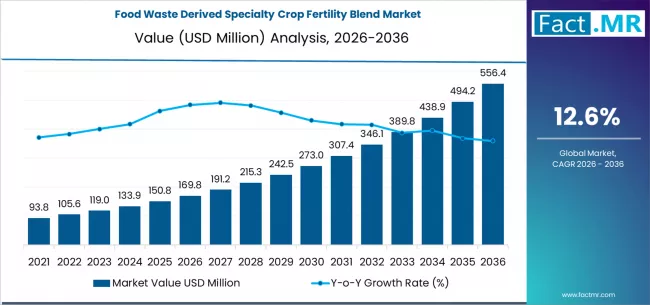
The global market for food waste derived specialty crop fertility blends is projected to rise from USD 169.83 million in 2026 to USD 556.42 million by 2036, expanding at a CAGR of 12.6%. This market represents a sophisticated nexus of waste valorization and precision horticulture, creating tailored nutritional solutions for high-value crops from diverted organic food streams. Growth is driven by the concurrent demands of major food and beverage manufacturers to achieve circularity in their operations and the intensive nutritional management required by producers of fruits, vegetables, and specialty grains.
Summary of Food Waste Derived Specialty Crop Fertility Blend Market
Market Snapshot
Global food waste derived specialty crop fertility blend market revenue stood atUSD 169.83 million in 2026and is forecast to reachUSD 556.42 million by 2036.
At a12.6%CAGRfrom 2026 to 2036, this market is set to expand~3.3x in value, addingUSD 386.59 million in absolute opportunity.
Growth reflects the increasing shift towardcircular agriculture, where organic food waste streams are converted into tailored fertility blends for high-value specialty crops.
These blends are evolving intoprecision nutrient formulations, designed to meet crop-specific nutritional requirements while reducing reliance on synthetic fertilizers.
Demand and Growth Drivers
Rising global focus onfood wastevalorizationand circular economy practicesis driving adoption of these fertility blends.
Increasing demand forsustainable and organic farming inputsis reinforcing market growth across specialty crop segments.
Growing pressure to reducelandfill waste and greenhouse gas emissionsis encouraging conversion of food waste into agricultural inputs.
Expansion ofhigh-value horticulture and specialty crop productionis creating demand for customized nutrient blends.
Integration ofbiological processing, composting, and nutrient recovery technologiesis improving product consistency and scalability.
Product and Segment View
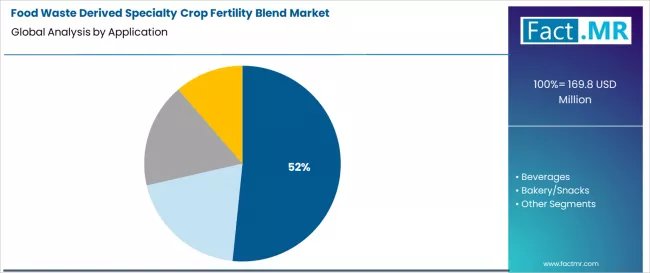
Dairy / alternative dairy segment accounts for 52% of application share in 2026,emergingas the leading segment.
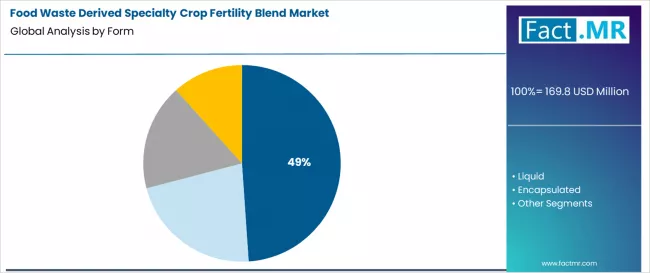
Powder form holds 49% of segment share in 2026, positioning it as the dominant formulation due to ease of storage, transport, and application.
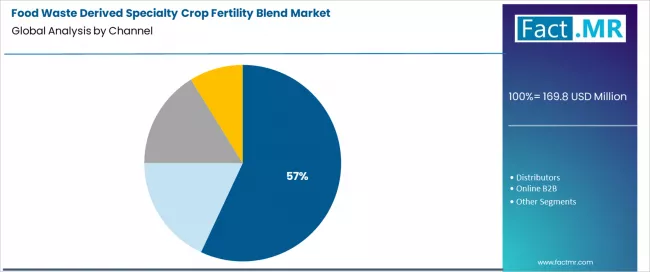
Direct-to-B2B channel accounts for 57% of sales share in 2026, reflecting the industrial nature of supply and formulation partnerships.
These blends typically incorporate:
Processed food waste inputs
Organic nutrient concentrates
Microbial or compost-derived additives
Geography and Competitive Outlook
Growth is supported globally, with strong adoption inAsia Pacific and Europe, driven by sustainability policies and waste management regulations.
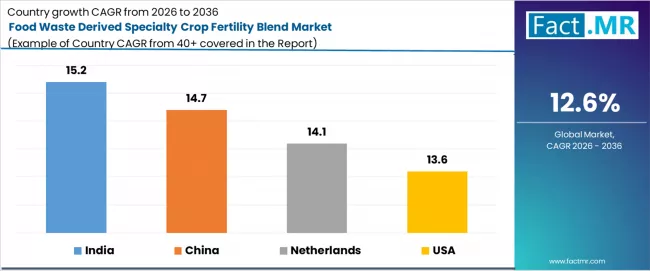
India (15.2%CAGR), China (14.7%), Netherlands (14.1%), and United States (13.6%)are key growth markets.
Market expansion is closely tied towaste management infrastructure, circular agriculture initiatives, and organic farming adoption.
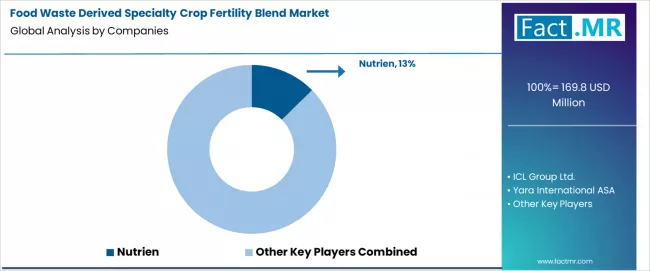
Key companies active in this market includeNutrienLtd.,ICLGroup Ltd.,YaraInternationalASA,UPLLimited,EuroChemGroup A.G., and BASF SE.
Food Waste Derived Specialty Crop Fertility Blend Market — At a Glance
Attribute
Details
Market Value 2026
USD 169.83 million
Market Value 2036
USD 556.42 million
Absolute Dollar Opportunity 2026-2036
USD 386.59 million
Total Growth 2026-2036
227.7%
CAGR2026-2036
12.6%
Growth Multiple
~3.3x
Key Demand Theme
Conversion of food waste into high-value, crop-specific fertility blends within circular agriculture systems
Leading Segment by Application (2026)
Dairy / Alt-Dairy
Segment Share (2026)
52%
Leading Segment by Form (2026)
Powder
Segment Share (2026)
49%
Leading Segment by Channel (2026)
Direct-to-B2B
Segment Share (2026)
57%
Key Growth Regions
Asia Pacific, Europe, North America
CountryCAGRs
India 15.2%, China 14.7%, Netherlands 14.1%, USA 13.6%
North America, Latin America, Western Europe, Eastern Europe, East Asia, South Asia & Pacific, MEA
Source: Fact.MR analysis. Updated Apr 7, 2026
Unlike bulk organic amendments, these products are engineered blends that combine recovered nutrients with biostimulants, micronutrients, and organic carbon specifically formulated to address the physiological stages of sensitive crops. This transforms food waste from a disposal cost into a strategic input for the premium agricultural sector. The market capitalizes on stringent corporate sustainability goals, which now encompass Scope 3 emissions from waste, and the agronomic need for consistent, bioactive fertilizers that enhance crop quality, flavor, and yield resilience. The evolution of this segment focuses on advanced processing and formulation science to ensure product safety, nutrient bioavailability, and batch-to-batch consistency. Success depends on creating verifiable value chains that connect food processors with blend manufacturers and ultimately with specialty crop growers, ensuring transparency and building trust in these novel, sustainable inputs.
The dairy/alt-dairy segment leads with a 52% market share. Waste streams from dairy processing (whey, lactose derivatives) and alt-dairy production (nut pulps) are rich in proteins, sugars, and minerals, providing an excellent, consistent feedstock for microbial fermentation and nutrient extraction.
These blends are particularly valued in horticulture for promoting flowering and fruit set, creating a high-value outlet for a significant and regulated waste stream from a major food industry sector.
By Form, Which Offers Greatest Versatility for Growers?
Food Waste Derived Specialty Crop Fertility Blend Market Analysis By Form | Source: Fact.MR
Powder form holds a 49% share, favored for its stability, ease of blending, and flexible application. Powdered blends can be soil-incorporated, used in fertigation systems after dissolution, or formulated into custom mixes by growers.
This versatility, combined with lower shipping costs compared to liquids, makes powder the dominant form for delivering concentrated, food-waste derived nutrients and bioactive compounds to specialty crop operations.
By Channel, How are These Tailored Blends Reaching Growers?
Direct-to-B2B sales constitute the leading channel at 57%. This reflects the customized, technical nature of the products. Blend manufacturers work directly with large specialty crop producers, vertical farms, or organic grower cooperatives to develop formulations specific to their crop mix, soil, and irrigation system. This direct relationship is essential for providing agronomic support, ensuring correct usage, and gathering feedback for product refinement.
What are the Drivers, Restraints, and Key Trends of the Food Waste Derived Specialty Crop Fertility Blend Market?
The primary driver is the corporate sustainability imperative within the food and beverage industry, where waste-to-resource programs significantly improve ESG metrics. For growers, consumer and retailer demand for sustainably produced specialty crops creates a premium for inputs that verify a lower carbon footprint. The proven efficacy of certain fermented food-waste blends in enhancing soil microbiome health and plant resilience further supports adoption.
A major restraint is ensuring the consistent chemical and biological composition of the source waste stream, which can vary with production runs. The regulatory pathway for approving novel fertilizer ingredients derived from food waste can be complex and varies by region, potentially slowing market entry. Higher costs compared to conventional specialty fertilizers can also limit adoption to premium crop segments where the sustainability story directly translates to market price.
Key trends include the rise of precision formulation, where blends are customized not just for a crop, but for a specific growth stage or stress condition such as blossom-end rot prevention. Strategic partnerships between large food processors and fertilizer companies are becoming common to secure feedstock and co-develop products. There is also a trend toward strong branding and certification of these blends, using names that connect them to their source such as vine-ripened tomato blend and carrying certifications for organic use or low contaminant levels.
Analysis of the Food Waste Derived Specialty Crop Fertility Blend Market by Key Countries
Food Waste Derived Specialty Crop Fertility Blend Market Cagr Analysis By Country | Source: Fact.MR
Country
CAGR (2026-2036)
India
15.2%
China
14.7%
Netherlands
14.1%
USA
13.6%
Source: Fact.MR analysis. Updated Apr 7, 2026
How is India's Food Processing Growth and Agricultural Need Driving Demand?
India’s leading CAGR of 15.2% is fueled by its massive and growing food processing sector, generating substantial organic waste, coupled with a national focus on natural farming and soil health. Government initiatives promote the conversion of agro-processing waste into valuable products. For millions of smallholder farmers growing high-value vegetables and fruits, access to affordable, effective organic nutrition blends derived from local food waste presents a transformative opportunity for yield and quality improvement.
What is the Impact of China's Circular Economy and Premium Agriculture Push?
China’s 14.7% growth is driven by top-down circular economy mandates for its vast food manufacturing base and the simultaneous rise of a premium domestic market for quality fruits and vegetables.
National policies actively support technological innovation in resource recovery. The resulting blends are increasingly used in greenhouse and controlled-environment agriculture operations that supply urban centers, creating a closed-loop model within regional food systems.
Why are the Netherlands a Hub for High-Tech Integration?
The Netherlands' 14.1% CAGR reflects its status as a global leader in high-value horticulture and circular design. Dutch greenhouse operators and vertical farms constantly seek optimized inputs.
The country’s advanced food processing industry and collaborative innovation ecosystem facilitate the development of highly refined, research-backed fertility blends from specific waste streams, including potato peels and brewing grains, for targeted use in its high-tech agricultural sector.
How is the USA's Diverse Specialty Crop and ESG Landscape Influencing the Market?
Food Waste Derived Specialty Crop Fertility Blend Market Country Value Analysis | Source: Fact.MR
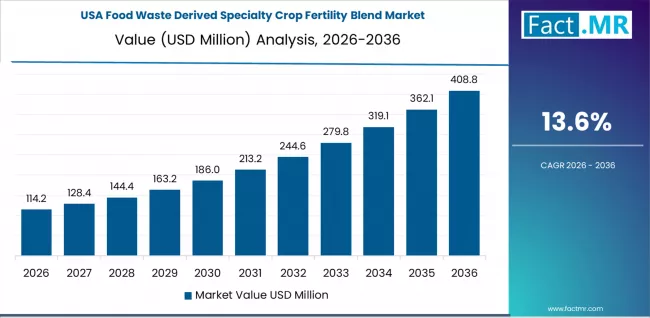
The USA’s 13.6% growth is segmented across its diverse agriculture. In states like California, large-scale fruit, nut, and vegetable growers under pressure from retailer sustainability programs are early adopters.
The branded consumer goods sector, with ambitious zero-waste goals, is partnering with innovators to create branded fertility products from their own waste, marketing the circular story to environmentally conscious consumers.
Competitive Landscape of the Food Waste Derived Specialty Crop Fertility Blend Market
Food Waste Derived Specialty Crop Fertility Blend Market Analysis By Company | Source: Fact.MR
The competitive landscape features established fertilizer companies diversifying into circular inputs and agile technology-driven start-ups specializing in waste valorization. Competition centers on proprietary fermentation, extraction, and stabilization technologies, and the scientific capability to document specific crop benefits through rigorous trials.
Securing exclusive or long-term feedstock agreements with major food brands is a critical competitive advantage, as is building a strong technical service team to support adoption by discerning specialty crop growers.
Key Players in the Food Waste Derived Specialty Crop Fertility Blend Market